
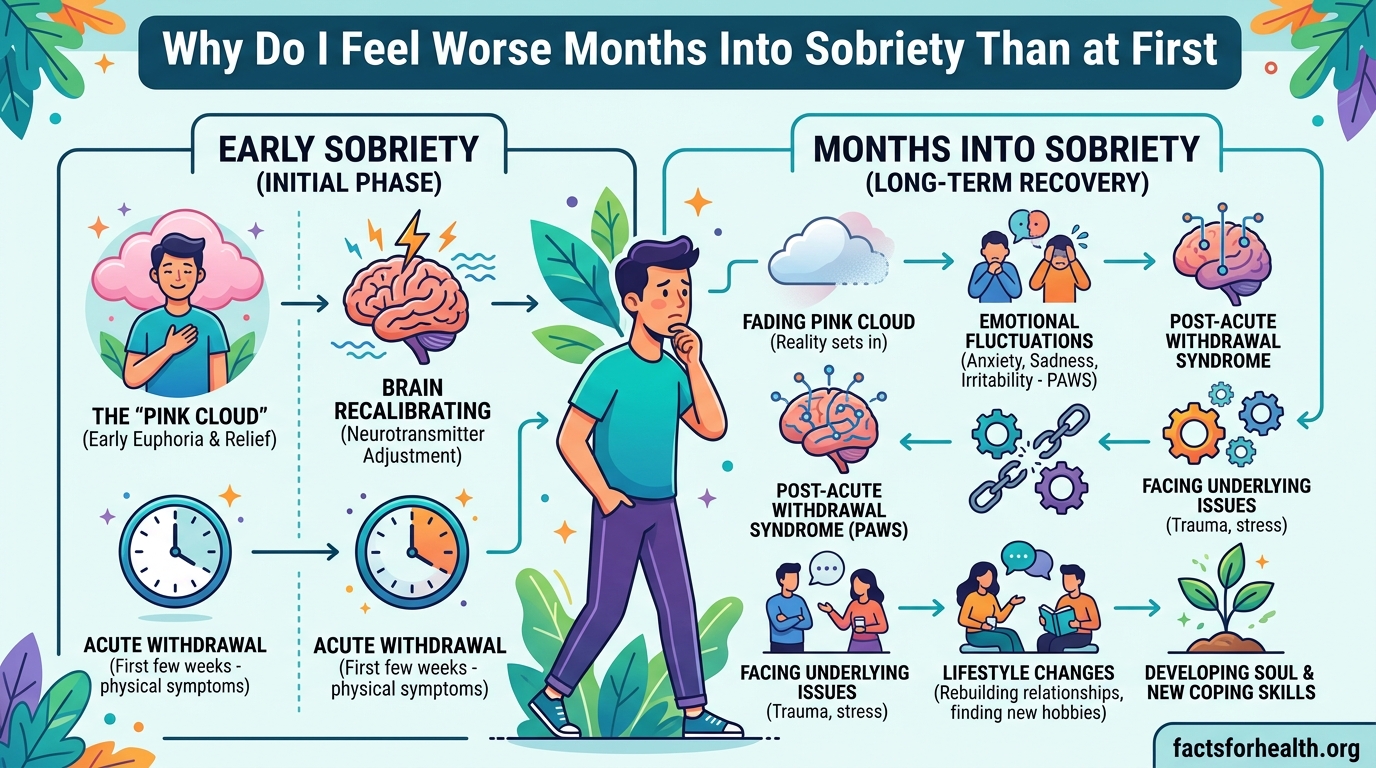
Feeling worse months into sobriety than at first is a nearly universal experience known as Post-Acute Withdrawal Syndrome (PAWS), a temporary condition where your brain continues recalibrating its chemistry long after the initial withdrawal symptoms have faded. In the first weeks of sobriety, many people ride a wave of optimism and motivation, only to crash into emotional exhaustion, brain fog, and mood swings weeks or months later.
If you are asking yourself “why do I feel worse months into sobriety than at first,” you are not broken, and you are not failing. Your brain is healing, and that healing process is not linear. It is messy, unpredictable, and sometimes deeply uncomfortable. But it is also temporary.
Our team has analyzed recovery research, clinical literature, and real experiences from people in recovery communities to explain exactly what is happening in your brain, why the timeline looks the way it does, and what you can do to get through it. Understanding the biological reality behind PAWS is often the first step toward feeling less scared of it.
Table of Contents
Why Do I Feel Worse Months Into Sobriety Than at First?
The short answer is that your brain is rewiring itself, and that process takes far longer than the initial physical detox. When you stop drinking or using substances, your body clears the chemicals within days to weeks. But your brain’s reward system, stress response, and emotional regulation circuits were shaped by months or years of substance use, and they need months to recalibrate.
This creates a confusing gap between how you expect to feel and how you actually feel. You did the hard work of getting sober. You pushed through withdrawal. You expected to start feeling better. Instead, around month two or three, the anxiety, depression, and fatigue hit harder than ever.
This is where many people in recovery communities express the same frustration. One Reddit user in r/stopdrinking wrote, “First two months is often super easy and then it gets HARD — obsessing about drinking, low motivation, arguing with myself.” Another shared, “My lows feel much worse after 6 months of sobriety. Every other week, my mood turns extremely bad.”
These experiences are not signs of weakness. They are textbook PAWS symptoms, and understanding them can change how you experience this phase entirely.
What Is PAWS (Post-Acute Withdrawal Syndrome)?
Post-Acute Withdrawal Syndrome, or PAWS, is a cluster of lingering emotional, cognitive, and physical symptoms that persist for weeks or months after the acute withdrawal phase has ended. While acute withdrawal involves physical symptoms like tremors, sweating, nausea, and seizures, PAWS operates on a completely different timeline and affects entirely different systems.
PAWS is sometimes called “protracted withdrawal” or “post-acute withdrawal” in clinical literature. It is not officially recognized as a standalone diagnosis in the DSM-5, which means some healthcare providers may not name it directly. However, addiction specialists widely acknowledge it as a real, biologically driven phase of recovery.
Understanding the difference between acute withdrawal and PAWS helps explain why you might feel fine at week two but terrible at month three. The two phases involve different brain systems and follow completely different timelines.
Acute Withdrawal vs PAWS: Key Differences
| Feature | Acute Withdrawal | PAWS (Post-Acute Withdrawal Syndrome) |
|---|---|---|
| Timeline | Days 1-14 (peaks within first week) | Weeks 2-24+ (can last 6 to 24 months) |
| Symptom Type | Physical: tremors, nausea, sweating, seizures | Emotional and cognitive: mood swings, brain fog, anxiety, depression |
| Intensity Pattern | Intense at first, steadily improves | Wave-like: good periods followed by flare-ups |
| Primary Driver | Central nervous system rebound | Neurotransmitter recalibration (dopamine, serotonin, cortisol) |
| Management Approach | Medical detox, symptom-specific medication | Lifestyle changes, therapy, patience, time |
| Medical Risk | Can be life-threatening (especially alcohol, benzos) | Not life-threatening but high relapse risk |
That wave-like pattern is one of the most confusing parts of PAWS. We will come back to it, because understanding it can prevent you from interpreting every bad week as a permanent setback.
The Brain Chemistry Behind Feeling Worse
To understand why sobriety gets harder before it gets better, you need to understand what alcohol and other substances did to your brain chemistry over time. This is not about willpower or moral failing. It is pure neurobiology.
The Dopamine Problem
Alcohol and most recreational substances flood the brain’s reward center with dopamine, the neurotransmitter responsible for motivation, pleasure, and reward-seeking behavior. Over time, your brain adapted to these artificial dopamine floods by reducing its own natural dopamine production and pulling back dopamine receptors.
When you stop drinking, those dopamine surges disappear overnight. But your brain’s reduced dopamine capacity does not recover overnight. For weeks and months, you are operating with a dopamine deficit. This is why nothing feels enjoyable, motivation drops to zero, and activities that used to bring pleasure feel flat or meaningless.
This state, called anhedonia, is one of the most distressing PAWS symptoms. It is also completely temporary. Research on neuroplasticity shows that dopamine receptors regenerate, but the process takes weeks to months depending on the duration and intensity of substance use.
Serotonin and Mood Instability
Serotonin regulates mood, sleep, and emotional stability. Chronic alcohol use disrupts serotonin signaling, and when you quit, your serotonin system takes time to find its new baseline. This disruption is a primary driver of the mood swings, anxiety, and depressive symptoms that characterize PAWS.
You might feel perfectly fine on Tuesday and utterly miserable on Wednesday, with no obvious trigger. That unpredictability is serotonin recalibration in action. It feels chaotic, but it is your brain actively working to restore balance.
Cortisol and the Allostatic State
During active addiction, your brain maintained a delicate chemical balance that included elevated stress hormones. When you remove the substance, your brain enters what researchers call an “allostatic state” — a condition where stress-response systems remain elevated and dysregulated even though the original trigger (the substance) is gone.
Cortisol, your primary stress hormone, stays elevated. This keeps you in a low-grade fight-or-flight mode, making everything feel more intense and overwhelming than it normally would. Simple stressors feel like crises. Minor inconveniences trigger disproportionate emotional reactions.
This elevated stress response also directly interferes with sleep, concentration, and emotional regulation, compounding every other PAWS symptom you are experiencing.
The Prefrontal Cortex and Neuroplasticity
The prefrontal cortex, responsible for decision-making, impulse control, and emotional regulation, is significantly impaired by chronic alcohol use. This is the part of your brain that helps you pause before reacting, resist cravings, and make rational choices. During PAWS, it is still coming back online.
The good news is that neuroplasticity — your brain’s ability to rewire and heal itself — is remarkably effective. The brain does recover. But this recovery follows a timeline measured in months, not days. Understanding this timeline is key to managing expectations and avoiding the despair that comes from expecting week-one results at month four.
PAWS Symptoms: What Recovery Actually Feels Like
PAWS symptoms fall into four main categories. Recognizing your own experience in this list can be validating, especially if you have been wondering whether what you are feeling is “normal.”
Emotional Symptoms
Mood swings are the hallmark of PAWS. You might experience sudden waves of sadness, irritability, anxiety, or emotional numbness that seem to come from nowhere. Many people describe feeling emotionally raw, as though their skin has been removed and every sensation is heightened.
Other common emotional symptoms include anxiety that feels different from pre-sobriety anxiety, low-grade depression, irritability that strains relationships, and emotional oversensitivity to stressors that previously felt manageable.
Cognitive Symptoms
Brain fog is one of the most commonly reported PAWS symptoms in recovery forums. It manifests as difficulty concentrating, memory lapses, trouble finding words, and a general feeling that your thinking is slower than it used to be.
For people whose work requires sharp cognitive function, this can be particularly distressing. Tasks that once took an hour might take three. Following complex conversations feels overwhelming. Reading a book becomes a struggle. These cognitive symptoms are real, they are frustrating, and they will improve as your brain heals.
Physical Symptoms
Profound fatigue is almost universal in PAWS. This is not the kind of tiredness that a good night’s sleep fixes. It is a deep, bone-level exhaustion that comes from your brain expending enormous energy on neural repair.
Other physical symptoms include low energy, changes in appetite, and vivid or disturbing dreams as your brain’s sleep architecture reorganizes itself. Some people also experience physical sensations of anxiety like a racing heart, muscle tension, or gastrointestinal discomfort.
Sleep Disturbances
Sleep problems are often the most disruptive PAWS symptom because poor sleep amplifies every other symptom. Insomnia, fragmented sleep, early waking, and vivid dreaming are all common.
Alcohol suppresses REM sleep, so when you quit, your brain experiences a REM rebound effect. This leads to intensely vivid dreams and a sleep architecture that takes months to normalize. Many people find that their sleep actually gets worse before it gets better, which can feel deeply unfair when you are already exhausted.
The PAWS Timeline: Month by Month
One of the most frustrating things about PAWS is the uncertainty. Knowing what to expect at each stage can help you contextualize your experience and avoid panicking when symptoms fluctuate.
PAWS Timeline: What to Expect
| Timeframe | What Typically Happens | Common Symptoms |
|---|---|---|
| Weeks 1-2 | Acute withdrawal phase. Pink cloud may begin as physical symptoms fade. | Physical withdrawal symptoms, initial optimism, relief |
| Month 1 | Pink cloud in full effect for many. Energy and motivation feel high. | Euphoria, gratitude, confidence, sometimes mild anxiety |
| Months 2-3 | Pink cloud fades. PAWS symptoms emerge or intensify. Often the hardest period. | Mood crashes, brain fog, insomnia, cravings, anhedonia, irritability |
| Months 4-6 | Symptoms continue but may begin to stabilize. Good days start mixing with bad. | Gradually improving mood, intermittent brain fog, sleep slowly normalizing |
| Months 6-12 | Significant improvement for most people. Waves become less frequent and less intense. | Longer good stretches, occasional bad days, improved cognition |
| Months 12-24 | Most people feel substantially better. Brain chemistry largely rebalanced. | Occasional mild symptoms, improved emotional stability, restored motivation |
Note that these timeframes are averages. Your experience may differ based on the substance you used, how long you used it, your overall health, genetics, and whether you have co-occurring mental health conditions.
The Wave-Like Pattern: Why Good Weeks Follow Bad Weeks
PAWS does not improve in a straight line. It follows a wave-like pattern where periods of feeling good are interrupted by symptom flare-ups. You might have two great weeks followed by four terrible days, then another good stretch, then another dip.
This pattern is one of the most psychologically challenging aspects of PAWS. Every time symptoms return after a good period, it feels like you are back at square one. People in recovery forums frequently describe this exact experience: feeling great for a week, then crashing and wondering if they are relapsing into something permanent.
Understanding that waves are the normal recovery pattern, not a sign of failure, is one of the most important mindset shifts you can make. Each wave tends to be shorter and less intense than the one before it. The overall trajectory is upward, even when individual dips feel devastating.
Common PAWS Triggers
Certain things can intensify PAWS symptoms or trigger a wave. Being aware of these triggers can help you anticipate and manage them:
- Stressful life events (job changes, relationship conflicts, financial pressure)
- Poor sleep or disrupted sleep schedules
- Exposure to people, places, or situations associated with drinking
- Holidays, celebrations, or social events where alcohol is present
- Anniversaries of significant dates related to drinking or trauma
- Physical illness or poor nutrition
- Emotional stressors that were previously numbed by alcohol
- Certain medications or supplements that affect neurotransmitters
PAWS vs Depression: How to Tell the Difference
One of the most common fears people express in recovery forums is whether their symptoms are PAWS or “real” clinical depression. This is an important question, because the answer affects how you approach treatment.
PAWS and major depressive disorder share many symptoms: low mood, fatigue, poor concentration, sleep disruption, and loss of interest in activities. However, there are key differences that can help you and a healthcare provider distinguish between them.
PAWS typically follows a wave-like pattern with fluctuating symptoms, is directly tied to the timeline of substance cessation, and shows gradual overall improvement over months. Clinical depression tends to be more persistent and consistent, may have roots that predate substance use, and does not necessarily improve just with time.
If you have a personal or family history of depression or anxiety that existed before your substance use, you may be dealing with both PAWS and a co-occurring mental health condition. This is extremely common and does not mean anything is wrong with you. It means you may benefit from professional evaluation to determine the best treatment approach.
The most important thing is to be honest with a healthcare provider about your symptoms, your recovery timeline, and your history. They can help determine whether what you are experiencing is PAWS, a co-occurring condition, or both, and recommend appropriate treatment.
How to Cope With PAWS: Practical Strategies
While PAWS cannot be rushed, there are concrete things you can do to manage symptoms, reduce their intensity, and protect your recovery during this vulnerable period.
Build a Daily Structure
Routine is one of the most powerful tools during PAWS. When your brain’s internal regulation systems are unreliable, external structure provides stability. Wake up at the same time, eat meals at consistent times, and build in regular activities even when you do not feel like doing them.
Action often precedes motivation during PAWS, not the other way around. You will rarely feel like exercising, socializing, or engaging in hobbies. Do them anyway, on a smaller scale if needed. The behavior helps retrain your brain’s reward system, even when it does not feel rewarding in the moment.
Prioritize Sleep
Sleep is the foundation of PAWS recovery. Poor sleep amplifies every other symptom. Establish a consistent sleep schedule, create a wind-down routine, limit screen time before bed, and avoid caffeine in the afternoon.
If sleep problems persist for more than a few weeks and are significantly impacting your functioning, talk to a healthcare provider. There are non-habit-forming sleep aids and strategies that can help bridge the gap while your sleep architecture normalizes.
Nutrition and Exercise
Your brain needs raw materials to rebuild neurotransmitters, and those materials come from food. Focus on protein-rich foods (which provide amino acids for dopamine and serotonin production), complex carbohydrates, healthy fats, and plenty of water.
Exercise, even gentle walking, directly supports dopamine recovery and helps regulate cortisol levels. You do not need intense workouts. Twenty to thirty minutes of moderate movement most days can make a measurable difference in mood and energy over time.
Therapy and Support Systems
Cognitive-behavioral therapy (CBT) has strong evidence for helping people navigate PAWS and early recovery. CBT helps you identify and reframe the thought patterns that make PAWS symptoms feel more overwhelming, particularly the “I am failing at sobriety” narrative that so many people experience.
Motivational interviewing, another evidence-based approach, helps you reconnect with your reasons for getting sober when PAWS makes you question whether it is worth it. Many addiction counselors are trained in both modalities.
Support groups, whether 12-step programs like AA, SMART Recovery, or online communities, provide something that individual therapy cannot: the experience of hearing other people describe exactly what you are going through. The validation of “I thought it was just me” is powerful medicine.
Medication Awareness
Some people benefit from medication during PAWS. Acamprosate, a medication that helps restore the balance of excitatory and inhibitory neurotransmitters disrupted by alcohol use, has shown effectiveness in reducing PAWS symptoms for some individuals. Antidepressants may be appropriate if PAWS symptoms are severe or if a co-occurring depressive disorder is present.
Talk to an addiction medicine specialist or a psychiatrist experienced in addiction recovery about whether medication might be appropriate for your situation. Medication is not a failure of willpower. It is a tool.
What NOT to Do During PAWS
Certain behaviors can make PAWS significantly worse and increase relapse risk. Avoid these common traps:
- Do not isolate yourself, even when every instinct tells you to withdraw
- Do not expect linear progress — waves are normal, not setbacks
- Do not compare your recovery timeline to others’ highlight reels on social media
- Do not interpret bad days as evidence that sobriety is not working
- Do not self-medicate with other substances, including excessive caffeine or sugar
- Do not make major life decisions during intense symptom waves
- Do not skip meals, sleep, or self-care because you do not feel like it
When to Seek Professional Help
While PAWS is a normal part of recovery, certain symptoms warrant immediate professional attention. If you experience persistent thoughts of self-harm or suicide, reach out immediately. You can call or text the SAMHSA National Helpline at 1-800-662-4357 for free, confidential support and treatment referral 24/7.
You should also seek professional help if your symptoms are so severe that they interfere with your ability to function at work, in relationships, or in daily self-care for more than a few weeks. If you are considering relapse, reach out to your support network or a healthcare provider before acting on it.
PAWS does not mean you need to white-knuckle through it alone. Professional support is a sign of strength, not weakness.
FAQs
What is the hardest month of sobriety?
For many people, months 2 through 4 are the hardest. This is when the initial pink cloud euphoria fades and PAWS symptoms become most noticeable. The brain’s dopamine and serotonin systems are deep in recalibration, and the contrast between early optimism and current struggle can feel jarring. However, the hardest month varies by individual, depending on substance history, duration of use, and overall health.
Is it normal to feel worse after quitting alcohol?
Yes, it is completely normal to feel worse after quitting alcohol, especially in the first three to six months. This experience is called Post-Acute Withdrawal Syndrome (PAWS). While acute physical withdrawal fades within one to two weeks, PAWS symptoms like mood swings, anxiety, brain fog, and sleep disruption can persist for months as your brain chemistry recalibrates. Feeling worse does not mean sobriety is not working. It means your brain is healing.
How long does it take for the body to adjust to sobriety?
Physical detox typically takes one to two weeks, but full neurochemical adjustment takes significantly longer. PAWS symptoms generally last between 6 and 24 months. Most people notice significant improvement by the 6-month mark, with continued gradual recovery through the first year and beyond. The brain’s neuroplasticity allows it to heal, but this process happens on a timeline measured in months, not days.
Can PAWS symptoms come back after they have gone away?
Yes, PAWS symptoms can return in waves even after a period of improvement. This wave-like pattern is a normal feature of the recovery process, not a sign of regression. Each wave tends to be shorter and less intense than the previous one. Certain triggers, such as stress, poor sleep, or exposure to drinking-related cues, can intensify or reactivate symptoms. The overall trajectory is still upward even when individual waves feel discouraging.
Does the pink cloud happen to everyone in recovery?
No, not everyone experiences the pink cloud. Some people feel immediate relief and euphoria in early sobriety, while others feel the emotional weight of withdrawal from the start. The pink cloud tends to be more common in people who had a dramatic or emotionally charged reason for getting sober. Whether or not you experience it, PAWS can still occur as your brain chemistry recalibrates.
Will quitting alcohol lower A1c?
Quitting alcohol can help lower A1c levels over time for some people. Alcohol affects blood sugar regulation and can contribute to insulin resistance. After several months of sobriety, improvements in weight, diet, and metabolic health may positively influence A1c. However, individual results vary and depend on many factors including diet, exercise, and overall health status.
You Are Not Failing at Sobriety
If you have been wondering why you feel worse months into sobriety than at first, the answer is biological, not personal. PAWS is your brain doing the hard, unglamorous work of healing. The waves will get smaller. The good stretches will get longer. The brain fog will clear, and motivation will return.
Understanding why you feel worse months into sobriety than at first does not make the experience painless, but it does make it survivable. You are not broken. You are not failing. You are healing, and healing takes time.
Keep going. Reach out for support when you need it. And remember that every person in long-term recovery has been exactly where you are right now.