
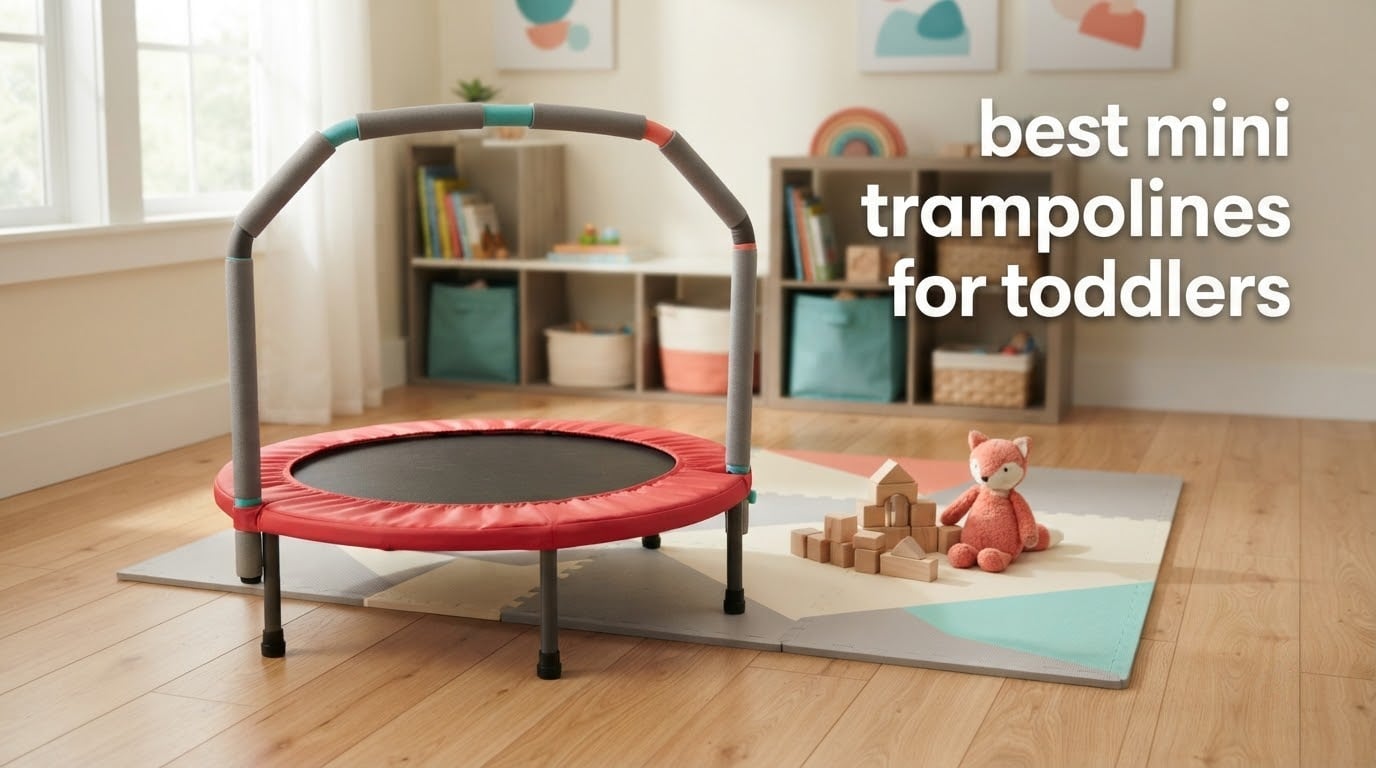
The best mini trampoline for toddlers we tested is the Little Tikes 3′ Trampoline. It suits ages 3 to 6, carries a 55-pound weight limit, and its padded handle bar is the reason so many parents keep it for years. A toddler trampoline is not the same thing as the adult rebounders that dominate the fitness pages, and the difference decides almost every safety choice you will make.
We spent weeks going through the spec sheets, the verified-owner reviews and the failure complaints behind ten of the best-known mini trampolines on the market, then sorted them by the things that actually matter at toddler height: how low the frame sits, what the child can grab, whether any metal is exposed, and whether the whole thing can be dragged out of the way when tea time arrives. Every pick below lists a skip-this-one-if line, because the wrong mini trampoline for a 2 year old is a very specific mistake.
One quick disambiguation first. Adult rebounders, the kind we cover in our best rebounder trampolines for low impact cardio guide, are built for 150-pound-plus bodies and a stiff, high-tension mat. A toddler trampoline sits a few inches off the floor, has a padded stability bar and a low weight limit. If you want a full-size unit for a teenager, start with our tested trampoline guide instead.
If you are looking for a way to burn off energy in a small playroom, a ball pit for toddlers does the same job with no pinch points at all, and plenty of our readers pair one with a trampoline rather than replacing it. For older toddlers, a balance bike builds the same balance skills outdoors.
Table of Contents
Top 3 Best Mini Trampolines for Toddlers in 2026

Little Tikes 3′ Trampoline
- Foam-padded handle bar
- Ages 3 to 6
- 55 lb weight limit
- Plastic and metal frame

SereneLife 36 inch Foldable
- Springless bungee design
- Folds flat for storage
- 24 inch handle bar
- 150 lb listed limit
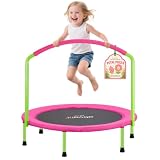
ATIVAFIT 36 inch Big Handle
- Silent elastic band system
- Adjustable foam handle
- Suction cup feet
- 55 lb limit
Those three cover most households. The Little Tikes is the default answer for a 3-to-6-year-old who just wants to jump. The SereneLife is the one to buy if a fold-flat frame and a springless surface matter more than a small price tag. The ATIVAFIT is the earliest starting point here, rated from age 2.
Quick Overview: All 10 Mini Trampolines for Toddlers Compared (October 2026)
| Product | Specifications | Action |
|---|---|---|
| Little Tikes 3′ Trampoline |
|
Check Latest Price |
| SereneLife 36 inch Foldable |
|
Check Latest Price |
| ATIVAFIT 36 inch Big Handle |
|
Check Latest Price |
 VEVOR 36 inch with Enclosure Net VEVOR 36 inch with Enclosure Net |
|
Check Latest Price |
 BCAN SP1 36 inch BCAN SP1 36 inch |
|
Check Latest Price |
 FitinOne 55 inch Play Set FitinOne 55 inch Play Set |
|
Check Latest Price |
 ATIVAFIT 36 inch Foldable ATIVAFIT 36 inch Foldable |
|
Check Latest Price |
 SZBOB 55 inch with Zipper Doors SZBOB 55 inch with Zipper Doors |
|
Check Latest Price |
 Skywalker 48 inch with Enclosure Net Skywalker 48 inch with Enclosure Net |
|
Check Latest Price |
 Happin 36 inch with Handlebar Happin 36 inch with Handlebar |
|
Check Latest Price |
Is a Mini Trampoline Safe for a 2 Year Old? What the AAP Says
Pediatric groups do not recommend trampolines for children under 6, and parents raise it on r/toddlers more than any other objection. The point is not about small play equipment in general. It is about the injury pattern: a low, flexible surface that a small child cannot control, launching them onto hard ground or into furniture.
What that recommendation does not say is that every indoor unit is equally risky. The mitigation plan that makes a mini trampoline defensible in a playroom is simple: one jumper at a time, an adult within arm’s reach rather than watching from the sofa, a frame height low enough that a fall means landing on the mat, and no trampoline parks before the age of 6 because those surfaces are built for bigger children moving faster.
Our own rule after working through this group is that the safety case is made by three physical features, in this order. First, a handle bar the child grips, because a balanced jumper falls in slow motion rather than toppling sideways. Second, no exposed metal at foot level, which means a spring-free band or bungee design or a complete no-gap mat. Third, an honest weight limit and a manufacturer who will name a certification such as ASTM on the listing.
If you are still uneasy, a foam-based indoor climber covers the same gross motor and balance development with zero fall energy. We think most families are best served by the trampoline plus a clear supervision rule.
1. Little Tikes 3′ Trampoline: Best Overall Mini Trampoline for Toddlers
Little Tikes 3′ Trampoline – (Amazon Exclusive)
36 in L x 36 in W x 33.5 in H
Ages 3 to 6, indoor only
55 lb weight limit
13 lb item weight
Pros
- Holds up to daily toddler use
- Handle bar steadies young jumpers
- Easy for parents to assemble
- Compact 3 ft footprint
- Covered springs reduce pinch points
Cons
- Blue edge trim lifts over time
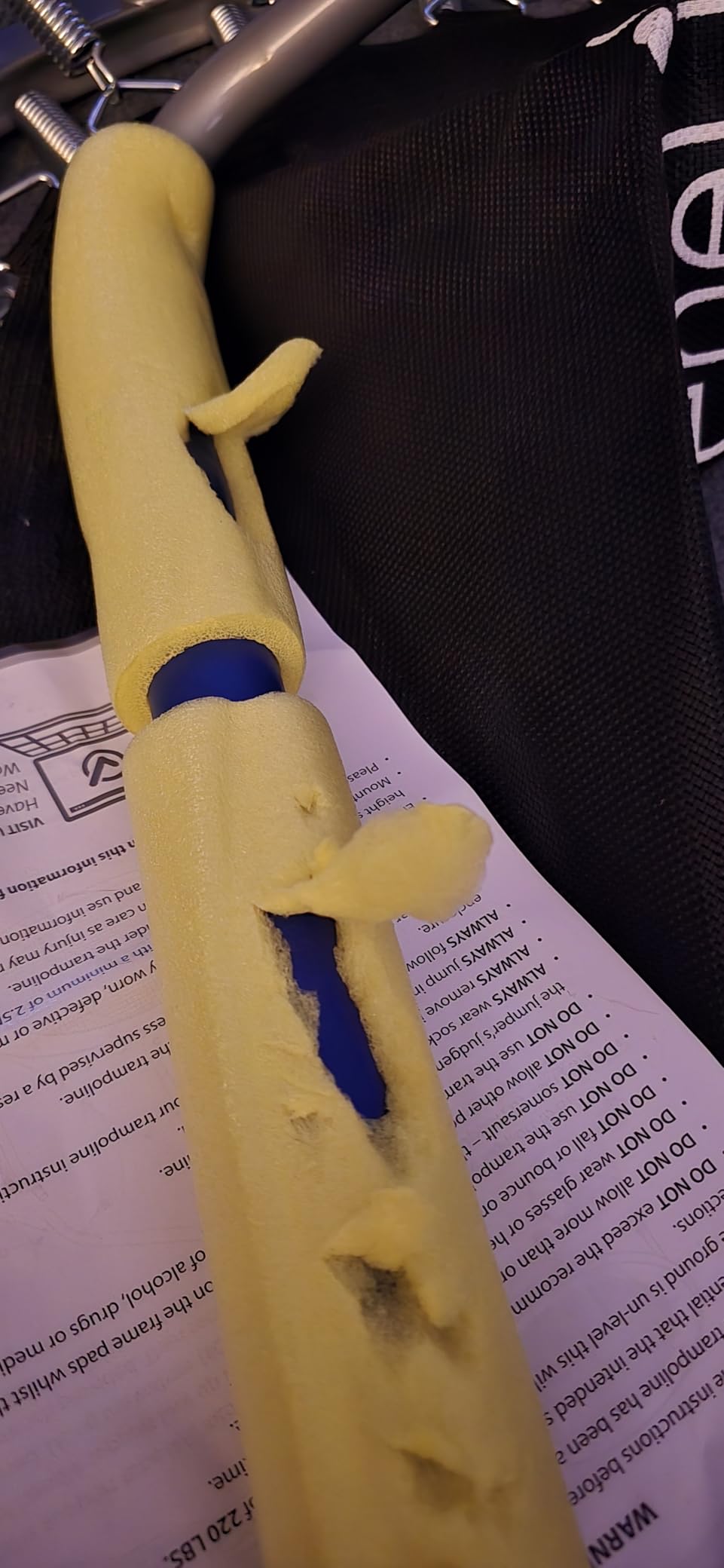
- Handle cushion can tear if chewed
- Rear legs can creep on mats
The handle bar sits 34 inches off the ground with the jumping surface 26.25 inches below it, a geometry built for a three-year-old’s reach rather than an adult’s. Assembly is quick screw-together work with no special tools, and the frame weighs 13 pounds so one parent can move it between rooms.
Parents on r/toddlers call it the durable classic that gets handed down, and 33k+ reviews support that pattern. It is the pick we kept coming back to, because the handle geometry does more for a beginner than any other single feature here.
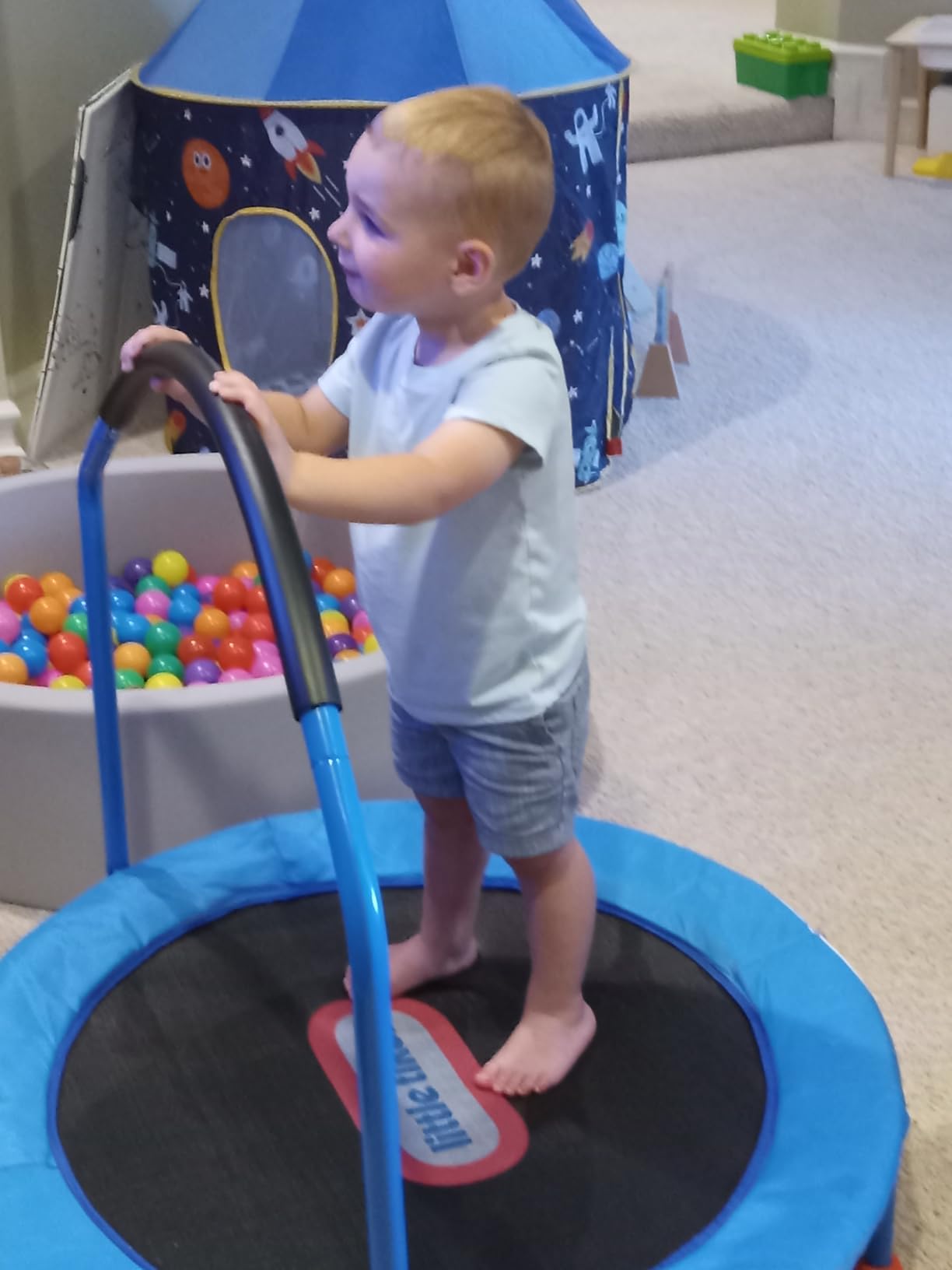
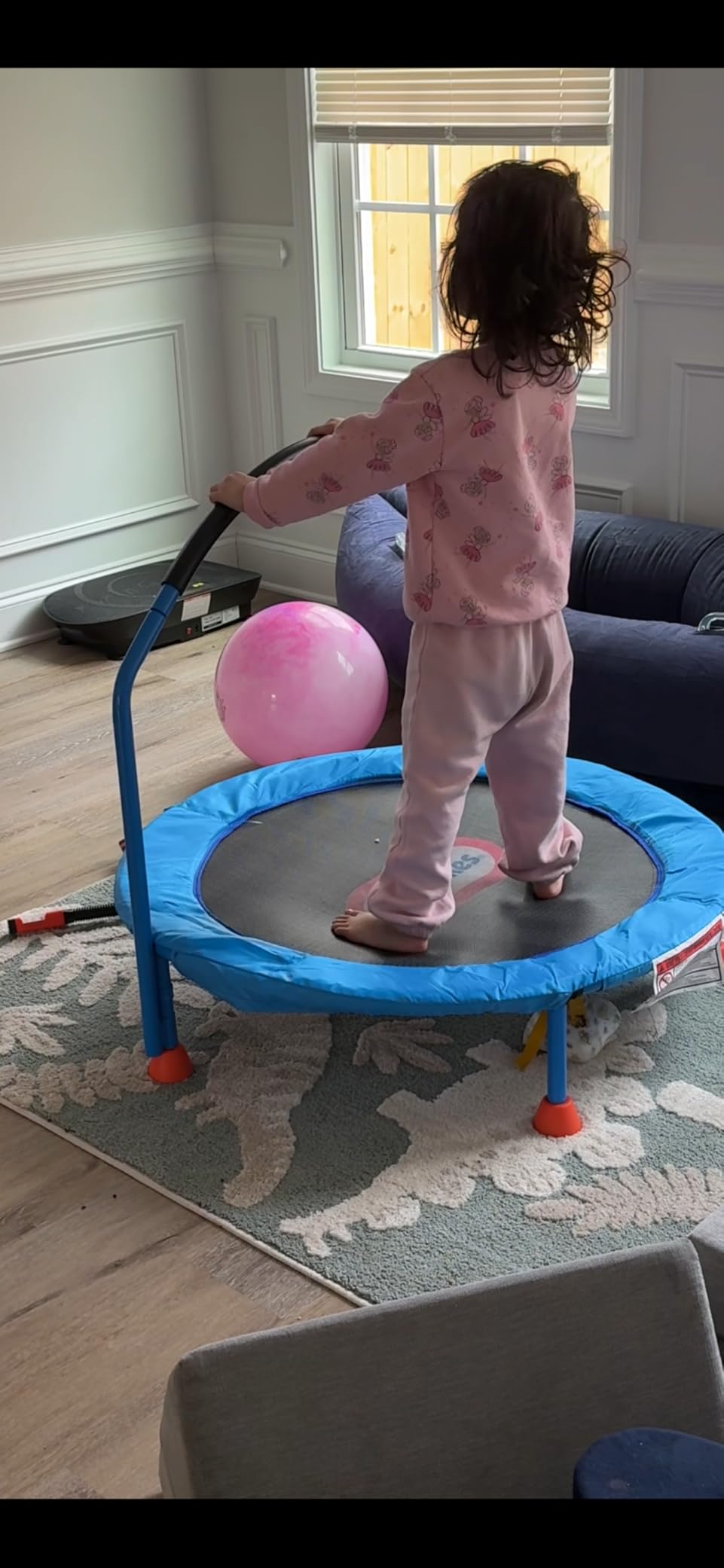
The complaints are cosmetic. Owners report the blue edge trim lifting at the seam and the black handle cushion tearing if a toddler chews on it. A few also note the rear legs creeping on foam mats, so put it on hard flooring or a rug.
Check the clearance before you commit
At 33.5 inches tall it needs a ceiling with real room above it, and about 26 inches of clear floor all round so a wobble does not become a collision with a sofa. It is rated indoor use only, so the yard is not an option.
Skip this one if you have a 2 year old
The rating is ages 3 to 6 and the weight limit is 55 pounds, so a younger or smaller toddler is outside the design envelope. If you need something a 2 year old can use from the first jump, look at the elastic band models further down this list.
2. SereneLife 36 inch Foldable Mini Trampoline: Best Value Pick for Small Homes
Serenelife 3FT/ 36″ Toddler Trampoline with Foam Handle – Foldable Mini Trampoline for Kids Ages 0–5, Indoor & Outdoor Use, Non-Slip Design, Ideal Birthday Gift
36 in L x 36 in W x 32 in H assembled
Springless design, 24 in handle bar
150 lb listed weight limit
14.1 lb item weight
Pros
- Springless and quieter than coil springs
- Folds under a bed or into a closet
- Handle bar builds confidence
- Capacity outlasts toddler years
Cons
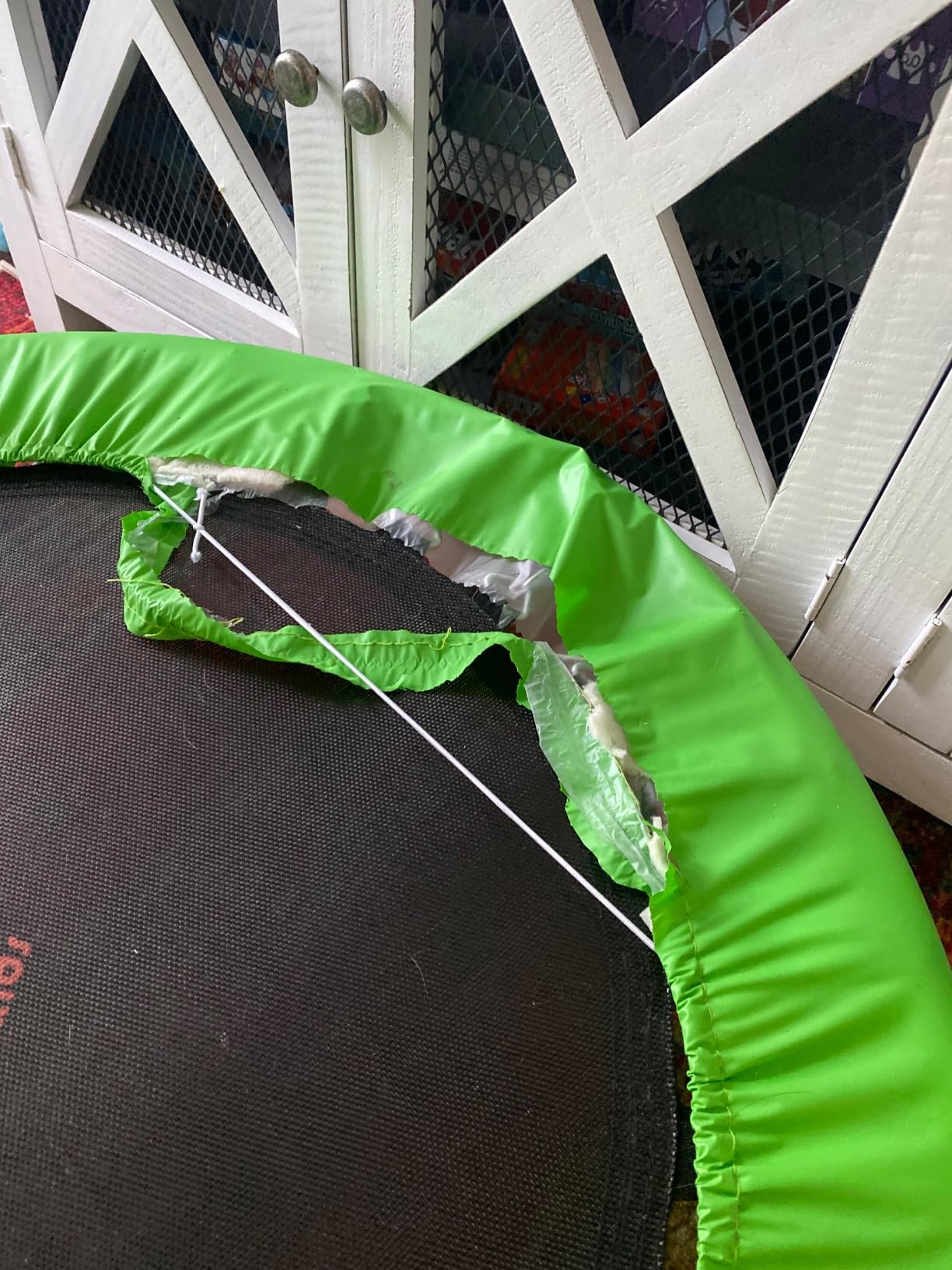
- Blue cover fabric tears with extended use
- Two strong adults needed to unfold the frame
- Hard to fold again once assembled
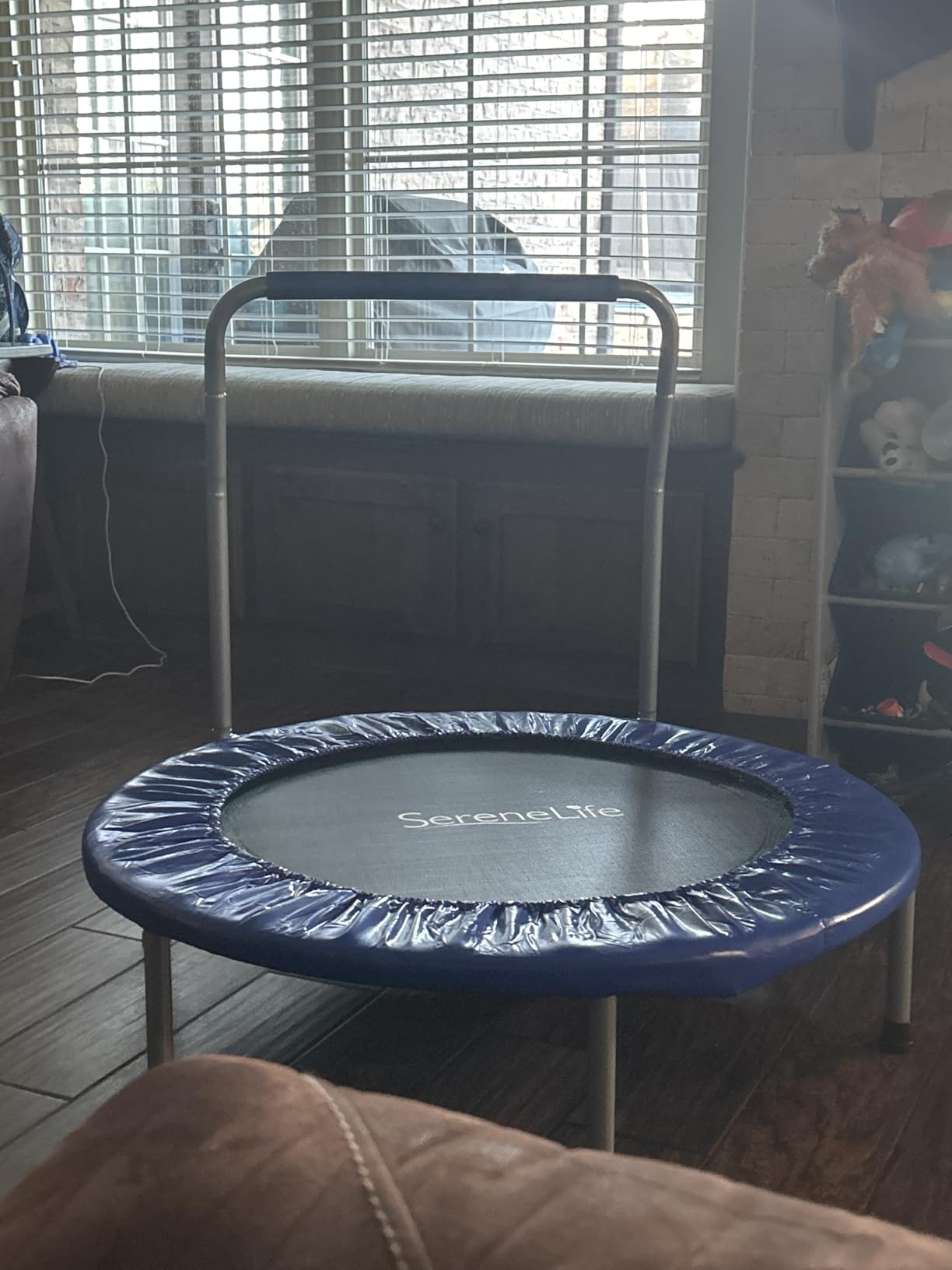
The SereneLife solves a problem none of the 3-foot models do: where to put it when nobody is jumping. It collapses flat enough for a closet or under a bed, and the springless mat means no exposed steel near the surface. With 3k+ reviews, many reporting years of use, it is well established.
The 24 inch handle bar is the main balance aid, and the listed weight recommendation of 150 pounds is well beyond anything a toddler reaches, which gives you room if a bigger sibling joins in.
Two practical notes. Opening the folded frame into its locked circular shape genuinely takes two strong adults, and once assembled it is not easy to fold again, so the included carry bag gets less use than the marketing implies. The most repeated negative across reviews is wear on the blue cover fabric after extended use.
How much space do you actually need?
Allow roughly three feet in every direction from the frame edge, which in a small flat can be the difference between a usable play corner and a daily trip hazard. Measure the ceiling height too.
Skip this one if you plan to move it weekly
The two-adult unfold and near-permanent folded state is the wrong design if your ideal setup is jumping in the morning and clearing the floor before school. Choose a model with a genuine one-person fold instead.
3. ATIVAFIT 36 inch Elastic Band Big Handle: Best Mini Trampoline for Ages 2 to 6
ATIVAFIT 36“ Kids Trampoline with Big Handle Compact Indoor/Outdoor Mini Trampoline for Toddlers 2‑6 Years (Pink)
36 in L x 36 in W x 33 in H
Elastic band system, no springs
Ages 2 to 6, 55 lb weight limit
14.3 lb item weight
Pros
- Quiet gentle bounce suits ages 2 to 6
- Adjustable foam handle grows with child
- Suction cups grip tile and hardwood
- Waterproof Oxford cloth mat wipes clean
Cons
- Handle and band system needs more floor space
- Assembly needs close attention to the included tools
This is the model we recommend when the child is genuinely two. The rating starts at 2 years rather than 3, and the whole jumping system is elastic bands with no springs exposed, which removes the usual pinch point in this category. The bounce is quieter and gentler than a coil spring, which suits a child still working on balance.
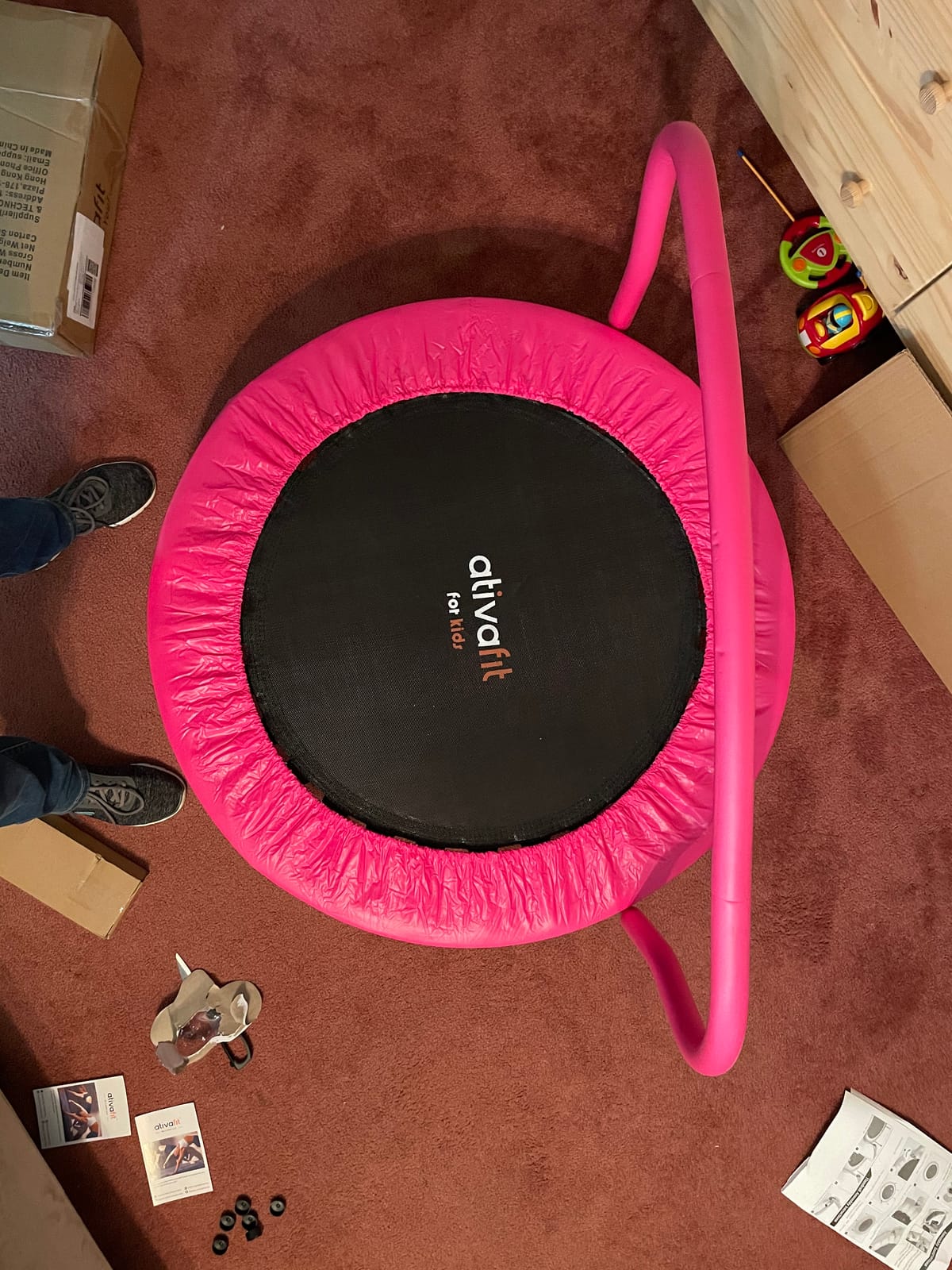
The handle is foam-padded and adjustable in height, so the same unit can follow a child from 2 up toward 6 without a replacement purchase. That grow-out path is what stops parents buying twice.
The base is the quiet hero. Rubber suction cup feet plus wide rubber-tipped legs grip hardwood and tile without scratching, and reviews repeatedly single this out as the difference between a trampoline that stays put and one that drifts.
Is the adjustable handle actually worth fitting?
Yes, and it takes a few minutes during assembly. The foam bar is what turns an awkward bounce into a controlled one, and adjusting it once means you are not redoing the build every year.
Skip this one if your room is tight
The higher-capacity handle and band assembly claim more floor space than a plain rebounder of the same diameter. In a very small play corner, the simpler 36 inch models take up less.
4. VEVOR 36 inch Trampoline with Enclosure Net: Best Quick-Fold for Garages
VEVOR 3FT Trampoline for Kids, 36″ Trampolines Indoor/Outdoor Trampoline for Toddlers, Foldable Mini Baby Jump Toy with Foam Handle, Recreational Trampolines Birthday Gift for 3+ Years Kids
36 in L x 36 in W x 32 in H
28 elastic bands, 0.24 in foam cover
132 lb listed capacity
Ages 3 and up, one jumper
Pros
- Coated all-steel frame resists rust
- Folds in about three seconds
- One-person assembly
- Waterproof mat wipes clean
Cons
- Recommended for a single child at a time
- Band rebound feels softer than coil springs
Three seconds flat is the headline, and it is why this one converts an apartment dweller. The frame folds small enough to slide under a sofa or into a car trunk, so it can live in a garage rather than owning a permanent square of floor. Assembly is a genuine one-person job.
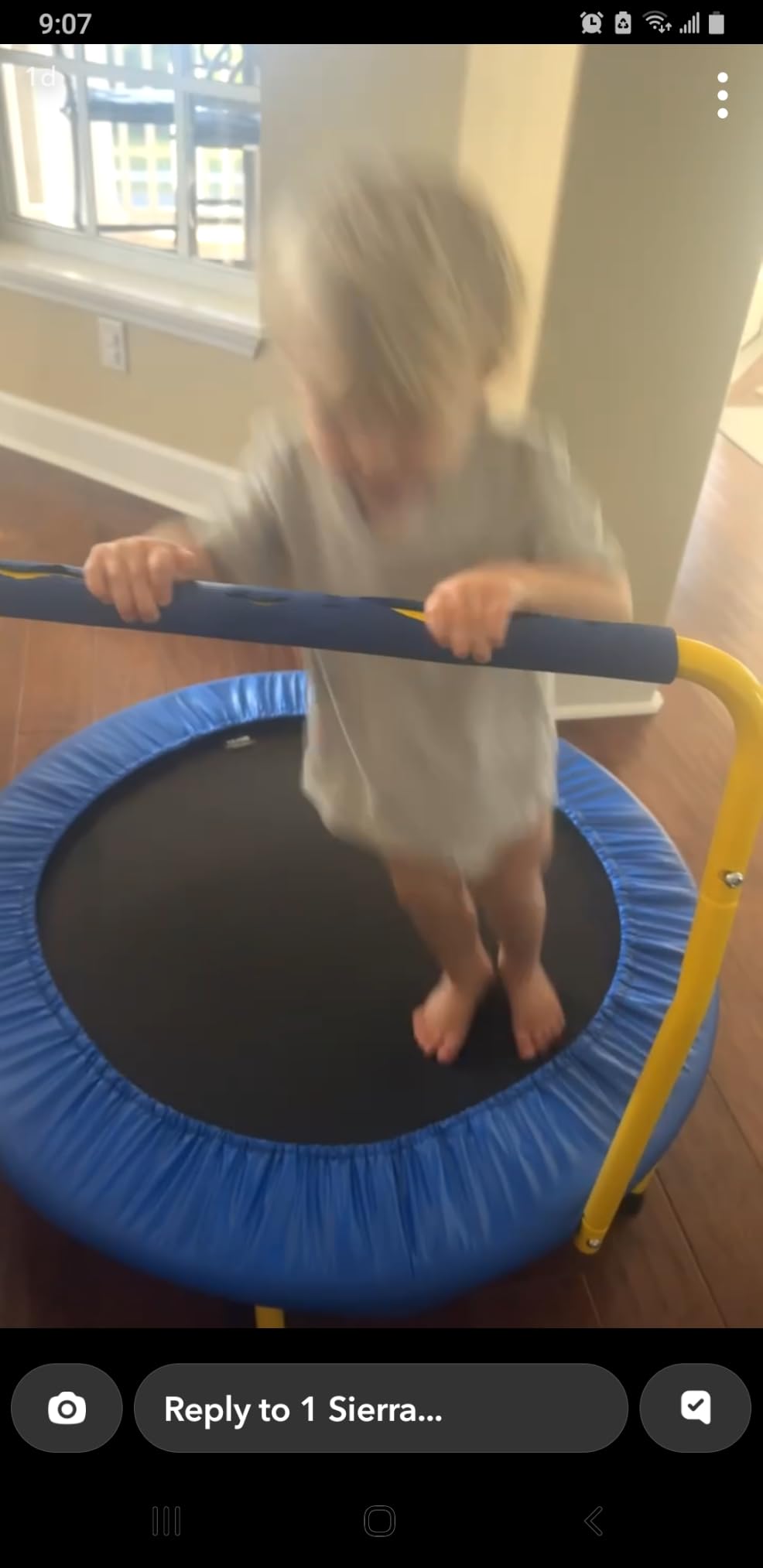
Safety-wise it uses 28 elastic bands with no steel springs in the perimeter, 0.24 inch spring foam protection over the frame, and a foam handle with rubber foot pads. The waterproof mat wipes down, so the same unit works indoors and out.
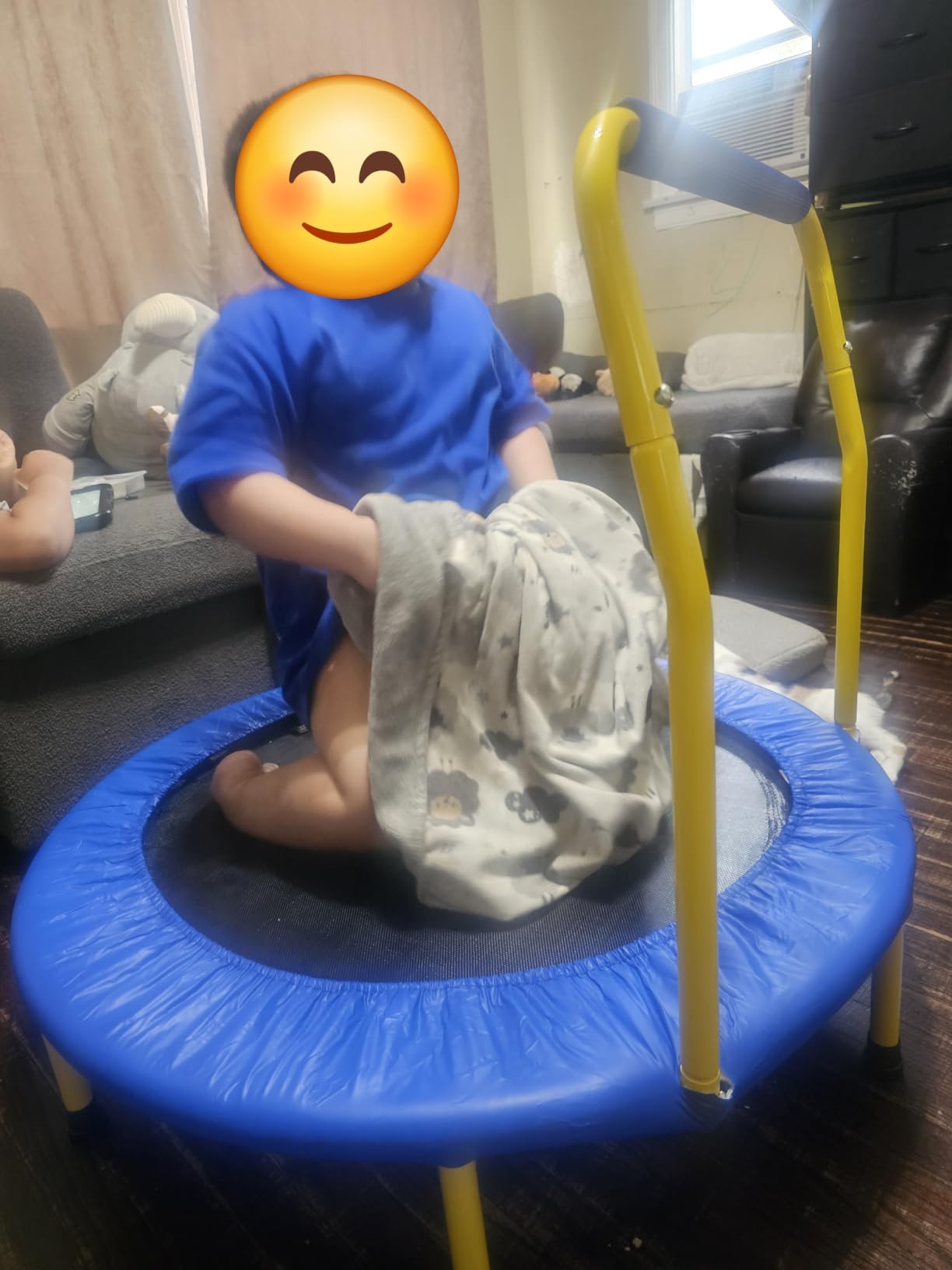
Two limits are stated in the listing itself. It is recommended for single-child use and not suitable for children under 36 months, and the listed 132 pound capacity is a ceiling for one child rather than a target for two. The band rebound is gentler than a coil-spring mat, so a child chasing airtime will not find it here.
Is ASTM certification worth filtering for?
More than most shoppers expect. A stated certification means a third party tested the product against a written standard rather than the brand describing itself as safe. That is a stronger signal than any brand reputation.
Skip this one if your child wants a big high bounce
Band systems trade airtime for quiet and safety. If your 4-year-old has outgrown gentle bouncing and wants real height, look at a coil-spring model with a no-gap mat instead.
5. BCAN SP1 36 inch: Best No-Gap Mat Toddler Trampoline
BCAN SP1 36” Kids Toddler Trampoline Indoor, Foam Handle | FED Fitness
36 in assembled diameter
ASTM certified, 20+ safety tests
28 springs supporting 132 lb
13.7 lb item weight
Pros
- ASTM certification with 20+ safety tests
- No-gap mat blocks foot gaps
- T-shaped foam handle adds stability
- Five-step assembly with tools and video
Cons
- Center of handlebar is not foam covered
- Screws can loosen over time
- Weight limit varies by variant
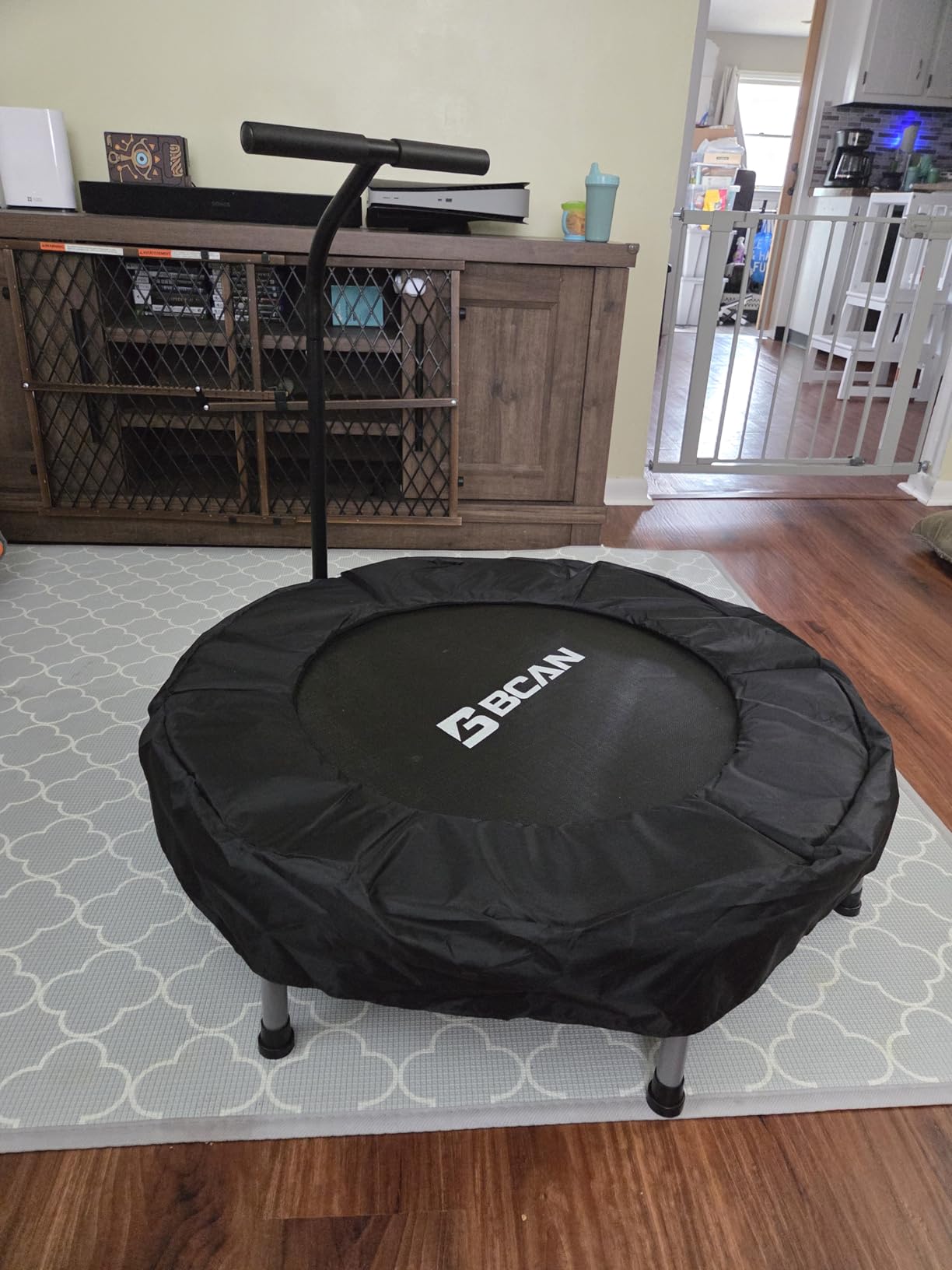
The BCAN names both a certification and a test count, with ASTM certification across 20+ safety tests. That matters more than a brand name, because somebody outside the manufacturer checked the frame, mat and spring zone against a written standard. The upgraded no-gap mat is the other headline, with 40 percent higher fabric density than the previous version.
Handle shape is the quiet differentiator here. A T-shaped foam handle with a triangular bar layout gives a toddler more to hold from several angles than a single straight rail, and parents say the geometry is what calms them about balance.
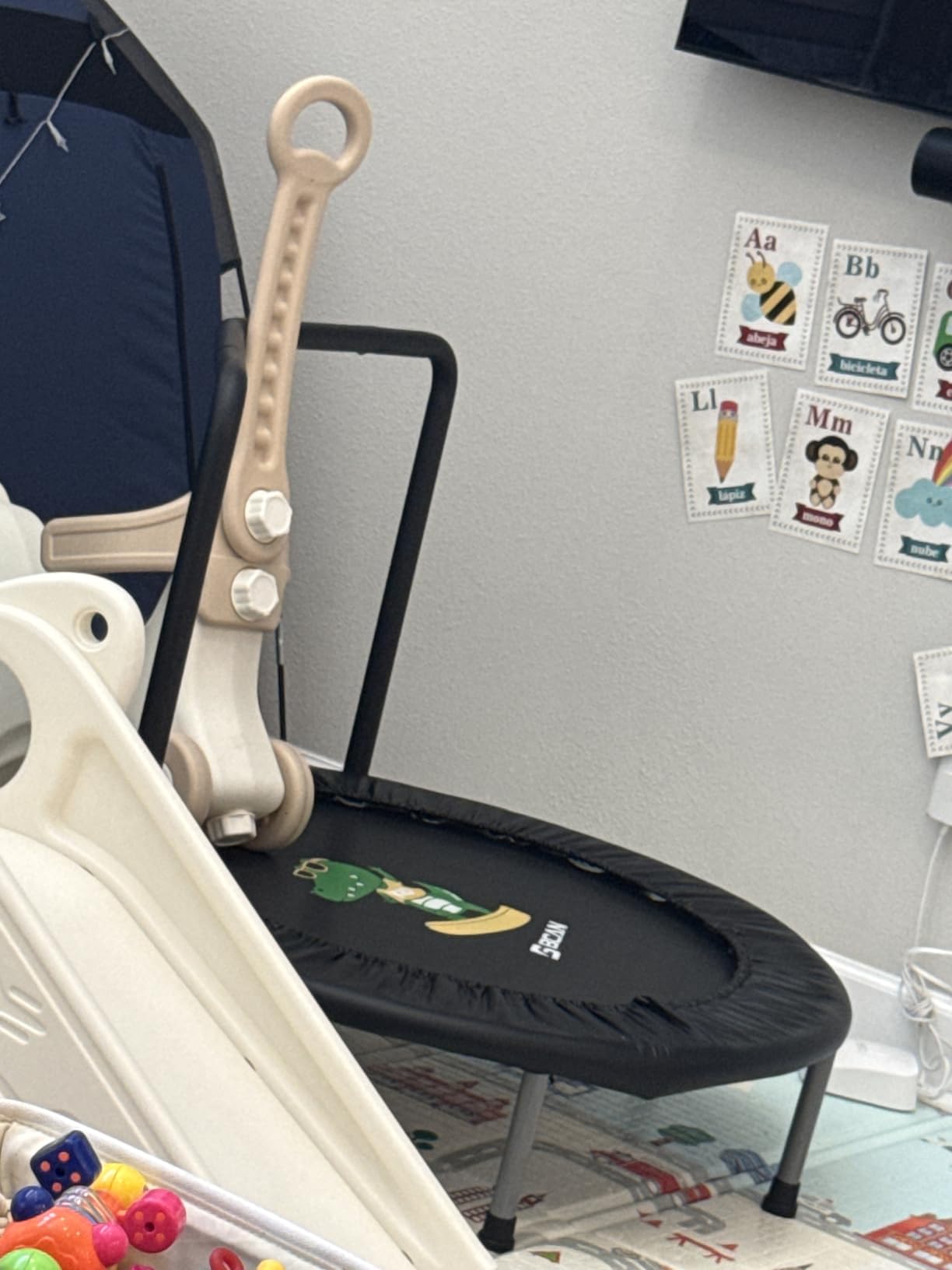
The most common complaint is specific and reasonable: the center section of the handlebar is not foam covered, so a hard landing toward the middle of the bar can bump a head. Some owners also report screws loosening over time, so a monthly check of the handle bolts is sensible. The listed weight limit also varies by variant, so confirm the number on the model you receive.
Why do springs matter if you are buying for a two-year-old?
Because a spring zone is the pinch point. Here the springs sit under a padded sleeve and the mat is stitched so there is no gap for a small foot to fall through. Parents who have used coil-spring mini trampolines say the no-gap design is the feature that removed their anxiety.
Skip this one if you need it for a sibling under three
This is a toddler-focused 36 inch unit, not a shared family trampoline. If two children will bounce at once, move to an enclosed-net model with a higher capacity.
6. FitinOne 55 inch Toddler Trampoline with Swing: Best Play-Set Style Trampoline
FitinOne 55″ Toddler Mini Trampoline for Kids, Indoor Outdoor Toys with Swing, 440lbs Baby Kids Trampoline, Gymnastics Bar, Birthday Gifts for Boy Girl Age 1-8
55 in L x 55 in W x 9.3 in H
36 steel springs, 440 lb capacity
Full enclosure net and foam bars
Swing, sandbags and balls included
Pros
- Full enclosure net and foam handlebars
- Three-level adjustable horizontal bar
- Anti-tip U-shaped leg design
- Accessories turn it into a play set
Cons
- Large 55 inch footprint dominates a room
- Lowest rating in the group at 4.4 stars
This is the one to buy when the trampoline is meant to be the center of a play area. The transparent safety net sits over a raised circular enclosure, both handlebars are foam padded, and the horizontal bar adjusts through three levels so a two-year-old and a six-year-old can both use it. The accessory box is full, with a swing, sandbags, ocean balls and rings included.
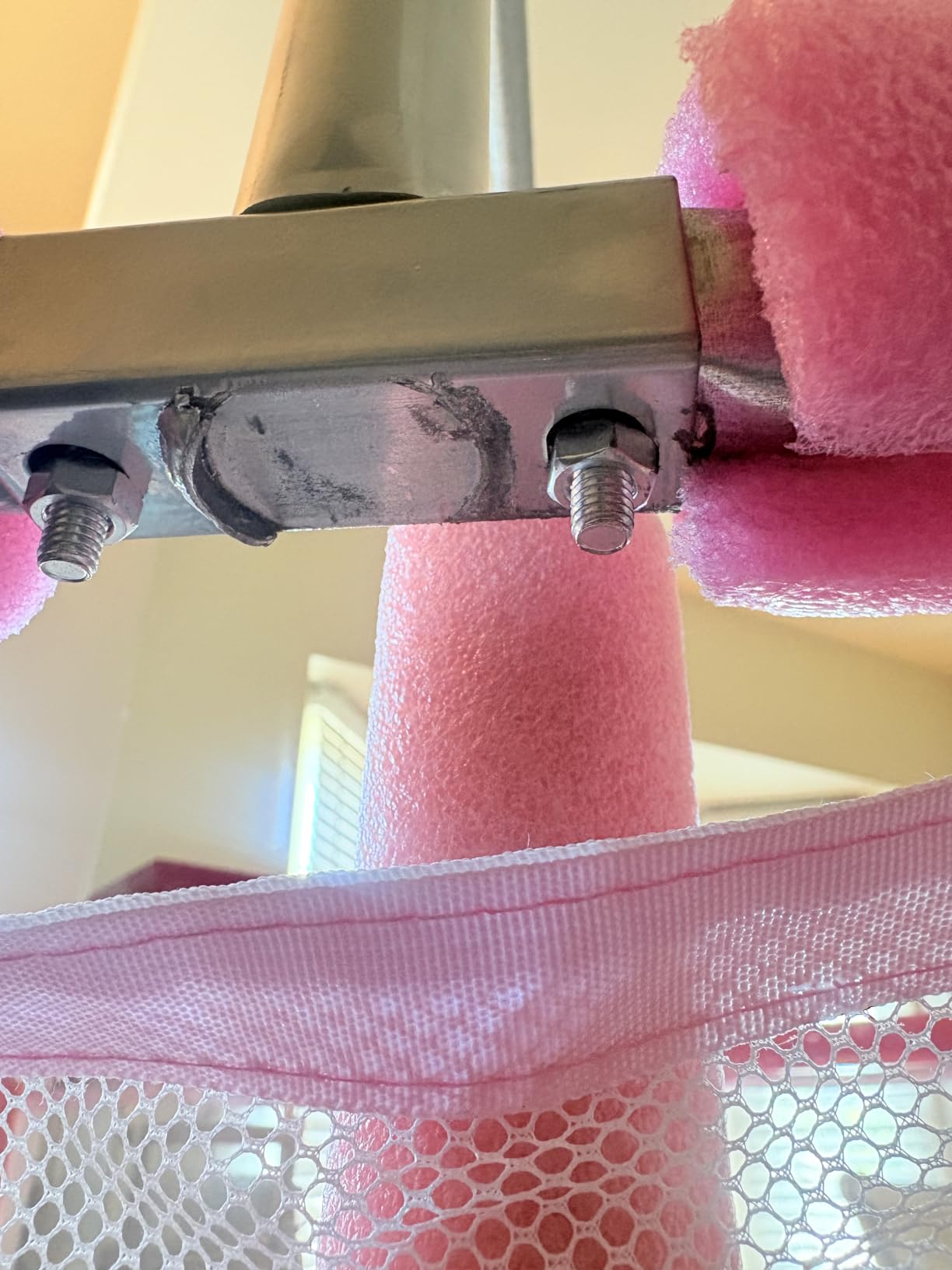
Capacity is the standout number at 440 pounds, and the frame uses 36 heat-treated steel springs on three U-shaped thickened legs with a C-shaped anti-tip design. At 55 inches it is closer to a small family trampoline than a mini one.
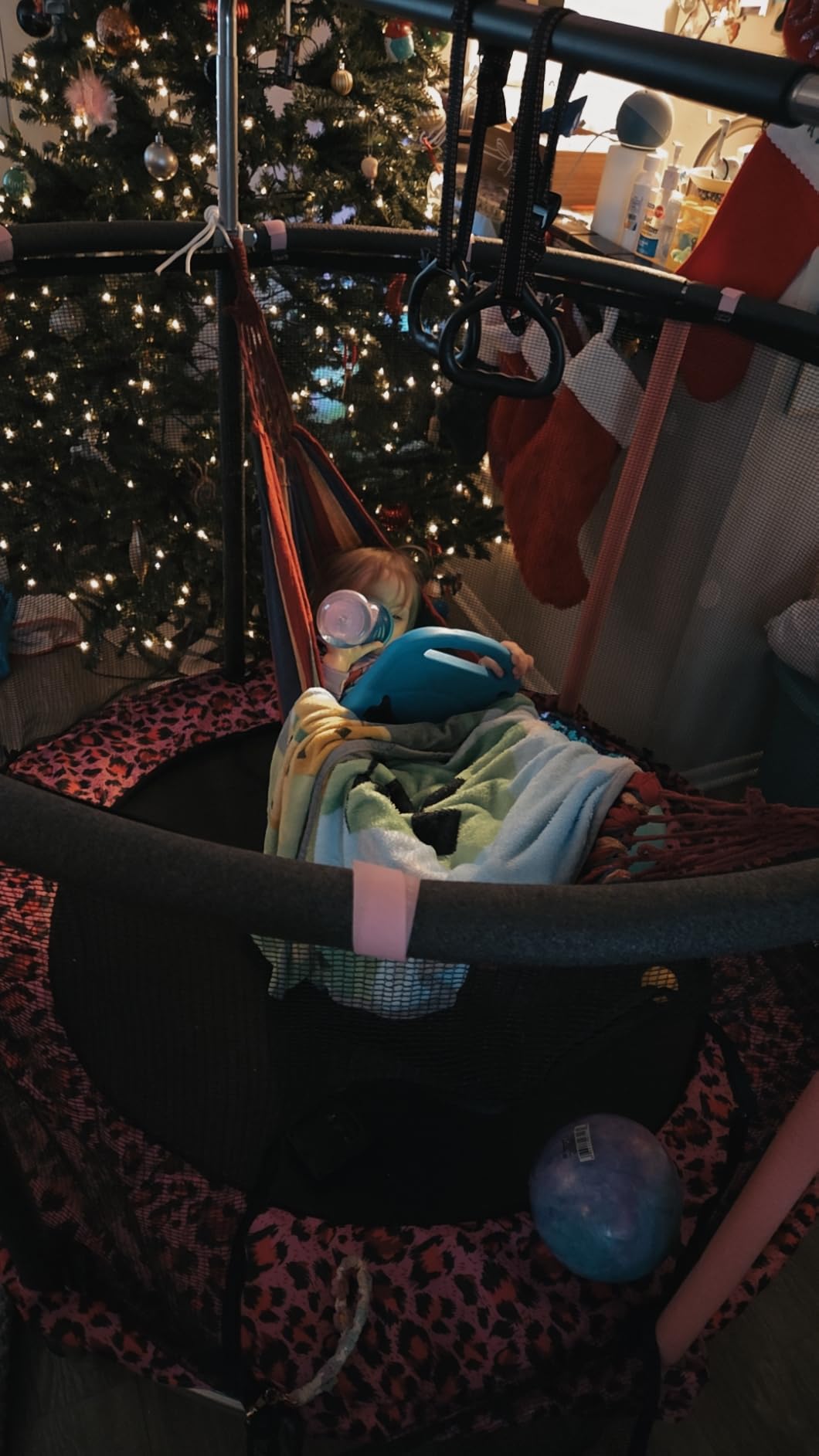
The trade is space, and it is a large one. At 55 inches you need a dedicated room or a real corner of the yard, plus clearance for the swing arm, which makes this a poor fit for a flat. It carries a 4.4 rating with 7 percent one-star reviews, so expect more variability in the build you receive.
Do you need this much trampoline for a toddler?
Probably not, unless you have the space. A toddler rarely uses more than a 36 inch mat, and the extra diameter here buys shared use and a swing rather than better bouncing. If you are short on room, this is the wrong shape of solution.
Skip this one if your child is a solo jumper under 3
The height, the net posts and the swing all create more surfaces to supervise, not fewer. A lower foam-handle unit is simpler to watch during a high-energy 2 year old session.
7. ATIVAFIT 36 inch Foldable Mini Rebounder: Best Quiet Foldable for Apartments
Ativafit 36inch Mini Toddler Trampoline for Kids Ages 1-6 Indoor Outdoor Folding Small Rebounder Trampoline with Foam Handle Safety Padded Cover Fun for Kids
36 in L x 36 in W x 23.6 in H
Silent elastic band operation
Ages 1 to 6, 55 lb weight limit
One-person assembly
Pros
- Quiet band bounce and silent operation
- Waterproof non-slip Oxford cloth mat
- Foam handle and six-leg base with lock
- One-person fold
Cons
- 55 lb capacity limits it to younger toddlers
- Band mat gives a lower softer bounce
If your household includes a downstairs neighbour, this is the model we would pick. The spring-free elastic band mat operates silently, so a 7pm bouncing session does not become a noise complaint, and its 4.7 rating sits at the top of the foldable options here.
The 23.6 inch overall height is lower than most competitors here, which matters in a low-ceilinged room. A six-leg base with a safety lock keeps the frame steady, and the non-slip waterproof Oxford cloth mat holds grip even when damp.
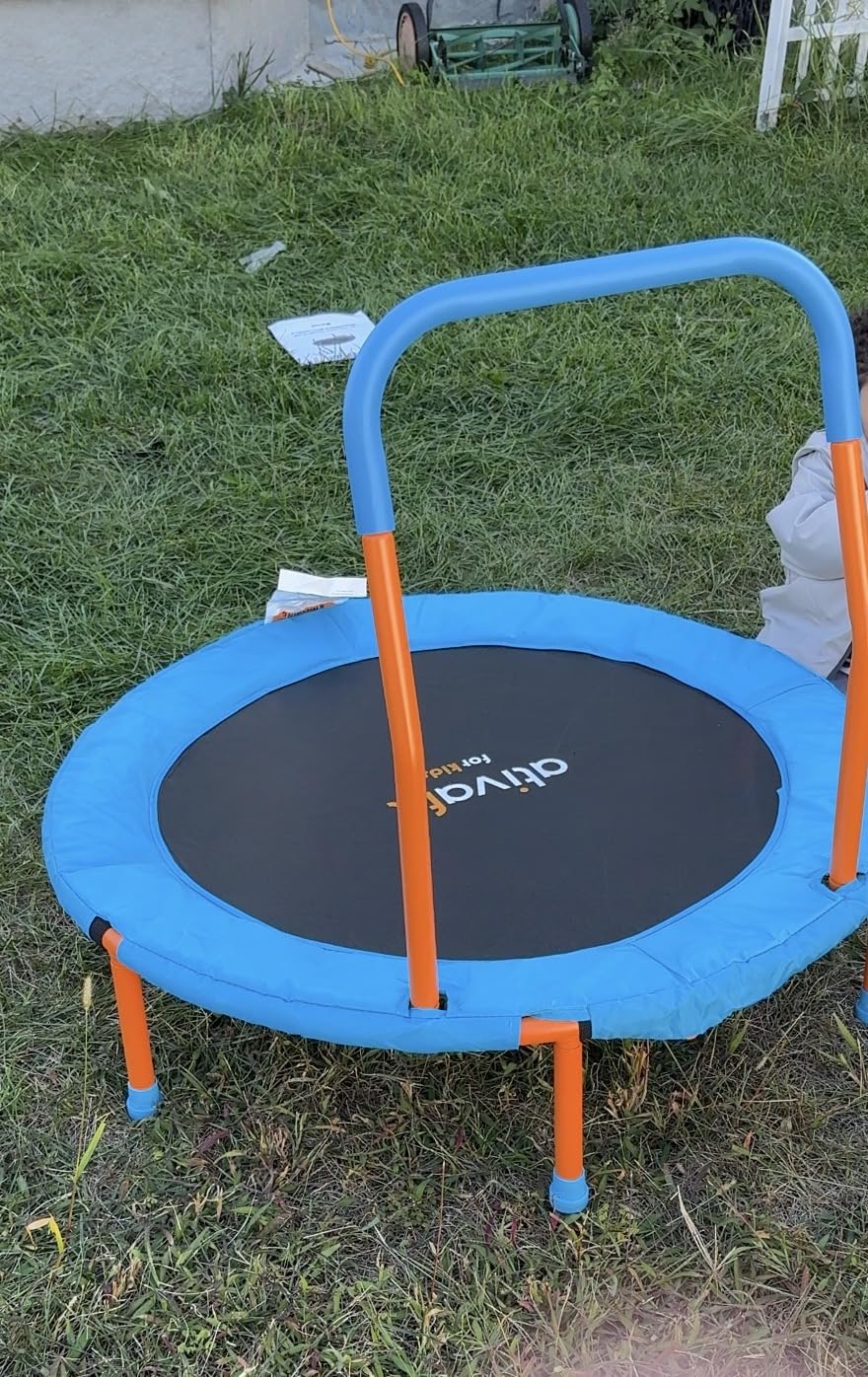
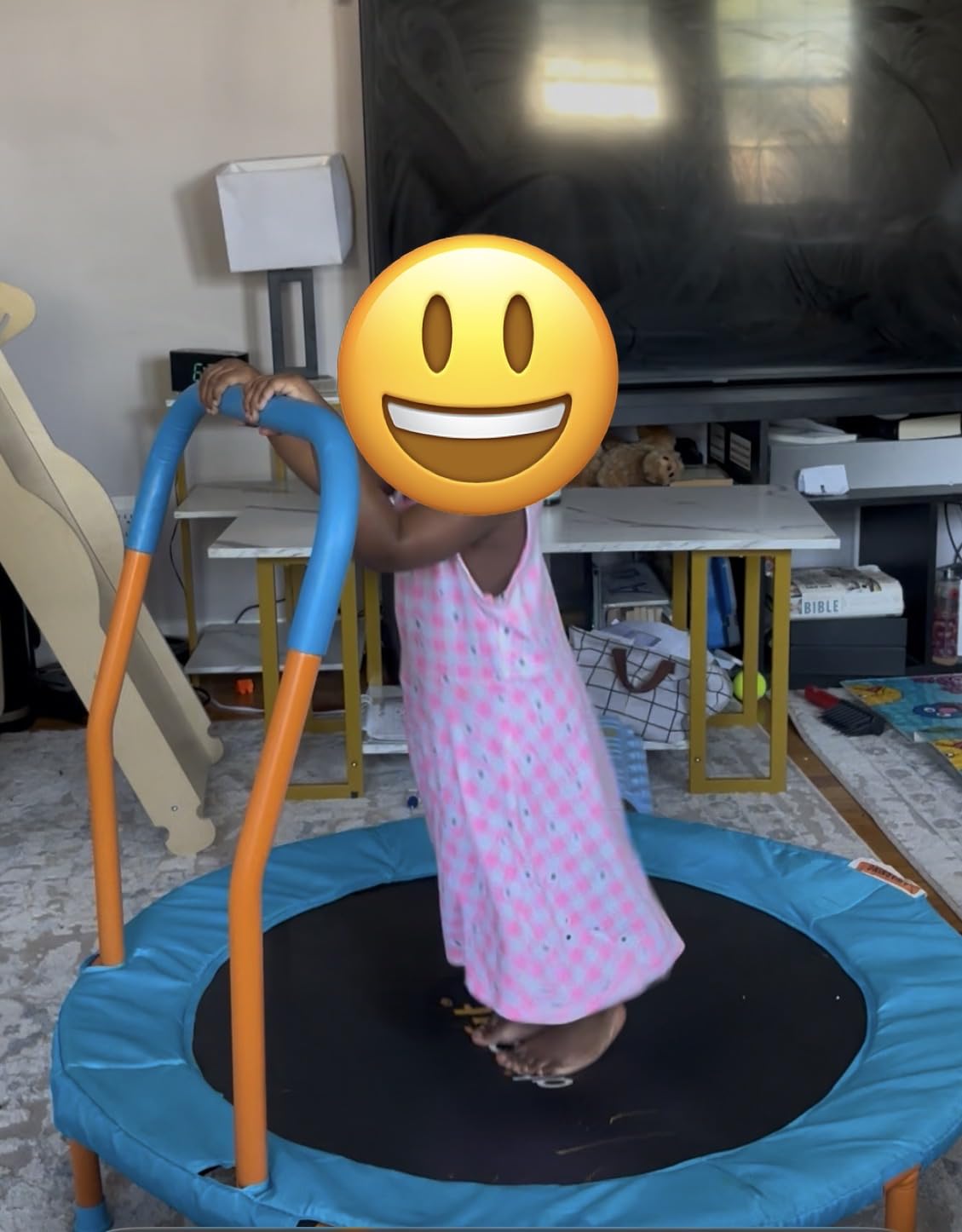
The honest limitation is the 55 pound weight limit, which caps it at younger toddlers and means you will shop again sooner if your child is already near 50 pounds. The band mat also gives a lower, softer bounce than a coil spring, so this is a balance and confidence machine rather than an airtime machine.
How quiet is quiet?
Quiet enough that our own rule of thumb is it can go under a bed between uses, and the fold is a genuine one-person job. If your child bounces at any volume and you have thin walls, that combination is the whole point of this model.
Skip this one if you want a big springy bounce
Every band-driven model here trades airtime for silence and safety. This one does it more quietly than most, but a 5-year-old who wants height will be disappointed.
8. SZBOB 55 inch Trampoline with Zipper Doors: Best Full Enclosure for Shared Use
Toddler Trampoline for Kids Ages 1-8, 55” Small Trampoline Indoor Outdoor
55 in L x 55 in W x 12 in H
36 closed-design steel springs
Two double-sided zipper doors
220 lb capacity
Pros
- Galvanized frame with closed-design springs
- Two double-sided metal zipper entries
- Three-layer thickened safety pad
- Suction cup feet quiet the bounce
Cons
- Heaviest unit here at 19.4 pounds
- Net installation is easy to get wrong
- Lowest average rating in the group
The engineering here is the most traditional in the group, and for families with more than one jumper it is a real answer. Rather than bands it uses 36 closed-design steel springs, so there are no exposed attachment points at the edge for small hands. The full enclosure net has two double-sided metal zipper doors, and the three-layer thickened safety pad reduces foot-gap falls.
Suction cup feet on each U-shaped leg quiet the bounce and reduce rolling, and the waterproof Oxford cloth mat is easy to clean. The 220 pound capacity and 55 inch diameter make it a shared unit rather than a solo toy.
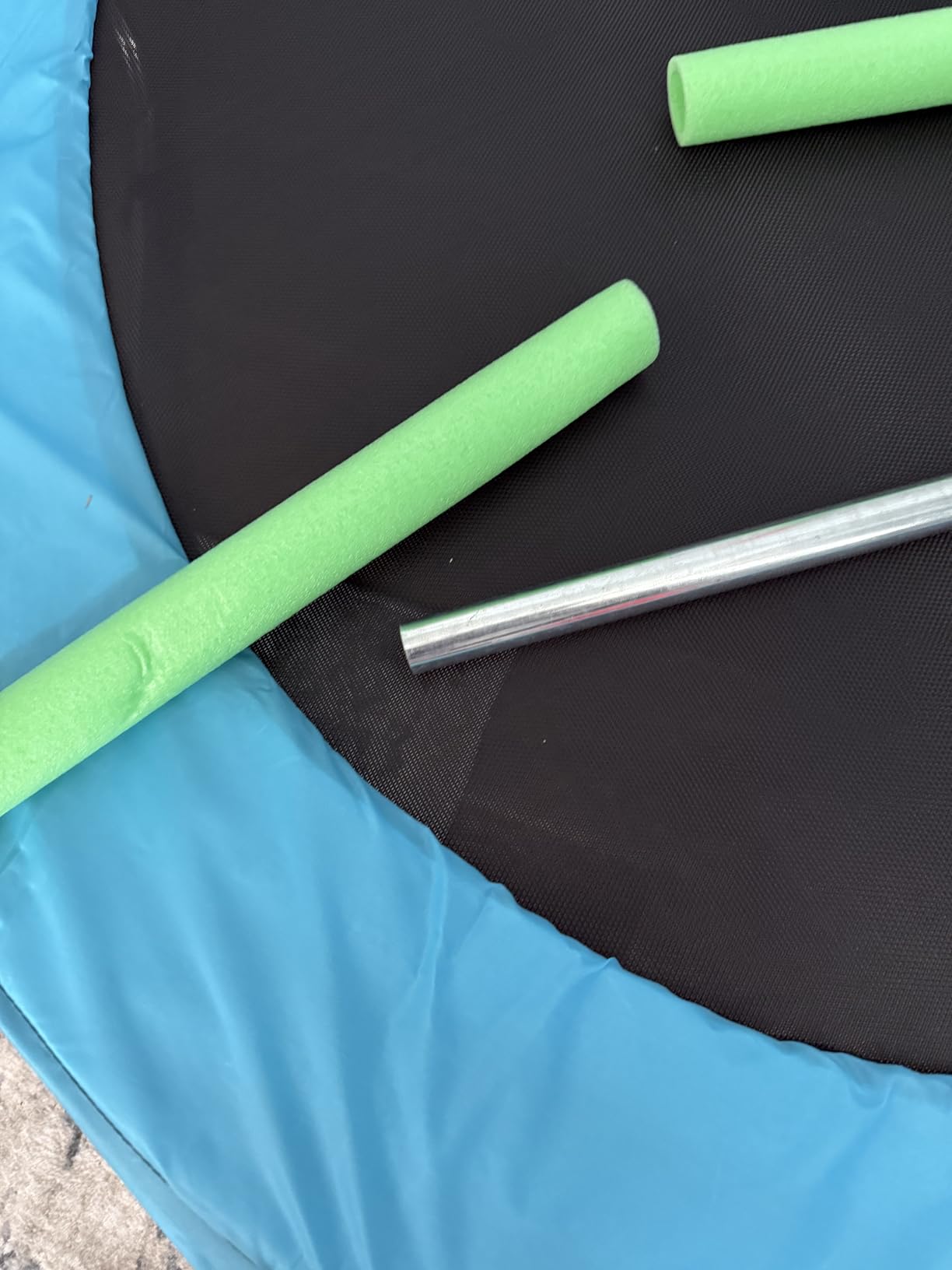
Two things tempered the rating. At 19.4 pounds it is one of the heavier models here, so shifting it between rooms is a chore. Net installation is finicky and easier to fit wrong than right, and the 4.2 score with 10 percent one-star reviews reflects that assembly frustration rather than a safety complaint.
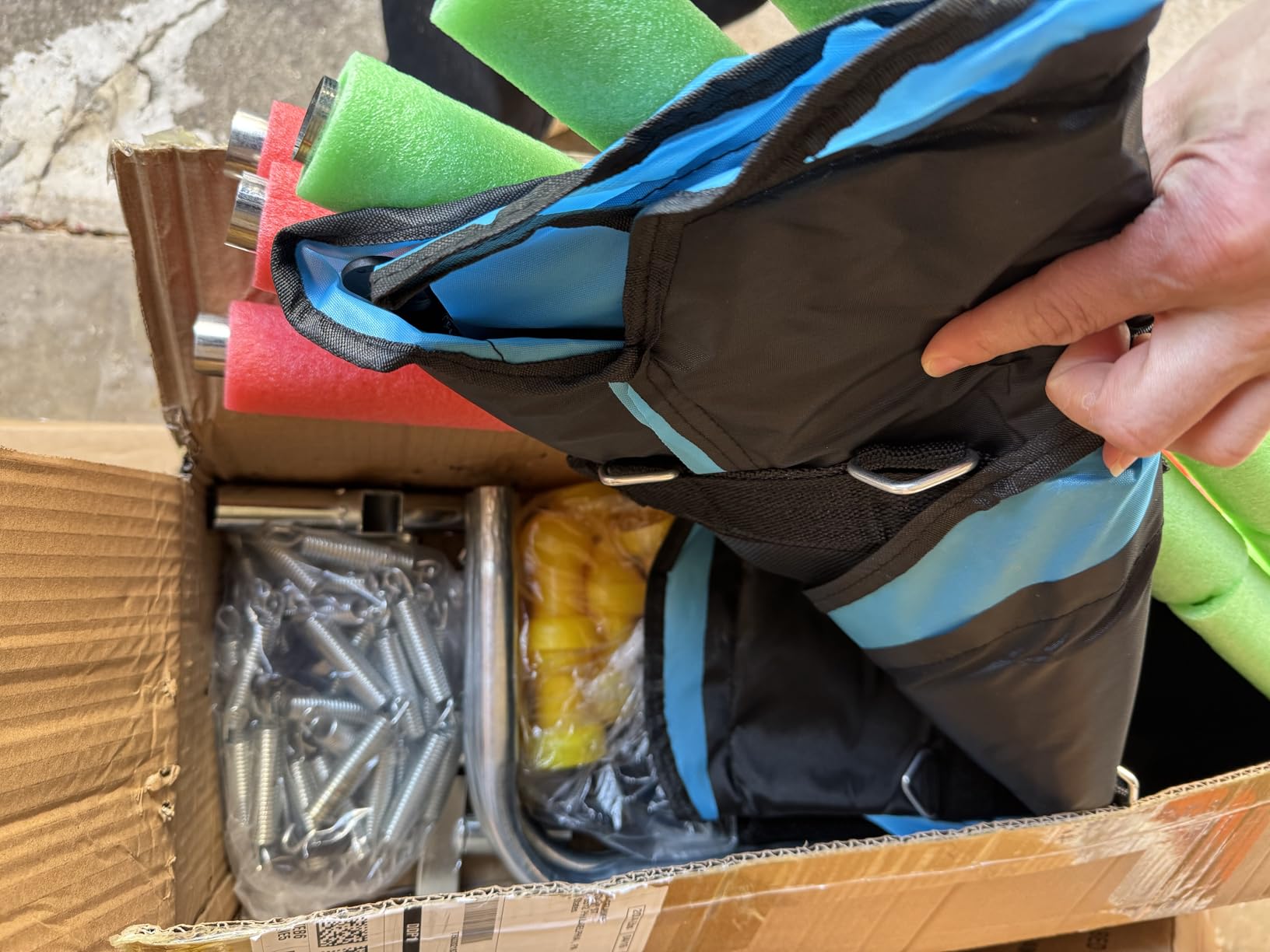
Are zipper-door enclosures worth it indoors?
For more than one child, yes. A single handlebar model needs a rule that only one person jumps at a time, which a 4-year-old and a 2-year-old will not reliably follow. A proper door removes the temptation to climb in from the outside.
Skip this one if you are furnishing a small room
A 55 inch footprint plus 19.4 pounds of frame is a dedicated-space purchase, and the assembly is not a one-evening job alone.
9. Skywalker 48 inch Mini Trampoline with Enclosure Net: Most Versatile for Safety-Focused Families
Skywalker 48″ Round Mini Trampoline w/ Enclosure – Zoo Adventure
48 in L x 48 in W x 57.1 in H
Net sewn directly to the jump mat
Bungee cords, 30 count
100 lb weight limit
Pros
- Net sewn to the mat closes the fall-through gap
- 360 degree padded handle bar
- Bungee cords remove pinch risk
- Bottom net fixed to the base
- Fast replacement part service
Cons
- Assembly needs two people and a power screwdriver
- Light netting can tear against wheeled toys
- Frame weighs 21 pounds
With 15k+ reviews at 4.5, this is one of the best-proven enclosed units in the group. The design decision that matters is the net sewn directly to the jump mat, closing the gap between mat and mesh that a child could otherwise fall through. Bungee cords replace steel springs entirely, the bottom net is fixed to the base so nobody can crawl underneath, and a 360-degree padded handle bar wraps the jumping area.
The warranty is the longest here at 3 years on the frame and 1 year on other materials, and owners report fast replacement part service, which matters because replacement parts are the thing parents in r/BuyItForLife say they worry about most.
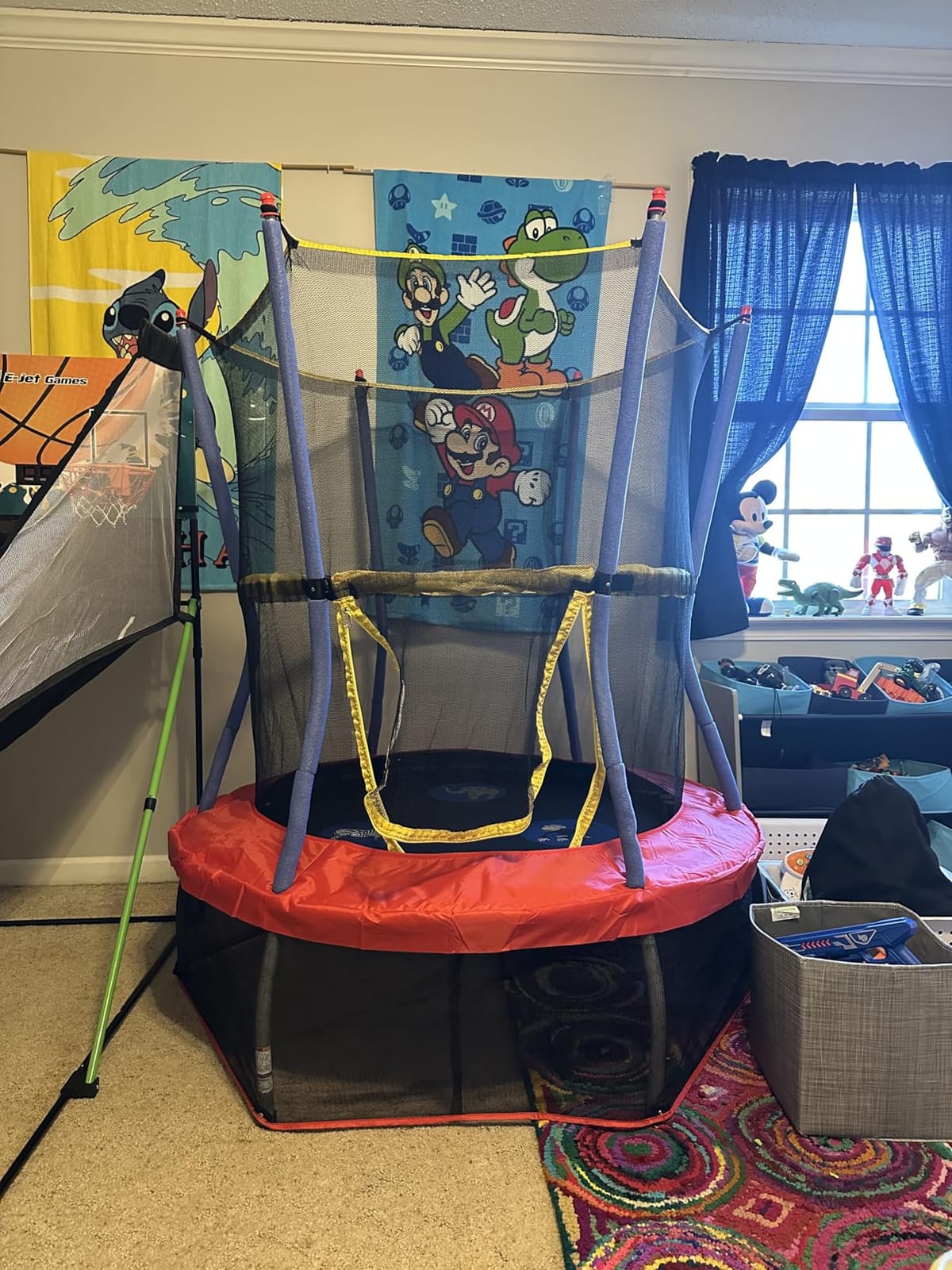
Assembly is the dominant negative and we will not dress it up. It is a two-person job and a power screwdriver makes it bearable. The netting is light-duty, so keep wheeled toys away, and a taller child leaning hard on the handle bar can lift the back of the frame, which is the tip-over behaviour we see across this category.
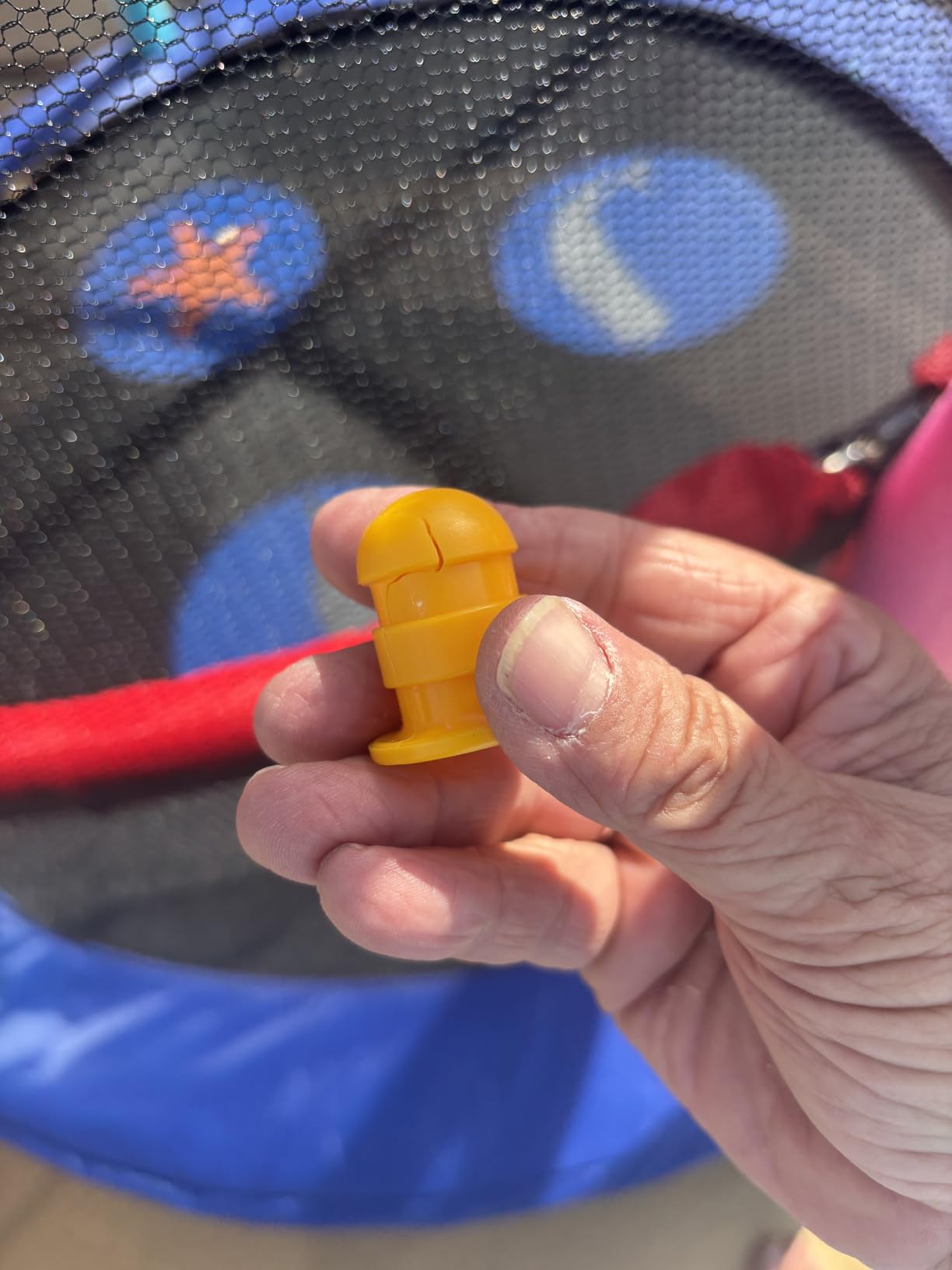
Does a full net enclosure justify the extra steps?
If your child is 4 or 5, bounces hard, or shares the trampoline with a sibling, we think yes. The mat-sewn net and fixed bottom cannot be retrofitted later, and 48 inches leaves room for a real bouncing motion rather than a shuffle.
Skip this one if you need it assembled in ten minutes
Budget an evening and a second adult. For a parent who wants a unit up before dinner, a foldable foam-handle model is a far better fit.
10. Happin 36 inch Toddler Trampoline with Handlebar: Best for Quick Setup
Happin 36″ Toddler Trampoline for Kids with Handlebar, Foldable Indoor Mini
36.02 in L x 36.02 in W x 11.81 in H
Spring-free and slip resistant
Tool-free assembly
55 lb weight limit
Pros
- Tool-free assembly in minutes
- Well-balanced bounce for ages 2 to 3
- Lightweight enough to move between rooms
- No net or zipper doors to work around
Cons
- Thin frame padding on the rail
- Handle bolt can be hard to seat
- One report of a handle breaking off
This is the pick when the deciding factor is that you want it open and bouncing before the child finishes their snack. There are no tools, setup takes minutes, and the unit folds flat and is light enough to carry between rooms yourself. The spring-free, slip-resistant design needs no enclosure net, so there are no poles or zipper doors to negotiate.
At 11.81 inches tall it is the lowest profile among the 36 inch models here, which reduces the height of any fall. The bounce is tuned for a 2-to-3-year-old, and the stainless steel frame keeps it honest structurally.
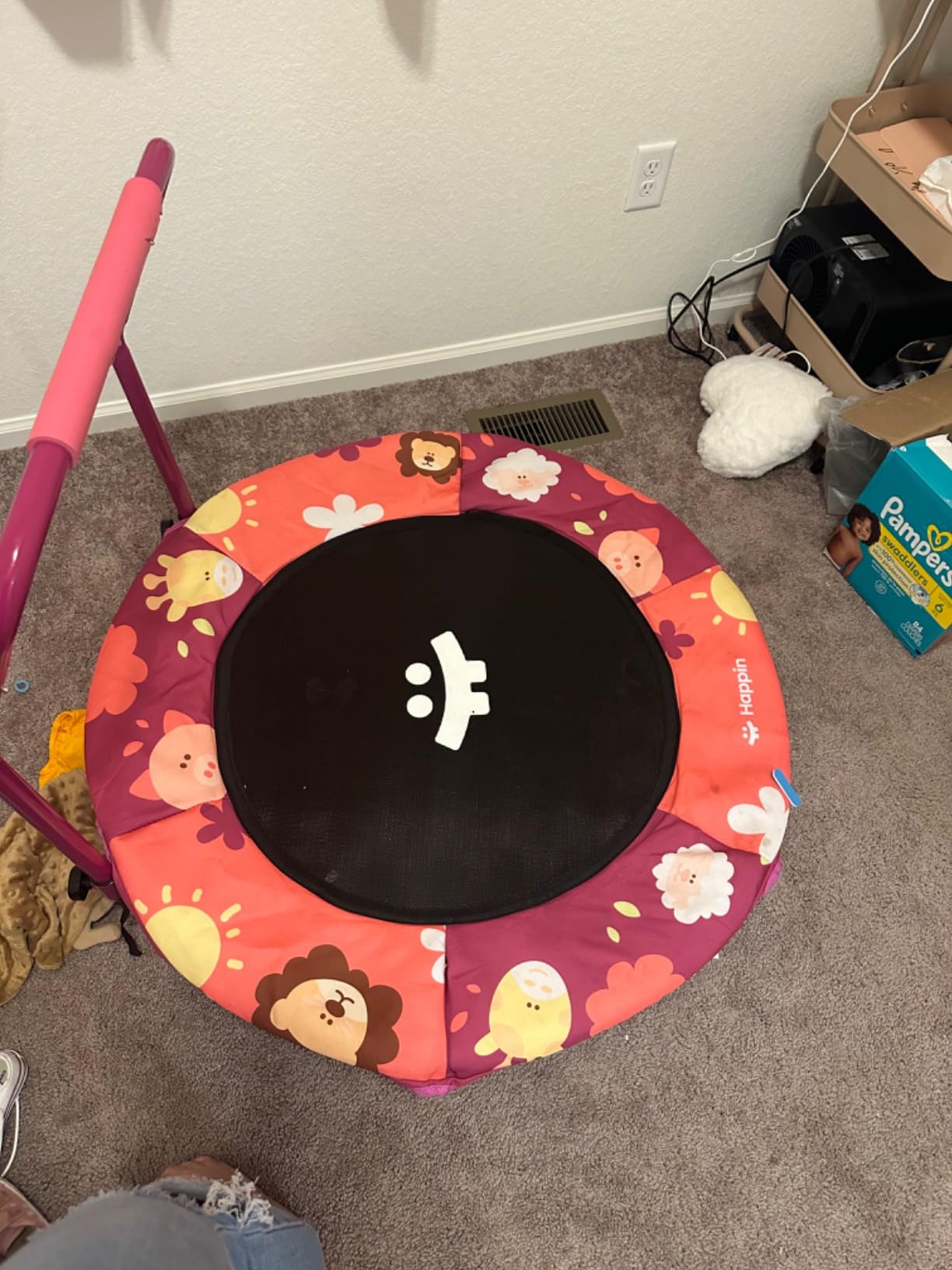
The critical reviews focus on the thin frame padding and on the handle joint, where one owner reported the handle breaking off and leaving a sharp edge. That is isolated rather than a pattern, but it is the part we would inspect first on a used unit.
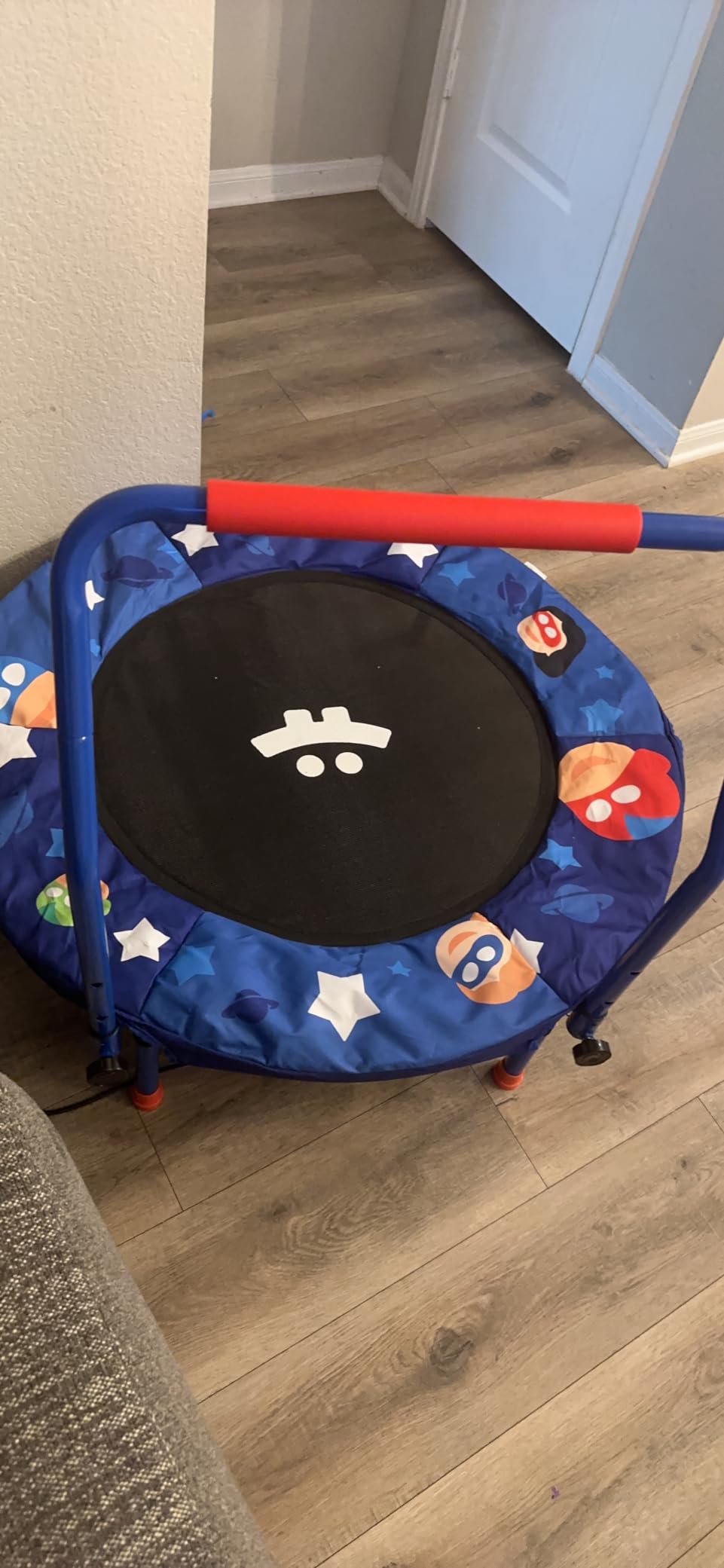
Is a 12 inch tall frame actually safer?
For falls, yes, marginally. The lower the jumping surface sits, the less energy a toddler generates before landing. This is the shortest frame among the models here, and that is a genuine safety argument rather than a marketing one.
Skip this one if you want it to grow with your child
The bounce is deliberately gentle and the frame has no height adjustment, so a 4 or 5 year old will outgrow it quickly. It can also slide on a smooth floor, so put a rug underneath.
How to Choose a Mini Trampoline for Toddlers: Buying Guide
The three decisions that matter are the spring system, the handlebar and the space you have. Get those right and the brand name matters far less than shoppers assume. Get them wrong and no certification will save you.
Bands, bungee cords or steel springs: which spring system suits a toddler
Steel springs give the highest bounce and the most pinch risk. A no-gap mat with a padded sleeve mitigates that, and the BCAN does it properly, but the design is inherently more hazardous for a two-year-old. Elastic bands are the quietest and gentlest, with no metal near the perimeter, which is why the ATIVAFIT models start at age 2. Bungee cords sit in between: no exposed steel, a firmer bounce than bands, and the mechanism the Skywalker uses inside its net enclosure. For a 2 year old, lean toward bands. For a 4 or 5 year old who wants real bounce, consider bungee or a covered spring mat.
Handlebar geometry and the tip-over question
A handlebar is the most valuable safety feature in this category, because a child holding on falls in slow motion rather than toppling sideways. But the idea that a bar is purely protective is incomplete. A bar mounted at one end is a lever: a child swinging on it can lift the opposite side of the frame, and reviewers on several of these models report exactly that. Bars that surround the jumping area, like the 360 degree padded rail on the Skywalker, distribute that force instead.
Net enclosures, weight limits and ASTM certification
Every mini trampoline has a weight limit and they are low, typically 55 to 100 pounds for a child-focused unit. The number matters less as a hard limit than as a signal of the frame’s engineering class, and it is usually buried low in a listing. On certification, a named standard such as ASTM with a stated test count is worth more than a brand name, because a third party has checked the product against written criteria.
Size, ceiling clearance and indoor versus outdoor use
Allow three feet of clearance on every side, and check your ceiling height against the tallest child’s reach with a margin. A 36 inch unit is the toddler standard; 48 inches suits a 4-to-7-year-old; 55 inch units are effectively small family trampolines. Many foam-handle mini trampolines are indoor only, and the Little Tikes in particular is rated for indoor use.
Age-Band Navigator: Which Mini Trampoline for Which Toddler
At 18 to 24 months, choose a spring-free elastic band model with an adjustable foam handle. The ATIVAFIT 36 inch Big Handle and the Happin 36 inch are the two we would start with, because both rate from a young age and neither has exposed metal at the mat edge. Hold off on anything with a coil spring until your child can control a landing.
At 2 to 3 years, the Little Tikes 3′ and the BCAN SP1 36 both work well. This is the age where the handlebar stops being optional and becomes the reason a child bounces happily instead of fearfully. The Little Tikes is rated from 3 years, so check your child’s actual age first.
At 3 to 4 years, the Little Tikes sits in its sweet spot, and the SereneLife 36 gives you a higher listed capacity and a fold-flat frame. This is also the age where a full enclosure starts to make sense if a sibling will share the trampoline.
At 4 to 6 years, gentle band systems are running out of road. The Skywalker 48 with its mat-sewn net and bungee cords, or the SZBOB 55 if you have the space and can manage the assembly, is the more realistic fit. Both carry higher weight limits and both reward the bigger movement a four-year-old wants.
For physical therapy or sensory-integration use, the quiet band models and the low-profile Happin are the least stimulating and most controllable, which is usually the point in a therapy room.
Frequently Asked Questions
What is the safest mini trampoline for toddlers?
The safest configuration is a low-to-the-ground unit with no exposed steel springs, a fully foam-padded handlebar your child can grip, and a no-gap mat or full enclosure net. In our group the ATIVAFIT elastic band models remove springs entirely, while the BCAN SP1 pairs a no-gap mat with ASTM certification and 20-plus safety tests. Whichever you choose, one jumper at a time and an adult within arm’s reach are non-negotiable.
What is a good mini trampoline for a 2-year-old?
For a 2 year old, pick a spring-free elastic band model with an adjustable foam handle and suction cup feet. The ATIVAFIT 36 inch Big Handle is rated for ages 2 to 6 and adjusts as your child grows, which avoids buying twice. The Happin 36 inch is the quieter, lower-profile alternative with tool-free setup, though its gentle bounce suits a younger child.
Can a 2 year old use a mini trampoline?
Medical bodies including pediatric orthopedic groups do not recommend trampolines for children under 6, so a 2 year old sits inside the caution zone. If you choose to use one, the mitigations matter more than the product: one jumper at a time, an adult within arm’s reach, a low frame, no exposed springs, and no trampoline parks until the age of 6.
Is it okay for a 3 year old to jump on a trampoline?
A 3 year old is at the low end of the age range most of these units are rated for. The Little Tikes 3′ Trampoline is rated for ages 3 to 6 with a 55 pound limit and is our overall pick. Choose a model with a padded handlebar and covered or spring-free perimeter, and keep sessions short with close supervision.
Do mini trampolines have weight limits?
Yes, and they are usually low. Toddler-focused units in this group are commonly rated at 55 pounds, while larger enclosed models reach 100 to 220 pounds and one 55 inch play set reaches 440. Treat the weight limit as a signal of frame engineering class rather than a suggestion, and check the number on the exact variant you are buying.
Are bungee cord trampolines safer than spring trampolines?
They remove the pinch risk, because there is no exposed steel at the mat edge. What you trade is some of the bounce response, since bungee cords are less springy than coil springs. For a 2 year old we would choose elastic bands or bungee over a covered coil spring, and for a 4 or 5 year old who wants height the bungee or covered spring mat is a fair compromise.
Conclusion: The Best Mini Trampolines for Toddlers in 2026
For most families the best mini trampolines for toddlers in 2026 come down to two decisions: no exposed springs, and a handlebar the child can actually hold. The Little Tikes 3′ Trampoline wins overall for a 3-to-6-year-old because it is the most proven unit in the group, with a 55 pound limit and a padded bar at the right height. For a 2 year old, the ATIVAFIT 36 inch Big Handle starts where it should. For a child near 5 who bounces hard, the Skywalker 48 with its mat-sewn enclosure net is worth the assembly evening.
Whatever you pick, check your ceiling height, clear three feet of floor on every side, and set the one-jumper-at-a-time rule before the first bounce rather than after the first fall.