
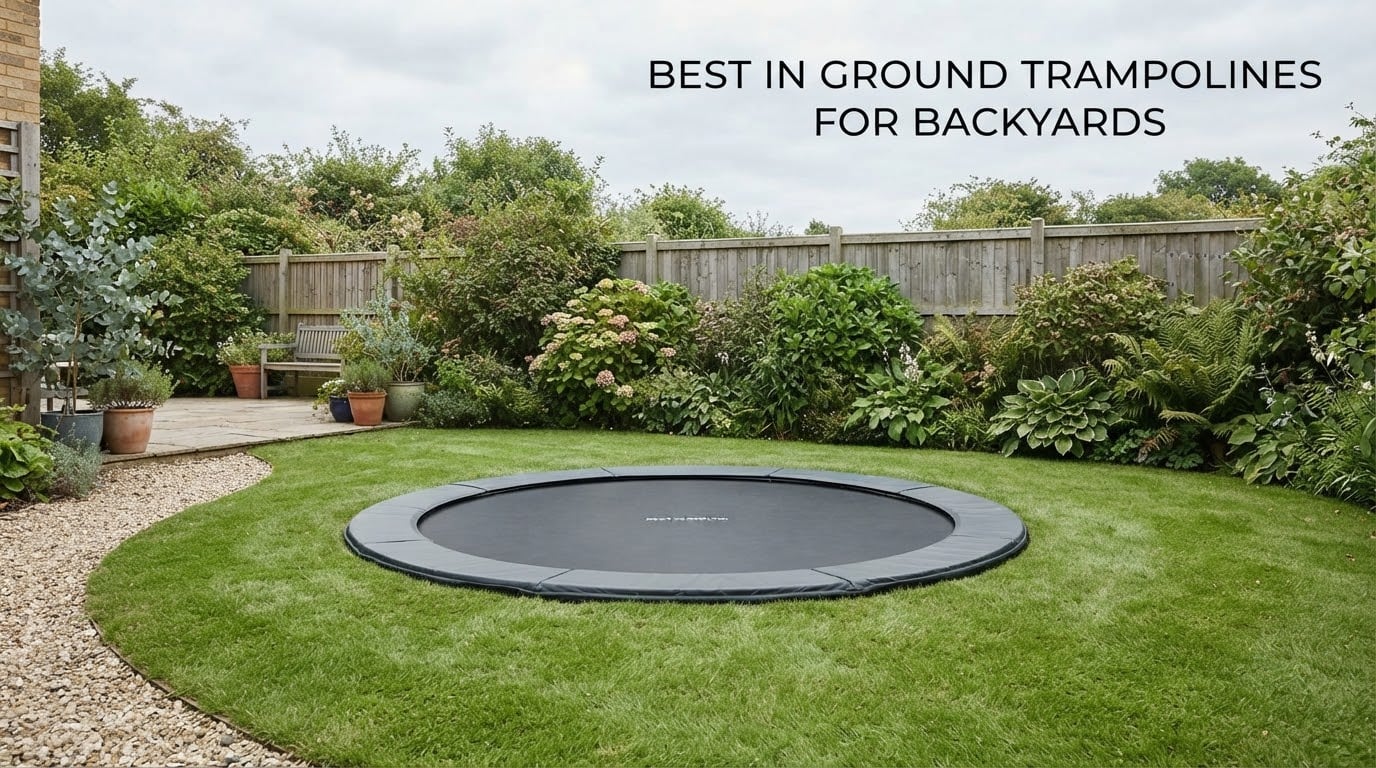
Buying the best in ground trampolines for backyards is mostly a question of what happens beneath the lawn, not above it. The frame is the cheap half of an in-ground project. The pit, the retaining wall, the drainage and the labour decide whether you end up with a backyard asset or a summer’s worth of regret, and almost every guide we read glosses over that second half.
So we did the comparison properly. We looked across the whole in-ground category, pulled the published specifications and the owner feedback, and ranked six real in-ground units by what they actually do for a family backyard: how the mat sits, how the bounce feels, what is included in the box, and what you are still holding when the digging is done. Two of the six ship with a safety enclosure in the box. Only one ships with the retaining wall.
One honesty note before we start. The review pools in this category are thin. The six units below carry 15, 14, 13, 10, 4 and 0 customer reviews between them, which is not a lot of evidence for a purchase that involves a hole in your garden. We have said plainly where the evidence is thin rather than presenting a thin average as a verdict, and we lean on the published specifications where the reviews are sparse. If you want the wider picture on above-ground and rectangular trampolines, our guide to the best trampolines covers the rest of the market.
Everything below is written for 2026 and reflects the current state of the in-ground category.
Table of Contents
Top 3 Best In-Ground Trampolines for Backyards (October 2026)
Avyna Premium In-Ground
- Flush-to-ground frame with cushioned surround
- 11-gauge hot-dip galvanized steel
- Up to 1750 pounds rated user weight
- Vented mat plus enclosure with lockable entry
BERG Champion InGround 14ft
- Safety net enclosure included
- 96 TwinSpring gold springs
- Airflow mat with 50% more breathability
- Low 20 cm step-on threshold

Capital Play Inground Rectangle Kit
- Retaining wall included in the box
- Double frame in 2mm double-dip galvanized steel
- 10-year frame warranty
- Compact 11 x 8 ft rectangular footprint
All Six In-Ground Trampolines Compared in 2026
Everything that separates these six is in the table below. The two columns that catch most first-time buyers are the retaining wall and the enclosure, because a unit that omits both is not cheaper, it is unfinished.
| Product | Specifications | Action |
|---|---|---|
| Avyna Premium In-Ground Trampoline |
|
Check Latest Price |
| Capital Play Inground Rectangle Kit |
|
Check Latest Price |
| BERG Champion InGround 14ft |
|
Check Latest Price |
 ANYTHING SPORTS Rectangular In-Ground Kit ANYTHING SPORTS Rectangular In-Ground Kit |
|
Check Latest Price |
 ANYTHING SPORTS Round In-Ground Kit ANYTHING SPORTS Round In-Ground Kit |
|
Check Latest Price |
 ExacMe No-Gap In-Ground Trampoline ExacMe No-Gap In-Ground Trampoline |
|
Check Latest Price |
Are In-Ground Trampolines a Good Idea?
Yes, for a specific kind of yard and a specific kind of buyer. An in-ground trampoline suits families with a small, highly visible backyard, households with young children mounting an elevated frame, and adults rebounding for fitness who want a low, stable platform. It costs more and takes longer than an above-ground kit, and it is worth it only if you are prepared to run a real excavation.
1. Avyna Premium In-Ground Trampoline – Best Overall Flush Design
Avyna Premium Round In-Ground Trampoline, 15, 14, 12 FT
11-gauge galvanized frame
Up to 1750 lb rated weight
96 springs
Vented mat and enclosure
Pros
- Flush frame needs no ladder and no elevated platform to climb
- 11-gauge hot-dip galvanized steel built for full-family weight
- Vented mat moves air through the weave for a responsive bounce
- Enclosure with lockable entry plus full spring cover and thick UV pad
- Lifetime frame cover with 10-year spring and 3-year mat coverage
Cons
- Self-assembly is not quick - one owner spent about five days
- Frame is heavy enough to need several adults to lower it into the pit
- Some buyers report slow pad replacement support
- Excavation and install labour are not included
Verdict: the strongest all-round in-ground unit in this set, and the one we would put in a family backyard without hesitating. The frame is 11-gauge high-tensile steel that has been hot-dip galvanized against sun and rain, rated to carry up to 1,750 pounds, which is far and away the highest user weight figure in the group. That number matters more than most buyers realise, because it is what lets adults, teens and children share one mat instead of taking turns.
What sets it apart physically is the flush-to-ground geometry. There is no ladder to climb and no platform to hop down from, and the wide cushioned surround means you step on and step off. The Air X-TREAM vented mat pushes air through the weave, which is the difference between a responsive surface and the dead, thumpy feel you get when a mat is sealed into a pit with nowhere for the air to go.
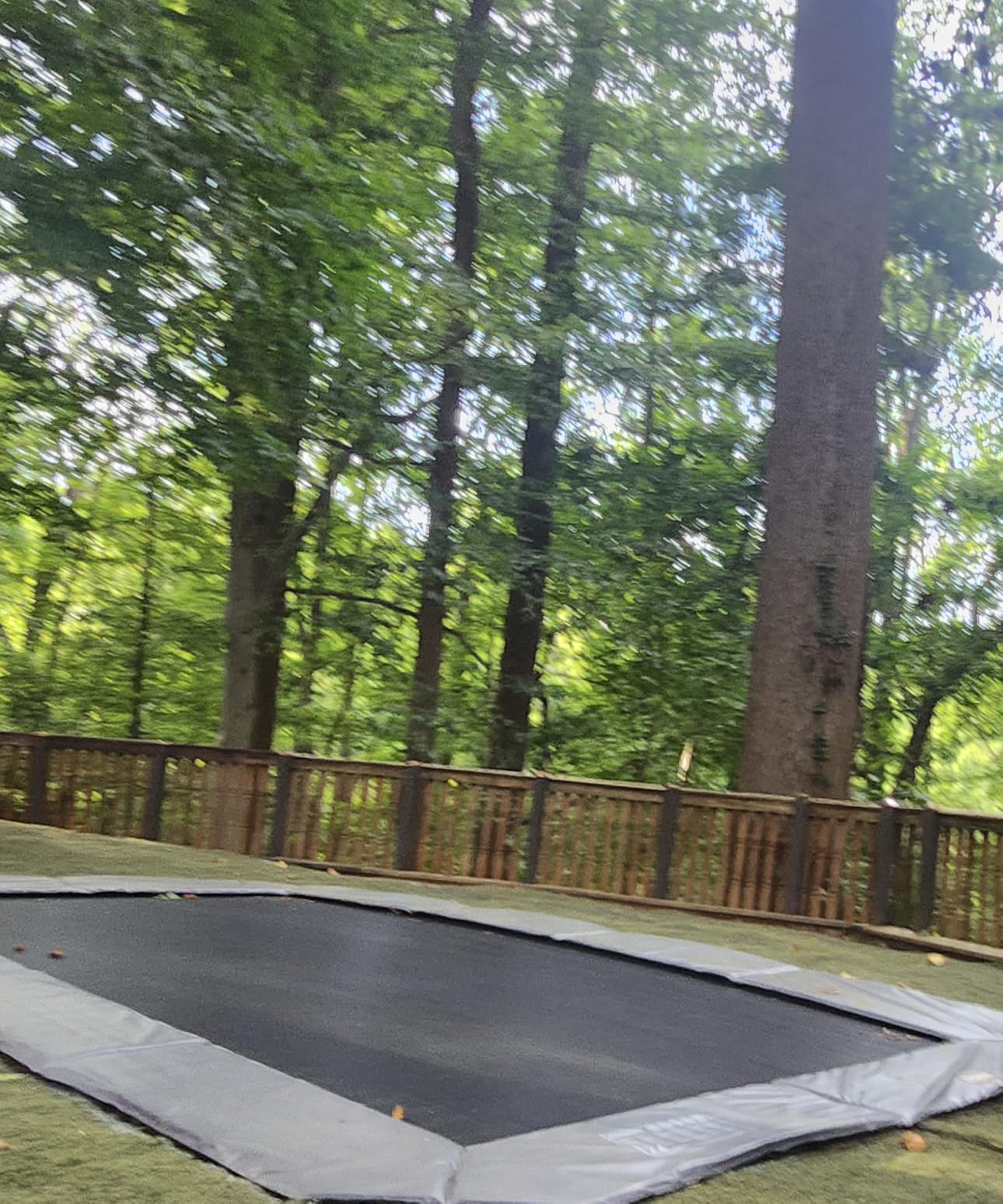
Owner feedback is warm and consistent. Reviewers describe the build quality as solid and the finished yard as clean and unobtrusive, and several say it became the family favourite once it was in the ground. Ninety percent of the ratings in the pool are five-star, which is a strong signal from a small group of 14 reviews.
The honest reservations cluster around installation rather than the product itself. One reviewer spent roughly five full days on self-assembly. The frame weighs 235 pounds and needs several strong adults to manoeuvre into the pit. And a few buyers report friction with pad replacement support, so if a pad tears, expect a slower resolution than a local dealer would give you. None of that is a defect; it is the shape of a heavy permanent installation.
What the 1750 pound rating really means in practice
Rated user weight is the ceiling for the whole group sharing the mat, not a per-person allowance. At 1,750 pounds this unit absorbs an adult, two teens and a small child bouncing at once, which is the configuration most family backyards actually run on a warm afternoon. It is also the reason we would put it at the top of a list of in ground trampolines for backyards rather than treating weight capacity as a tiebreaker.
Where the extra spend really goes
The enclosure, the lockable entry and the fully covered springs are the parts that separate this from a bare mat in a hole. The enclosure is weather-treated, the pad is UV-protected and the springs are covered, so the two most common sources of jump injuries on an in-ground unit are both addressed in the box. The warranty ladder is unusually generous for the category: lifetime on the frame, 10 years on springs, 3 years on the mat and pad.
2. Capital Play Inground Rectangle Kit – Premium Pick With the Retaining Wall Included
Capital Play Inground Trampoline 11ft x 8ft Rectangle | High Jump Trampoline Unique Airflow Vented Pads | Heavy Duty Commercial Grade | Long Warranty | Enclosure Available. (Green Pads)
Retaining wall included
2mm double-dip galvanized frame
80 springs
10-year frame warranty
Pros
- Retaining wall ships in the box
- saving a separate purchase
- Unique double frame in 2mm double-dip galvanized steel
- Rebound mat designed to minimise soil disposal
- Compact 11 x 8 ft rectangle suits tight yards
- 10-year frame warranty
Cons
- Only a 4-review pool
- so the 4.4 average is very thin evidence
- One reviewer judged the kit light on materials for the cost
- 220 pound rated user weight is modest for shared adult and child use
- Enclosure sold separately in this configuration
Verdict: the pick that makes the most financial sense, largely because of what arrives in the carton. The box contains the trampoline, jump mat, springs, safety pads and the retaining wall. That last item is the one every competitor charges extra for, and it is the single largest hidden cost in an in-ground build after labour, so having it included changes the arithmetic.
The frame is the interesting part. This kit uses a double frame system in 2mm thick, double-dip galvanized steel, and that second layer is why the unit feels rigid once it is set. At 11 by 8 feet the footprint is genuinely compact for a rectangular in-ground trampoline, and the rectangular surface gives even spring tension right out to the corners, which is what you want for anything more athletic than casual bouncing.
Two things temper the recommendation. The rated user weight is 220 pounds, the second lowest here, which rules out a family where a large adult wants to jump with a child. And the evidence is thin: four reviews, 68 percent five-star and 32 percent three-star, with one substantive complaint that the kit felt light on components for what it cost. Treat the specification sheet as the evidence here and the review pool as a sanity check.
Why the retaining wall is worth more than it looks
A retaining wall is the structure that holds your soil back at the pit edge. Without one, the wall of the hole slumps inward, the frame sits in a collapsing trench and the rim of your lawn caves in within a season or two. Owners on forums consistently list a missing retaining wall as a deal breaker, and this is the only unit in our set that ships one.
What the rectangle geometry gives you
An even tension rectangle produces a more uniform bounce across the whole surface, which is why this shape suits skill work and why two-jumper family use is easier to manage on it. The included TDU vented pads and the commercial-grade mat are aimed at heavy use. The 10-year frame warranty is a step above most kits in this bracket.
3. BERG Champion InGround 14ft – Best Value With the Net in the Box
BERG Champion InGround 14ft Trampoline with Safety Net, Trampoline for Kids, High Performance & Safety Features, Jump Higher with Airflow
14 ft round
Enclosure included
96 TwinSpring springs
330 lb rated user weight
Pros
- Safety net enclosure and TwinSpring gold springs in one package
- Airflow mat with 50% more breathability reduces drag
- Low 20 cm threshold makes step-on access safe for adults
- Sits only a few inches proud of the ground so the dig is shallower
- 10-year warranty extendable to 13 years by registering
Cons
- Several reviewers report very slow or unavailable US replacement parts
- Requires drilling an extra hole underneath the pit
- Freight delivery with scheduled lead time
- Heaviest unit at nearly 400 pounds
- Lowest average rating here at 3.9 stars
Verdict: the best-specified product in this roundup, held back almost entirely by after-sales friction rather than by the trampoline itself. The 14-foot round frame carries 96 TwinSpring gold springs and an Airflow jumping mat rated at 50 percent more breathability than a standard mat, which reduces drag and produces a noticeably higher jump. It sits only a few inches proud of the ground, and the 20 cm threshold is a genuine step-over rather than a step-up.
That shallow profile is the practical headline. Because the frame does not sit deep in the ground, air can escape through the sides and the hole does not need to be as deep as a full bowl pit. Owners repeatedly call the shallow dig out as an advantage, and it is the reason this unit is more achievable in a normal backyard than a deep-pit competitor.
Now the problem, and it is a real one. Multiple reviewers describe very slow or unavailable replacement parts in the US, including nets and jump mats, with some told to buy an entire new kit rather than wait. A trampoline that is excellent until the net tears and then unusable for years is a serious ownership risk, and it is why this unit carries the lowest average rating in the set at 3.9 stars with a 15 percent one-star share despite having the largest review pool here.
The parts and service question to ask before you buy
Before committing, ask the seller directly where replacement nets and mats ship from and what the expected turnaround is. If the answer is a distributor several time zones away, factor a long wait into your ownership plan. This is the kind of question that costs nothing to ask and saves a great deal later, and it applies to any in-ground unit you are considering.
What the shallow design gives you at install time
Two practical wins. The reduced pit depth means far less soil to remove, which is where most of the labour cost of an in-ground build lives. And the side venting keeps the bounce lively without a vented mat costing extra. The catch is that installation still requires excavating a pit and drilling a hole underneath, and the unit ships by freight with a scheduled delivery window rather than arriving on a standard courier run.
4. ANYTHING SPORTS Rectangular In-Ground Kit – Best for Gymnastics and Tricks
Rectangular In-Ground Trampoline – Heavy-Duty Flush-to-Ground Outdoor Jumping Mat, Safety Padding & Easy Install Kit | Ideal for Kids, Families & Athletes | 7×10 Without Enclosure
Rectangular surface
Frame size 10 ft
120 x 84 x 20 inches
12-month warranty
Pros
- Even tension rectangle suits flips
- tricks and training
- Flush to ground for ladder-free access
- Galvanized frame and durable outdoor jump mat
- Kit includes frame
- springs
- padding and ground anchors
- 68 percent five-star share with no one-star ratings
Cons
- Only 13 reviews
- so the 4.4 average is thin evidence
- Soil preparation and excavation are not covered
- 12-month warranty is far shorter than premium coverage
- Small brand with limited long-term parts history
Verdict: the pick to beat if anyone in the household wants to do more than bounce in a straight line. The rectangular surface spreads spring tension evenly across the full area, which gives you a consistent landing zone at the ends and corners rather than the deadening you get toward the perimeter of a round mat. That geometry is why trampolines used for gymnastics and skill training are rectangular, and it is the main reason to choose this over a cheaper round kit.
The hardware side is competent for the money. You get a galvanized steel frame, a durable jump mat, perimeter padding and ground anchors in the kit, with variants that include a 10 by 17 foot option with an enclosure and a 7 by 10 foot option without one. Owners point to the flush fit, the even bounce and the completeness of the hardware as the three things they like most.
The reservations are about depth of support rather than product quality. This brand has a small footprint and a short parts history, which matters for a permanent installation you expect to keep for years. The warranty is 12 months, no-questions-asked, and that is a long way behind the lifetime frame coverage on the premium units here. Excavation and soil preparation are entirely yours and entirely outside the kit.
Skill work versus casual family bouncing
If the intent is flips, twists and landings, the rectangle earns its keep immediately. If the intent is two children bouncing on weekend afternoons, a round mat gives a better safety margin around the edge and a gentler perimeter bounce. Judge this kit on what you will actually do on it, because the shape is the decision that is hardest to change later.
How the 12-month warranty should change your plan
Treat the first year as the proving window. Check frame bolts, mat tension and pad condition at the end of the first season, and photograph everything. A 12-month warranty means the manufacturer expects early-life failures to surface quickly, and staying inside that window is the difference between a free replacement and a purchase you fund yourself.
5. ANYTHING SPORTS Round In-Ground Kit – Best for Young Children Stepping On
ANYTHING SPORTS Premium Round In-Ground Trampoline, 12FT and 14FT Diameters (14 FT Without Enclosure)
Circular flush-mount
Frame size 10 ft
100 x 100 x 100 inches
12-month warranty
Pros
- Circular design guides jumpers toward the centre
- Step on and step off with no ladder
- Galvanized frame with reinforced springs
- UV-resistant mat and thick edge padding
- Owners like the quiet cover fit and weather performance
Cons
- One owner found the supplied springs soft and replaced them
- The 14 ft version without an enclosure has no perimeter shield
- Only 10 recent reviews so durability is unproven
- 12-month warranty is short beside lifetime-frame options
Verdict: the friendliest flush-to-the-lawn option for a household with small children. The circular geometry naturally directs jumpers back toward the centre, which is a subtle but genuine safety advantage over a rectangle when the person on the mat is four years old and bouncing in an unpredictable direction. There is no ladder and no elevated platform, so a small child gets on and off without an adult lifting them.
Owners consistently highlight three things: how cleanly the unit sits in the yard, how easily children mount and dismount, and how quiet the spring cover is while keeping the mat and frame protected in the weather. The kit includes the frame, heavy-duty springs, safety padding and ground anchors, with 12 foot and 14 foot variants and an enclosure option on the smaller one.
Two cautions. One owner found the supplied springs soft, which made the surface feel under-responsive until they fitted different springs, so budget for a spring upgrade if the bounce feels muted. And the 14 foot version without an enclosure has no perimeter shield, which means older teens and adults need supervision rather than free rein. Seventy-one percent of the ratings in the pool are five-star across ten reviews, all of them recent.
Why the round shape suits small jumpers
The centre-seeking property of a round mat is the reason many safety guides prefer it for younger children. Combine it with zero step-in height and there is no ladder to fall from and no platform to fall off, which removes the two most common in-ground injury routes for small users. Add a perimeter shield on an enclosed variant if adults will share the mat.
What the enclosed and unenclosed variants change
The 12 foot variant with an enclosure is the one to choose for mixed-age family use, because the net gives you a defined boundary and removes the need to supervise a teenager in a 14 foot circle. The 14 foot without enclosure is a bigger, cheaper mat for younger jumpers only. Deciding this before you order matters, because the enclosure is a separate configuration rather than an add-on.
6. ExacMe No-Gap In-Ground Trampoline – Budget Pick for Safety-Minded Beginners
ExacMe No-Gap In-Ground Trampoline for Kids, 14 12 10 8FT with Safety Enclosure Net, Round Outdoor Heavy-Duty Round Backyard Trampoline for Family Fun (10FT)
No-gap mat and spring design
Zipperless self-closing entry
Fiberglass net
5-year frame warranty
Pros
- No-gap design closes the space where feet get pinched
- 360-degree support structure spreads load evenly
- Zipperless entry that cannot be left open accidentally
- Fiberglass net holds tension and stays round
- ASTM and US CPC certified
- Five-year frame warranty
Cons
- No customer reviews at all
- so durability is unproven
- 250 pound rated user weight is the lowest here
- Ships with a ladder that a sunken pit does not really need
- New listing with limited service history
Verdict: a well-specified safety design with no owner evidence behind it yet, and that distinction matters. The central idea is the no-gap system, which closes the space between the mat edge and the springs so there is no slot for a foot to drop into. That is a real, well-understood injury mechanism on conventional trampolines, and eliminating it by design is better than managing it with pads.
The rest of the safety thinking is consistent. A 360-degree multi-point support structure with reinforced vertical struts spreads load and resists warping. The entry is a zipperless self-closing overlap that cannot be left open by a distracted child, which removes the single most common net failure. The fiberglass net holds tension without sagging, and the whole unit carries ASTM and US CPC certification for material safety and structural integrity, plus a five-year frame warranty. A ladder and spring tools are bundled in.
With zero customer reviews, everything above is a manufacturer claim and nothing here is field-tested. The rated user weight of 250 pounds is the lowest in this group, which limits shared adult use, and it is odd to ship a ladder with a unit designed to sit flush. Treat it as unproven and buy it for the safety architecture rather than for a bounce you can feel in a video.
What no-gap design actually prevents
On a conventional trampoline, the gap between mat and springs is a trap for feet and toes, particularly for children landing awkwardly or for anyone who stops a bounce at full extension. Closing that gap means the mat physically extends to meet the spring channel. It is the same principle as the fully covered springs you see on premium units, applied at the mat edge instead.
How to buy an unproven listing without gambling
Check the certification and the warranty before anything else, because those are verifiable commitments rather than opinions. Confirm the pit depth the design needs, since a flush unit that needs a different hole shape changes your excavation plan. And keep the receipt and packaging, because with no owner history you have no market evidence if something goes wrong.
In-Ground vs Above-Ground: Which Is Safer?
In-ground trampolines are safer than above-ground units for one decisive reason: fall height. An above-ground frame stands roughly a foot above the lawn, so a jumper who bounces off the edge falls from that height onto hard ground. A sunken mat sits level with the surface, so the same mishap ends in grass. The trade is the dig itself, the retaining wall, and drainage that has to be right the first time.
Safety is not automatic, though. A level mat with no perimeter barrier just means a jumper who travels off the edge hits the ground sooner rather than being stopped. For families with toddlers, the combination that works is a flush mat plus an enclosure plus spring coverage, which is exactly the specification set on the Avyna and the BERG. The Capital Play kit gives you the wall and the flush fit but sells the enclosure separately.
For adults using a trampoline as low-impact cardio equipment rather than as children’s play equipment, a smaller dedicated rebounder is often the more sensible purchase, and our guide to the best rebounder trampolines for low impact cardio covers that category in detail. It costs a fraction of a dug-in unit, needs no excavation and survives a rental yard.
What to Know Before You Buy: Size, Shape and Weight
Size and shape decide the bounce, weight rating decides who can share it, and nothing about either is reversible once the pit is dug. The rectangle in this set gives even tension and a large usable landing area at the cost of more usable-yard discipline. The round units give a centre-seeking bounce and a softer perimeter, which is the better choice when a small child is on the mat. Measure your yard, then measure clearance around the pit, because you also need room to service the frame and to reach the retaining wall.
Rated user weight is a group total, not a per-person figure, and it is the number most buyers misread. Across these six, the figures run from 220 pounds on the Capital Play kit through 250, 330 and up to 1,750 pounds on the Avyna. If your household bounces as one group, the Avyna is the only unit here rated high enough to absorb an adult plus children at once. If a large adult will share with a child, most of the rest of this set is not the right tool.
Always apply the single-jumper rule. One person on the mat at a time, no exceptions, regardless of the weight rating. Weight capacity tells you what the structure will hold; it does not make simultaneous jumping safer. Suppliers commonly quote 70 to 110 kg as a typical working limit per model, which is a guideline for a single user rather than a shared-bounce endorsement.
Then check what is in the box before you commit. Two of these six ship with a safety enclosure, one ships with the retaining wall, and every one of them requires you to supply the excavation. Our guide to the best trampolines overall covers the shapes and sizes in more depth, and if you want to add a basketball hoop to a flush pit, the in-ground basketball hoops guide covers that specific install.
Installation and Excavation: The Part That Decides Everything
Plan the pit before you order anything, because the frame diameter determines the hole and getting it wrong means a hole you cannot use. Call for a utility line check before any digging; owners on forums who skipped this are the ones who regret it. Decide the depth from the frame profile: a shallow-proud design like the BERG needs a shallower hole because air escapes through the sides, while a deeper flush design needs a full bowl and a gravel drainage base. Mark the footprint with stakes and hose, and leave clearance for the retaining wall thickness on every side.
Set the retaining wall, level it, then lay drainage. This is the step most skipped and the one that quietly causes the failures people complain about years later. A gravel base and a soakaway give water somewhere to go; without them the pit holds water after rain and you get the ponding problem described below. Owners consistently describe drainage as the least glamorous and most important part of the install.
Professional installation is worth it for most people. The excavation, the levelling and the drainage are skilled work, and a frame that sits out of level twists the mat and stresses the springs unevenly. If you are doing it yourself, budget for a mini-excavator rental and for soil removal, because the volume of spoil is what turns a weekend into a fortnight. The heaviest units here are around 235 pounds and nearly 400 pounds, so plan the lowering with several people rather than alone.
Finally, plan the end. Homeowners describe selling a property with a filled pit as unremarkable, but removing an in-ground trampoline and backfilling the hole properly is a genuine chore. Know your plan before you dig rather than discovering it when the mat tears and you need the garden back.
Lawn Care, Drainage and Wind: What Owners Deal With
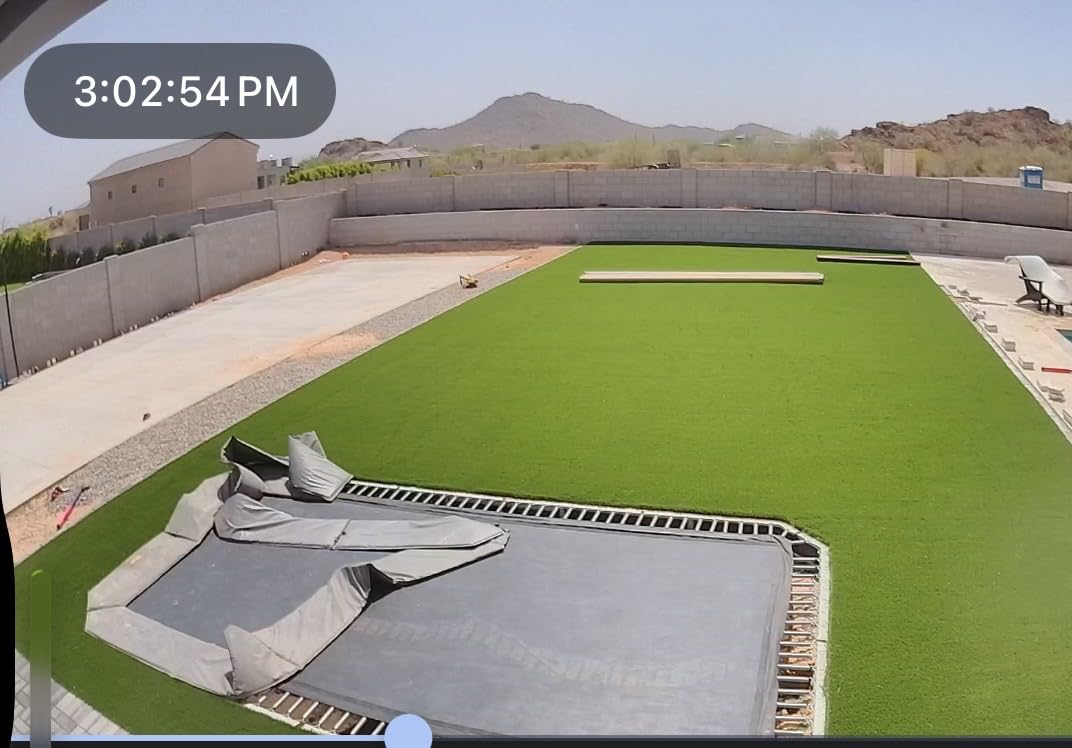
The dead grass ring is real and it is not a defect. The rim blocks light and traps moisture, so the grass under and around an in-ground unit dies in a perfect circle. Owners on r/Trampoline and r/GardeningAustralia treat this as an expected consequence rather than a fault with the trampoline, and r/GardeningAustralia users report the practical routine: mow or strim the edge regularly and cut off weed seed heads before they spread under the rim. Plan to accept a trimmed lawn ring as the ongoing appearance of your in-ground unit.
Ponding is the failure mode nobody warns you about. A pit with poor drainage collects water after rain, and standing water in a shallow pit is exactly how a backyard turns into a mosquito habitat. This is why the gravel base and soakaway are not optional, and why a cover that seals out rain matters on a unit that sits in a low spot. Check the pit after a heavy downpour in your first autumn.
Wind is the risk that gets discussed most on forums and least on manufacturer pages. Users report trampolines blown over, gutters damaged, shingles stripped from first-floor roofs and units landing in a neighbour’s property. The consistent fix reported is proper staking into the ground, which is why four of these six kits include ground anchors. Anchor the unit before the first windy season, not after the first bad night.
Two situations deserve a different answer entirely. On a mostly concrete yard, an in-ground pit is often impractical, and several owners report regretting the project for that reason alone. In a rental yard, an in-ground trampoline is close to a permanent alteration you cannot take with you, so check your tenancy terms and your local ordinances before ordering. If you are pairing the pit with a hoop, our trampolines with basketball hoops guide covers mounting depth.
Frequently Asked Questions
What is the best in-ground trampoline?
The best in-ground trampoline for most family backyards is the Avyna Premium, with a flush-to-ground frame rated to 1750 pounds, a vented mat, a lockable enclosure and lifetime frame coverage. For buyers who want the retaining wall in the box, the Capital Play rectangle is the stronger economics. The BERG Champion InGround 14ft is the best-specified but carries real after-sales service risk in the US.
Are in-ground trampolines a good idea?
Yes, for a specific kind of yard and buyer. An in-ground trampoline suits small or highly visible backyards, families with young children mounting an elevated frame, and adults rebounding for fitness. It costs more and takes longer than an above-ground kit, so it only makes sense if you are prepared to run a real excavation with a retaining wall and drainage.
How deep do you dig for an in-ground trampoline?
Plan the pit from the frame profile before you order. A shallow-proud design where the frame sits only a few inches above grade needs a shallower hole, while a flush design needs a full bowl pit. Across the in-ground category, pit depths typically run from 39 to 48 inches. Always mark the footprint and check for utility lines before digging.
Do you need a retaining wall for an in-ground trampoline?
Yes, in practice. The retaining wall is the structure that holds soil back at the pit edge so the lawn rim does not slump into the frame. Only the Capital Play kit in this roundup ships one in the box. Skipping it is one of the most common regrets reported by owners, because a collapsing trench undermines the frame within a season or two.
Are in-ground trampolines safer than above-ground trampolines?
In-ground trampolines are safer mainly because of fall height. An above-ground frame stands about a foot above the lawn, so a jumper who goes off the edge falls from that height onto hard ground, while a flush mat ends in grass. But safety still depends on an enclosure and spring coverage for young children, since a level mat alone stops nobody.
Which trampolines in this roundup can hold 300 pounds?
Four of the six units clear 300 pounds of rated user weight. The Avyna Premium is rated to 1750 pounds, the BERG Champion InGround 14ft to 330 pounds and the ExacMe No-Gap to 250 pounds. The two ANYTHING SPORTS kits do not publish a rated user weight at all. Rated user weight is a group total, not a per-person allowance.
What is the average cost of an inground trampoline?
The trampoline itself is only part of the figure. A realistic installed total has to include the unit, a safety enclosure if it is not included, the retaining wall, the gravel drainage base, soil removal and install labour, which is why the dig is usually the largest line item. Buyers who quote only the sticker figure consistently underestimate the project by a wide margin.
Can you install an in-ground trampoline yourself?
Yes, but the levelling and drainage are skilled work. You will need to excavate, set and level the retaining wall, lay a gravel base for drainage, backfill and assemble the frame, and remove the spoil. A frame sitting out of level twists the mat and stresses springs unevenly. Plan for a mini-excavator rental and several adults to lower a frame weighing up to 235 pounds.
Final Verdict: Which In-Ground Trampoline to Buy in 2026
The Avyna Premium In-Ground Trampoline wins this roundup. It has the highest rated user weight in the set at 1,750 pounds, the most complete safety package with a lockable enclosure, full spring cover and thick pad, the longest warranty ladder with lifetime frame coverage, and owner feedback that consistently praises the bounce and the clean flush finish. It is heavy and slow to self-assemble, but those are properties of any serious in-ground install rather than flaws in the product.
Buy the Capital Play rectangle instead if the retaining wall in the box changes your budget, or the BERG Champion InGround 14ft if you want the best bounce specification and can tolerate slower parts service. Choose an ANYTHING SPORTS kit for a rectangular training surface or a round mat for small children stepping on unaided, and treat the ExacMe as a safety-designed option with no owner history behind it yet.
Whichever you pick, budget for the pit, the wall and the drainage, anchor it before the first storm, and accept the lawn ring as part of the look. That preparation is what separates an in-ground trampoline that still feels brilliant in five years from one that has become a landscaping problem.