
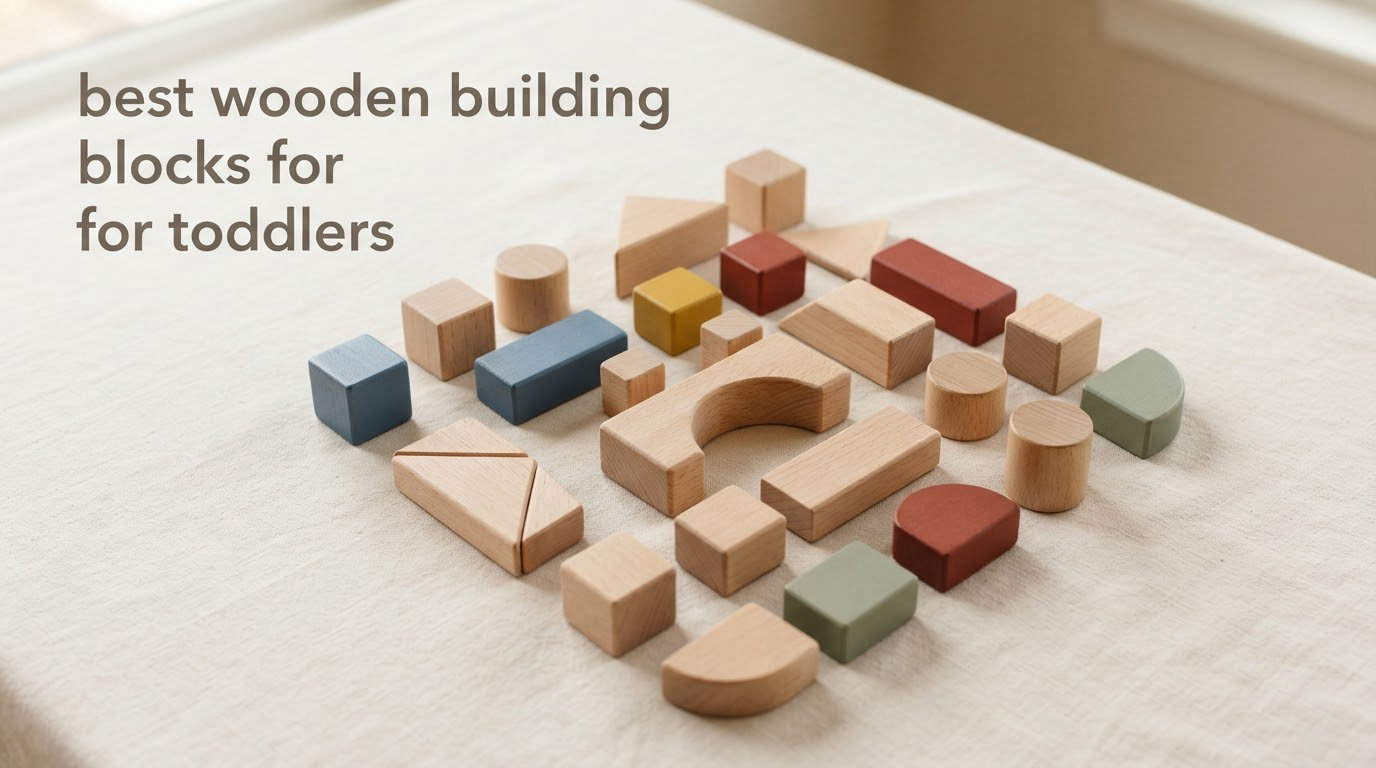
The best wooden building blocks for toddlers are solid hardwood or bamboo pieces in a mix of sizes and shapes, with rounded edges and a water-based or unfinished finish. A set works best when every block is larger than the diameter of a toilet paper roll, so nothing small enough to choke on gets past the youngest child.
Blocks look simple, and that is the point. There is no screen, no battery and no single correct build, so a toddler decides what happens next. Our team compared 12 wooden block sets side by side, weighing piece count against piece size, wood species, finish, storage and the age a set actually suits rather than the age printed on the box.
Two things came up again and again in parent forums while we worked through this roundup. The first is that age labels lie: sets marked for older toddlers often ask more of a child than a 22-month-old can manage. The second is that open-ended wooden blocks hold attention far longer than instruction-led toys, which is exactly what parents hunting for screen-free play are looking for.
If you also want the wider picture, we have covered the best building block sets overall in our building block set roundup, and for active play once your child is walking well, our picks for the best balance bikes for toddlers make a good pairing with a block set for indoor rainy days.
Table of Contents
Top 3 Best Wooden Building Block Sets for Toddlers in 2026
Quick Overview: All 12 Sets Side by Side (October 2026)
| Product | Specifications | Action |
|---|---|---|
 Melissa & Doug 100 Wooden Building Blocks Melissa & Doug 100 Wooden Building Blocks |
|
Check Latest Price |
 Melissa & Doug Standard Unit Blocks Melissa & Doug Standard Unit Blocks |
|
Check Latest Price |
 Hape Maple Wood Blocks Hape Maple Wood Blocks |
|
Check Latest Price |
 Pidoko Kids 100 Piece Blocks Pidoko Kids 100 Piece Blocks |
|
Check Latest Price |
 Joqutoys ABC Blocks Joqutoys ABC Blocks |
|
Check Latest Price |
 iPlay iLearn 72 Piece Set iPlay iLearn 72 Piece Set |
|
Check Latest Price |
 Melissa & Doug 200 Piece Set Melissa & Doug 200 Piece Set |
|
Check Latest Price |
 Bambilo Animal Stacking Blocks Bambilo Animal Stacking Blocks |
|
Check Latest Price |
 Atoylink ABC Blocks with Wagon Atoylink ABC Blocks with Wagon |
|
Check Latest Price |
 Quokka Realistic ABC Blocks Quokka Realistic ABC Blocks |
|
Check Latest Price |
 Onshine 64 Piece Large Blocks Onshine 64 Piece Large Blocks |
|
Check Latest Price |
 HABA 60 Piece Beech Blocks HABA 60 Piece Beech Blocks |
|
Check Latest Price |
1. Melissa & Doug 100-Piece Wooden Blocks: Best First Set for Most Families
Melissa & Doug 100 Wooden Building Blocks with Storage Box
100 solid wood blocks
4 colors and 9 shapes
Ages 2+ with FSC wood
8.86 x 12.6 x 3.74 inches
Pros
- Huge building variety from 9 shapes and 4 colors
- Smooth rounded edges that do not splinter
- FSC-certified wood from responsible sources
- Light enough for toddlers to stack and knock down
Cons
- Storage box is cardboard only so tidying is harder
- Smallest pieces need holding back from mouthing toddlers
- Paint can wear or chip over years of use
This is the set we hand to new parents most often, and it earns the place for a simple reason: nothing in it is too precious to be dropped. One owner reported the blocks still in great condition after 13 years of use, which is the kind of durability claim you can verify rather than take on trust.
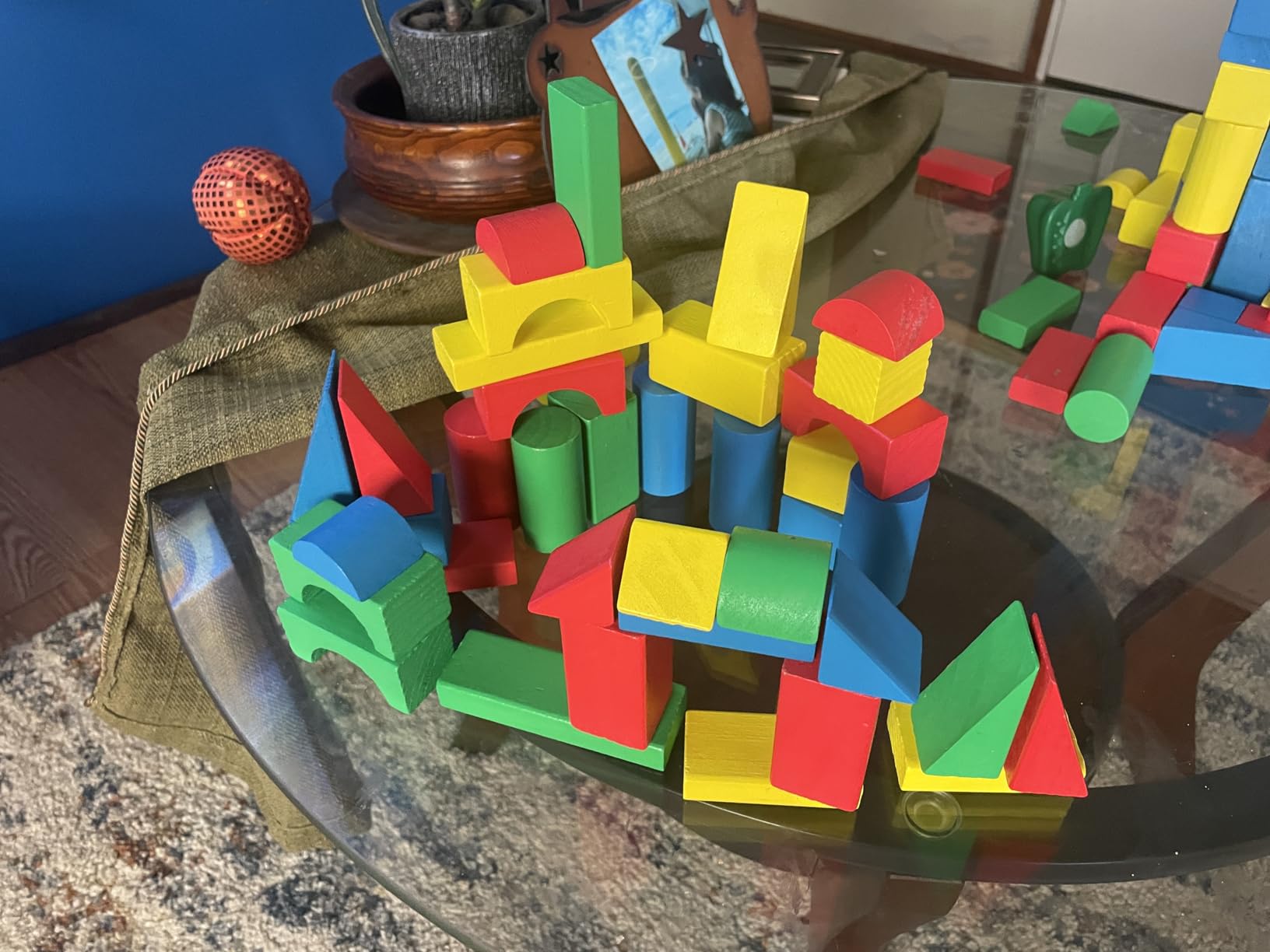
The 100 pieces across 4 colors and 9 classic shapes give enough volume that a two-year-old rarely runs out of parts mid-build. Towers, bridges and simple buildings all fall within reach, and the light weight means a toddler can knock a whole stack over without help.
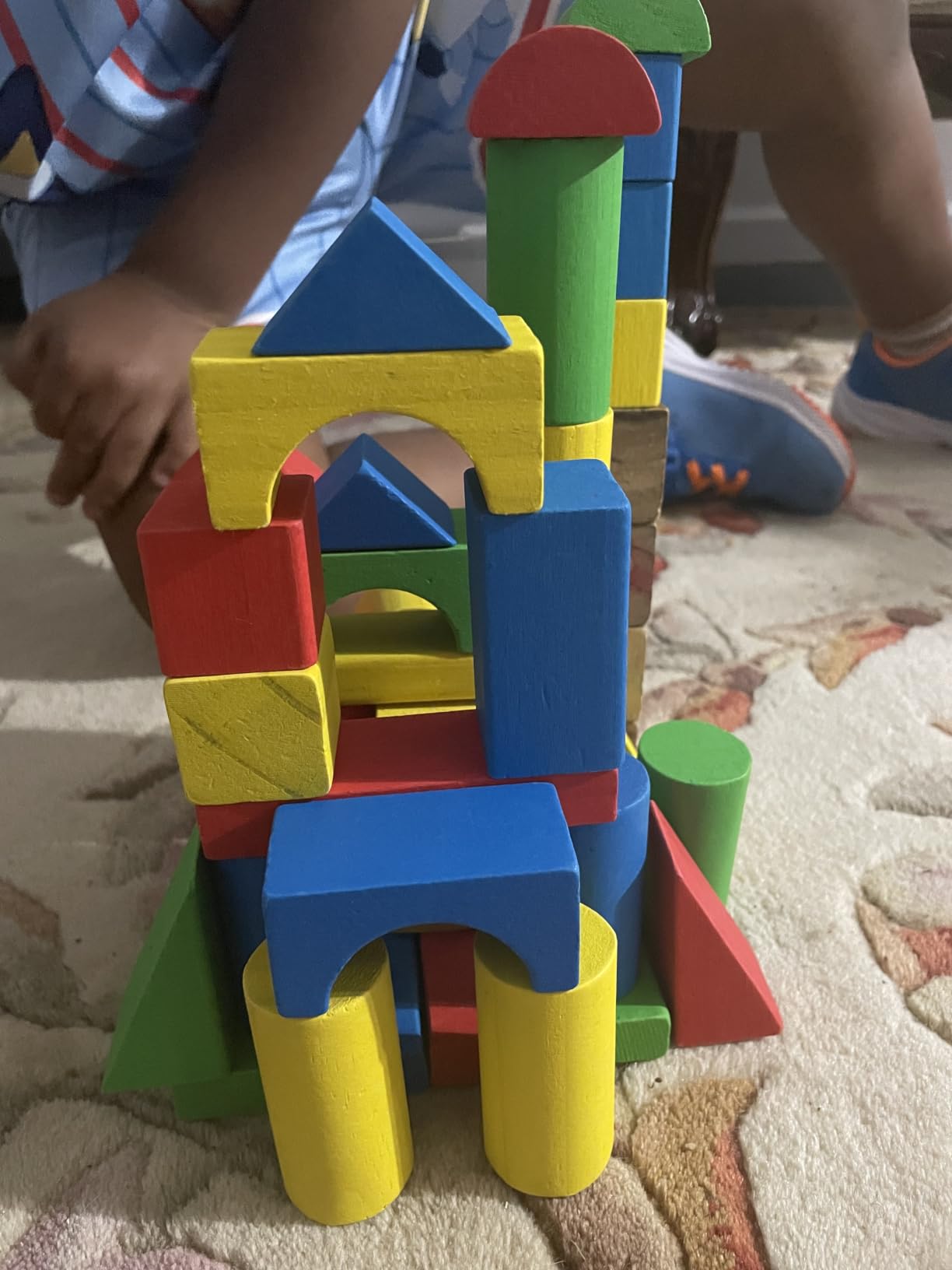
Developmentally it covers the basics a toddler needs: fine motor grip, hand-eye coordination, and early sorting and counting. Blocks that are chunky enough to be safe still teach the same grasp-and-rotate motion that prepares small hands for writing later.
The honest limitation is storage. The box is sturdy cardboard with a carrying handle, which is fine for getting the set into the car and out again, but a cardboard tray will not survive a determined four-year-old tidying session. A plastic tub on the shelf solves it in seconds.
Who this set suits best
It suits families buying a first set with no idea what their child will latch onto. The shape and colour spread is wide enough to hold a child who builds, one who sorts, and one who just stacks and topples, which are three very different play styles at two years old.
It also suits anyone who wants longevity on a modest spend. The wood is FSC-certified for new inventory, edges are rounded, and reviewers consistently report no splintering after heavy use.
Where it falls short
It is not a true unit-block set, so lengths do not line up in multiples and long flat spans are impossible. If your child is already stacking in a daycare or preschool class that uses unit blocks, this will not slot into that system.
The smallest pieces also deserve a decision. Parents of teething children sometimes hold those back, which is sensible, and the paint is the first thing to wear after many years of daily knocking about.
2. Melissa & Doug Standard Unit Blocks: Best True Unit Set
Melissa & Doug Standard Unit Solid Wood Building Blocks
60 unit blocks
Standard unit sizing
Unpainted rubberwood
20.1 pounds with tray
Pros
- Genuinely standard unit sizing compatible with classic unit systems
- Dense rubberwood that resists chipping
- Every length is a multiple of the unit
- Wooden tray doubles as a building piece
Cons
- Heavy
- so a loaded tray is awkward for a toddler to lift
- Only two 11 inch pieces so siblings compete for them
- Needs a hard floor rather than thick carpet
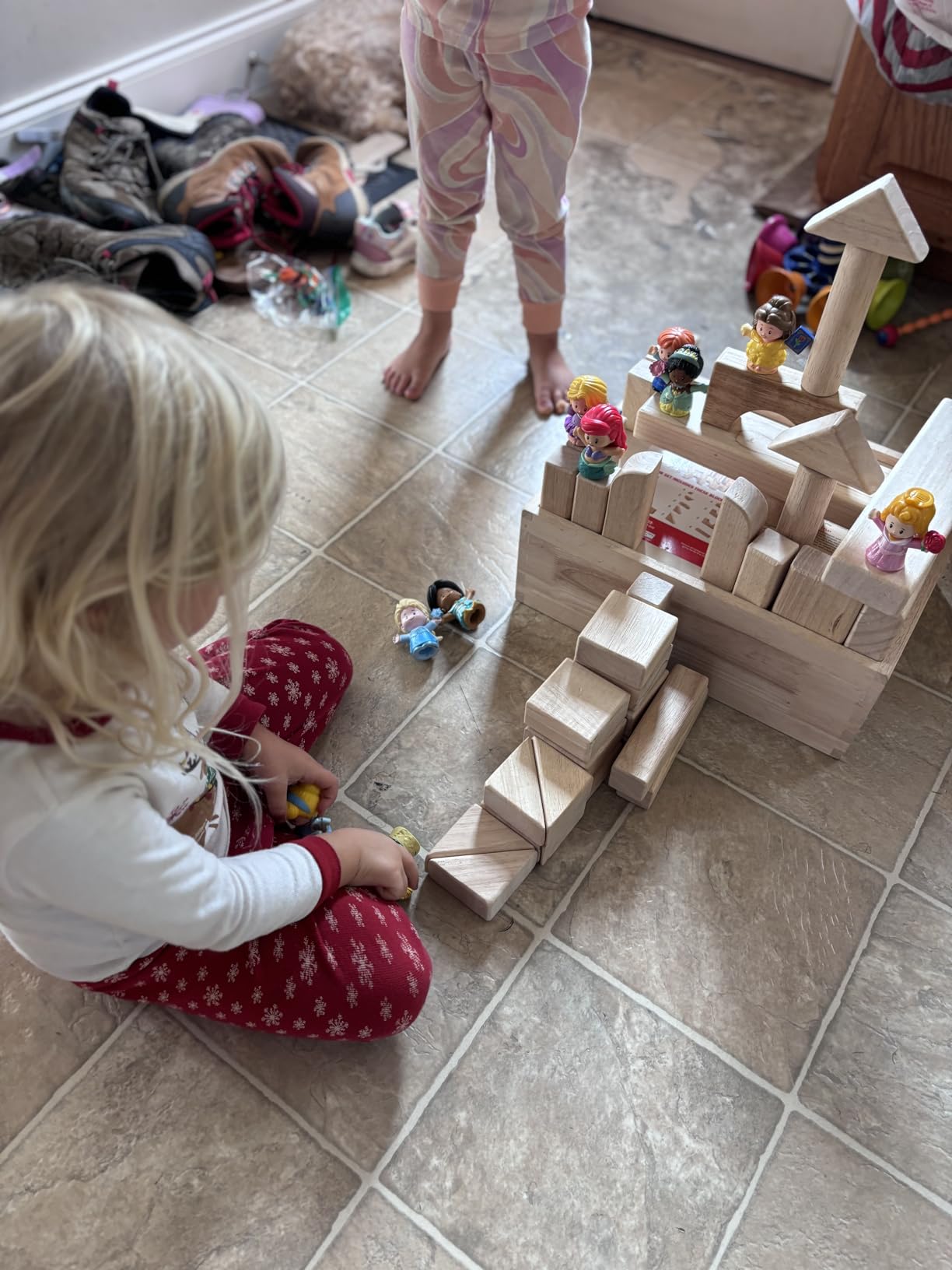
This is the most highly rated set in the roundup, and the rating is justified by something you can measure: every block length is a multiple of the same unit. That single fact is what turns loose stacking into architecture, with walls that stand straight and floors that close without gaps.
At 5.5 by 2.75 by 1.375 inches, the pieces are cut to the classic 1.5 by 2 by 5 inch standard unit, which means they pair with older unit block collections many families already own. If your child moves up to a preschool that teaches with unit blocks, this is the set that transfers.
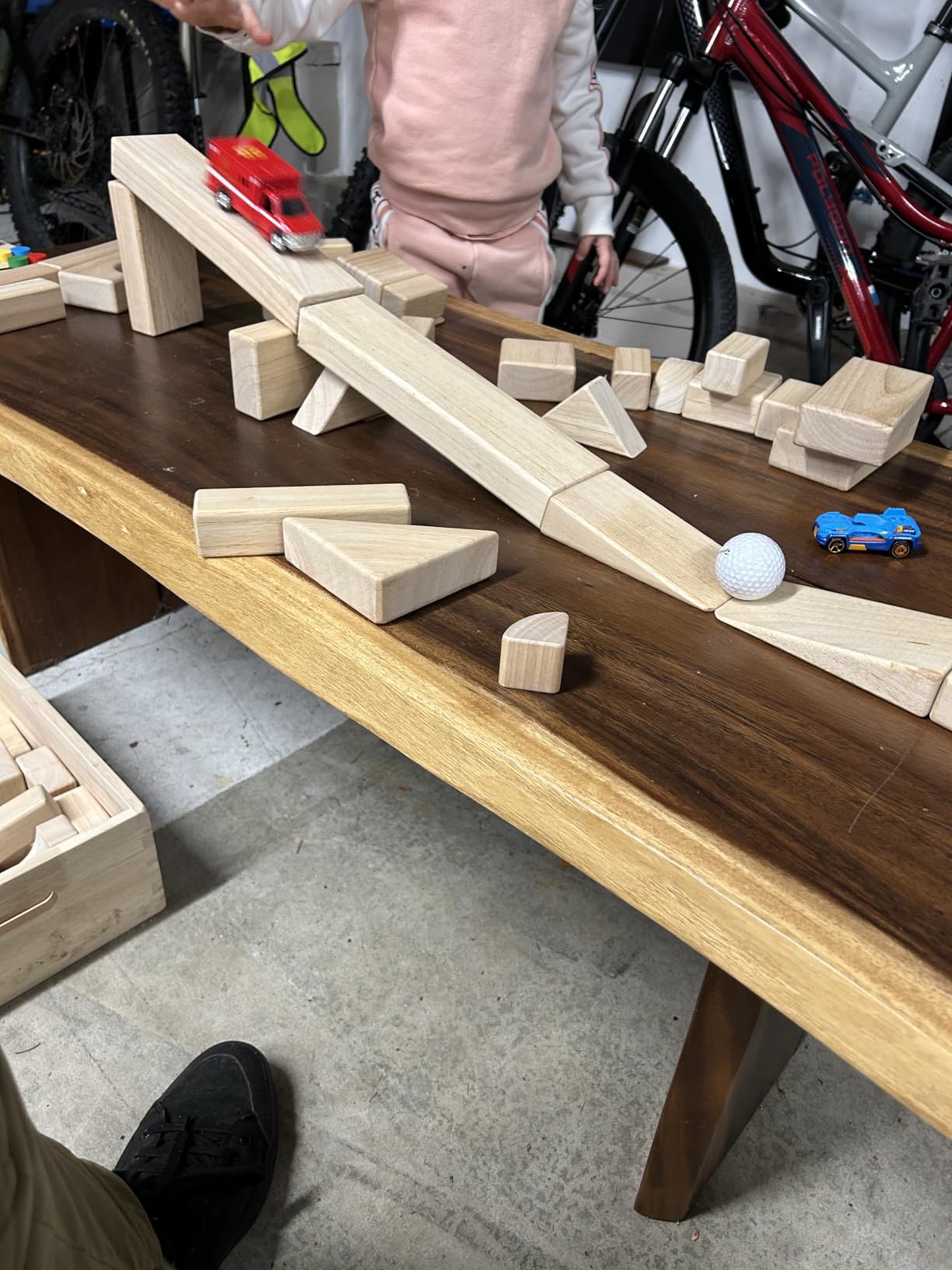
The wood is unpainted natural rubberwood with no lacquer or chemical finish, and that is the reason it outlasts everything else here. There is no coating to chip, scratch or wear through, so year three looks like year one apart from ordinary scuffing.
Weight is the trade-off. At 20.1 pounds the set is genuinely substantial, and a loaded tray is a real lifting issue for a two-year-old. We would put the tray on the floor and let the child pull pieces out rather than carry it.
Who this set suits best
It suits families who care about building that stands up. Towers stay standing for days because the pieces are dense, and that long-lived structure is exactly what keeps a determined child coming back to the same project.
It also suits anyone chasing heirloom quality now rather than later. Unfinished hardwood, a wooden tray that becomes part of the build, and sizing that stays compatible with other collections all point the same way.
Where it falls short
Manufacturer guidance runs 36 months to 6 years even though the listing says 2+, so a young toddler will find these pieces heavy and few. The long 11 inch pieces are limited to two per set, which is a common source of sibling negotiation.
There are no quad-unit blocks, so a long span cannot be built from a single set, and on thick carpet the pieces do not sit flat enough for stable structures. A hard floor matters more than anything else with this one.
3. Hape Maple Blocks: Best First Set from 12 Months
Hape Maple Wood Kids Building Blocks Stacking Wooden Block Educational Toy Set for Toddlers, 50 Brightly Colored Pieces in Assorted Shapes and Sizes
50 maple pieces in 5 colors
12 months to 3 years
Water-based paint
8.3 x 6.1 x 4.7 inches
Pros
- Genuinely usable from 12 months old
- Lightweight pieces easy for small hands to grasp
- Cotton bag makes storage and travel simple
- Mix of rectangles cylinders triangles and arches
Cons
- Only 50 pieces so big structures run short
- Bright paint shows scratches with heavy use
- Shapes are simpler than unit block sets
Hape comes up by name in parent recommendations more often than any other brand in our reading, and this 50-piece maple set is the one that keeps appearing. The manufacturer lists 12 months as the starting age, which puts it ahead of nearly everything else in this roundup for the youngest buyers.
That early start works because the pieces are light and shaped for small hands. Rectangles, cylinders, triangles and arches in five bright colours plus natural wood give enough contrast to hold a baby’s attention without overwhelming it.
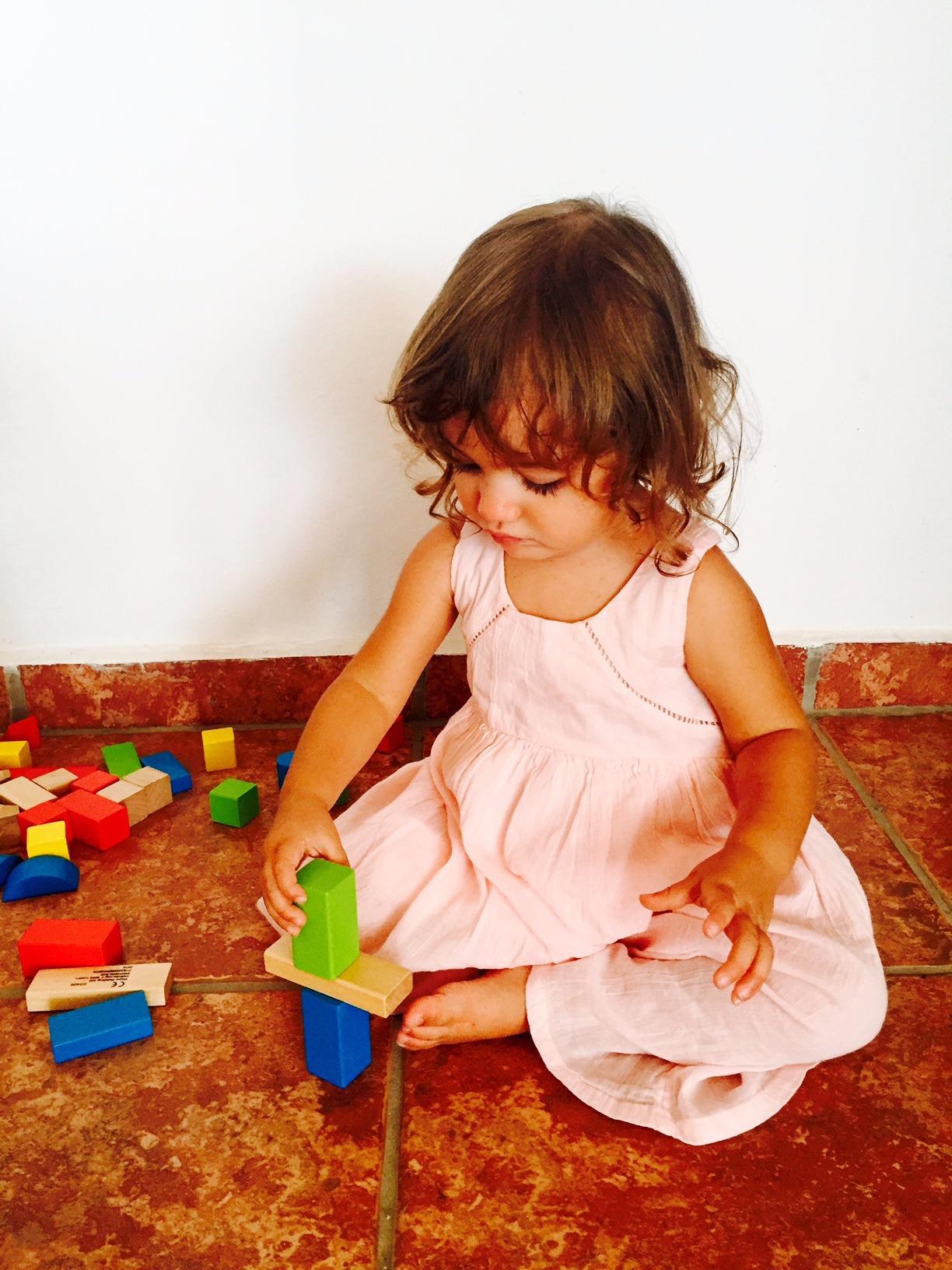
Parents on forums describe Hape as one of the few genuinely simple wooden sets they trust for a two-year-old, and the finish backs that up. It is a non-toxic water-based paint on quality wood, with all edges smooth, and Hape warrants the set against manufacturer defects.
Piece count is the real limit. Fifty pieces sounds generous until a child starts building something that needs a wall, a roof and a floor at the same time, at which point the set runs dry fast and the structure waits for more blocks.
Who this set suits best
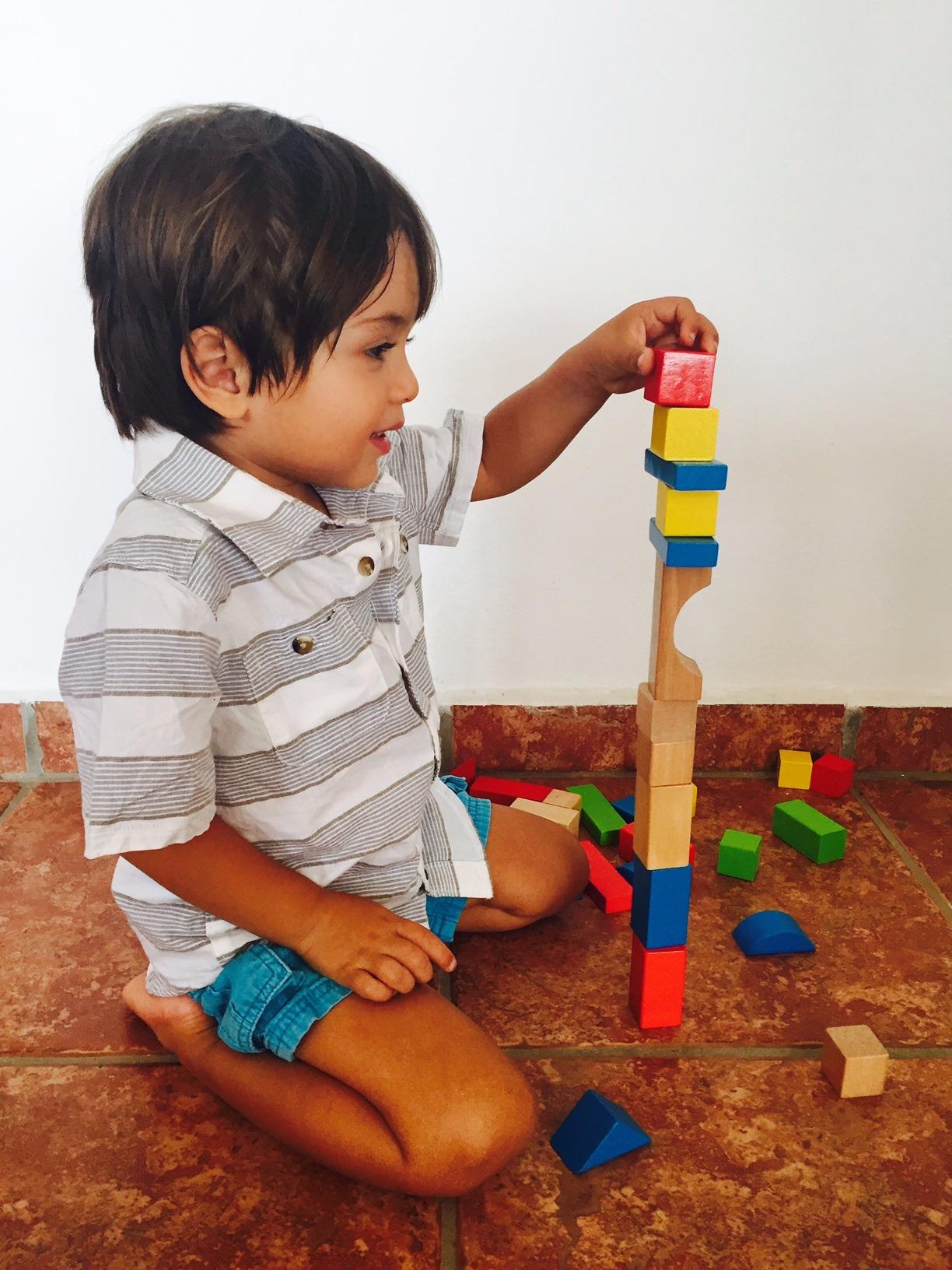
It suits a child between 12 and 24 months, especially one who mouths objects. The pieces are chunky, light and free of small components, so it is a reasonable first wooden set rather than a set to hand over at three.
It also suits travel and grandparents. The cotton storage bag is genuinely useful, because the whole set collapses into it and comes out in one motion.
Where it falls short
It will not stretch as far as a 100-piece set. Once a child moves into imaginative building, the shape range here is simpler than what unit block sets offer, and painted surfaces scratch visibly with heavy daily use.
It is also not the choice for a child already building in a unit system, since none of these lengths are multiples of a standard unit.
4. Pidoko Kids 100-Piece Set: Best Bucket-and-Sorter Design
Pidoko Kids Building Blocks for Toddlers 1-3, 100 Pcs Wooden Blocks
100 hand-crafted wood pieces
Shape-sorter lid
4 colors plus natural wood
Ages 1 to 3
Pros
- Shape sorter lid adds a sorting activity to the set
- Bucket makes cleanup and carrying easy
- Hand-crafted pieces with no rough edges
- 100 pieces gives strong building volume
Cons
- Manufacturer guidance lists age 3 and up
- Some pieces are small for teething children
- Painted pieces show wear versus natural wood
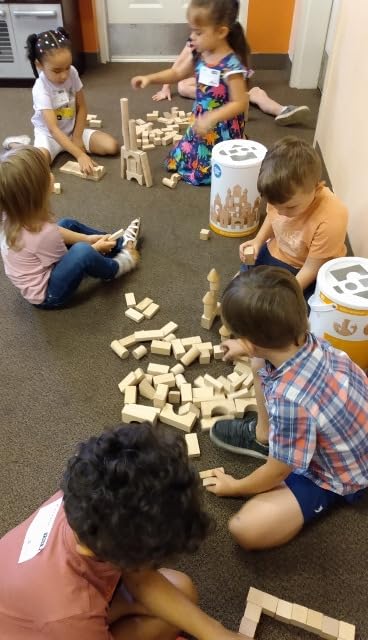
The idea that sells this set is the lid. The carrying bucket doubles as a shape sorter, so the same object that solves tidying also introduces a matching and sorting game that a free-stacking set simply does not have.
Inside are 100 hand-crafted traditional-style blocks in four bright colours plus natural wood, with multiple shapes for open-ended building. The bucket means a toddler can clear the floor themselves, which sounds minor until you have picked up 100 blocks from a rug.
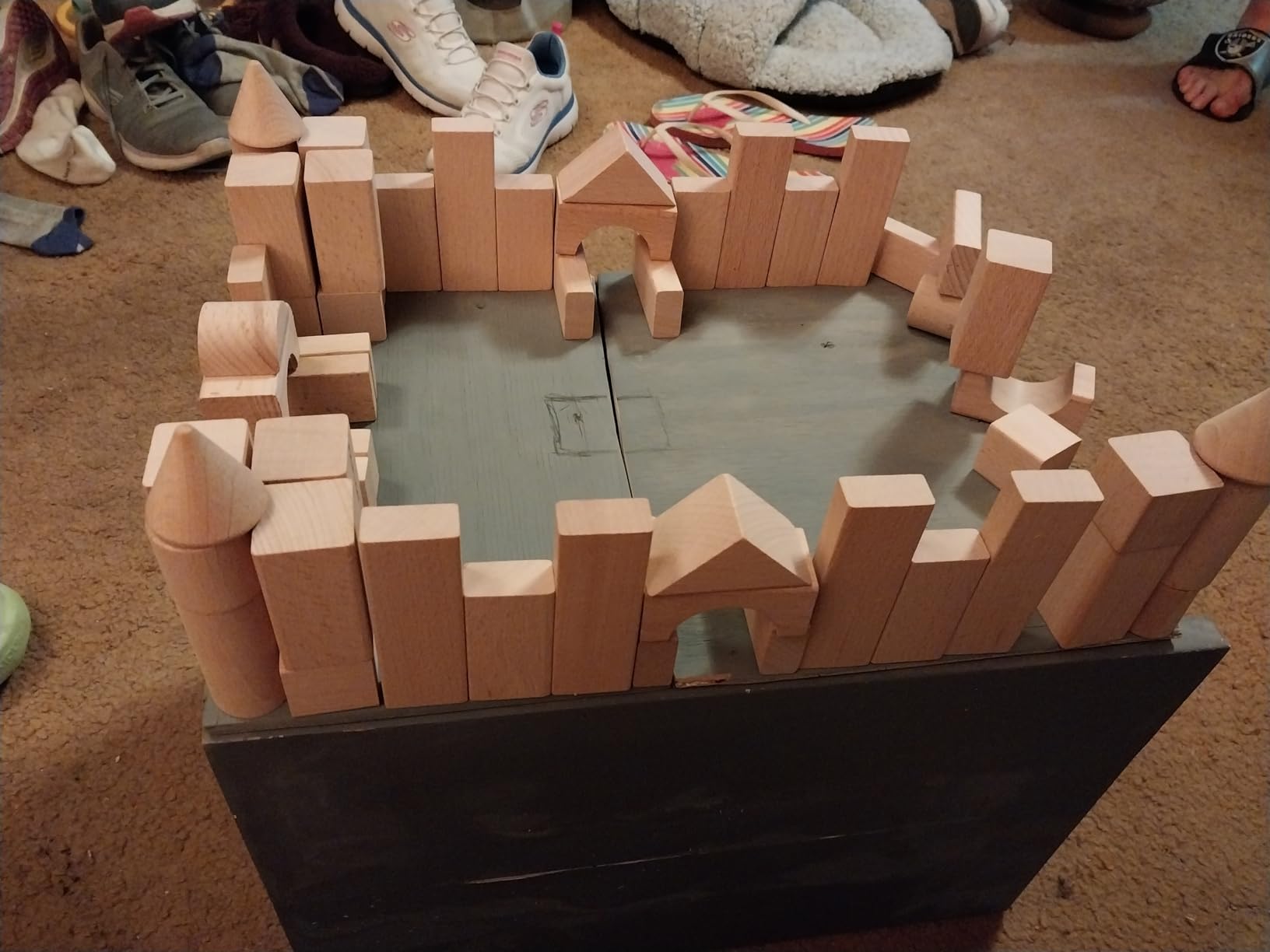
It sits in the top ten of Toy Stacking Block Sets, and at 4.8 stars the reviews are overwhelmingly positive on finishing and volume. Parents note the pieces have no rough edges, which matters more than the marketing suggests for a child still teething.
There is one labelling wrinkle worth flagging honestly. The listing frames this as a set for toddlers 1 to 3, while the manufacturer’s own guidance says 3 and up. We would treat it as a 24-month-plus set and keep the smallest pieces away from a younger mouther.
Who this set suits best
It suits families where cleanup is the recurring complaint. A bucket with a lid is the single most practical feature in this roundup, and it doubles as a travel bag for grandparents, a holiday or a waiting room.
It also suits a child ready for a second activity once stacking is mastered, since the sorter turns the same pieces into a matching puzzle.
Where it falls short
The age guidance is the weak point, and you should read it rather than the listing title. If you have a one-year-old, this is not the set to hand over unsupervised.
Like most painted sets, the colour shows wear sooner than unfinished wood would, and some pieces are small enough that teething children need close supervision.
5. Joqutoys ABC Blocks: Best Printed Letter and Number Blocks
Joqutoys ABC Wooden Building Blocks for Toddlers 1-3 Large, 26 PCS Alphabet & Number Stacking Blocks, Educational Learning Toys for Boys Girls Kids Gifts 1.65”
26 blocks at 1.65 inch
100% natural wood
ASTM and CPSIA approved
Ages 36 months to 6 years
Pros
- 1.65 inch blocks are large enough to avoid choking
- Each face shows a letter number shape or animal
- Printed artwork holds up without fading
- All edges smoothed
Cons
- Wood is soft and dents at the first hard knock
- Only 26 pieces so large structures need a second set
- Some illustrations do not match the letter on that face
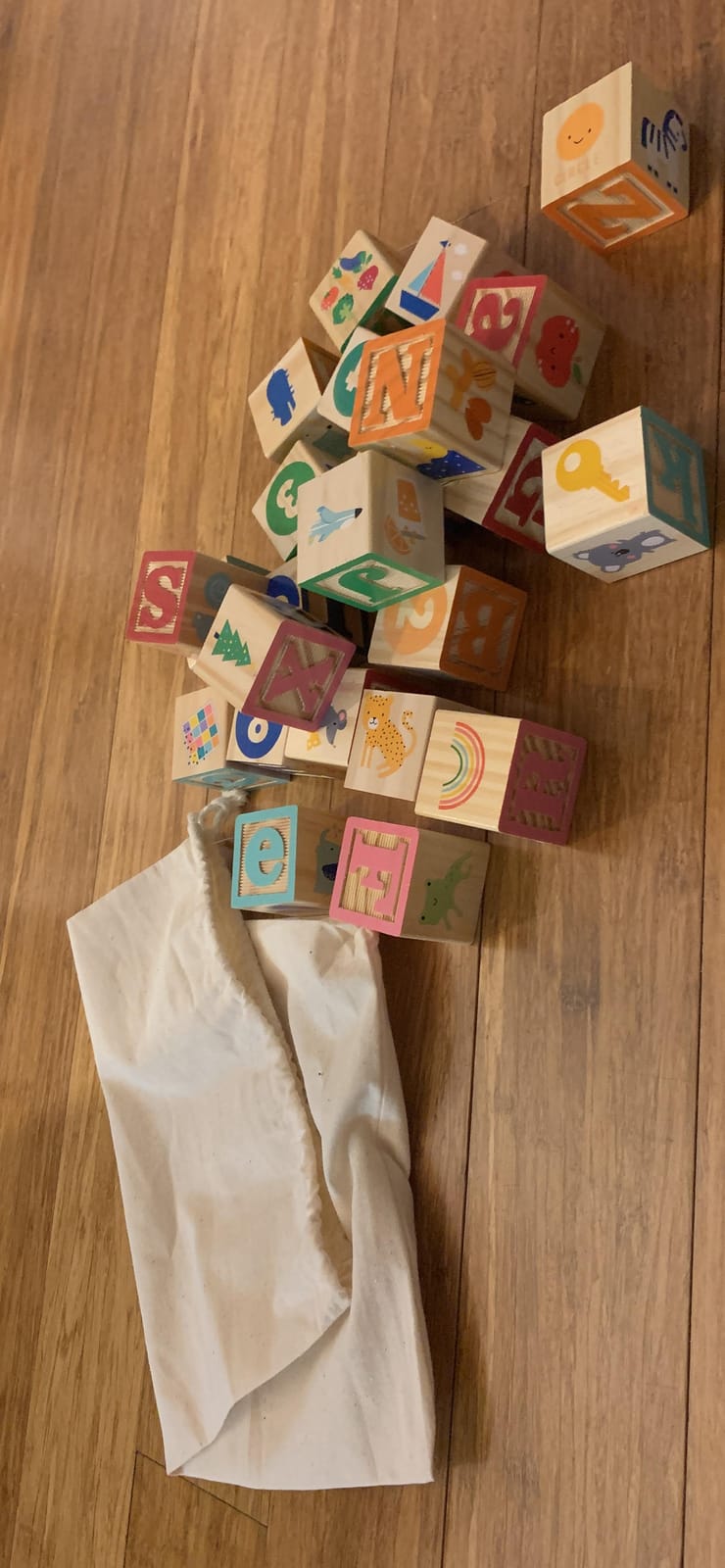
These are the only set in the roundup where every face is printed, and that changes what a child can do with them. A cube showing C on one side, a cat on another and a colour on a third gives four play modes from one piece rather than one.
At 1.65 inches the blocks are big enough that parents of younger toddlers tend to relax about them, while staying small enough for a three-year-old to grasp and stack one-handed. All edges are smoothed, and the set is ASTM and CPSIA test approved.
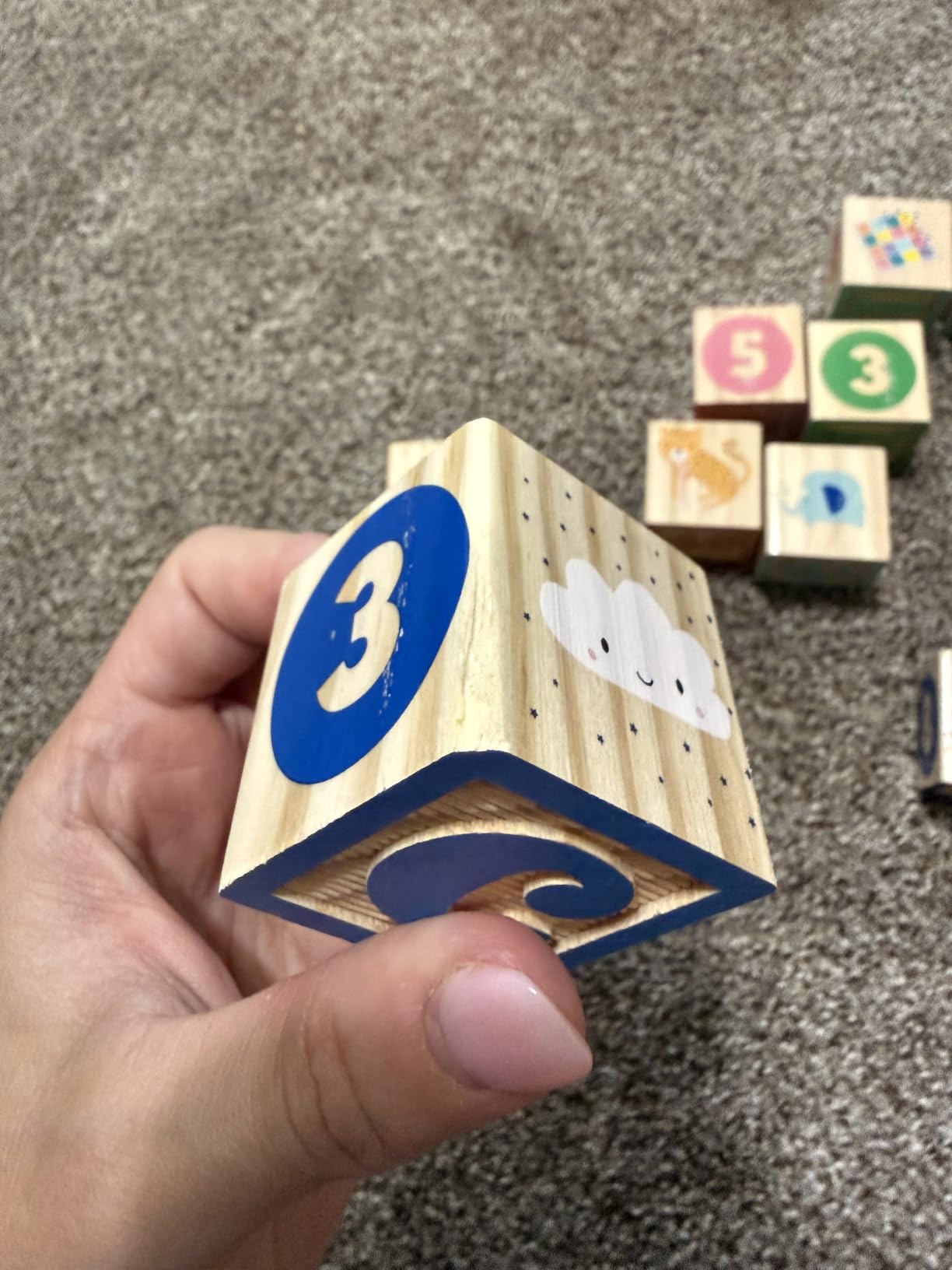
Reviewers consistently like the artwork, reporting that the printing has not faded with use. That matters more than it sounds, because on cheaper printed blocks the faces rub blank within a year and the educational value disappears with them.
The honest weakness is the material. This is soft wood, and parents describe blocks that dent and scratch at the first hard knock. It suits gentler indoor play and a supervised room rather than a hard-play environment.
Who this set suits best
It suits a child between three and five who is learning letters and numbers as part of play rather than as a worksheet. Because each block carries several printed elements, it works as much for sorting and matching as for stacking.
It also suits a family that wants a small, portable set. A storage bag is included, so 26 blocks travel easily for a waiting room or a car journey.
Where it falls short
Twenty-six pieces is not enough for free building, so it works best alongside a plain block set rather than instead of one. If your child only has this, large structures simply run out of parts.
It is also a poor match for a one-year-old. Manufacturer guidance starts at 36 months, and although the blocks are large, the printed density suits a child who already points at letters.
6. iPlay iLearn 72-Piece Set: Best All-Natural Hardwood Look
iPlay, iLearn Kid Wooden Building Block Toy Set, Toddler Natural Wood Block
72 hardwood blocks, 13 shapes
Unpainted natural wood
Wooden crate
Ages 24 months to 12 years
Pros
- Unpainted hardwood means no coating to chip
- 13 different shapes for varied structures
- Wooden crate makes tidying simple
- Blocks stack and balance well
Cons
- Plain wood is less engaging for babies than painted sets
- Natural finish shows scuffs quickly
- Shape mix is not standardised like unit blocks
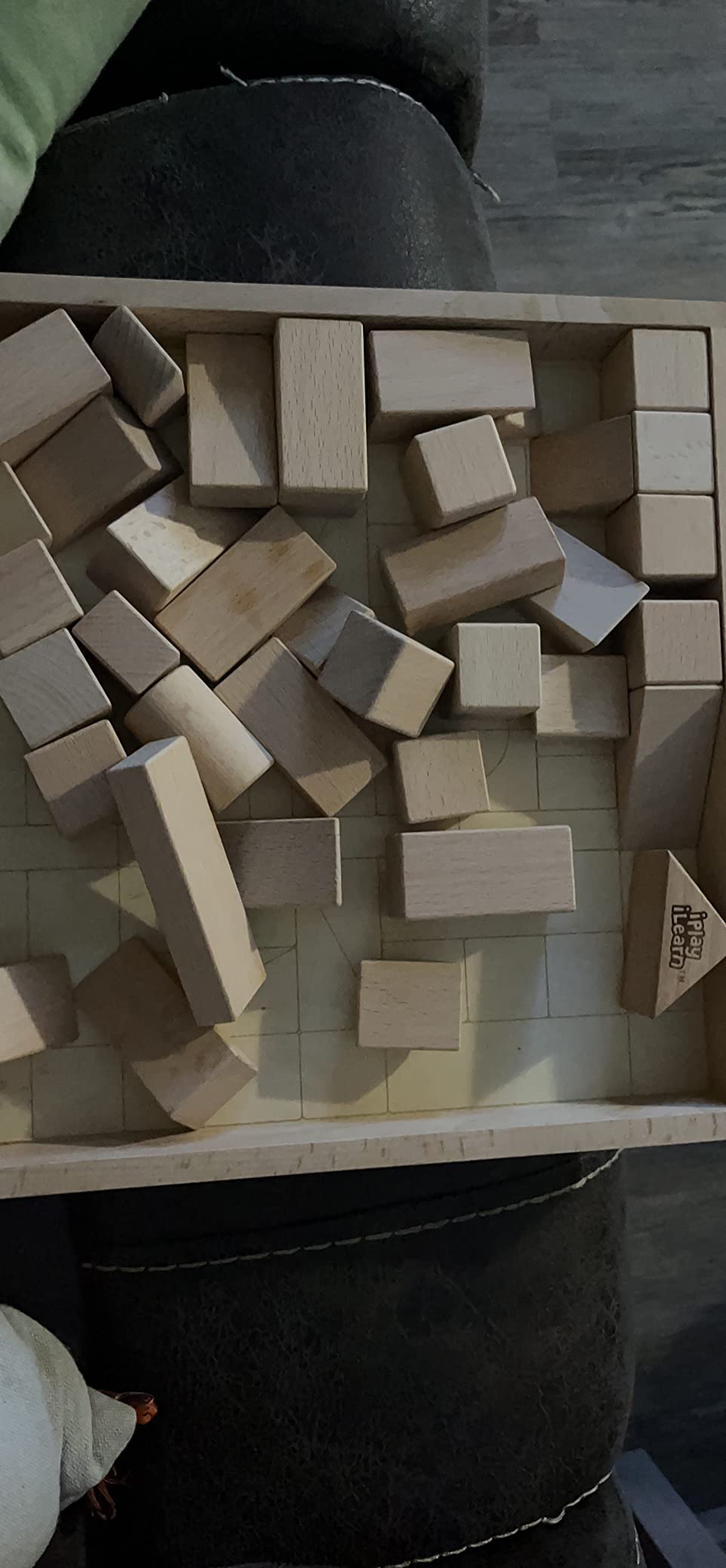
Thirteen different shapes is the headline here, including square, rectangle, circle, half-circle, triangle, cylinder and arch. That mix gives a wider range of structures than a standard set, so roofs, wheels and bridges are all achievable from the same crate.
The wood is naturally finished and smooth-sanded, with no coating of any kind. For parents worried about non-toxic finishes, a set with nothing to chip away from is the simplest answer available.
The crate is 13 by 12 by 2 inches and doubles as part of the play space, which is a small design touch that makes cleanup much less of a fight. Blocks stack and balance well enough for castles, cabins and garages rather than only toppling piles.
Manufacturer guidance runs 24 months to 12 years, the widest span of any set here. The set is also rated for indoor or outdoor use, which is unusual for painted wooden sets but sensible for unfinished hardwood.
Who this set suits best
It suits a family that wants a plain, natural look and no paint questions at all. Unfinished wood also ages well, since there is no finish to wear through and the grain shows more as the child handles it.
It suits multi-child households and shared play spaces, because 72 pieces across 13 shapes supports two children building side by side without competing for the same few blocks.
Where it falls short
It is the least engaging option for a baby. Plain wood gives a one-year-old nothing to look at beyond grain and shape, so this works better from about two years old than from 12 months.
It is also the lowest-rated full-size set in the roundup at 4.6 stars, with parents noting the unfinished look shows scuffs quickly and the shape mix is not standardised like true unit blocks.
7. Melissa & Doug 200-Piece Set: Best for Piece Count
Melissa & Doug Wooden Building Block Set – 200 Blocks in 4 Colors & 9 Shapes
200 blocks in 4 colors
9 different shapes
Ages 24 months to 5 years
11.75 x 3.9 x 16.9 in
Pros
- Largest piece count here so a four-year-old rarely runs out
- Good finish with no defects reported
- Reported to look new after nearly three years of daily play
- 9 shapes support sorting and counting
Cons
- Blocks are smaller than many buyers expect
- Painted coating is slick and slippery to build with
- Larger plain wood pieces in the range are not coloured
Two hundred pieces changes the maths of play. A child building a town, not a tower, simply runs out of everything else at around the 100-piece mark, and this set is the answer for a four-year-old who has outgrown single structures.
Nine shapes in red, yellow, blue and green give enough variety for sorting, counting and open-ended construction, and reviewers report the finish is bright and defect-free.
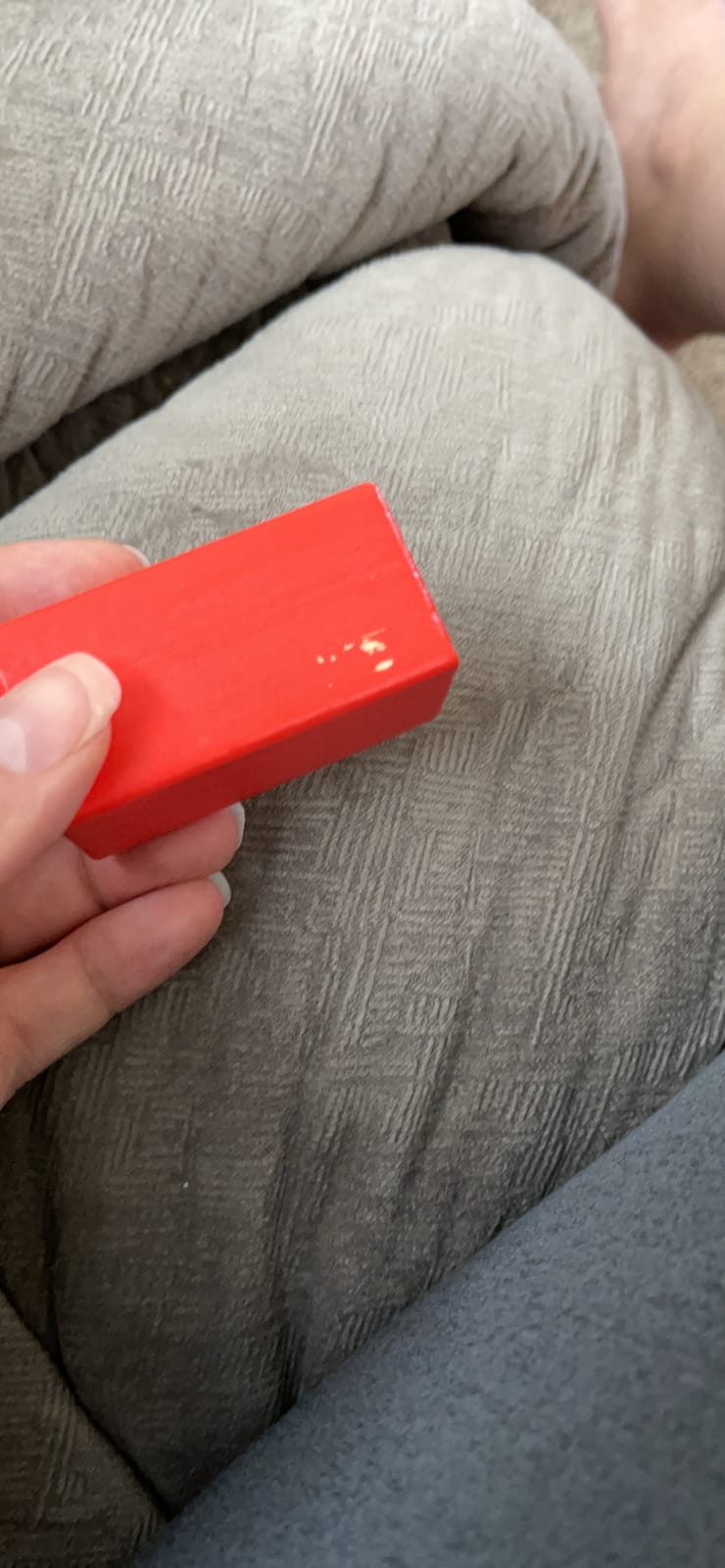
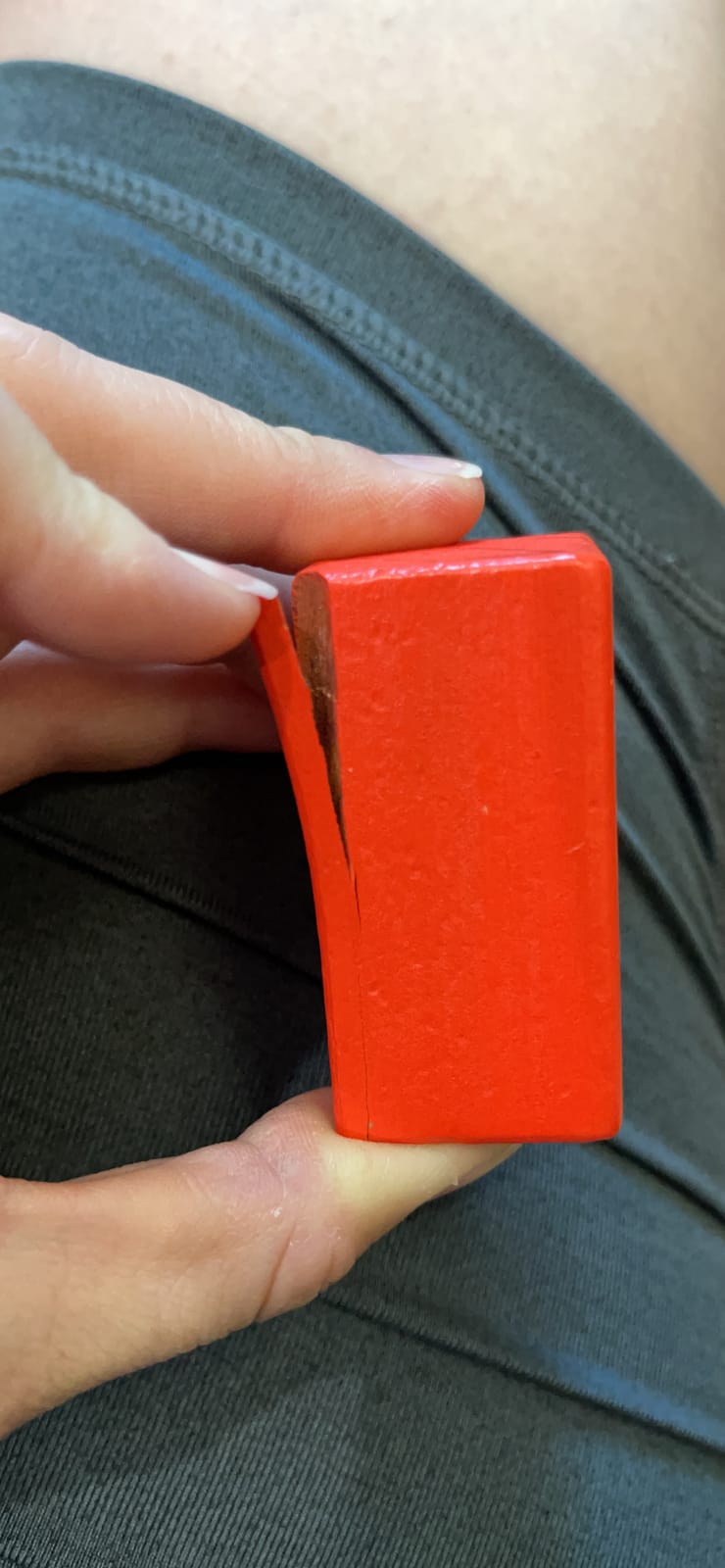
Durability holds up well in the reviews, with owners reporting the set still looked new after nearly three years of daily play. That is a meaningful data point for anyone hoping to hand it down rather than replace it.
Size is the catch buyers mention most often. The blocks are smaller than expected for the piece count, which is exactly how you fit 200 into a manageable box, and the slick painted coating makes fine-motor building harder for younger hands.
Who this set suits best
It suits a three-to-five-year-old who builds collaboratively, because two children can work on separate structures without sharing the same supply. It also suits daycare and preschool rooms where pieces get spread across a floor fast.
It suits a family already using a 100-piece set who needs depth rather than another small set, since the nine shape types overlap with what most children already own.
Where it falls short
It is not a set for a one-year-old. Manufacturer guidance starts at 24 months and the individual pieces are on the small side, so check a piece against a toilet paper roll before handing it to a younger sibling.
The slippery finish also frustrates the youngest builders, and the count advantage disappears if your child expects the larger plain-wood pieces in the wider range to be colour matched.
8. Bambilo Animal Stacking Blocks: Best for Story Play and Travel
Bambilo Montessori Toys for 2 3 4 Year Old Girls & Boys, Wooden Animal Stacking Blocks for Toddlers 1-3, Building Blocks Game Stacking Toys Ages 2-4 Toddler Birthday Gifts
10 large animal blocks
10 double-sided challenge cards
12 months to 4 years
1 x 5 x 8 inches with bag
Pros
- Chunky animal pieces that invite storytelling
- Big thick blocks with smooth edges and rounded corners
- Challenge cards add three levels of difficulty
- Storage bag included for travel
Cons
- Only 10 blocks so it is not a general building set
- Some stylised animals are hard to identify
- Rounded shapes are hard to balance on each other
Ten blocks is a small number, and this set is honest about what that means. It is a fine-motor stacking game with a story attached, not a free-build construction set, and treating it that way is the difference between a toy that gets used daily and one that ends up in a drawer.
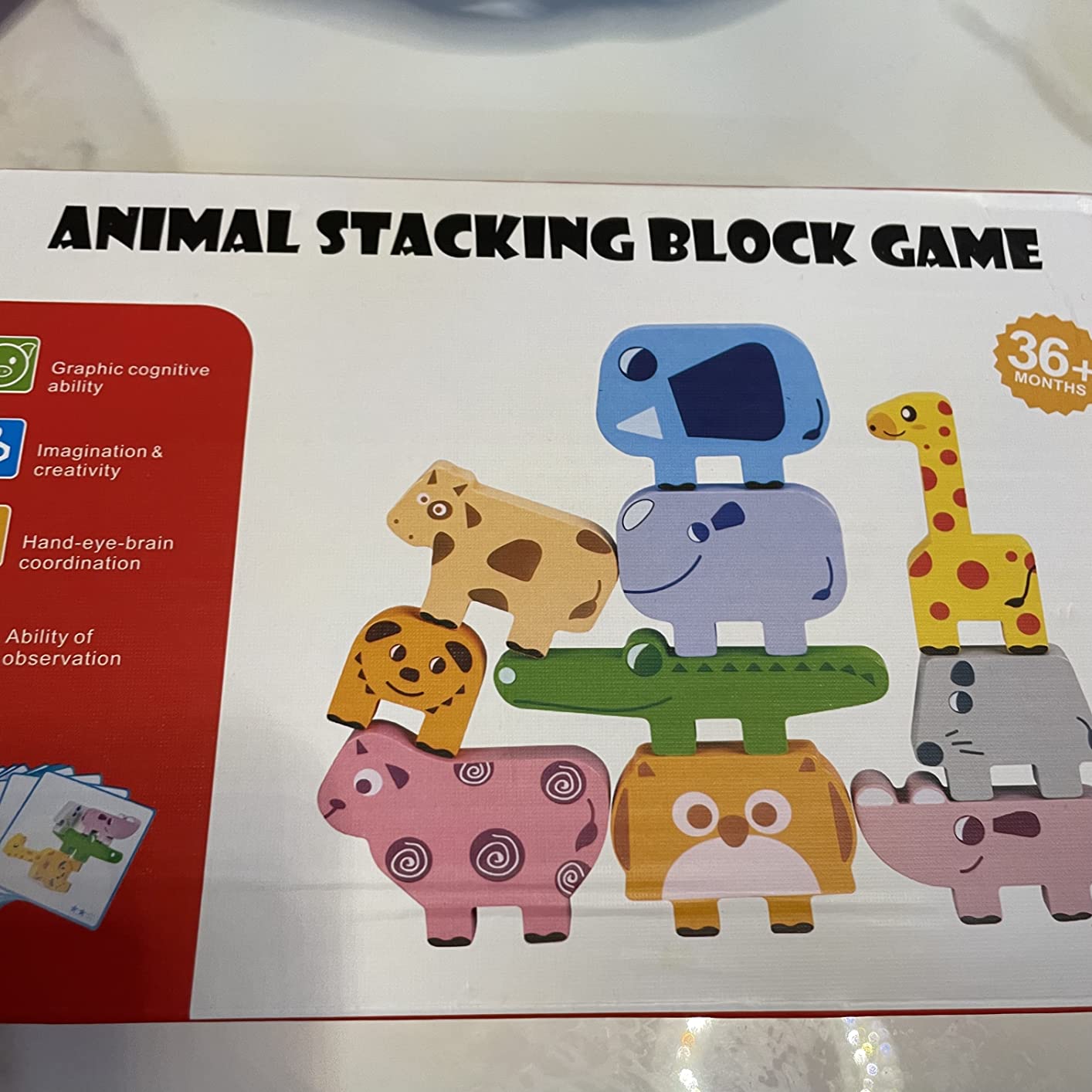
The animals cover a farm and zoo range including giraffe, sheep, puppy, cow, crocodile, hippo, elephant, mouse and rhino. Chunky forms with smooth edges and rounded corners are safe and satisfying for a one-year-old’s hands.
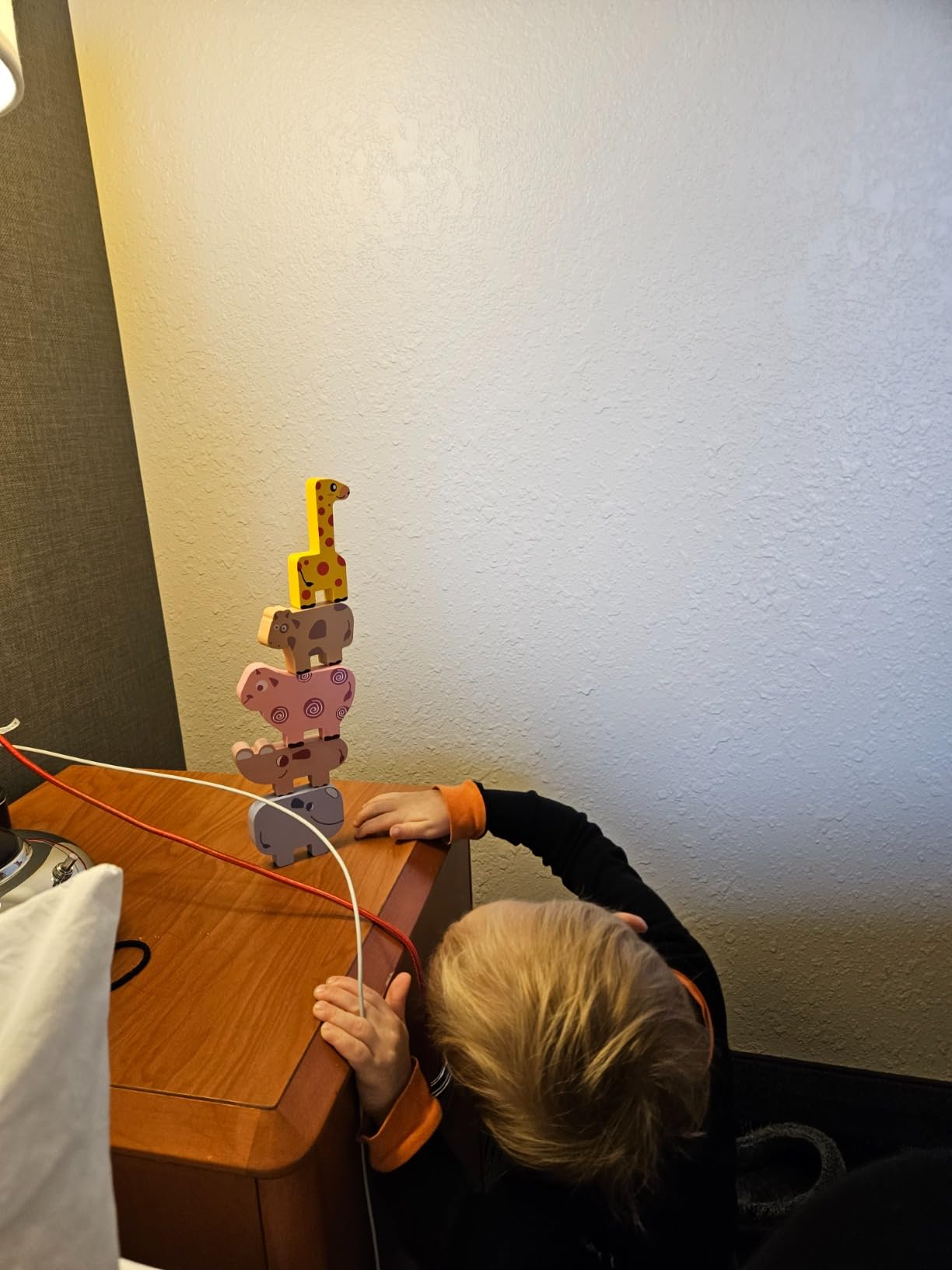
The double-sided challenge cards are the feature that makes it grow with the child. Three levels of stacking difficulty mean the same ten blocks work from first attempts up to more deliberate balance challenges, which is unusual at this piece count.
Manufacturer guidance runs 12 months to 4 years, which is the widest early-age range in the roundup. No batteries are required, and the whole set fits in the included storage bag.
Who this set suits best
It suits a child who builds characters rather than structures. Naming animals, giving them names and stacking them into a scene is open-ended play that a plain block set does not prompt on its own.
It also suits travel and small spaces. Ten pieces and a bag means it fits in a handbag, and a focused ten-piece game often holds attention longer than a hundred loose pieces scattered across a floor.
Where it falls short
It cannot replace a general block set, and parents should not expect it to. If you have nothing else, buy a plain set first and add this second.
Some of the stylised animals are hard to identify, which can confuse younger children, and rounded forms are difficult to balance on top of one another once the challenge cards get demanding.
9. Atoylink ABC Blocks with Pull Wagon: Best Storage Design
Atoylink ABC Wooden Building Blocks for Toddlers 1-3, 30 Pcs Alphabet & Number Stacking Toys with Storage Pull Toy Car Learning & Education Montessori Toys for 1 2 3 Year Old Baby Boy Girl Gifts
30 blocks with pull wagon
180 printed elements
Water-based paint on wood
Ages 0 to 3 years
Pros
- Wagon stores the blocks and adds push-along play
- 180 printed elements across the block faces
- Smooth polished and rounded edges
- Water-based paint on natural wood
Cons
- Blocks are smaller than most buyers expected
- Pull wagon string is too short to pull comfortably
- A few units arrive with a missing or extra string
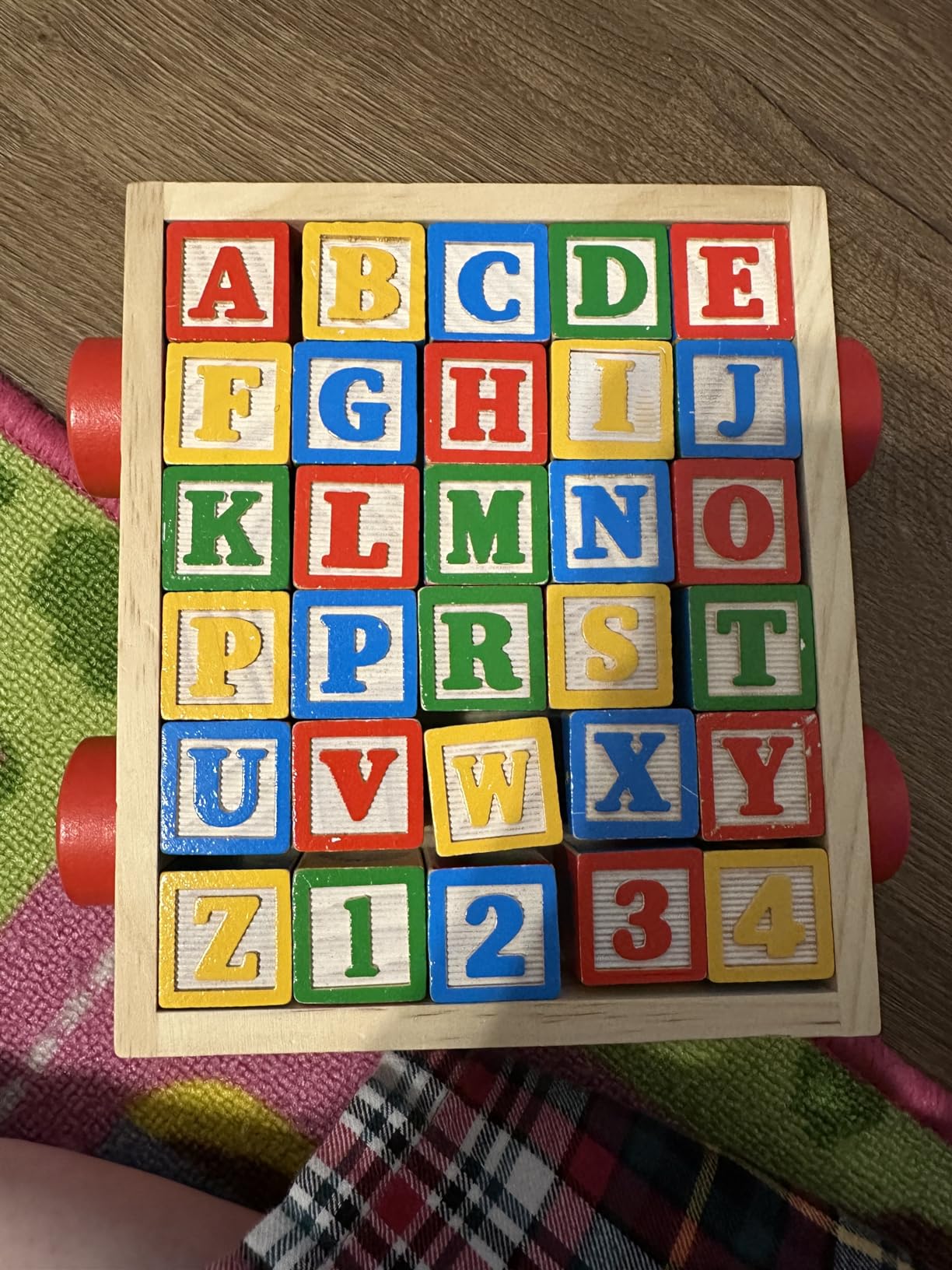
The storage wagon is the idea here, and it works on two levels. The blocks ride inside it for tidying, and then the child pushes or pulls it around, which turns the clean-up routine into a game rather than a chore.
Thirty blocks carry 180 printed elements across their faces, covering upper and lowercase alphabet, numbers, symbols, shapes, animals, fruits, vegetables and daily objects. That density of information suits a child who already enjoys matching and naming.
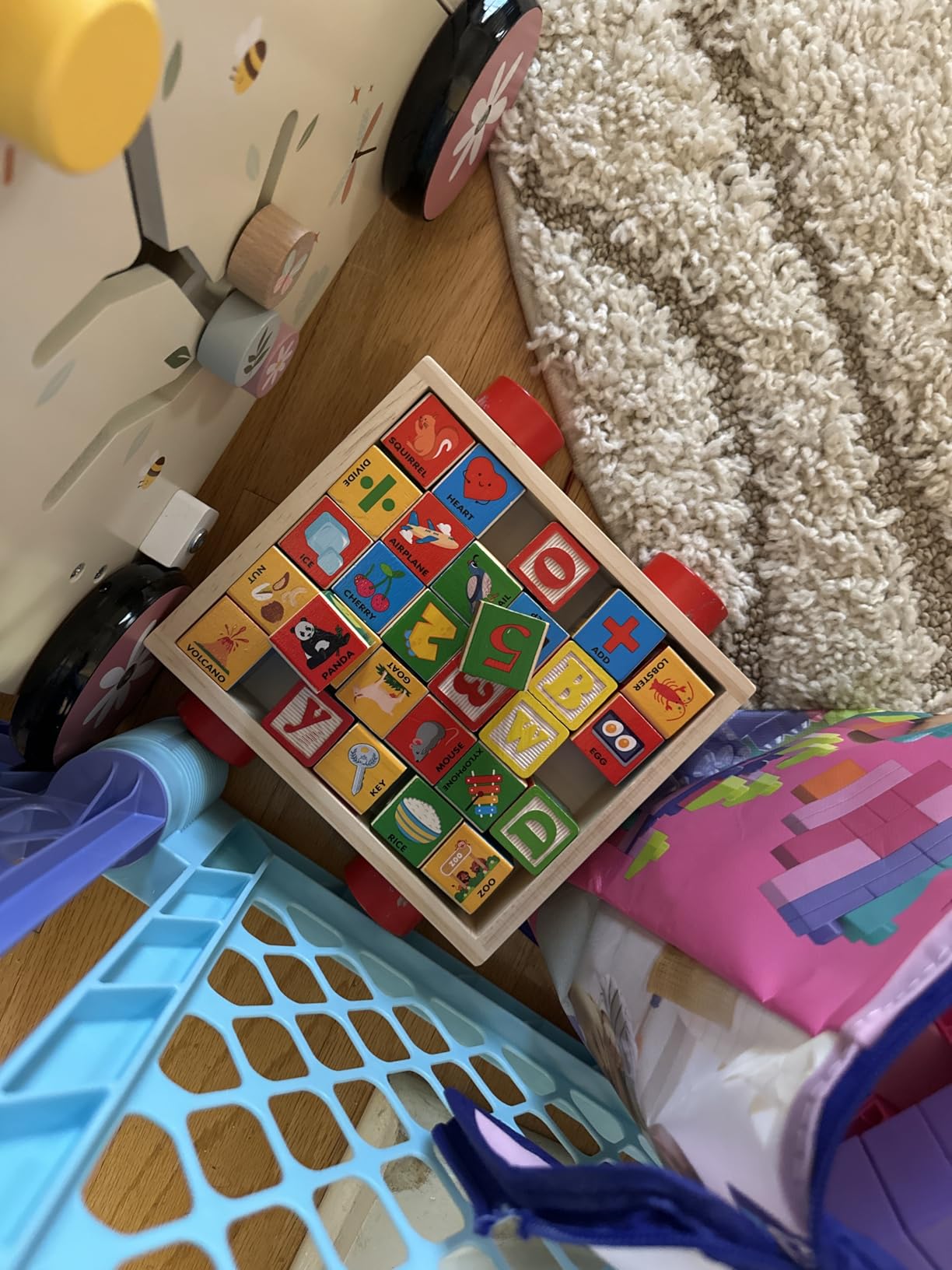
Edges on both the blocks and the wagon are polished and rounded, and the paint is water-based on natural wood, so the finish question is settled. Manufacturer guidance lists 0 to 3 years, the earliest range claimed by anything in this roundup.
This is the lowest-rated set here at 4.5 stars, and the reviews are specific about why. Blocks are smaller than most buyers expected, and the pull string is reported as too short to actually pull the car comfortably.
Who this set suits best
It suits families where tidying is the sticking point and where a toddler can be trusted with a pull toy. Thirty blocks is a manageable number that a young child can clear away rather than abandon across the room.
It also suits a child who likes vehicles, since the wagon adds a second play mode that a plain block set cannot offer, and it travels as one unit.
Where it falls short
Expect smaller blocks than the listing suggests. Check a piece against a toilet paper roll before giving this to a child under 18 months, despite the wide age claim on the box.
Quality control is the other issue. A number of buyers report a missing or extra pull string, and the string length is a recurring complaint, so this is a set to inspect on arrival.
10. Quokka 35 Realistic ABC Blocks: Best Certification Record
Quokka Montessori Wooden Blocks for Toddlers 1-3 – 35 Realistic ABC Blocks
35 alphabet blocks
FSC compliant wood
GREENGUARD, ASTM, EN-71, CE
1.6 inch, 12 months to 5 years
Pros
- Vivid realistic illustrations that hold a child's attention
- GREENGUARD ASTM EN-71 and CE certified
- Made in Europe from FSC compliant wood
- Peg board adds matching and memory play
Cons
- Some blocks carry spelling and image typos
- Wood can sting a little if thrown
- Some letters form multi-piece pictures that stack less easily
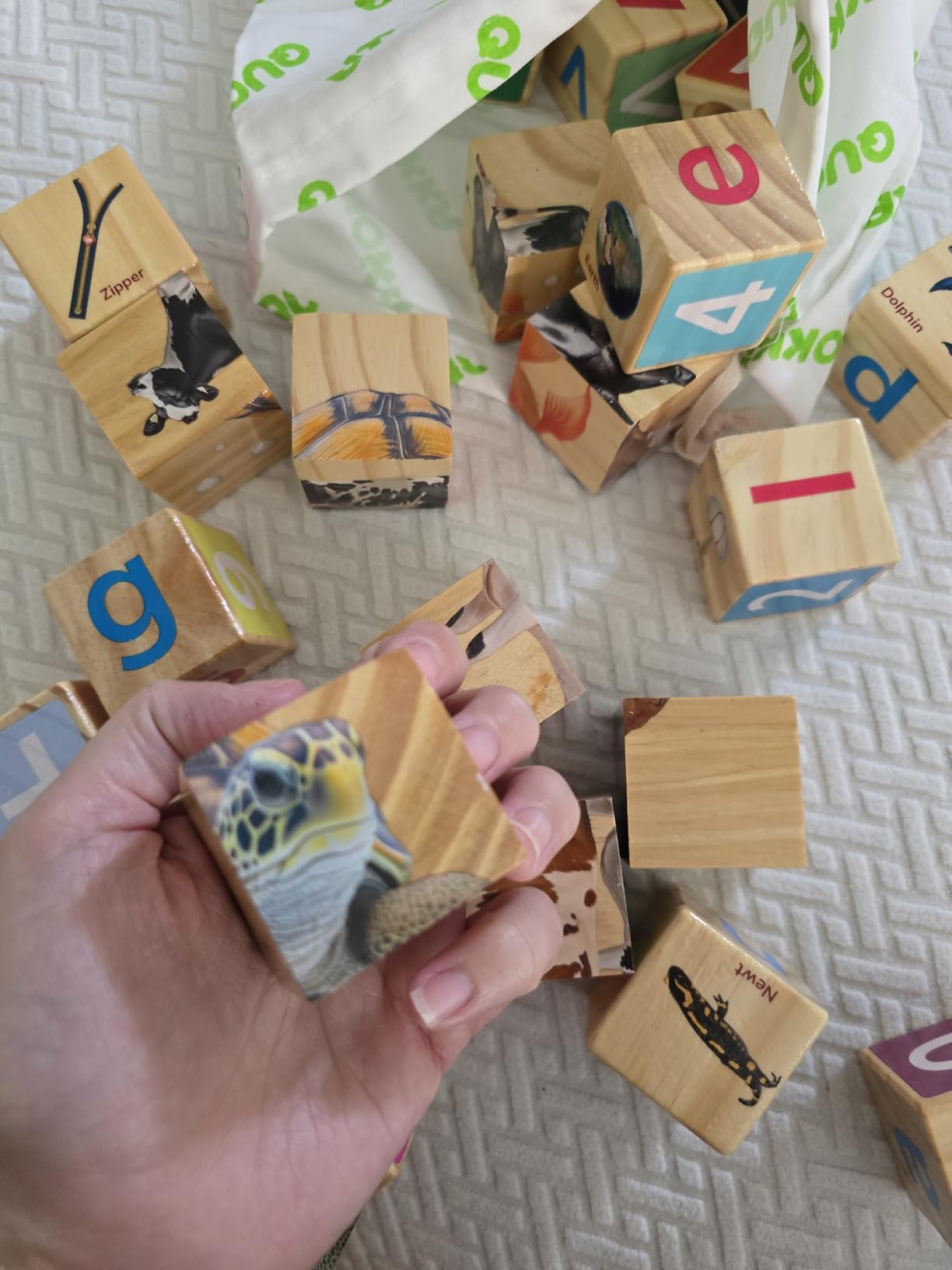
If certification is the deciding factor for your family, this set has the strongest documentation in the roundup. It is made in Europe from FSC compliant wood with US GREENGUARD Children and Schools certified paint, and it carries ASTM, EN-71 and CE certification.
The artwork is the draw. Realistic animal illustrations rather than cartoon icons give a lot more to look at, and parents report that the detail holds a toddler’s attention longer than simpler printed sets manage.
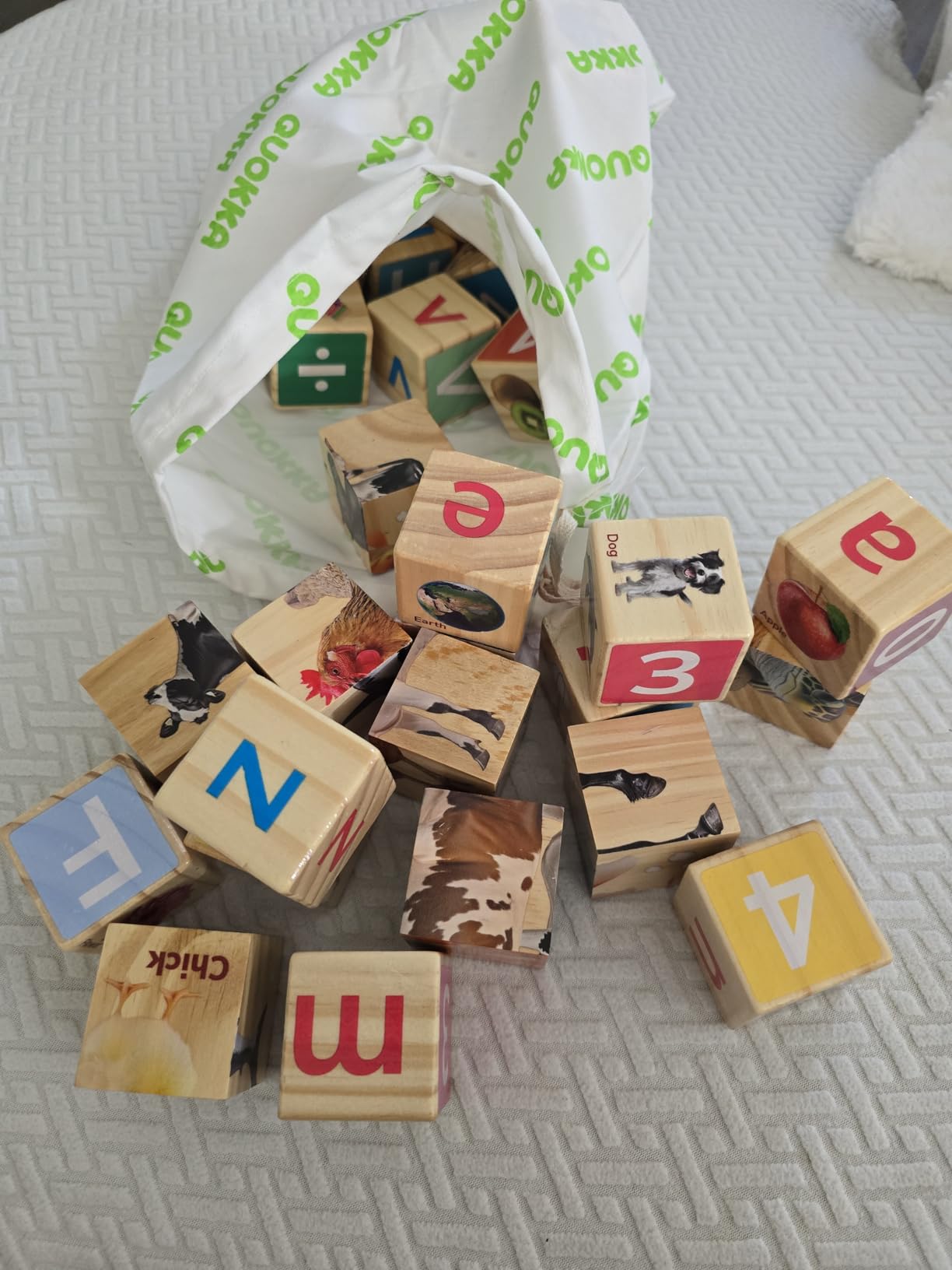
The peg puzzle board adds a second activity, turning the set into a name puzzle and a matching game as well as a stacking set. At 1.6 inches the blocks are big enough to grip and small enough that they are not a choking hazard, per the reviews.
Manufacturer guidance runs 12 months to 5 years, and a storage bag is included. The proofing is the weak point, with some blocks carrying spelling and image errors, including on the letter U.
Who this set suits best
It suits a family that wants documented safety standards rather than a non-toxic claim without evidence. Naming the certifying body is the clearest signal you can give, and this set provides more of them than anything else here.
It also suits a child who is drawn to pictures rather than shapes, since realistic animal art invites naming and sorting by consonant, vowel, colour or size.
Where it falls short
It is not a general building set. At 35 printed cubes, stacking is part of the play but the real value is letters, matching and sorting, so it complements rather than replaces a plain block set.
Watch the proofing if that matters to you, and supervise throwing, because the hardwood can sting a little when it lands on bare skin.
11. Onshine 64-Piece Large Blocks: Best Big Pieces for One-Year-Olds
Large Wooden Blocks for Toddlers 1-3, 64Pcs Big Wood Building Blocks Set
64 large blocks in unpainted pine
12 months and up
Wooden storage box
15.16 x 12.99 x 6.3 inches
Pros
- Pieces are genuinely large and not a choking risk
- Light enough that throwing them causes no harm
- Unpainted so there is no paint to worry about
- All pieces fit fractions of the largest block
Cons
- Soft pine dents if chewed or knocked
- Neutral colour gives less visual variety
- Lowest review count here at 200
This is the set for the youngest buyer in the roundup. The pieces are large enough that they cannot fully enter a one-year-old’s mouth, and light enough that being thrown or knocked over causes no harm, which are the two properties that matter most at that age.
Sixty-four pieces cover half cylinders, arch bridges, cylinders, cuboids, cubes and triangular columns. Every piece is a fraction of the largest block, which is a quietly excellent design choice because the wooden storage box repacks perfectly every time.
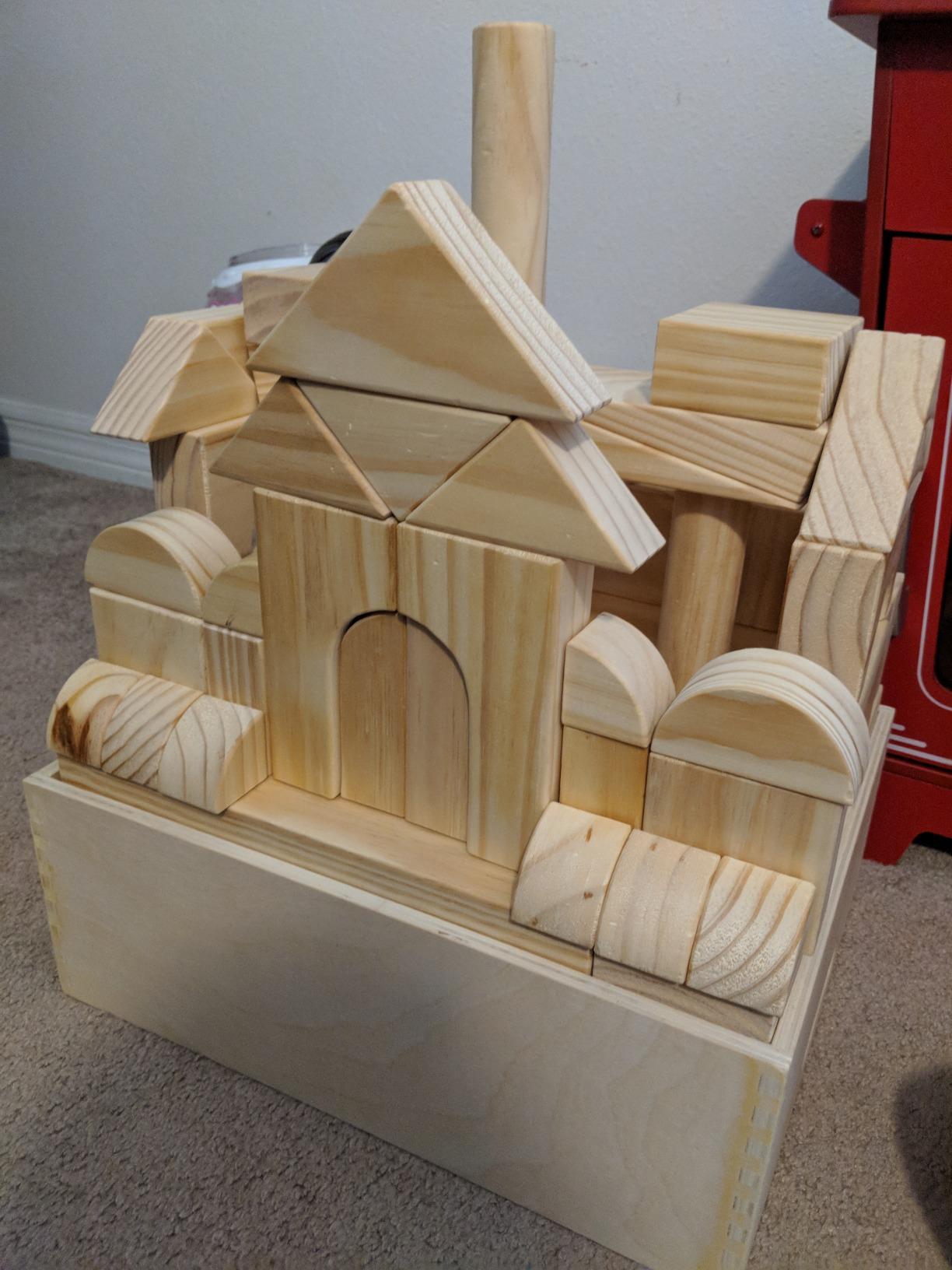
The material is selected New Zealand pine, unpainted, smooth and splinter-free, and the set conforms to the US toy standard. Nothing can chip because there is no finish, and neutral natural wood suits a playroom that already has colour in it.
Reviews are almost uniformly positive, with 88 percent five-star ratings. The honest limit is the review count itself, at 200, which is the smallest sample here, so there is less long-term evidence to lean on.
Who this set suits best
It suits a child aged 12 to 24 months and any family that wants a set with zero finish questions. Unpainted wood is the most direct answer there is to concerns about non-toxic paint or chewable coatings.
It also suits siblings or a shared room, since 64 large pieces support several children building at once without arguing over the same blocks.
Where it falls short
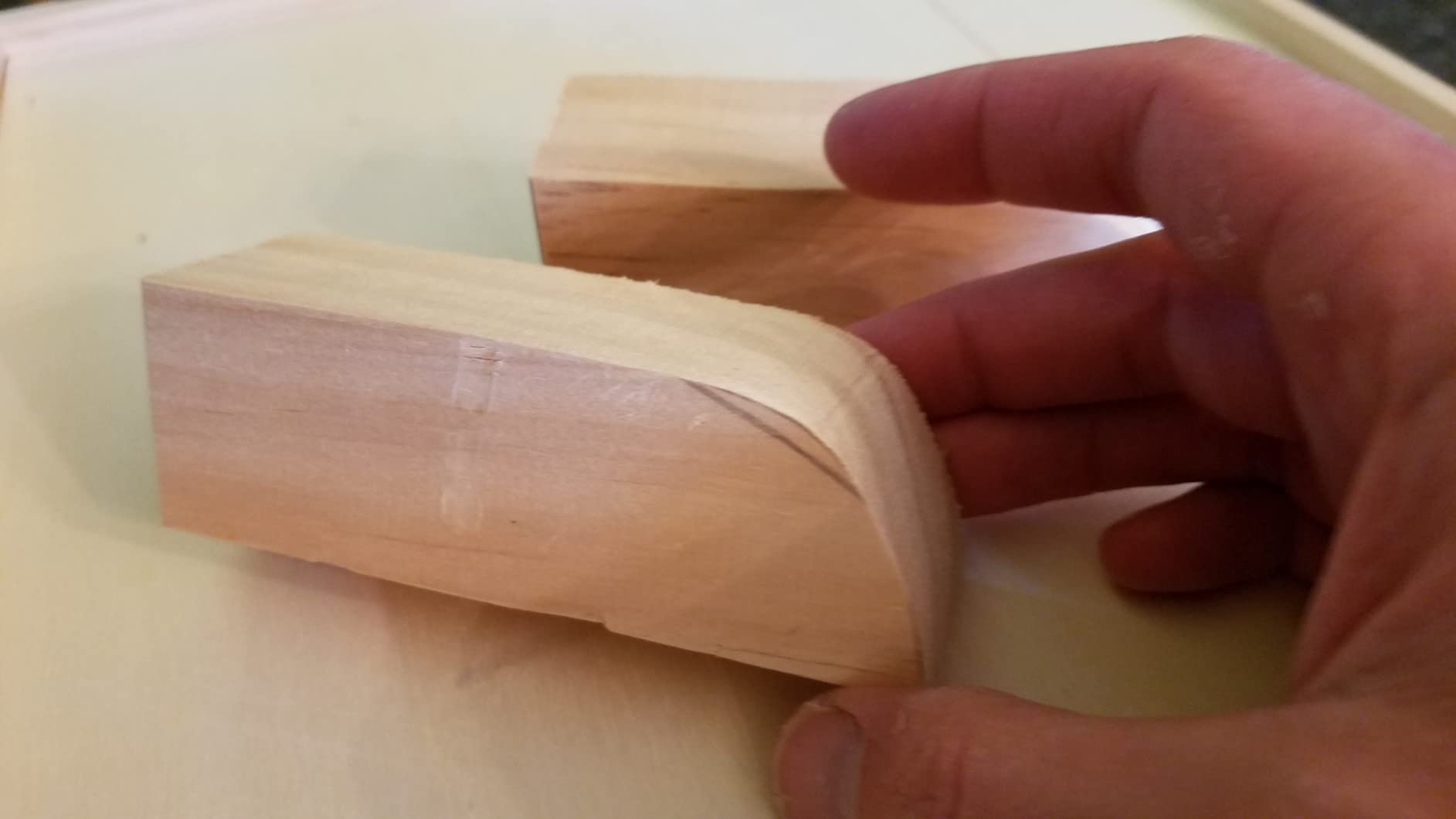
Pine is a softwood, so chewing or hard knocks will dent the surface. It is a good indoor set, not one for a garden or a rough playroom.
The natural colourway also gives less visual variety for a baby who is drawn to bright things, and the small review sample means we would treat the durability claims as encouraging rather than proven.
12. HABA Beech Blocks: Best Untreated European Hardwood
HABA Wooden Building Blocks 60 Piece Set, Ideal Toddler Blocks for & Kids Stacking Toys for Ages 1 & Up for Open-Ended Play, Made in Germany
60 solid untreated beech blocks
1.75 inch unit measure
1 year to 8 years
Made in Germany, 2.2 pounds
Pros
- Substantial weight keeps tall towers standing
- No piece small enough to fully enter a mouth
- Standard HABA sizing compatible with other systems
- Untreated wood with no lacquer or chemical finish
Cons
- Most expensive set in the roundup by a wide margin
- Box art shows some shapes that are not included
- Some blocks arrived with rough corners that could splinter
HABA is the outlier in this roundup on material, and that is the reason it is here. These blocks are solid natural untreated beech from sustainable German forestry, with no lacquer and no chemical finish, and the density is noticeably different from a softwood set the moment you pick one up.
Weight is the practical benefit. The pieces have real heft, which is why tall towers stand for days rather than minutes, and 2.2 pounds for the whole set means it stays where you put it.
Who this set suits best
It suits a family that wants a set to hand down, and it suits a child ready for construction that stays standing. Manufacturer guidance runs from 1 year to 8 years, the widest upper range in the roundup, and no piece is small enough to fully enter a toddler’s mouth.
It also suits anyone already invested in a HABA system. The 1.75 inch unit measure is compatible with other HABA building systems and marble runs, so the pieces extend an existing collection rather than starting a new one.
Where it falls short
Cost is the honest drawback. It is by far the most expensive set here, and parents justify premium prices in this category with material quality, so the value depends on whether you plan to keep it for years.
Quality control is inconsistent at this level. Reviews report blocks arriving with rough corners that could splinter, and box art that shows shapes, including X pieces, which are not in the actual set. Inspect the pieces on arrival.
How to Keep Wooden Blocks Safe: Choking, Finishes and Falling Towers
Safety is where most block roundups go quiet, so we have made this section concrete rather than reassuring. Every check here is one you can run yourself in a few minutes, before the set reaches a child’s hands.
The single most useful test is the toilet paper roll check. A piece that fits inside the empty cardboard tube can block a small airway, so anything that slides in should stay out of reach of a child under three.
Find an empty toilet paper roll and stand a block on end inside it.
If the block drops fully inside, set it aside for a child old enough to handle small parts.
Repeat for every shape in the set, including the half circles and the small slats.
Repeat the check again with any set you inherit or buy second hand.
Piece size and age run together. Sets labelled 2 and up in our roundup include pieces that pass comfortably, while the printed 200-piece set is closer to the line and we would test before giving it to a younger sibling.
Then check the finish. The sets here describe water-based paint, unpainted wood, or untreated beech, and those are the three categories worth accepting. Look for ASTM F963 or CPSIA approval, or European equivalents such as EN-71, and treat an unqualified non-toxic claim with more caution.
FSC-certified or FSC compliant wood matters for a different reason: it is a supply chain claim rather than a safety one, but it tells you someone tracked where the timber came from. On the 100-piece Melissa and Doug set, certification applies to new inventory only, which is worth knowing before you rely on it.
One hazard gets almost no coverage anywhere, and parents have flagged it on their own. A block tower that falls can injure a child standing close by, which is why plenty of daycare settings have rules against building tall towers. We build low and wide, and we keep toddlers out of the drop zone.
Last, check your floors. The true unit set and the large pine set both behave better on a hard surface, and a structure built on thick carpet has a habit of collapsing at exactly the wrong moment.
How to Choose Wooden Building Blocks: A Buying Guide
Block play is one of the best-evidenced open-ended activities in early childhood, and the reason is physical. A child grasps, rotates, stacks and topples, and none of it happens through a screen or with a battery. The benefits show up in specific skills:
Fine motor control, as the pincer grip and wrist rotation practised on a block transfer directly to writing.
Hand-eye coordination, since placing a block on a tower requires judging distance and alignment in real time.
Spatial reasoning, because a structure that stands teaches proportion, balance and the relationship between base and height.
Early mathematics, through counting, sorting by size or colour, and noticing patterns.
Problem-solving and persistence, as a collapsing tower turns into a reason to try again.
Imaginative and symbolic play, since blocks become whatever the story needs them to become.
With those in mind, piece count is the first filter. Roughly 50 pieces suits a child under two who stacks and topples. Around 100 gives enough volume for towers, bridges and a road or two at once, and 200 only makes sense once a child is building collaboratively or running a small town.
Wood species comes next, and it explains durability better than any brand claim. Dense hardwoods such as beech, maple and rubberwood resist chipping and splintering, which is why the unfinished sets here outlast the painted softwood sets over a decade. Pine dents if chewed but is light, unpainted and entirely safe to mouth. Bamboo is hard and light, with a smooth surface and no splinter risk when finished well.
Shape family matters as much as wood. Unit blocks are cut so every length is a multiple of the same unit, which is what makes straight walls and flat floors possible. Flat block sets are cheaper and more numerous. Geometric and printed sets trade stacking for matching, sorting and letter recognition, so they usually work best as a second set.
Finish is a simple rule: unpainted, water-based paint, or untreated are all acceptable, and anything described only as non-toxic without naming a standard deserves a second look. A painted block that chips is also a block a child will put in their mouth, which is why we weight unfinished sets heavily for the youngest buyers.
Storage decides whether a set gets used. A 200-piece set in a cardboard box ends up on the floor forever, while the same pieces in a bucket with a lid or a wooden crate get returned every time. If your set has no real container, buy one.
Then think about cost per piece, which is the most honest comparison across such different sets. A 200-piece set works out at a fraction of the cost of a 10-piece animal set, and a 60-piece untreated beech set costs more per block than a painted 100-piece set. You are buying material, finish and sizing, not just numbers, and the heirloom sets earn their price through durability rather than through piece count.
Interoperability is worth checking before you buy. Standard unit sizing lines up with older unit block collections, and HABA pieces are compatible with other HABA systems and marble runs. Parents ask about pairing wood with Duplo, Magna-Tiles and wooden trains, and the honest answer is that plain wooden blocks do not clip together, though unit-sized pieces can bridge the gap visually between systems.
On care, wipe pieces with a damp cloth, dry them immediately, and keep them out of standing water. Do not soak, dishwash or sterilise, since moisture is what opens wood grain and leads to splintering. Once a year, run a finger along the edges and sand anything that has raised.
For the wider floor-level play picture, our picks for the best ball pits for toddlers pair well with a block set for indoor play, and once your child is confident on their feet, the best balance bikes for toddlers build the same balance and coordination that stable towers do.
Wooden Blocks by Age: What to Buy at 12, 18, 24 and 36 Months
At 12 months you want big, light and completely unpainted. The Onshine 64-piece pine set is the clearest fit, since the pieces are too large to enter a mouth and light enough that being knocked over causes no harm. The Hape maple set is the other option if you want colour at this age.
At 18 months the picture changes to chunky pieces a toddler can grip and rotate without frustration. The Melissa and Doug 100-piece set works well here because the pieces are light and varied, and the challenge cards in the Bambilo animal set give a focused activity for a child who wanders off during free play.
At 24 months, a hundred pieces is the sweet spot. A child can now build something with walls and a roof in mind, and the Pidoko bucket set adds a sorting task that keeps the same pieces useful once stacking is mastered. This is also the age where you should start reading the age label sceptically.
At 36 months, standard unit sizing becomes usable. The Melissa and Doug unit set and the HABA beech set both suit a three-year-old who is ready for structures that stay standing, and printed sets such as the Joqutoys, Quokka and Atoylink blocks start making sense for a child learning letters.
One caution from parent forums applies across every age. Sets marked 18 months and up often ask more of a child than a 22-month-old can manage, and a frustrated toddler abandons a toy fast. Judge the actual assembly demand, not the printed age.
Frequently Asked Questions
What is the best wooden block set for toddlers?
The best wooden block set for toddlers offers enough variety to build with, pieces large enough to be safe, and a finish you can verify. Our top pick is the Melissa and Doug 100-piece set, which gives 4 colours and 9 classic shapes, rounded edges and FSC-certified wood. For a child under two, prioritise pieces that fail the toilet paper roll test and confirm the finish is water-based paint or unfinished wood.
What is a good building block set for a 2-year-old?
At two years old, aim for roughly 100 pieces in a mix of shapes so a child can build a tower, a bridge and a wall in one session. The Melissa and Doug 100-piece set fits that brief, and the Pidoko 100-piece set adds a shape-sorter lid for matching play. Skip sets with very small pieces, and check every shape against a toilet paper roll before handing it over.
What are some good building blocks for 3-year-olds?
At three, structure starts to matter more than counting. Standard unit sizing lets walls stand straight, so the Melissa and Doug 60-piece unit set and the HABA 60-piece beech set are strong choices. Printed sets such as the Joqutoys or Quokka alphabet blocks complement them by adding letter recognition and sorting play at the same time.
Are wooden blocks safe for babies?
Wooden blocks are safe for babies when every piece is too large to enter the airway. Run the toilet paper roll test: a piece that fits fully inside an empty cardboard tube is a choking hazard and should be kept from children under three. Also confirm the finish is water-based paint or unfinished, and check for ASTM F963 or CPSIA approval.
What are some non-toxic wooden blocks for toddlers?
The safest sets are the ones with nothing to chip: unpainted or untreated wood, or wood finished with water-based paint. The Onshine 64-piece pine set and the HABA beech set are entirely unfinished. For a documented standard, the Quokka set carries GREENGUARD, ASTM, EN-71 and CE certification and is made from FSC compliant wood.
What is a non-toxic wood finish safe for children’s toys?
For wooden toys, choose a finish that is water-based, low in VOCs, and labelled safe for children’s products, or leave the wood unfinished. Shellac, plant oils and food-grade waxes are commonly used on plain blocks at home. Avoid solvent-based polyurethane and varnishes, and always let any finish cure fully in a well-ventilated room before a child plays with the pieces.
Is Hape a reliable brand for wooden blocks?
Hape is regularly named by parents as one of the first wooden block brands they trust, and the maple set in this roundup carries a non-toxic water-based paint finish, all edges smoothed, and a manufacturer warranty against defects. It is one of very few sets here with manufacturer guidance starting at 12 months, which is why we rate it as the best first set for the youngest buyers.
How long can a two-year-old play with wooden blocks?
A two-year-old who is genuinely engaged will often play with blocks independently for 15 to 20 minutes at a stretch, and longer when a sibling or adult joins in. The limit is usually attention rather than the toy. Sets that include a second activity, such as the Pidoko shape-sorter lid or the Bambilo challenge cards, tend to hold a child longer than loose stacking alone.
Our Final Recommendation
For most families, start with the Melissa and Doug 100-piece set. It has the widest shape and colour spread, edges that do not splinter, and a track record that includes a set still going strong after 13 years. The only thing you need to add is a proper storage tub.
If your child is under two, choose the Onshine 64-piece unpainted pine set for pieces that cannot enter a mouth and a finish with nothing to chip. If you are buying for a child ready for structures that stand, go with the true unit sizing of the Melissa and Doug 60-piece set, and put it on a hard floor.
Everything else in this roundup is a specialist addition. The Hape maple set is the safest first purchase at 12 months, the Quokka set has the best certification record, and the HABA beech set is the one to buy if you expect to hand it down. Check every set against a toilet paper roll, and keep towers low and wide.
We re-checked all 12 sets in September 2026. If some links are affiliate links, that does not change how we ranked anything.