
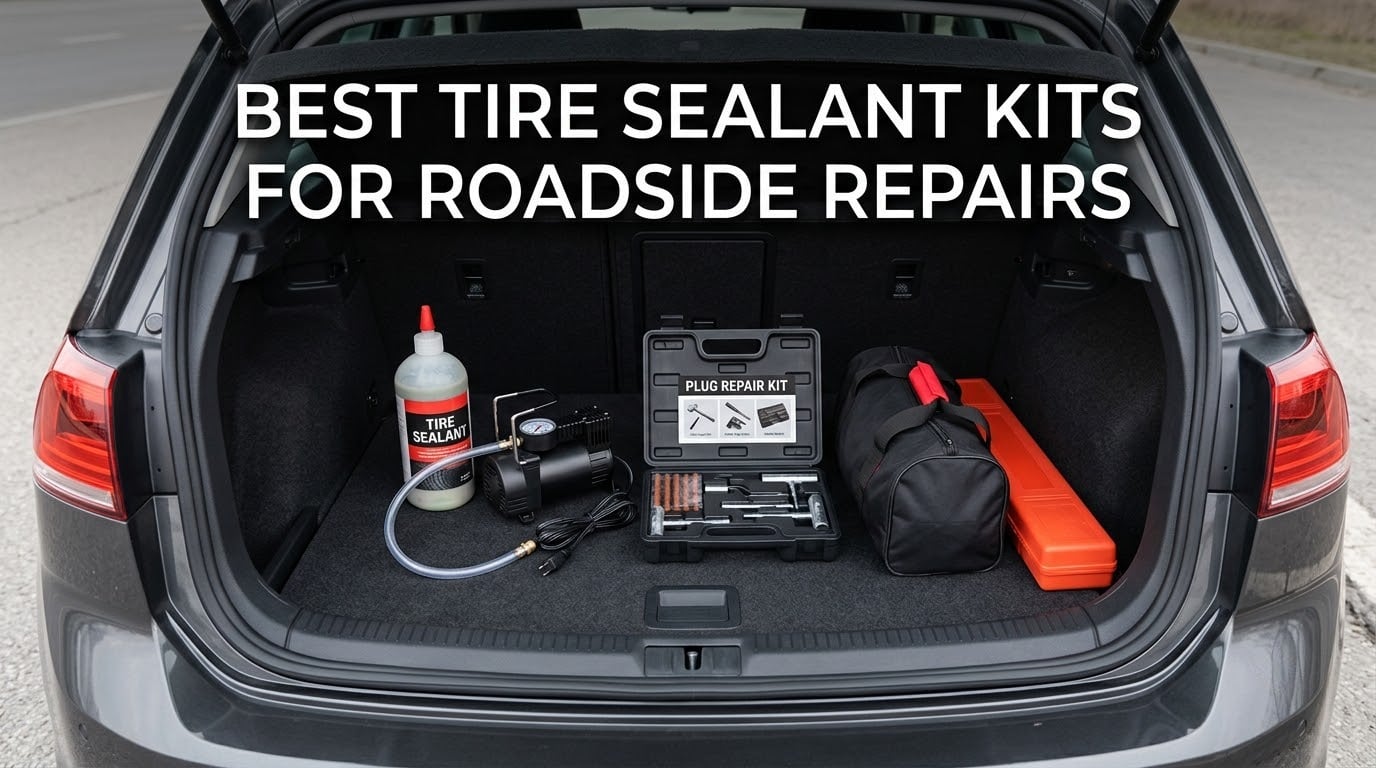
A tire sealant kit is the piece of roadside gear that has quietly gone from optional to essential. Most new cars no longer ship with a spare, and the ones that do usually hide a space-saver under the cargo floor that takes an hour to drop. A good kit does something simpler: it puts a plug in the hole, refills the tire with air, and gets you to a shop without wrestling a wrench on a shoulder of a highway at night.
That is what this roundup covers. We compared the best tire sealant kits for roadside repairs on the details that decide whether a kit works when you actually need it: the puncture size each one claims to seal, whether it is safe for TPMS sensors, how long the formula stays usable in a hot trunk, whether the inflator runs from the 12V socket, and what buyers say after using them. Nine products, all with published specifications worth reading before you buy.
We also spent time on the question most guides skip, which is what a sealant kit costs you afterward. Sealant residue means the tire has to be flushed before a proper repair, and on a TPMS-equipped wheel that cleanup can add real money. If you want the wider kit context, our picks for the best roadside emergency kits cover the tools that sit next to the sealant in a trunk.
Table of Contents
Top 3 Tire Sealant Kits for Roadside Repairs in 2026
The three below are the strongest combinations of sealing capability, specification transparency and buyer history in this group. The Fix-A-Flat leads on review volume and single-can simplicity, the Slime Smart Spair wins on kit completeness, and the TireJect off-road formula has the highest rating here with a seal that reaches further than anything else on the list.

Fix-A-Flat S60420 Aerosol Sealant
- Seals tread punctures up to 1/4 inch
- Seal and inflate in one aerosol can
- TPMS safe
- Single can stores in a trunk

Slime 50107 Smart Spair Kit
- Inflator and 16 oz sealant in one bag
- 15-minute four-step fix
- Seals up to 1/4 inch
- TPMS safe and non-corrosive

TireJect Off-Road 5-in-1 Sealant
- Seals tread
- sidewall
- bead and slow leaks
- Seals punctures up to 3/8 inch
- Permanent liquid rubber with aramid fibers
- Off-road and low-speed use only
Best Tire Sealant Kits for Roadside Repairs in 2026
Every product below appears once, in the order we would shop. The first three are all-in-one kits, the middle group is sealant for drivers who already own an inflator, and the last two are specialty options for off-road and truck use. Read the table for a fast scan, then jump to the section that matches your vehicle.
| Product | Specifications | Action |
|---|---|---|
| Fix-A-Flat S60420 Aerosol Emergency Repair and Inflator |
|
Check Latest Price |
| Slime 50107 Smart Spair Emergency Kit |
|
Check Latest Price |
 Slime 50122 Emergency Kit with Analog Inflator Slime 50122 Emergency Kit with Analog Inflator |
|
Check Latest Price |
| TireJect Off-Road 5-in-1 Sealant Kit |
|
Check Latest Price |
 TireJect Automotive Truck and SUV 2-in-1 Kit TireJect Automotive Truck and SUV 2-in-1 Kit |
|
Check Latest Price |
 AUTOWN 54-Piece Plug Kit with Air Compressor AUTOWN 54-Piece Plug Kit with Air Compressor |
|
Check Latest Price |
 AIRMAN 450ml UNIBOTTLE Tire Sealant AIRMAN 450ml UNIBOTTLE Tire Sealant |
|
Check Latest Price |
 Woowind Tire Sealant Flat Tire Repair Kit Woowind Tire Sealant Flat Tire Repair Kit |
|
Check Latest Price |
 Slime 10011 16 oz Sealant Bottle Slime 10011 16 oz Sealant Bottle |
|
Check Latest Price |
1. Fix-A-Flat S60420 Aerosol Sealant and Inflator
Fix-A-Flat S60420 Aerosol Emergency Flat Tire Repair and Inflator, for Standard Tires, Eco-Friendly Formula, Universal Fit for All Cars, 16 oz. (Pack of 1)
16 oz aerosol can
Seals tread punctures to 1/4 inch
TPMS safe
1.31 lb, seals and inflates
Pros
- Seal and inflate in one step with no jack
- Reliably holds air for days on highway drives
- Easy to follow instructions printed on the can
- Washes out with a hose
- Works on cars
- trucks
- mowers and inner tubes
Cons
- Cannot seal sidewall or rim damage
- About two years of shelf life
- Aerosol can is awkward to hold steady
- Residue can glue rubber to the rim if ignored
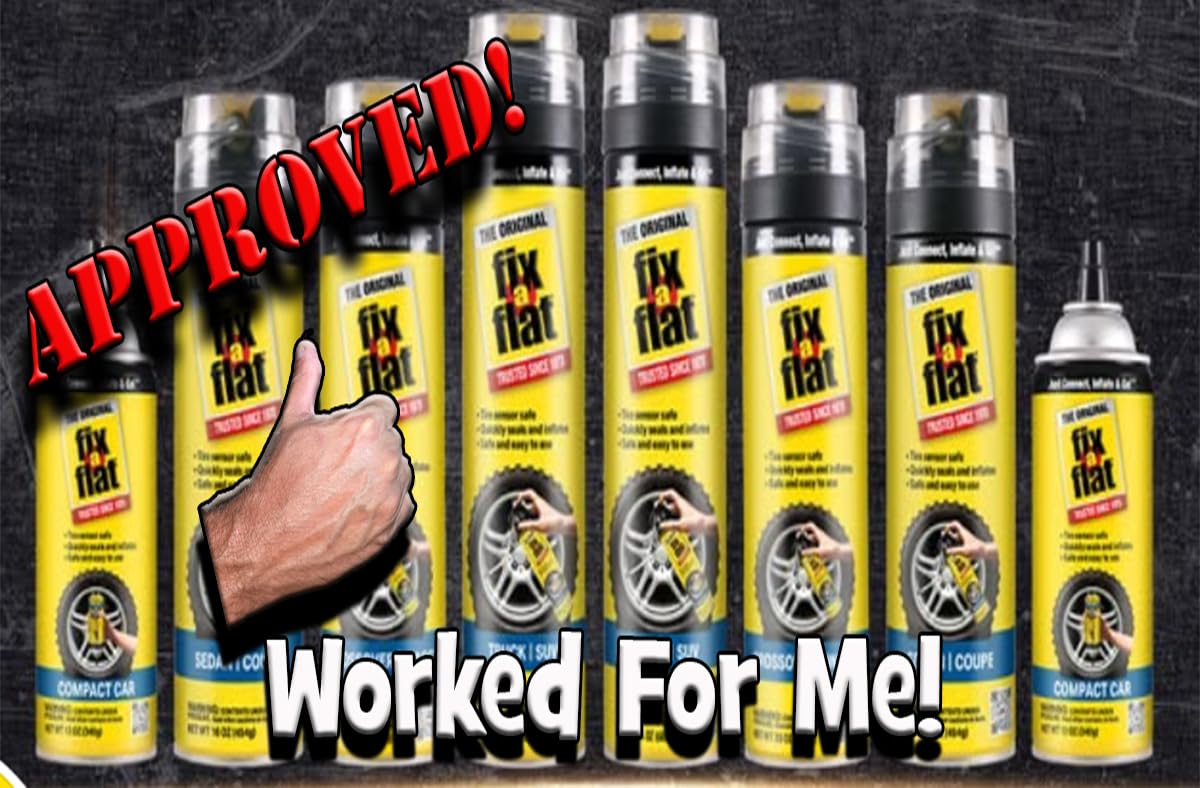
The Fix-A-Flat S60420 is the reason tire sealant became a household product. It is a single 16 oz aerosol can that both seals and inflates, which removes the two things that usually go wrong on a roadside: hunting for an air source and losing the plug kit. Point the nozzle at the valve, press the cap, and the formula rides the escaping air into the tread puncture and clots it on contact.
Buyers consistently describe the same experience. One can is enough to get a fully flat tire back onto the road, the instructions on the can are readable in bad light, and a water hose is enough to flush the residue out of the tire at the shop. It also handles riding mowers and bicycle inner tubes, which makes it the one product in this roundup that is not locked to passenger cars.
What you are giving up is precision. The published limit is tread punctures up to 1/4 inch, and the can does nothing for a sidewall cut or a damaged bead. The manufacturer also asks you to get a professional repair within 3 days or 100 miles, which is a tight window if your nearest tire shop is a two-hour drive away.
The aerosol format also has an ergonomics problem that shows up in reviews. Dispensing needs steady pressure, and if you cannot hold the can level, residue can leak out of the puncture hole. That is messy rather than dangerous, but it means you should work somewhere you can set a foot on the ground and let the can sit on your knee.
What you get with the Fix-A-Flat that other kits leave out
The can replaces the inflator. There is no 12V plug to fail, no gauge to read wrong at night, and no separate bottle to lose. For a driver who wants one object in the trunk rather than a bag of parts, that simplicity is the whole argument.
It is also the most forgiving product here about puncture size. The label claims 1/4 inch tread coverage, and 12097 reviews at 4.3 stars suggest it usually delivers on slow leaks as well as on nails and screws.
When a single aerosol can is not enough
If your vehicle has run-flat or acoustic foam tires, or if you tow a trailer with a different puncture pattern, the one-can approach is limited. Off-road work also needs more sealing coverage than a 1/4 inch tread claim delivers, which is exactly what the TireJect off-road kit is built for.
Budget for the cleanup. The instructions on this can and on the tire shop’s counter both assume the residue gets flushed before a plug is installed, and owners report that shops charge for that work when they are not told in advance.
2. Slime 50107 Smart Spair Emergency Kit
Slime 50107 Flat Tire Puncture Repair, Smart Spair, Emergency Kit For Car Tires, Includes Sealant And Tire Inflator Pump, Suitable For Cars And Other Highway Vehicles, 15 Min Fix
Inflator plus 16 oz sealant
Zipped storage bag
Seals up to 1/4 inch
15-minute fix
Pros
- Everything needed for a fix in one bag
- No jack or tire removal required
- Compact enough for a trunk or rear seat
- Double duty as a standalone inflator
Cons
- Sealant bottle is single-use
- Gauge is not illuminated
- Inflator reading is not accurate against a digital gauge
- Zip bag will not hold the bottle with tubing attached
The Slime 50107 is the kit we would hand to someone who has never used a tire sealant before. It combines a 16 oz bottle of sealant, a 12V inflator, sports-ball inflation accessories and instructions in a single zipped bag, and the published process is four steps in about 15 minutes with no jack and no tools.
What separates this from a bottle of sealant is the reasoning behind the bundle. A bottle alone is a problem when the tire is flat, because you still need air. This kit answers the whole sequence: kill the air, push sealant through the valve, fire up the inflator, drive. Owners on cars, ATVs and trailers describe the same result.
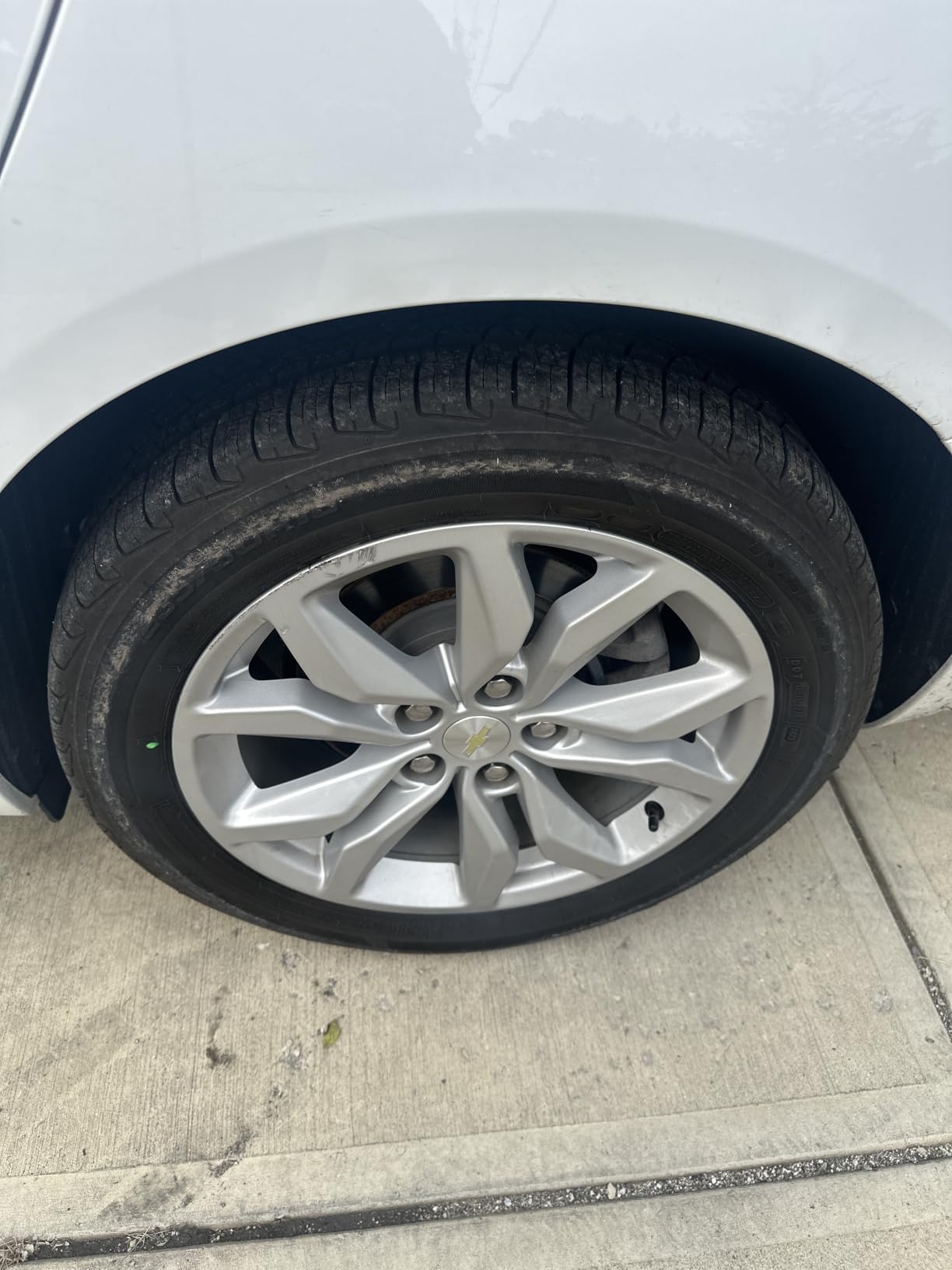
The honest weakness is the hardware. The inflator gauge has no backlight, which matters on a dark shoulder, and owners comparing it against a digital tire gauge report that the reading runs off. The zip bag is also designed around the pump, since the bottle and tubing will not fit back inside once the cap and fill line are attached.
Second issue, the same one on every temporary sealant in this roundup: the bottle is consumed by a single use. A kit can sit in a trunk for years and still have a working inflator but a spent bottle, so pair it with a spare bottle if you want the setup to stay complete.
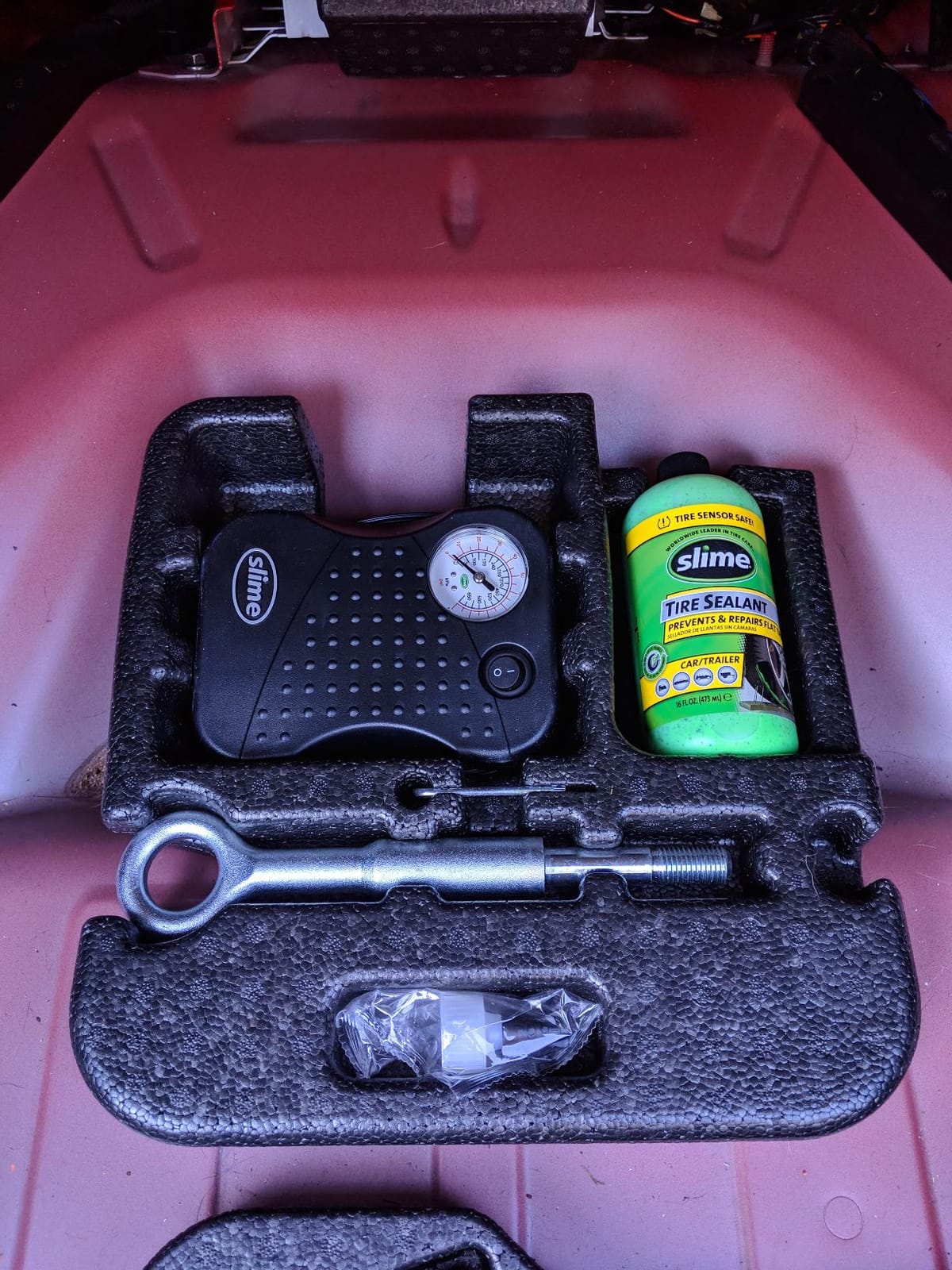
Why kit completeness beats a bigger bottle
Every failure story we read involved the missing half of the setup. Someone had sealant and no air, or air and no sealant. A bag that contains both removes a decision you would be making in bad light with a wheel on the shoulder.
The 16 oz bottle size is also the one most road tires need for a full application. It covers cars and light highway vehicles, and the manufacturer rate is 3 days or 100 miles before professional service.
Where the Slime 50107 falls short
The inflator runs from the 12V accessory socket, so it is dead if your car’s socket is on a failed fuse or you are driving something with no outlet. It is also a temporary fix, and the tire still has to come off the rim for a lasting repair.
For pure tread punctures on a passenger car, a mechanical plug from the AUTOWN kit is faster and lasts longer. This one wins when the goal is not the best repair but the least effort at the worst moment.
3. Slime 50122 Emergency Kit with Analog Inflator
Slime 50122 Flat Tire Puncture Emergency Kit, Includes Sealant and Tire Inflator Pump, Analog, Suitable for Cars and Other Highway Vehicles, 10 Min Fix
Analog inflator plus 14 oz sealant
Two-step, about 12 minutes
Seals up to 1/4 inch
3 lb kit
Pros
- Thin and compact for a trunk or under a seat
- Illuminated gauge helps in low light
- Two-step process is simpler than most kits
- Owners report long drives home on a repaired tire
Cons
- 12V power plug is thin and cracked for some owners
- Gauge reading does not match a digital gauge
- Screw-on hose connection is slow and leaks air
- Sealant is single-use
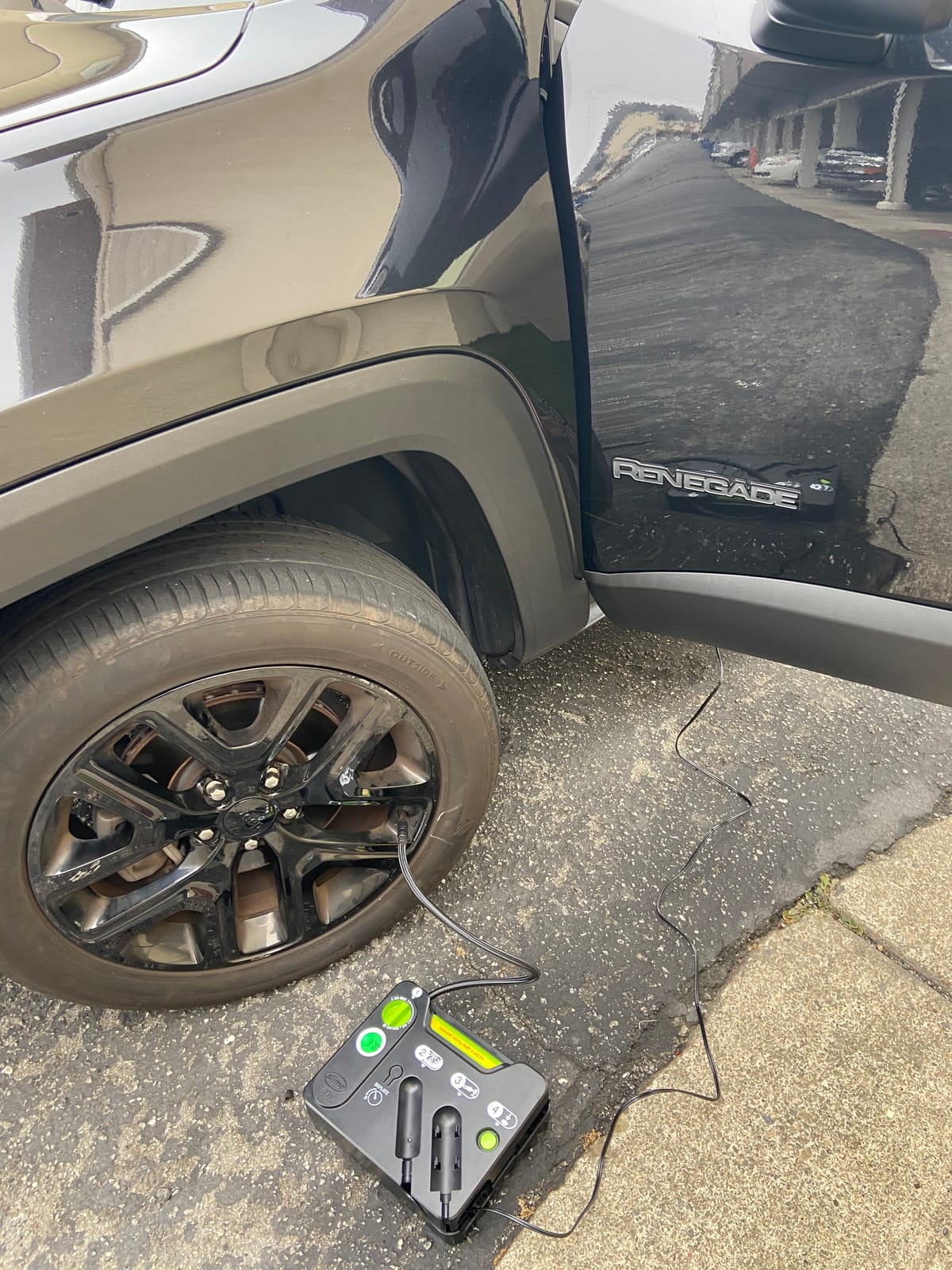
The Slime 50122 is the slimmer sibling of the Smart Spair, and the difference is mostly the pump. Instead of a 16 oz bottle and four steps, you get a 14 oz bottle and a two-step process that finishes in about 12 minutes. The gauge on this one is illuminated, which is the single feature owners notice most at night.
The compactness is genuine. The kit is thin and light enough for a rear seat or a small trunk, and the two-step process means less to remember when you are kneeling on gravel. Reviewers describe rescues in bad weather and at least one owner drove 600 miles on an interstate move after using it.
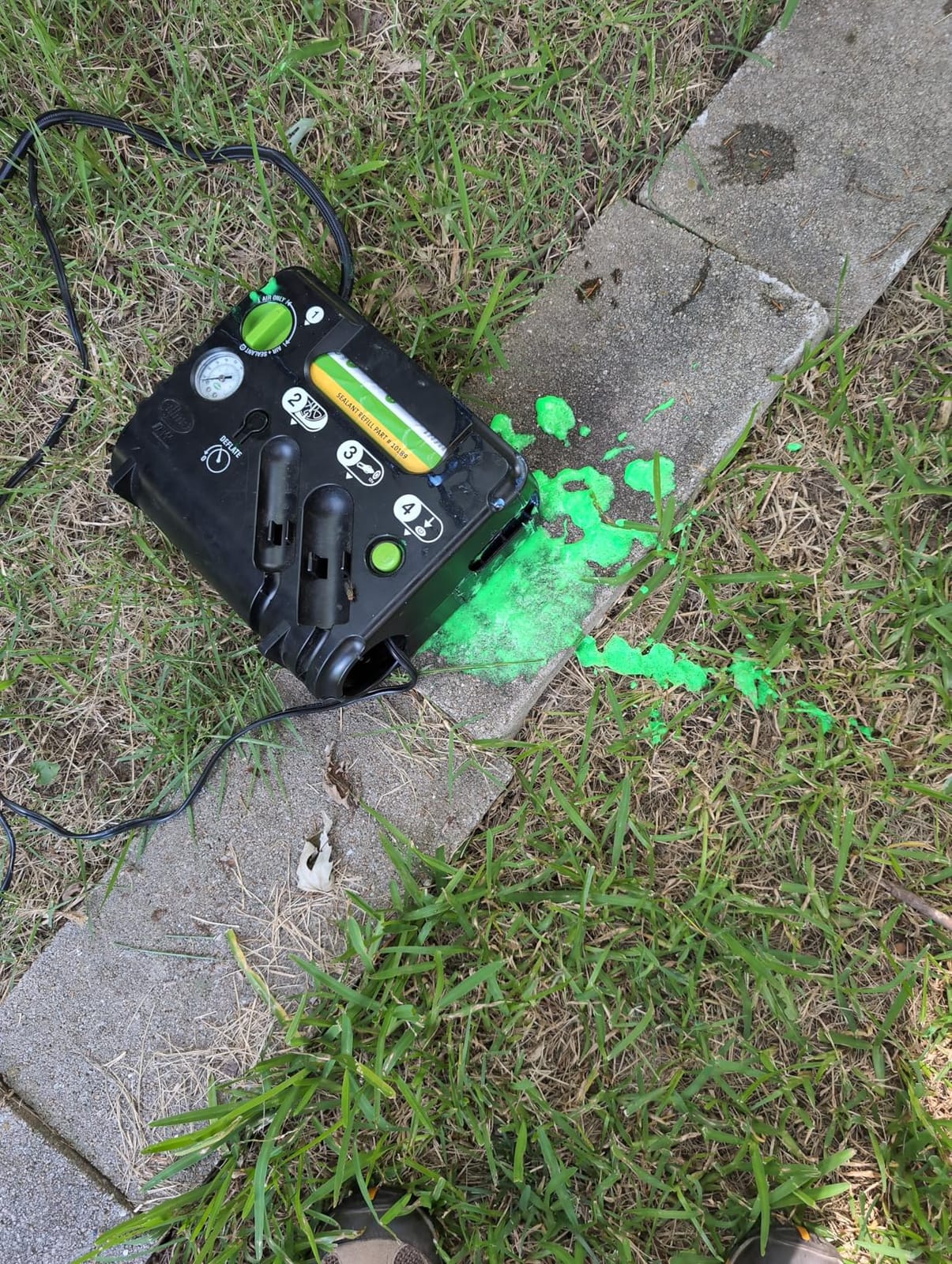
Build quality is where this kit loses points. Several owners report the 12V cigarette lighter plug cracking and requiring rewiring, which is a failure that only shows up when you need it. The screw-on hose connection is also slower than a snap-on fitting and vents air while you attach it.
Accuracy is the other recurring note. The analog gauge does not agree with a digital tire gauge, and if you are topping off to a specific cold pressure, the difference matters. The brand response has been good: one detailed complaint produced a free replacement unit from customer support.
Who should pick this over the 50107
Nighttime use on a dark shoulder is the deciding factor. The illuminated gauge is not a luxury in a breakdown, and the shorter two-step process means less time kneeling next to a lane with traffic behind you.
Space matters too. If you already have a full roadside bag, this kit stacks into a narrow gap that the wider 50107 will not.
Why the 12V plug worries us
A cracked power plug is a failure mode with no warning. It looks fine in the bag, then the pump simply does not run on a night when the gauge is no longer the only thing standing between you and a long walk.
Check the plug and the cable before you rely on the inflator half. If the kit is going to sit for a season, it is worth confirming the socket still powers the pump.
4. TireJect Off-Road 5-in-1 Sealant Kit
TireJect Off-Road Tire Sealant Kit – 5-in-1 Sealing – Fix and Prevent Flat Tires (10oz)
10 oz bottle
Seals up to 3/8 inch
Permanent liquid rubber seal
Off-road and low-speed use only
Pros
- Highest rating in this roundup at 4.6 stars
- Seals bead leaks and slow leaks others miss
- 5-in-1 coverage including sidewall punctures
- Works on tubeless and tubed tires
Cons
- Not for highway-speed driving
- Not recommended for TPMS-equipped wheels
- Thin liquid is easy to spill
- Included valve core tool felt low quality
The TireJect off-road kit is the most capable sealant in this group and the least appropriate for a daily driver. It is built around a 5-in-1 sealing claim: tread punctures up to 3/8 inch, sidewall punctures up to 3/8 inch, bead leaks, slow leaks and minor dry rot on low-speed tires. Nothing else here comes close to that coverage, and it is the only product on the list rated 4.6 stars with 3413 reviews behind it.
The chemistry is also different. Instead of a temporary polymer that rinses out, it uses liquid rubber, recycled tire particles and aramid fibers to form a permanent seal. That is why owners on ATVs, UTVs, riding mowers and tractors report going years between flats rather than weeks.
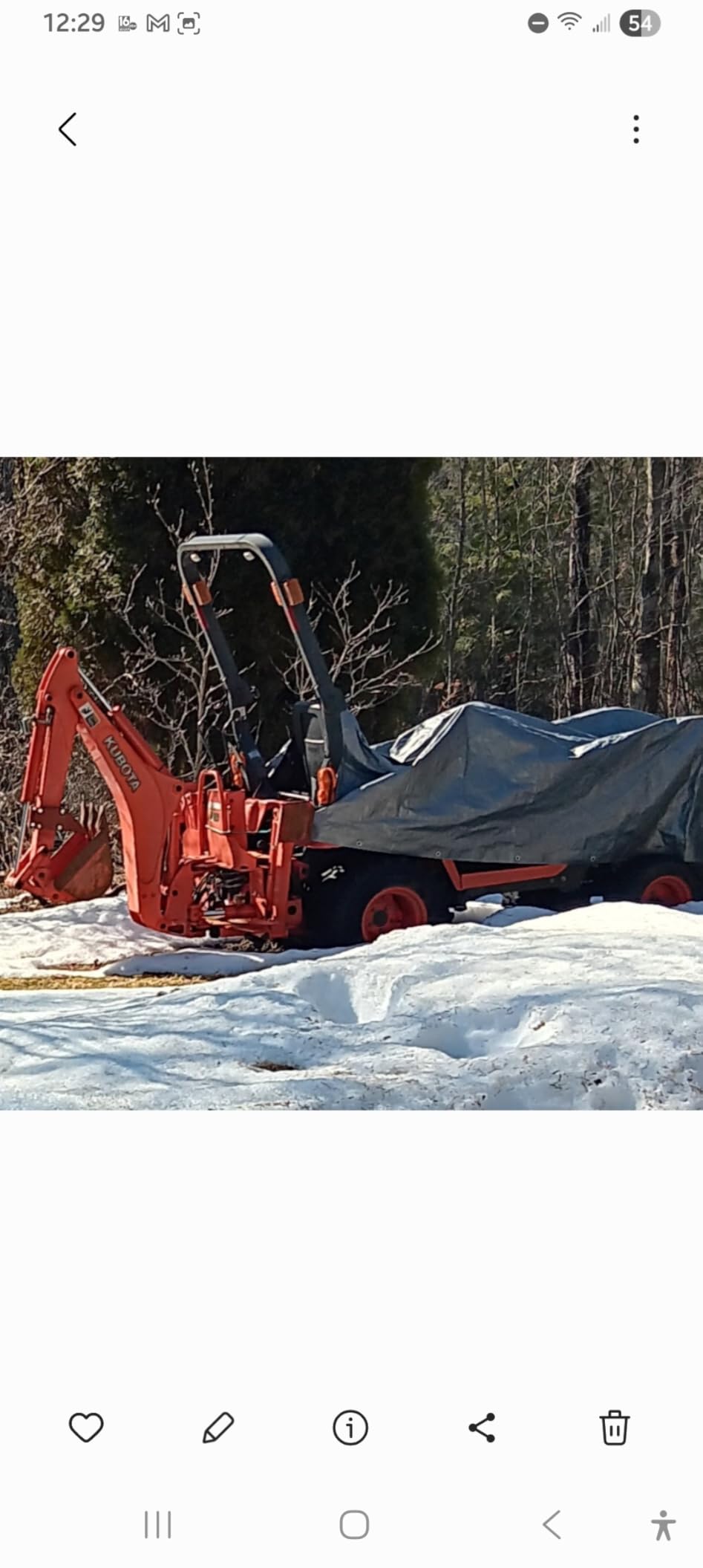
Two constraints are not negotiable, and they come straight from the manufacturer. This product is for off-road and low-speed tires, and it is not recommended for wheels with TPMS sensors. Highway speed is exactly the environment the rest of this roundup is built for, so treat this as a tool for a second vehicle or a machine, not for the family car.
The liquid is thinner than buyers expect and spills easily during application. The included valve core remover also drew complaints about build quality from at least one buyer, and the residue still has to be washed out of the tire before professional service.
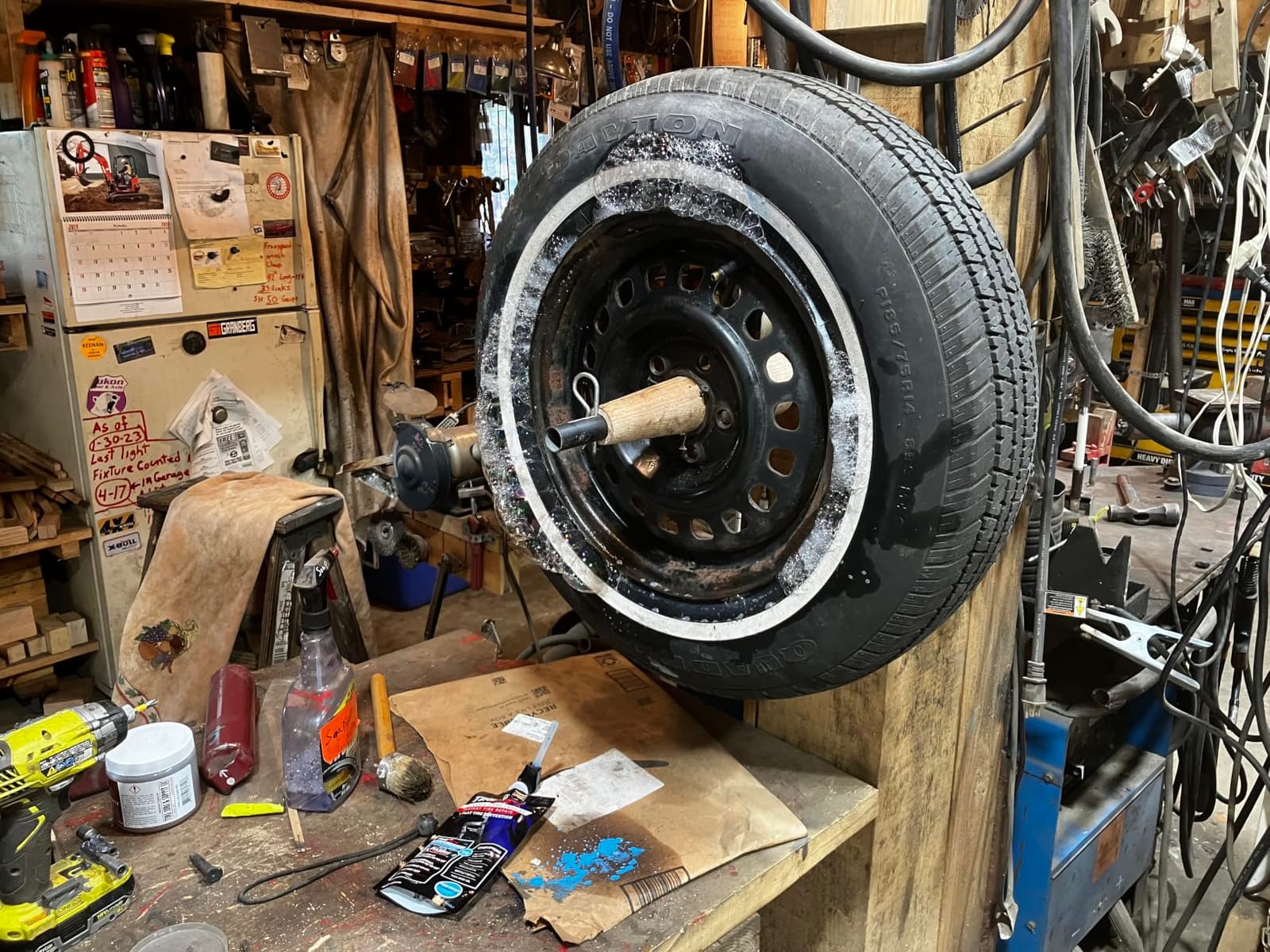
Where off-road sealants earn their keep
Tread patches on low-pressure off-road tires fail because the carcass flexes and the plug works loose. A liquid rubber seal with fibers that bond to rubber handles that movement, which is why this product shows up on rock crawlers and tractors rather than on highway sedans.
Bead leaks and slow leaks are the other category. These are the failures a plug tool cannot touch at all, and they are why this formula treats the tire from the inside instead of attacking the hole from outside.
Why this is not the roadside answer
The label restriction on TPMS wheels and low-speed use is the deciding factor. On a highway at 60 miles per hour, a permanent seal is not the concern, and a sensor-clogging risk is a real one when a dealer later replaces sensors.
If you need sealing power but drive on the highway, the TireJect automotive version in the next section is the TPMS-safe formulation, and it is the one to buy for a truck or SUV.
5. TireJect Automotive Truck and SUV 2-in-1 Kit
TireJect Automotive Full-Size Truck/SUV 2-in-1 Tire Sealant & Bead Sealer Kit for tire Repair of leaks and punctures
8 oz pouch sized for full-size truck and SUV tires
Seals tread punctures and bead leaks
TPMS and rim safe
Permanent liquid rubber seal
Pros
- TPMS safe unlike the off-road version
- Seals bead leaks as well as tread punctures
- Permanent seal rather than a temporary patch
- Dose sized for full-size tires
- Installation tools included
Cons
- One pouch treats one tire
- Requires removing the valve core first
- Limited written buyer feedback on this variant
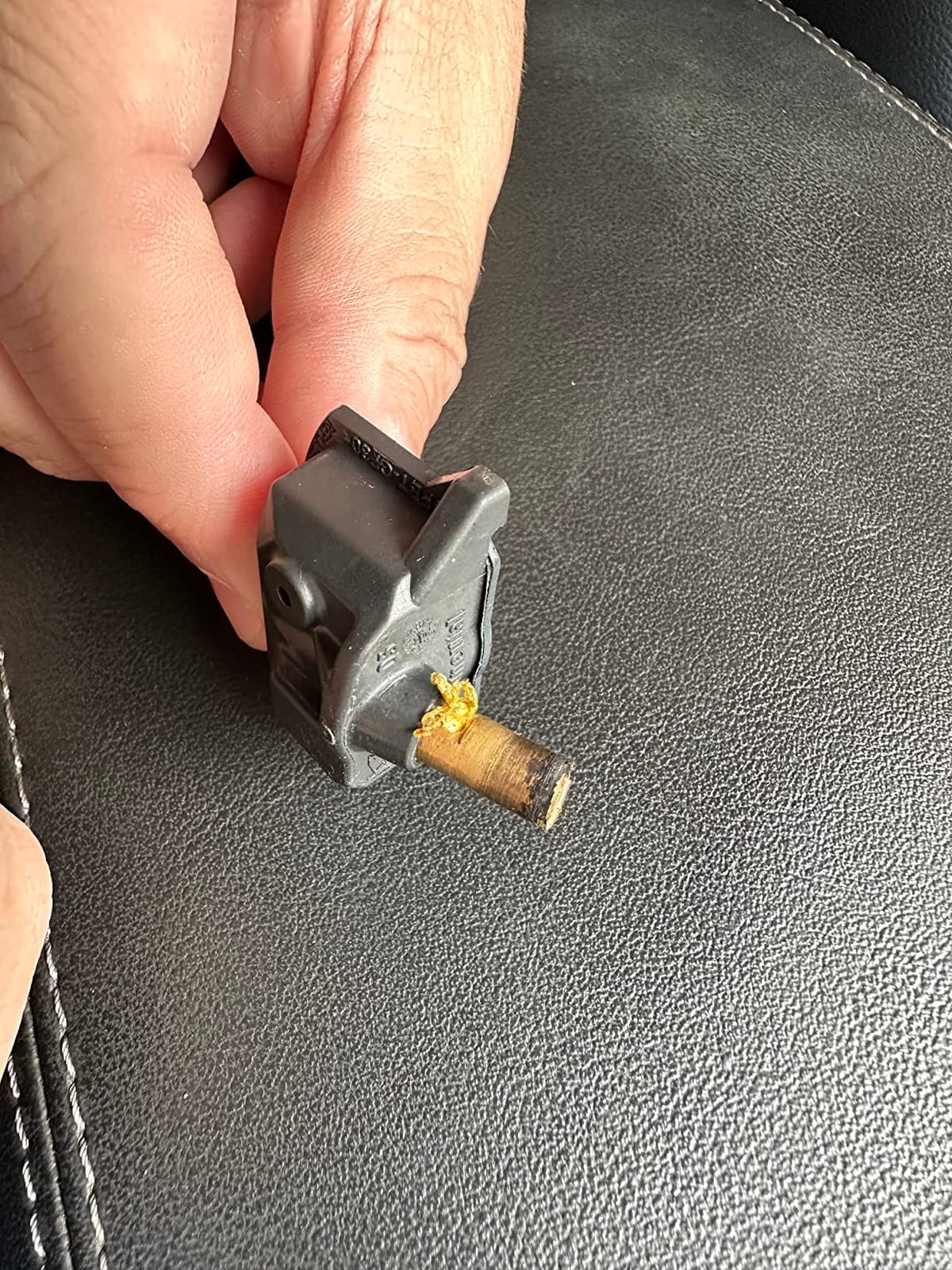
This is the road-legal version of the TireJect formula, dosed for full-size truck and SUV tires rather than off-road rubber. The 8 oz pouch is sized to the larger cavity, and the stated coverage is bead leaks plus tread punctures up to 1/4 inch. The manufacturer lists it as safe for the tire, the rim and the TPMS sensor, which is the difference that matters if you drive on pavement.
It ships with the same small toolset as the off-road kit: a dispensing cap, a metal valve core remover and a valve stem cap. The red cap is a small, genuinely useful detail, because you can see at a glance which tires have been treated.
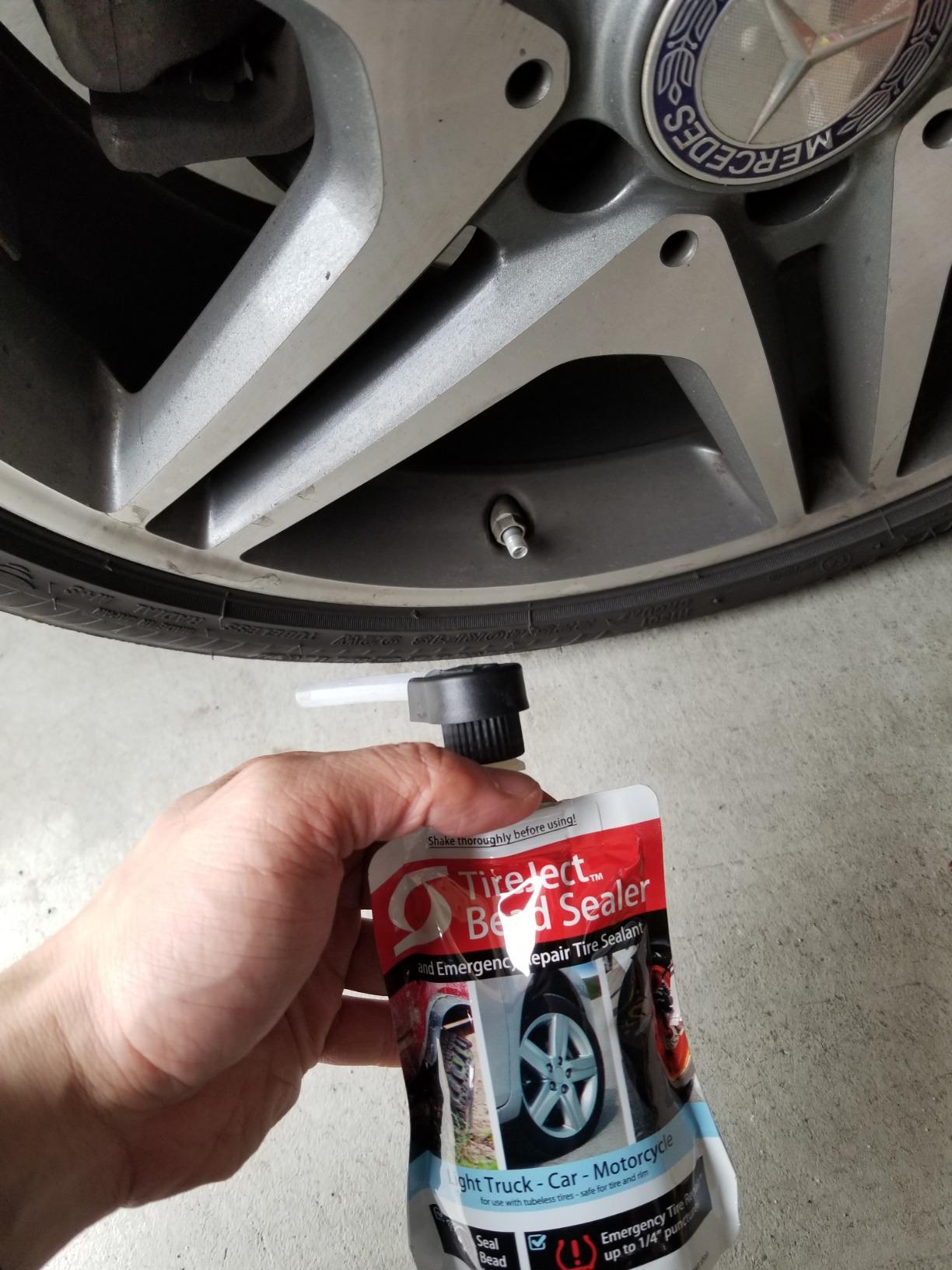
The dosing is the trade-off. One pouch is a one-time dose for one tire, so treating all four means buying four. The application also requires pulling the valve core, which is a fiddly job with a damaged core and a small part that can disappear into a gutter.
Buyer feedback on this specific variant is thin. It carries 1049 reviews at 4.4 stars, but the listing returned no individual review text, so the assessment rests on the rating profile and the published sealing specs rather than on owner accounts.
Why trucks and SUVs need their own dose
A full-size truck or SUV tire holds considerably more air than a compact car tire, and the interior cavity is larger. An under-dosed bottle leaves the puncture partially sealed, which is worse than no sealant because it looks like a completed repair.
Bead sealing is the second reason. Trucks and SUVs on rough roads and driveways pick up more bead and rim-edge problems, and a bead sealer handles a class of leak that no tread plug can reach.
When to choose the bottle products instead
If you are fixing a single low-pressure tire on a highway shoulder, a temporary aerosol or a bottle with an inflator will get you moving faster than this one. The permanent seal is a better outcome, but it takes more setup.
Also note the cost of the permanent approach. Because the liquid rubber stays inside the tire, a shop must cut it out before fitting a patch-plug repair, and that is a different conversation than flushing a water-soluble sealant.
6. AUTOWN 54-Piece Plug Kit with Air Compressor
AUTOWN Flat Tire Repair Kit with Air Compressor, Professional Tire Plug Kit
54-piece steel plug kit
12V air compressor included
T-handle and spiral probe
1.39 lb plus case
Pros
- Highest rated kit with a compressor here at 4.6 stars
- Includes pliers that competing kits omit
- Working 12V compressor covers plug and inflate
- Refined steel tools rather than plastic handles
- Two-compartment case keeps things organized
Cons
- Requires removing the tire for a proper plug
- Compressor is socket powered and not rechargeable
- Case is bulky for a motorcycle or tight trunk
- Plug is an emergency fix rather than a permanent patch
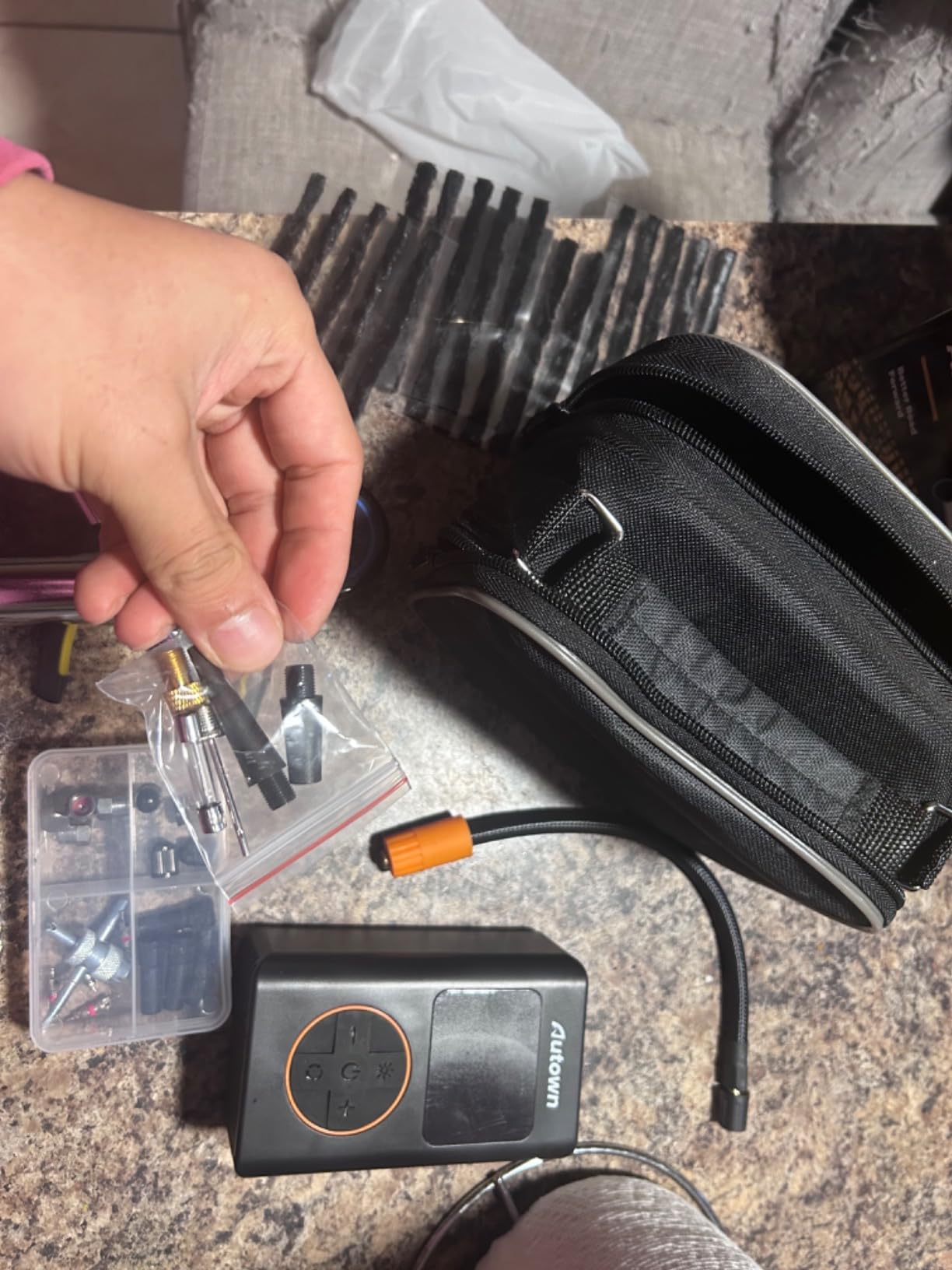
This is the one mechanical option in the roundup, and for a tread puncture in daylight it is the most reliable answer on this list. A 54-piece kit built from refined steel includes the T-handle reamer and spiral probe that make a plug go in straight, and unlike most kits of this size it includes pliers. The 12V compressor is in the same case, so you cover the whole sequence in one bag.
It rates 4.6 stars across 555 reviews with 77 percent five-star ratings, and the coverage list is genuinely wide: cars, motorcycles, ATVs, tractors, lawn mowers, RVs, jeeps and trucks. Buyers report using it across that range, including a repair and inflation completed in roughly 30 minutes on a nail puncture.
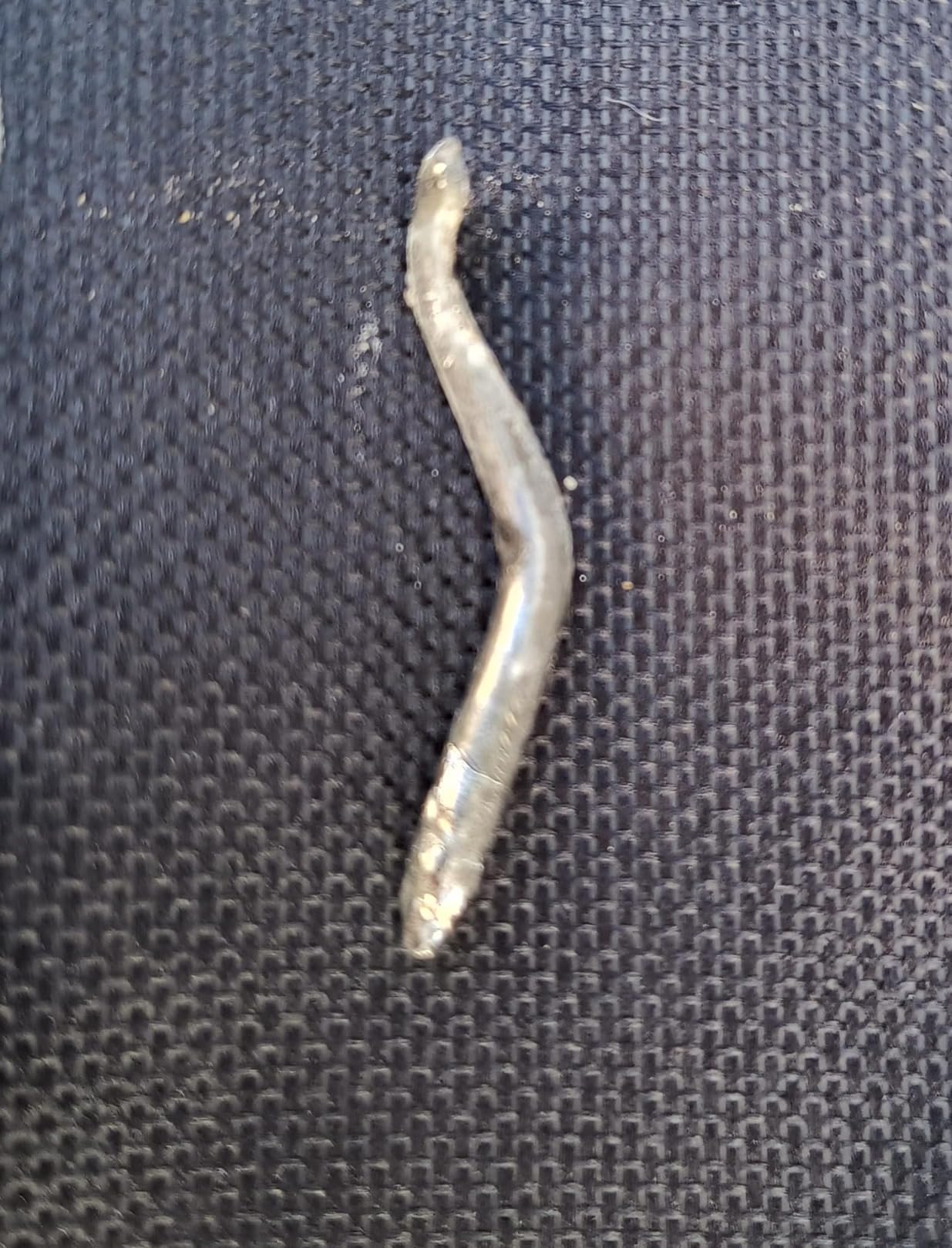
The requirement that decides everything is that a proper plug means demounting the tire. On a highway shoulder with no jack, that turns a ten-minute job into an hour, and it puts you in traffic while a wheel is off. A plug also does nothing for a sidewall, a bead or a slow leak, so a tire that is losing air steadily will keep losing it.
The compressor runs from the 12V socket rather than a rechargeable battery, and the case is bulky for a motorcycle side case. Buyers also point out that a plug is still an emergency repair rather than a patch-plug, even though it lasts much longer than sealant.
Why steel tools matter more than piece count
The complaint that shows up across tire repair forums is plastic-handled plug tools snapping on the first use. This kit is refined steel throughout the working tools, and the T-handle gives the reamer real leverage, which is what you need when a nail has packed the hole with grit.
The included pliers matter more than they sound. Most competing kits assume you already have a way to pull the object back out of the hole before you ream it, and improvising that step is how a good repair turns into a ruined one.
When a plug kit is the wrong tool
Two situations rule it out. The first is a tire you cannot safely remove and refit where you are, which covers most true roadside emergencies. The second is any leak that is not a discrete object in the tread, including bead leaks, which is where sealant wins.
The practical answer for many drivers is to carry both. The plug kit handles the common daylight case at home or at work, and a bottle of sealant covers the dark highway case where removing a wheel is not an option.
7. AIRMAN 450ml UNIBOTTLE Tire Sealant
Airman Tire Repair Sealant 450ml UNIBOTTLE – Tire Sealant for Car Tire Repair, Flat Tire Repair Kit Alternative, Works with Any Tire Compressor, Emergency Tire Puncture Repair, TPMS Safe
450 ml bottle
Seals punctures up to 6 mm
Connects to any compressor
Up to 4-year shelf life
Pros
- Uses any inflator you already own
- No valve core removal and no adapters
- Long shelf life suits permanent trunk storage
- Seals and inflates in a single pass
- Water-based formula rinses out easily
Cons
- No inflator included
- Seals up to 6 mm which is smaller than some rivals claim
- Temporary fix rather than a permanent patch
- Limited written buyer feedback
The AIRMAN’s whole idea is the UNIBOTTLE cap. It screws onto the end of a standard inflator hose, which means the sealant runs straight through the hose and into the tire without pulling the valve core and without a proprietary adapter. If you already own a decent inflator, this removes the single most annoying step in every other bottle on this list.
It is also the most durable product to keep in a car long-term. The stated shelf life is up to four years, the formula is water-based, non-toxic, non-corrosive and TPMS safe, and the manufacturer rates it drivable for 125 or more miles after a repair. The listed rim coverage runs up to 20 inches across cars, SUVs, trucks, motorcycles and ATVs.
The catch is obvious and worth stating plainly. There is no inflator in the box, so this is not a roadside kit on its own. It is a component for a setup you already have, which is a fine thing to own and a poor thing to rely on as your only plan.
The 6 mm sealing claim is also narrower than the quarter-inch figures elsewhere, though those numbers are close enough that the difference rarely matters on a nail hole. Like every temporary sealant here, it is an emergency fix, and this listing returned no individual review text beyond the 368-review rating profile.
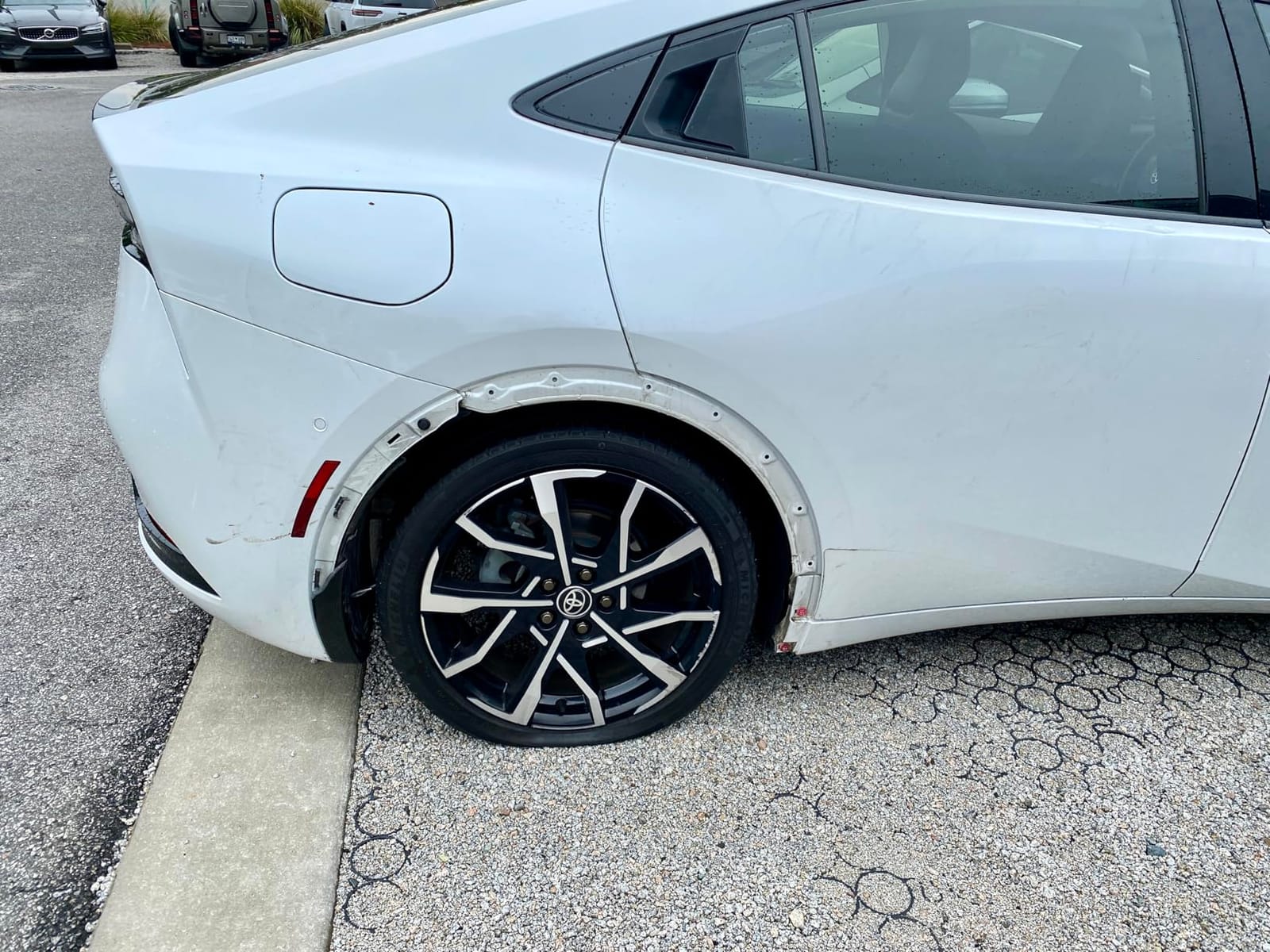
Why a long shelf life changes the buying decision
Expiring sealant is a quiet failure. A bottle in a trunk looks identical whether it is fresh or past date, and the most common forum complaint about garage-stored sealant is not knowing when it was bought. A four-year window removes that problem almost entirely.
That is why the AIRMAN works well as a permanent trunk item rather than a consumable. Pair it with an inflator you trust and you have a setup that stays ready for years, which is a different proposition from restocking a kit every season.
Who gets value from this and who does not
If you carry a quality 12V or cordless inflator anyway, this bottle costs you less than duplicating a pump. Our guide to the best portable tire inflators covers which pumps pair well with this style of bottle.
If you have nothing, buy a kit with a compressor inside instead. A bottle plus no air source is the exact combination that turns a manageable puncture into a tow.
8. Woowind Tire Sealant Flat Tire Repair Kit
Woowind Tire Sealant Flat Tire Repair Kit, Seals 0.236in, TPMS Safe
450 ml leak-proof bottle
Seals up to 0.236 inch
Effective from -20C to +70C
5-year shelf life
Pros
- Longest stated shelf life in the group at five years
- Wide operating range for cold and hot climates
- Valve-through design aimed at protecting TPMS sensors
- Drivable 125 miles at 50 mph after repair
- Leak-proof bottle suits a glove compartment
Cons
- Seals only up to 0.236 inch
- No inflator included
- Lowest sales rank in the group
- Treats smaller punctures only
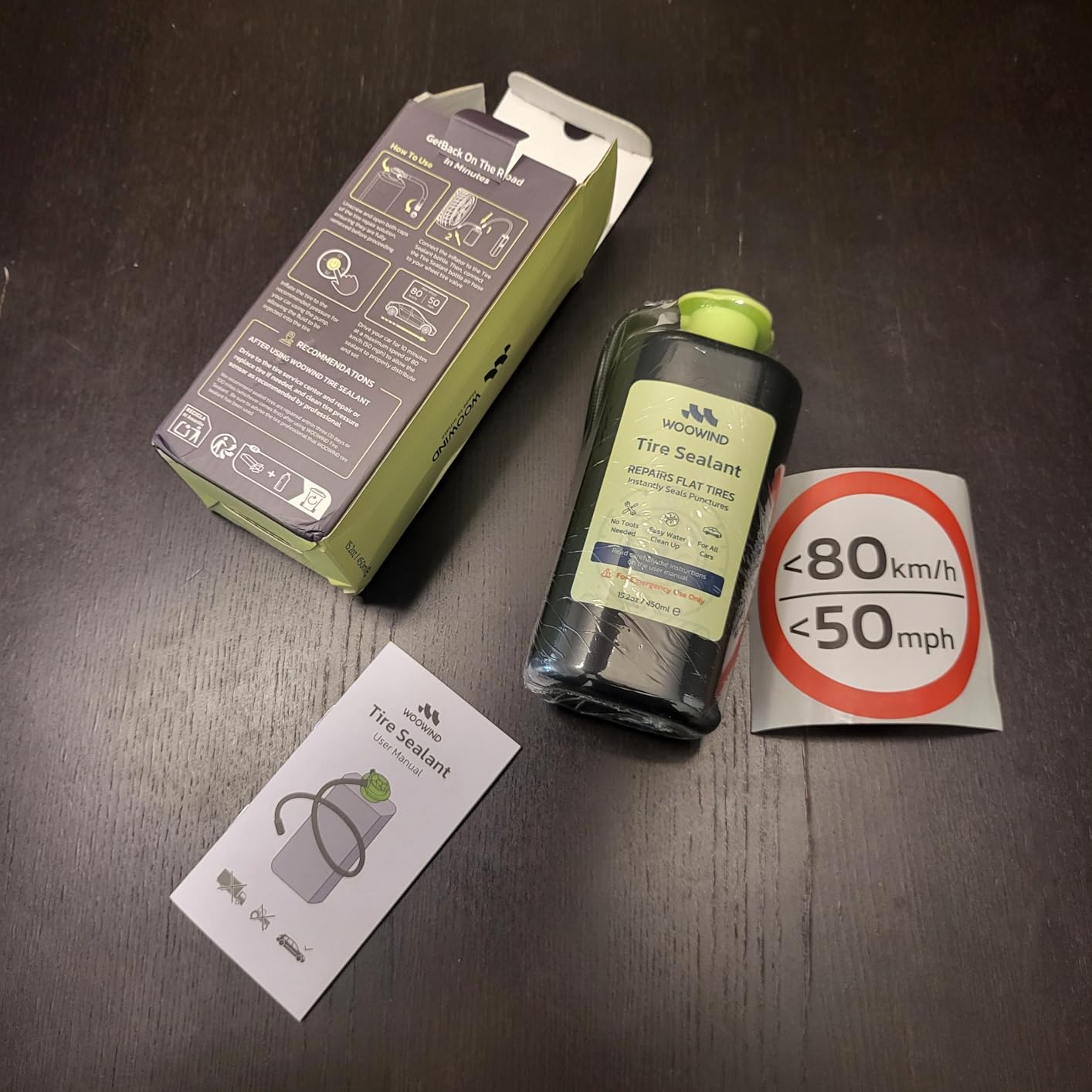
On paper, the Woowind has the most generous specification sheet in this roundup. It seals punctures up to 0.236 inch in about 10 minutes, works from -20C to +70C, carries a five-year shelf life and is ROHS-certified with a non-toxic natural rubber formula. The leak-proof 450 ml bottle is sized for tires up to 21 inches on cars, SUVs and trucks.
The temperature range is the differentiator. Most products in this category do not publish a working range at all, and a driver in a northern climate needs to know the formula has not frozen solid in a January trunk. This one tells you it works from -20C.
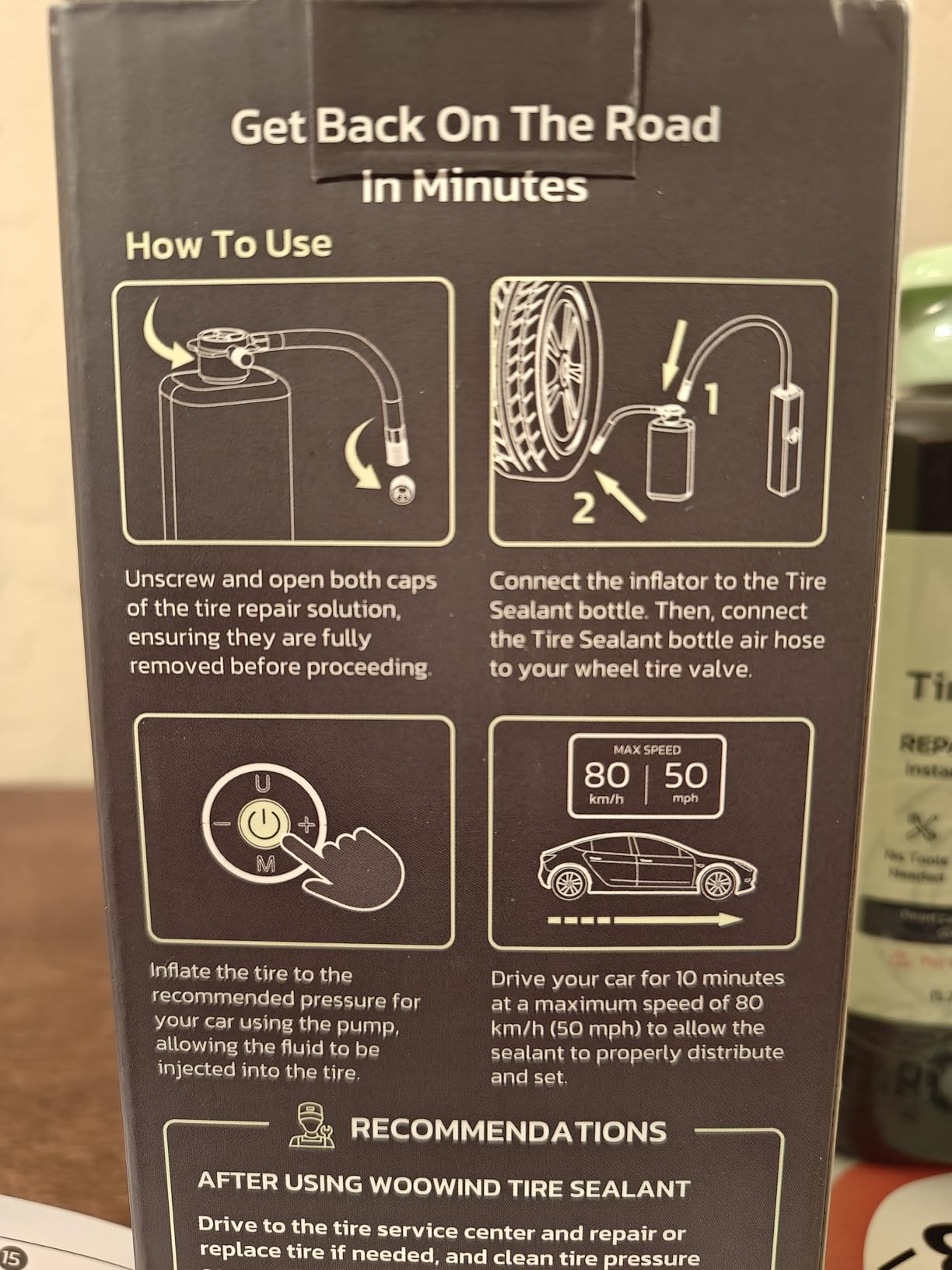
The post-repair drive limit is generous: 125 miles at 50 mph. For a product with no inflator included, that assumes you already have a way to put air in the tire, which is the same limitation as the AIRMAN. The puncture size claim is also the smallest in the group, so a larger nail or a cut is out of scope.
Buyer evidence is thin. It holds 252 reviews at 4.4 stars with 76 percent five-star ratings, but it trails the field heavily on sales volume, and the listing returned no individual review text. The specifications are the argument here, not owner accounts.
What the TPMS valve-through design changes
Sealant that passes the sensor is not a cosmetic specification. A TPMS sensor sits just behind the valve, and formula that pools around it can trigger a fault code that a dealer then wants to charge to diagnose. A valve-through delivery path is a design choice aimed at keeping the fluid moving past the sensor rather than sitting on it.
That matters most on vehicles where a replacement sensor is expensive, which includes most newer cars and every EV in this weight class.
When a five-year shelf life does not help
It only helps if the bottle is present and usable when you need it. A long shelf life does nothing for a driver with no inflator, and nothing for a puncture larger than the published 0.236 inch limit, which is a fairly narrow target.
Pair this with a good inflator and it becomes a durable trunk item. Carry it alone and the gap between it and an all-in-one kit is exactly the moment you are stuck on.
9. Slime 10011 16 oz Sealant Bottle
Slime 10011 Flat Tire Puncture Repair Sealant, Emergency Repair for Highway Vehicles, Suitable for Cars/Trailers, Non-Toxic, eco-Friendly, 16 oz Bottle
16 oz bottle
Fibro-Seal seals up to 1/4 inch
Water soluble, non-toxic
1.3 lb
Pros
- Highest review count in the roundup at 12385
- Reliable on slow leaks that keep triggering warnings
- Works on riding mowers
- UTVs and older tires with dry rot
- Water soluble and non-toxic
- Multiple bottle sizes available
Cons
- Instructions call for fully deflating the tire first
- Needs a separate inflator
- Shop should always be told sealant was used
- Tread area only
- Not a permanent repair
The Slime 10011 is the most proven product in this roundup by a wide margin. With 12385 reviews at 4.4 stars and a top 1000 Automotive sales rank, it is the bottle that most owners have actually had for years rather than months. The Fibro-Seal Technology carries sealant particles into the puncture as escaping air pushes them through, forming a flexible plug up to 1/4 inch across.
Its real specialty is slow leaks, and that is where the review volume tells a useful story. Long-term owners on riding mowers, tractors and older vehicles with dry rot report sealing leaks that had them topping up tires every week. A slow leak is the failure a plug tool can never address, because there is no object in the hole to grab.
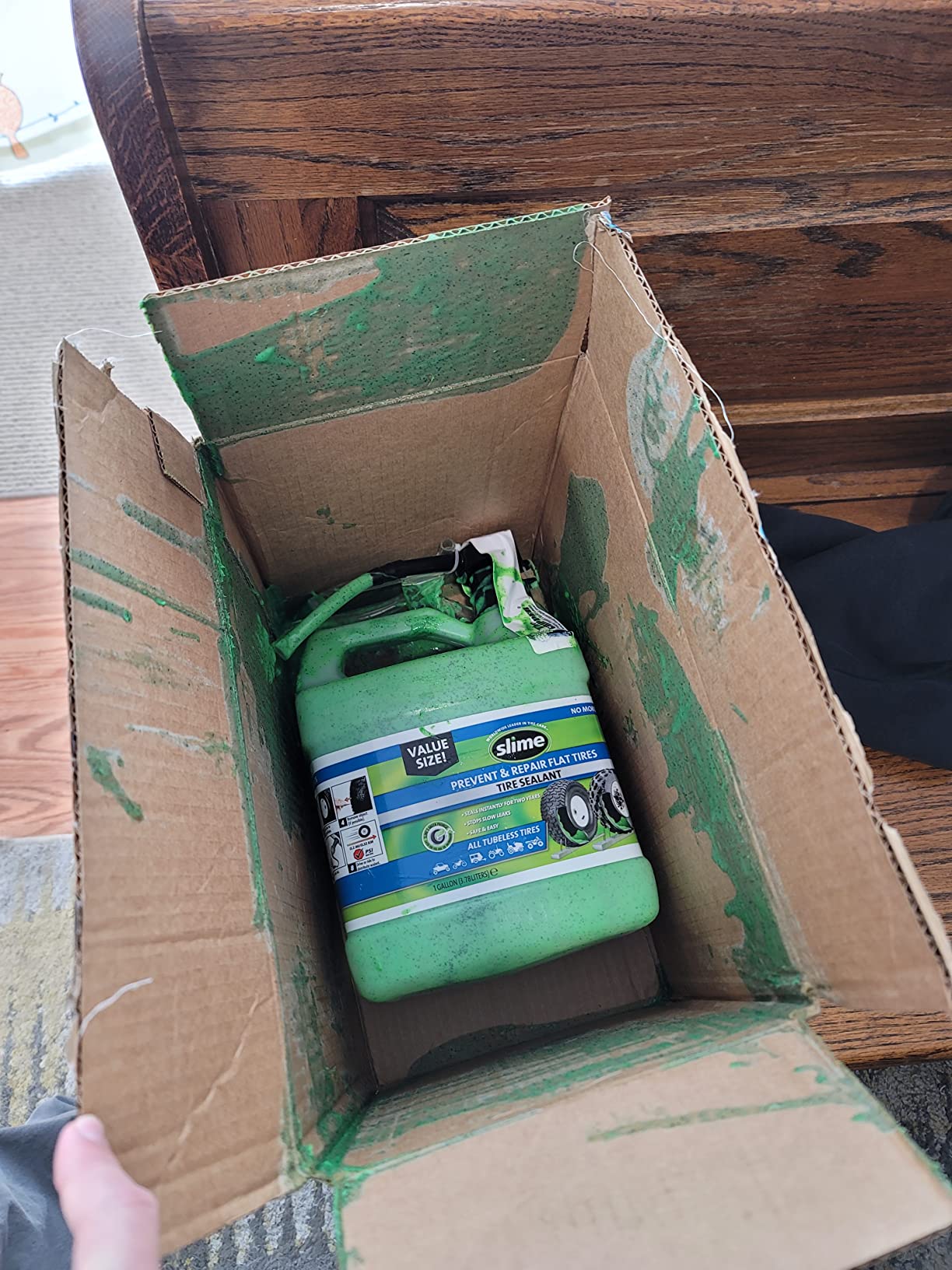
Two practical points come up repeatedly. The directions call for fully deflating the tire before application, which means you need an inflator to put it back up, and the bottle needs real hand strength to squeeze. Both are manageable if you plan for them, and both are frustrating at 1 a.m. on a shoulder.
There is also the shop conversation. Slime is water soluble and non-corrosive, but the residue still has to be flushed before a proper repair, and owners advise telling the tire shop the sealant was used so the work is done properly the first time.
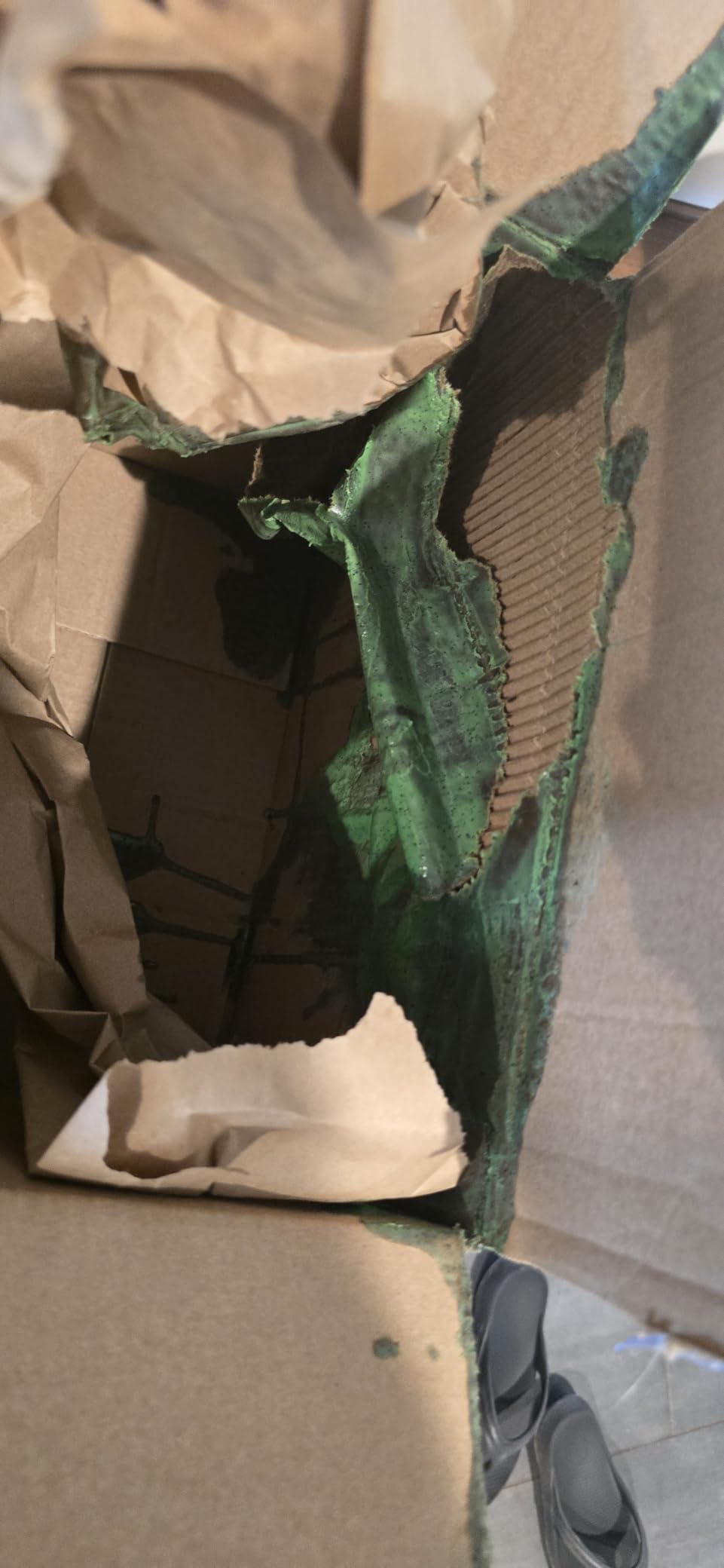
Why slow leaks are the case sealant is built for
A nail hole announces itself. Pressure drops fast, the warning light comes on, and you stop. A slow leak does not, which means it can quietly cost you a tire over months and, on a long trip, become the reason you are standing on a shoulder far from anywhere.
A fiber-loaded formula that is already circulating inside the tire plugs a seepage point before it becomes a visible flat. That is why this bottle has stayed in trunks and farm sheds for years while faster-acting products cycle in and out.
What the bottle does not solve
Air supply. A bottle that requires a deflated tire and no inflator is half a solution, and the pairings that work best are this bottle with a quality cordless pump rather than a cheap 12V unit that overheats.
It also only addresses the tread area and it is explicitly temporary, with a 3 day or 100 mile limit before professional service. For anything lasting, a patch-plug repair inside the tire is the correct procedure.
How to Use a Tire Sealant Kit Without Wrecking the Repair
Most failed sealant jobs fail the same way: the wrong order of steps. Air pressure is what carries sealant into the hole, so a tire that still holds pressure can swallow the formula and a tire at zero pressure cannot deliver it to the puncture. Every product here works on that principle, whether the instructions are two steps or four.
For the aerosol cans such as the Fix-A-Flat, the sequence is printed on the label. Remove the valve core, point the nozzle at the valve stem opening, and dispense until the can stops hissing, which means the puncture is sealed. Then reinflate to driving pressure, check with a gauge you trust rather than the kit’s own dial, and drive to a shop.
For bottle sealants, the typical order is to release the tire’s air, unscrew the valve core, pour the sealant in through the valve, reinstall the core loosely, and then inflate. Slime calls for deflating first. The AIRMAN and Woowind bottles connect to a hose instead, which removes the valve core step entirely.
Tell the tire shop before you leave, or as soon as you arrive. A shop needs to know sealant is inside the tire because the repair is a patch-plug from the inside rather than a plug from the outside, and because the cavity has to be flushed first. Owners report that being upfront avoids the situation where a tire is declared unrepairable.
Do not rely on gas station air. Forum conversations about roadside emergencies mention broken and slow pumps as a recurring theme, and one owner described a highway flat that turned into a multi-hour wait because nearby pumps would not hold pressure. A personal inflator is the reason to buy a kit with a pump in it.
Finally, respect the distance limit. Temporary sealants across this roundup are rated for 100 to 125 miles, and the shorter figure applies at higher speeds. That window exists so you reach a shop, not so you can finish a trip.
Sealant vs Plug Kit: What to Actually Carry
A plug gives a better, longer repair, and a sealant is far more convenient when you cannot remove a wheel. That is the entire argument, and it is why the best answer for most drivers is both. The decision changes completely based on where you are when the tire goes down.
Reach for the plug kit when you have a jack, a safe place off the road, daylight and the tire can come off. A mechanical plug seals the injury channel from the inside, holds far longer than any temporary sealant and costs nothing extra at the shop because there is no residue to flush. The AUTOWN kit covers this case with steel tools and a working compressor.
Reach for the sealant when the tire is on a highway shoulder at night, when you are alone, when it is raining, or when you physically cannot change a wheel. Forum discussion on this question is blunt. Corvette owners frame sealant as an emergency measure rather than a fix for slow or bead leaks, and Miata owners tend to argue a tire repair kit should handle anything sealant can handle. Both points are correct, and both describe different conditions.
For EVs and newer cars with acoustic foam tires, be more careful. Forum owners running those setups tend to favor a compressor and plug kit over sealant, because foam holds sealant near the sensor and near the rim. If your vehicle came with a factory sealant bottle instead of a spare, treat that as a stopgap and add a plug kit.
Do not plan to fix a sidewall puncture with anything on this page. Sidewall damage is outside the scope of every product here, including the TireJect off-road kit that makes sidewall claims, and the honest answer for a split sidewall is tire replacement.
What to Look for When Buying a Tire Sealant Kit in 2026
Start with the puncture size claim, because it is the number that determines whether the product matches your problem. Most emergency sealants claim 1/4 inch, the AIRMAN and Woowind bottles claim 6 mm or 0.236 inch, and the TireJect off-road kit claims 3/8 inch. For nails and screws on pavement, any of them will do. For a gash, none of them are the answer.
Next, check TPMS compatibility in writing. Every highway-rated product here says it is TPMS safe, and the one that does not says so clearly: the TireJect off-road kit is not recommended for TPMS wheels. This matters because sealant residue around a sensor is what turns an emergency into a dealer bill.
Shelf life is the most underrated criterion. A bottle in a hot trunk degrades quietly and looks the same expired as fresh, and the range here runs from about two years for the Fix-A-Flat aerosol to five years for the Woowind. If you intend to buy once and forget it, take the longer number.
Temperature range matters if you live somewhere with real winters or real summers. Only the Woowind publishes a working range in this group, at -20C to +70C. Everything else is unspecified, which is not a disqualifier but is worth knowing.
Kit completeness decides convenience. A bag with sealant, an inflator, accessories and a case is what you want if you are buying once. A bottle alone is only sensible if you already own a good inflator, and our portable tire inflator guide covers that half of the equation.
Tool material is a quick filter. Steel T-handles and reamers beat plastic handles, which are the most common complaint about budget plug kits, and a kit that includes pliers and lubricant saves you a second trip to a hardware store.
Match the product to the vehicle. A full-size truck or SUV tire needs a bigger dose than a compact, an off-road machine wants the permanent liquid rubber formula, and a motorcycle side case cannot swallow a bulky compressor kit. Read the vehicle list in the specifications rather than assuming a universal fit.
Finally, price the aftermath. A temporary water-soluble sealant rinses out and the shop charges for a normal patch-plug repair. A permanent liquid rubber seal has to be cut out of the tire, and a TPMS-equipped wheel may need sensor cleaning or replacement afterward. That difference is invisible at checkout and very visible later, so include it in the decision.
Frequently Asked Questions
What is the best roadside tire repair kit?
The Fix-A-Flat S60420 is the best all-round choice because one aerosol can seals and inflates, covers tread punctures up to 1/4 inch, and is TPMS safe. For a complete bag that also includes an inflator, the Slime 50107 is the stronger pick, and for a tread puncture in daylight where you can remove the wheel, the AUTOWN plug kit gives the longest-lasting repair.
What is the best emergency tire repair sealant?
For a temporary emergency sealant that stays usable in your trunk, the Slime 10011 16 oz bottle has the most proven track record with 12385 reviews and a water-soluble, non-toxic formula that handles tread punctures up to 1/4 inch and slow leaks. The Woowind bottle lasts longer in storage, with a stated five-year shelf life, and the AIRMAN UNIBOTTLE is the cleanest option if you already own a compressor.
What is the best emergency tire repair kit?
The Slime 50107 Smart Spair is the most complete emergency kit in this roundup, combining a 16 oz sealant bottle, a 12V inflator, sports-ball accessories and instructions in a single zipped bag, with a published four-step process that takes about 15 minutes and no jack. The Slime 50122 is the compact alternative, with an illuminated gauge for night use and a shorter two-step process.
Is tire sealant safe for TPMS sensors?
Most highway-rated sealants are formulated to be TPMS safe, including every product in this roundup except the TireJect off-road 5-in-1 kit, which the manufacturer does not recommend for TPMS wheels. Sealant residue still has to be flushed from the tire before a proper repair, and owners report that dealers charge for sensor cleaning or replacement, so tell the shop the sealant was used before the work is done.
Can you repair a sidewall puncture with sealant?
No. Sidewall damage is outside the scope of every tire sealant and plug kit on the market, because the sidewall flexes and carries load in ways that no permanent patch is designed to hold. A split or cut sidewall means tire replacement. The only exception is a very small sidewall puncture on a low-speed off-road tire, which some off-road sealants claim to address.
Final Verdict
The Fix-A-Flat S60420 takes our pick as the best tire sealant kit for roadside repairs because it removes every step that goes wrong at night. One can seals a tread puncture up to 1/4 inch and refills the tire, it is TPMS safe, and 12097 reviews show it works as advertised often enough to trust it.
Buy the Slime 50107 instead if you want the pump and the sealant in one bag, the TireJect off-road kit if you run low-speed machines, and the AUTOWN plug set if you regularly can remove a wheel for a repair that lasts. Whatever you choose, add it to your roadside emergency kit, check the expiry date every year, and get a proper patch-plug repair once you are safely parked.