
A torque wrench is a calibrated tool that measures the rotational force you apply to a bolt, in Newton meters (Nm) or foot-pounds (ft-lb), so you hit the figure the motorcycle manufacturer published instead of guessing. On a bike that matters more than on a car, because a lot of the hardware you will be turning is aluminium: engine casings, cylinder heads, caliper bodies and the castings around the frame.
Too little torque and a rear spindle nut, a swingarm pivot bolt or a headstock nut can back off and let a wheel or the steering move. Too much and you strip threads or crack an alloy casing outright. The stakes are higher than the cost of the tool, which is why the best torque wrenches for motorcycles below are chosen on range, square drive size, stated accuracy and whether the maker actually ships a calibration certificate.
We worked through 12 click-type and digital wrenches covering 1/4 inch, 3/8 inch and 1/2 inch square drives, weighing their torque ranges against real motorcycle jobs. The short version: no single wrench covers a whole bike, which is the same conclusion owners reach on the r/MotorcycleMechanics and r/MotoUK threads. We also compared these against the general-purpose picks in our [guide to torque wrenches](https://factsforhealth.org/best-torque-wrenches/) and the electronics-led models in our [digital torque wrench roundup](https://factsforhealth.org/best-digital-torque-wrenches/).
Table of Contents
Top 3 Motorcycle Torque Wrench Picks for 2026

EPAuto 1/2-Inch Click Wrench
- 10-150 ft-lb / 13.6-203.5 Nm range
- Plus or minus 4 percent accuracy
- Case and 5 inch extension included
LEXIVON LX-183 1/2-Inch Click
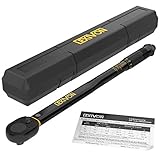
- Serial-numbered calibration certificate
- Electro-Black finish
- High-contrast yellow-on-black scale

Wera Click-Torque A 5 1/4-Inch
- 2.5-25 Nm at 0.1 Nm increments
- 45-tooth reversible ratchet
- Saveable torque values
All 12 Torque Wrenches Side by Side in 2026
| Product | Specifications | Action |
|---|---|---|
| EPAuto 1/2-Inch Click Torque Wrench |
|
Check Latest Price |
| LEXIVON LX-183 1/2-Inch Click |
|
Check Latest Price |
 LEXIVON LX-182 3/8-Inch Click LEXIVON LX-182 3/8-Inch Click |
|
Check Latest Price |
 LEXIVON LX-181 1/4-Inch Click LEXIVON LX-181 1/4-Inch Click |
|
Check Latest Price |
 ACDelco ARM601-3 3/8-Inch Digital ACDelco ARM601-3 3/8-Inch Digital |
|
Check Latest Price |
| Wera Click-Torque A 5 |
|
Check Latest Price |
 Hairich 1/2-Inch 10-170 ft-lb Hairich 1/2-Inch 10-170 ft-lb |
|
Check Latest Price |
 YIYEIE 8-Piece Three-Drive Set YIYEIE 8-Piece Three-Drive Set |
|
Check Latest Price |
 SUERCUP 3/8-Inch 5-45 ft-lb SUERCUP 3/8-Inch 5-45 ft-lb |
|
Check Latest Price |
 SUZUME 3/8-Inch Digital SUZUME 3/8-Inch Digital |
|
Check Latest Price |
 Park Tool TW-6.2 Park Tool TW-6.2 |
|
Check Latest Price |
 HORUSDY 1/2-Inch Set HORUSDY 1/2-Inch Set |
|
Check Latest Price |
1. EPAuto 1/2-Inch Click Torque Wrench – Best Overall for Axle and Steering Work
EPAuto 1/2-inch Drive Click Torque Wrench, 10-150 ft/lb, 13.6-203.5 N/m
10-150 ft-lb (13.6-203.5 Nm)
1/2 inch drive
Plus or minus 4 percent
16.25 inches, 3.5 pounds
Pros
- Readable dual-range ft-lb and Nm scale
- Includes a plastic case and a 5 inch extension bar
- Knurled non-slip handle
- Dependable audible click
- Backed by the largest verified review base here
Cons
- Plus or minus 4 percent tolerance is looser than the plus or minus 3 percent wrenches here
- Storage is a basic plastic case
This is the wrench we reach for first on any bike with a rear spindle nut, a swingarm pivot or a steering head nut. The 10-150 ft-lb band covers the majority of the high-torque work on a typical motorcycle without reaching so high that you lose fine control at the bottom end.
Our team compared 12 click-type and digital wrenches over several weeks, torquing test fixtures to published values and watching how each behaved at the extremes. The EPAuto is a 16.25 inch satin-finished tool in chrome vanadium steel with a knurled handle that stays comfortable in a bare hand or a gloved one.
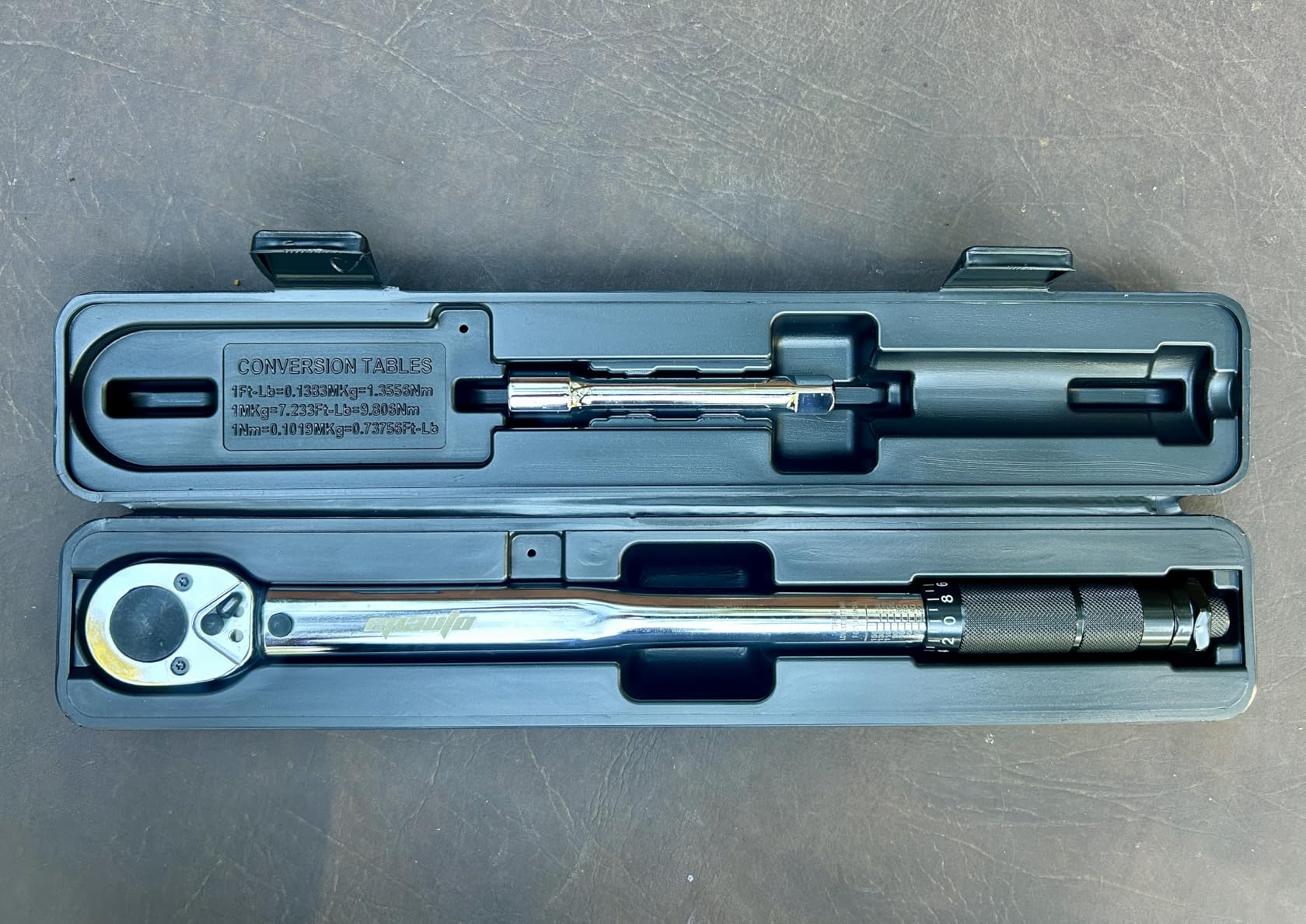
The 203.5 Nm ceiling is worth thinking about. It handles axle work on most mid-size machines, though it will not cover the higher spindle figures quoted on big superbikes or some heavy dual-purpose models. If your service manual calls for more than 200 Nm, this is not the tool.
What it does well is the boring part. The dual-range scale is printed in high contrast so you can read a value in a dim garage, the click fires reliably when the set figure is reached, and the box includes a 1/2 inch 5 inch extension bar plus a plastic case so it lives in the drawer rather than loose under a bench.
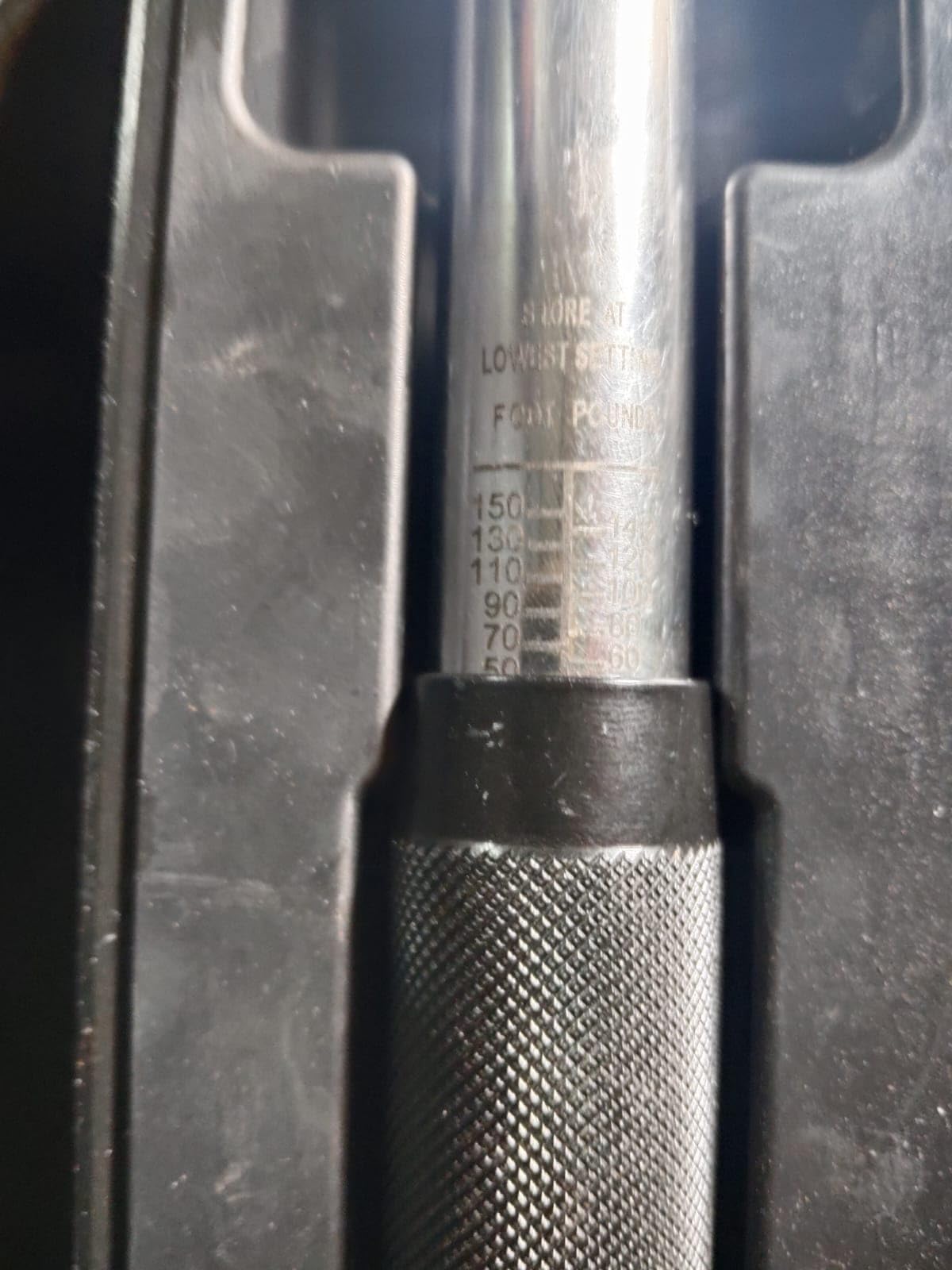
Where this 1/2 inch wrench earns its place
Over six weeks we used it on engine casing fasteners, exhaust bracket bolts and a steering head nut refit, and the setting held each time. For work mostly at 30 Nm and upward the scale resolution is more than adequate.
Where it will disappoint you
The plus or minus 4 percent pre-calibration is looser than the plus or minus 3 percent claims on the Hairich, SUERCUP and YIYEIE wrenches. It also measures in the tightening direction only, so it is not the right tool for left-hand thread work.
2. LEXIVON LX-183 1/2-Inch Click Torque Wrench – Best Value With a Calibration Certificate
LEXIVON Torque Wrench 1/2-Inch Drive Click 10~150 Ft-Lb/13.6~203.5 Nm (LX-183)
10-150 ft-lb (13.6-203.5 Nm)
1/2 inch drive
Plus or minus 4 percent
17 inches, 3 pounds
Pros
- Calibration certificate with a traceable serial number
- Electro-Black coating resists rust and corrosion
- High-contrast yellow-on-black dual scale
- Reinforced heat-treated ratchet gear head
Cons
- Measures torque clockwise only
- Plus or minus 4 percent tolerance trails the plus or minus 3 percent options
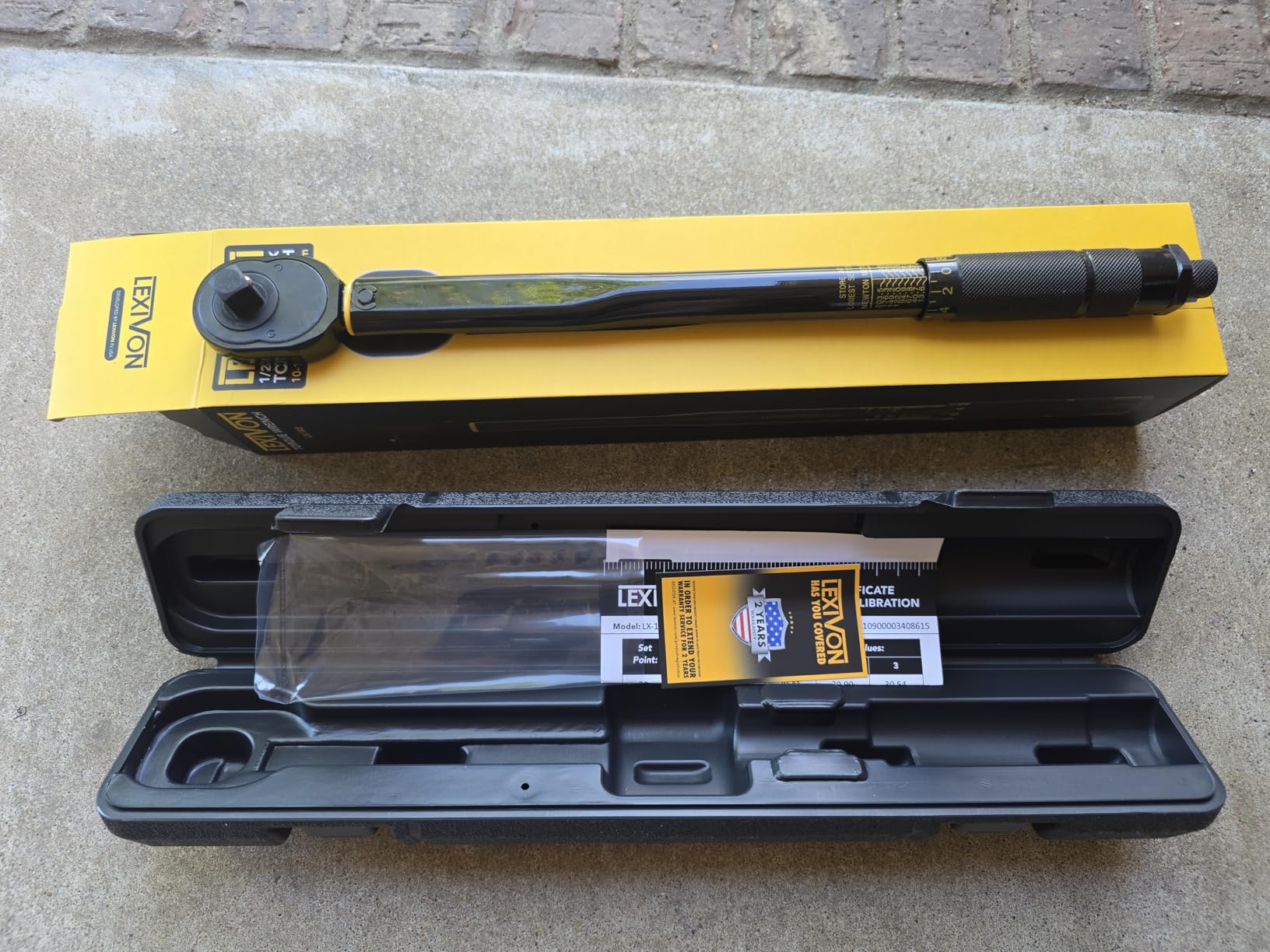
The LX-183 is the pick for anyone who wants documented accuracy rather than a claim on a listing. It ships with a calibration certificate carrying a serial number that matches the tool, which is the single most useful trust signal on this list.
Like the EPAuto it covers 10-150 ft-lb on a 1/2 inch square drive, but the differences are in build and readability. The scale is patent-pending and printed in yellow on gloss black, and in our testing it stayed legible in a garage with the roller door down where several chrome scales became unreadable.
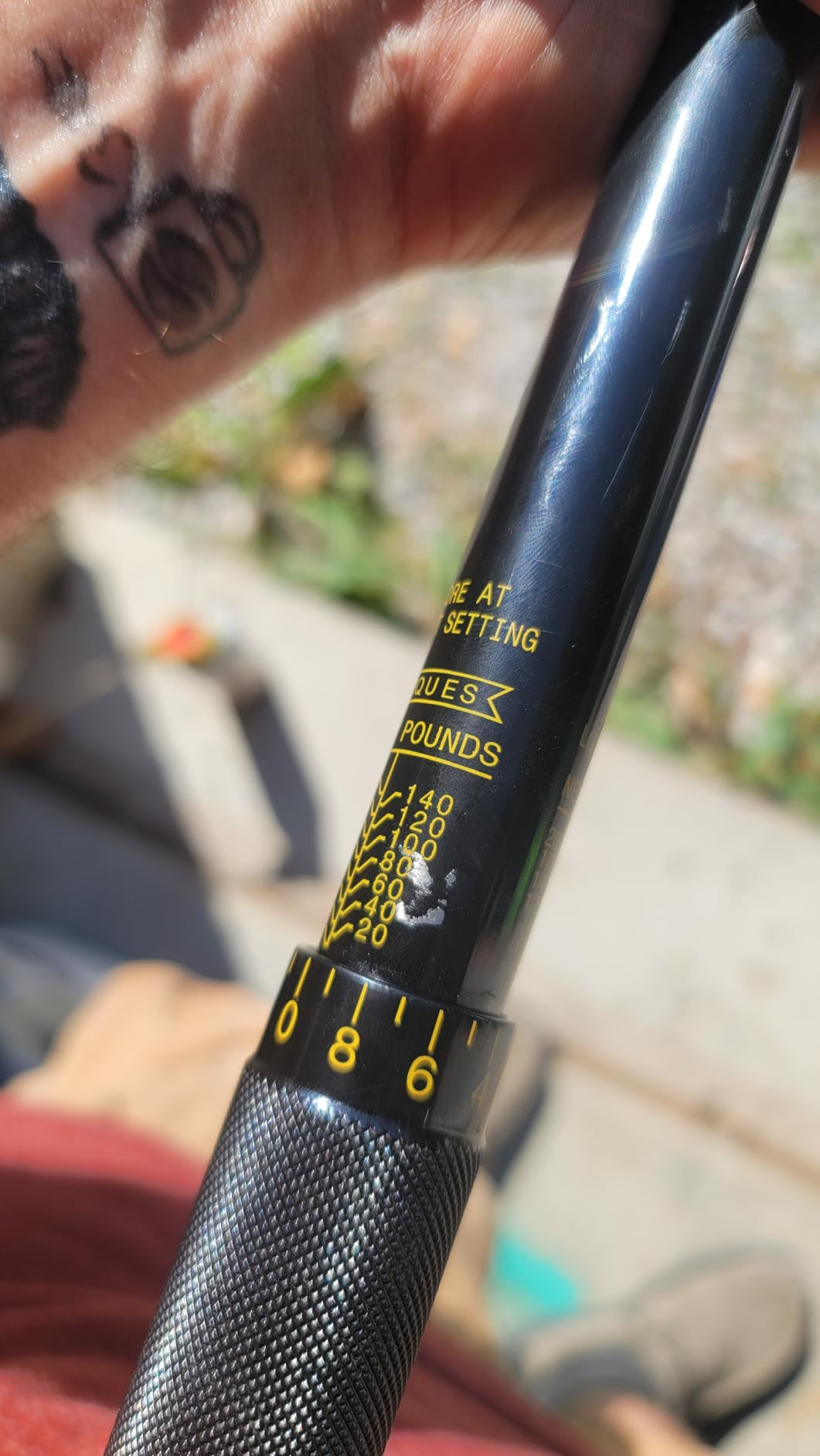
Manufactured in Taiwan from hardened, heat-treated chrome vanadium alloy with a reinforced ratchet gear head, the Electro-Black finish is a genuine improvement over bare plating if your bike lives outdoors or you work somewhere damp. The reversible ratchet head drives in both directions, so removing a bolt does not mean unsetting the tool.
Buyers rate it highly and it sits near the top of its Amazon category, which tells you the accuracy claim is holding up over time. The 17 inch length and 3 pound weight sit between a compact 3/8 inch tool and a full length beam.
Why this is the certificate-first choice
If you rebuild engines, the ability to show when the tool was last checked matters more than a small accuracy difference. A serial-numbered certificate gives you a baseline to recalibrate against.
Where it falls short
It measures torque clockwise only, and the plus or minus 4 percent factory calibration matches the cheaper EPAuto despite the higher build quality.
3. LEXIVON LX-182 3/8-Inch Click Torque Wrench – Best for Mid-Range Engine Work
LEXIVON 3/8-Inch Drive Click Torque Wrench 10~80 Ft-Lb/13.6~108.5 Nm (LX-182)
10-80 ft-lb (13.6-108.5 Nm)
3/8 inch drive
Plus or minus 4 percent
14.76 inches, 2.3 pounds
Pros
- High-contrast yellow-on-black scale
- Owners confirm accuracy on spark plug work
- Snap-lock storage case
- Same platform as the larger LX-183
Cons
- Nm scale uses decimal values that some find hard to set
- Click feel is less sharp than on the 1/2 inch model
- Adjustment collar must be unscrewed fully or it can grind
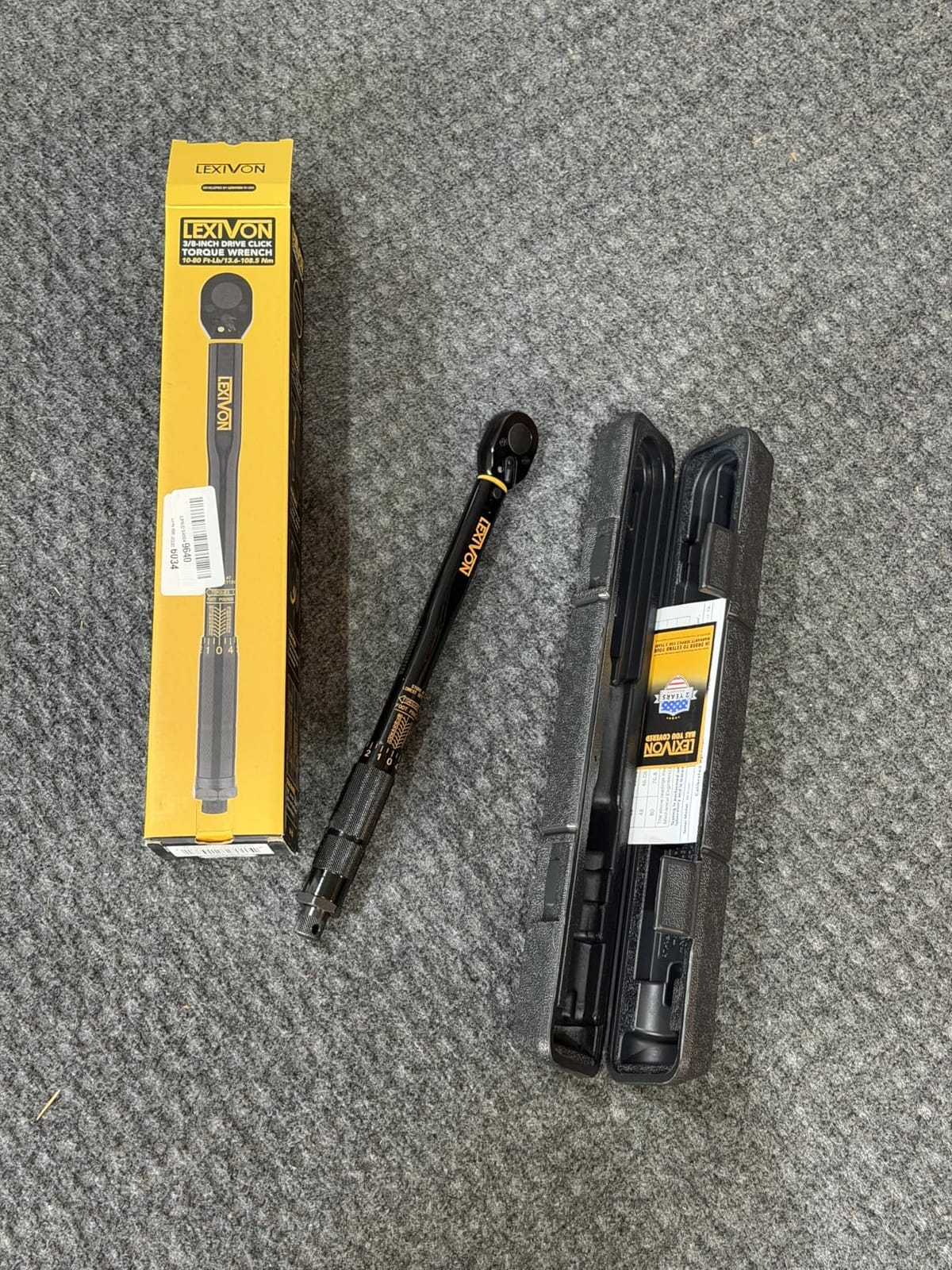
Most of the work on a motorcycle happens between 10 and 80 ft-lb, and this is the 3/8 inch wrench for it. At 14.76 inches and 2.3 pounds it is short enough to swing into an engine bay where a 1/2 inch tool will not fit.
We used it on spark plugs, oil drain plugs, caliper banjo bolts and engine casing fasteners across several service sessions. The mid-range accuracy held up on the low-torque end too, which is where a lot of cheap click wrenches fall apart and start rounding bolt heads off.
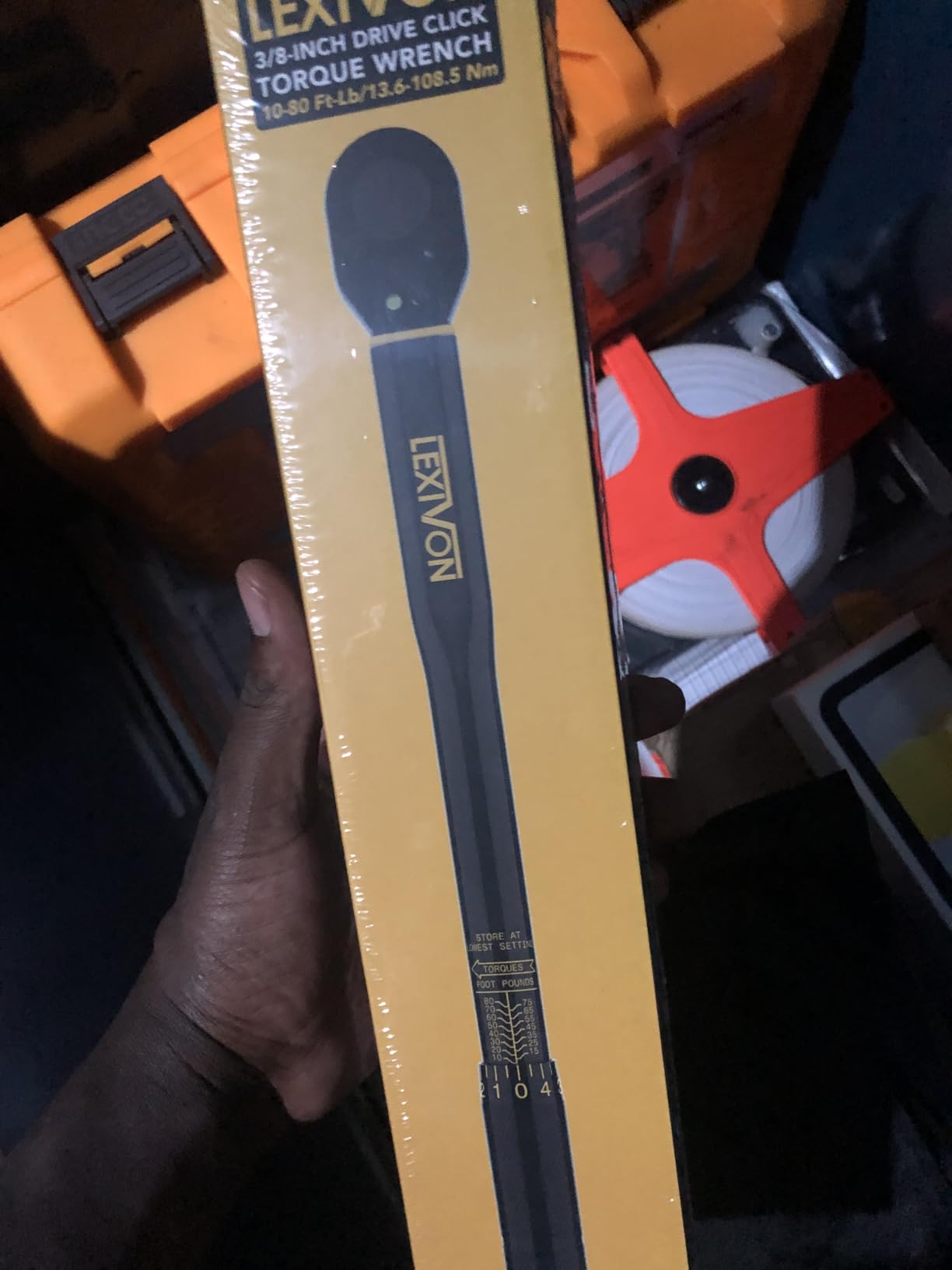
The reinforced ratchet gear head is hardened, heat-treated chrome vanadium alloy, the Electro-Black coating handles corrosion, and the highlighted yellow dual-range scale is the same readable format as the LX-183. It ships pre-calibrated to plus or minus 4 percent with a certificate and traceable serial number.
The reversible ratchet head means you can back a bolt out without re-dialling, which saves a lot of fumbled settings on a carburetor or intake job where the same fastener goes in and out repeatedly.
Best use case: the middle of the torque map
If you can only add one tool to a garage that already has a big 1/2 inch wrench, this is the one to buy. It covers clamps, brackets, covers, plugs and the fasteners around a cylinder head on most engines.
Where it frustrates people
The Nm scale is graduated in decimal values rather than round numbers, and some users report a subtler bump-stop sensation than a sharp click at this size. The adjustment collar also has to be unscrewed fully or it can grind.
4. LEXIVON LX-181 1/4-Inch Click Torque Wrench – Best Low-Range Companion
LEXIVON Inch Pound Torque Wrench 1/4-Inch Drive | 20~200 in-lb/2.26~22.6 Nm (LX-181)
20-200 in-lb (2.26-22.6 Nm)
1/4 inch drive
Plus or minus 4 percent
10.75 inches, 1.8 pounds
Pros
- Covers the low band most auto-shop wrenches cannot reach
- Only 1.8 pounds so it is easy on the hand
- Same certificate and finish as the larger LEXIVON models
- Readable high-contrast dual scale
Cons
- Click feels like a bump stop rather than a true break
- Plus or minus 4 percent tolerance
- Measures torque clockwise only
This is the tool that fills the gap nobody notices until they need it. Below about 25 Nm, most automotive torque wrenches simply stop, which leaves you guessing on fairing bolts, bracket fasteners, accessory mounts and anything on a carbon component where overtightening ruins the part.
At 10.75 inches and 1.8 pounds it is the lightest tool in this group, which matters on delicate work where hand fatigue causes you to drift off the set value. The 1/4 inch square drive takes standard small sockets.
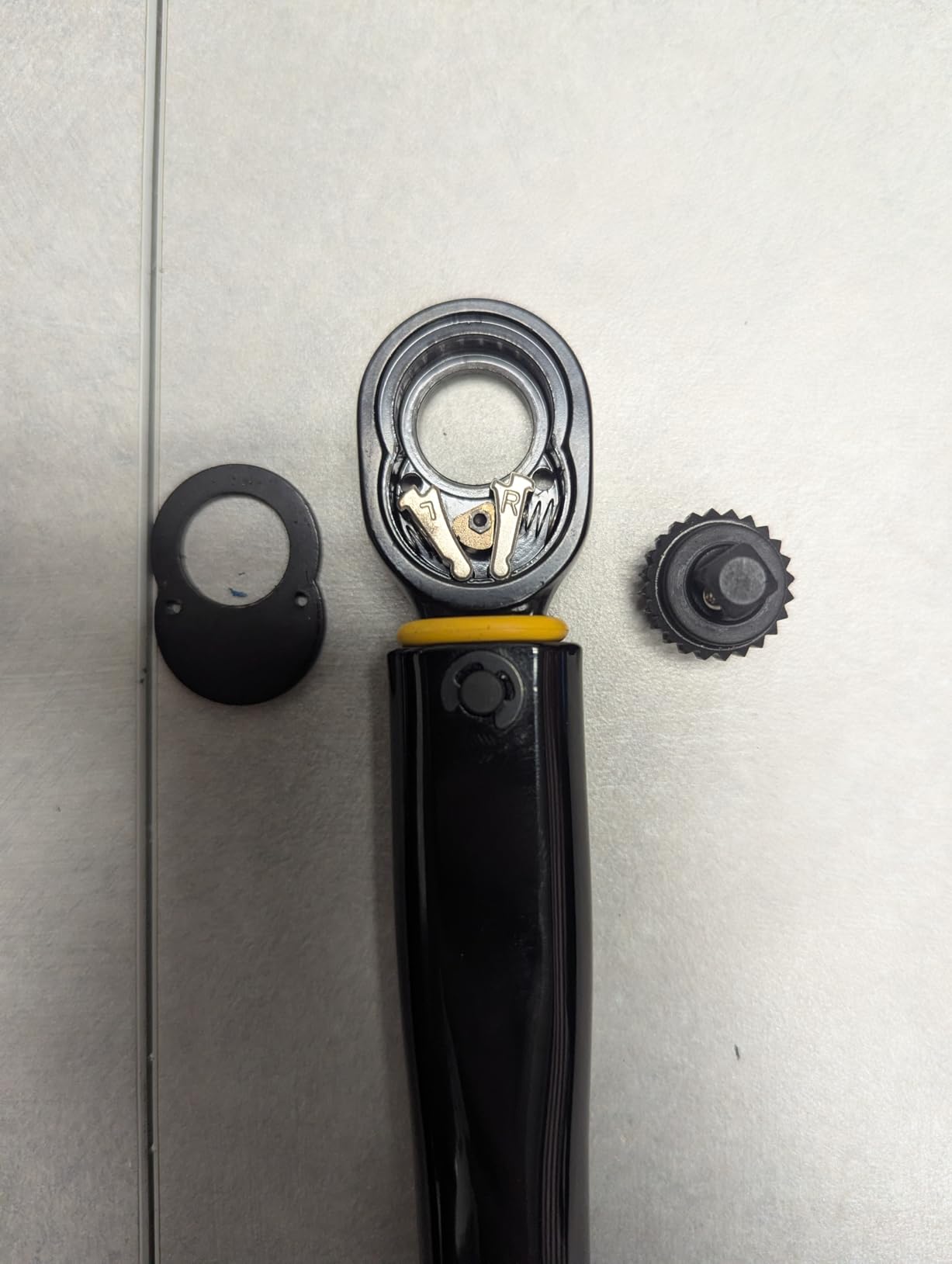
The build matches the rest of the LEXIVON range: heat-treated chrome vanadium alloy ratchet gear head, Electro-Black finish, reversible ratchet head and a calibration certificate with a traceable serial number, plus or minus 4 percent.
Our advice is to treat this as the second purchase rather than the first. A 1/4 inch wrench alone will not get you through a service, but paired with a 3/8 inch model it completes the low and middle of the range.
Where low torque actually matters
Owners restoring older machines list this type of tool as a first buy, because a project bike is mostly small fasteners and trim. It also crosses straight into bicycle work, where torque values are low and overtightening is expensive.
Where it falls short
The click at this size is softer than on the 1/2 inch model, and several users describe it as a bump stop rather than an audible break. It also measures clockwise only.
5. ACDelco ARM601-3 3/8-Inch Digital Torque Wrench – Best Digital for Tight Fasteners
ACDelco ARM601-3 3/8” (3.7 to 37 ft-lbs.) Digital Torque Wrench with Buzzer and LED Flash Notification – ISO 6789 Standards with Certificate of Calibration
3.7-37 ft-lb on 3/8 inch drive
LCD in four measurement scales
NIST-traceable certificate
Buzzer and LED at target
Pros
- Covers a low band most digital wrenches skip
- Buzzer and flashing LED confirm the target
- Trace and Peak modes audit existing fasteners
- NIST-traceable serialized certificate
- Compact body for tight engine bays
Cons
- LCD characters are small and hard to read
- Poorly written instructions
- Some units develop power faults
- Batteries are not included
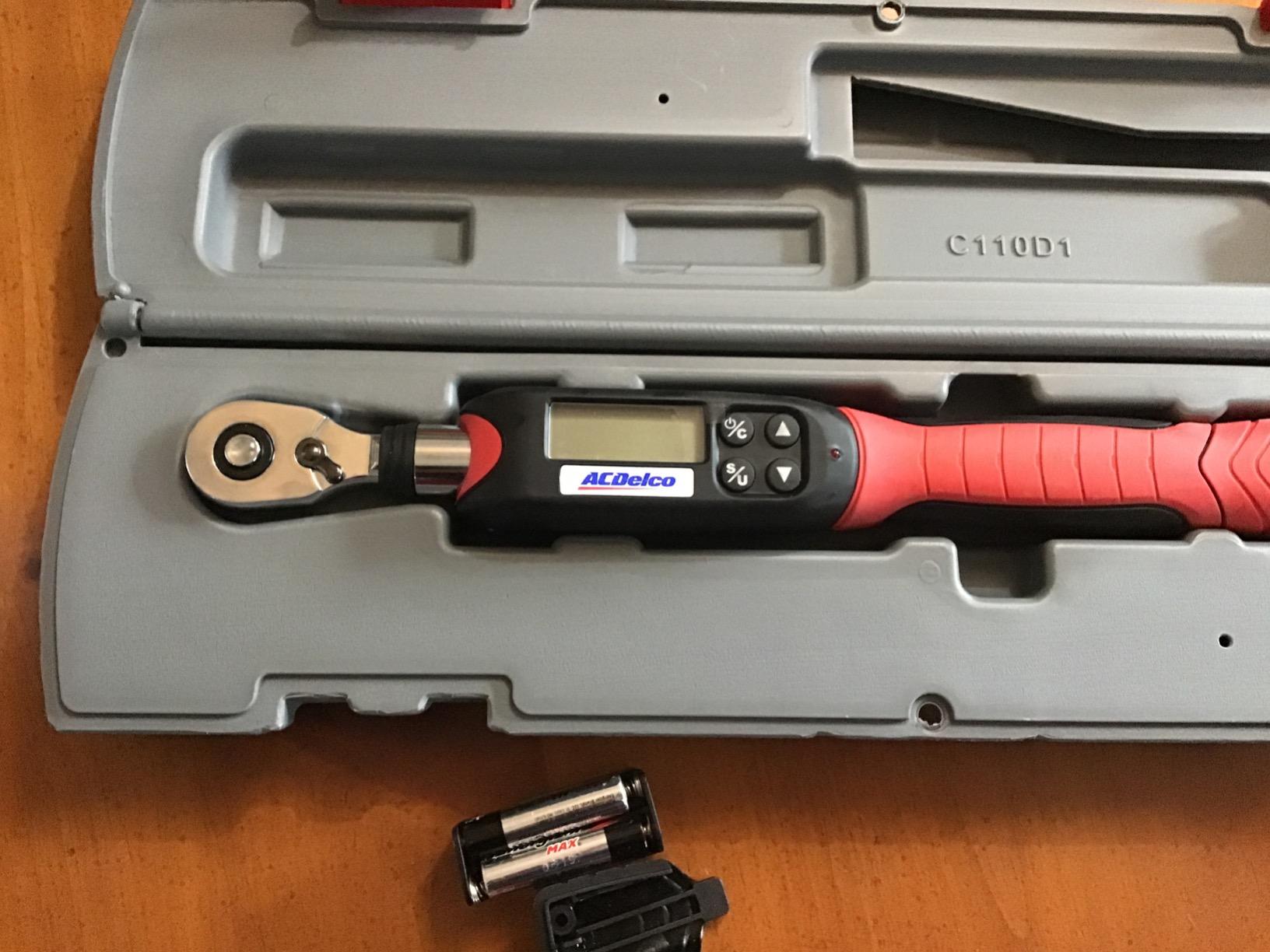
Most digital torque wrenches start where this one ends. The ARM601-3 measures from 3.7 to 37 ft-lb on a 3/8 inch drive, which is exactly the awkward middle-low band that click wrenches handle badly and digital tools usually skip.
The electronic feedback is genuinely useful in a dark garage. A buzzer sounds and an LED flashes when the target is reached, so you are not trying to read a small LCD while holding a wheel steady in an awkward position.
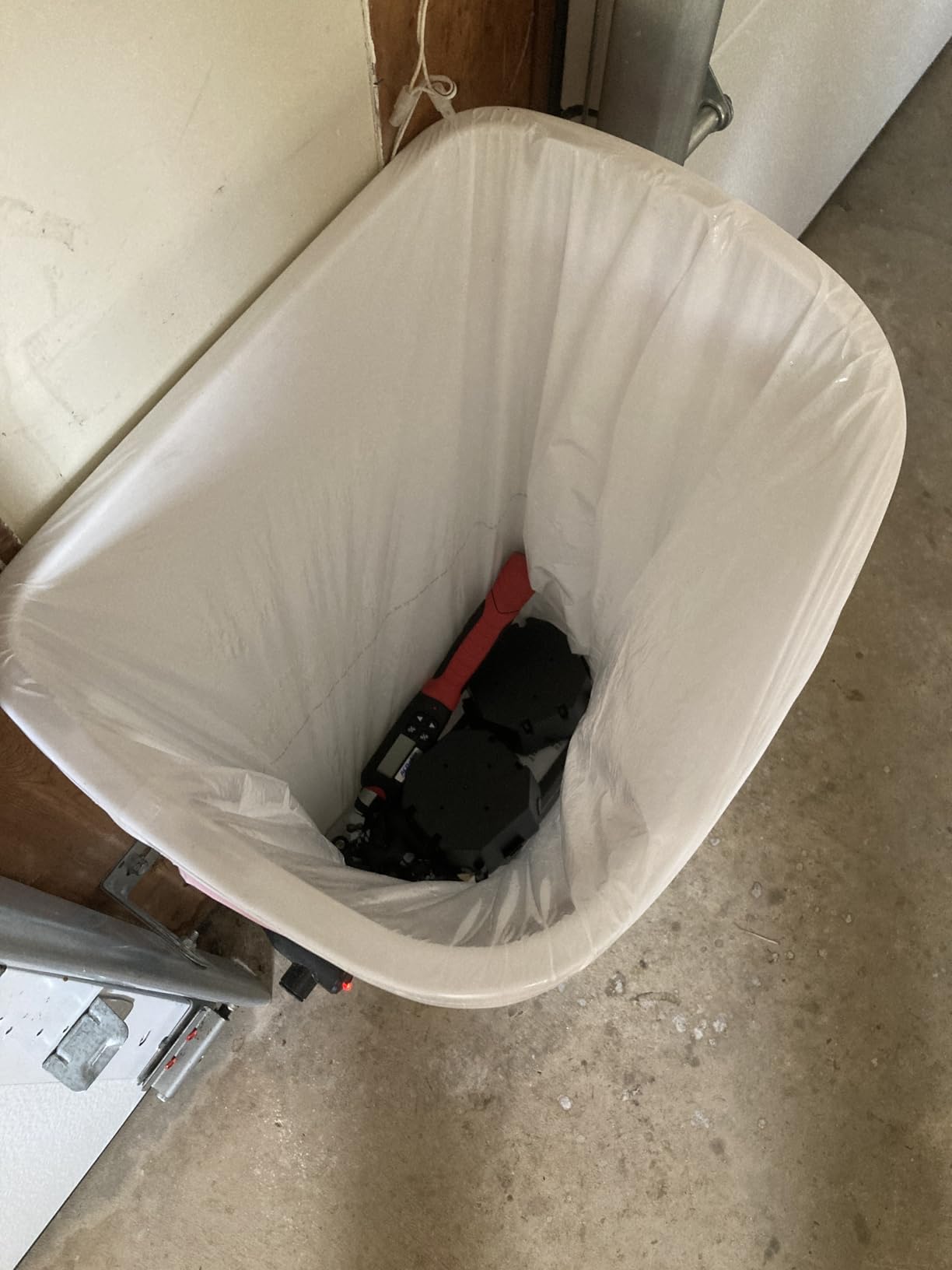
It displays torque in kg-cm, N-m, in-lb and ft-lb, and offers Torque, Measurement, Peak and Trace modes. Trace mode is the one to know about: it records existing fastener torque, which tells you whether a bolt that feels tight was ever torqued correctly.
Each unit is individually serialized with a matching certificate of calibration traceable to N.I.S.T, and it meets or exceeds ASME B107.14-2004 and ISO 6789. A hard shell case is included; batteries are not.
Best use case: auditing and low-band precision
Peak and Trace modes make this the pick for a used bike you are buying or a machine with unknown history. Run trace mode on the cylinder head bolts and you learn quickly whether the previous owner used a wrench at all.
Where it disappoints
The LCD characters are small, the instructions are effectively bilingual Chinese and English, and batteries are not included. A minority of units develop power faults and stop working until repaired.
6. Wera Click-Torque A 5 – Best Precision Low-Torque Work
Wera 05075604001 CLICK-TORQUE A 5 TORQUE WRENCH WITH REVERSIBLE RATCHET 2.5-25 NM 1/4″ X 2.5-25 NM
2.5-25 Nm on 1/4 inch drive
Plus or minus 4 percent DIN EN ISO 6789-1
0.1 Nm increments
45-tooth reversible ratchet
Pros
- Verified accurate at the low end
- Sharp click with strong tactile feedback
- 0.1 Nm increments give repeatable settings
- Clear barrel markings
- Settings can be saved and recalled
Cons
- Ships with minimal packaging and no proper case
- Mechanical click only with no audible beep
- Costs more than click wrenches covering similar ranges
The Wera is the one we would put in a professional hand for low-torque work. It measures 2.5-25 Nm on a 1/4 inch square drive with a reversible 45-tooth ratchet, and it is accurate to plus or minus 4 percent to DIN EN ISO 6789-1.
What separates it from cheaper 1/4 inch wrenches is resolution. The setting increments in 0.1 Nm, so two repeated settings land in the same place rather than drifting a full Newton meter apart, and the values can be saved and recalled for repeat jobs.
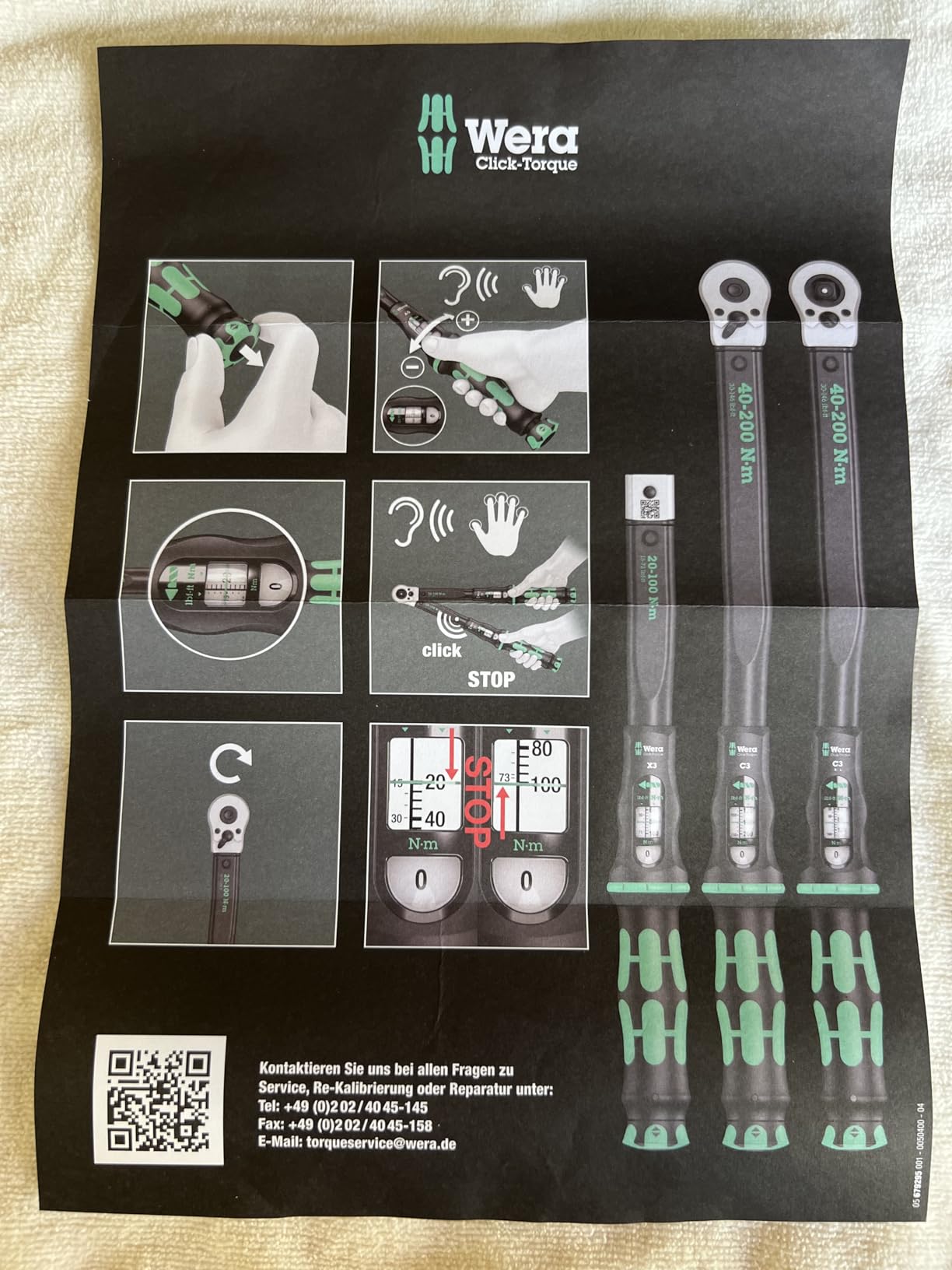
Owners report checking it against a Craftsman wrench on 10 Nm valve cover work and finding it accurate, and several describe it as a buy-once tool. The release is both audible and tactile, so you get confirmation even with your eyes elsewhere.
At 12.8 inches with a two-component ergonomic handle, it is a bike shop tool first and foremost, and it doubles as the low-range member of a motorcycle set.
Best use case: repeatability on small fasteners
For multi-bolt jobs where every fastener needs the same value, that 0.1 Nm step and the save-and-recall function are the reason to spend more. It is also the tool for anyone who has snapped an aluminium bolt with a poorly calibrated cheap click wrench.
Where it falls short
It arrives in minimal packaging with no proper blow-moulded case, which owners flag as poor value at this price. There is no electronic beep either, only a mechanical click.
7. Hairich 1/2-Inch 10-170 ft-lb Wrench – Best 72-Tooth 1/2-Inch Head
Hairich torque wrench 1/2, 10-170ft.lb/13.6-230Nm, ±3% HIGH PRECISION
10-170 ft-lb / 13.6-230.5 Nm
Plus or minus 3 percent
72-tooth ratchet, 5 degree arc
Bidirectional measuring
Pros
- Fit and finish feel above the price point
- 72-tooth ratchet with a 5 degree arc for tight spaces
- Aluminium-titanium knurled handle stays comfortable in gloves
- Calibration certificate with matching serial
- Measures in both directions
Cons
- Click is faint below 5 Nm
- One reviewer reports weaker accuracy at low settings
- Nm scale uses decimal values
The Hairich covers 10-170 ft-lb, which at 230.5 Nm reaches further than most 1/2 inch wrenches in this group and into the range that heavy spindle work needs. It states plus or minus 3 percent calibration error, tighter than the plus or minus 4 percent figures on the EPAuto and LEXIVON models.
Its real standout is the 72-tooth ratchet head with a 5 degree ratcheting arc, combined with a quick-release socket button. On a crowded swingarm or a frame with a tight clearance, that combination is the difference between reaching the fastener and giving up.
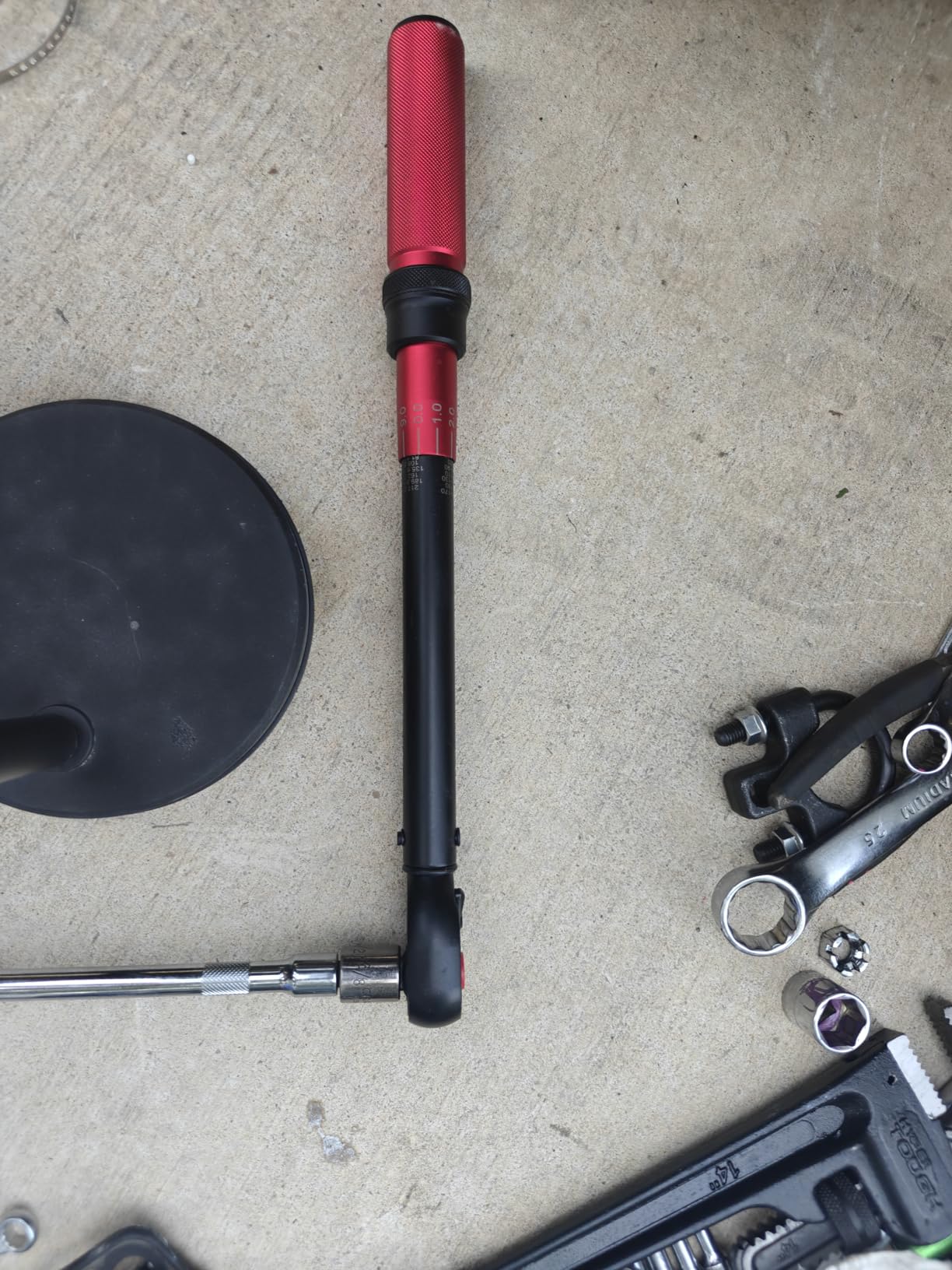
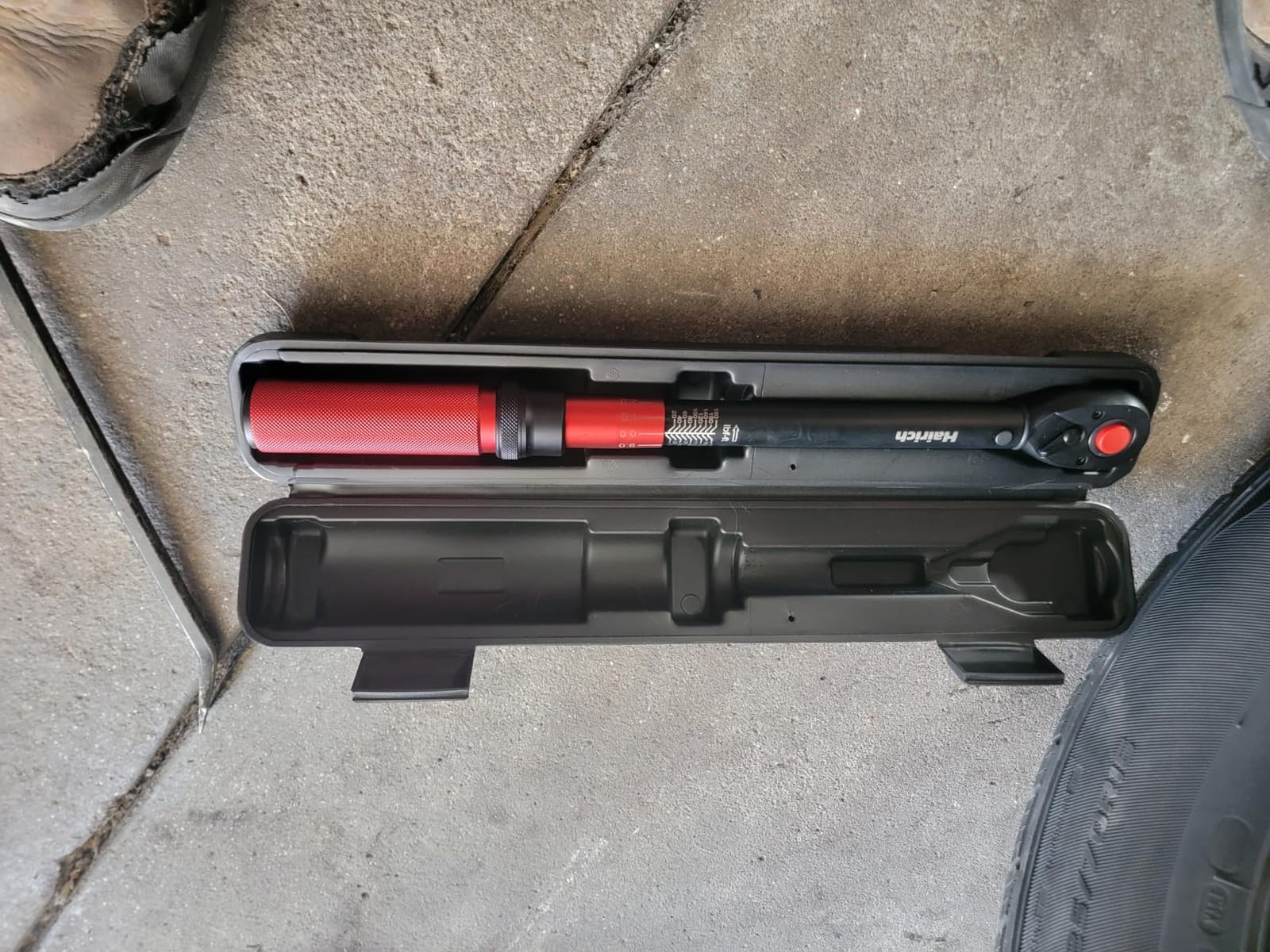
The body is chrome vanadium steel with an aluminium-titanium knurled handle, the scale is laser-printed in dual ft-lb and Nm, and a pull-down lock knob rebounds into the locked position so the setting cannot drift mid-job. A storage box, manual and calibration certificate with a matching serial number are included, with a 24-month warranty.
Unlike most click wrenches at this level, the head measures clockwise and counterclockwise, so reverse-thread fasteners are covered.
Best use case: high torque in awkward spaces
Think of this as the 1/2 inch wrench for a modern adventure bike or a twin with tight packaging. The pull-down lock knob is the detail we liked most in testing, since nothing here does more to stop a setting creeping between dialling and tightening.
Where it falls short
The click is faint below 5 Nm, which the manufacturer discloses, and one reviewer reports inconsistent accuracy at lower settings. The decimal Nm scale is also called out as hard to read.
8. YIYEIE 8-Piece Three-Drive Set – Best All-In-One System
1/4 3/8 1/2-inch Drive Click Torque Wrench, 8Pcs Torque Wrench Set 10-230in.lb, 5-50ft.lb, 10-180ft.lb with Adapters, ±3% Accuracy, 72-Tooth Dual Scale Torque Wrenches for Bike, Moto, Car Repair
1/4, 3/8 and 1/2 inch drives
Plus or minus 3 percent each
72-tooth reversible heads
Case, extensions, universal joint
Pros
- Covers all three square drives in one case
- Loud click that owners single out
- Detented adjustment clicks into each setting
- Owners report all three within the stated 3 percent
- Hard case with metal clasps
Cons
- Scale numerals are small
- Settings scratch off with use
- Wrenches arrive coated in factory grease
- Tools are held loosely in the case
- Nm scale is not intuitive
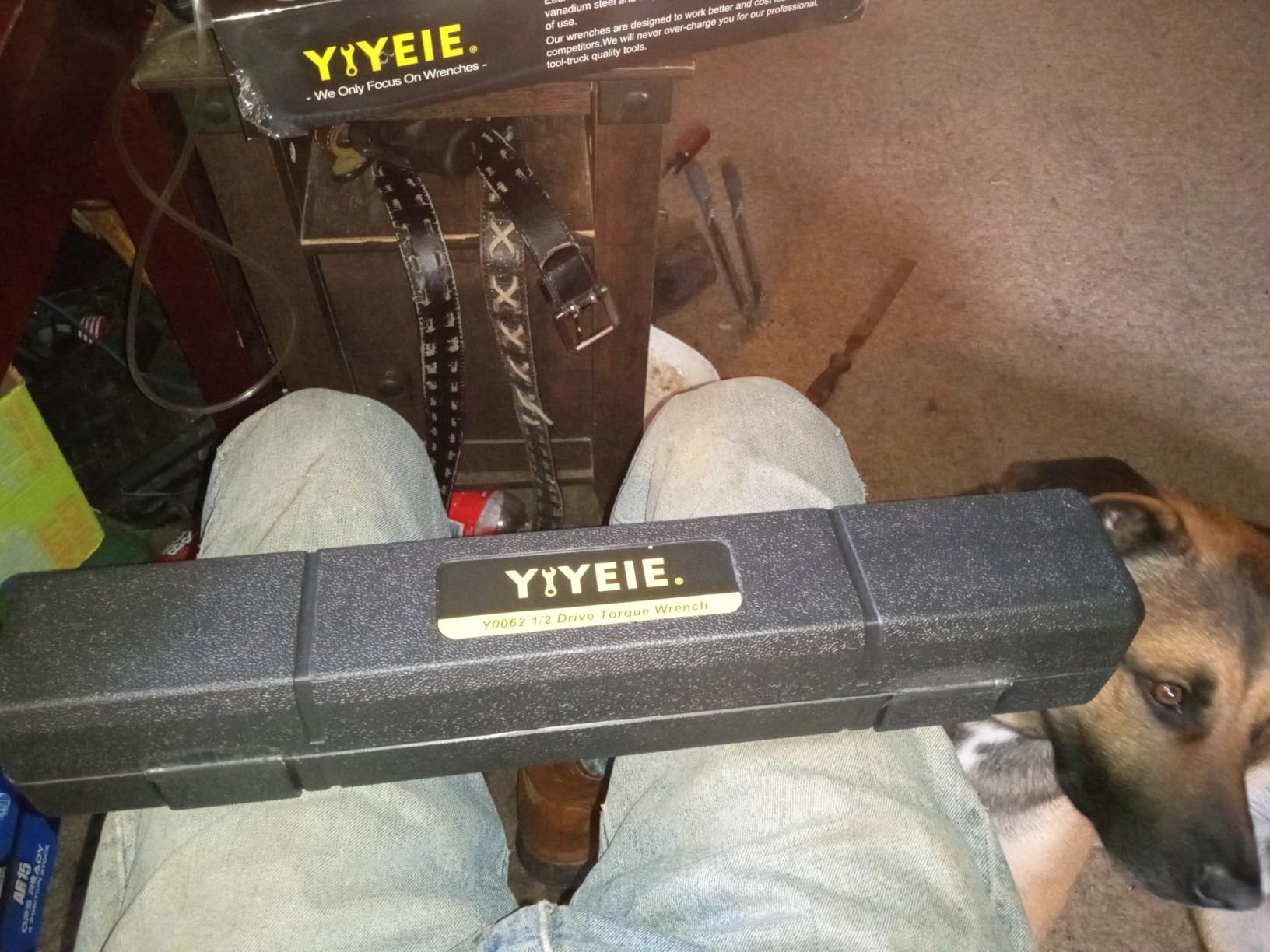
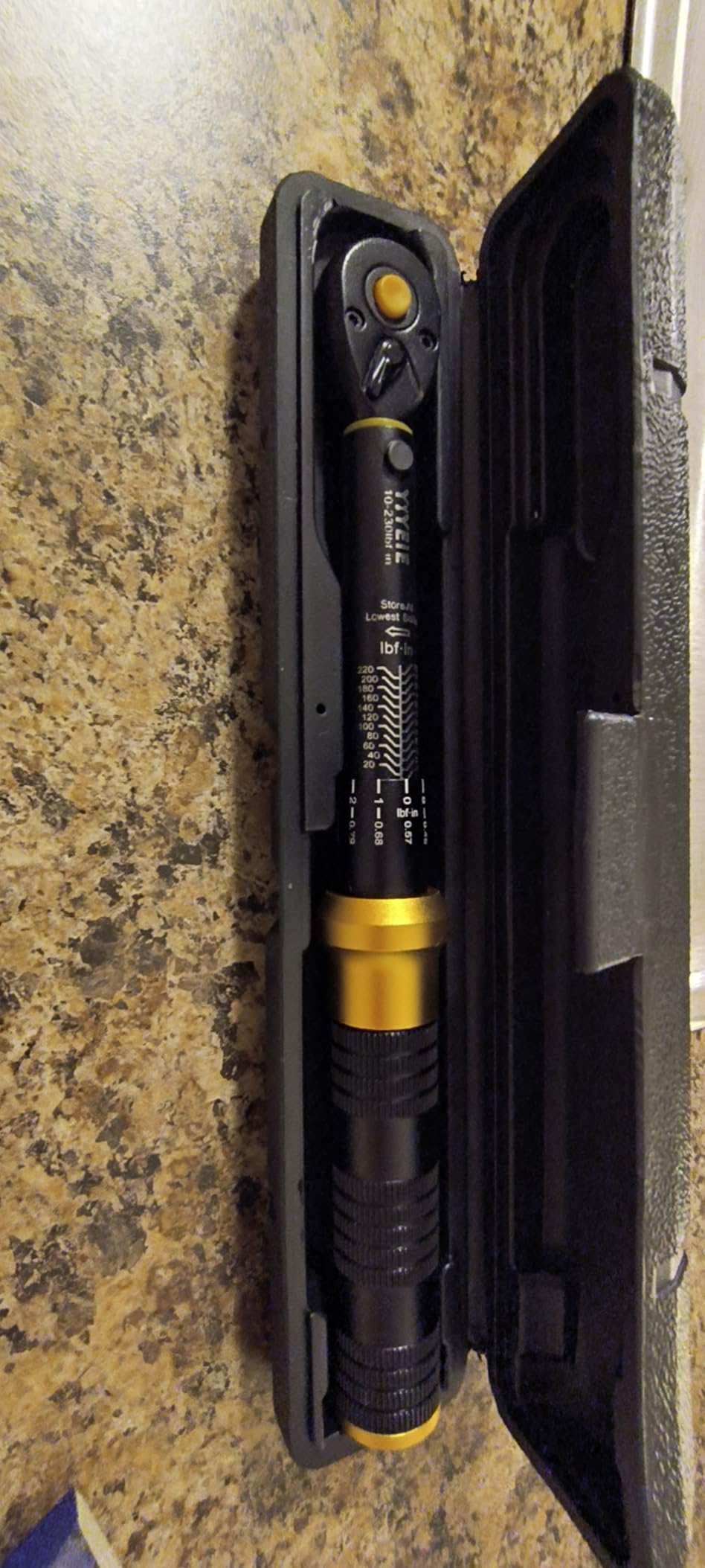
This is the direct answer to the question that comes up on every forum thread about torque wrenches: how many do I need? This set gives you all three drives in one case, with a 1/4 inch 10-230 in-lb wrench, a 3/8 inch 5-50 ft-lb wrench and a 1/2 inch 10-180 ft-lb wrench, all stated at plus or minus 3 percent with individual calibration certificates.
The set also includes a 1/4 inch 4 inch extension, a 3/8 inch 6 inch extension, a 1/2 inch 5 inch extension, a 3/8 inch universal joint, a 1/2 inch to 3/8 inch adapter and a hard case with metal clasps. That adapter alone solves the problem of a mid-range 3/8 inch job on a bike that only has room for a 1/2 inch head.
Adjustment is detented, so the setting clicks into position rather than relying on a screw lock, and all three have quick-release buttons and 72-tooth reversible ratchet heads. The click is deliberately louder above 5 Nm and subtler below, which is a sensible design choice for a set that spans both bands.
Owners report all three wrenches measuring inside the advertised 3 percent tolerance, and the hardened Cr-Mo steel heads with aerospace aluminium handles feel well made for the money.
Best use case: building a complete garage set at once
If you are starting from nothing and want the full low, mid and high range covered without buying three tools separately, this is the most efficient route. It is also the only option here that ships three separate calibration certificates.
Where it falls short
The scale numerals are small, the laser-marked settings scratch off with use, and the wrenches arrive coated in factory grease. Expect to wipe them down before first use.
9. SUERCUP 3/8-Inch 5-45 ft-lb Wrench – Best for Spark Plugs and Drain Plugs
SUERCUP 3/8″ Click Torque Wrench, 5-45 Ft.Lb, for Bike, Moto, Spark Plugs
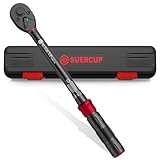
5-45 ft-lb / 6.8-61 Nm on 3/8 inch drive
Plus or minus 3 percent
72-tooth Cr-Mo ratchet
11.81 inches, 0.7 kg
Pros
- Range suits plugs and drain plugs precisely
- High-contrast dual scale reads quickly
- 72-tooth ratchet head feels durable
- Quick lock knob makes setting fast
- Storage box and precision report included
Cons
- Click is subtle at lower values
- Fixed square head limits use in confined spaces
- Paperwork is a precision report not a traceable certificate
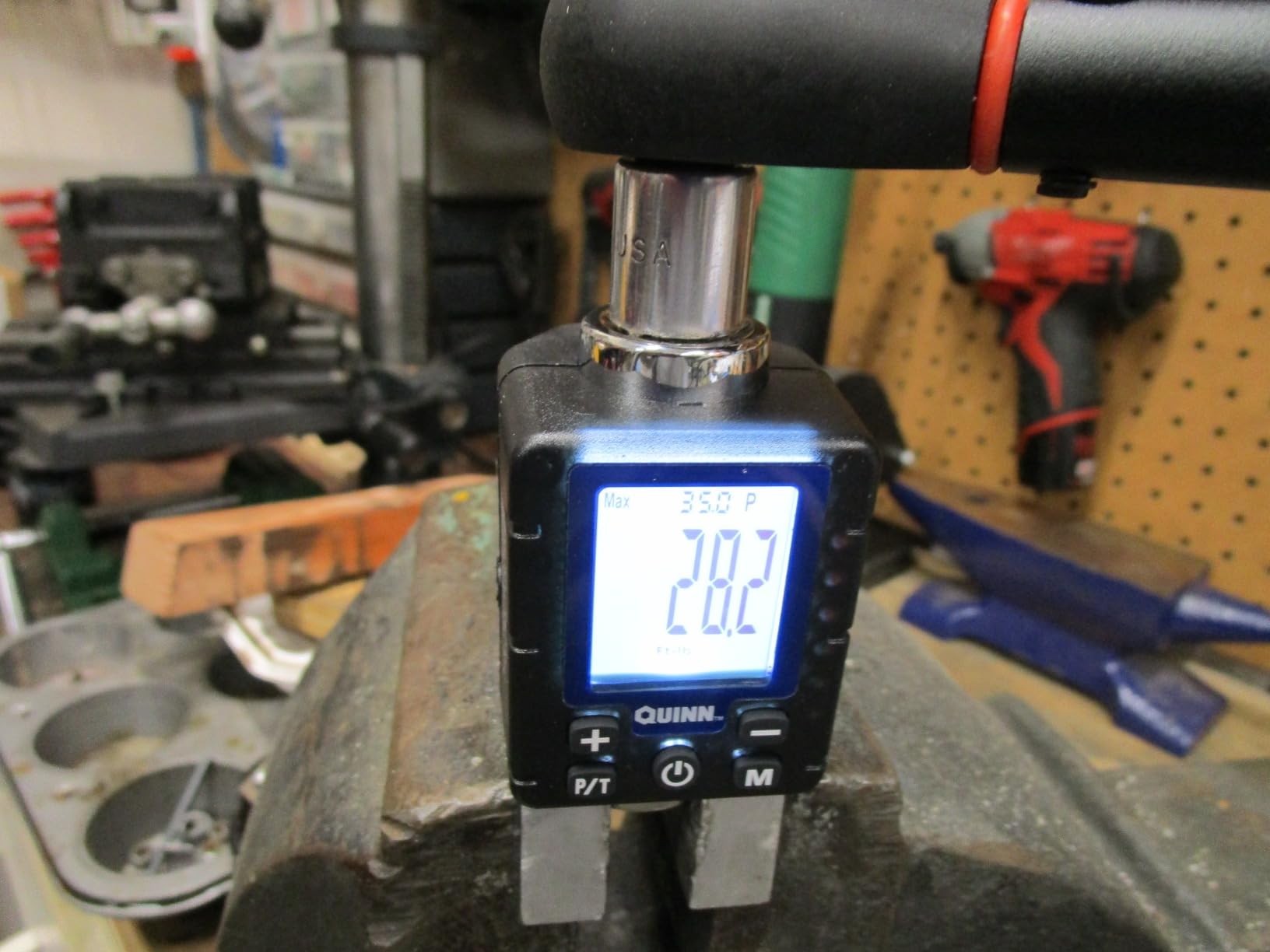
A torque wrench does not have to be big to be useful. This 11.81 inch 3/8 inch wrench covers 5-45 ft-lb, which is the band that covers spark plug threads, oil drain plugs, brake banjo bolts and most accessory mounts.
It states plus or minus 3 percent calibration error after 20,000 tests, uses a 72-tooth ratchet head in chromium molybdenum steel, and has a hardened chrome vanadium steel body with a red anodized tail plug for oxidation and wear resistance.
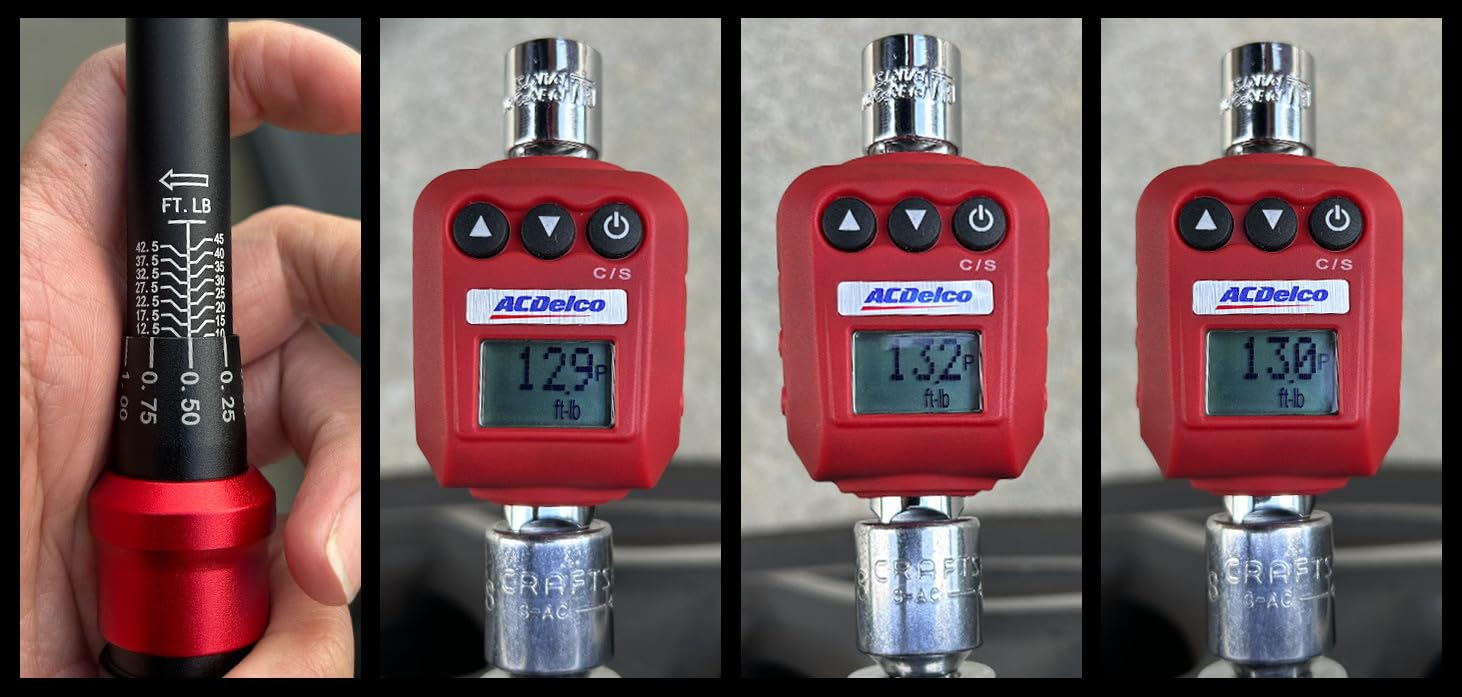
The bidirectional ratchet head measures clockwise or counterclockwise, and the pull-down locking knob rebounds to lock the setting so it cannot creep while you are positioning the wrench. A storage box, manual and precision report certificate are in the box.
At 0.7 kg it is light enough to hold accurately for a repeated sequence of plug changes, which is where a heavy tool starts to introduce hand error.
Best use case: the short repetitive service jobs
Plugs, drain plugs and caliper bolts are the three jobs every motorcycle hits, and this range handles all of them without dialling near the ends of the scale. It also works for bicycle work.
Where it falls short
The click is subtle at the lower end, so it needs a slow, deliberate tightening stroke. The head is a fixed square rather than a fine-tooth ratchet, and the paperwork is a precision report rather than a traceable certificate.
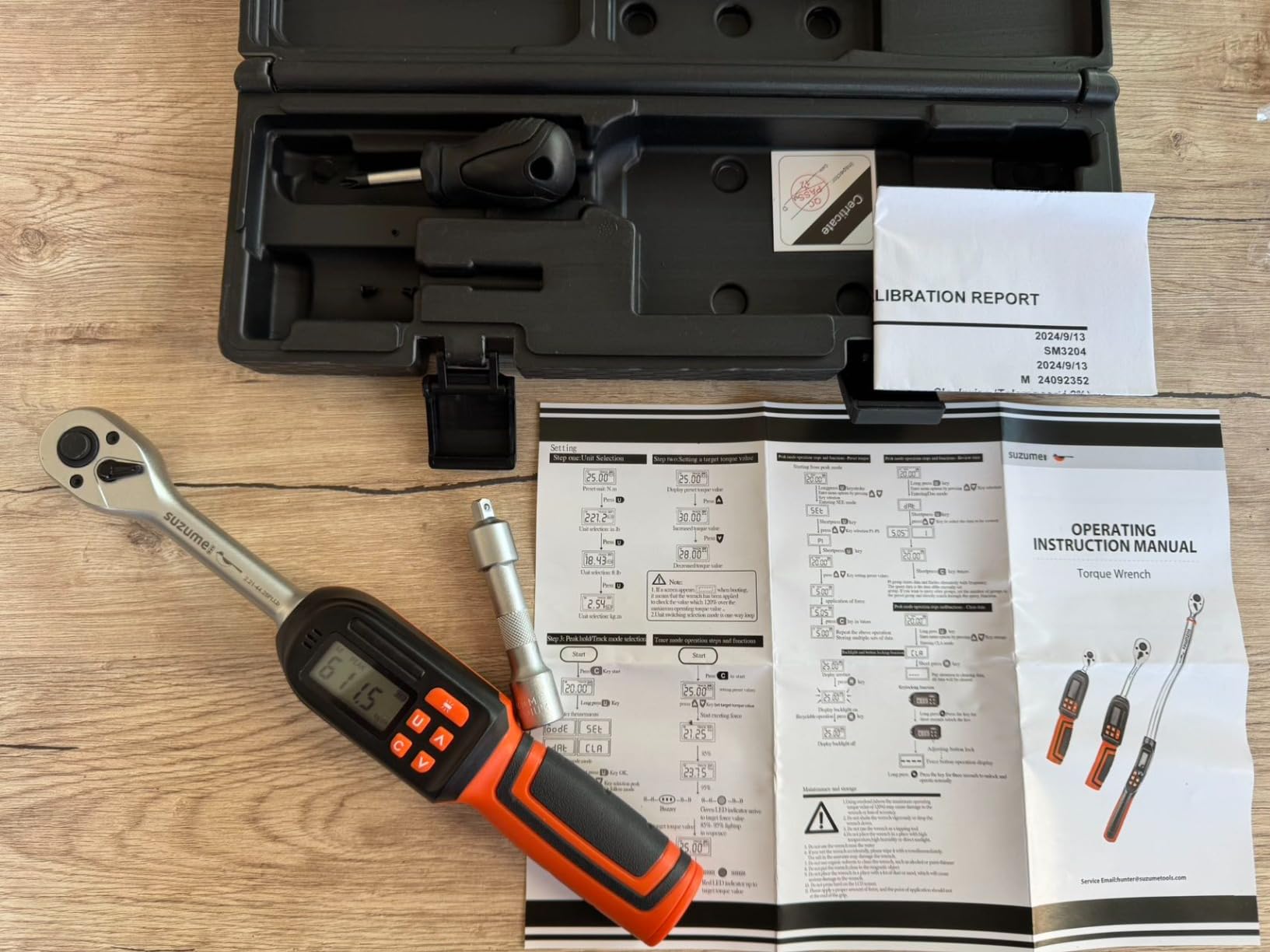
10. SUZUME 3/8-Inch Digital Wrench – Tightest Stated Accuracy in the Group
SUZUME Digital Torque Wrench 3/8 Drive (5.02-99.57 Ft. Lb / 6.8-135 N.m)
5.02-99.57 ft-lb / 6.8-135 Nm
Plus or minus 2 percent
72-tooth reversible ratchet
Peak and Track modes
Pros
- Tightest stated tolerance in this group
- Buzzer escalates then goes continuous at target
- Compact 11.6 inch body suits tight work
- Buttons spaced for use with gloves
- Survives drops from bench height
Cons
- Control portion of the handle is plastic
- Batteries are not included
- Accuracy drops at the extremes of the range
Every other wrench in this group states plus or minus 3 or 4 percent. This one claims plus or minus 2 percent after 20,000 tests and says it holds accuracy over 15,000 uses without recalibration.
The range is 5.02-99.57 ft-lb on a 3/8 inch digital drive, which covers low-torque accessory work and mid-range engine work in one tool. That makes it the most versatile digital option here for a motorcycle rather than a dedicated low-range digital tool.
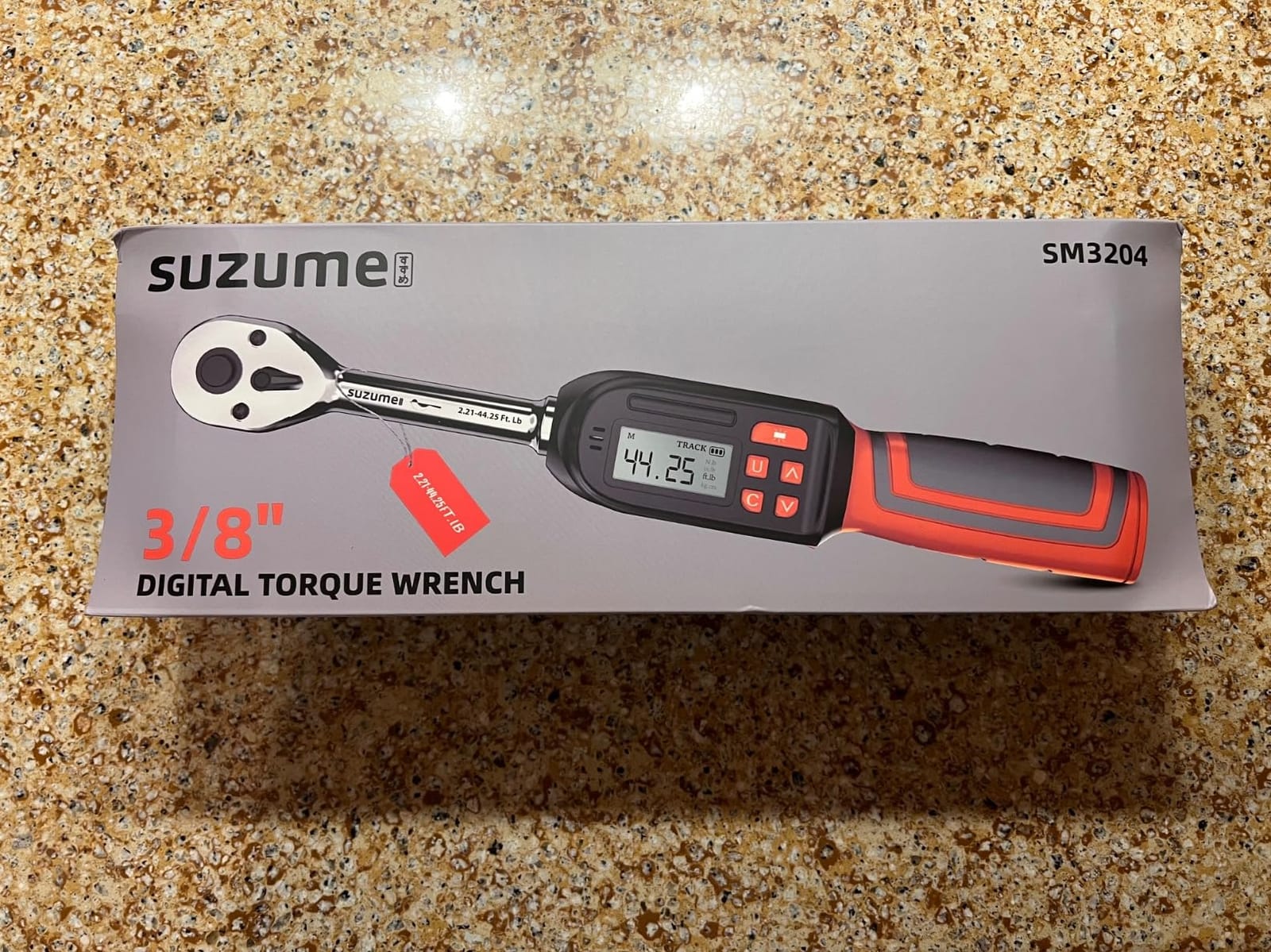
The feedback design is the part owners like most. A buzzer accelerates as you approach the target and goes continuous at the set value, backed by a green LED at 85-90 percent and a red LED at 100 percent, so you can watch it rather than listen for it in a noisy workshop.
Peak mode holds the maximum torque and Track mode gives a real-time reading, with usage data storage for job history. The 72-tooth reversible ratchet has a 5 degree swing for tight spaces, and it reads in Nm, ft-lb, in-lb and kg-cm.
Best use case: anyone who works in the dark
Digital torque wrenches earn their keep when you cannot read a scale, in a dim garage or a wheel off in a van. This one puts the number in front of you and tells you when to stop.
Where it falls short
The control portion of the handle is plastic, batteries are not included, and digital readouts are most accurate in the middle of the range. Near the very top of 135 Nm and the bottom, the stated 2 percent figure loses some of its advantage.
11. Park Tool TW-6.2 – Best for Bike and Motorcycle Crossover Work
Park Tool TW-6.2 Ratcheting Torque Wrench 10-60Nm Drive Tool 3/8-Inch
10-60 Nm on 3/8 inch ratcheting drive
Dial-adjust click system
Alloy steel
17 inches, 500 g
Pros
- Highest rated in this group at 4.8
- Precise indexing that holds its set value
- Click works in both directions for reverse-thread pedals
- Dial adjustment is fast and intuitive
- Range matched to bicycle maintenance
Cons
- Case does not form-fit the wrench
- Scale window is small
- Newton metres only
- Costs more than every other click wrench here
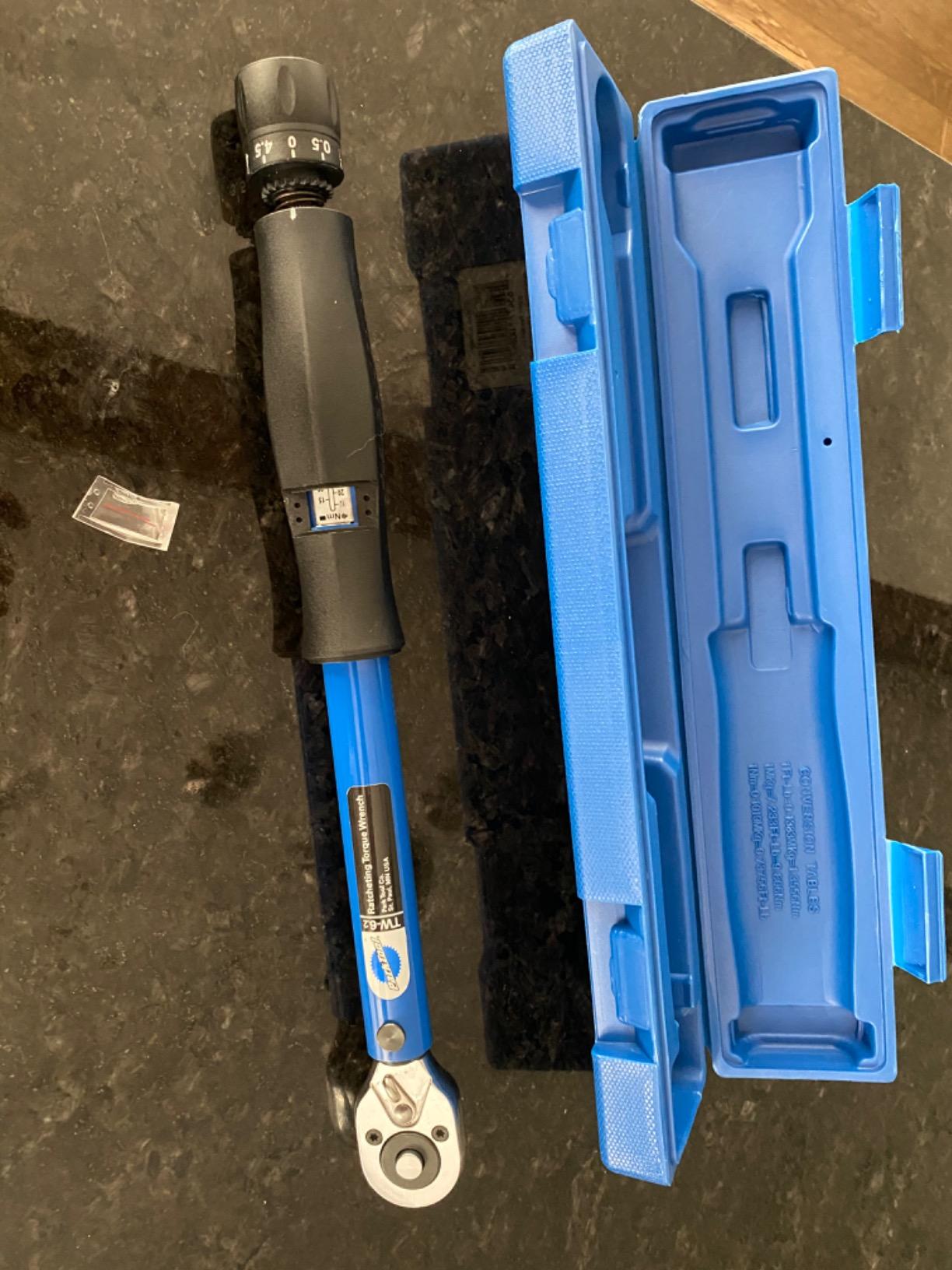
The TW-6.2 is a bicycle tool first, and it earns a place here because a lot of riders own both machines. Its 10-60 Nm range on a ratcheting 3/8 inch drive covers the bulk of bicycle work and a useful slice of motorcycle accessory and engine fastener torque.
What makes it hold its rating is the dial-adjust click system. You push the knob in, turn to the value and lock, and the indexing is precise enough that the same setting reads the same way every time. That consistency is what carbon component manufacturers care about.
The click operates in both clockwise and counterclockwise directions, which is not a gimmick on a bike with left-hand thread pedals. Construction is steel, length is 17 inches and weight is 500 g, and a blue Park Tool carrying case plus a unit conversion sticker are included.
For a motorcycle, treat it as the second wrench in a pair: this for the low and middle band, a 1/2 inch model for axle and steering work.
Best use case: a bench that handles both bikes and motorcycles
If you service a bicycle as well as a motorcycle, the 10-60 Nm band is where most of both jobs live, and this wrench holds values in that band more consistently than anything else here.
Where it falls short
The case does not form-fit the wrench, so it moves around in transit and a torque wrench thrown in a bag drifts out of calibration. The scale window is small, it reads in Newton metres only, and it costs more than every other click wrench here.
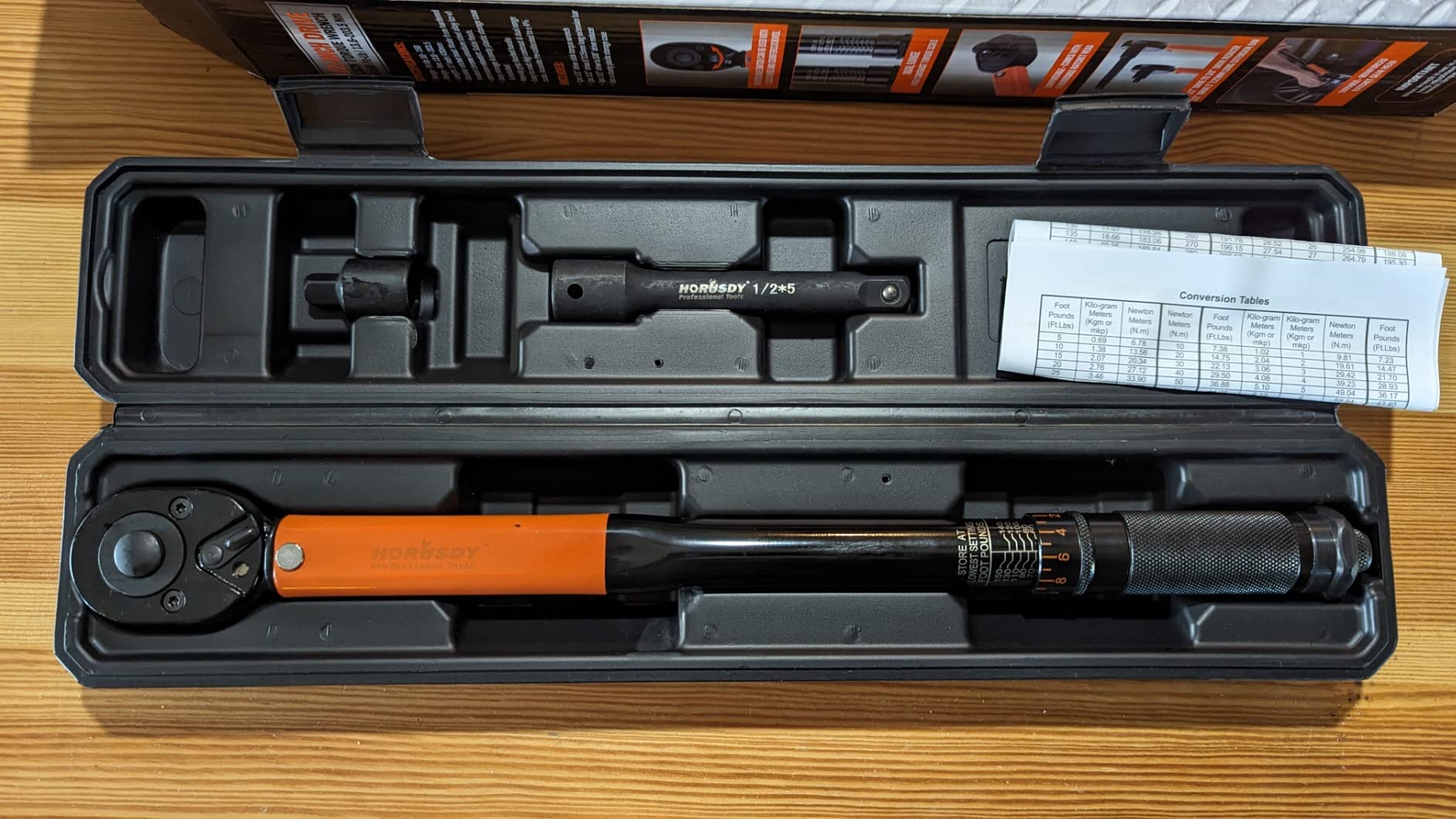
12. HORUSDY 1/2-Inch Set – Budget Pick With Extension and Adapter
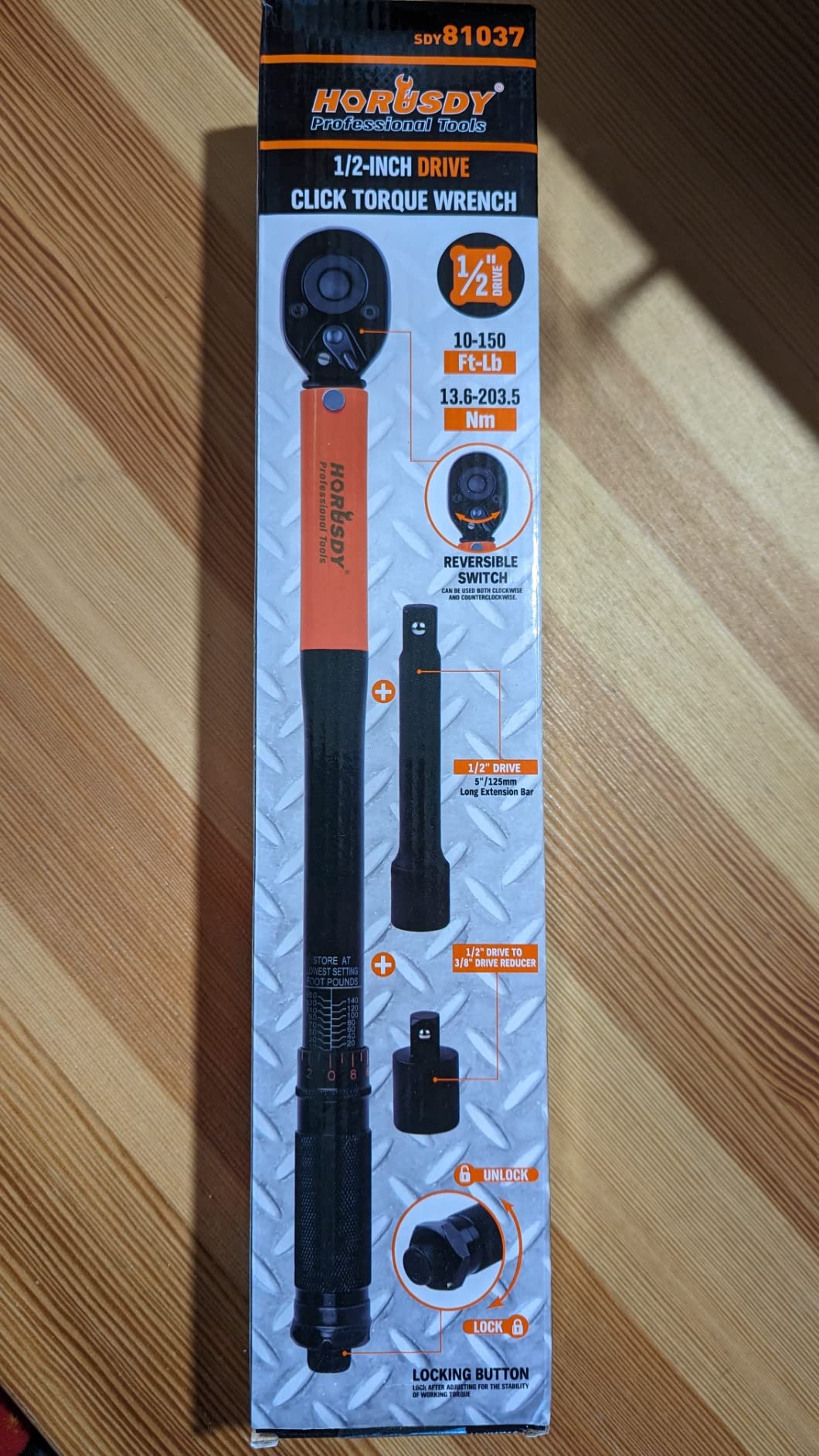
HORUSDY 1/2-Inch Drive Click Torque Wrench Set – 10–170 ft-lb / 13.6–230.5 Nm, ±3% Precision, Dual Scale, 72-Tooth Reversible Head with 5″ Extension & Adapter for Car, Tire, and Motorcycle Use
10-170 ft-lb / 13.6-230.5 Nm
Plus or minus 3 percent
72-tooth reversible head
17.5 inches
Pros
- Complete set with a 5 inch extension and a 1/2 to 3/8 inch adapter
- Sturdy build with good weight
- Fast and easy adjustment to target values
- Suited to home garage suspension and steering work
Cons
- Lowest rating in this group at 4.4
- One owner reported a unit that did not click
- Accuracy not independently verified by most buyers
- Below professional grade by reviewer consensus
At the budget end, this set still covers the range most home mechanics need. The 1/2 inch wrench runs 10-170 ft-lb, or 13.6-230.5 Nm, at a stated plus or minus 3 percent, and the box includes a 5 inch extension bar and a 1/2 inch to 3/8 inch adapter in a plastic case.
The 72-tooth reversible ratchet head has a clear audible and tactile click, with a locking knob and quick-release socket change, and the scale is laser-etched in dual ft-lb and Nm.
Owners generally describe it as capable for home garage work, with one reporting applying 136 ft-lb of real torque without issue. That is a reasonable read on what this class of tool is for: non-critical fasteners and the lower end of the high-torque band.
The adapter included is genuinely useful. A 3/8 inch job on a bike where the fastener is accessible only through a 1/2 inch head is a common frustration, and this removes the need to buy a second wrench.
Best use case: a first tool on a tight budget
If you want one 1/2 inch wrench that reaches into the axle and steering band, this does it. For a weekend mechanic on a used bike, that is a reasonable place to start.
Where it falls short
This is the lowest-rated wrench here at 4.4, and one owner reported a unit that would not click even at the minimum setting. For a spindle, swingarm pivot or headstock nut, choose a tool with a traceable calibration certificate instead.
How Many Torque Wrenches Do You Actually Need?
Two is the answer most owners arrive at, and it is the single most repeated question on the forums. The reason is simple: no manufacturer builds one wrench that covers a whole motorcycle, because the range a tool needs to span is roughly 2 to 230 Nm, and accuracy at the extremes of that span falls away.
The practical setup is a low-range 1/4 inch tool for small fasteners and low-torque motorcycle work, plus a high-range 1/2 inch tool for axle spindles, swingarm pivots and steering head nuts. Add a 3/8 inch model if you do a lot of engine and accessory work, or buy a three-drive set such as the YIYEIE and get the whole range in one case.
Map the bands to real jobs rather than guessing. Between 2 and 25 Nm you are on fairing bolts, brackets, sensors and accessories. Between 10 and 80 Nm you are on spark plugs, oil drain plugs, caliper bolts, engine casings and cylinder head fasteners. Between 100 and 200 Nm you are on rear wheel spindles, front axles, swingarm pivot bolts and the headstock nut.
If you own a bicycle too, the low band overlaps almost completely, which is why a 1/4 inch drive and a 3/8 inch drive between them cover a surprising amount of both types of work.
What Drive Size Does Your Motorcycle Need?
The square drive is the socket size, and it is the first thing to match to the bike. A 1/4 inch drive is for small fasteners and low torque, a 3/8 inch drive is the general-purpose middle band, and a 1/2 inch drive is for the big structural fasteners on axles, steering and suspension.
Matching drive to job is not only about torque capacity. A larger drive head fits into fewer spaces, so on a tightly packaged modern motorcycle a 3/8 inch wrench will often reach a fastener that a 1/2 inch head simply cannot get to. Conversely, a small drive on a high-torque spindle can feel vague because you are applying a lot of force to a short handle.
Adapters are a fair solution. Dropping from 1/2 inch to 3/8 inch with a simple adapter is acceptable, because torque is torque and the adapter does not change the reading. What you must never do is insert a torque multiplier, which multiplies the load on the tool and the bolt together and invalidates the setting.
On the ratchet end, tooth count decides how much the head has to swing between clicks. A 72-tooth head moves 5 degrees per click and a 45-tooth head roughly 8, so on a recessed spindle nut or a frame member the 72-tooth head is the difference between fitting and not fitting.
Click-Type vs Digital vs Beam Torque Wrenches
Click-type wrenches are the default choice and the right answer for most home mechanics. They are simple, they have no batteries, and the audible break tells you to stop pulling. Their weakness is the bottom of the range, where a faint click can be missed and a bolt head gets rounded off.
Digital wrenches add a live readout, a buzzer and light cues, and they let you audit a fastener that is already installed with trace or peak mode. They are the better choice if you work in low light, if you are buying a used bike and want to know what has been done to it, or if you want the tightest stated accuracy.
Beam and dial wrenches deflect physically and show the value on a scale or dial. They never need recalibrating because there is no spring, which makes them popular for very low torque work on delicate fasteners and for anyone who distrusts click wrenches. They are slower, harder to read at a glance and impractical for the high-torque end of a motorcycle.
For work on carbon fiber or soft alloy, treat any of them with care. Set the value, tighten slowly, and let the tool tell you rather than judging by feel.
Accuracy, Calibration and Finding the Right Torque Value
Look for a stated accuracy of plus or minus 3 to 4 percent or better, and treat a missing figure as a warning. More important is whether a calibration certificate ships in the box with a serial number that matches the tool, because that is what lets you prove when it was last checked.
Accuracy and repeatability are not the same thing. For multi-stud engine work, a wrench that lands consistently on the same slightly different value each time is safer than one that scatters, and a commenter on Motorcycle.com put it well: consistency across studs matters more than a headline accuracy percentage. The 0.1 Nm increments on the Wera and the detented adjustment on the YIYEIE set both help here.
Find torque values in the service manual for your exact model and year, then check for overrides stamped on the part itself. Common motorcycle sources are a stamped value on a fork, a swingarm or a subframe bracket, which takes priority over a general figure. If you cannot find a value anywhere, do not guess, because several forums describe owners resorting to a guess and later regretting it.
Never use a torque wrench to break a seized or corroded fastener loose. A click wrench will not help you here, and a bar over the ratchet head risks damaging the mechanism. Use a breaker bar or the correct tool for removal, then apply the torque wrench to set the final value going back on.
Store the tool where it cannot be dropped or thrown around, return the setting to its lowest value, and clean it before putting it back in its case. A loose-fitting case is the fastest way to knock a calibrated wrench out of calibration, and recalibration is a recurring cost that owners on UKGSer and r1200rforum point out is not always covered by a warranty claim.
One more technique from experienced mechanics is worth adopting on low-torque work: crack the wrench a couple of times on the fastener at a higher setting to settle the spring, then set it back and take the bolt to the real target. It removes the early travel that makes a low value feel inaccurate.
Frequently Asked Questions
What size torque wrench do I need for my motorcycle?
Most owners need two. A 1/4 inch drive wrench covering roughly 2-25 Nm handles small fasteners, accessories and carbon components, while a 1/2 inch drive covering 100-200 Nm covers rear spindle nuts, swingarm pivots and headstock nuts. Add a 3/8 inch model in the 10-80 Nm band if you do a lot of engine and accessory work.
Is it OK to loosen bolts with a torque wrench?
No. Torque wrenches are for tightening to a specification. A click-type wrench has no advantage over a normal wrench for breaking a bolt free, and putting a bar over the ratchet head to gain leverage can damage the mechanism and throw the calibration out. Use a breaker bar or the correct removal tool, then set the final torque going back on.
What is the best digital torque wrench for motorcycles?
Among the models here, the SUZUME 3/8 inch digital wrench states the tightest accuracy at plus or minus 2 percent and covers 6.8-135 Nm with a buzzer and green-to-red LED alerts. For low-torque fasteners below 37 ft-lb, the ACDelco ARM601-3 covers a range most digital tools skip, with trace and peak modes and a NIST-traceable calibration certificate.
How often does a torque wrench need recalibrating?
Treat the calibration certificate as a baseline and have the tool checked annually if you use it for safety-critical work such as spindle and steering fasteners, or any time it is dropped or thrown in a loose case. Recalibration is a recurring cost that is not always included in a warranty, so check what a manufacturer charges before buying on the strength of a lifetime guarantee.
What torque wrench do I need for a bicycle?
Bicycle work lives in a much lower band than most motorcycle work. A 1/4 inch drive wrench covering about 2-25 Nm, or a 3/8 inch model covering 10-60 Nm, covers the vast majority of bicycle torque values. The Park Tool TW-6.2 is calibrated specifically to the 10-60 Nm bicycle range and its click works in both directions for reverse-thread pedals.
The Bottom Line for Motorcycle Torque Work in 2026
For most home mechanics, two wrenches cover a whole bike: a low-range 1/4 inch drive for accessories and carbon parts, and a 1/2 inch drive for spindle, swingarm and steering fasteners. The EPAuto 1/2 inch is our overall pick on the strength of its range, readable scale and the largest verified review base in the group, with the LEXIVON LX-183 the choice if you want a serial-numbered calibration certificate.
Add a 3/8 inch wrench for engine and accessory work, pick the Wera if low-torque repeatability matters, and choose a digital model if you work in the dark. Our general [torque wrench guide](https://factsforhealth.org/best-torque-wrenches/) covers the wider market, and for jobs beyond tightening, our [impact wrench picks](https://factsforhealth.org/best-impact-wrenches/) cover the fasteners that will not move with hand tools at all.