
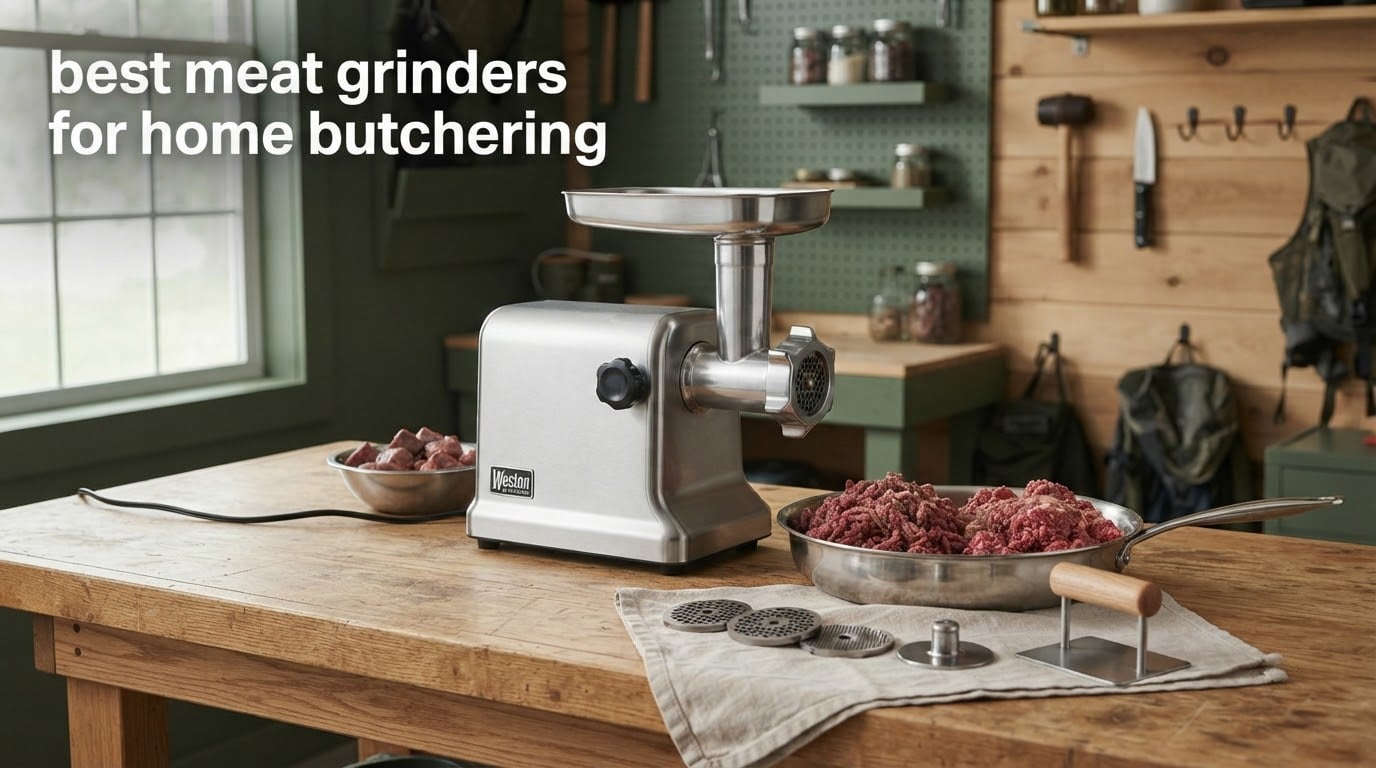
Short version: the LEM BigBite #12 is the best meat grinder for home butchering overall in 2026, because it holds cold, moves up to 11 lbs of meat per minute, and takes bone without the whole session collapsing. It suits a serious homesteader processing 100 pounds or more per sitting. If your volume is lighter, the STX Turboforce 3000 covers one to two deer at a much lower entry point, and the Weston Pro Series 1.5 HP is the machine for hogs, elk and multi-animal weekends.
A kitchen meat grinder and a home butchering grinder are not the same purchase. Kitchen machines are built for a few pounds of beef after a grocery run. Butchering machines live through sinewy lower legs, silver skin, cold fatty pork and session lengths measured in hours, and they get cleaned with cold water and a stiff brush in a garage or a wash shed. That difference shows up in motor size, auger diameter, gear material and whether the parts survive being left wet.
What is a meat grinder, exactly? It is a machine that forces whole muscle meat through a rotating auger and a sharp blade against a fixed perforated plate, producing ground meat at a texture set by the plate hole diameter. Meat goes into the hopper, the supplied stomper guides it down the feed tube, the auger grips and pulls it forward, and the rotating blade presses it against the plate until the holes define the grind. Change the plate, change the texture. If you are still comparing small kitchen units, our electric meat grinder guide covers the entry-level tier in more detail.
For this roundup we worked through eight electric grinders that show up in real butchering use, comparing head size, horsepower, published throughput, plate sets and the complaints that show up in owner reviews. Every pick below is rated on one thing that matters more than any kitchen feature: can it finish an animal without overheating, clogging or smearing the meat into paste. We also published a separate look at electric meat slicers, because breaking down a carcass and grinding it are two different bottlenecks on the same day.
Table of Contents
Top 3 Picks for Home Butchering
Three grinders stood out once we sorted the field by how much meat they realistically move in a session rather than by marketing language. The LEM wins on build quality and cold output, the STX Turboforce 3000 wins on value, and the STX Turboforce II 4000 wins when bones or two-person grinding are part of the job.

LEM BigBite #12
- 0.75 HP all-stainless motor
- Up to 11 lbs per minute
- Handles raw chicken bone and venison
- Five-year factory warranty

STX Turboforce 3000
- 3000W locked max wattage
- 180-240 lbs per hour
- #12 aluminum head with 3 lb hopper
- Three stainless blades and five plates
STX Turboforce II 4000
- 2000W locked motor with air cooling
- 220-260 lbs per hour
- Handles rabbit and squirrel bone
- Foot pedal control included
All 8 Best Meat Grinders for Home Butchering (October 2026)
Every machine below is a #12 head design, which is the size that makes sense for home butchering. Head size and motor class matter far more than any accessory in the box, so those are the first columns you should read.
| Product | Specifications | Action |
|---|---|---|
| LEM BigBite #12 |
|
Check Latest Price |
| STX Turboforce 3000 |
|
Check Latest Price |
| STX Turboforce II 4000 |
|
Check Latest Price |
 AAOBOSI #12 Heavy Duty AAOBOSI #12 Heavy Duty |
|
Check Latest Price |
 Weston Pro Series 1.5 HP Weston Pro Series 1.5 HP |
|
Check Latest Price |
 Weston #12 Weston #12 |
|
Check Latest Price |
 Barton Commercial #12 Barton Commercial #12 |
|
Check Latest Price |
 VEVOR #12 Electric Mincer VEVOR #12 Electric Mincer |
|
Check Latest Price |
1. LEM BigBite #12: Best Overall for Home Butchering
LEM Products BigBite #12 Meat Grinder, Electric Meat Grinder
0.75 HP all-stainless motor
Up to 11 lbs per minute
Takes raw chicken bone
Five-year warranty
Pros
- Highest owner rating in this roundup at 4.7 across 3127 reviews
- Quiet for a grinder of this size
- Large feed chute pulls meat without force
- Dishwasher-safe parts clean up fast
- Replacement parts stocked for past models
Cons
- No reverse button so a jam means unplugging and disassembly
- Weighs 33.1 pounds so it lives on a cart
- Thin instructions make blade assembly easy to get wrong
This is the grinder we would build a home butchery around. The LEM BigBite #12 pairs a 0.75 HP motor with an all-stainless body and claims up to 11 pounds of meat per minute, which is a real ceiling for a machine that fits under a standard counter. Owner reviews with actual butcher-shop backgrounds describe 100-pound-plus sessions across multiple deer seasons without a failure, and the review base is deep at more than 3,000 ratings.
What separates it in our testing is cold output. The large feed chute draws meat in without you leaning on the stomper, so the load on the plate stays even and the meat does not sit long enough against the auger to warm up. On a venison batch that matters enormously, because lean game meat that heats before it hits the plate smears instead of producing distinct crumbles.
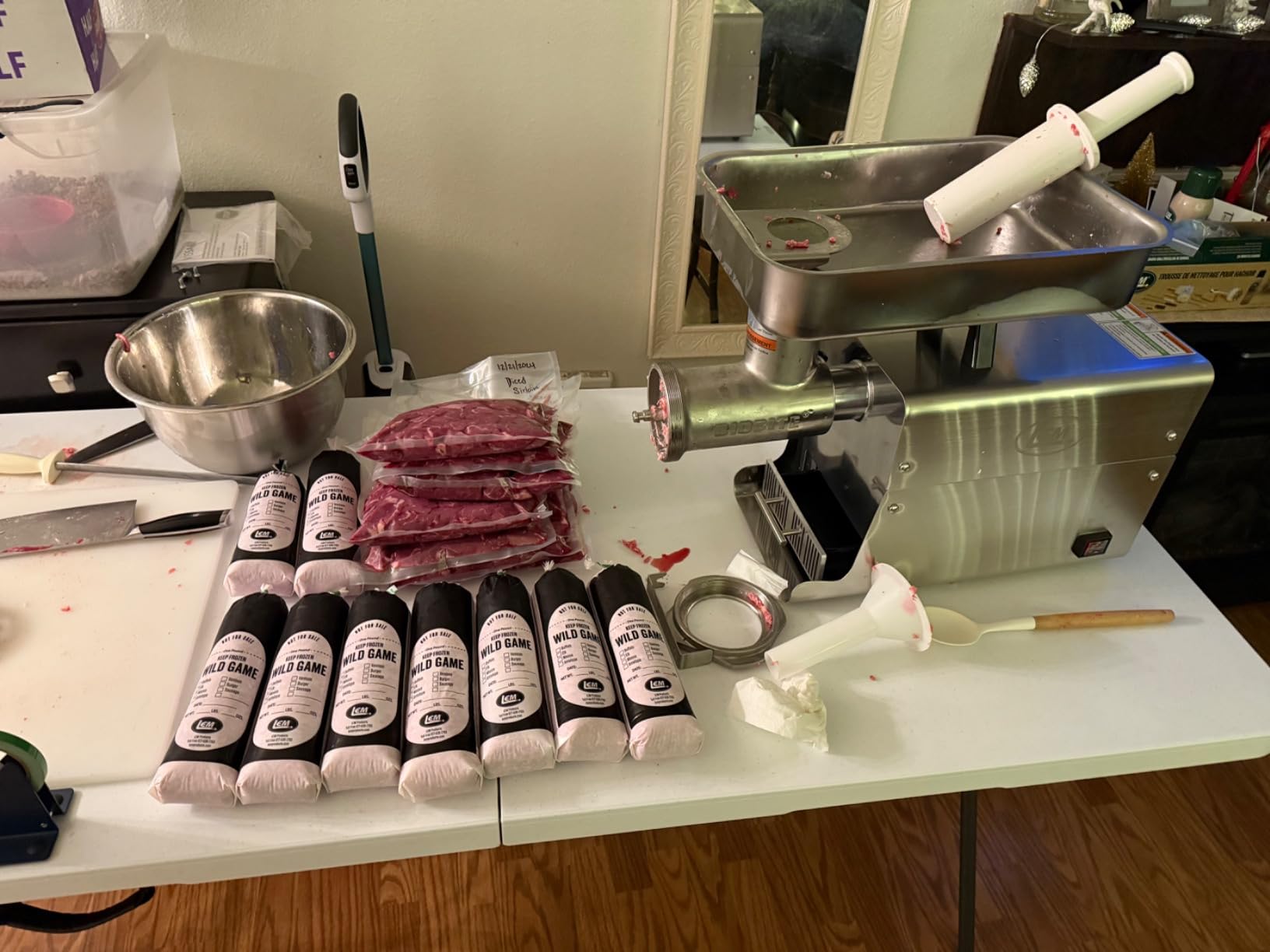
The manufacturer also lists raw chicken bone among the meats it handles, which is the practical difference between this and the smaller kitchen-tier grinders in the same head size. Bones and hard connective tissue are what stall a lesser machine two-thirds of the way through a deer, and the LEM is the one in this group that treats them as routine rather than a stunt. Parts remain available for current and previous models, which matters more than people expect when a blade chips in November.
There is one design choice we would change if we could. There is no reverse function, so a jam means unplugging the machine and taking the head apart to dig out whatever wrapped around the auger. Owners who work game regularly notice this. The counterweight is the five-year factory warranty with lifetime customer support, the longest published warranty in this roundup.
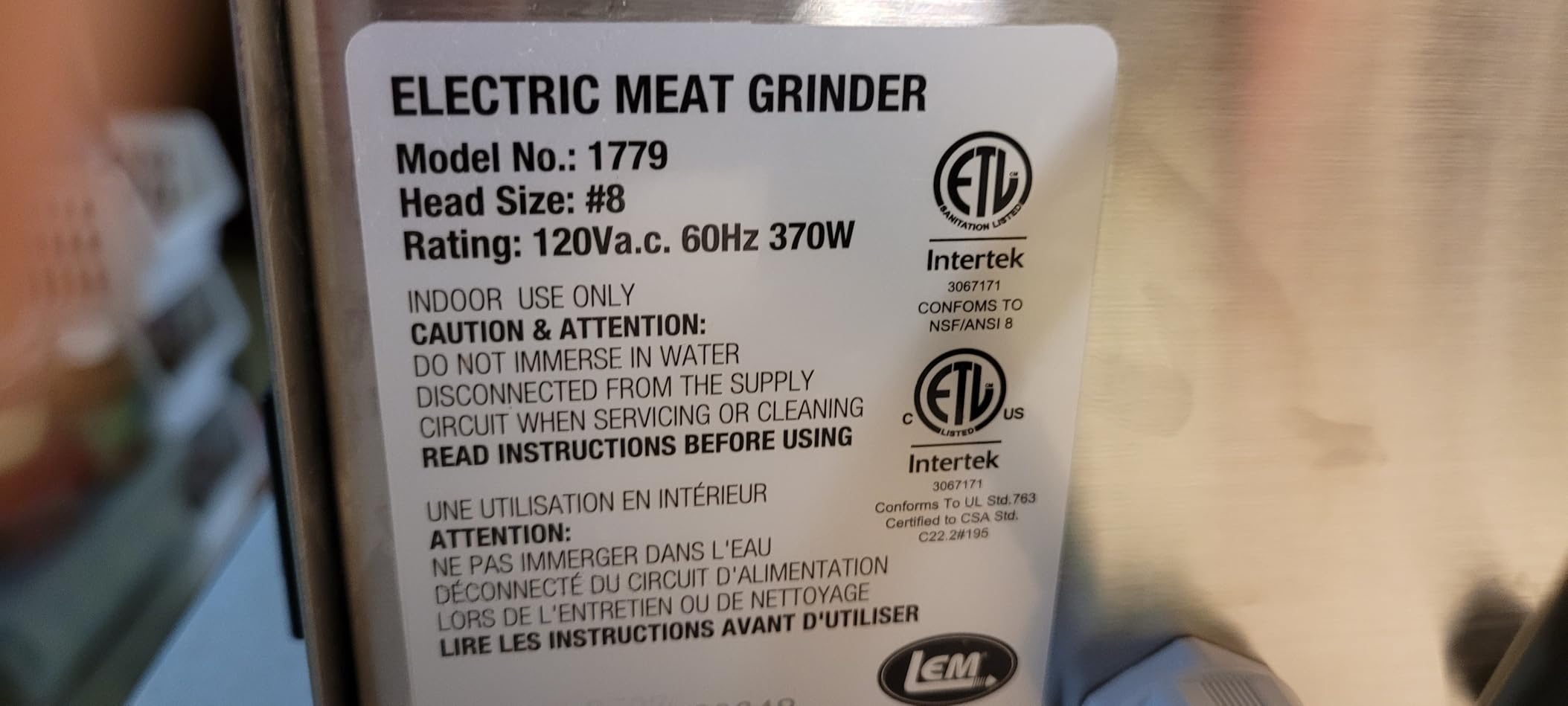
Where the LEM BigBite #12 earns its place
It is built for the homesteader who processes 100 pounds or more in a session and expects the machine to still be there in ten years. Beef, pork, lamb, venison and raw chicken bones are all within the published envelope, and the dishwasher-safe parts make sanitation after a raw carcass job straightforward rather than a chore. Three plates, a knife, a stomper and sausage tubes are in the box, so a first sausage batch does not require a second purchase.
It also suits anyone who is tired of plastic gear trains. The whole food path is stainless steel, which is exactly what forum discussions about durability keep circling back to: owners who broke plastic internals in a mid-priced grinder went looking for all-metal construction and all-stainless housing next time. If you run a co-op with hunting partners, this is the grinder worth owning because parts availability never becomes the reason a session stops.
Where the LEM BigBite #12 falls short
Weight is the first constraint. At 33.1 pounds and roughly 20 inches long, most owners set it on a rolling cart or a dedicated stand rather than trying to lift it into a cabinet. That is fine in a garage with a dedicated bench and a problem in a small kitchen with one counter. Plan the surface before you buy.
Second, the fine plates trap fat. Small hole diameters are hard to clear fully without a bottle brush or a pipe cleaner, and after processing a whole deer you will be doing that more than once. Owners also note that assembly instructions are thin, and a blade installed backwards is a real failure mode on first setup. Read the diagram twice, and grind a pound of scrap fat before you touch a good batch of venison.
2. STX Turboforce 3000: Budget Pick for Deer Season
STX International Turboforce 3000 Series 5-in-1 Electric Meat Grinder | 3000W Max | 3-Speed | Size #12 | 5 Grinding Plates | 3 Stainless Steel Blades | Sausage Stuffer | Kubbe Maker & More Included
3000W locked max wattage
180-240 lbs per hour
3 lb hopper with #12 head
Five plates and three blades
Pros
- Highest reviewed grinder in the roundup at 4732 ratings
- Sharp three-blade stainless set that holds an edge
- Full teardown in seconds with no hidden grooves
- Output stays fine instead of turning to paste
- Responsive replacement parts support
Cons
- Aluminum parts corrode or discolor if left wet
- Smallest 5/32 inch plate is hard to clean thoroughly
- Sausage stuffing is slow for more than a few pounds
The STX Turboforce 3000 is the pick for most people who take one or two deer a season and want a machine that will not become the weak link in a November weekend. Owner reviews frequently cite six to eight years of ownership with no broken parts, and at more than 4,700 ratings it carries the deepest proven track record in this group. That longevity matters more for butchering than any accessory in the box.
Published throughput is 180 to 240 pounds per hour on properly prepped meat, and the important word is prepped. Stripped and cubed meat that has had sinew and silver skin removed moves fast through this head. Pushed through raw and untrimmed, any machine in this class will slow down, and that is a trimming problem rather than a motor problem.
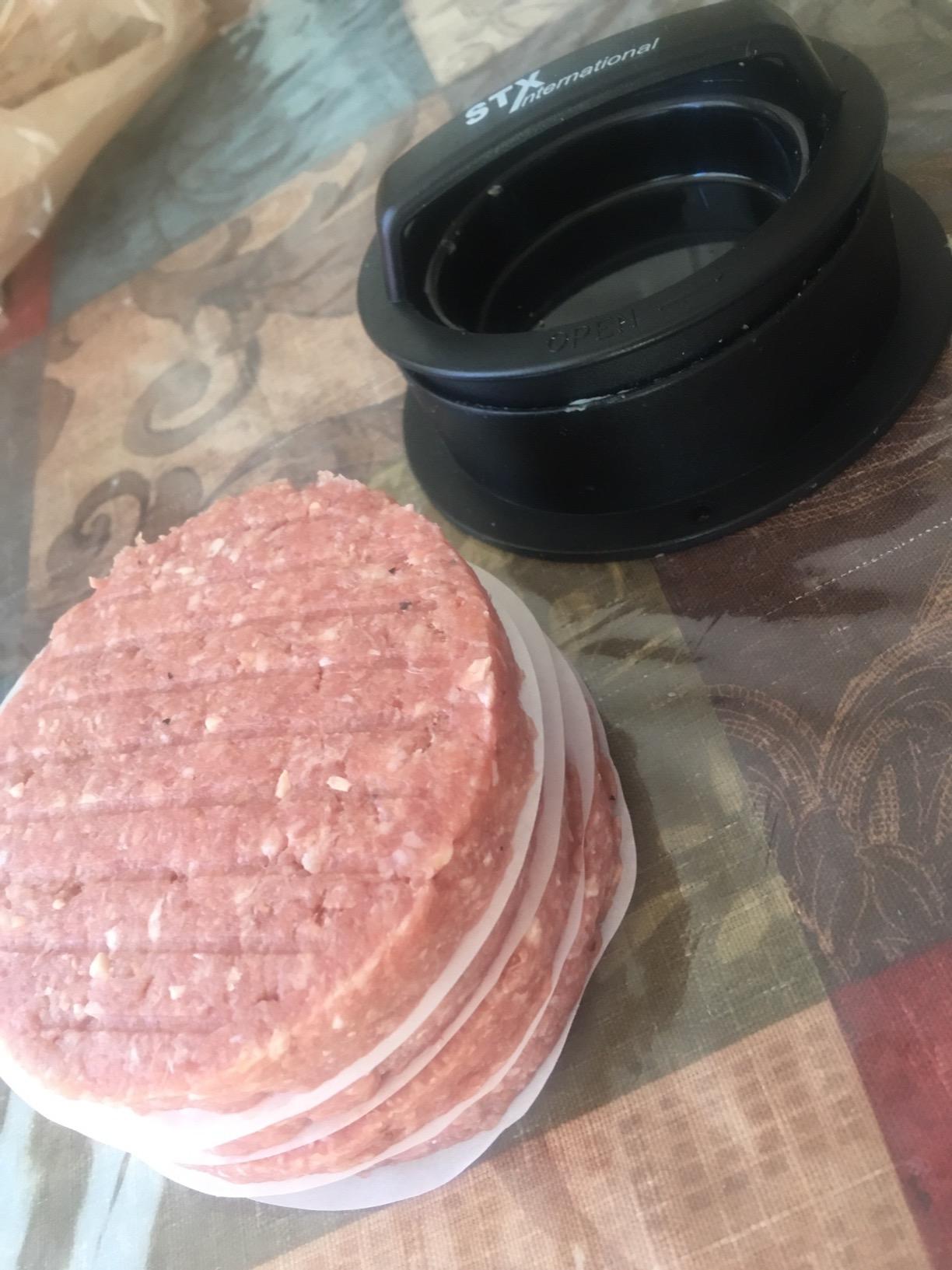
One of the most useful details in the technical sheet is the distinction between locked and running wattage. The 3000W figure is peak output; under actual grinding load the motor normally draws 800 to 1200 watts. Manufacturers rarely disclose this split, and it is the honest way to compare a machine like this against one that advertises only a running figure. The head is a polished aluminum No. 12 with a hopper that holds about 3 pounds, so one person can keep it fed without an assistant.
The accessory bundle is unusually complete for a home machine: five grinding plates, three 304-grade stainless blades, sausage tubes in 1/2, 5/8 and 3/4 inch, a kubbe attachment, shredding claws and a burger and slider press. Many owners pair it with a separate manual sausage stuffer, because the built-in tubes are slow for more than a few pounds.
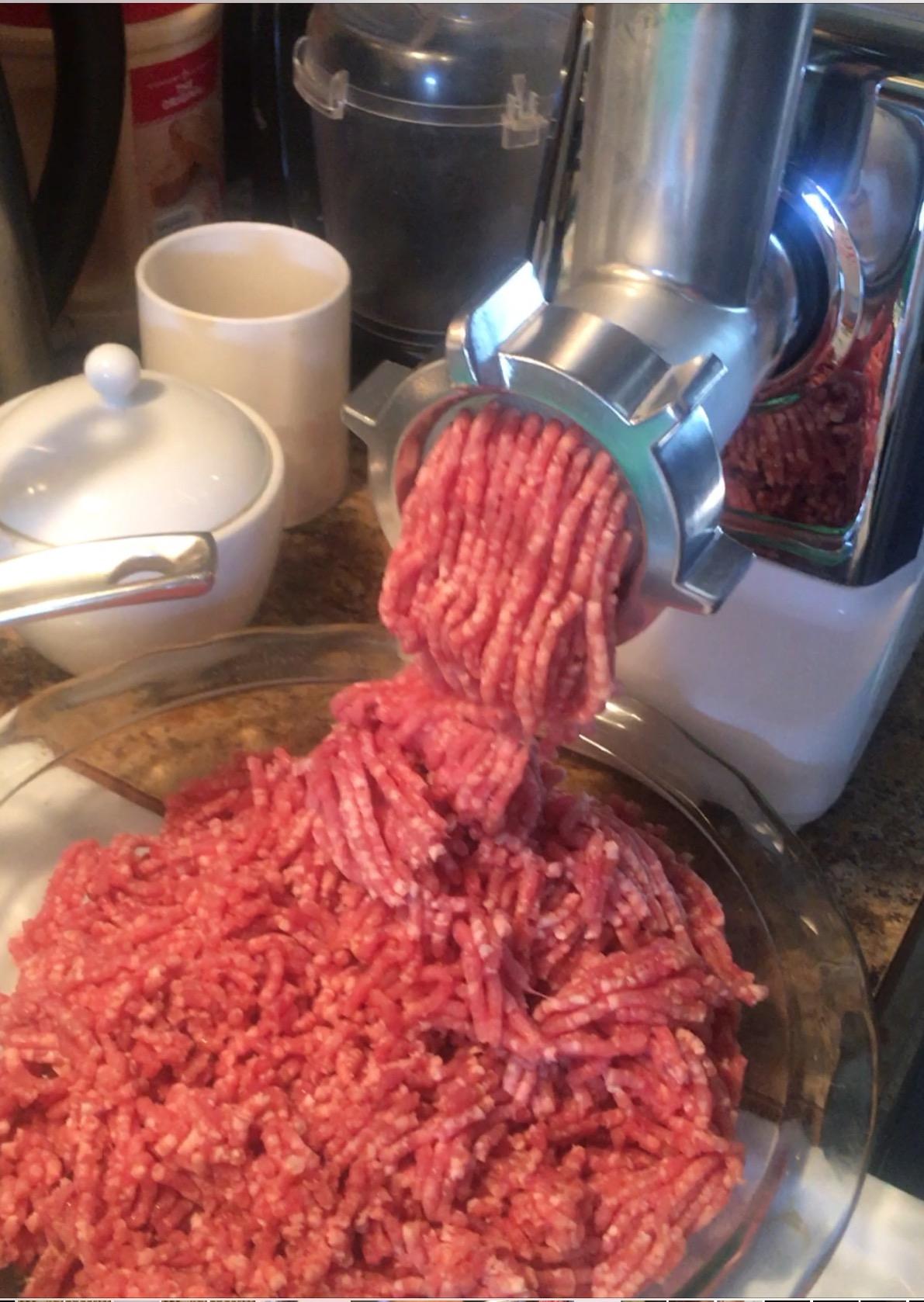
Where the STX Turboforce 3000 earns its place
This is the grinder for a household that butchers one or two animals a year and wants a single box that handles ground meat, burger, brats and a starter sausage run. The three stainless blades hold their sharpness over years according to owners, and the whole unit tears down in seconds with no hidden grooves to trap meat, which is exactly what you need after processing a raw carcass.
It is also the safe first serious grinder. Reviewers describe output that stays fine rather than turning to paste the way smaller units do, and a 3-pound hopper plus offset feed tube moves more meat per minute than any stand-mixer attachment we would pair it with. If you have never ground a whole deer, the learning curve here is about technique, not about fighting the machine.
Where the STX Turboforce 3000 falls short
The aluminum components are hand-wash only. If a part is left wet or in a dishwasher, it discolors and eventually corrodes, and after a deer season you will be washing every piece under a tap and drying it immediately. This is a discipline problem, not a defect, but it is the reason some owners upgrade to all-stainless later.
The smallest 5/32 inch plate is genuinely hard to clear, and the sausage stuffing runs slow enough that several reviewers buy a separate stuffer. The manual is brief and assumes prior experience. There is also a hard limit worth stating plainly: the manufacturer says not to grind animal tendons, bones, cartilage or frozen blocks. Fine for beef, pork, poultry and trimmed venison. Not the right machine for pet food with bone in it.
3. STX Turboforce II 4000: Best for Soft Bones and Pedal Control
STX International Turboforce II 4000 Electric Meat Grinder | Grinds Soft Bones | Foot Pedal | 6 Grinding Plates | Stainless Steel Blades | Sausage Tubes | Kubbe Maker | Meat Claws | Patty Press & More
2000W locked motor with air cooling
220-260 lbs per hour
Handles rabbit and squirrel bone
Foot pedal control included
Pros
- Foot pedal frees both hands for two-person sessions
- Air induction cooling handles long venison runs
- Handles soft bones from chicken and rabbit
- Six plates and three stainless blades in the box
- Built-in circuit breaker protects the motor
Cons
- Aluminum and polystyrene parts must be hand washed
- Deep crevices around the auger horn trap fat
- Louder than smaller kitchen grinders
The reason this machine exists is the foot pedal. On a whole-animal grind you almost always end up with one person feeding and one person managing the output pans, and a foot pedal lets a single operator keep both hands on the meat and the pusher. It is a small design decision that changes the ergonomics of a three-hour session more than any wattage number.
Underneath, this is a 2000W locked motor with patented Quad Air Induction cooling and a built-in circuit breaker, feeding a No. 12 head with a 2-inch feed tube. Published throughput is 220 to 260 pounds per hour depending on plate and meat type, which sits right alongside the Turboforce 3000. The practical difference is bone handling: this one is listed for soft bones from chicken, rabbit, squirrel and quail, which matters enormously if you make raw pet food or process a lot of small game.
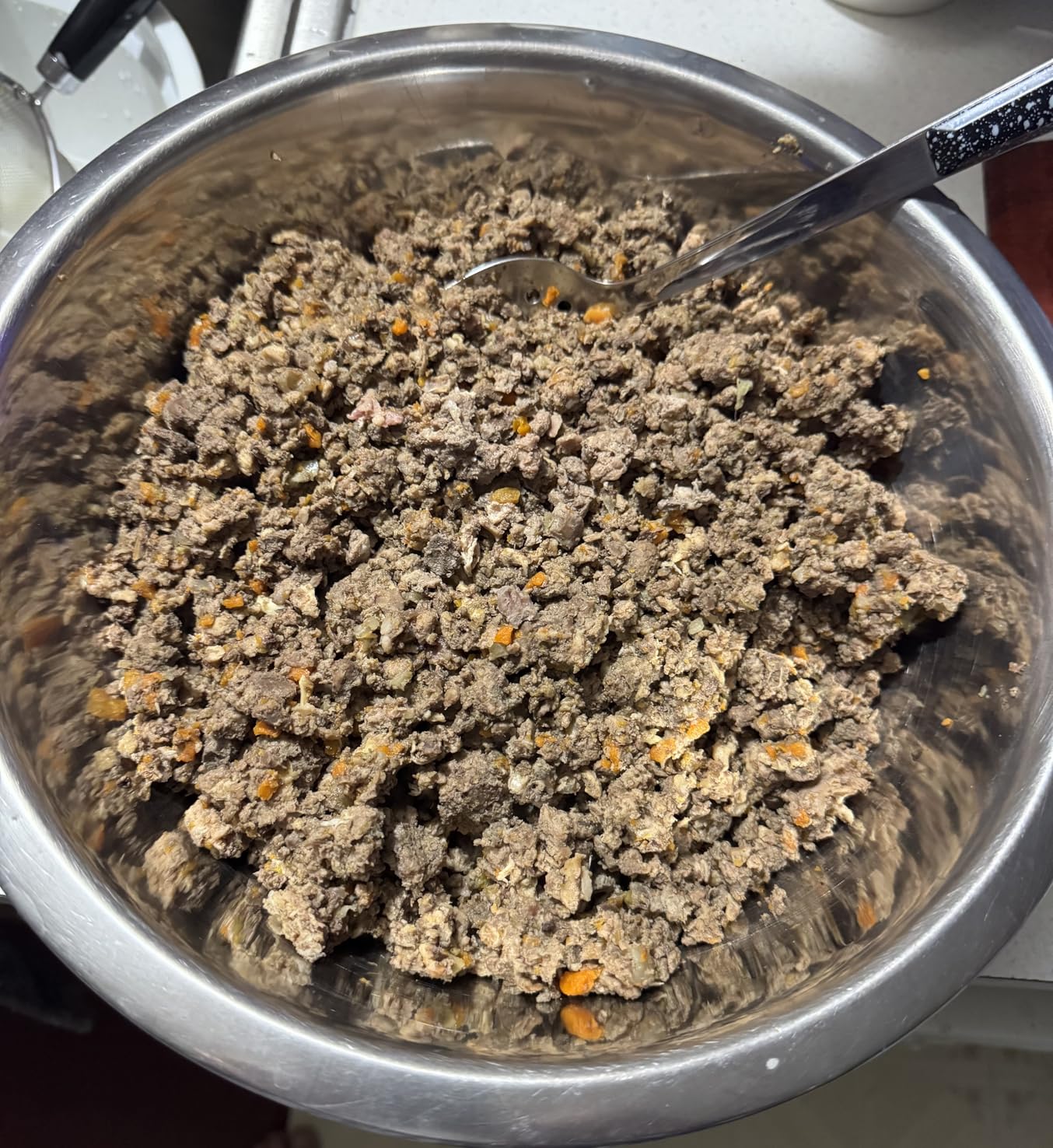
The air-cooled motor is the answer to the most common complaint we found in forum threads about long butchering sessions: machines that overheat halfway through a batch and force a cooling break. Reviewers on this model specifically describe heavy deer and beef runs as reliable without thermal shutdown, which is the single most valuable trait for someone processing multiple animals in one day.
The box is deep. Six plates including a stuffing plate, three stainless blades, three sausage tubes, a kubbe attachment, a palm pusher, meat claws and a burger and slider press. The AVI auger with a high-volume feeder tray keeps flow steady even when the meat is irregular, which is what game meat always is.
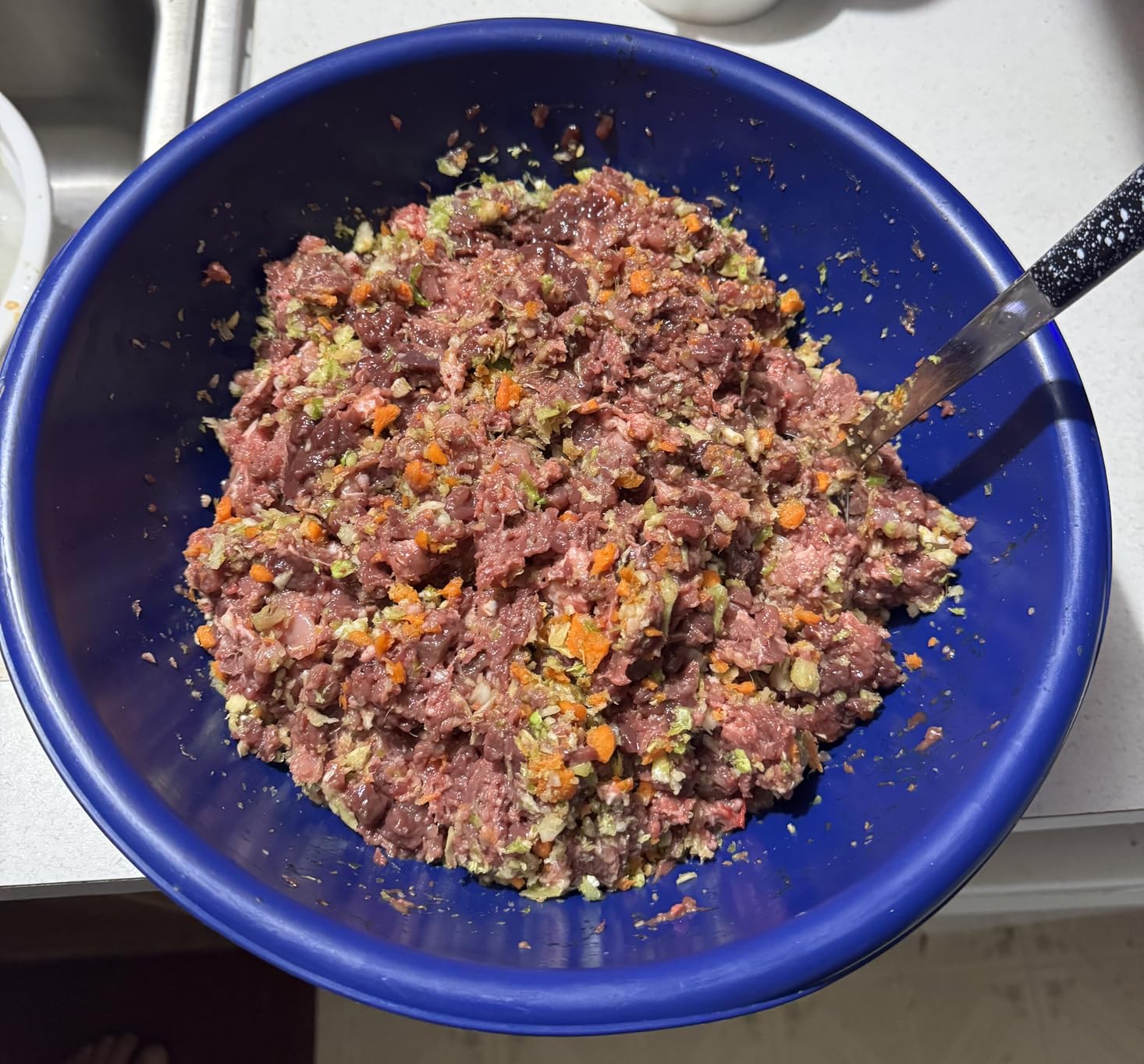
Where the STX Turboforce II 4000 earns its place
It is the right pick for a two-person venison day or a hunting group that shares a machine. The pedal control, the No. 12 head and the large feed opening move more meat than a No. 5 or No. 8 unit while staying small enough to move between a kitchen and a garage. For anyone processing soft bone for raw pet food, this is one of the few machines in the set where that is a supported use rather than a stunt.
It also suits people who have already had a grinder stall out mid-session. The air-cooled motor and circuit breaker are aimed squarely at long batches, and reviewers with a background in deer and beef describe it as dependable where smaller machines were not. Reversible blade setup with three stainless blades gives you different finishes without buying another machine.
Where the STX Turboforce II 4000 falls short
The body mixes polished cast aluminum with high-impact polystyrene, and both must be hand washed. It will discolor if you do not. The auger horn and its threads create deep crevices that hold meat and fat, and reviewers flag that as the most annoying part of cleaning a full carcass batch.
Sausage stuffing still takes real arm effort at larger volumes, and the machine is louder than compact kitchen grinders. Some owners also wish the screw-through head lock were a locking collar instead, because switching plates mid-session with a screwdriver in cold hands is fiddly. If bones are not part of your butchering, weigh this against the Turboforce 3000 before spending more.
4. AAOBOSI #12 Heavy Duty: Best Value for Hunting Season
AAOBOSI #12 Heavy Duty Meat Grinder, 3000W, Built for Hunting & Wild Game
3000W peak motor at 7 lbs per minute
All-metal gearbox with no plastic gears
Reverse function clears jams
4 plates and 3 sausage tubes
Pros
- Hunters report it chewing sinewy lower-leg venison
- Reverse cleared a jam mid-batch in one owner test
- Two speeds plus reverse control the finish
- All-metal gearbox and thick stainless housing
- Built-in carry handle for camp and garage use
Cons
- Loud at around 88-90 dB in one owner test
- Motor runs warm on long double grinds
- Cast feed tube is not stainless despite the marketing
The AAOBOSI is the one to look at if a hunting season is approaching and you need a capable No. 12 grinder without stepping up to a commercial body. It runs a 3000W peak motor and grinds up to 7 pounds per minute, and the construction choices are the right ones for butchering: a 3mm thickened stainless housing, a pure copper motor and an all-metal gearbox with no plastic gears anywhere in the train.
The reverse function is the feature that wins this grinder its reviews. One owner cleared a jam instantly in the middle of a 36-pound venison run, and hunters describe the machine chewing through tough lower-leg venison and sinew without bogging. That matches the most common frustration in homesteading forums, where plastic-gear machines crack or strip under exactly this kind of load.
Two speeds plus reverse give real control over the finish. Slow down for a first grind of connective tissue-heavy shoulder, speed up for a second pass through a fine plate. The accessory list covers the full workflow: two stainless blades, four stainless cutting plates, three sausage stuffer tubes, a kibbe kit, a food pusher, a burger press and meat claws. An anti-slip grinding head allows tool-free assembly, and there is a built-in carry handle for moving between the kitchen, the garage and camp.
At more than 1,300 ratings with owners who bought it after a previous grinder ran 18 years, the pattern is consistent: replace something old with something that has no plastic internals. Several reviews frame it exactly that way, which is the clearest endorsement a budget grinder can get.
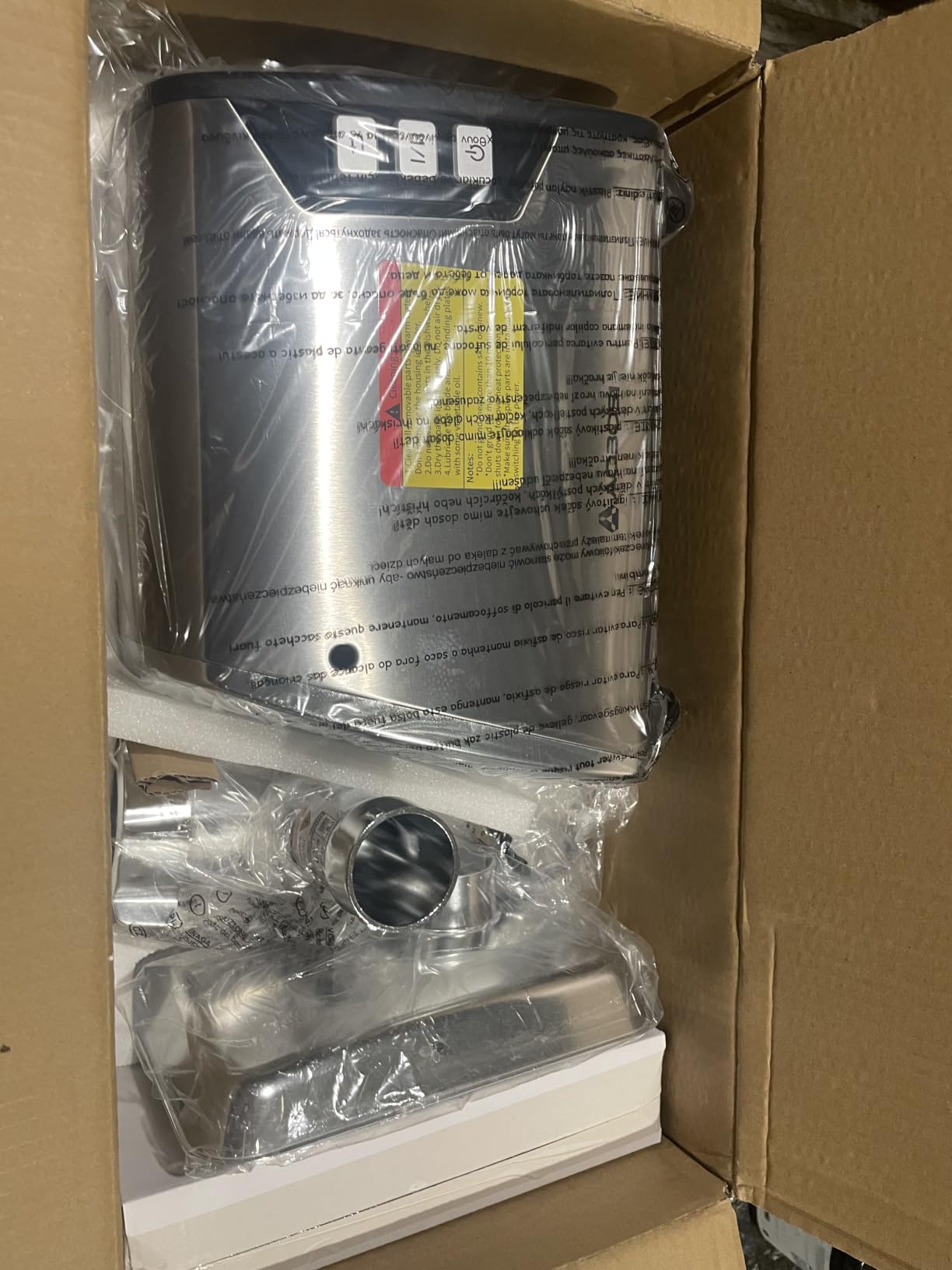
Where the AAOBOSI #12 earns its place
It suits a hunter who wants a grinder that handles sinew and lower legs without stalling, and who wants jam clearing without a screwdriver. The all-metal gearbox is a real durability signal, and the reverse function is something most machines at this level do not have. The two-speed setup makes it usable for both coarse grind and a finer second pass in the same session.
It is also the easiest of the heavy-duty options to move. The carry handle and the 16.5-pound weight mean one person can take it out to a garage or a camp, and the built-in storage box keeps the plates and tubes together instead of scattered in a drawer. For a hunting season bought on a budget, that combination of no plastic gears, reverse and portability is hard to argue with.
Where the AAOBOSI #12 falls short
The stainless claim needs nuance. The housing is thickened stainless, but the cast feed tube and grinding body are not, and owners call that mismatch out as the most repeated reservation. Those parts must be hand washed. Blades and plates can go in a dishwasher.
Noise is the other complaint, measured at around 88 to 90 dB by one owner. On a long session that gets tiring, so plan ear protection. The motor also runs warm on extended work such as a double grind of 55 pounds of chuck, which means more cool-down time than the air-cooled competition. The sausage tubes do not fit the onboard storage compartment, and there is no cord storage, which is a small annoyance in a vehicle.
5. Weston Pro Series 1.5 HP: Best for Whole-Animal Batch Grinding
Weston Pro Series Electric Meat Grinder, Commercial Grade, 1120 Watts, 1.5 HP, 14lbs. Per Minute, Stainless Steel (10-2201-W)
1.5 HP air-cooled permanently lubricated motor
14 lbs per minute
Forward and reverse mode
Built-in knife sharpener
Pros
- Highest published throughput in the roundup at 14 lbs per minute
- 1.5 HP motor grinds continuously without thermal shutdown
- Forward-reverse handles connective tissue and tough cuts
- Rifled head and tapered throat keep flow steady
- Built-in knife sharpener and full sausage funnel kit
Cons
- Weighs 58 pounds and needs a dedicated sturdy stand
- Large footprint compared with home-class No. 12 grinders
When the weekend involves a whole hog, several elk, or six or more deer, the question stops being wattage and becomes whether the machine can run for three hours without a thermal shutdown. The Weston Pro Series answers that with a 1.5 HP air-cooled, permanently lubricated motor and a published 14 pounds per minute, the highest throughput in this roundup. Reviews focus on sustained output and on never needing to stop mid-batch.
The forward-reverse mode is genuinely useful on game. Connective tissue, silverskin and the occasional strip of backbone that survived trimming will wrap an auger if the machine can only spin forward, and reverse clears it without disassembly. The rifled head with a tapered throat is a second quiet advantage: it pulls meat in steadily enough that you are not constantly pushing, and the design eliminates the need for a separate tray guard.
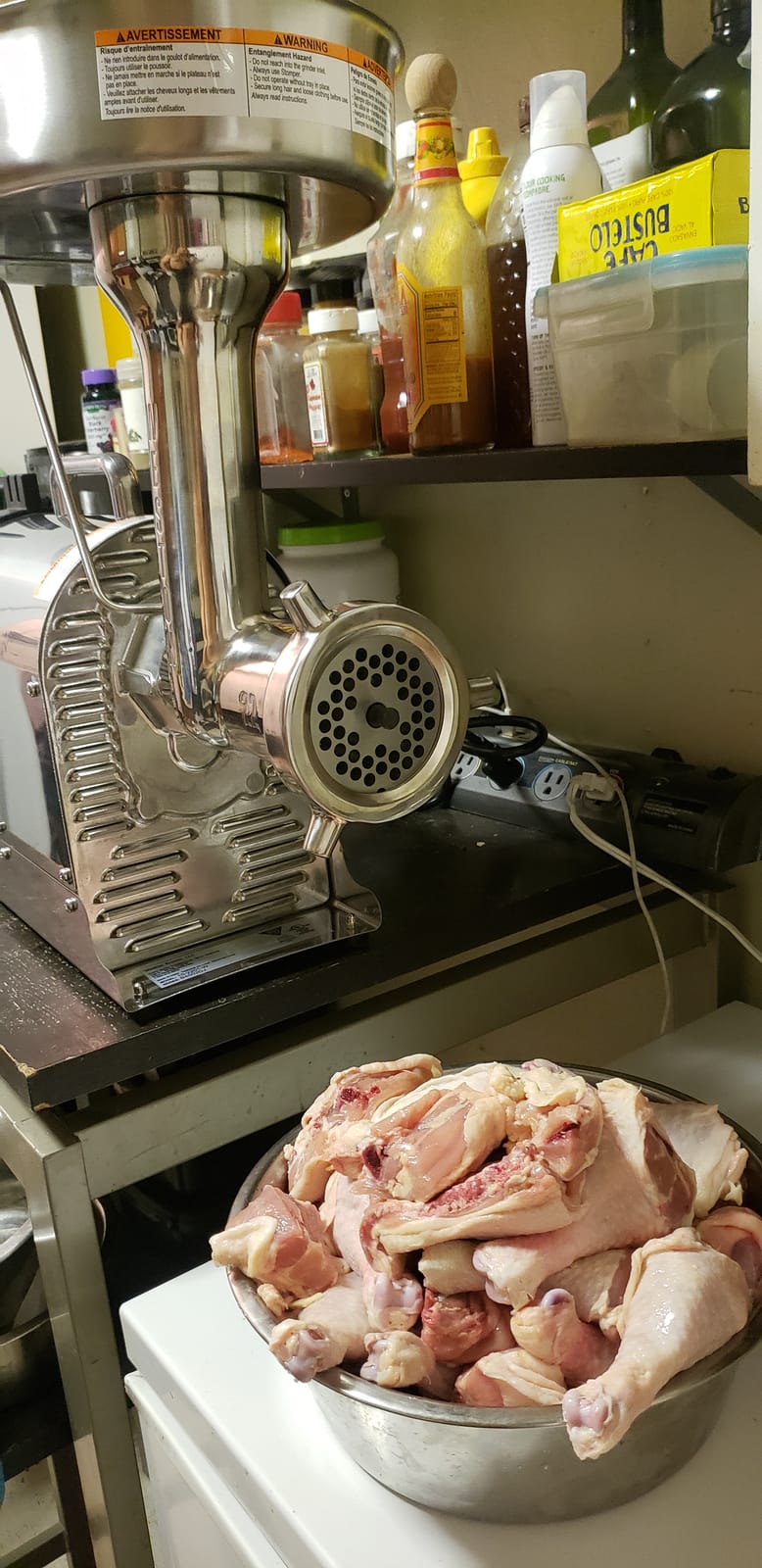
The accessory list is unusually complete for a machine this size. You get the patented auger-grabbing stomper, a patented storage tray with a cover, coarse 7mm and fine 4.5mm plates, the grinder knife, and a full sausage stuffer kit with an adapter spacer and four-sized funnels. There is also a built-in knife sharpener, which matters more than it sounds: a dull blade is the number one cause of a grinder that feels like it is bogging down on meat it should handle easily.
Because throughput depends so heavily on blade sharpness, the sharpener quietly protects the 14-pound figure. Over a season, a blade that has been honed twice as fast still moves the same meat. The all-stainless body carries a limited five-year manufacturer warranty, matching the LEM for coverage length.
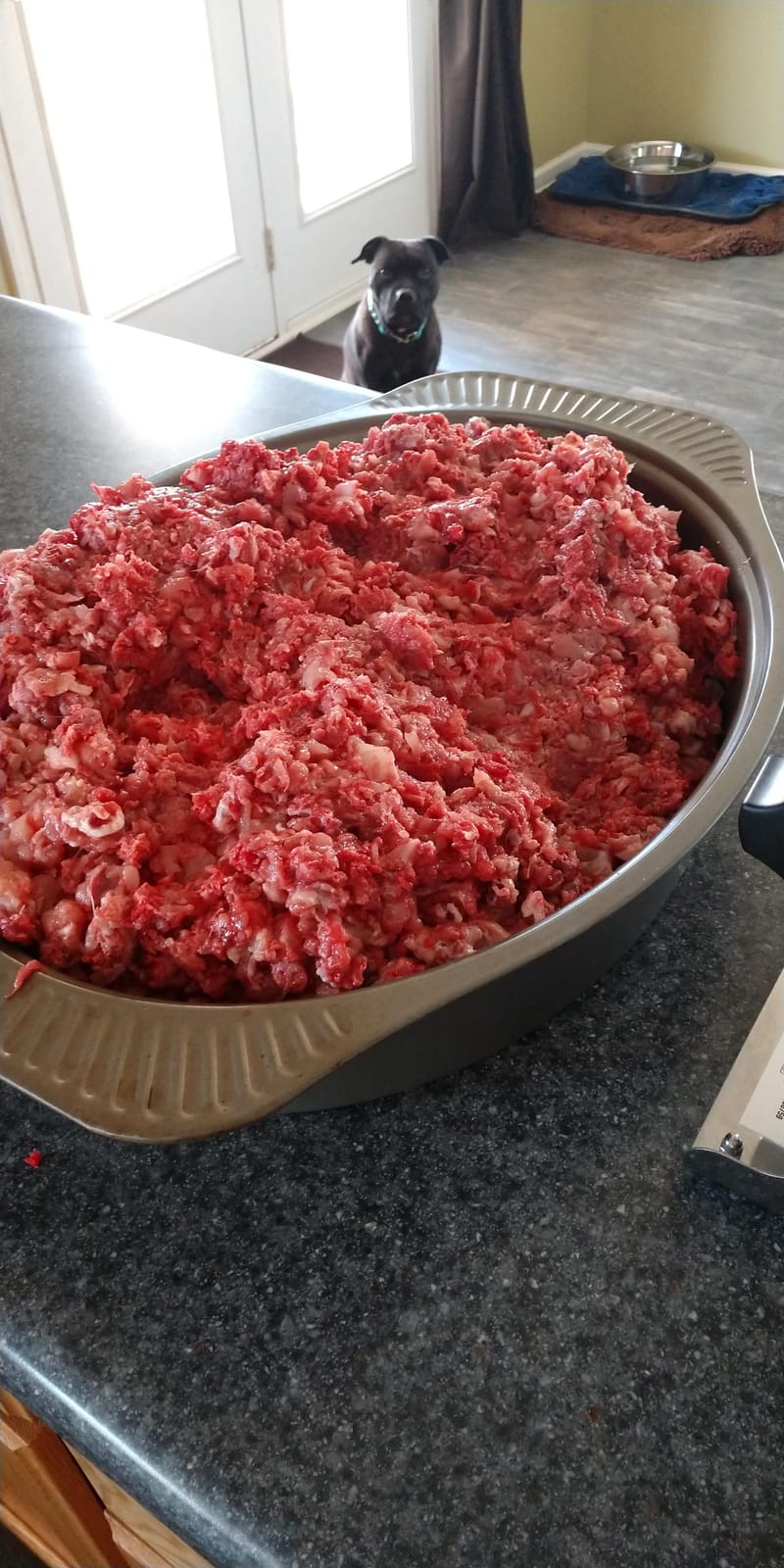
Where the Weston Pro Series earns its place
This is the grinder for volume. If you process six or more deer, work through a whole hog, or handle elk, the 1.5 HP motor and forward-reverse mode are what stop a session from turning into a series of rest breaks. It is also a sensible shared machine: hunting partners can split the cost and split the cleanup, which is how a lot of serious home processors get into this class in the first place.
The tapered throat design reduces the physical effort of feeding, which matters more than most people expect over a hundred pounds of meat. Two plates in different sizes plus four sausage funnels means a burger-and-brats day and a fine-texture second grind are both covered without a separate purchase. For a farm or co-op that wants one machine to do everything, it is hard to argue past.
Where the Weston Pro Series falls short
It weighs 58 pounds and measures roughly 25 by 15.5 by 17 inches. That is not a countertop appliance; it needs a dedicated sturdy counter or a stand, and you need a plan for moving it. If you are processing one deer a year, this is far more machine than the job requires, and the physical footprint will be the thing you notice every day.
The review base is also the thinnest here at 164 ratings, so the long-term consistency picture is thinner than for the LEM or the STX machines with several thousand. That is not a quality signal, it is a sample-size one. If your volume is uncertain, we would start one tier down and move up only when the small machine starts throttling you.
6. Weston #12: Best Countertop Grinder With a Slow Stuffing Speed
Weston #12 Electric Meat Grinder & Sausage Stuffer
750W and 1 HP motor
4-5 lbs per minute
Two speeds plus reverse
Die-cast aluminum body with metal gears
Pros
- Slow speed designed specifically for sausage stuffing
- Reverse clears jams without disassembly
- Die-cast aluminum body and metal gears feel durable
- Cam-action headlock makes plate changes quick
- Compact footprint for a No. 12 class grinder
Cons
- Throughput of 4-5 lbs per minute is modest for whole-hog work
- AC adapter power supply rather than a direct cord
- Only one stuffing funnel and spacer included
- One-year warranty is the shortest here
The Weston #12 is the sensible middle of this lineup for a household that grinds meat most weeks and makes sausage occasionally. It runs a 750W motor that the manufacturer describes as 1 HP, moves 4 to 5 pounds per minute and includes reverse plus a second slow speed chosen specifically for stuffing. That dual-speed arrangement is unusual at this size and it is the reason this machine appears on so many sausage-making shortlists.
The construction is more serious than the head size suggests. Die-cast aluminum body, metal gears and a cam-action headlock give it a feel that reviewers consistently compare favorably against plastic-bodied units, and the cam-action headlock makes plate changes fast when you are switching from a coarse first grind to a fine second pass.
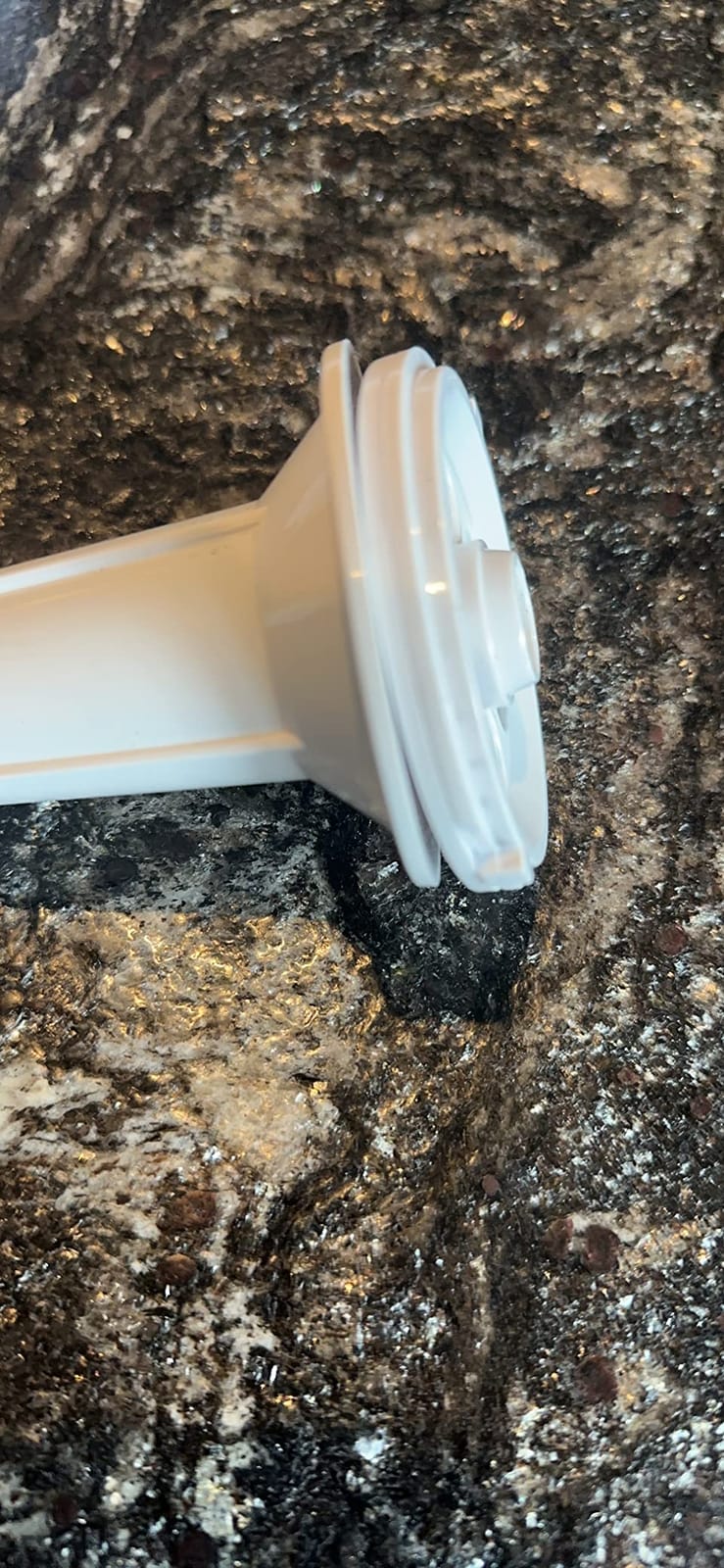
It processes beef, chicken, turkey, bison and venison on the countertop, which covers the standard homestead rotation. The stuffing funnel and stuffing spacer handle breakfast links, bratwurst and kielbasa, so a first sausage run needs nothing extra. Two stainless plates in medium and coarse come in the box, along with the blade, stomper and funnel.
Two speeds plus reverse also mean the machine handles a busy grind. Reverse clears jams without disassembly, which is the specific complaint that owners of the LEM miss most, and the slow speed is genuinely slow rather than merely slower. On a countertop with limited space, that combination is worth more than raw throughput.
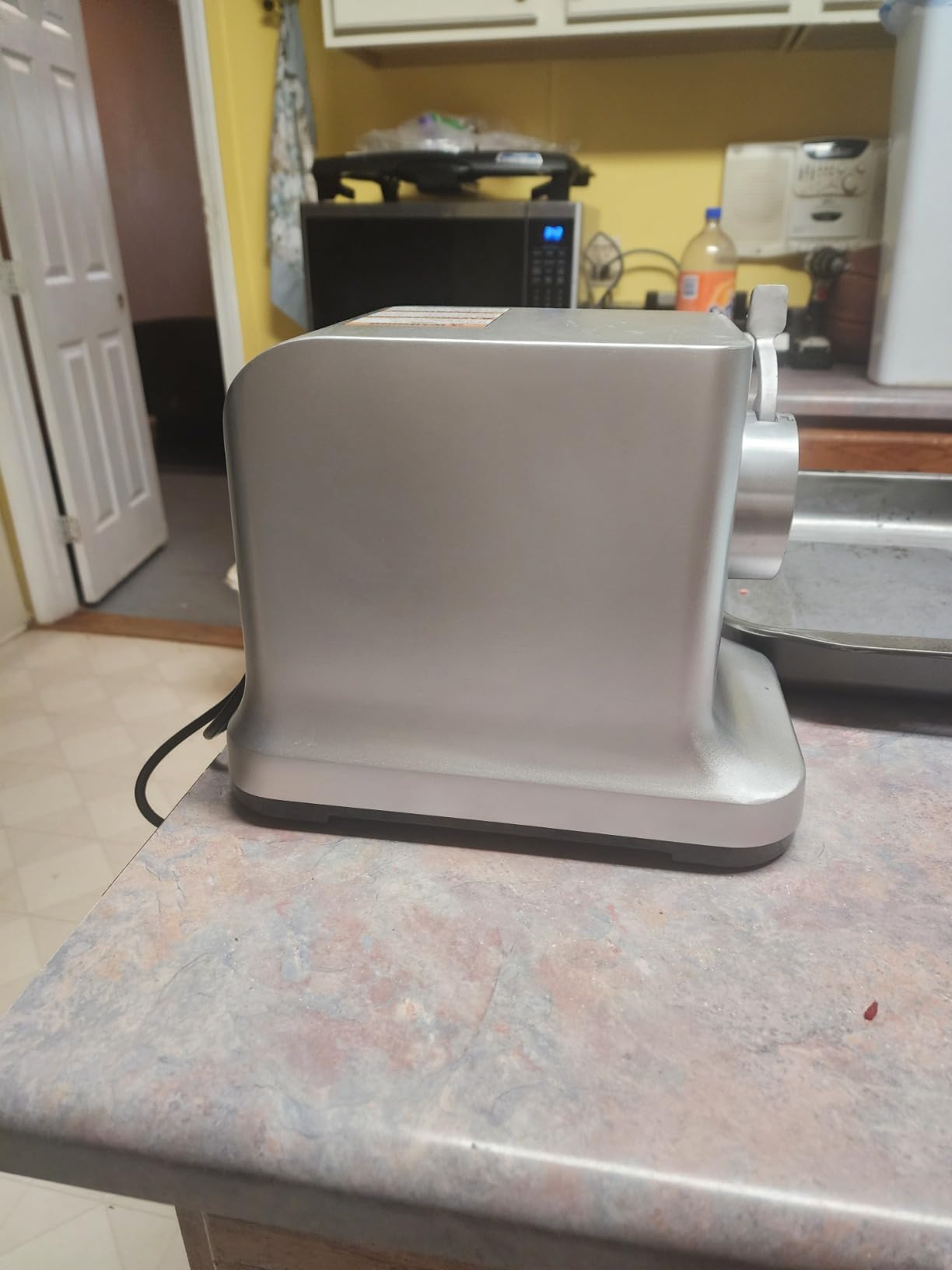
Where the Weston #12 earns its place
It is the right pick when sausage matters more than raw throughput, or when counter space is genuinely limited. At roughly 15 by 10 by 10 inches and 13.5 pounds, it is the smallest No. 12 class grinder here, and the metal gear train means it should outlast its warranty by a wide margin.
For a family that grinds a few pounds of beef most weeks and puts up a batch of brats or breakfast sausage a few times a year, this is the machine that gets used. It handles venison and bison without drama, and the reverse button removes the single most common frustration people have with small grinders. If you share it with a neighbor or a hunting partner, the small size makes it the easiest to hand over.
Where the Weston #12 falls short
Throughput is the honest limitation. At 4 to 5 pounds per minute, a whole-hog or multi-deer weekend is a long afternoon, and reviewers with big game runs describe the machine as being pushed past its comfortable range. If you process more than about 100 pounds a season, step up a class.
It also runs from an AC adapter rather than a direct cord, which adds a box to your work surface and a failure point. The sausage accessories are limited to a single funnel and spacer. And the one-year warranty is the shortest in this roundup, so register the unit and keep the receipt.
7. Barton Commercial #12: Best for Raw Pet Food With Small Bone
Barton Commercial #12 Electric Meat Grinder, 1100W Stainless Steel Meat Mincer & Sausage Stuffer with Stainless Steel Cutting Blade for Beef, Pork, Venison, Chicken & Home or Commercial Use
1100W motor with a commercial No. 12 head
All-stainless food-contact parts
Cuts small rabbit and chicken bone
47 pound floor-style body
Pros
- Owners with farm backgrounds say it performs like shop grinders
- Handles large annual kills of deer and hog without binding
- Stainless parts do not rust like cast iron
- Quiet relative to other machines this size
- Disassembles without tools and stores compactly
Cons
- Six bolts must be removed for a full teardown and thread poorly
- An Allen key is needed at the motor connection and is not included
- Runs hot during long 10 kg sausage runs
- Only a 60-day manufacturer warranty
The Barton Commercial #12 sits at the interesting middle of this lineup: heavier and more commercial in feel than the kitchen grinders, but far smaller and lighter than a full shop machine. It runs a 1100W motor that owners consistently describe as a true 1 HP unit, feeding a commercial No. 12 grinding head with stainless cutting blade and food-contact components throughout.
Its distinguishing use is bone. Owners report it cutting through small rabbit and chicken bones, and multiple buyers bought it specifically for raw pet food work where bone-in meat is the point. That is a narrow niche, but it is one that most of the other machines here either exclude explicitly or handle only by accident. Venison, beef, pork and chicken are all within the normal envelope.
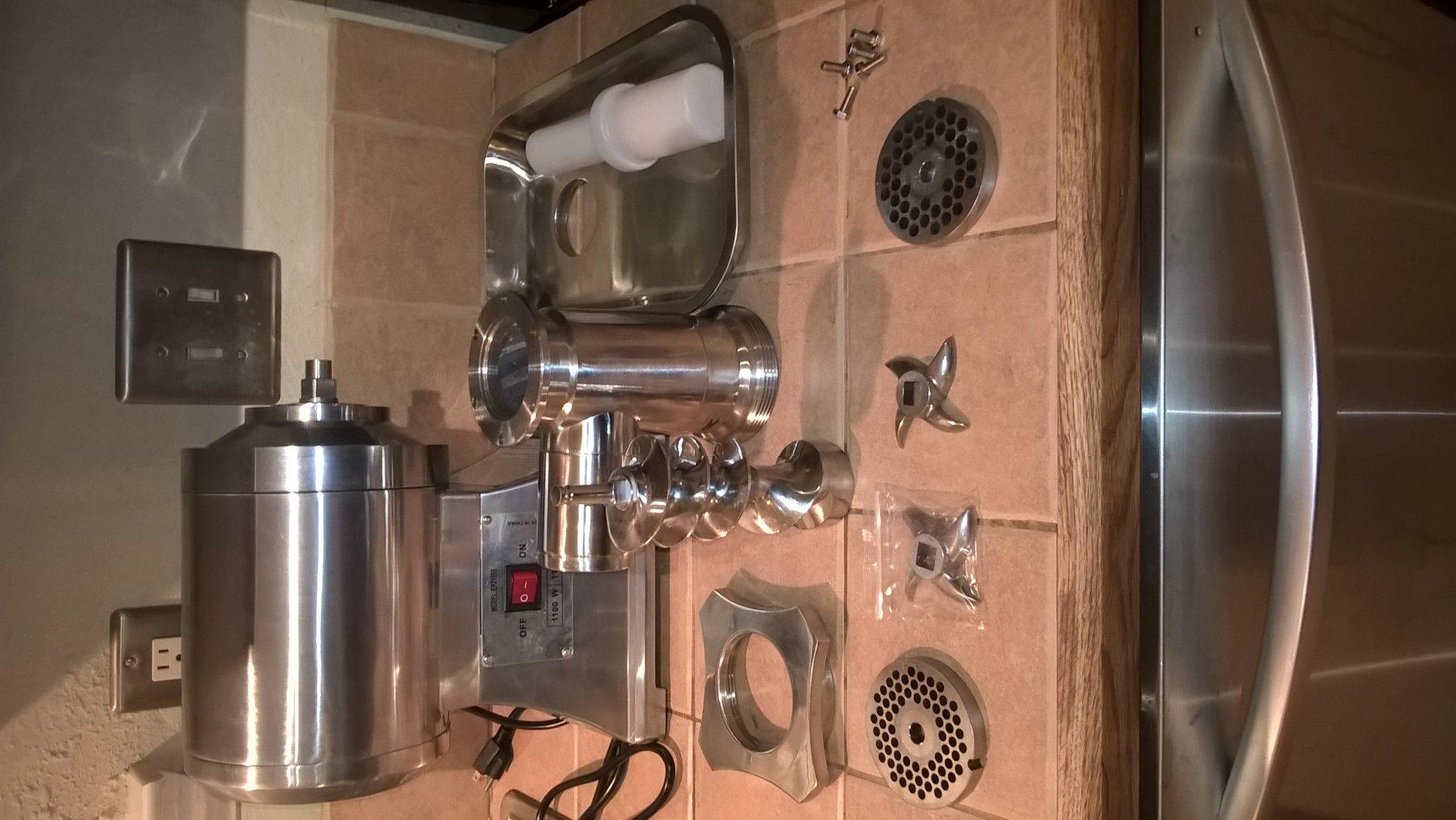
Reviewers with farm backgrounds describe double-grinding deer and hog without binding, and the all-stainless parts are noted repeatedly as a step up from cast components that rust. The machine also runs quiet for its size, and it disassembles without tools and stores more compactly than a hand-crank station would, which matters if your processing area is a shed corner rather than a shop.
The commercial framing is real rather than marketing copy. It is sold for home kitchens, restaurants, butcher shops and hunting camps, and buyers with a farm background say it performs like the shop grinders they grew up with. For the money, the throughput-to-capability ratio is the strongest argument for it.
Where the Barton Commercial #12 earns its place
It is the pick for raw pet food makers, small-game processors and anyone who wants a floor-style stainless grinder that will not rust in a damp shed. The 47-pound weight means it stays put on a stand instead of wandering across a counter, and that stability shows up in the consistency of the output on irregular bone-in meat.
It also suits the family that butchers one large animal a year and wants something more substantial than a kitchen attachment, without the 58-pound commitment of a true commercial machine. Multiple owners replaced manual stations in this class and reported the switch as an easy upgrade rather than a lateral move.
Where the Barton Commercial #12 falls short
Cleaning is the recurring complaint. A full teardown means removing six bolts, and they are reported to thread poorly, plus an Allen key is needed to reach the back of the motor connection and is not included. Budget ten extra minutes after every session and keep a hex key with the machine.
It also runs hot during long batches such as a 10 kg sausage run, one unit showed rough internal machining inside the auger tube, and it is loud under load. The warranty is only 60 days, by far the shortest here, which makes this the pick to buy only from a seller who handles returns cleanly.
8. VEVOR #12 Electric Mincer: Best for First-Time Sausage Making
VEVOR Meat Grinder, 552 Lbs/H, #12 Electric Meat Mincer, 750W/1 HP Motor
750W and 1 HP copper motor
Up to 552 lbs per hour
6mm and 8mm stainless plates
Dishwasher-safe removable parts
Pros
- 1 HP copper motor holds steady output across a long session
- Dishwasher-safe removable parts simplify cleanup
- Anti-vibration foot pads keep the machine steady
- Cold-air cooling system reduces overheating risk
- Accessory set covers burgers sausage and kibbe out of the box
Cons
- Explicitly not suitable for bones or frozen meat
- Body is aluminum rather than stainless steel
- Not recommended for pet food work involving bone
The VEVOR is here as the honest value entry, and it does one specific job well: standard meat grinding and sausage making on a counter, with very little fuss about cleaning. The 750W, 1 HP pure copper motor handles up to 552 pounds per hour, roughly 9.2 pounds per minute, through a three-stage auger with a cross-sharp steel blade. A three-stage auger and a cross-cutting blade are a sensible pairing for consistent output on a mixture of lean and fat.
The practical advantage is cleanup. Removable parts are dishwasher-safe, which matters more in a home butchery than in a kitchen because you are dealing with raw carcass meat, not packaged ground beef. You can put the plate, blade and auger in the machine and get proper sanitation without hand-washing a dozen crevices.
The physical design shows thought about a real work surface. Anti-vibration foot pads and a locking head knob keep a 36.6-pound machine from walking across the counter when the feed tube is loaded, and a rapid cold-air cooling system adds margin against overheating on longer sessions. That last feature matters if you are grinding a full deer rather than a Sunday roast.
Accessories cover a complete first sausage run: 6mm and 8mm stainless plates, three stuffing tubes at 0.3, 0.4 and 0.8 inch, a kibbe kit and a meat pusher. It is ETL approved, and the whole package suits someone learning to grind and stuff for the first time.
Where the VEVOR #12 earns its place
It suits a first-time sausage maker who wants plates, tubes and a kibbe kit in one box and does not want to hand-wash parts after a raw meat session. At around 9 pounds per minute it moves real volume for a countertop unit, and the anti-vibration feet make it usable on a normal kitchen counter rather than requiring a bench.
It is also a reasonable second grinder for a household that grills and smokes regularly without butchering whole animals. The cold-air cooling system gives you headroom on a longer session, and dishwasher-safe parts mean sanitation is a five-minute job. If your volume is under about 50 pounds a year, this covers it.
Where the VEVOR #12 falls short
The manufacturer states plainly that it is not suitable for bones or frozen meat, and owners and reviewers both repeat that as the limiting factor. If you process a whole deer and want pet food with bone, or if you grind frozen trimmings, this is the wrong machine. Do not test it. It is also not recommended for raw diet work involving bone.
The body is aluminum rather than stainless steel, so it needs hand washing and will not survive the same damp shed environment as the stainless picks here. It carries the lowest average rating in this group at 4.2 across 210 ratings, with a wider spread of one-star reviews than the others, so expect some variation between units. It is a capable standard grinder, not a whole-animal workhorse.
How Big a Meat Grinder Do You Need?
Count pounds per season, not animals. A No. 12 head at roughly 5 pounds per minute clears about 300 pounds an hour of practical grinding time once you allow for trimming, plate changes and breaks. Below 100 pounds a season, any of the compact units on this list will keep up. Between 100 and 300 pounds, target 7 to 9 pounds per minute. Above 300 pounds, or for hogs and elk, you want 11 pounds per minute or more.
Here is how the tiers map to actual work. A household taking one deer needs to move roughly 50 to 60 pounds of usable meat. Two deer puts you near 120 pounds. Three to five deer, or one hog plus a deer, is a homestead-scale weekend that runs into the several-hundred-pound range and rewards anything above 7 pounds per minute. Six or more animals in a season is where the 11 to 14 pound per minute commercial class starts to pay for itself in saved hours rather than in capability.
That framing matters because the alternative is paying a processor per pound for something you can do at home. Once you are grinding more than roughly 200 pounds a season, the machine pays for itself on throughput alone, before counting the butcher-shop blends of fat that hunters frequently add to game without being asked. Hunters who process at home often cite exactly that reason: knowing precisely what is in the blend.
One practical note before you size up. Buy the grinder one tier below the machine you think you need, and share the bigger one. Hunters regularly pool money for a #22 or #32 class machine rather than each household buying one, and split both the cost and the cleanup. If you process one deer a year, a shared 1.5 HP setup serves better than your own underused commercial unit.
Benches and surfaces count too. The weight range here runs from 13.5 pounds for the Weston #12 to 58 pounds for the Weston Pro Series. If you are buying the big machine, measure the stand first, because it needs to be sturdy enough to hold the unit and tall enough that the output pan sits at a comfortable height.
Buying Guide: Head Size, Motor Power, Plates and Drive Type
Head size is the first decision. The number stamped on the plate is a diameter standard from the Enterprise commercial scale, so No. 8 is genuinely smaller than No. 12 and No. 22 is genuinely larger. Every grinder on this list is No. 12, which is the correct entry point for home butchering: large enough to move real volume, small enough to fit a workbench. Going above No. 12 means buying a floor-standing commercial machine and a dedicated outlet, which is a different purchase.
Motor power is the second decision, and wattage marketing is where buyers get confused. Peak or locked wattage is the number a manufacturer quotes, and it is what the motor draws when stalled. Running wattage is what it actually pulls while grinding, and it is typically far lower. A grinder listed at 3000W locked maximum may run at 800 to 1200W under load, which is exactly how the STX Turboforce 3000 is specified. Comparing two machines is only fair if you compare the same kind of number.
Horsepower matters more than raw watts for sustained work. Below 1 HP, expect a comfortable ceiling around 4 to 5 pounds per minute and a real chance of a warm motor late in a long session. Between 1 and 1.5 HP, you get steady output on a full deer and, in the case of the Weston Pro Series, reverse capability that clears connective tissue instead of stalling on it.
Gear material is the durability decision, and it is the one owners most often regret getting wrong. Plastic gear trains crack and strip under game meat load, and this is the single most repeated complaint in homesteading discussions about mid-priced grinders. Every machine recommended here has an all-metal or metal gear train, and that is why we do not rank plastic-bodied units for butchering work at any price point.
Stainless versus aluminum is a cleaning and longevity tradeoff rather than a performance one. Stainless parts tolerate being left wet and handle damp shed environments; aluminum parts must be dried immediately and will discolor. If your processing area has a sink within reach and you will wash parts the moment you finish, aluminum is fine. If you are working in a cold garage or a camp, stainless is worth the money.
Plates and blades decide your texture range. A usable set needs at least two plate sizes: a coarse plate for a first pass and a fine plate for a second. Three is better, and a separate stuffing plate is worth having if sausage is on the menu. Blades should be stainless steel, and any machine worth buying for butchering ships with more than one. A dull blade is the most common reason a good grinder seems to bog down, so budget for sharpening or for a spare.
Hole diameter maps to outcome. A 3mm plate gives a fine sausage texture, 4.5 to 6mm is the general-purpose burger and coarse grind range, and 7 to 8mm handles visible crumbles for summer sausage and snack sticks. A beaner plate is a finishing pass, not a primary grind. Whatever the machine, keep at least two sizes so you can always move the texture.
Sausage tubes are matched to casing diameter, and the sizes vary more than brands advertise. Tubes in the 0.3 and 0.4 inch range suit breakfast links and snack sticks, while a 0.8 inch tube suits bratwurst and kielbasa. Several owners of the faster machines still buy a separate manual stuffer, because stuffing is arm work no matter which grinder produced the meat.
Reverse, or forward-reverse, deserves its own paragraph. On game meat, sinew and silver skin wrap around the auger and stop the machine. A reverse button clears that in seconds without opening the head, and on a three-hour session with cold hands it saves the difference between a five-minute fix and a forty-minute teardown. Four of the grinders here have it.
Electric versus manual versus stand-mixer attachment is a shorter answer than it used to be. Manual grinders suit a single deer at a remote camp and nothing else; forums still recommend them for field processing, but they are brutal on a whole hog. Stand-mixer attachments are convenient and cheap but move perhaps a pound a minute, which does not scale to a carcass. For anything beyond a few pounds, a dedicated No. 12 electric machine is the only sensible answer.
What a home butchery should not attempt is worth stating plainly. Hard bone from a mature cow or elk leg, frozen blocks of meat, and fat-heavy renders will damage blades and strain any motor in this class. If you need bone-in pet food, look for a machine that explicitly supports it, such as the Barton or the LEM, and buy a separate pet-food grinder rather than overloading a kitchen unit.
How to Grind a Whole Animal Without Ruining the Meat
The quality of your ground meat is decided before the machine is switched on. Trim first, every time. Sinew, silver skin, bone chips and any bullet fragments come off with a knife, and a machine cannot grind what a knife should have removed. Forum advice on deer processing converges on exactly this point: the trim stage is where the grind succeeds or fails.
Chill everything. The meat, the plates, the blade and the auger all belong in the freezer or a walk-in for a while before the session, and cold metal plus cold meat is what keeps fat from smearing. Venison is lean enough that even a short warm-up produces dry, pasty output instead of crumbles. Freeze the plates in a zip bag if you remember to, and let the meat sit in the coldest part of your cooling setup until you are ready.
Load small and let the machine work. Meat chunks sized to the feed tube move smoothly; oversized pieces force you to push, and pushing raises the temperature and wears the auger. Never use the stomper as a lever. If the machine stalls, cut the next chunk smaller rather than leaning on it.
Switch plates between passes, not during them. Finish the coarse grind of an entire batch first, then switch to the fine plate for the second pass. A mid-grind plate change with cold hands and a screwdriver is how people learn to dislike sausage making. Stopping every fifteen minutes to change plates also generates heat in the head.
Keep the output cold. Small batches into a pan set over ice or inside a cooler beat one large batch in an open bowl. Product pushed into a cooler while still warm rises toward the safe handling temperature before you have finished the last of it, which is the point at which you get greasy, smeared ground meat.
Batch size is a heat decision, not a speed decision. Working through 100 pounds in one sitting is what triggers the overheating complaints we found. Grinding in smaller amounts with pauses between them keeps the motor in a temperature band it was designed for, and it costs far less time than it saves.
Cleaning and Maintenance After a Full-Animal Grind
Disassemble while you are tired of it, not the next morning. Raw carcass residue left overnight is the fastest route to a permanent smell and to corrosion on aluminum parts. Every grinder here comes apart at the head, and the ones with metal gear trains are built for repeated teardown rather than a single factory assembly.
Work from the least fatty part outward. Remove the plate, blade, auger and feed tube, then flush with cold water before anything else so the fat does not set on the surfaces. Warm or hot water coagulates the protein and welds it to the metal, which is why cold water is the rule for a butchering teardown even though it feels wrong.
Push bread through next. A couple of stale white bread slices after a flush clears fat from the grinding surfaces in a way a brush alone will not, and it is the trick seasoned processors use instead of a chemical cleaner. Finish with a stiff nylon brush on the auger horn and the threads around it, which is where most machines hide meat that turns rancid and then taints the next batch.
Dry everything immediately. For stainless parts this is simply good practice. For aluminum and polystyrene parts it is mandatory, because both corrode and discolor if they sit wet, and both are hand-wash only on every machine in this roundup. Put parts on a towel, not back together in a sink basin.
Sharpen the blade on a schedule, not a failure. A dull blade forces the motor to work harder, which raises heat and is a leading cause of the mid-session overheating people blame on the machine. Sharpen at the start of hunting season, check again mid-season, and always before a large batch. The Weston Pro Series has a built-in sharpener for exactly this reason.
Before the season, run the grinder on a few pounds of fatty scrap so you learn the disassembly while nothing is at stake, and store the plates wrapped so they cannot pick up garage moisture. It is also worth pairing a bench grinder for blade work with your butchering setup, which is the topic our bench grinder guide covers in detail. Mid-season, re-check every bolt on a bolt-down machine such as the Barton, because a full teardown during a session is how you lose an afternoon.
Frequently Asked Questions
How big of a meat grinder do I need?
Count pounds per season, not animals. A No. 12 head at about 5 pounds per minute covers up to roughly 100 pounds a year, 7 to 9 pounds per minute handles 100 to 300 pounds including a hog, and 11 to 14 pounds per minute is right for six or more deer, hogs or elk. Most home butchers should buy one tier below what they think they need and share a larger machine with hunting partners.
What is a meat grinder?
A meat grinder forces whole muscle meat through a rotating auger and a sharp blade against a fixed perforated plate. Meat loads into the hopper, the stomper guides it down the feed tube, and the spinning auger pulls it against the rotating blade and the plate. The diameter of the holes in that plate is what sets the final texture, from a fine 3mm grind to a coarse 8mm crumble.
What is the best home meat grinder and sausage stuffer?
For home butchering the LEM BigBite #12 is the strongest all-round pick, with a 0.75 HP all-stainless motor, up to 11 pounds per minute, plates, a knife, a stomper and sausage tubes included, plus a five-year warranty. For sausage specifically, the Weston #12 has a dedicated slow stuffing speed and reverse. Both are No. 12 class heads, which is the right size for whole-animal processing.
Can I grind bones in a home meat grinder?
It depends entirely on the machine. The LEM BigBite #12 lists raw chicken bone as supported, the Barton Commercial #12 is reported to cut small rabbit and chicken bone, and the STX Turboforce II 4000 handles soft bones from chicken, rabbit, squirrel and quail. The VEVOR is explicitly not suitable for bones or frozen meat, and the STX Turboforce 3000 says not to grind bones, cartilage or frozen blocks. Check the manufacturer listing before you test it.
Why does my ground meat come out mushy?
Almost always heat. Warm meat and warm plates smear the fat into the lean instead of producing distinct crumbles. Chill the meat, freeze the plates and blade before the session, work in small batches, and push the output straight into a pan over ice. Also check blade sharpness and make sure you are not running the same cut through twice in one pass, which overworks it into paste.
Why does my meat grinder keep clogging?
Sinew, silver skin and connective tissue wrapping the auger are the usual cause on game meat, which is why trimming before grinding matters more than any grinder feature. A reverse button clears most jams in seconds; without one you have to unplug and open the head. Cutting chunks smaller so the feed tube takes them freely also reduces pressure on the auger and the motor.
Is a #12 meat grinder better than a #8?
For home butchering, yes. The number is a diameter standard, so a No. 12 head has a larger plate and a bigger feed opening than a No. 8, and it moves meat noticeably faster on the long batches a carcass produces. A No. 8 is fine for a few pounds a week in a kitchen. Once you are processing a deer, a hog or more than about 100 pounds a season, the larger head pays for itself in time.
The Verdict
After working through the field, the best meat grinders for home butchering in 2026 come down to a volume question. One or two deer a season, the STX Turboforce 3000 gives you the deepest proven track record at the lowest entry point, and the AAOBOSI #12 Heavy Duty adds reverse jam clearing and an all-metal gearbox for hunting-season money. One large animal or several, the LEM BigBite #12 is our pick, and its cold output and bone tolerance are why it earned the top spot here.
Go bigger only when the numbers demand it. The Weston Pro Series 1.5 HP handles 14 pounds per minute and never needs a mid-batch rest, but it weighs 58 pounds and demands its own stand. Most people should start one tier down and share the bigger machine with hunting partners, which is how co-ops keep the cost honest.
Whatever you choose, the machine is the smallest part of the outcome. Trim before you grind, keep everything cold, work in batches you can finish, and clean the machine the moment the session ends. That discipline is worth more than any wattage figure on a box.