
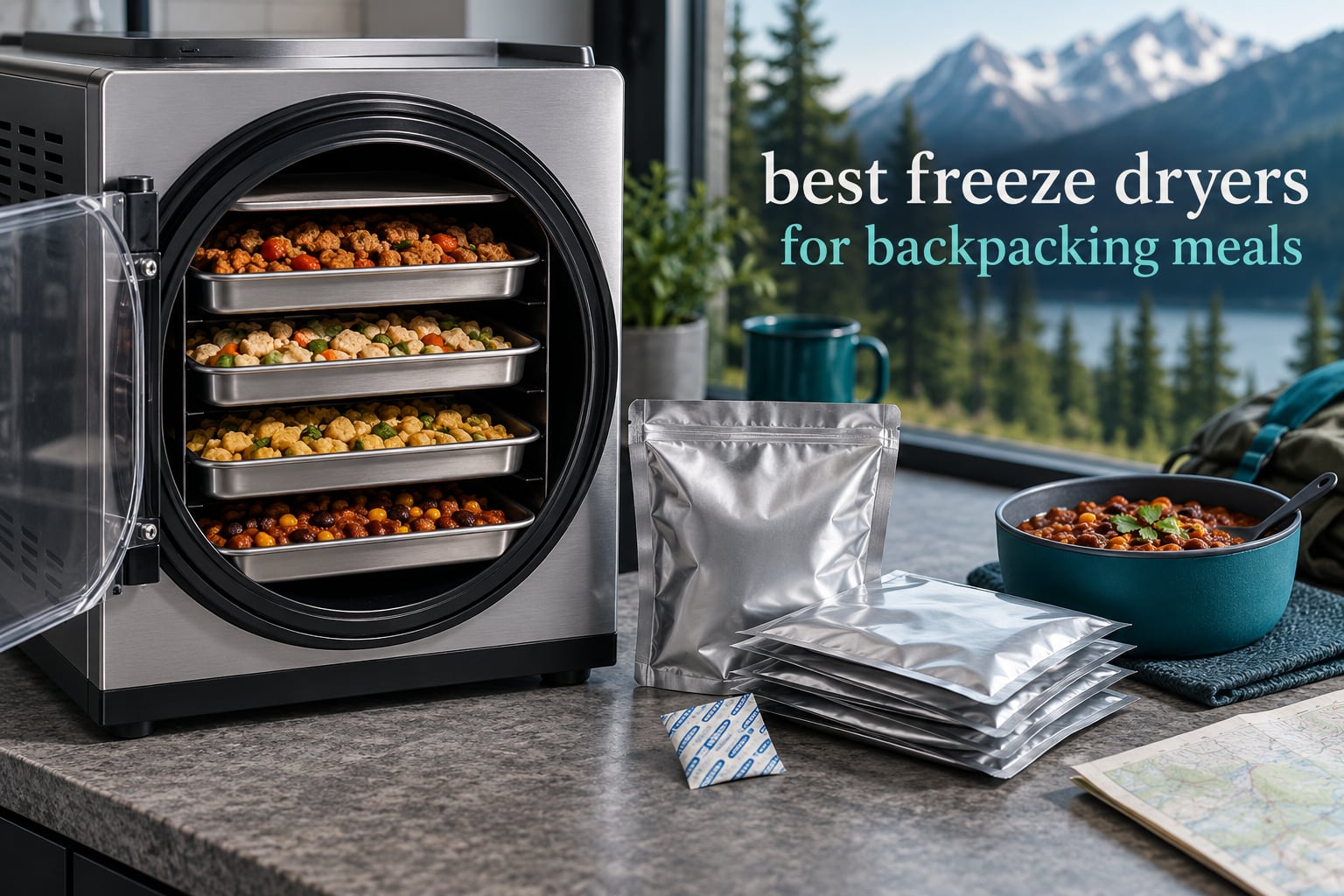
The VEVOR four-layer vacuum freeze dryer is the best freeze dryer for backpacking meals we could justify from published specifications and owner feedback, because it is the only machine in this group with a meaningful review history: 3.7 stars across 48 ratings, a 8.8-13.2 lb batch on four stainless trays, a cold trap rated to -35C, and published noise figures at or below 60dB. Everything else on this list is either thinly reviewed or entirely unreviewed, and that difference matters more here than in most appliance categories.
Here is the thing nobody tells you before you spend four thousand dollars on a countertop freeze dryer. A freeze dryer is not a dehydrator with a marketing sticker. A true vacuum freeze dryer freezes food solid, pulls a vacuum, applies gentle heat, and lets ice move directly from solid to vapor. That process, sublimation, is what keeps flavor, nutrition, and cell structure intact.
A hot-air dehydrator does something much simpler. It cooks water out of food at around 130-160F, and the result is food you rehydrate by soaking for hours. Backpacking Light’s field review of a home freeze dryer reported cold-soak rehydration in 5-20 minutes for whole cooked meals, a decisive practical advantage over air-dried food on a trail. That rehydration speed, not shelf life marketing, is the reason to own one of these machines.
We want to be straight about our method here. We did not lab-test eight four-figure machines. Every specification below comes from the manufacturer listing, and every performance judgement comes from the owner-review data attached to each product. Where a listing has no reviews at all, we say so, because six of these eight machines have no owner history to draw on. Forum experience comes from Backpacking Light’s review thread and from Reddit communities such as r/FreezeDrying and r/Ultralight, and we attribute it to those sources rather than presenting it as our own testing.
The lineup itself is a lesson in buying carefully. Every one of these units is a genuine vacuum freeze dryer with a real cold trap and a real pump, which puts them all above the flood of listings under two hundred dollars that flood the shopping carousel and are nothing but hot-air boxes with a vacuum-shaped name. If you are still choosing appliances for a small kitchen, our guide to portable dryers for apartments covers the footprint side of that decision.
Table of Contents
Top 3 Picks for Best Freeze Dryers for Backpacking Meals (October 2026)


Camellia River 25 lb Freeze Dryer
- 25 lb per cycle on 5 trays
- Mylar and absorber kit included
- 120V operation
Two notes before you read further. The Banfluxion carries a perfect 5.0 rating, but that rating comes from a single review, so we treat it as a listing claim rather than as evidence. And the Camellia River is the only machine here that ships the packaging consumables you need to actually store finished meals, which is a bigger deal for a backpacker than raw throughput numbers.
All Eight Home Freeze Dryers Compared in 2026
| Product | Specifications | Action |
|---|---|---|
| VEVOR 4-Layer Vacuum Freeze Dryer |
|
Check Latest Price |
 Banfluxion Lyophilizer 11 lb Banfluxion Lyophilizer 11 lb |
|
Check Latest Price |
 EQCOTWEA 4-Tray Freeze Drying Machine EQCOTWEA 4-Tray Freeze Drying Machine |
|
Check Latest Price |
 INTSUPERMAI Scientific Freeze Dryer INTSUPERMAI Scientific Freeze Dryer |
|
Check Latest Price |
 HNZXIB ZZKD 0.46 m2 Freeze Dryer HNZXIB ZZKD 0.46 m2 Freeze Dryer |
|
Check Latest Price |
 WYDDDARY 0.4 m2 Sublimation Dryer WYDDDARY 0.4 m2 Sublimation Dryer |
|
Check Latest Price |
| Camellia River 25 lb Freeze Dryer |
|
Check Latest Price |
 Generic 6-Tray 1600W Freeze Dryer Generic 6-Tray 1600W Freeze Dryer |
|
Check Latest Price |
Read the batch column carefully, because manufacturers measure it differently. Some quote raw pounds of fresh food loaded, some quote a loaded tray weight, and one quotes a capacity figure with no tray area behind it at all. Where a listing gives a drying area in square meters alongside a pound figure, we have included both so you can compare like with like.
1. VEVOR 4-Layer Vacuum Freeze Dryer – the Only One With Real Owner History
VEVOR Vacuum Freeze Dryer Machine, 8.8-13.2 LBS/Batch Food Freeze Drying Machine with 4-Layer Trays, Vacuum Pump, Adjustable Timer and Temperature Control, for Fruits Vegetables Meat, White
8.8-13.2 lb batch
4 trays
-35C cold trap
110V 1550W
245.8 lb
Pros
- 8.8-13.2 lb batch across four trays
- 304 stainless build reviewers call high quality
- Set temperature and time then walk away
- Transparent acrylic door for monitoring
- Rated noise at or below 60dB
Cons
- Manual widely criticized as unclear
- Compressor oil not included and must be bought separately
- Customer service described as poor with difficult returns
Our team spent the bulk of our comparison time on this machine because it is the only one here with a review history worth reading. Across 48 ratings it averages 3.7 stars, split roughly 54 percent five-star and 22 percent one-star, and that spread tells you something useful: people who get this unit running like it, and people who fight it, in almost equal numbers.
The specification sheet is genuinely competitive at this price tier. Batch capacity runs 8.8-13.2 lbs (4-6 kg) across a four-layer tray design, the cold trap pulls down to -35C, and the chamber uses 304 stainless steel trays behind a high-transparency acrylic door so you can watch a cycle rather than guess at it. It runs on 110V AC at 1550W, which means an ordinary household outlet rather than a dedicated 20-amp circuit, and the swivel casters underneath mean you can roll it into a garage instead of lifting it.
That 60dB operating rating deserves context. It is a manufacturer figure, not an independent measurement, and Backpacking Light’s review thread is unanimous on the point that the vacuum pump, not the compressor, is what you hear. Even on a well-sited unit, treat this as a garage or shed appliance rather than something you run in a bedroom at midnight.
Reviewers who succeed with it describe the same simple experience: set the temperature, set the time, and it runs unattended. That walkaway behaviour is the entire reason people buy these machines, because a freeze-drying cycle runs for a day or more and you cannot babysit it. Reviewers also single out the interior space and the quiet circulation for praise, and several mention success with meat jerky style loads.
The problems cluster around documentation and setup rather than around the machine itself. The instruction manual is the single most criticized item, with reviewers describing it as unclear or effectively unusable and reporting little online documentation to fall back on. Compressor oil is not included in the box, which catches first-time buyers out, and some machines needed meaningful adjustment before they would run properly, with oil leaks reported on a portion of units. One reviewer reported the chamber not reaching its indicated temperature at all.
What To Check Before You Buy The VEVOR
Confirm the oil situation first. If your machine arrives dry, the pump is the most expensive part in the build and it needs its oil before the first cycle, so budget for that consumable up front rather than treating it as a surprise repair cost.
Then ask for setup guidance before your first load, because the manual will not give it to you. A backyard freeze-drying forum regular put it plainly: these machines break down if you are not careful with them. The people who get good results are the ones who check seals, keep the drain routine, and do not assume walkaway means hands-off.
Who The VEVOR Suits And Who It Does Not
This suits a hiker who wants roughly 8-13 lbs of finished trail meals per run and can dedicate a garage corner to it. At 245.8 lbs and 29.92 by 21.65 by 35.04 inches, it is a floor-standing machine in weight even though the footprint is modest, so plan the location before the purchase rather than after.
It is a poor choice if you need a documented support line. Customer service is the weakest part of this package, with returns and exchanges described as hard to arrange, and that risk is higher for you than for a buyer who has a nearby friend with a workshop.
The VEVOR wins our recommendation on evidence, not on polish. It is the only machine in this roundup where we can point to a real distribution of owner outcomes instead of a single five-star review or none at all.
2. Banfluxion Scientific Lyophilizer – the Coldest Trap With a Single Review
Banfluxion Scientific Lab Lyophilizer & Home Freeze Dryer Machine with Vacuum Pump, -40℃ Ultra-Low Temperature, 110V 1550W, 11lbs/Batch, 4 Stainless Steel Trays, for Food/Fruit/Vegetable Dehydration
11 lb batch
-40C cold trap
2 L/s pump speed
110V 1550W
4 trays
Pros
- Up to 11 lbs processed per batch
- -40C cold trap with 2 L/s pump speed
- 7-inch HD touchscreen with curve presets
- Tecumseh or Secop compressor with anti-oil-return pump
Cons
- Only one review exists so owner feedback is thin
- Noise cycle time and yield unconfirmed from that single review
The Banfluxion lists as a scientific lab lyophilizer that also handles food, and that dual positioning shows in the hardware. A 1550W pure copper motor drives a high-performance vacuum compressor with a cold trap rated to -40C and a pumping speed of 2 L/s, which is the most aggressive water-removal specification in this group after the ZZKD.
Tray area is the number to notice: four food-grade stainless steel trays totalling 0.4 square meters, with a quoted load capacity up to 13.2 lbs and single-batch processing up to 11 lbs. Those two figures describe the tray hardware and the food throughput separately, which is exactly the kind of clarity that helps when you are comparing listings that mix the two.
Control is handled by a 7-inch HD LCD touchscreen with one-key start and preset multi-scenario parameter curves, plus a transparent organic glass door with an automatic defrost function. For a first-time buyer, preset curves and auto defrost are the two features that decide whether your first two batches are successful or whether you end up with a garage full of half-dried slabs.
Now the honest part. There is exactly one review on this listing, a verified five-star note from a single owner. That tells us almost nothing about noise, cycle time, yield, or durability, and at that volume the rating history carries no statistical weight. Everything else you have read above is manufacturer-supplied.
One more constraint is worth flagging. The rotary vane pump is rated for continuous operation but not for hot running, which means your scheduling has to work around the pump rather than the food schedule. Plan cycles so you do not need the chamber warm immediately after a long pull.
When The Banfluxion Specification Set Is Worth It
Pick this one if your priority is pull speed and you can accept an unproven support history. A -40C cold trap with a 2 L/s pump is the specification that shortens the dry, and shorter cycles mean more batches per season for a hiker who wants a full pantry before a long trip block.
The preset curves matter more for beginners than the spec sheet suggests. Nobody running their first cycle wants to guess at shelf-plate temperature, and a one-key start with stored curves removes the most common failure point, which is a load that never quite finishes.
Who Should Look Elsewhere
If your decision depends on other people having already broken it, this is the wrong machine. There is no public body of owner feedback here, so you would be the first, with no community to search when something goes wrong at hour thirty of a cycle.
Roughly 255 lbs and a laboratory-style chassis also mean this is not a countertop appliance for a small kitchen. Our notes on portable dryers for apartments cover the space question in general terms, and the same logic applies: pick the room before the machine.
3. EQCOTWEA 4-Tray Freeze Drying Machine – Best Interface In The Group
EQCOTWEA 110V 4-Tray Freeze Dryer Vacuum Freeze Drying Machine with 0.4㎡ Freeze-Drying Area -25~+60℃ Temperature 11lbs/Batch Vacuum Food Dehydrator for Fruits Vegetables Meat, Used in Home Laboratory
11 lb batch
0.4 m2 area
-40C cold trap
110V
254 lb
Pros
- 11 lb batch across four stainless trays
- 7-inch LCD shows temperature vacuum and curves
- Transparent door with automatic defrost
- Food-safe rectangular chassis
Cons
- No customer reviews so reliability is unverified
- Rotary vane pump runs continuously but not hot
The EQCOTWEA is the most informative control panel we found in this roundup, and for backpacking meal prep that matters more than raw capacity. The 7-inch LCD touchscreen reports heater temperature, cold trap temperature, and sample temperature, and it draws both vacuum and data curves live while the cycle runs, so you can see a stall or a slow ramp instead of waiting twelve hours to open the door and find out.
Underneath, four stainless steel trays give 0.4 square meters of drying area and an 11 lbs-per-batch capacity. The compressor is described as high quality with a -40C cold trap temperature, and the vacuum side is a rotary vane pump with a pure copper motor, anti-return oil protection, and a low-noise design claim.
The chamber door is colorless transparent organic glass with an automatic frosting and defrost function, which solves the least pleasant part of the workflow. Nobody enjoys chipping ice off an inner panel after every batch, and an automatic cycle is worth real money in avoided handling.
Weight is 254 pounds with dimensions of 28.74 by 19.69 by 35.24 inches, so this is a compact chassis that still needs a serious floor. That is the recurring pattern across this whole category: small footprint, large mass, because the cold trap and compressor are the heaviest parts of the machine.
There are no customer reviews or ratings on this listing at all. Reliability, finished meal quality, and real-world noise are entirely unverified, and every performance claim here comes from the manufacturer. We include it because the control specification is genuinely the most detailed in the group, not because owners have validated it.
Why Live Curve Data Changes Batch Outcomes
Freeze drying fails quietly. A load can look fine at hour eight and still be wet in the middle because the shelf temperature never caught up with the food core. Live vacuum and temperature curves are how you catch that, and this panel gives you the most visibility of the eight.
For trail meals specifically, that matters twice over. You need a genuinely dry product to pack into mylar with an oxygen absorber, and residual moisture is the single biggest driver of both spoilage risk and a failed pack. Watching the curve is how you confirm the dry instead of assuming it.
Limitations To Plan Around
With zero reviews, you are the test case. r/FreezeDrying threads on brands without owner histories keep circling the same concern, which is parts availability and support when something fails, and a lab-derived chassis from an unnamed seller gives you fewer fallback options than an established consumer brand.
The pump scheduling constraint also applies here. A rotary vane pump rated for continuous but not hot operation means you cannot run back-to-back cycles back to back, which reduces your effective throughput below the 11 lb headline number.
4. INTSUPERMAI Scientific Freeze Dryer – Built-In Sensors On The Trays
INTSUPERMAI Scientific Freeze Dryer Home Lab Vacuum Freeze Dryer with Vacuum Pump 11lb/batch Processing Capacity 4 Trays -25-+60℃ Drying Temperature Sublimation Drying Machine for Food
11 lb batch
4 trays
-40C cold trap
1550W
320 lb
Pros
- Tray rack has integrated heating and temperature sensors
- Built-in cold trap with flow deflectors and auto defrost
- Preset control curves for first-time users
- 11 lb batch on four 7.87 by 16.73 inch trays
Cons
- No customer reviews so results are unverified
- Listed 320 lb weight needs dedicated floor space
- Transparent door may discolour over long use (unverified)
The INTSUPERMAI differentiates itself in one specific place: the storage rack carries integrated heating elements and temperature sensors. Most machines measure air temperature somewhere in the chamber and leave you inferring what the food is doing. Sensors at the tray level give a much closer read on whether a slab of chili or lasagna has actually reached plate temperature and held it long enough.
Capacity is 11 lbs per batch across four stainless steel trays, each measuring 7.87 by 16.73 inches (200 by 425 mm), which is a tray footprint worth checking against your own cookware. If your prep containers do not fit that footprint, the nominal capacity does you no good.
Thermal performance comes from a Tecumseh or Secop compressor with a cold trap at or below -40C unloaded, and a drying temperature range of -25 to +60C. The motor is 1550W with a 2 L/s pump speed and a rotary speed of 1700 r/min through a G3/4 inlet, which is a conventional laboratory-grade vacuum train rather than a consumer one.
The cold trap is built in rather than a separate bowl, with multiple flow deflectors and an automatic defrost function for easier cleanup. A colour LCD touchscreen handles preset parameters and control curves. Listed weight is 320 pounds, the heaviest figure in this group, so this machine wants floor space and not a counter.
As with several others here, no customer reviews exist. Cycle time, finished shelf stability, and noise are all manufacturer claims, and we cannot confirm any of them from owner data.
Why Tray-Level Sensors Matter For Full Meals
Freeze drying whole cooked meals is harder than freeze drying fruit slices. A tray of apple chips gives up water quickly from a thin edge. A frozen casserole gives up water from the centre last, and that centre is what decides whether the meal is safe to pack and whether it reconstitutes in five minutes instead of twenty.
Sensors at the tray rack narrow that guesswork. Backpacking Light’s field review noted that complete takeout meals worked well in a home freeze dryer, with sesame tofu and spaghetti pomodoro described as excellent results. That is the outcome you are buying sensors for.
Where This Machine Falls Short
Three hundred and twenty pounds is the practical problem. Unless you have a dedicated floor location and a plan for moving it, the heaviest machine in the roundup is also the hardest to live with, and you will move it exactly once, which is the worst time to discover that.
With no reviews and a laboratory product code rather than a consumer model line, expect limited parts and service options. The transparent organic glass door is also a long-term scratch risk in a machine you will open and load repeatedly for years.
5. HNZXIB ZZKD Freeze Dryer – the Deepest Cold Trap and Fastest Defrost
ZZKD -60℃ Vacuum Freeze Dryer for Home, Food Lyophilizer with Vacuum Pump, Food Grade Freeze-Dried For Fruits, Candy, Fish, Milk, Pet Foods, One Freeze-Drying Area Of 0.46㎡
-60C cold trap
0.46 m2 area
8.8-13.2 lb batch
15 min auto defrost
1500W
Pros
- -60C medical-grade cold trap reaching temperature in 40 minutes
- 15-minute automatic defrost with wastewater discharge
- Complete kit with pump hose clips trays and manual
- 7-inch touchscreen with one-touch food presets
- 1-year warranty with setup guidance and support
Cons
- No reviews so the 800-hour and nutrition claims are manufacturer stated
- 304.2 lb weight needs dedicated floor space
- Single drying area means one-zone batches only
The ZZKD is the only machine in this group with a stated complete kit, and for a first-time buyer that matters more than raw cold numbers. The box includes the vacuum pump, vacuum hose, tube clips, four trays, and a manual, so you are not hunting down a pump on delivery day the way you would with a listing that treats the pump as an accessory.
The cold trap is the headline: a medical-grade unit rated to -60C, reaching that temperature in 40 minutes, with a manufacturer claim of preserving up to 97 percent of nutrition. The vacuum side is a 4.5 CFM rotary vane pump with an anti-oil-return design, rated by the manufacturer for 800+ hours of continuous operation. Take all three as seller claims rather than verified data.
Drying area is 0.46 square meters, the largest single-area figure here, with 8.8-13.2 lbs batch capacity on food-grade stainless trays at 110V and 1500W. The 7-inch touchscreen carries one-touch presets for fruits, vegetables, and pet treats, which tells you who this machine is actually marketed to, and why it shows up in camping food searches.
Our pick for this machine is the defrost. A 15-minute automatic cycle with wastewater discharge cuts the cleanup step between batches from a twenty-minute chore to something you start and walk away from. When you are planning three or four runs in a week to build a trip’s worth of meals, that time saving compounds fast.
Weight is 304.2 pounds at 31.89 by 17.72 by 31.1 inches, so plan a floor space with clearance around the door. There is a 1-year warranty with setup guidance and round-the-clock support listed, which is more than most unbranded machines in this category offer.
Where The Cold Trap Actually Pays Off
A deeper cold trap pulls more water out of the product before the cycle ends, which translates to lower residual moisture in the finished meal. Residual moisture is the number that decides whether a mylar bag with an oxygen absorber holds for years or whether you find a soft patch in month three.
It also helps with the oily and high-sugar meals people actually want on trail. Freeze dried fruit and pasta have no trouble giving up water. Glazed snacks and higher-fat cooked meals are slower, and a stronger cold trap buys you margin on exactly the foods people struggle with.
Buying This One With Your Eyes Open
Single-zone batches only. One freeze-drying area means you cannot run two independent loads at different settings, so every batch in a week uses the same curve whether it is fruit, jerky, or a frozen lasagna portion.
Then accept the evidence problem. No reviews exist, so the 800-hour pump life, the 40-minute cold trap time, and the nutrition retention figure are all unverified. The warranty and the included kit are the parts you can hold the seller to; the performance numbers are the parts you cannot.
6. WYDDDARY Sublimation Freeze Dryer – the Easiest Pump to Swap
WYDDDARY Scientific Vacuum Freeze Drying Equipment, Fruit and Vegetable Vacuum Dryer with Four Trays, Laboratory Sublimation Freeze Dryer, 0.4㎡ Dried Area
11.02 lb batch
0.4 m2 area
-40C cold trap
4 trays
1550W
Pros
- 11.02 lb per batch over 0.4 m2 of drying area
- Tecumseh or Secop compressor with -40C cold trap
- Standard KF connector makes pump swapping easy
- Transparent door for full-process observation
Cons
- No customer reviews so output is unverified
- Color listed as Neutral so finish is unspecified
The WYDDDARY’s practical advantage is a small piece of hardware. Its vacuum pump uses an international KF quick connector, and that is the difference between a fifteen-minute swap and a job that needs a specialist. Since forum consensus across Backpacking Light and r/FreezeDrying is that pumps are the part that eventually fails, serviceability is not a consolation prize.
Everything else is a conventional laboratory-class build: a Tecumseh or Secop compressor with a cold trap at or below -40C, a drying temperature range of -25C to +60C, four internal stainless steel trays measuring 7.87 by 16.73 inches each, and 11.02 lbs (5 kg) of processing capacity over a 0.4 square meter drying area at 110V and 1550W.
The chamber has a colorless transparent organic glass door so you can observe the full process without opening it and admitting humid air, and an LCD touchscreen with preset parameters and temperature control curves handles the programming. The listing describes the chassis as low noise, which is a seller claim, not a measurement.
It also has the strongest sales rank in this group, at number 2 in Lab Freeze Dryers, which tells you the model moves units. It does not tell you they work well. There are no customer reviews or ratings on this listing, so durability and real output remain unverified.
Why Serviceability Beats Headline Specs Here
Owners in freeze drying communities consistently describe breakdowns as the defining ownership risk, and the recurring complaint about established consumer brands is parts and support rather than build quality. A standard connector turns the most common failure from a crisis into a weekend project.
It also makes the machine a better long-term hold. If you keep it for five years of trail meals, the vacuum pump will outlast at least one seal and one gasket, and every hour you save in the repair is an hour you do not spend re-planning a trip.
Where The Listing Falls Short
No owner feedback at all, so we cannot tell you whether the -40C cold trap delivers in practice or only on paper. Buying an unreviewed machine is a bet on the compressor brand rather than on the seller, and Tecumseh and Secop are decent names to be betting on.
The finish is listed as Neutral rather than a specific colour or material, so appearance is unspecified. Minor in itself, but on a several-hundred-pound appliance you are going to look at every day for years, it is worth asking before purchase.
7. Camellia River 25 lb Freeze Dryer – the Biggest Batch and the Full Packaging Kit
Camellia River Freeze Dryer Machine with Vacuum Pump, Large Capacity for Home Food Preservation
25 lbs per cycle
5 stainless trays
120V power
220 lb
Sealer and mylar kit
Pros
- 25 lbs of food per cycle across five trays
- Kit includes pump sealer mats mylar bags and oxygen absorbers
- Automated cycles with intuitive digital controls
- Runs on standard 120V household power
Cons
- No reviews or ratings so real output is unverified
- No cold trap or wattage data given for comparison
- Listed height figure looks wrong so confirm dimensions
This is the one to look at if you cook for a household rather than for yourself. Capacity is quoted at 25 lbs of food per cycle across five stainless steel trays, which is more than double the 11 lb figure most laboratory-derived listings in this roundup advertise, and the operating power is standard 120V household current.
The accessory bundle is the sleeper feature. The package includes the vacuum pump, an impulse sealer, silicone mats, mylar bags, and oxygen absorbers. For a backpacker that is the difference between finishing a batch and having a finished, packable, storable meal, because the packaging consumables are a recurring cost that most listings quietly leave to you.
Operation is described as automated freeze-drying cycles with intuitive digital controls, and the access is front-load on a 220 pound unit. Front loading matters more than it sounds: a chest you cannot reach into means bent arms and dropped trays a dozen times a year.
Now the caution. There are no reviews, no ratings, and no sales-rank data on this listing, and it gives no cold trap temperature and no wattage, so you cannot compare its drying capability against anything else here. One of the three dimensions listed reads 314 inches tall, which cannot be right, so confirm the real footprint with the manufacturer before you plan a location.
When 25 lbs Per Cycle Actually Pays Off
Batch size only matters if you have somewhere to put the output. A hiker who eats 3000 calories a day for a week needs roughly 21 lb of finished food, and if your finished-to-fresh ratio is around a third, a 25 lb load is one full resupply cycle plus a margin.
For a family or a shared hiking group, the math inverts completely. One 25 lb run replaces eight or nine separate small batches, and each avoided batch also avoids a defrost cycle and a pump start, which is where the wear actually accumulates.
Who This Is Not For
Solo hikers with limited freezer space. A 25 lb fresh load has to be frozen solid before it goes in, which means freezer shelf area and several days of pre-chilling, and most apartment freezers cannot hold a load like that.
Anyone buying on specifications alone. With no cold trap temperature and no wattage published, you are choosing on capacity and bundle contents alone, and both of those numbers come from the seller rather than from owners.
8. Generic 6-Tray 1600W Freeze Dryer – the Most Tray Layers, the Least Specificity
Freeze Dryer Machine, 1600W Stainless Steel Food Dehydrator with Vacuum Pump, 6-Tray Home Drying Machine with Touchscreen Pre-Set Modes for Fruits, Vegetables, Herbs
6 tray layers
1600W
external vacuum pump
touchscreen
201 stainless
Pros
- Six tray layers for organised loading and unloading
- External vacuum pump is easier to service or replace
- Digital touchscreen with preset food modes
- 1600W output rated to preserve texture
Cons
- No reviews and only a Generic manufacturer name
- 201 stainless is a thinner grade than 304
- No cold trap temperature batch weight or tray dimensions listed
This listing has the simplest description and the least to verify. It is a 1600W freeze dryer with a six-layer tray system, an external vacuum pump for vacuum extraction, a digital touchscreen with preset food modes, and a 201 stainless steel body described as easy to clean.
Two things make it interesting despite that. Six tray layers is the deepest tray stack in this roundup, which lets you load a wide variety of small items in one pass, and an external vacuum pump is by definition easier to service or replace than a pump sealed into the chassis. Both are real advantages for a machine you intend to keep for years.
The construction grade is where we hesitate. 201 stainless is a thinner and less corrosion-resistant grade than the 304 stainless listed by several competing machines here, and in a device that runs cold and wet on every cycle, chamber material is not a place to economise.
Beyond that, the listing simply does not give us the numbers needed for comparison. There is no cold trap temperature, no batch weight in pounds, and no tray dimensions. There is no customer review, no rating, and the manufacturer name is Generic, so there is no reputation behind the warranty and support terms, which are not stated at all.
When A Six-Tray Layout Actually Helps
More trays means more separate loads per cycle, which suits trail snacks far better than full meals. Granola clusters, jerky strips, fruit slices, and cocoa-dusted almonds each want their own shelf temperature, and spreading them across six thin layers dries more evenly than piling the same total weight onto four trays.
For a hiker building a snack-heavy resupply rather than hot meals, that geometry is worth more than a headline pound figure that the listing never states anyway.
Why We Rank It Last
Every performance detail here is seller-supplied with no owner verification behind it, and the brand itself is Generic. That is a different risk profile from the VEVOR, which at least has 48 owners willing to describe where it failed.
The missing cold trap specification is the specific concern. A freeze dryer without a documented cold trap cannot be compared on drying speed or residual moisture, and those two numbers determine whether your finished meals are actually shelf stable.
What You Actually Need From a Vacuum Freeze Dryer
Before comparing models, it helps to know which specifications actually change your meals and which ones are decoration. Across these eight machines the meaningful variables are the cold trap temperature, the vacuum pump’s serviceability, batch capacity against your real freezer space, and the defrost routine. Everything else is secondary.
Cold Trap Temperature Sets Your Dry
The cold trap is the part of the machine that actually removes water. Anything at -35C will produce shelf-stable food for normal trail meals, and anything at -40C or deeper gives you margin on higher-fat and higher-sugar foods that are slower to give up water. The -60C claim on the ZZKD is the deepest in this group but is unverified by owners.
Capacity Should Match Your Freezer, Not Your Ambition
Every load must be frozen solid before it goes in, so your real limit is freezer space, not chamber space. A hiker with one small freezer bin should size batches to that bin. Households with chest freezers can justify the 25 lb Camellia River load, and most people should be looking at the 8.8-13.2 lb range.
The Pump Is The Loud Part And The Wear Part
Every owner account we found in the Backpacking Light thread and on r/FreezeDrying makes the same point. The vacuum pump is what you hear, so run the machine in a garage or shed, and expect the pump rather than the compressor to be the eventual failure. That is why the KF quick connector on the WYDDDARY and the external pump arrangement on the Generic unit deserve more weight than their spec sheets suggest.
Oil-Free Versus Oil-Lubricated Pumps
An oil-free pump needs no drips and no oil top-ups, which simplifies ownership, but it typically pulls water more slowly and so extends cycle time. An oil-lubricated pump pulls harder and faster, at the cost of periodic draining and the small risk of contamination if the drain is missed. The VEVOR is the one product here with reviews that describe the oil handling directly, including units arriving without their compressor oil.
Used Versus New, And The Sub-200 Dollar Trap
Buying a used freeze dryer means buying an unknown pump history and usually no warranty at all. Beyond that, avoid anything sold as a freeze dryer under roughly two hundred dollars: those are hot-air dehydrators with a vacuum-shaped name, and no amount of listing photography changes the fact that they cannot sublimate. If a listing has no cold trap temperature and no pump specification, treat it as a dehydrator until proven otherwise, which is the same scepticism we bring to ventless dryer shopping, where the product name tells you nothing about the mechanism underneath.
And if the machine cost is the sticking point, the answer more backpackers use than any other is not a cheaper machine. It is borrowing one. Backpacking Light forum commenters point to shared and cooperative setups, where a group buys a single unit and splits the output, and that removes the capital cost entirely while keeping the rehydration advantage.
Freeze Dryer vs Dehydrator for Backpacking Meals
A freeze dryer is better for backpacking meals, and the deciding factor is rehydration time rather than price or capacity. Backpacking Light’s field review found home freeze-dried food rehydrated in 5-20 minutes in cold water, while air-dehydrated food of the same meals took hours.
A dehydrator wins on every other axis, and it wins badly. Units cost a fraction of a freeze dryer, run far faster, handle high-moisture fruit without special treatment, and are what most people should buy if they only want ingredients like banana slices or apple chips. If the space you are working with is the real constraint, start with our hooded dryer and apartment-appliance sizing guides before deciding anything.
The structural difference is that a dehydrator cooks water off with heat and air. It cannot make a complete meal behave like a meal, because the texture of reheated pasta and the texture of dried pasta are not the same thing. A freeze dryer preserves the structure that lets you rehydrate a frozen serving of chili and eat it with a spoon after five minutes of cold water.
A dehydrator also cannot do fruit well without pretreatment, because sugar burns at drying temperatures. Oily and high-moisture foods are the classic failure cases. If your plan is whole cooked meals with real rehydrated texture, only a vacuum freeze dryer gets you there.
How to Prep Meals That Rehydrate on Trail
The machine matters less than the prep, and this six-step pipeline is where most disappointing first batches come from. Get it right and a mediocre freeze dryer will produce meals you look forward to eating.
Cook the meal first. Freeze drying works on cooked food, and uncooked rice or raw pasta comes out as a brittle, unreconstituting shell. Cook your pasta two minutes under, cook your rice slightly firm, and let stews and chilis reduce a little so they are not soup.
Portion for the trail. Freeze in the container sizes you will eat, because a block you have to break apart after rehydration is a mess at 7am in a tent.
Spread thin. A quarter-inch layer across the tray dries far faster and more evenly than a thick slab. A thick centre is the part that stays wet, and wet means not shelf stable.
Cool completely before freezing. Warm food going into a freezer forms ice crystals that damage texture and slow the freeze, which lengthens the next cycle.
Freeze solid, then load. Pre-frozen food loads faster and gives cleaner results, and you should cool the trays after loading before starting the vacuum.
Package immediately after the cycle. Into mylar bags with an oxygen absorber, leaving headspace, dated and labelled. Air is the enemy once the food leaves the chamber.
Some foods simply will not work, and it is better to know now. Oily spreads such as peanut butter will not dry at all. Raw whole eggs turn into an unpleasant powder, and heavily glazed or fried items tend to fuse into a single slab. Someone with access to a farm kitchen tried a cheesy green chile egg scramble, lasagna, and store-bought pizza rolls in the same session, and reported the scramble as excellent, the lasagna as merely acceptable, and the pizza rolls as not good at all.
The scheduling side of meal prep matters just as much as the cooking side, and trail kitchens are no different from any other feeding routine in that respect. Getting portion timing and reheat scheduling straight is the same planning problem we cover in our roundup on automatic feeders for scheduled meals, applied here to bags going into a pack rather than bowls going onto a floor.
Cost Per Meal and Break-Even Math
We are not going to quote you a purchase price for any of these machines, because prices in this category swing by thousands and change constantly. What we can do is give you the calculation, because a commenter in the Backpacking Light thread did exactly this and it is the most useful thing anyone has written on the subject.
That owner put running electricity at roughly three to four dollars per batch on a medium machine with an oil-free pump. That is the operating cost of one load, and it excludes the machine itself, which is the entire reason the objection exists.
The break-even calculation is straightforward. Divide the machine cost by the number of finished meals one batch produces, and that is your true cost per meal. The same commenter compared that against roughly 30-40 nights a year on commercial meals such as Peak Refuel, which they calculated at several hundred dollars annually. Hikers in that category can often justify a machine over a few seasons.
The awkward truth is at the other end of the frequency range. A hiker who gets out for fewer than about 15 nights a year will probably never reach break-even, because the machine only runs when you are using it and it sits idle the rest of the time. For those hikers the honest answer is to rent, borrow, or join a shared setup rather than to buy the cheapest machine available.
One more line item deserves attention. Pack your meals in mylar with oxygen absorbers from the start, and count that consumable in your per-meal figure from day one. A freeze dryer that produces food you cannot store correctly is an expensive way to make compost.
Frequently Asked Questions
What size freeze dryer should I get?
For most backpackers, a machine in the 8.8-13.2 lb per batch range is the right size, because it matches a single household freezer bin and produces roughly a week of trail meals per run. Larger 25 lb machines only make sense if you cook for a family or share output with a group, since you still need freezer space to pre-freeze every load solid before loading the chamber.
What is the best home freeze dryer on the market?
Among the eight machines we compared, the VEVOR four-layer vacuum freeze dryer is the best-supported choice, with a 3.7 star average across 48 ratings, 8.8-13.2 lbs of batch capacity, a -35C cold trap, 304 stainless trays, and published noise figures at or below 60dB. It is also the only unit here with a wide enough review history to show where it fails.
Which is better for backpacking, a dehydrator or a freeze dryer?
A vacuum freeze dryer is better for backpacking meals because freeze-dried food rehydrates in 5-20 minutes in cold water, versus hours for air-dehydrated food. A dehydrator is far cheaper, faster, and better suited to fruit slices and ingredients. If you want whole cooked meals with real texture, a freeze dryer is the only option that delivers.
How do I freeze dry meals for backpacking?
Cook the meal first and slightly underdone, portion it into trail-sized servings, spread it thin across trays no deeper than a quarter inch, cool it completely, freeze it solid, then load the chamber and run the cycle. Pack the finished food immediately into mylar bags with an oxygen absorber, leaving headspace and labelling each bag with the date.
What are the drawbacks of using a food freeze dryer?
The main drawbacks are capital cost, weight, noise, and idle time. Units weigh 220-320 pounds and need dedicated floor space, the vacuum pump is the loud part and belongs in a garage, and a batch runs for a day or more. Most importantly, if you hike fewer than about 15 nights a year, you will struggle to reach break-even against buying commercial meals.
The Best Freeze Dryers for Backpacking Meals in 2026
The best freeze dryers for backpacking meals come down to evidence, and only one machine here has it. The VEVOR four-layer vacuum freeze dryer takes our recommendation at 3.7 stars across 48 ratings, with 8.8-13.2 lbs per batch, a -35C cold trap, 304 stainless trays, and the only published noise figure in the group.
Cook for a household rather than for yourself? The Camellia River at 25 lbs per cycle is the one to look at, and its included sealer, mylar, and oxygen absorbers solve the storage step most listings leave to you. Building a first freeze-dried meal this year and willing to accept an unproven support history? The Banfluxion’s -40C cold trap and 2 L/s pump give you the strongest drying specification here.
And if your nights on trail number fewer than about fifteen a year, our honest advice is to borrow, rent, or join a shared setup instead. No machine on this list changes that arithmetic, and buying the cheapest one only guarantees a worse version of the same problem.