
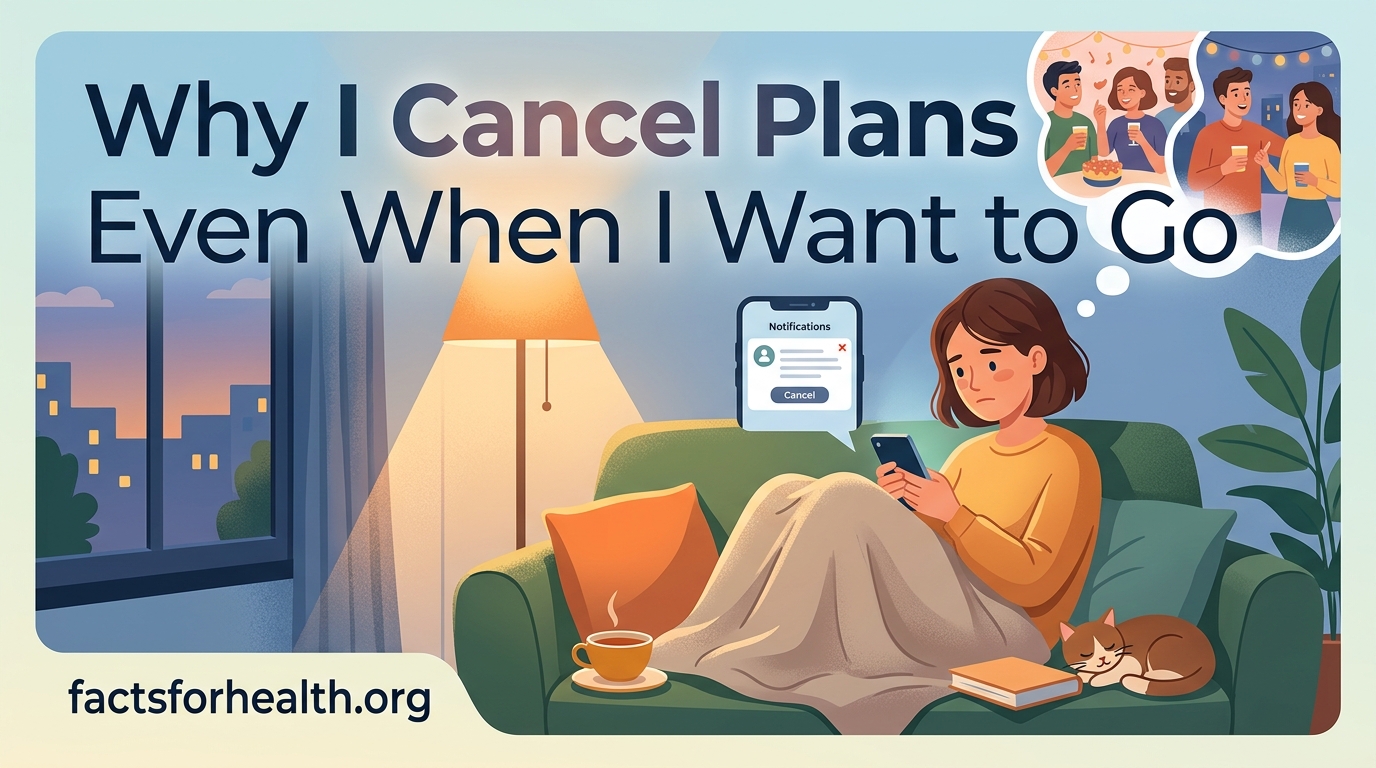
You say yes to dinner on Tuesday. By Friday afternoon, you are staring at your phone, drafting a text about feeling “under the weather.” The thing is, you actually like these people. You genuinely wanted to go when you said yes. So why does every fiber of your being want to bail?
If this sounds familiar, you are far from alone. In fact, the question of why I cancel plans even when I want to go is one of the most common topics in mental health forums, Reddit threads, and therapy sessions across the country. Thousands of people describe the exact same pattern: enthusiasm at the moment of invitation, followed by a slow build of dread as the event approaches, culminating in a last-minute cancellation that brings immediate relief and lingering guilt.
Our team has spent months researching the psychology, neuroscience, and lived experiences behind this phenomenon. What we found is that canceling plans you wanted to attend is rarely about laziness or flakiness. It is almost always about what is happening in your nervous system, your energy reserves, and your mental health.
In this guide, we will walk you through the real reasons this happens, the mental health conditions most commonly connected to it, and what you can do about it. Whether you are someone who cancels plans and feels terrible about it, or you love someone who does, this article will help you understand what is actually going on beneath the surface.
Table of Contents
The Short Answer: Why You Cancel Plans Even When You Want to Go
Canceling plans you genuinely want to attend is typically driven by anticipatory stress — your brain begins preparing for the social event long before it happens, building anxiety that eventually feels overwhelming and causing you to seek relief through cancellation. This is compounded by energy depletion, where your mental and emotional reserves are already running low by the time the event arrives.
When you cancel, your nervous system registers it as a safety response. The threat of social demands disappears, tension releases, and you feel a wave of relief. But that relief is often followed by guilt, shame, and the fear that you are damaging your relationships. This cycle is incredibly common, and understanding it is the first step toward breaking it.
Here are the five most common reasons people cancel plans they wanted to keep:
- Anticipatory stress builds as the event approaches, making it feel bigger and more exhausting than it actually is
- Energy depletion means your social battery is already drained before the event begins
- Social anxiety triggers a fight-or-flight response about being judged or evaluated
- People-pleasing tendencies cause you to say yes when you should say no upfront
- Neurodivergent traits like ADHD or sensory sensitivity make planning and execution feel overwhelming
None of these mean you are broken, flaky, or a bad friend. They mean your brain and body are responding to perceived demands in ways that made sense at some point but may no longer serve you.
Why I Cancel Plans Even When I Want to Go: The Psychology Explained
To really understand why you cancel plans even when you want to go, we need to look at the psychological mechanisms at play. This is not a single problem with a single cause. It is usually a combination of factors that interact and build on each other.
Anticipatory Stress: Your Brain Starts Worrying Before the Event
Anticipatory stress is the anxiety you feel about something that has not happened yet. When you make plans, your brain immediately starts simulating the upcoming event. It thinks about what you will wear, what you will say, who will be there, how long it will last, and how tired you might feel afterward.
This mental simulation is actually your brain trying to protect you. It is scanning for potential threats and preparing you for them. But when you are prone to anxiety or have a sensitive nervous system, this preparation goes into overdrive. Instead of mild anticipation, you experience a building sense of dread that grows stronger as the event gets closer.
Researchers at the University of Pennsylvania’s Center for Health Incentives and Behavioral Economics have studied this phenomenon extensively. They found that the brain treats upcoming social demands as stressors, and the body responds accordingly — elevated heart rate, muscle tension, shallow breathing, and a sense of wanting to escape.
One Reddit user described it perfectly: “It is not that I do not want to see my friends. It is that my chest gets tight and my brain starts spiraling about everything that could go wrong, and canceling feels like the only way to make it stop.”
The key insight here is that anticipatory stress has very little to do with the actual event. It is your brain’s preparation process running in overdrive. The event itself might be perfectly fine — even enjoyable. But the buildup becomes so uncomfortable that cancellation feels like the only option.
Energy Depletion: You Are Not Flaky, You Are Drained
Sometimes the answer is simpler than psychology. Sometimes you are just tired. Energy depletion is one of the most overlooked reasons for plan cancellation, and it has nothing to do with motivation or character.
Think of your social energy like a battery. Every interaction, decision, and obligation throughout your day draws from that battery. By the time evening plans roll around, you may have already spent your reserves on work, family obligations, and the basic demands of daily life.
This is particularly relevant for people in high-stress jobs, caregivers, and anyone dealing with chronic stress or health conditions. As one mental health blogger put it: “You are not flaky. You are tired.” That framing resonated with thousands of readers who had been beating themselves up for years.
Energy depletion also connects to the concept of an introvert hangover — the exhaustion that follows social interaction, especially for introverts or highly sensitive people. If you know from experience that socializing will leave you drained for days, your brain may preemptively push you to cancel in order to protect your energy.
The problem is that energy depletion is invisible. Your friends cannot see how exhausted you are the way they can see a physical injury. So when you cancel, it looks like you just do not care. Understanding that energy is a real, finite resource can help you plan better and communicate more honestly.
The Relief and Guilt Cycle
One of the most confusing aspects of this pattern is the emotional whiplash. When you cancel, you feel an immediate sense of relief. The tension in your body releases. Your breathing slows. The dread evaporates. For a brief moment, everything feels okay again.
But that relief is almost always followed by guilt. You start thinking about how you let your friends down. You worry they will stop inviting you. You feel ashamed of yourself for not being able to follow through on something as simple as showing up to dinner.
This creates what psychologists call a reinforcement loop. The relief you feel after canceling acts as a reward, which makes your brain more likely to repeat the behavior in the future. Meanwhile, the guilt makes you overcorrect by saying yes to the next invitation, even when you know you probably should not.
Many people describe a specific form of cognitive dissonance here. They genuinely value their friendships and want to be reliable. But they also feel an overwhelming need to protect themselves from the stress of social demands. Holding both of these truths at once creates a painful internal conflict that is hard to resolve.
Breaking this cycle starts with recognizing that the relief is real and valid, and so is the guilt. Neither feeling makes you a bad person. The goal is not to eliminate one or the other but to understand what is driving both so you can make more intentional choices.
How FOMO Creates Internal Conflict
FOMO, or the fear of missing out, adds another layer of complexity. You want to go because you do not want to miss the experience, the connection, or the memories. But you also feel unable to go because of the stress and exhaustion it requires. This creates a tug-of-war inside your mind.
Therapists at Anchor Therapy in New Jersey describe this as the “FOMO paradox.” You are simultaneously afraid of missing the event and afraid of attending it. Both fears are real, and they feed off each other in ways that make the decision feel impossible.
Even when you cancel, FOMO does not disappear. You might spend the evening scrolling through social media, seeing photos of the event you bailed on, and feeling a fresh wave of regret. This makes the guilt even worse because now you are not just letting friends down, you are also missing out on something you could have enjoyed.
Understanding FOMO as a driver of plan cancellation can help you make better decisions upfront. If you know you will regret missing the event, that is valuable information. It might mean you need to plan differently, build in recovery time, or find ways to reduce the stress of attending rather than canceling at the last minute.
Mental Health Conditions Connected to Plan Cancellation
While everyone cancels plans sometimes, persistent patterns of cancellation are often connected to underlying mental health conditions. Understanding these connections is not about labeling yourself. It is about getting clarity on what is happening so you can find the right support and strategies.
Social Anxiety and Plan Cancellation
Social anxiety is one of the most common drivers of plan cancellation. If you have social anxiety, your brain perceives social situations as genuinely threatening. This is not shyness or introversion. It is a physiological fear response that can include racing heart, sweating, nausea, and an intense desire to escape.
When someone with social anxiety makes plans, they often feel excitement mixed with apprehension. As the event approaches, the apprehension grows until it overshadows everything else. Canceling becomes a way to escape the perceived threat, even when the person genuinely likes the people they are supposed to meet.
Common signs that social anxiety is driving your cancellations include worrying about being judged, replaying past social interactions and cringing, fearing you will say something embarrassing, and feeling physical symptoms like nausea or a racing heart when you think about the event.
The tricky part is that avoidance makes social anxiety worse over time. Each time you cancel and feel relief, your brain learns that social situations are dangerous and that avoiding them is the solution. This is why treatment for social anxiety often involves gradual exposure — slowly building tolerance to social situations rather than avoiding them entirely.
Depression and Low Motivation
Depression can make everything feel harder, including socializing. When you are depressed, the energy required to get dressed, leave the house, and interact with people can feel insurmountable. Even activities you normally enjoy can feel pointless or exhausting.
People with depression often want to maintain social connections. They know that isolation makes depression worse. But the illness itself drains the motivation and energy needed to follow through. This creates a painful cycle: you need connection to feel better, but depression makes connection feel impossible.
Depression-related cancellations often come with a different emotional signature than anxiety-related ones. Instead of dread or panic, you might feel numbness, heaviness, or a sense that nothing matters. The guilt afterward may be less about letting people down and more about feeling like a burden or a failure.
If you suspect depression is behind your pattern of canceling plans, it is worth talking to a mental health professional. Depression is treatable, and the right support can make a significant difference in your ability to engage socially.
ADHD and Plan Cancellation Patterns
People with ADHD face a unique set of challenges when it comes to social plans. ADHD affects executive function, which includes planning, time management, working memory, and impulse control. These are all skills you need to successfully follow through on social commitments.
When someone with ADHD says yes to plans, they often mean it in the moment. But as the event approaches, several things can go wrong. They might forget the plan entirely until the last minute. They might underestimate how long it will take to get ready. They might get overwhelmed by the number of decisions involved, like what to wear and how to get there.
Rejection sensitive dysphoria (RSD) is another factor for many people with ADHD. RSD is an intense emotional response to perceived rejection or criticism. If someone with ADHD worries that friends are judging them for past cancellations, that fear can actually trigger more cancellations. The anxiety about being judged becomes worse than the social event itself.
ADHD-related cancellations are often impulsive rather than planned. The person might fully intend to go, then suddenly feel overwhelmed and cancel minutes before they need to leave. This pattern can be particularly frustrating for friends who do not understand that the cancellation is not personal.
Introversion and the Introvert Hangover
Introversion is not a mental health condition, but it is a personality trait that profoundly affects social energy. Introverts process social stimulation differently than extroverts. While extroverts gain energy from social interaction, introverts expend energy. After enough socializing, introverts need time alone to recharge.
The introvert hangover is a term used to describe the exhaustion that follows social interaction. It can include feeling drained, overstimulated, irritable, and needing silence and solitude. For introverts who have already spent their social energy during the week, evening plans can feel like being asked to run a marathon after already finishing one.
Introverts are not antisocial. They genuinely enjoy connection. But they need to manage their social energy carefully, and that sometimes means declining or canceling plans when their battery is low. The key is learning to anticipate energy needs rather than pushing through and burning out.
Many introverts report feeling misunderstood by extroverted friends who interpret their cancellations as disinterest. Open communication about being an introvert and how it affects your social energy can go a long way toward preserving friendships.
Neurodivergent Experiences and Social Energy
Beyond ADHD, other neurodivergent conditions like autism spectrum disorder also affect social energy. Autistic individuals may experience sensory overload in social environments, struggle with the social communication demands of gatherings, or need significant recovery time after social events.
The concept of spoon theory, originally developed in the chronic illness community, has been widely adopted by neurodivergent people to describe limited energy reserves. Each activity costs “spoons,” and once you run out, you cannot do more without serious consequences. Social events typically cost many spoons, and if your reserves are already low, cancellation becomes a matter of self-preservation.
For neurodivergent individuals, the pattern of making plans and then canceling is often not about motivation at all. It is about the mismatch between neurotypical social expectations and neurodivergent energy capacities. Understanding this can help reduce the shame and self-blame that often accompany these cancellations.
The Neuroscience: Why Canceling Feels Like Safety
To truly understand why canceling plans feels so good in the moment, we need to look at what happens in your brain and nervous system. The answer lies in how your body processes threat and safety.
Your Nervous System and the Safety Response
When you make plans, especially if you are prone to anxiety, your nervous system may interpret the upcoming social event as a stressor. This activates your body’s fight-or-flight response. Your sympathetic nervous system kicks in, raising your heart rate, tightening your muscles, and flooding your body with stress hormones like cortisol and adrenaline.
When you cancel, the perceived threat disappears. Your parasympathetic nervous system — the rest-and-digest branch — takes over. Your heart rate drops, your muscles relax, and your body releases tension. This creates an immediate sensation of relief that can feel almost euphoric.
As the experts at NeuroLaunch explain: “Neurologically, the brain registers canceling as safety.” That association becomes stronger each time it is repeated. Your brain learns that canceling plans is the fastest way to return to a state of calm, and it begins to default to that response whenever social demands feel overwhelming.
How Avoidance Patterns Get Reinforced
This is where things get tricky. The relief you feel after canceling acts as positive reinforcement. In behavioral psychology, when a behavior is rewarded, it becomes more likely to be repeated. Each time you cancel and feel better, you strengthen the neural pathway that says “canceling equals safety and relief.”
Over time, this can develop into an avoidance pattern. Avoidance is a coping mechanism where you reduce anxiety by staying away from the situations that trigger it. In the short term, it works. You feel better. In the long term, it makes anxiety worse because you never give yourself the chance to learn that the situation is not actually dangerous.
This is why therapists often use cognitive behavioral therapy (CBT) and gradual exposure to help people overcome avoidance patterns. The goal is not to force yourself into overwhelming situations. It is to gradually build tolerance and teach your nervous system that social events are not threats.
Breaking an avoidance pattern does not mean never canceling plans again. It means learning to tell the difference between a genuine need for rest and a fear-driven urge to escape. That distinction is the foundation of healthier social habits.
Self-Determination Theory and Social Motivation
Self-determination theory, a well-established framework in psychology, offers another lens for understanding plan cancellation. According to this theory, humans have three basic psychological needs: autonomy, competence, and relatedness.
When you make plans, your need for relatedness — connection and belonging — is being fulfilled. You want to feel close to people, so you say yes. But as the event approaches, your need for autonomy — control over your own time and choices — may start to conflict. The plan starts to feel like an obligation rather than a choice, and you want to reclaim your freedom.
This conflict between relatedness and autonomy is at the heart of many cancellation decisions. You want connection, but you also want to feel like your time is your own. When a social commitment starts to feel like it infringes on your autonomy, the urge to cancel becomes a way of reasserting control over your life.
Understanding this dynamic can help you make better choices about which plans to accept. If a plan feels like it honors both your need for connection and your need for autonomy, you are more likely to follow through. If it feels like an obligation imposed from outside, cancellation becomes more likely.
Are You Canceling Too Much? A Self-Assessment
Not all cancellations are problematic. Sometimes canceling is the healthiest choice you can make. But how do you know when your pattern of canceling plans has crossed the line from self-care into avoidance?
Here are seven warning signs that your cancellation pattern may be worth examining more closely:
- You cancel more than you follow through. If you are bailing on the majority of your plans, the pattern may be driven by something deeper than occasional fatigue.
- You cancel plans you were genuinely excited about. When you cancel events you were looking forward to, it suggests anxiety or energy depletion is overriding genuine desire.
- Your friends have stopped inviting you. This is a clear signal that your cancellations are affecting your relationships and that friends may feel hurt or frustrated.
- You feel relief followed by intense guilt, every time. The relief-guilt cycle is a sign that your cancellations are not fully aligned with what you actually want.
- You avoid making plans in the first place. If you have started declining invitations preemptively to avoid the stress of potentially canceling, avoidance may be taking hold.
- You spend significant time worrying about plans before canceling. Hours or days of anxiety leading up to a cancellation indicate anticipatory stress is driving your decisions.
- Your social life has significantly narrowed. If your world has gotten smaller over time and you are seeing fewer people, your cancellation pattern may be contributing to isolation.
If you recognize yourself in three or more of these signs, it may be time to take a closer look at what is driving your cancellations. This does not mean something is wrong with you. It means you may benefit from additional support or new strategies.
Healthy Cancellation vs. Problematic Avoidance
One of the most important distinctions to make is between healthy cancellation and problematic avoidance. Both involve backing out of plans, but they come from very different places.
Healthy cancellation is intentional and honest. You recognize that your energy is genuinely depleted, that you are sick, or that you need time to rest and recover. You communicate early, you reschedule when possible, and you do not make a habit of it. Healthy cancellation is a form of boundary-setting and self-care.
Problematic avoidance is driven by fear. You cancel because the anxiety of attending feels unbearable, not because you genuinely cannot go. You may cancel at the last minute, offer vague excuses, or avoid communicating honestly. Over time, avoidance narrows your world and reinforces the belief that social situations are dangerous.
The difference comes down to motivation and pattern. Are you canceling because you are listening to your body’s genuine needs, or because you are running from discomfort? Is this an occasional occurrence, or a recurring pattern that is affecting your relationships and your life?
Here is a simple way to tell the difference: healthy cancellation leaves you feeling rested and at peace. Problematic avoidance leaves you feeling relieved but guilty, and the pattern tends to get worse over time rather than better.
How to Cancel Plans Gracefully (Without Losing Friends)
Sometimes you do need to cancel. Maybe you are genuinely exhausted, maybe you are getting sick, or maybe your mental health needs attention that day. When that happens, how you cancel matters just as much as whether you cancel.
Here are five steps to cancel plans in a way that preserves your relationships and minimizes guilt:
Step 1: Cancel as early as possible. The sooner you let people know, the less disruptive your cancellation will be. Last-minute cancellations feel more hurtful because the other person has already prepared and may not be able to make other plans.
Step 2: Be honest without over-explaining. You do not need to provide a detailed excuse. A simple “I am not feeling well and need to stay home tonight” is sufficient. Being honest about needing rest or having low energy is better than inventing a fake reason that you might forget about later.
Step 3: Offer to reschedule immediately. This shows that you value the relationship and the plan. “Can we do next Thursday instead?” demonstrates that you are not blowing them off, you just need a different time.
Step 4: Apologize once, sincerely, and move on. A brief apology is appropriate. Excessive apologizing can make the other person feel awkward and may actually draw more attention to the cancellation.
Step 5: Follow through on the rescheduled plan. This is the most important step. If you reschedule, make every effort to attend the new date. This rebuilds trust and shows that your cancellation was genuine, not a pattern of flakiness.
Here are a few message templates you can adapt:
“Hey, I have been looking forward to seeing you, but I am completely drained today and need to stay in. Can we reschedule for sometime next week? I really want to make it happen.”
“I am so sorry, but I need to cancel tonight. My mental health needs a quiet evening. I value our friendship and I want to find another time that works. Are you free next weekend?”
“I was really looking forward to this, but I am not feeling well and do not want to risk getting you sick. Let me make it up to you — dinner is on me next time.”
How to Manage the Urge to Cancel: Practical Strategies
If you want to reduce the frequency of your cancellations without ignoring your genuine needs, here are seven strategies that can help.
1. Build in recovery time before and after social events. If you know you have plans on Saturday, keep Friday evening free for rest and do not schedule anything demanding for Sunday. Buffer time reduces the energy pressure around social events.
2. Say no upfront instead of yes-then-cancel. If you know in your gut that you probably will not follow through, decline the invitation at the outset. “That sounds great but I already have plans that weekend” is kinder than canceling at the last minute. Your friends would rather hear an honest no than a yes that turns into a cancellation.
3. Start small with low-pressure social interactions. Instead of committing to a full evening out, suggest a shorter, lower-stakes interaction. A 30-minute coffee or a quick walk is easier to commit to and less draining than a three-hour dinner party.
4. Challenge your anticipatory thoughts. When you notice your brain spiraling about everything that could go wrong, pause and ask yourself: what evidence do I have that this will be as stressful as I am imagining? Often, the actual event is far less overwhelming than the mental buildup.
5. Use the 10-minute rule. Tell yourself you will go for just 10 minutes. If you want to leave after that, you can. In practice, most people who get through the door end up staying longer and enjoying themselves. As one Reddit user in the introvert community noted: “Even when I do not want to go and then force myself to go, I am actually happy to have spent time with those friends.”
6. Track your energy patterns. Pay attention to when you are most likely to want to cancel. Is it after long workdays? During certain seasons? When you have had multiple social events in a row? Identifying your patterns helps you plan ahead and avoid overcommitting.
7. Consider professional support. If your cancellation pattern is driven by anxiety, depression, ADHD, or another mental health condition, therapy can help. Cognitive behavioral therapy, in particular, is effective for addressing avoidance patterns and building social tolerance gradually.
None of these strategies are about forcing yourself to do things that harm you. They are about giving yourself more tools and more options, so that your choices about socializing are driven by what you actually want, not just by what your anxiety demands.
FAQs
Why do I always want to cancel my plans?
You likely want to cancel your plans because of anticipatory stress, energy depletion, or an underlying mental health factor like social anxiety, depression, or ADHD. Your brain perceives the upcoming social event as a demand, and canceling provides immediate relief by activating your nervous system’s safety response. This creates a cycle where relief reinforces the urge to cancel again in the future.
Why do ADHD people cancel plans?
People with ADHD often cancel plans due to executive function challenges including difficulty with time management, working memory, and impulse control. They may forget about plans, underestimate preparation time, or feel suddenly overwhelmed. Rejection sensitive dysphoria, which is common in ADHD, can also make the fear of being judged feel unbearable and trigger last-minute cancellations.
How do you cancel plans when you don’t want to go?
Cancel as early as possible, be honest without over-explaining, offer to reschedule immediately, and apologize once sincerely. A message like ‘I am drained today and need to rest, but I really want to see you — can we reschedule for next week?’ shows you value the relationship while being honest about your needs.
What is the psychology behind canceling?
The psychology behind canceling plans involves anticipatory stress building as the event approaches, the nervous system’s safety response triggering relief upon cancellation, and a reinforcement loop where relief makes the brain more likely to repeat the behavior. Self-determination theory also plays a role, as the conflict between the need for social connection and the need for autonomy creates internal tension.
Why do I always want to cancel my plans last minute?
Last-minute cancellation urges typically peak because anticipatory stress builds over time and reaches its highest point right before the event. Your energy may also be depleted by the time the event arrives, making the effort of preparing and leaving feel impossible. The last-minute timing reflects the point where the stress of attending finally outweighs your resolve to follow through.
What to Take Away From All This
If there is one thing we hope you take away from this article, it is this: understanding why I cancel plans even when I want to go is not about finding another reason to judge yourself. It is about gaining the self-awareness to make choices that serve both your relationships and your well-being.
Canceling plans is not a character flaw. It is a signal. It tells you something about your energy, your anxiety, your boundaries, and your needs. When you learn to read that signal accurately, you can start making decisions from a place of intention rather than fear.
Some days, that means honoring your exhaustion and staying home with no guilt. Other days, it means recognizing that the urge to cancel is anxiety talking, and pushing through to discover that you actually have a wonderful time. The goal is not perfection. The goal is getting better at telling the difference.
If your pattern of cancellation is affecting your mental health or your relationships, reach out to a therapist or counselor. You do not have to figure this out alone. And if you have a friend who cancels frequently, try responding with curiosity and compassion instead of frustration. They are probably struggling with something they do not fully understand yet either.