
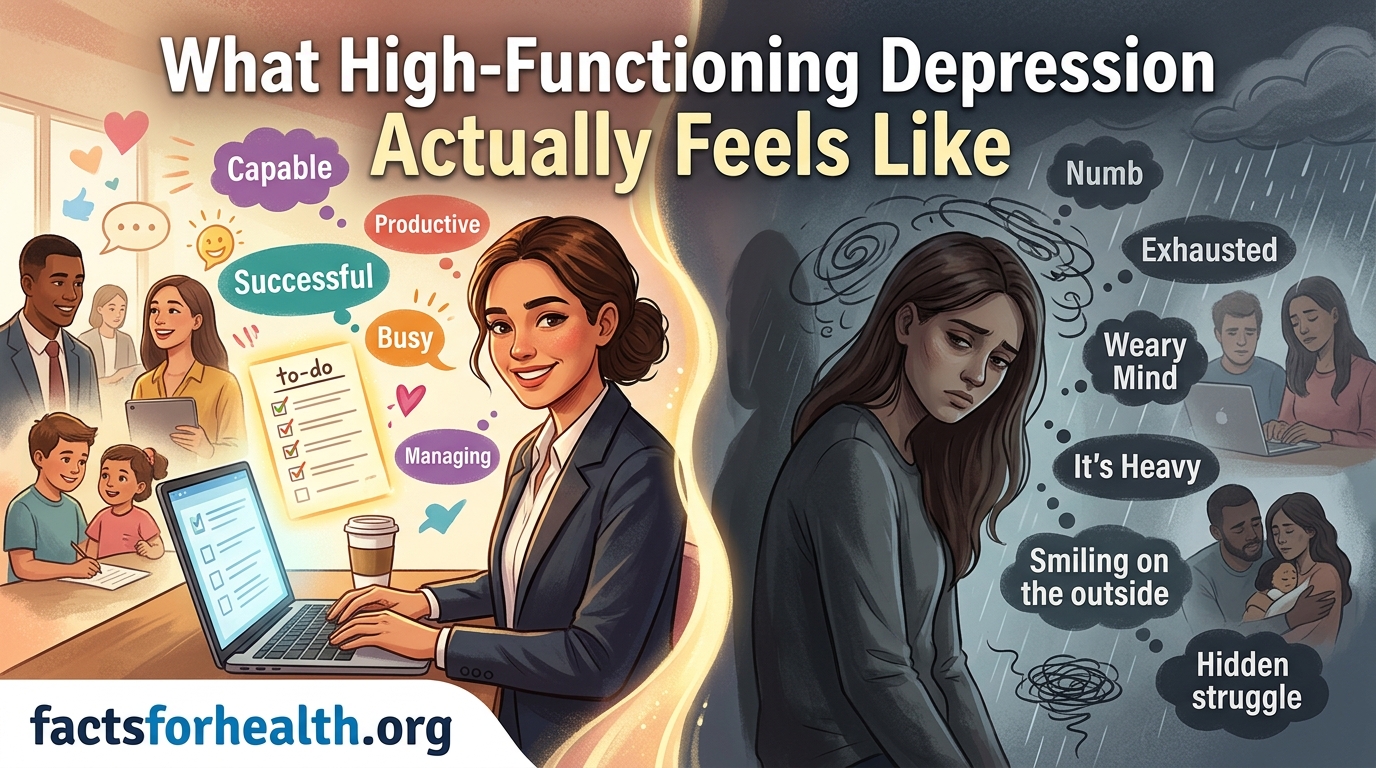
You show up to work on time. You meet deadlines. Friends describe you as reliable, maybe even successful. But underneath that composed exterior, you feel hollow, exhausted, and disconnected from the life you appear to be living so well.
If that sounds familiar, you may be experiencing what people commonly call high-functioning depression. It is a frustrating and often isolating condition because the very fact that you can keep going makes it hard to recognize, let alone explain to others.
In this article, our team breaks down what high-functioning depression actually feels like day to day. We cover the signs that are easy to miss, how it differs from major depression, why it so often goes unrecognized, and what genuinely helps when you are exhausted from holding it all together.
If you are in crisis or considering harming yourself, please call or text 988 right now to reach the Suicide and Crisis Lifeline. You can also text HOME to 741741. Help is available 24/7.
Table of Contents
What High-Functioning Depression Actually Feels Like
High-functioning depression feels like running on a treadmill that never stops. You are moving, you are sweating, and from the outside it looks like you are getting somewhere. But internally, you feel stuck in the same gray place you were in yesterday, last month, and possibly last year.
People describe the experience differently, but a common thread is the sense of living a double life. At work or in social settings, you perform. You smile at the right moments. You answer emails. You show up for your family. Then you get home, close the door, and feel the weight of everything you have been carrying crash down all at once.
Many people liken it to the old metaphor of a duck gliding across a pond. Above the water, everything looks calm and effortless. Below the surface, your legs are paddling furiously just to stay afloat. The effort required to maintain that calm surface is enormous, and nobody sees it.
There is also a persistent emotional flatness. Things that should bring joy, a promotion, a vacation, a child’s milestone, register as barely a blip. You feel like you are watching your own life through glass rather than participating in it. Pleasure feels muted, and even accomplishments that others celebrate leave you thinking, “Is this all there is?”
Then there is the guilt. Because you can function, because your life looks fine on paper, you tell yourself you have no right to feel this way. You compare yourself to people who cannot get out of bed and think, “I am not that bad.” So you push the feeling aside and keep going, which only deepens the exhaustion.
Signs and Symptoms: What to Watch For
High-functioning depression shares many symptoms with other forms of depression, but it tends to fly under the radar because you are still meeting your daily obligations. The symptoms are real, though, and they take a significant toll over time.
Here are the signs that commonly appear, broken down into what others can see and what only you can feel.
External Signs Others Might Notice
Outwardly, the changes can be subtle. Friends or coworkers might notice you seem more withdrawn, irritable, or tired than usual. You might start declining invitations more often, arriving late, or seeming distracted in conversations.
Some people appear more perfectionistic or controlling, not because they are thriving but because holding everything tightly is the only way they can keep it from falling apart. Overworking can be a coping mechanism, not a sign of passion.
Internal Signs Only You Feel
Internally, the experience is far more intense. You may feel a constant low-grade sadness or emotional numbness that never fully lifts. Tasks that used to be easy now require enormous mental effort, even if you still complete them.
You might experience persistent fatigue that sleep does not fix, difficulty concentrating, and a sense that you are just going through the motions. Many people describe a feeling of heaviness, as if they are wading through wet sand just to get through an ordinary day.
Seven Signs of High-Functioning Depression
If you are wondering whether this sounds like you, here are seven signs that are especially common and easy to overlook:
1. Persistent low mood that has lasted for two years or more, even if it never feels severe enough to be a crisis.
2. Chronic fatigue that does not improve with rest, sleep, or time off.
3. Difficulty enjoying things you used to love, a symptom clinically known as anhedonia.
4. Harsh self-criticism and a constant sense that you are falling short, no matter how well you are performing.
5. Overworking or perfectionism as a way to feel in control or avoid confronting difficult emotions.
6. Irritability or short temper that surprises even you, because it does not match your usual personality.
7. Using substances, food, or excessive screen time to numb or escape, even if it never looks like a serious problem from the outside.
High-Functioning Depression vs. Major Depression
Understanding the difference between high-functioning depression and major depressive disorder (MDD) helps make sense of why this condition is so often dismissed. Both are real, both are serious, and both deserve treatment, but they look and feel different.
Major depression typically hits in episodes. During an episode, symptoms are severe enough that daily functioning becomes difficult or impossible. You may struggle to get out of bed, go to work, or care for yourself. The intensity is obvious to you and often to the people around you.
High-functioning depression, by contrast, is more chronic and lower-grade. It relates closely to what mental health professionals call persistent depressive disorder or dysthymia. The symptoms are less severe on any given day, but they persist for years. You keep functioning, but at a constant emotional cost.
The key distinction is the word “functioning.” With major depression, the impairment is visible. With high-functioning depression, you maintain your responsibilities, your job, your social life, and your appearance of competence. That is exactly what makes it so dangerous. Because you can function, you and others may assume nothing is wrong.
It is also possible to experience both. Someone with persistent depressive disorder can have episodes of major depression layered on top, a pattern sometimes called double depression. This can be especially confusing because the baseline always felt low, so the worse periods may feel like just another bad stretch rather than a clear signal that something needs to change.
Why High-Functioning Depression Goes Unnoticed
One of the most painful aspects of high-functioning depression is how invisible it is. Not just to others, but sometimes to yourself. There are several reasons this condition hides in plain sight.
First, masking becomes second nature. Over time, you learn exactly what expression to wear, what tone to use, and what to say so that nobody worries. The mask becomes so automatic that you barely notice you are wearing it. But maintaining it takes enormous energy, energy you no longer have for things that actually matter to you.
Second, there is a deep cultural problem with how we define illness. We tend to equate depression with inability to function. If you can hold a job, maintain a relationship, and pay your bills, people assume you are fine. You may have internalized this message yourself, concluding that because you are not “bad enough,” you do not deserve help.
Third, high-functioning depression often develops slowly. If the decline happens over months or years, you adapt to each new baseline without realizing how far you have fallen. You forget what it felt like to genuinely enjoy things, to wake up with energy, to feel present in your own life. The new normal just feels like normal.
Finally, people around you may actively discourage recognition. When you try to open up, you hear things like, “But you seem so together,” or “You have so much going for you.” These responses are meant to be reassuring, but they often have the opposite effect. They confirm your fear that nobody will believe you, so you stop trying to explain.
The Emotional Cost of Appearing Fine
The hidden price of high-functioning depression is exhaustion. Not the kind that a good night of sleep fixes, but a bone-deep weariness that comes from performing wellness all day, every day. By the time you finally let your guard down, you have nothing left for yourself or the people you love most.
Relationships often suffer in ways that confuse both partners. Your friends might feel you pulling away, but because you still show up when it matters, they do not realize something is wrong. Your partner might sense distance but attribute it to stress or busyness. Meanwhile, you feel increasingly alone even when surrounded by people who care.
There is also the guilt of not being “sick enough.” Forum discussions are full of people questioning whether they even have the right to call themselves depressed. They read about severe cases and think their experience does not count. This comparison trap keeps countless people from seeking help until they reach a breaking point.
And breaking points do come. Many people who appear fine for years suddenly hit a wall where the coping mechanisms stop working. That crash can be jarring precisely because it seems to come out of nowhere, even though the warning signs were there all along.
Coping Strategies That Genuinely Help
If any of this resonates with you, there are concrete steps that can ease the burden. None of them are magic fixes, but together they can begin to shift the weight you have been carrying alone.
Start by validating your own experience. You do not need to be unable to get out of bed to deserve support. If you feel persistently low, exhausted, or emotionally flat for months on end, that is a real signal worth paying attention to. The fact that you are still functioning does not invalidate the suffering.
Name what you are going through. Putting words to the experience, even privately in a journal, can reduce its power. Many people find that simply acknowledging “I am not okay, even though I look okay” is a meaningful first step toward change.
Talk to someone safe. This does not have to be a therapist right away, though that is an excellent option. It can be a trusted friend, a partner, or a support group. The goal is to stop carrying this entirely alone. Being believed and understood by even one person can be profoundly relieving.
Prioritize small, sustainable changes. Rather than overhauling your entire life, focus on basics. Aim for consistent sleep, regular movement, time outdoors, and meals that nourish you. These sound simple, but when depression drains your energy, even small acts of self-care are victories.
Challenge the inner critic. High-functioning depression often comes with a relentless voice telling you that you are not doing enough, not good enough, or not sick enough. Notice that voice. Question it. It is not telling you the truth; it is a symptom, not a fact.
Consider professional support. Therapy, particularly cognitive behavioral therapy (CBT) and psychodynamic therapy, has strong evidence for treating persistent depressive symptoms. A therapist can help you understand patterns, develop coping tools, and determine whether medication might also play a role in your treatment.
When to Seek Professional Help
You do not need to wait until things fall apart to reach out for help. In fact, the best time to seek support is while you are still functioning, because that is when you have the most resources to engage in treatment and make meaningful changes.
If you have felt persistently low, tired, or emotionally flat for two years or more, talk to a mental health professional. If you are using substances to cope, if your relationships are suffering, or if you ever have thoughts of harming yourself, reach out sooner rather than later.
Treatment options include talk therapy, medication such as SSRIs or SNRIs, lifestyle changes, and combinations of all three. What works varies from person to person, but the first step is always the same: telling someone what you are going through.
If you are having thoughts of suicide, call or text 988 (Suicide and Crisis Lifeline) or text HOME to 741741. These services are free, confidential, and available 24 hours a day. You do not have to be in immediate danger to reach out.
FAQs
What is it like to live with high-functioning depression?
Living with high-functioning depression often feels like maintaining a convincing performance while internally exhausted and emotionally flat. You meet your responsibilities, appear competent to others, and may even excel professionally, yet you feel persistently low, disconnected, and drained. Many people describe it as living a double life where no one sees the effort required just to get through an ordinary day.
How do I know if I have functional depression?
Signs include a low mood lasting two years or more, chronic fatigue that rest does not fix, loss of interest in activities you once enjoyed, harsh self-criticism, overworking or perfectionism, irritability, and relying on substances or distractions to cope. If you are still functioning but feel persistently empty or exhausted inside, it is worth speaking with a mental health professional.
Can you cure high-functioning depression?
High-functioning depression, often related to persistent depressive disorder, is highly treatable. Treatments include cognitive behavioral therapy, psychodynamic therapy, medication such as SSRIs or SNRIs, and lifestyle changes. Many people see significant improvement with the right combination of approaches, though it may require ongoing management rather than a one-time cure.
What are 7 signs of high-functioning depression?
The seven most common signs are: persistent low mood lasting two or more years, chronic fatigue not relieved by rest, anhedonia or inability to enjoy things you used to love, harsh self-criticism and feelings of inadequacy, overworking or perfectionism as a coping mechanism, increased irritability, and using substances, food, or excessive screen time to numb difficult emotions.
Is high-functioning depression a real diagnosis?
High-functioning depression is not a formal clinical diagnosis on its own, but it describes a real and recognized pattern. It most closely aligns with persistent depressive disorder (dysthymia), which is a DSM-5 diagnosis. The term captures the experience of meeting daily responsibilities while suffering significant depressive symptoms internally.
You Do Not Have to Earn the Right to Feel This Way
High-functioning depression is real, even if no one in your life has noticed it yet. The fact that you can hold everything together does not mean you are not struggling. It means you are strong, and strength should not be a barrier to getting support.
If anything in this article resonated with you, take one small step today. Call a therapist. Text a friend. Write down what you are feeling. You do not have to keep paddling beneath the surface forever. Help is available, and you deserve it exactly as you are.