
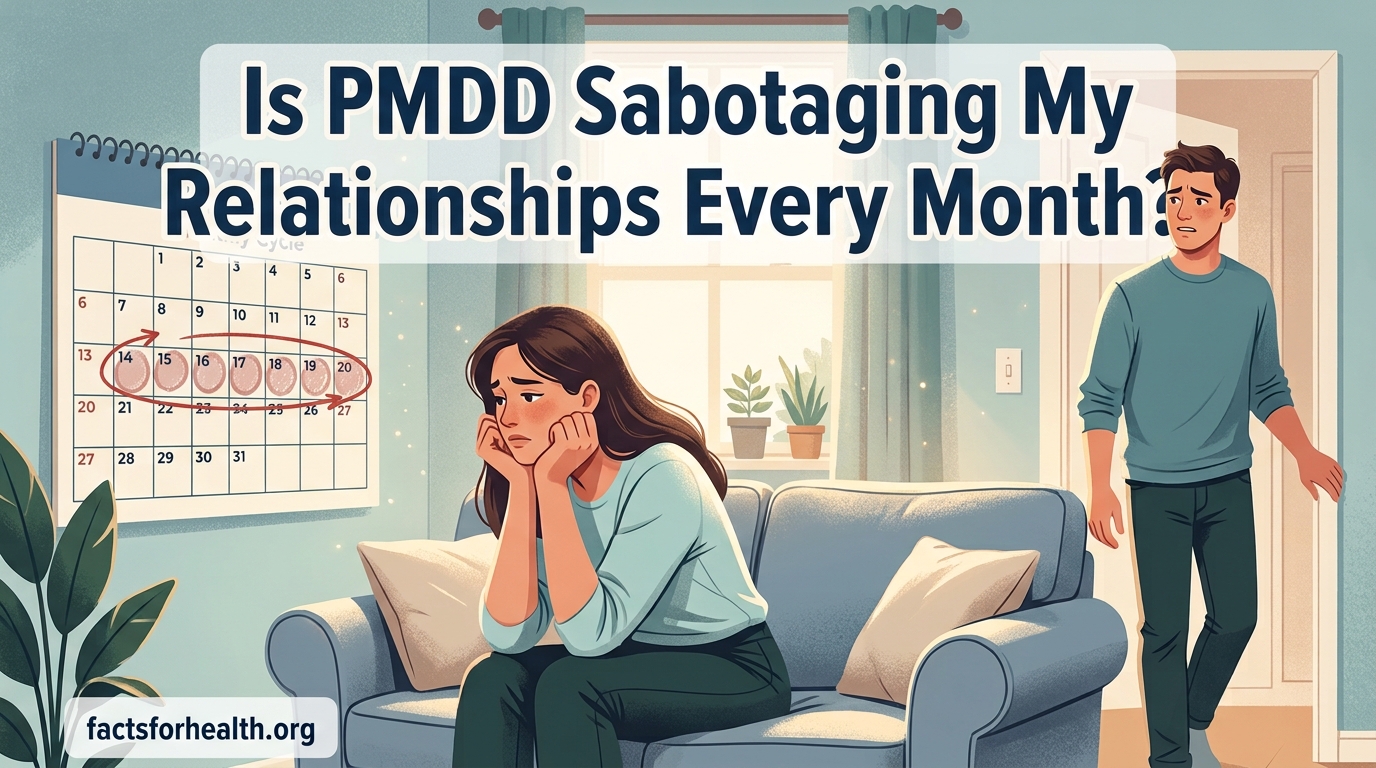
Yes, PMDD could absolutely be the reason you sabotage your relationships every month. Premenstrual Dysphoric Disorder affects an estimated 3 to 9 percent of people who menstruate, and one of its most devastating symptoms is the way it attacks your closest connections during the luteal phase.
If you have noticed a repeating pattern of picking fights, doubting your love, or wanting to end your relationship right before your period, you are far from alone. Thousands of people in PMDD support communities describe the exact same experience. The urge to push your partner away feels real and overwhelming in the moment, but it follows your cycle like clockwork.
Our team has spent months analyzing forum discussions, clinical research, and expert guidance on PMDD and relationships. What we found is that PMDD relationship sabotage is one of the most common yet least talked about symptoms of this condition. People suffer in silence, convinced something is fundamentally wrong with them or their relationship, when the real culprit is a neurological response to normal hormone shifts.
The most important thing to understand is this: the thoughts and feelings you experience during your luteal phase are not a reliable reflection of your relationship. They are symptoms. And once you learn to recognize the pattern, you can take concrete steps to protect your relationship from PMDD-driven destruction.
In this guide, we will walk through exactly how PMDD drives relationship sabotage, how to tell the difference between PMDD symptoms and genuine relationship problems, and what you can do starting today to break the cycle. Whether you have PMDD yourself or you are watching your partner go through it, this information can change how you handle the next luteal phase.
This topic, is PMDD the reason I sabotage my relationships every month, is one that demands a direct and honest answer. So let us start with what the research and lived experiences of thousands of people tell us.
Table of Contents
Quick Summary: 5 Signs Your Relationship Sabotage Is PMDD
Before we get into the science, here is a quick checklist. These five signs strongly suggest that PMDD, not your relationship, is driving the chaos.
1. The doubts arrive on a schedule. You feel completely fine about your relationship for two weeks, then suddenly want to end it about 7 to 10 days before your period, every single month.
2. The intensity is disproportionate. During your luteal phase, minor annoyances feel like dealbreakers. Your partner chewing too loudly becomes proof that you are incompatible.
3. The feelings lift when your period starts. Within a day or two of menstruation beginning, the rage, doubt, and urge to leave suddenly fade. You wonder why you were so upset.
4. You get relationship OCD symptoms. You obsess over whether your partner is the right person, replay conversations looking for red flags, or develop sudden aversions (getting the ick) that did not exist a week ago.
5. The pattern repeats across relationships. You have noticed this same cycle of sabotage in previous relationships, not just your current one. The common factor is not the partner, it is your cycle.
If you recognized yourself in four or five of these signs, PMDD is very likely the driving force. The rest of this guide will help you understand why this happens and what to do about it.
What Is PMDD (Premenstrual Dysphoric Disorder)?
PMDD is a severe, hormone-based mood disorder that occurs during the luteal phase of the menstrual cycle. That is the one to two weeks between ovulation and the start of your period. During this window, people with PMDD experience intense emotional and physical symptoms that go far beyond typical PMS.
The key difference between PMDD and regular PMS is severity and impact. PMS might make you feel irritable or bloated. PMDD can trigger disabling depression, rage episodes, suicidal thoughts, and a complete personality shift that disrupts your ability to function at work and in relationships.
Does PMDD affect you every month? Yes. PMDD is cyclical by definition. The diagnostic criteria require that symptoms occur in most menstrual cycles during the past year. If symptoms are sporadic or do not follow your cycle, something else may be going on.
The Core Emotional Symptoms of PMDD
PMDD affects each person differently, but the emotional symptoms tend to cluster around several key areas that directly impact relationships.
Mood symptoms include sudden depression, feelings of hopelessness, intense irritability, and rage that feels uncontrollable. Many people describe feeling like a different person during their luteal phase.
Anxiety symptoms include heightened worry, panic attacks, and rejection sensitivity. Small things that would normally roll off your back suddenly feel like personal attacks.
Cognitive symptoms include brain fog, difficulty concentrating, and intrusive thoughts. Some people experience relationship OCD patterns where they cannot stop analyzing whether their partner is right for them.
Physical symptoms include extreme fatigue, bloating, breast tenderness, headaches, and joint or muscle pain. The physical exhaustion alone can lower your emotional tolerance significantly.
What Causes PMDD?
PMDD is not caused by a hormone imbalance. This is a common misconception. People with PMDD have normal hormone levels. The difference is that their brains have an extreme sensitivity to the normal fluctuations of estrogen and progesterone that happen during every menstrual cycle.
When estrogen and progesterone levels shift during the luteal phase, these changes affect neurotransmitters in the brain. Serotonin, which regulates mood and emotional stability, is particularly affected. Dopamine and GABA, which influence motivation, pleasure, and calm, are also disrupted.
This neurological sensitivity is why PMDD symptoms are so severe despite normal hormone levels. Your brain is essentially overreacting to hormonal signals that other people’s brains handle without issue.
PMDD vs. PMS vs. PME: Understanding the Difference
It is important to distinguish PMDD from two other conditions that can cause similar symptoms.
PMS (Premenstrual Syndrome) causes mild to moderate physical and emotional symptoms before your period. It is uncomfortable but does not severely disrupt your life or relationships. About 75 percent of menstruating people experience some form of PMS.
PMDD (Premenstrual Dysphoric Disorder) is the severe form. Symptoms are intense enough to damage relationships, work performance, and quality of life. It affects roughly 3 to 9 percent of menstruating people.
PME (Premenstrual Exacerbation) is when an existing mental health condition like anxiety, depression, or ADHD gets worse during the luteal phase. The underlying condition is always present, but PME amplifies it before your period.
Getting the right diagnosis matters because the treatments differ. PMDD often responds to SSRIs, specific birth control pills, and cycle-aware lifestyle changes. PME requires treating the underlying condition while also managing the premenstrual worsening.
Is PMDD the Reason I Sabotage My Relationships Every Month? The Connection Explained
Yes, PMDD is a well-documented cause of relationship sabotage. The connection between PMDD and relationship destruction is so consistent that therapists who specialize in reproductive psychiatry see it in nearly every PMDD patient.
Understanding why PMDD drives relationship sabotage requires looking at what happens in your brain during the luteal phase. The hormonal shifts do not just make you moody. They fundamentally alter how you perceive your partner, process emotions, and evaluate your relationship.
Why Does PMDD Ruin Relationships?
PMDD ruins relationships through a combination of neurological changes that affect perception, emotional regulation, and impulse control. Here is what is actually happening.
Serotonin disruption changes how you see your partner. When serotonin levels drop during the luteal phase, your brain becomes less able to maintain positive emotional states. Your partner’s flaws become more visible while their positive qualities fade into the background. This is not a shift in your relationship. It is a shift in your neurochemistry.
Heightened amygdala reactivity amplifies threats. The amygdala, your brain’s threat detection center, becomes more reactive during the luteal phase in people with PMDD. This means your partner’s words, tone, and actions register as more threatening than they actually are. A casual comment feels like an attack.
Reduced prefrontal cortex activity weakens impulse control. The prefrontal cortex helps you pause before acting on emotions. PMDD appears to reduce its effectiveness during the luteal phase, making it harder to stop yourself from saying things you will regret.
Rejection sensitivity goes into overdrive. Many people with PMDD experience a dramatic increase in rejection sensitivity during the luteal phase. You may interpret your partner’s need for space as abandonment, or read disinterest into a neutral expression.
The Luteal Phase Truth Serum Effect
Many people in PMDD communities describe a phenomenon called the luteal truth serum. During the luteal phase, negative thoughts about the relationship feel absolutely real and undeniable. Every doubt seems like a revelation. Every irritation feels like proof of a deeper problem.
This is one of the most dangerous aspects of PMDD relationship sabotage. The thoughts do not feel like symptoms. They feel like clarity. You may convince yourself that you have been lying to yourself during the rest of your cycle and that the luteal phase is when you finally see things clearly.
This is the opposite of what is happening. The luteal truth serum is actually a distortion serum. Your brain is feeding you a worst-case interpretation of your relationship and presenting it as unvarnished truth. The conviction you feel is a symptom, not a sign.
The Sabotage Cycle: How It Plays Out Month After Month
PMDD relationship sabotage follows a predictable cycle that repeats every month. Recognizing this pattern is the first step toward breaking it.
Phase 1: The shift. Ovulation ends and the luteal phase begins. Within days, you start feeling more irritable, anxious, or emotionally withdrawn. Your partner notices you pulling away.
Phase 2: The buildup. Small annoyances accumulate. You start cataloging everything your partner does wrong. You may find yourself relistening to relationship advice podcasts or reading articles about toxic relationships, looking for confirmation of your doubts.
Phase 3: The eruption. A conflict erupts, often over something minor. You say things you cannot take back. You may threaten to leave, give an ultimatum, or deliver a monologue about everything wrong with the relationship.
Phase 4: The shame. Your period starts and the fog lifts. You see clearly what happened. The shame, guilt, and regret are overwhelming. You apologize, promise it will not happen again, and try to repair the damage.
Phase 5: The calm. For two weeks, things are good. You feel connected and loving. Then the cycle begins again.
Why PMDD Makes You Want to Break Up Every Month
Does PMDD make you want to break up with your partner? Yes, and this is one of the most distressing symptoms people with PMDD experience. The breakup urge is so common in PMDD communities that it has become a defining feature of the condition.
The desire to end your relationship during the luteal phase is driven by several overlapping PMDD symptoms that distort your perception and amplify negative emotions.
Relationship OCD and the Need for Certainty
Many people with PMDD develop relationship OCD patterns during the luteal phase. Relationship OCD involves intrusive, obsessive doubts about whether you are with the right person, whether you really love them, and whether the relationship is fundamentally flawed.
One person in a PMDD support group described it this way: “My strongest PMDD symptom is relationship OCD. I doubt, I obsess, I get the ick, and it all reinforces the thought that my spouse is not the one.”
The OCD component is important because it explains why the doubts feel so urgent and compelling. OCD demands certainty, and during the luteal phase, your brain cannot tolerate the normal ambiguity that exists in every relationship. Every imperfection becomes evidence that you should leave.
Emotional Numbness and the Loss of Connection
Some people with PMDD experience emotional numbness during the luteal phase. They cannot feel love, attraction, or warmth toward their partner. This numbness is terrifying because it feels permanent.
If you suddenly cannot feel love for someone you know you love, your brain tries to make sense of it. The conclusion it reaches is that the love was never real. In reality, the numbness is a temporary symptom of neurotransmitter disruption that will lift when your period starts.
The Overwhelming Urge to Escape
Another person shared: “I always get an overwhelming urge to end my relationship during my PMDD phase. Every month I go through all of these breakup conversations in my head.”
This urge to escape is driven by the nervous system being in a state of chronic stress during the luteal phase. When your nervous system is dysregulated, your brain interprets the relationship as a source of danger rather than safety. The natural response is to flee.
The problem is that acting on this urge during the luteal phase means making a life-altering decision while your brain is in crisis mode. It is like deciding to quit your job while having a panic attack. The decision is based on a temporary state, not on your actual values and desires.
Getting The Ick on a Schedule
Getting the ick refers to a sudden feeling of disgust or aversion toward your partner. While this can happen in any relationship, in PMDD it follows a pattern. The ick appears during the luteal phase and disappears when your period starts.
If the aversion is cyclical, it is almost certainly PMDD. If it persists across all phases of your cycle, it may reflect a genuine issue. The timing is the key differentiator.
Is It PMDD Sabotage or Real Relationship Problems? How to Tell the Difference
This is the question that haunts everyone with PMDD. How do you know if it is PMDD driving the sabotage or if there are genuine relationship problems you have been ignoring? It is also one of the most common questions in PMDD support forums.
As one community member put it: “I am trying to understand if my self-sabotage is part of my PMDD or if I have some personality disorder or something.”
The answer lies in tracking the pattern. Genuine relationship problems exist across all phases of your cycle. PMDD-driven problems exist only during the luteal phase.
The Cycle Test: The Most Reliable Indicator
If you want to know whether your relationship doubts are PMDD-driven, the most reliable method is cycle tracking. Track your symptoms and relationship feelings every day for two to three months.
Rate your relationship satisfaction on a scale of 1 to 10 each day. Also track where you are in your cycle. If you see a consistent pattern where satisfaction drops dramatically during the luteal phase and rebounds after your period starts, PMDD is the primary driver.
If your relationship satisfaction is consistently low across all phases of your cycle, the problems may be genuine. Both things can also be true simultaneously. You can have a real relationship issue that PMDD makes feel ten times worse.
Key Differences: PMDD Sabotage vs. Real Problems
Timing: PMDD sabotage follows your cycle. Real problems persist regardless of cycle phase.
Intensity: PMDD makes small issues feel catastrophic. Real problems feel serious but proportional.
Clarity: PMDD creates a sense of sudden, urgent revelation. Real problems develop gradually and have a clear, identifiable cause.
Reversibility: PMDD feelings lift when your period starts. Real problems remain after menstruation begins.
Pattern across relationships: If you have had the same doubts about multiple partners, always during the luteal phase, the common factor is your cycle, not your partners.
Can Both Be True?
Absolutely. You can have genuine relationship issues that PMDD amplifies. For example, if your partner has a communication problem, it may bother you mildly during your follicular phase but feel unbearable during your luteal phase.
In this case, both the relationship issue and PMDD need to be addressed. The PMDD does not invalidate the real problem, and the real problem does not invalidate the PMDD. They interact with each other.
The best approach is to address relationship issues during your follicular phase, when you can think clearly and communicate calmly. Trying to solve relationship problems during the luteal phase is like trying to defuse a bomb while someone sets off firecrackers around you.
5 Practical Strategies to Stop PMDD Relationship Sabotage This Month
Understanding why PMDD causes sabotage is important, but what you really need are strategies to stop it. Here are five practical approaches that people in PMDD communities and clinical experts recommend.
Strategy 1: Track Your Cycle and Create a Warning System
Cycle tracking is the single most effective tool for preventing PMDD sabotage. When you know exactly when your luteal phase begins, you can prepare yourself and your partner.
Use a tracking app or a simple calendar. Mark the first day of your period and track symptoms daily. After two or three months, you will see your pattern clearly. Most people with PMDD can identify a specific day or two when the shift happens.
Share your cycle information with your partner. When they know your luteal phase is starting, they can adjust their expectations, give you more space, and avoid bringing up sensitive topics during your most vulnerable days.
Strategy 2: Implement a No-Decisions Rule During Your Luteal Phase
This is a strategy that has saved relationships. Make a firm rule with yourself: no major relationship decisions during the luteal phase. No breakup conversations, no ultimatums, no texts about ending things.
If a thought about ending the relationship arises during your luteal phase, write it down instead of acting on it. Tell yourself you will revisit it on day three of your period, when your brain is back to baseline. Almost every time, the urgency will have disappeared.
One person shared that writing out all their rage and doubts in a journal during the luteal phase, then reading it back after their period started, was eye-opening. The thoughts that felt so urgent and real during luteal looked completely irrational in hindsight.
Strategy 3: Use Nervous System Regulation Techniques
PMDD puts your nervous system into a state of chronic stress during the luteal phase. You can counteract this with regulation techniques that signal safety to your brain.
Box breathing: Inhale for 4 seconds, hold for 4, exhale for 4, hold for 4. Do this for 5 minutes when you feel rage or panic building. It activates the parasympathetic nervous system.
Cold exposure: Splashing cold water on your face or holding an ice pack to your chest triggers the mammalian dive reflex, which rapidly calms the nervous system.
Bilateral stimulation: Tapping alternating sides of your body or going for a walk can help process overwhelming emotions without acting on them.
Co-regulation: If your partner is supportive, physical contact like a long hug can help regulate your nervous system. Make this a planned strategy, not an in-the-moment ask.
Strategy 4: Create a PMDD Communication Script
During the luteal phase, your ability to communicate calmly is compromised. Having pre-written scripts can prevent destructive conversations.
Work with your partner during your follicular phase to create phrases you both agree on. Examples include: “I am in my luteal phase and feeling overwhelmed. I need some time alone, but I am not upset with you.”
Another useful script: “My brain is telling me everything is wrong right now. I know this is PMDD. I am going to ride this out and we can talk about it in a few days.”
The key is creating these scripts when you are thinking clearly so they are available when you are not. Using the framework of Nonviolent Communication can help structure these conversations in a way that minimizes harm.
Strategy 5: Build a PMDD Action Plan Together
Sit down with your partner during a good week and create a written action plan for handling the luteal phase. This plan should cover what each of you will do when symptoms hit.
Include specifics: Who handles household tasks when you are exhausted? What are the off-limits conversation topics? When should your partner give you space versus check in? What are the signs that you need professional support?
Having this plan in place removes the need to negotiate during the luteal phase, when negotiation is most likely to go wrong. Both partners know the playbook and can follow it without thinking.
How to Repair After a PMDD Episode: A 4-Step Process
Even with the best strategies, PMDD episodes will sometimes cause damage. What matters is how you repair afterward. A structured repair process can prevent resentment from building over time.
Many couples fall into a pattern where the PMDD episode happens, the period starts, the person with PMDD feels terrible, and they apologize profusely. But the underlying wound never gets properly addressed. Over time, the partner’s trust erodes.
Step 1: Acknowledge What Happened Without Minimizing
After your period starts and you have perspective, sit down with your partner and name what happened. Say specifically what you said or did that was hurtful. Do not minimize it by blaming hormones entirely.
Acknowledge the impact on your partner. Even though PMDD caused the behavior, your partner still experienced the pain of it. Validation matters enormously here.
Step 2: Take Responsibility for the Pattern
Owning the pattern does not mean blaming yourself. It means acknowledging that while you did not choose to have PMDD, you are responsible for how you manage it going forward.
Tell your partner what you are doing to prevent the next episode. This might mean starting treatment, tracking your cycle more consistently, or implementing the strategies above. Action is more meaningful than apology.
Step 3: Listen to Your Partner’s Experience
Ask your partner how the episode felt from their side. Listen without defending or explaining. They may feel confused, hurt, angry, or emotionally exhausted.
Your partner may also need reassurance that you still love them and that the things you said during the luteal phase were symptoms, not hidden truths. This reassurance needs to come from you, not from their own attempts to rationalize what happened.
Step 4: Update Your Action Plan
Use the episode as data. What triggered it? What could you have done differently? What could your partner have done differently? Update your PMDD action plan to address whatever gap allowed this episode to escalate.
The goal is not perfection. The goal is progressive improvement. Each cycle should look a little better than the last as you refine your strategies and deepen your mutual understanding.
How to Help a Partner Understand PMDD (When They Do Not Believe It Is Real)
One of the most common pain points in PMDD communities is partners who do not believe PMDD is real. If your partner thinks PMDD is just an excuse for bad behavior, it adds another layer of pain to an already difficult situation.
Here is how to approach this challenge productively.
Educate With Facts, Not Emotions
When you try to explain PMDD during or right after an episode, your partner may be too hurt or defensive to hear it. Have the conversation during your follicular phase, when things are calm.
Share information from authoritative sources. The International Association for Premenstrual Disorders (IAPMD) has excellent educational materials designed for families and partners. Medical journals have documented PMDD as a recognized clinical condition with specific diagnostic criteria.
Frame it as a medical condition, not a personal failing. PMDD is a recognized disorder in the DSM-5. It has biological mechanisms involving serotonin and GABA receptors. This is not opinion. It is neuroscience.
Show Them Your Tracking Data
Data is hard to argue with. If you have been tracking your symptoms and cycle for a few months, show your partner the pattern. When they can see that your relationship satisfaction drops from an 8 to a 2 at the exact same point every month, it becomes harder to dismiss.
Some partners have a breakthrough moment when they see the data laid out visually. It transforms PMDD from a vague excuse into a predictable, measurable pattern.
Invite Them to a Medical Appointment
If your partner still struggles to understand, invite them to an appointment with your doctor or therapist. Hearing a medical professional explain PMDD can shift their perspective in ways that your explanations cannot.
A provider can explain the neuroscience, the diagnostic criteria, and the treatment options. They can also answer your partner’s questions directly, which may address concerns they have been hesitant to raise with you.
Acknowledge Their Experience Too
Your partner is also affected by PMDD, even though they do not have it. They may feel like they are walking on eggshells for two weeks every month. They may feel rejected, confused, or emotionally battered.
Acknowledging their experience does not diminish yours. It builds empathy on both sides. When your partner feels seen and understood, they are more likely to extend the same understanding to you.
When to Seek Professional Help for PMDD
PMDD is a serious medical condition that often requires professional treatment. If your symptoms are damaging your relationship, disrupting your life, or causing suicidal thoughts, it is time to get help.
Treatment options for PMDD include SSRIs (which can work remarkably fast for PMDD, sometimes within days), specific birth control pills, cognitive behavioral therapy, and lifestyle interventions. A healthcare provider can help you find the right combination.
The most critical red flag is suicidal ideation. If you experience suicidal thoughts during your luteal phase, seek immediate help. Contact a crisis line, go to an emergency room, or call your doctor. PMDD-related suicidal ideation is dangerous because the intensity is extreme, even though it will likely lift when your period starts.
A provider who specializes in reproductive psychiatry will understand PMDD in ways that a general practitioner may not. The IAPMD website has a provider directory that can help you find a specialist in your area.
Frequently Asked Questions
Why does PMDD ruin relationships?
PMDD ruins relationships because it disrupts serotonin, dopamine, and GABA neurotransmitters during the luteal phase, which alters mood perception, amplifies negative emotions, weakens impulse control, and heightens rejection sensitivity. These neurological changes make you perceive your partner more negatively, react more intensely to minor issues, and act on impulses you would normally suppress.
Why am I purposely sabotaging my relationship?
If the sabotage follows a monthly pattern tied to your cycle, it is likely driven by PMDD rather than a conscious choice. PMDD creates overwhelming urges to push your partner away, end the relationship, or pick fights. These behaviors feel intentional in the moment but are actually driven by neurochemical changes that distort your perception and lower your emotional control.
Does PMDD make you want to break up with your partner?
Yes, the urge to break up is one of the most common and distressing PMDD symptoms. During the luteal phase, PMDD can trigger relationship OCD, emotional numbness, and an overwhelming desire to escape. These feelings typically disappear within a day or two of your period starting. If the breakup urge follows your cycle, it is almost certainly PMDD-driven.
Does PMDD affect you every month?
Yes, PMDD is cyclical by definition. The diagnostic criteria require symptoms to occur in most menstrual cycles during the past year. PMDD symptoms appear during the luteal phase (1 to 2 weeks before your period) and resolve within a few days after menstruation begins. If symptoms do not follow this pattern, another condition may be responsible.
Can a relationship survive PMDD?
Yes, relationships can survive PMDD, but it requires both partners to understand the condition, track the cycle, create an action plan, and commit to repair after each episode. Many couples report that their relationship grew stronger after they learned to manage PMDD together. Professional treatment for PMDD significantly improves relationship outcomes.
How do I know if it is PMDD or if I really want to break up?
Track your relationship satisfaction daily for two to three months alongside your cycle. If your desire to break up spikes during the luteal phase and fades after your period starts, it is PMDD. If the doubts persist consistently across all phases of your cycle, the issues may be genuine. Both can also be true at the same time.
How do I explain PMDD to my partner?
Choose a calm moment during your follicular phase, not during or right after an episode. Share educational materials from the IAPMD, show your cycle tracking data, and frame PMDD as a medical condition with documented neurological causes. Consider inviting your partner to a doctor’s appointment so they can hear a medical professional explain it.
Conclusion
If you have been asking yourself whether PMDD is the reason you sabotage your relationships every month, the answer is likely yes. The monthly pattern of doubt, rage, emotional withdrawal, and breakup urges is one of the most well-documented effects of PMDD on relationships.
You are not broken. You are not a bad partner. You are dealing with a neurological condition that distorts your perception during a specific window of your cycle. The thoughts that feel so urgent and real during your luteal phase are symptoms, not truths.
Start with cycle tracking today. Build a no-decisions rule for your luteal phase. Talk to your partner during a good week. And if your symptoms are severe, reach out to a healthcare provider who understands PMDD. Treatment works, and your relationship is worth protecting.