
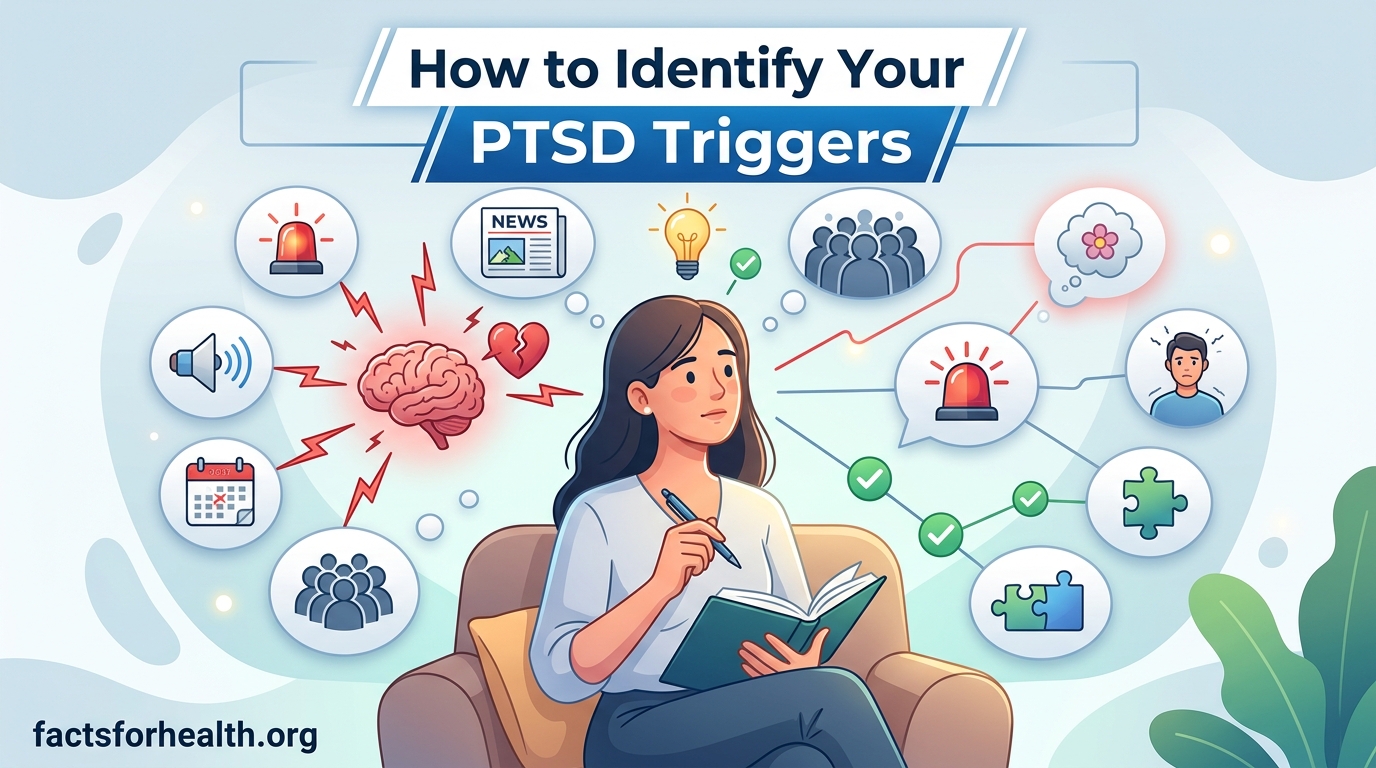
Learning how to identify your own PTSD triggers is one of the most empowering steps you can take in trauma recovery. Triggers are the sights, sounds, thoughts, feelings, and situations that pull you back into a traumatic memory, often before you even realize what is happening. When you can name what sets off your symptoms, you gain the ability to anticipate, prepare for, and manage your reactions.
Our team has spent years researching trauma responses, interviewing mental health professionals, and listening to the real experiences of people living with PTSD and C-PTSD. What we found is that most resources explain what triggers are, but very few walk you through the actual process of finding your own. That gap leaves people feeling overwhelmed and stuck.
This guide fills that gap. You will learn the difference between internal and external triggers, practical methods for tracking your own patterns, and grounding techniques to use in the moment. We also address the subtle, hard-to-spot triggers that many people miss, plus guidance on identifying triggers without re-traumatizing yourself in the process.
Whether you are working with a therapist or exploring this on your own, the strategies here are designed to be practical, compassionate, and immediately useful. Let us start with the basics.
Table of Contents
What Are PTSD Triggers?
A PTSD trigger is anything that reminds your brain of a traumatic event and causes you to re-experience symptoms such as flashbacks, panic, emotional numbness, or hypervigilance. Triggers can be obvious, like a loud noise that sounds like a gunshot, or incredibly subtle, like a specific shade of light or a passing thought you barely notice.
Your brain processes traumatic memories differently than ordinary ones. During a traumatic event, the amygdala, the brain’s alarm system, goes into overdrive. The hippocampus, which normally files memories away neatly, gets overwhelmed. As a result, the memory does not get stored properly. It stays raw and unprocessed, almost like a file left open on your computer.
When something in your current environment resembles the original trauma, your brain’s alarm fires again. This is not a conscious choice or a sign of weakness. It is an automatic survival response hardwired into your nervous system.
A trigger is not the same as a flashback, though the two are related. A trigger is the cause, the thing that sets off the response. A flashback is one possible effect, where you feel as though the traumatic event is happening again in the present moment. Triggers can also cause other responses such as sudden anxiety, dissociation, irritability, or emotional shutdown.
Understanding this mechanism matters because it removes the shame. You are not overreacting. Your brain is doing exactly what it evolved to do after a threat. The goal is not to eliminate triggers entirely, which is rarely possible, but to recognize them so you can respond with intention rather than being caught off guard.
Internal vs External Triggers: Understanding the Difference
PTSD triggers fall into two main categories: internal and external. Most people are more familiar with external triggers because they are easier to spot. Internal triggers can be harder to identify because they happen inside your own mind and body, but they are just as powerful.
External Triggers
External triggers come from your environment. They are things you can see, hear, smell, taste, or physically sense around you. Common external triggers include specific places, certain people or types of people, loud or sudden sounds, particular smells, specific dates or holidays, weather conditions, and certain types of touch.
People in trauma support communities frequently describe external triggers like the sound of doors slamming, the smell of a specific cologne or perfume, seeing someone who resembles an abuser, or driving past the location of a traumatic event. These triggers are often easier to identify because you can usually point to the specific thing that happened right before your reaction.
Internal Triggers
Internal triggers originate from within. They include thoughts, emotions, physical sensations, and memories. A feeling of helplessness, a sudden memory, a racing heart, tightness in your chest, or even a particular train of thought can all serve as internal triggers.
These are trickier to catch because they do not come with an obvious external cue. You might suddenly feel terrified or furious and not connect it to the thought that flashed through your mind moments before. Many people in support forums describe this experience, saying they react before they even realize what triggered them.
Subtle and Subconscious Triggers
Some of the most challenging triggers operate almost entirely below conscious awareness. These might include a fleeting facial expression, the tone of someone’s voice rather than their words, a temperature change, or even a body position that mirrors what happened during the trauma.
Research and community experiences suggest that physical reactions often appear before emotional recognition. You might notice your jaw clenching, shoulders stiffening, or breathing getting shallow before you consciously feel afraid or upset. Learning to catch these physical signals early is a skill we will cover in the identification section below.
This distinction between internal and external triggers is not just academic. It directly shapes your identification strategy. External triggers can often be tracked through environmental observation, while internal triggers require tuning into your body and thought patterns.
How to Identify Your Own PTSD Triggers
Identifying your personal PTSD triggers is a process that takes time, patience, and self-compassion. There is no instant fix, but the following methods have helped thousands of people build a clearer picture of what sets off their symptoms. You do not need to do all of these at once. Start with one approach and build from there.
Step 1: Keep a Trigger Diary
A trigger diary is one of the most effective tools for identifying patterns. Each time you notice a PTSD symptom, write down what happened in the moments before. Include the date and time, where you were, who you were with, what you were doing, what you heard, saw, smelled, or felt physically, what thought or emotion passed through your mind, and how your body and mind reacted.
Do not worry about being perfectly detailed in the moment. Even a few notes jotted on your phone can reveal patterns over time. After two to three weeks, review your entries. You may notice that certain sounds, types of interactions, or emotional states consistently appear before your symptoms spike.
The goal is not to analyze every entry deeply right away. Let the data accumulate. Patterns often become visible only after you have enough entries to compare.
Step 2: Practice Body Scanning
Since physical reactions often precede conscious awareness of a trigger, learning to read your body’s signals can help you catch triggers earlier. A body scan involves mentally checking in with different parts of your body to notice tension, discomfort, or changes.
Start at the top of your head and slowly move your attention down through your face, jaw, neck, shoulders, chest, stomach, arms, hands, legs, and feet. Notice any areas of tightness, heat, tingling, or heaviness. People with PTSD commonly hold tension in the jaw, shoulders, and chest.
When you notice physical changes during your day, pause and ask yourself what was happening in the moments before. This practice helps you connect bodily signals to their triggers, even when the trigger itself was subtle.
Step 3: Track Emotional Patterns
Beyond physical symptoms, track your emotional shifts. Notice when you suddenly feel irritable, withdrawn, panicked, numb, or disproportionately upset. These emotional changes are often the surface signal of a trigger that fired beneath your awareness.
Ask yourself: Was I feeling fine a few minutes ago? What changed? Sometimes the answer is obvious. Other times, it requires reflection. The combination of tracking physical sensations, emotional shifts, and environmental details in your diary will eventually help you connect the dots.
Step 4: Look for Themes, Not Just Single Events
Once you have a few weeks of tracking data, look for themes rather than isolated incidents. You might discover that your triggers cluster around certain types of experiences, such as feeling criticized, being in crowded spaces, hearing raised voices, or experiencing physical confinement.
Identifying themes helps you prepare. If you know that interpersonal conflict is a major trigger cluster, you can develop strategies for difficult conversations in advance. If confinement is a theme, you can plan seating arrangements or exits when attending events.
Step 5: Identify Triggers Without Re-Triggering Yourself
One concern that comes up frequently in trauma communities is the risk of re-triggering yourself while trying to identify triggers. This is a valid concern. The process of examining traumatic memories and reactions can sometimes pull you back into the experience.
To minimize this risk, approach trigger identification gently. Limit your journaling sessions to 10 to 15 minutes at a time. If you notice yourself becoming flooded or dissociating, stop immediately and use a grounding technique (described later in this guide). Work on identifying triggers when you feel relatively stable, not during an active crisis.
If you are working with a therapist, they can guide you through this process safely. Professional support is especially important if you have Complex PTSD or if your trauma involved repeated events, as the trigger landscape can be more complex.
Common PTSD Triggers: What to Look For
While every person’s triggers are unique to their experience, certain categories of triggers appear frequently across people with PTSD. Knowing these common categories can give you a starting framework as you work on identifying your own.
Sensory Triggers
Sensory triggers involve your five senses. Visual triggers include specific colors, lighting conditions, seeing blood, or witnessing someone who resembles someone from the trauma. Auditory triggers are extremely common and can include loud bangs, sirens, specific songs, arguing voices, whispering, or the sound of footsteps.
Olfactory triggers, related to smell, can be particularly powerful because the brain’s smell center connects directly to memory centers. A specific perfume, the smell of alcohol, gasoline, a particular food, or smoke can all serve as triggers. Tactile triggers involve touch or physical sensation, such as someone bumping into you, the feeling of being restrained, or a specific temperature.
Emotional and Thought Triggers
Internal emotional states can trigger PTSD symptoms. Feelings of helplessness, loss of control, being trapped, abandonment, rejection, or betrayal can all activate trauma responses. Even positive emotions can be triggering for some people, particularly if the trauma occurred during a moment when they felt safe or happy.
Intrusive thoughts are another internal trigger category. A thought like “I am not safe” or a sudden memory fragment can cascade into a full PTSD response. These thought triggers are often the hardest to identify because they happen so quickly.
Situational Triggers
Situational triggers relate to specific contexts or scenarios. These might include anniversaries of the traumatic event, holidays, medical appointments, court dates, being in enclosed spaces, driving or riding in vehicles, or being in crowds.
Many people find that situational triggers are the easiest to anticipate, which makes them more manageable. If you know a specific date or setting is coming up, you can prepare with coping strategies and support.
Relationship-Specific Triggers
Triggers that occur within relationships deserve special attention because they can affect your connections with partners, family members, friends, and colleagues. Common relationship triggers include criticism, perceived abandonment, raised voices, someone standing too close, unexpected physical contact, or a partner pulling away emotionally.
In trauma support forums, many people describe being triggered by interpersonal conflict, feeling like they cannot voice their needs, or sensing that someone is angry with them. These triggers can strain relationships if they are not understood and communicated about openly.
Childhood Trauma Triggers in Adulthood
If your trauma occurred in childhood, your triggers in adulthood may look different than those from a single-event trauma. Childhood trauma often creates triggers around authority figures, loud voices, being told you are wrong, feeling ignored or dismissed, or situations that echo the powerlessness of being a child.
Adult survivors of childhood trauma frequently report triggers related to parenting their own children, entering intimate relationships, or achieving success that was not permitted in their family of origin. The trigger landscape for developmental trauma tends to be broader and more diffuse, which can make identification more challenging.
Complex PTSD Specific Triggers
Complex PTSD, which results from repeated or prolonged trauma, often involves a wider and more interconnected web of triggers. People with C-PTSD may experience emotional flashbacks, which do not involve a visual replay of a memory but instead bring back the emotional state of the trauma, such as overwhelming shame, terror, or despair.
C-PTSD triggers often relate to relational dynamics, such as feeling criticized, ignored, controlled, or abandoned. Because the trauma typically involved other people, interpersonal situations tend to be the most triggering. Identifying these triggers requires paying close attention to relational patterns and emotional responses.
How Do I Know If My PTSD Has Been Triggered?
Recognizing that you have been triggered is a skill that develops over time. Many people initially struggle to tell the difference between a PTSD response and general anxiety, stress, or a bad mood. The following signs can help you determine whether your reaction is a trauma response.
Physical Signs
Your body often reacts before your mind catches up. Common physical signs of being triggered include a sudden racing heart, shallow or rapid breathing, sweating, shaking or trembling, muscle tension, especially in the jaw, shoulders, or fists, nausea or stomach upset, dizziness, and a feeling of being either hyper-alert or completely drained of energy.
People in support communities frequently describe the sensation of suddenly losing all energy, as if someone pulled the plug. This can be a sign of the freeze or collapse response, which is a common trauma reaction.
Emotional Signs
Emotionally, being triggered might feel like a sudden wave of fear, anger, sadness, shame, or emotional numbness. You might feel suddenly small, helpless, or fragile. Some people describe feeling as though they are back in the original situation, even without a full visual flashback.
Other emotional signs include disproportionate reactions, feeling intensely irritable for no clear reason, sudden urges to flee or hide, emotional shutdown or dissociation, and feeling disconnected from your surroundings or yourself.
Cognitive Signs
Cognitive signs include racing thoughts, difficulty concentrating, feeling like you are in danger even when you are objectively safe, intrusive memories or images, difficulty making decisions, and black-and-white thinking. You might also notice yourself entering what some community members describe as a specific mental mode, a distinct state of mind that feels different from your normal baseline.
Distinguishing a Trigger from General Anxiety
Telling the difference between a PTSD trigger and general anxiety comes down to intensity and pattern. Triggered reactions tend to be more intense, feel out of proportion to the current situation, and follow identifiable patterns. If you react similarly across different situations that share an underlying theme, that points toward a trigger rather than situational stress.
General anxiety tends to be more diffuse, building gradually and not tied to a specific reminder. A triggered response often hits suddenly, almost like a switch being flipped. Your trigger diary can help you distinguish between the two by revealing whether your reactions connect to consistent themes.
Coping Strategies: What to Do When You Are Triggered
Once you can identify your triggers, the next step is having strategies ready for when they activate. The following techniques can help you manage triggered responses and return to the present moment. Practice these when you are calm so they feel natural when you need them.
1. Ground Yourself with the 5-4-3-2-1 Technique
The 5-4-3-2-1 grounding technique uses your senses to pull you back into the present. Name five things you can see, four things you can physically feel, three things you can hear, two things you can smell, and one thing you can taste. This exercise engages your brain’s sensory processing networks, which helps interrupt the trauma response loop.
Take your time with each step. The goal is not to rush through the list but to genuinely notice each item. If your mind drifts, gently bring it back to the next sense.
2. Use Slow, Deep Breathing
Controlled breathing activates your parasympathetic nervous system, which counteracts the fight-or-flight response. Try breathing in slowly through your nose for four counts, holding for four counts, exhaling through your mouth for six counts, and repeating for several rounds.
The longer exhale is key. It signals to your body that the threat has passed. Focus entirely on the counting and the physical sensation of breathing.
3. Orient to Your Surroundings
Trauma responses pull your attention inward and backward in time. Orienting is the practice of deliberately looking around your current environment to confirm you are safe in the present. Look at the room you are in. Name the date, your location, and your age. Remind yourself that the traumatic event is in the past.
This may sound simple, but it directly addresses the core problem of a trigger, which is that your brain believes the danger is happening right now. Giving yourself concrete evidence of present-moment safety helps correct that signal.
4. Use Temperature to Reset Your Nervous System
Cold temperature can rapidly interrupt a trauma response. Splash cold water on your face, hold an ice cube, or run cold water over your wrists. The intense sensory input forces your brain to attend to the present moment and can help reduce the intensity of emotional flooding.
Some people keep ice packs in their freezer specifically for this purpose. The shock of cold activates the mammalian dive reflex, which naturally slows your heart rate and calms your nervous system.
5. Create and Use a Safety Plan
A safety plan is a personalized set of steps you follow when you feel triggered. It might include your early warning signs, a list of grounding techniques that work best for you, contact information for supportive people, and a reminder of why you are safe in your current environment.
Write your safety plan down and keep it accessible, perhaps in your phone or wallet. When you are triggered, your thinking brain goes offline, making it hard to remember what to do. Having a pre-written plan removes that burden.
When Everything Feels Like a Trigger
If you reach a point where everything feels triggering, that is a sign your nervous system is overwhelmed. In this state, individual trigger identification is less helpful than nervous system regulation. Focus on rest, reducing sensory input, gentle physical movement, and professional support.
This experience is common and not a sign of failure. People in trauma communities consistently validate that periods of feeling triggered by everything happen, and they pass with time, rest, and support.
When to Seek Professional Help
Self-identification of triggers is valuable, but it is not a substitute for professional treatment. If your triggers are frequent, intense, or interfering with your daily life, relationships, or ability to function, it is time to reach out to a mental health professional.
Several evidence-based therapies can help you process triggers rather than just manage them. Cognitive Behavioral Therapy helps you identify and change thought patterns connected to triggers. Eye Movement Desensitization and Reprocessing (EMDR) uses bilateral stimulation to help your brain reprocess traumatic memories so they no longer feel as intense. Prolonged Exposure therapy gradually helps you face trigger situations in a safe, controlled way.
You do not have to hit a crisis point to seek help. If you are struggling, reach out. Trauma-informed therapy can make a significant difference, and you deserve support.
FAQs
What can trigger a PTSD episode?
A PTSD episode can be triggered by anything that reminds the brain of a traumatic event. Common triggers include loud sounds, specific smells, certain places, seeing someone who resembles a person from the trauma, anniversaries of the event, feelings of helplessness, raised voices, crowded spaces, or even subtle cues like a facial expression or body position.
What sounds trigger PTSD?
Sounds that frequently trigger PTSD include loud bangs, fireworks, gunfire, sirens, slamming doors, arguing or raised voices, specific songs or music, footsteps, helicopters, engines backfiring, and whispering. The specific sounds that trigger an individual depend on what they heard during their traumatic event.
How to heal trauma triggers?
Healing trauma triggers typically involves professional therapy such as EMDR, Cognitive Behavioral Therapy, or Prolonged Exposure. These approaches help the brain reprocess traumatic memories so triggers become less intense over time. Self-help strategies include keeping a trigger diary, practicing grounding techniques, building a safety plan, and developing nervous system regulation skills.
Why do PTSD symptoms come and go?
PTSD symptoms come and go because they are activated by triggers that vary day to day. When you encounter a trigger, symptoms flare up. When you are in a safe, calm environment, symptoms may subside. Stress levels, sleep quality, and overall health also influence symptom intensity, which is why symptoms can feel worse during difficult periods.
What does a PTSD trigger look like?
A PTSD trigger can be a specific sight, sound, smell, touch, taste, thought, emotion, or situation. It might be obvious, like a firework explosion, or subtle, like a fleeting thought or a change in room temperature. The trigger causes a sudden physical and emotional reaction such as racing heart, panic, anger, dissociation, or a flashback, often out of proportion to the current situation.
What are the 17 symptoms of PTSD?
The 17 commonly referenced PTSD symptoms include re-experiencing symptoms like flashbacks and nightmares, avoidance of trauma-related stimuli, negative changes in mood and cognition such as guilt and detachment, and hyperarousal symptoms including irritability, hypervigilance, exaggerated startle response, sleep disturbance, and difficulty concentrating. These are based on the DSM-5 diagnostic criteria.
How do I know if my PTSD has been triggered?
Signs that your PTSD has been triggered include sudden physical reactions like racing heart, sweating, shaking, or muscle tension, emotional shifts such as fear, anger, shame, or numbness that appear suddenly and feel out of proportion, cognitive changes like racing thoughts or feeling like you are in danger, and behavioral responses like wanting to flee, shutting down, or dissociating.
Conclusion
Learning how to identify your own PTSD triggers is a journey that unfolds gradually. It starts with understanding what triggers are, recognizing the difference between internal and external cues, and building the habit of tracking your physical and emotional responses. Over time, patterns emerge, and what once felt random becomes understandable.
The methods in this guide, from keeping a trigger diary to practicing body scanning and grounding techniques, are tools you can start using today. Remember to approach this process with patience and self-compassion. Progress is not linear, and setbacks are part of recovery.
If you are ready for the next step, consider reaching out to a trauma-informed therapist who can support you in this work. You do not have to do this alone, and the awareness you build is the foundation for lasting healing.