
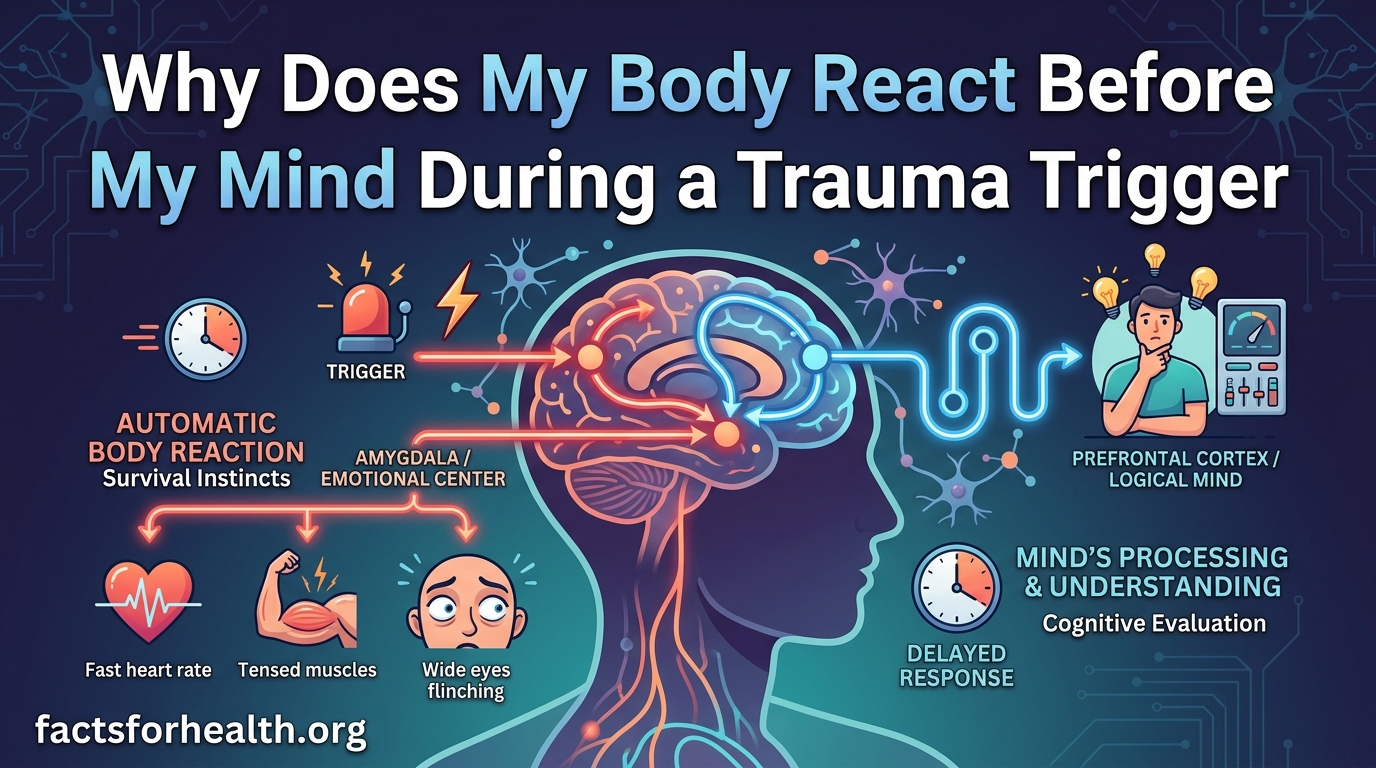
Your heart races before you even realize why. Your muscles tense before a single conscious thought forms. If you have ever wondered why does my body react before my mind during a trauma trigger, the answer lies in a subconscious process called neuroception. Your nervous system constantly scans your environment for danger at a speed far faster than conscious awareness, detecting threat cues in milliseconds and triggering protective physical responses before your thinking brain can catch up.
Approximately 80 percent of the nerve signals in your vagus nerve travel from your body to your brain, not the other way around. This means your body is sending threat information upward constantly. By the time your prefrontal cortex (the logical, reasoning part of your brain) processes what is happening, your heart is already pounding, your breathing has already gone shallow, and your muscles have already braced for impact.
This is not a flaw in your system. It is your nervous system doing exactly what it evolved to do: keeping you alive. But when past trauma has conditioned your body to interpret safe situations as dangerous, this survival mechanism becomes exhausting, confusing, and sometimes overwhelming.
In this guide, our team breaks down the neuroscience behind body-first trauma responses, explains why logic alone cannot calm your triggered nervous system, and shares practical grounding techniques you can use the next time your body reacts before your mind. Whether you are navigating PTSD, complex PTSD, or simply trying to understand why your body seems to have a mind of its own, this article will help you make sense of what is happening and what you can do about it.
Table of Contents
The Science: How Your Nervous System Detects Threat Before You Do
To understand why your body reacts before your mind, we need to look at how the nervous system processes threat. The process starts with something called neuroception, a term coined by Dr. Stephen Porges as part of his polyvagal theory.
Neuroception is your nervous system’s subconscious ability to detect whether an environment or situation is safe, dangerous, or life-threatening. This process happens entirely outside of your conscious awareness. Your brain evaluates thousands of sensory inputs every second including tone of voice, facial expressions, body language, smells, sounds, and even subtle changes in your own internal body state. When neuroception detects a cue that resembles past danger, it triggers a cascade of physical responses before you can think.
The Amygdala: Your Brain’s Alarm System
The amygdala is a small, almond-shaped structure deep in your brain that acts as a threat-detection center. It processes sensory information in approximately 20 milliseconds. That is staggeringly fast compared to your prefrontal cortex, which takes 300 to 500 milliseconds to consciously process the same information.
This speed difference is critical. When someone with a trauma history encounters a trigger, the amygdala sounds the alarm and activates the sympathetic nervous system long before the prefrontal cortex can evaluate whether the threat is real. Your body has already flooded with stress hormones like cortisol and adrenaline by the time your thinking brain says, “Wait, I’m actually safe right now.”
For someone without significant trauma history, the prefrontal cortex can usually step in and calm the amygdala’s alarm relatively quickly. But trauma physically changes the brain. Research published through the National Center for Biotechnology Information (NCBI) shows that chronic trauma exposure strengthens the amygdala’s threat response while weakening the prefrontal cortex’s ability to regulate it. This creates a brain that defaults to body-first reactions.
The Prefrontal Cortex Goes Offline
Your prefrontal cortex handles logic, planning, emotional regulation, and decision-making. It is what allows you to assess a situation rationally and tell yourself, “I am safe.” But during a triggered state, this region effectively goes offline.
This happens because blood flow and neural activity shift away from the prefrontal cortex and toward survival systems. Your brain treats conscious reasoning as a luxury it cannot afford when it believes you are in danger. This is why you cannot simply think your way out of a trauma response. The part of your brain that does the thinking is temporarily unavailable.
Polyvagal Theory and the Autonomic Nervous System
Dr. Stephen Porges’ polyvagal theory provides one of the most useful frameworks for understanding body-first trauma responses. According to this theory, your autonomic nervous system has three primary states that shape how you respond to the world.
The first is the ventral vagal state, associated with social engagement, safety, and connection. When you are in this state, your body feels calm, your breathing is easy, and you can connect with others. The second is the sympathetic state, which drives fight or flight. Your heart rate increases, muscles tense, and your body prepares for action. The third is the dorsal vagal state, which produces the freeze response. This is the oldest evolutionary survival mechanism, causing shutdown, numbness, and dissociation when neither fight nor flight is possible.
Trauma can cause your nervous system to get stuck cycling between sympathetic activation and dorsal vagal shutdown, rarely settling into the ventral vagal state of safety. This is what nervous system dysregulation looks like, and it explains why your body may react intensely even when nothing in your current environment is genuinely dangerous.
Fight, Flight, Freeze, and Fawn: Understanding Your Body’s Survival Responses
When your nervous system detects a threat, it activates one of four primary survival responses. These responses are automatic, involuntary, and deeply wired into your biology. Understanding which response your body defaults to can help you recognize what is happening during a trigger and respond more effectively.
The Fight Response
Fight is the body’s preparation to confront a threat directly. When this response activates, you may feel sudden anger, irritability, or an urge to argue. Your jaw clenches, your fists may ball up, your face feels hot, and your muscles fill with tension as if preparing to push back against something. People with a fight default are often told they are “too aggressive” or “overreactive,” but this is simply their nervous system trying to protect them.
The Flight Response
Flight is the urge to escape. Your heart rate spikes, breathing becomes rapid and shallow, and you may feel restless, fidgety, or desperate to leave the room. Your leg muscles tense as if ready to run. Many people describe flight as a feeling of being trapped or needing to get away immediately, even when they cannot identify what they are running from.
The Freeze Response
Freeze is what happens when your nervous system determines that neither fighting nor fleeing will work. This is the dorsal vagal shutdown. Your body goes still, your heart rate may slow, breathing becomes shallow, and you feel numb, disconnected, or spaced out. People in a freeze response often describe feeling paralyzed, unable to speak or move, or feeling like they are watching themselves from outside their body.
The freeze response is particularly confusing because it does not feel like fear. It feels like nothing. This can lead people to believe they are lazy, uncaring, or broken, when in reality their nervous system has entered an ancient survival mode designed to help them endure overwhelming situations.
The Fawn Response
Fawn is the fourth survival response, and it is the least discussed. When fawning, your body tries to neutralize threat by appeasing the person or situation causing distress. You may find yourself people-pleasing, over-apologizing, losing your own needs in someone else’s, or agreeing to things you do not want to do. Fawning is especially common in survivors of childhood abuse or domestic violence, where staying safe meant keeping the dangerous person happy.
The Incomplete Defensive Response
One of the most important concepts in understanding body-first trauma reactions is the incomplete defensive response. When an animal in the wild survives a predator attack, it physically shakes and trembles afterward, completing the fight or flight cycle and discharging the stored survival energy. Humans rarely get this opportunity.
When trauma occurs and you cannot fight back or run away, your body mobilizes enormous amounts of energy for survival that never gets discharged. That energy becomes trapped in your nervous system, muscles, and tissues. This is what therapists mean when they say trauma is “stored in the body.” Your muscles remain partially activated, braced for a threat that already passed, sometimes for years or decades.
Think of it like pressing the gas pedal and the brake at the same time. Your body is simultaneously revving with survival energy and slamming on the brakes to keep you still. This creates the chronic tension, exhaustion, and hypervigilance that many trauma survivors live with daily.
Physical Symptoms: Where Trauma Lives in Your Body
Trauma does not just live in your thoughts and memories. It takes up residence in your physical body, creating patterns of tension, dysregulation, and discomfort that can persist long after the traumatic event. Understanding where and how these somatic symptoms manifest can help you recognize when your body is reacting to a trigger.
Chest and Breathing
Chest tightness is one of the most common body-first trauma responses. When your sympathetic nervous system activates, your breathing shifts to the upper chest, becoming rapid and shallow. This pattern, called thoracic breathing, signals more danger to your nervous system, creating a feedback loop that intensifies the triggered state. You may feel like you cannot get a full breath, like someone is sitting on your chest, or like your heart is racing for no identifiable reason.
Stomach and Digestion
Your gut contains its own nervous system, the enteric nervous system, which is deeply connected to your brain through the vagus nerve. Trauma responses frequently manifest as stomach churning, nausea, irritable bowel symptoms, loss of appetite, or sudden digestive distress. Many people first notice they are triggered because their stomach reacts before anything else.
Muscle Tension Patterns
Trauma creates predictable muscle tension patterns. The jaw clenches as a protective response. The shoulders rise toward the ears as if bracing against a blow. The lower back tightens. The pelvic floor contracts. These patterns become chronic, meaning your body holds this tension even at rest. Over time, this stored tension contributes to chronic pain, headaches, TMJ disorders, and persistent fatigue.
Hyperarousal vs. Hypoarousal
Body-first trauma responses generally fall into two categories: hyperarousal and hypoarousal. Understanding the difference helps you identify what your nervous system is doing.
Hyperarousal is the revved-up state. Symptoms include a racing heart, rapid breathing, muscle tension, irritability, difficulty sleeping, racing thoughts, an exaggerated startle response, and a feeling of being on edge. Your sympathetic nervous system is stuck in overdrive, scanning for threats even in safe environments. This is the overfunctioning trauma response that keeps you hypervigilant and exhausted.
Hypoarousal is the shut-down state. Symptoms include numbness, heaviness, brain fog, extreme fatigue, emotional flatness, difficulty concentrating, disconnection from your body, and a sense of going through the motions without really being present. Your dorsal vagal system has hit the brakes, leaving you in a state of protective shutdown.
Many trauma survivors oscillate between these two states, never quite settling in the middle. This is where the concept of the window of tolerance becomes essential.
The Window of Tolerance
The window of tolerance, a concept developed by Dr. Dan Siegel, describes the zone of nervous system activation where you can function effectively, think clearly, and feel your emotions without becoming overwhelmed. Inside this window, you can handle stress, connect with others, and respond to life’s challenges flexibly.
Trauma narrows this window dramatically. Situations that most people handle easily can push you above the window into hyperarousal or below it into hypoarousal. A critical look from a coworker, a specific tone of voice, a particular smell, or even internal sensations like a racing heart can shove you outside your window before you know what happened.
The goal of trauma therapy and nervous system regulation is not to eliminate triggers entirely. It is to widen your window of tolerance so that you can experience more of life without your body sounding the alarm.
Trauma Triggers vs. Anxiety Triggers: Key Differences That Matter
One question that comes up frequently in trauma communities is whether what they are experiencing is a trauma trigger or general anxiety. This distinction matters because the two require different approaches. Yet surprisingly few resources clearly explain the difference.
A trauma trigger is a specific cue (sensory, emotional, or situational) that your nervous system has linked to a past traumatic event. The trigger activates a body-first survival response rooted in a real experience of danger. The reaction often feels disproportionate to the current situation because your body is responding to the original threat, not the present moment. Triggers can be obvious, like a loud noise that reminds you of an accident, or invisible.
An anxiety trigger is more generalized. It involves anticipatory worry about future threats rather than a response to past danger. While anxiety can certainly produce physical symptoms, the nervous system is responding to perceived future risk rather than re-experiencing a conditioned fear from the past.
Common Invisible Triggers
Not all trauma triggers are obvious. Many of the cues that set off body-first reactions are subtle and invisible to conscious awareness. These invisible triggers are often the most confusing because you cannot identify what caused your reaction.
Common invisible triggers include sleep deprivation, caffeine on an empty stomach, blood sugar drops, hormonal fluctuations, specific tones of voice, certain smells (perfume, cleaning products, food), particular textures or physical sensations, feeling rushed or pressured, being in spaces with no clear exit, and internal body sensations that resemble past trauma states like a racing heart or tight chest.
Because these triggers operate below conscious awareness, they can make you feel like your body is reacting randomly. In reality, your neuroception is detecting cues that your conscious mind has not registered yet. This is the core of brain-body disconnect after trauma.
Why This Distinction Matters
Understanding whether you are dealing with trauma triggers or anxiety triggers shapes the path forward. Generalized anxiety often responds well to cognitive behavioral therapy and thought-based interventions. Trauma triggers, however, require approaches that work with the body and the nervous system directly.
This is why so many people spend years in traditional talk therapy making intellectual progress but still experiencing intense body-first reactions. The thinking brain is not the part of the brain that needs healing. The survival brain, the autonomic nervous system, and the body itself need to learn that the present is safe.
Why Talk Therapy Alone Often Is Not Enough
If you have spent months or years in talk therapy understanding your trauma intellectually but still feeling your body react before your mind, you are not alone. This is one of the most common frustrations expressed in trauma recovery communities. There is a neurological reason for it.
Traditional talk therapy is a top-down approach. It starts with the thinking brain, using insight, logic, and cognitive reframing to change how you feel. This approach works well for many issues, but it has a fundamental limitation with trauma: the part of the brain it targets, the prefrontal cortex, goes offline during a triggered state.
You cannot reason with a nervous system that does not have access to reasoning. When you are triggered, your prefrontal cortex is not available to receive the logical message that you are safe. The threat response is happening at a level below conscious thought, in brain structures and nervous system pathways that logic cannot reach.
Bottom-Up Approaches: Working With the Body
Bottom-up approaches start with the body instead of the mind. They work directly with the nervous system, helping it process and release stored survival energy. Because trauma is stored in the body at the level of the autonomic nervous system, bottom-up approaches can reach what top-down therapy cannot.
Somatic experiencing, developed by Dr. Peter Levine, is one of the most established bottom-up approaches. It focuses on helping you track physical sensations in your body and slowly release trapped survival energy. Sensorimotor psychotherapy integrates body awareness with cognitive processing. EMDR (Eye Movement Desensitization and Reprocessing) uses bilateral stimulation to help the brain reprocess traumatic memories that are stuck in the nervous system.
This is not to say talk therapy has no place in trauma recovery. Many people benefit from combining top-down and bottom-up approaches. But if you have been doing only talk therapy and your body is still reacting before your mind, adding body-based work may be the missing piece.
Practical Strategies: How to Regulate Your Nervous System After a Trigger
Understanding why your body reacts before your mind is important, but knowing what to do in the moment is what changes your daily experience. The following techniques work directly with your nervous system to bring it back from a triggered state. They are bottom-up tools that do not require your thinking brain to be online.
1. The 5-4-3-2-1 Grounding Technique
This technique uses your senses to pull your nervous system into the present moment, signaling that the current environment is safe.
Step 1: Name five things you can see around you. Look for specific details like colors, shapes, and textures.
Step 2: Name four things you can physically feel. Notice the chair beneath you, your feet on the floor, the fabric of your clothing.
Step 3: Name three things you can hear. Listen for sounds near and far, from the hum of a refrigerator to distant traffic.
Step 4: Name two things you can smell. If nothing is apparent, think of two smells you enjoy.
Step 5: Name one thing you can taste. Take a sip of water or simply notice the current taste in your mouth.
2. Extended Exhale Breathing
When your sympathetic nervous system is activated, your breathing becomes rapid and shallow with shorter exhales. You can manually shift your nervous system toward calm by making your exhales longer than your inhales. This activates the parasympathetic nervous system through the vagus nerve.
Step 1: Inhale through your nose for a count of four.
Step 2: Exhale slowly through your mouth for a count of six.
Step 3: Repeat this cycle for at least two minutes. The longer exhale is what signals safety to your nervous system.
3. Orienting to Your Environment
Trauma keeps your nervous system focused on internal threat cues. Orienting pulls your attention outward.
Step 1: Look around your environment slowly and deliberately.
Step 2: Let your eyes land on different objects without rushing.
Step 3: Notice that nothing in your current environment is attacking you.
Step 4: Allow your neck and head to turn naturally, which activates the ventral vagal system associated with safety.
4. Pendulation
Pendulation is a somatic experiencing technique that helps your nervous system process triggered states by moving attention between tension and ease.
Step 1: Find a place in your body that feels tense, tight, or activated.
Step 2: Find a place in your body that feels neutral or relatively calm.
Step 3: Slowly shift your attention back and forth between the two areas.
Step 4: Notice how the sensations change as your nervous system processes the contrast.
5. Vagus Nerve Regulation Exercises
The vagus nerve is the main pathway of your parasympathetic nervous system. You can stimulate it directly through several simple exercises.
Cold exposure: Splash cold water on your face or hold an ice pack against your cheeks. The cold activates the mammalian dive reflex, which stimulates the vagus nerve and slows your heart rate.
Humming or singing: The vagus nerve runs through your vocal cords. Humming, singing, or chanting creates vibrations that stimulate the nerve and signal calm to your nervous system.
Slow neck stretches: Gently turning your head and stretching your neck can stimulate vagus nerve pathways, especially when combined with deep breathing.
Can the Nervous System Heal? Neuroplasticity and Recovery
One of the most common questions in trauma recovery communities is whether healing is actually possible. People ask how long it takes, whether the body will ever feel safe again, and whether the changes trauma made to the brain are permanent.
The answer is encouraging. Your nervous system retains neuroplasticity throughout your entire life. Neuroplasticity is the brain’s ability to reorganize itself by forming new neural pathways. This means the patterns trauma created in your nervous system are not permanent. They can be reshaped, softened, and replaced with new patterns of safety and regulation.
Healing does not mean erasing the past. It means teaching your nervous system that the present moment is safe, even when it carries echoes of what happened before. This happens gradually, through repeated experiences of safety and regulation that slowly widen your window of tolerance.
Therapy Approaches That Support Nervous System Healing
Several evidence-based therapy modalities work directly with the nervous system to support trauma recovery. EMDR helps the brain reprocess traumatic memories so they no longer trigger intense body-first reactions. Somatic experiencing helps release trapped survival energy from the body. Cognitive processing therapy (CPT) and prolonged exposure (PE) therapy are evidence-based approaches for PTSD that help reframe trauma narratives and reduce avoidance behaviors.
Internal Family Systems (IFS) therapy works with the different parts of yourself that developed protective roles after trauma. Acceptance and commitment therapy (ACT) helps you build distress tolerance and psychological flexibility. The right approach depends on your specific history, symptoms, and preferences.
Forum communities focused on complex PTSD and somatic experiencing consistently report that combining body-based practices with trauma-informed therapy produces the most meaningful progress. People who spent years in traditional talk therapy often describe finally feeling relief when they added somatic work, vagus nerve regulation, or EMDR to their recovery.
How Long Does Healing Take?
This is one of the most frequently asked questions, and the honest answer is that it varies. Nervous system regulation is not a linear process. Some people notice shifts within weeks of starting body-based practices. For others, especially those with complex PTSD from prolonged developmental trauma, the process unfolds over months or years.
The important thing to understand is that progress is measured not by eliminating triggers entirely but by how quickly your nervous system returns to regulation after being triggered. Over time, your window of tolerance widens, your recovery time shortens, and the intensity of your body-first reactions decreases.
When to Seek Professional Help
While the self-regulation techniques in this article can be powerful tools, they are not a substitute for professional support when you need it. Knowing when to reach out for help is itself an act of nervous system wisdom.
Consider seeking professional support if your body-first trauma responses are interfering with your daily life, relationships, or ability to work. If you are experiencing frequent dissociation, flashbacks, or panic episodes, a trauma-informed therapist can help you build the skills to navigate these experiences safely. If you have been in talk therapy for a long time without relief from physical symptoms, it may be time to explore body-based approaches like somatic experiencing or EMDR.
Look for a therapist who specifically identifies as trauma-informed and has training in nervous system-based approaches. Ask about their experience with polyvagal theory, somatic experiencing, EMDR, or other body-oriented modalities. The right therapist will understand that your body reactions are not a personal failing but a nervous system doing its best to protect you.
If you are experiencing thoughts of self-harm, severe depression, or feel that you are in crisis, please reach out to a mental health professional or crisis line immediately. Your safety comes first.
FAQs
What are the physical signs your body is releasing trauma?
Common physical signs include trembling or shaking, sudden waves of fatigue, changes in breathing patterns, muscle twitches, temperature fluctuations (hot flashes or chills), yawning, tears, stomach gurgling, and a sense of heaviness leaving the body. These are nervous system responses, not signs of weakness. They indicate that trapped survival energy is being discharged.
Why does my body react before my mind?
Your body reacts before your mind because your nervous system uses a subconscious threat-detection process called neuroception that scans for danger in milliseconds, far faster than conscious awareness. Approximately 80 percent of vagus nerve signals travel from body to brain, meaning your body can initiate protective responses like increased heart rate, muscle tension, and shallow breathing before your conscious mind registers any threat.
How to cope with trauma triggers?
Effective coping strategies include: using the 5-4-3-2-1 grounding technique to engage your senses, practicing extended exhale breathing (inhale for 4, exhale for 6) to activate the parasympathetic nervous system, doing a body scan to notice sensations without judgment, trying pendulation by shifting attention between tense and calm areas, and seeking trauma-informed professional support through approaches like EMDR, somatic experiencing, or CBT.
How does trauma affect the body?
Trauma affects the body by disrupting the balance between sympathetic and parasympathetic nervous systems, causing chronic cortisol release that strains physical health, storing incomplete defensive responses in muscles and tissues, and altering sleep, digestion, and immune function. This creates somatic symptoms like chronic pain, tension, fatigue, digestive issues, and hypervigilance that can persist long after the traumatic event.
Can trauma mess up your nervous system?
Yes, trauma can dysregulate the nervous system. Prolonged or repeated trauma alters how the autonomic nervous system balances activation and calming responses, creating a persistent state of hypervigilance, exaggerated startle responses, or shutdown. The good news is that the nervous system retains neuroplasticity throughout life and can be retrained through somatic therapy, grounding practices, and trauma-informed treatment.
What is the overfunctioning trauma response?
The overfunctioning trauma response refers to hyperarousal patterns where the nervous system stays excessively activated. This manifests as constant alertness, anxiety, irritability, difficulty sleeping, racing thoughts, and an exaggerated startle response. It is the body’s attempt to stay ahead of perceived danger. The opposite pattern, hypoarousal or underfunctioning, involves numbness, shutdown, and disconnection.
Can you reset your nervous system from trauma?
Yes, the nervous system can heal from trauma through neuroplasticity. Effective approaches include somatic experiencing to release stored trauma from the body, vagus nerve regulation techniques like cold exposure and extended exhale breathing, regular grounding and mindfulness practices, EMDR to reprocess traumatic memories, and consistent trauma-informed therapeutic support. Healing is about teaching the body that present-moment safety is real.
Conclusion: Your Body Is Not Broken
If you started this article wondering why does my body react before my mind during a trauma trigger, the most important takeaway is this: your body is not betraying you. It is protecting you. Every racing heartbeat, every muscle that tenses, every moment of freeze or flight is your nervous system doing exactly what it evolved to do, keeping you alive in a world it learned was dangerous.
The problem is not that your body reacts. The problem is that trauma taught your nervous system to react to safe situations as if they were dangerous. The good news, backed by neuroscience, is that this is changeable. Your brain retains neuroplasticity. Your nervous system can learn new patterns. Your window of tolerance can widen. Healing is not about fighting your body but about teaching it, gently and consistently, that the present moment is safe.
Start with the grounding techniques in this article. Practice them when you are calm, not just when triggered, so they become familiar to your nervous system. Consider exploring body-based therapies like somatic experiencing or EMDR if talk therapy alone has not resolved your physical reactions. And remember that progress is measured not by eliminating triggers but by how quickly you return to regulation after one.
Your body has carried you through a lot. With the right tools and support, it can also carry you toward healing.