
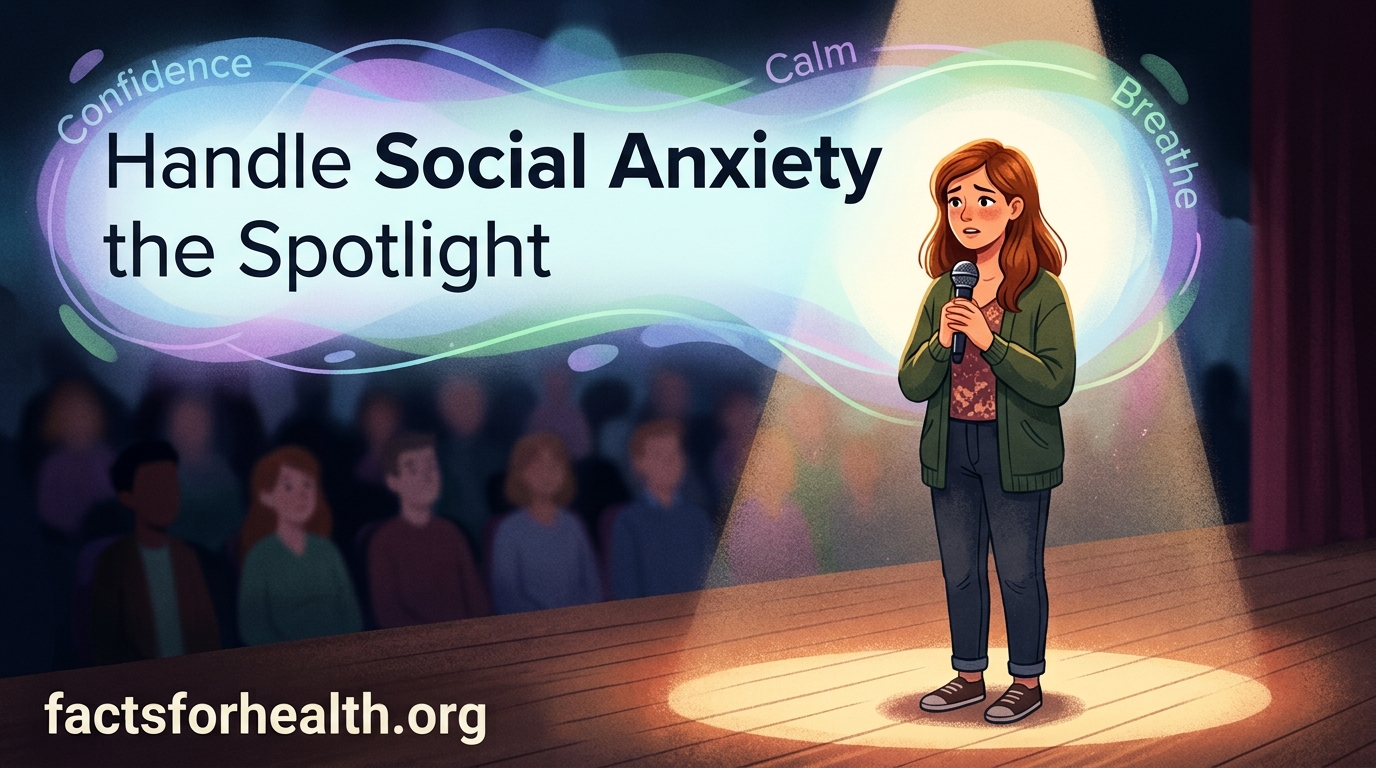
Picture this: you walk into a room, and every pair of eyes turns toward you. Your heart starts pounding before you can even process what is happening. If you live with social anxiety, this scenario probably sounds familiar and deeply uncomfortable.
Learning how to handle being the center of attention with social anxiety is not about forcing yourself to love the spotlight. It is about building a toolkit of practical strategies so those moments stop controlling your life. Whether it is a work presentation, your own birthday party, or simply being called on in a meeting, the fear is real, and it is valid.
Our team has spent months researching evidence-based techniques, reviewing community experiences from support forums, and analyzing what actually works for people who dread being noticed. What we found is that recovery is not about becoming an extrovert overnight. It is about shrinking the gap between how much fear you feel and how much that fear dictates your choices.
In this guide, you will learn why your brain reacts this way, quick relief techniques you can use in the moment, long-term strategies for building confidence, and when it makes sense to seek professional help. Everything here is based on established therapeutic approaches like cognitive behavioral therapy and exposure therapy, combined with real insights from people who have been exactly where you are.
Table of Contents
What Does It Mean to Fear Being the Center of Attention?
The fear of being the center of attention is an intense anxiety response triggered when you feel scrutinized, watched, or judged by others. It goes well beyond ordinary shyness or stage fright. For someone with social anxiety disorder, even positive attention like receiving a compliment or being sung “Happy Birthday” can trigger a full fight-or-flight response.
This fear exists on a spectrum. Some people feel mild discomfort when all eyes are on them, while others experience physical symptoms so severe they avoid any situation where they might be noticed. Shaking hands, a racing heart, difficulty making eye contact, sweating, and even hyperventilation are all common physical reactions.
What makes this particularly difficult is that the fear often does not match the actual threat level. You might logically know that giving a toast at your friend’s wedding is safe, but your nervous system responds as if you are facing actual physical danger. This gap between logic and physical response is one of the most frustrating aspects of social anxiety.
Many people describe a paradox that competitors rarely address. Sometimes attention feels fine, even enjoyable, and other times the exact same type of attention feels unbearable. This inconsistency can make you question whether your anxiety is real. It is. Social anxiety does not follow a predictable pattern, and feeling okay in one situation does not invalidate your struggle in another.
The Spotlight Effect Explained
The spotlight effect is a well-documented psychological bias where people tend to believe that others are paying far more attention to them than they actually are. Researchers Thomas Gilovich and colleagues at Cornell University first described this phenomenon, and it is particularly intense for people with social anxiety.
When you have social anxiety, your brain amplifies this effect dramatically. You might walk into a meeting convinced everyone noticed the tiny coffee stain on your shirt, when in reality, nobody saw it at all. Or you might stumble over one word during a presentation and spend hours replaying it, assuming everyone thought you were incompetent, while your coworkers have already moved on.
Understanding the spotlight effect matters because it gives you a factual counterargument to anxious thoughts. Studies show that people consistently overestimate how much others notice, remember, and judge their behavior by a significant margin. The people around you are largely focused on themselves, their own insecurities, and their own spotlight effect.
This does not mean your feelings are wrong. The anxiety you feel is very real. But knowing that your perception is amplified can help you question those thoughts instead of automatically accepting them as truth. That small shift in perspective is the foundation of many effective coping strategies.
Scopophobia: When the Fear Becomes a Specific Phobia
For some people, the fear of attention goes beyond social anxiety and develops into scopophobia, which is a specific phobia of being watched or stared at. Scopophobia can exist on its own or alongside social anxiety disorder, and the distinction matters for treatment.
Social anxiety disorder typically involves fear of negative evaluation across many social situations. Scopophobia is more specifically about the act of being observed itself, regardless of whether judgment is involved. Someone with scopophobia might feel intense panic simply being looked at, even by people they know well and trust.
If you find that your fear is specifically triggered by eye contact or the sensation of being watched rather than by social judgment, it is worth discussing this distinction with a mental health professional. Treatment approaches can be tailored based on whether you are dealing primarily with social anxiety disorder, scopophobia, or both.
Normal Nervousness vs. Social Anxiety Disorder
Almost everyone feels nervous before a big presentation or when meeting new people. This is a normal human response to socially significant situations. The difference between normal nervousness and social anxiety disorder comes down to intensity, duration, and how much it interferes with your daily life.
Normal nervousness typically peaks before the event and subsides once you start. You might have butterflies before a presentation, but they calm down within the first few minutes. Social anxiety disorder, on the other hand, can trigger intense symptoms that persist throughout the entire event and linger for hours or days afterward as you replay every moment.
Another key difference is avoidance. People with normal nervousness might feel uneasy about a social event but still attend. Social anxiety disorder often leads to active avoidance, making excuses, or enduring situations with extreme distress. If your fear of attention is causing you to skip promotions, avoid relationships, or miss important life events, that goes well beyond typical nervousness.
The physical symptoms are also typically more severe with social anxiety disorder. While anyone might feel a quickened heartbeat before public speaking, social anxiety can cause full panic symptoms including chest tightness, dizziness, nausea, and a sense of impending doom. These are not signs of weakness. They are your body’s alarm system misfiring.
How to Handle Being the Center of Attention With Social Anxiety: Quick Relief Techniques
When anxiety hits hard and fast, you need techniques that work in seconds, not after a 30-minute meditation session. Here are the most effective quick relief strategies that you can use anywhere, anytime, without anyone around you even noticing.
1. The 4-7-8 Breathing Technique. Inhale through your nose for 4 counts, hold for 7 counts, and exhale through your mouth for 8 counts. This specific breathing pattern activates your parasympathetic nervous system, which is responsible for calming your body down. Repeat this cycle 3 to 4 times. It works because the long exhale signals to your brain that you are safe.
2. The 5-4-3-2-1 Grounding Method. Name 5 things you can see, 4 things you can physically feel, 3 things you can hear, 2 things you can smell, and 1 thing you can taste. This technique pulls your attention away from internal anxious thoughts and anchors you in your physical environment. It is especially effective right before stepping into a situation where you will be noticed.
3. Progressive Muscle Relaxation (Quick Version). Tense every muscle in your body as tightly as possible for 5 seconds, then release all at once. Start from your feet and work up to your face, or do a full-body tense-and-release all at once. Anxiety stores tension in your muscles, and physically letting it go sends a powerful calming signal to your brain.
4. Temperature Shift. Hold something cold, like an ice cube or a cold water bottle, against your wrist or the back of your neck. The sudden temperature drop activates your mammalian dive reflex, which naturally slows your heart rate. This is one of the fastest ways to interrupt an escalating anxiety spiral.
5. Silent Counting With a Twist. Count backward from 100 by 7s. This forces your working memory to engage, leaving fewer cognitive resources available for anxious thoughts. It sounds simple, but the math is just hard enough to require focus, which gives your nervous system a chance to reset.
Keep in mind that no single technique works perfectly every time. The goal is to have a menu of options so you can try different ones depending on the situation and see what works best for you personally.
Deep Breathing Exercises That Actually Work
Almost every article on social anxiety mentions deep breathing, but most skip the specifics that make it effective. Generic advice like “just breathe deeply” can actually make anxiety worse if you do it wrong. Here is what actually works based on clinical evidence.
The problem with simply breathing deeply is that many people end up taking rapid, shallow breaths from their chest, which can increase hyperventilation and make anxiety symptoms worse. Effective breathing for anxiety relief must come from your diaphragm, the large muscle below your lungs.
To practice diaphragmatic breathing, place one hand on your chest and one on your stomach. Breathe in slowly through your nose so that the hand on your stomach rises while the hand on your chest stays relatively still. This ensures you are using your diaphragm rather than shallow chest muscles. Aim for a rate of about 5 to 6 breaths per minute, which research has shown is the sweet spot for activating your body’s relaxation response.
Box breathing is another effective technique used by Navy SEALs and therapists alike. You inhale for 4 counts, hold for 4 counts, exhale for 4 counts, and hold empty for 4 counts. The structured rhythm gives your mind something to focus on while the equal counts create a balanced, calming effect. Practice this when you are not anxious so it feels natural when you need it.
Consistency matters more than duration. Five minutes of daily breathing practice will serve you far better than thirty minutes done once a week. Many people find it helpful to pair breathing exercises with an existing daily habit, like during their morning commute or right before bed.
Grounding Techniques for Acute Anxiety Moments
When anxiety spikes sharply, grounding techniques help reconnect you to the present moment. They work by interrupting the cycle of anxious thoughts pulling you into a spiral of what-ifs and worst-case scenarios. The grounding method you choose should match the intensity of what you are experiencing.
For mild to moderate anxiety, sensory grounding works well. The 5-4-3-2-1 method described earlier is one option, but you can simplify it further. Pick one object in the room and describe it in as much detail as possible, either mentally or by whispering to yourself. Notice its color, texture, shape, size, and any other properties. This focused attention gently redirects your brain away from anxious self-monitoring.
For severe anxiety approaching panic levels, physical grounding is more effective. Press your feet firmly into the floor and notice the solid surface beneath you. Grip the arms of your chair or press your palms together firmly. The physical sensations of solidity and pressure help counteract the floating, disconnected feeling that often accompanies intense anxiety.
Mental grounding exercises engage your cognitive processes in ways that crowd out anxious thinking. Pick a category like “fruits” or “cities” and name one for each letter of the alphabet. Or recall the lyrics to a favorite song in order. These tasks are demanding enough to occupy your anxious brain without being so difficult that they add frustration.
One approach that forum contributors have found particularly helpful is the category technique for social events. Before attending a gathering, prepare a mental list of three conversation topics you can bring up if you feel anxious. Having this ready means you can shift from internal anxiety to external engagement without having to think on your feet.
Cognitive Reframing: Challenging Negative Thoughts
Social anxiety is fueled by negative thoughts that feel like facts but are actually distorted interpretations. Cognitive reframing, a core technique in cognitive behavioral therapy, teaches you to identify, question, and replace these thoughts with more accurate ones.
The first step is learning to catch negative thoughts in real time. Common patterns include mind reading, where you assume others are thinking negatively about you without evidence, and catastrophizing, where you imagine the worst possible outcome from a minor social mistake. Personalizing is another common distortion, where you assume that if someone looks bored or annoyed, it must be because of you.
Once you identify a negative thought, question it with specific challenges. What evidence do I actually have that everyone is judging me? Has anyone said or done anything that confirms this? What would I tell a friend who had this same thought? How many times has my predicted disaster actually come true in the past?
Then replace the thought with a more balanced alternative. Instead of “everyone thinks I’m awkward,” try “I felt awkward during that conversation, but I cannot know what others were thinking, and people are generally focused on themselves.” The replacement thought does not need to be overwhelmingly positive. It just needs to be accurate.
This process feels unnatural at first. Negative thoughts have often been running on autopilot for years, so challenging them requires conscious effort. With practice, the questions become more automatic, and the gap between a triggering situation and an anxious reaction grows wider, giving you more control over how you respond.
Here is a practical exercise to start with. For one week, carry a small notebook or use a notes app on your phone. Each time you notice a spike in anxiety, jot down the situation and the thoughts running through your mind. At the end of each day, review your notes and practice reframing at least one thought. This builds the habit of metacognition, thinking about your thinking, which is the foundation of cognitive behavioral therapy.
Gradual Exposure: Building Tolerance Step by Step
Exposure therapy is one of the most effective treatments for social anxiety, and you can begin a simplified version on your own. The core idea is to gradually face the situations you fear in a controlled, systematic way, allowing your brain to learn that these situations are not as dangerous as it believes.
Start by building an anxiety hierarchy, which is a ranked list of situations that trigger your fear of attention. Rate each one from 1 to 100 based on how much anxiety it causes you. For example, raising your hand in a small meeting might be a 30, speaking up in a large meeting might be a 60, and giving a formal presentation could be a 90.
Begin with the lowest item on your list, the situation that causes mild but manageable anxiety. Put yourself in that situation repeatedly until your anxiety drops to a comfortable level. This is called habituation, and it is how your brain learns that the situation is safe. Only then do you move to the next item on your list.
The key principle is that you should feel challenged but not overwhelmed. If a situation causes anxiety above a 70, it is probably too high on your list to start with. Break it down into smaller steps. If giving a presentation is a 90, a smaller step might be asking a question during someone else’s presentation first.
Track your progress in a journal or app. Note the situation, your anxiety level before, during, and after, and what you learned. Over time, you will see patterns emerge that help you understand your triggers and recognize that anxiety peaks and then naturally declines, even in situations that feel unbearable at first.
One important warning about self-guided exposure: if you find that exposure consistently makes your anxiety worse rather than better, or if it leads to extended periods of distress, it is time to work with a professional therapist. Exposure therapy done wrong can reinforce avoidance rather than reduce it. A trained therapist can help you calibrate the difficulty level and process the emotions that come up.
Workplace Strategies: Meetings, Presentations, and More
The workplace is one of the most common environments where people with social anxiety feel forced into the spotlight. Unlike social events, you cannot simply decline the invitation to present at the quarterly review. Having workplace-specific strategies is essential for career growth and daily functioning.
For meetings, preparation is your strongest tool. Before attending, review the agenda and prepare one comment or question in advance. This eliminates the pressure of thinking on your feet and gives you a concrete plan for contributing. Once you have spoken once, subsequent contributions feel easier because you have already broken the ice.
Positioning matters more than most people realize. If possible, sit slightly off to the side rather than directly across from the most senior person in the room. This reduces the feeling of being directly observed while still keeping you engaged in the discussion. Bringing a notebook and taking notes also gives you a natural reason to break eye contact when needed.
For presentations, arrive early to familiarize yourself with the space. Stand at the front before anyone arrives and look out at the empty room. This simple act of exposure reduces the shock of suddenly being in the spotlight when the audience arrives. Practice your opening three times out loud so that the first 60 seconds, which are typically the most anxiety-provoking, become automatic.
Consider focusing on a friendly face in the audience if direct eye contact feels too intense. Pick one or two supportive colleagues and deliver your presentation primarily to them. Alternatively, look at people’s foreheads or the space just above their heads, which appears as eye contact from their perspective but feels less vulnerable for you.
Video calls present a unique challenge because seeing your own face on screen can intensify self-consciousness. Hide your self-view as soon as you join the call. Research shows that seeing yourself continuously increases self-evaluation and anxiety. If hiding self-view is not an option, cover that portion of your screen with a sticky note.
One strategy that forum contributors consistently recommend is preparing an exit line for overwhelming moments. Having a simple, professional phrase ready, such as “Let me think about that and follow up by email,” gives you permission to pause without having to improvise under pressure. It buys you time to regulate your anxiety and respond thoughtfully.
Scripts and Phrases to Use When Feeling Overwhelmed
One of the biggest content gaps we identified across competitors is the lack of specific words to use when anxiety spikes. Community discussions on forums repeatedly ask for scripts, so here are practical phrases you can keep in your back pocket for common scenarios.
When asked an unexpected question: “That is a great question, let me take a moment to think about that.” This phrase is professional, buys you 10 to 15 seconds to collect your thoughts, and normalizes the pause so it does not feel awkward.
When you need to leave a conversation or event: “It has been wonderful talking with you, I am going to go grab a drink” or “I want to make sure I say hello to a few other people before I head out.” These are polite, socially acceptable exit strategies that do not require you to explain your anxiety.
When you stumble over words in a presentation: “Let me start that again” or “What I meant to say was.” Brief self-corrections signal confidence, not weakness. The audience reads a quick recovery as competence, and they typically forget the stumble within seconds.
When someone notices you seem nervous: “I am a bit nervous, but I am glad to be here.” Acknowledging anxiety openly is surprisingly disarming. It removes the pressure of hiding your feelings, which often reduces the anxiety itself. Most people respond with warmth and understanding.
When declining attention you cannot handle: “I appreciate that, but I would rather not go up front” or “Could we do this a different way?” Advocating for your needs is not weakness. Setting boundaries around your comfort level is a skill that improves with practice.
Write these phrases down and review them before entering anxiety-provoking situations. The more familiar they are, the more easily they will come to mind when your brain is in fight-or-flight mode and higher-order thinking becomes difficult.
When to Seek Professional Help
Self-help strategies can take you far, but they are not always enough. Knowing when to seek professional support is an important part of managing social anxiety responsibly. There is no threshold you need to meet to deserve help. If anxiety is affecting your quality of life, that is reason enough.
Specific signs that it is time to consult a professional include anxiety that consistently interferes with your work performance or career advancement, avoidance of important events like weddings or family gatherings, panic attacks triggered by social situations, and anxiety that has persisted for six months or more despite self-help efforts.
If you find yourself using alcohol or other substances to cope with social situations, this is a strong signal to seek professional support. Substance use as a coping mechanism for social anxiety is common, but it can create additional problems and ultimately reinforces the anxiety cycle rather than breaking it.
Physical symptoms that warrant professional attention include persistent sleep problems related to social worries, significant changes in appetite, chest pain that has not been evaluated by a doctor, and any thoughts of self-harm. These symptoms indicate that your anxiety has reached a level where medical guidance is essential.
Cognitive Behavioral Therapy (CBT)
Cognitive behavioral therapy is considered the gold standard psychological treatment for social anxiety disorder. It is a structured, time-limited therapy that focuses on identifying and changing the thought patterns and behaviors that maintain anxiety.
CBT for social anxiety typically runs 12 to 16 sessions and combines several techniques you have already read about in this article, including cognitive reframing, gradual exposure, and behavioral experiments. The difference is that a trained therapist guides the process, helps you identify thought patterns you might not see on your own, and provides support during exposure exercises.
Research consistently shows that CBT is highly effective for social anxiety, with studies indicating that 50 to 70 percent of people experience significant improvement. The skills you learn in CBT are tools you keep for life, which means the benefits often continue and even grow after therapy ends.
Many therapists now offer CBT online, which can be especially helpful if the thought of visiting a therapist’s office in person triggers anxiety. Online CBT has been shown to be equally effective as in-person therapy for social anxiety, and some people actually prefer it because they feel more comfortable in their own environment.
Exposure Therapy
Exposure therapy deserves its own discussion because it is one of the most powerful specific techniques for treating fear of attention. While we covered self-guided exposure earlier, professional exposure therapy is more structured and tailored to your specific triggers.
A therapist will work with you to build a detailed anxiety hierarchy, then guide you through each step with support. They help you process the emotions that come up, identify what you learned from each exposure, and adjust the difficulty level based on your progress. This professional guidance makes exposure more effective and less likely to backfire.
Virtual reality exposure therapy is an emerging option that uses VR technology to simulate social situations. Research published in medical journals has shown that VR environments can effectively provoke and then reduce social anxiety in individuals who fear being the center of attention. This approach is particularly useful for practicing situations that are difficult to recreate in real life, like giving a speech to a large audience.
The typical course of exposure therapy for social anxiety runs 8 to 15 sessions, depending on the severity of symptoms and the number of situations being addressed. Many people begin noticing significant improvement within the first few sessions, which builds motivation to continue the work.
Medication Options for Social Anxiety
Medication is not always necessary for treating social anxiety, but for many people it provides significant relief that makes therapeutic work more manageable. If you are considering medication, consult a psychiatrist or primary care physician who can evaluate your specific situation.
SSRIs (selective serotonin reuptake inhibitors) are the most commonly prescribed medications for social anxiety disorder. They work by increasing serotonin levels in the brain, which helps regulate mood and anxiety over time. Common SSRIs used for social anxiety include sertraline, paroxetine, and escitalopram. These medications typically take 4 to 8 weeks to reach full effectiveness.
The most commonly asked question about SSRIs for social anxiety is which one is best. The honest answer is that there is no single best SSRI for everyone. Sertraline and paroxetine both have strong research support and FDA approval for social anxiety disorder, but individual responses vary significantly. What works well for one person may cause side effects or provide little benefit for another. Your doctor will likely start with one option and adjust based on your response.
Beta-blockers are another option, particularly for performance-based anxiety like public speaking. They work by blocking the physical symptoms of adrenaline, such as rapid heartbeat and trembling hands, without affecting mental clarity. Many performers and public speakers use beta-blockers on an as-needed basis for specific high-pressure situations. Unlike SSRIs, beta-blockers work immediately and are taken only when needed.
Anti-anxiety medications like benzodiazepines are sometimes prescribed for short-term relief, but they are generally not recommended as a long-term solution for social anxiety due to the risk of dependence and the fact that they can interfere with the learning process in exposure therapy. Always discuss the risks and benefits thoroughly with your prescribing physician.
Building Long-Term Confidence
Coping techniques help you manage anxiety in the moment, but building genuine confidence requires a longer-term approach. Confidence is not the absence of anxiety. It is the ability to act despite it, knowing you can handle whatever comes up.
One of the most effective long-term strategies is to redefine your relationship with attention itself. Instead of viewing attention as inherently threatening, practice seeing it as neutral or even potentially positive. People asking you questions at a meeting means they value your input. Being invited to speak at an event means others respect your expertise.
Building competence in specific areas naturally builds confidence. If public speaking triggers your anxiety, take a public speaking course or join a group like Toastmasters. The combination of skill development and repeated exposure in a supportive environment is powerful. As your actual ability grows, the gap between perceived threat and real capability shrinks.
Celebrate small wins consistently. Made eye contact during a conversation? That counts. Spoke up once in a meeting when you wanted to stay silent? That counts too. The brain tends to focus on what went wrong and ignore what went right, so consciously acknowledging your progress retrains your attention toward growth rather than perceived failure.
Self-compassion is the foundation that makes all of this sustainable. People with social anxiety are often their own harshest critics, replaying social interactions and cataloging every perceived mistake. Treating yourself with the same kindness you would offer a friend is not just a feel-good concept. Research shows that self-compassion is strongly associated with lower anxiety levels and greater resilience.
Lifestyle Changes That Reduce Anxiety
Your daily habits have a significant impact on your baseline anxiety level. While lifestyle changes alone will not eliminate social anxiety, they create a foundation that makes every other strategy more effective.
Sleep is perhaps the most important factor. Chronic sleep deprivation increases activity in the amygdala, the brain’s fear center, making you more reactive to perceived threats. Aim for 7 to 9 hours of quality sleep per night. If anxiety itself is interfering with your sleep, address this with a professional rather than accepting it as inevitable.
Caffeine is a major trigger for many people with social anxiety. It mimics anxiety symptoms, including increased heart rate, sweating, and jitteriness, which your brain can interpret as the beginning of a panic response. Try reducing your caffeine intake, especially before social events or presentations. Many people are surprised by how much of a difference this one change makes.
Regular exercise reduces baseline anxiety levels over time by regulating neurotransmitters and providing a healthy outlet for the physical tension anxiety creates. Aerobic exercise in particular has been shown to reduce anxiety sensitivity, which is the fear of anxiety symptoms themselves. Even 20 minutes of moderate exercise three times per week can produce noticeable improvements.
Alcohol deserves special mention because it is the most commonly used coping mechanism for social anxiety. While it can temporarily reduce anxiety, it creates a rebound effect that actually increases baseline anxiety over time. It also prevents you from learning that you can handle social situations without chemical assistance, which undermines the confidence-building process.
Mindfulness meditation has strong research support for anxiety reduction. It teaches you to observe anxious thoughts without getting caught up in them, creating mental space between a trigger and your reaction. Even 10 minutes per day can make a meaningful difference over time. Many free apps and guided audio tracks are available to help you get started.
Enjoying Your Special Day: Weddings, Birthdays, and Milestones
One of the most painful aspects of fearing attention is that it can rob you of joy during events that are supposed to celebrate you. Weddings, milestone birthdays, retirement parties, and award ceremonies are all situations where the attention is well-intentioned, but that does not make it easier to handle.
Forum discussions reveal that this is one of the most common and distressing situations people with social anxiety face. Being unable to enjoy your own wedding day or dreading your birthday party adds a layer of guilt and frustration on top of the anxiety itself. You are not alone in feeling this way, and there are strategies that can help.
Planning ahead gives you control over how attention is distributed. At a wedding, consider a first look before the ceremony so the walk down the aisle feels less like all eyes suddenly turning. At a birthday dinner, choose a venue where conversation flows naturally rather than a setting that puts you physically on display. Small structural choices can significantly reduce the intensity of attention.
Designate a support person who understands your anxiety and can run interference when needed. This might be a partner, sibling, or close friend who can redirect conversations, help you take breaks, or simply provide a grounding presence when you need it. Brief them in advance about what you need and agree on a signal for when you need help.
Schedule breaks into the event timeline. Even five minutes alone in a quiet room can reset your nervous system enough to rejoin the celebration. Plan these breaks proactively rather than waiting until you are overwhelmed. Having them built into the schedule normalizes stepping away and removes the pressure to push through escalating anxiety.
Shift your focus outward. When you are the center of attention, your instinct is to monitor yourself, how you look, what you are saying, how you are coming across. Deliberately redirecting your attention to the people around you, their expressions, their words, their enjoyment, can reduce self-consciousness. You are not on stage performing for an audience. You are sharing a moment with people who care about you.
FAQs
How to cope with crippling social anxiety?
Start with evidence-based techniques like deep breathing, grounding exercises, and cognitive reframing. If anxiety is severe enough to feel crippling, professional treatment is strongly recommended. Cognitive behavioral therapy and exposure therapy have the strongest research support. SSRIs can also provide significant relief when prescribed and monitored by a doctor.
What SSRI is best for social anxiety?
Sertraline and paroxetine both have strong research support and FDA approval specifically for social anxiety disorder. However, individual responses vary significantly, so there is no single best option for everyone. Your doctor will typically start with one medication and adjust based on your response and any side effects. It often takes 4 to 8 weeks to feel the full benefit.
What is it like to live with social anxiety?
Living with social anxiety often means feeling a constant undercurrent of self-consciousness in social situations. Physical symptoms like racing heart, sweating, and difficulty making eye contact are common. Many people describe being able to function well externally while feeling exhausted from the effort of masking their anxiety. Avoidance of triggering situations can limit career growth, relationships, and participation in meaningful life events.
How to free your brain from social anxiety?
Freeing your brain from social anxiety involves rewiring thought patterns through consistent practice. Cognitive behavioral therapy teaches you to identify and challenge distorted thoughts. Gradual exposure retrains your brain to recognize social situations as safe rather than threatening. Mindfulness meditation helps create space between triggers and reactions. Lifestyle changes like quality sleep, reduced caffeine, and regular exercise support the process by lowering baseline anxiety.
Why do I hate being the center of attention even when I enjoy socializing?
This paradox is common and valid. You can enjoy social interaction while dreading focused attention because they activate different fears. Socializing involves reciprocal exchange where attention is shared, while being the center of attention creates a perception of one-way scrutiny. Social anxiety amplifies self-monitoring during those spotlight moments, triggering physical anxiety responses even when the attention is welcome or positive.
Can you overcome social anxiety without medication?
Yes, many people overcome social anxiety without medication using cognitive behavioral therapy, exposure therapy, and consistent self-help strategies. CBT alone has shown significant effectiveness for 50 to 70 percent of people with social anxiety. Medication can make therapeutic work more manageable but is not required for everyone. The best approach depends on the severity of your symptoms and your personal preferences, ideally discussed with a mental health professional.
Conclusion
Learning how to handle being the center of attention with social anxiety is a gradual process, not an overnight transformation. The strategies in this guide, from quick relief techniques like the 4-7-8 breathing method to long-term approaches like cognitive behavioral therapy and gradual exposure, give you a comprehensive toolkit to draw from.
Start small. Pick one technique from this article and practice it consistently for a week. Then add another. Progress compounds, and each time you face a feared situation and survive it, your brain updates its understanding of what is actually dangerous. Over time, the gap between how much fear you feel and how much control that fear has over your life will shrink.
You do not have to do this alone. If self-help strategies are not enough, reach out to a mental health professional who specializes in anxiety disorders. The combination of professional support and personal effort is the most powerful path forward. Every person who has learned to manage their social anxiety started exactly where you are right now, reading an article and wondering if things could get better. They can, and they do.