
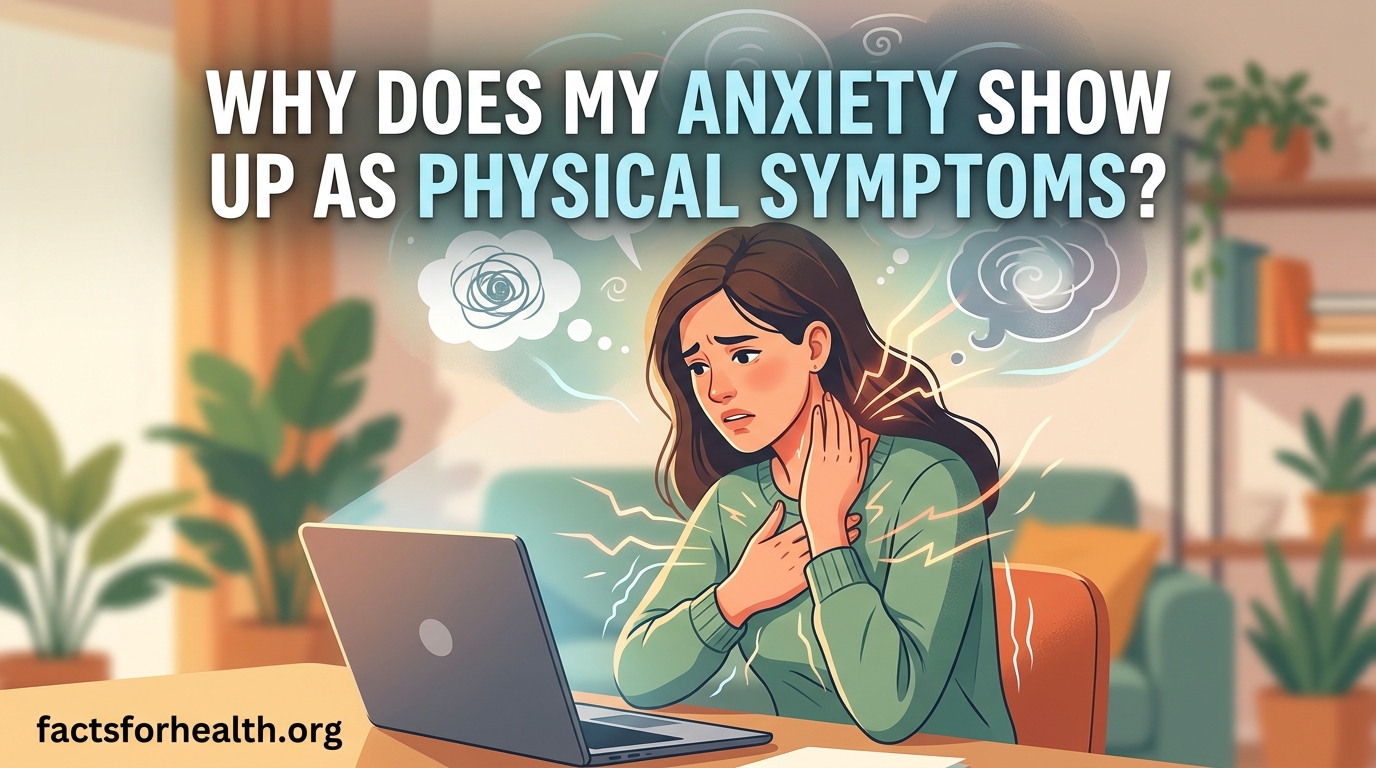
Your chest feels tight. Your heart is pounding. Your stomach is churning, your hands are shaking, and you feel like you might pass out. You rush to the doctor, convinced something is seriously wrong, only to hear: “Your tests look perfectly normal. This is likely anxiety.”
If you have ever experienced this, you are far from alone. According to the National Institute of Mental Health, nearly 1 in 5 adults in the United States deals with an anxiety disorder. Many of them, possibly including you, first discovered their anxiety not through worried thoughts but through their body.
So why does my anxiety show up as physical symptoms? The short answer is that anxiety triggers your body’s ancient fight-or-flight response, flooding your system with stress hormones like adrenaline and cortisol. These hormones cause very real, involuntary physical reactions, from a racing heart to digestive upset, even when there is no actual physical danger. Your brain and body are connected through a vast signaling network, and when your mind perceives a threat, your entire nervous system responds as if your life depends on it.
In this article, we will walk through exactly what happens in your body during anxiety, break down the physical symptoms by body system, explain why you can feel physically anxious without feeling mentally worried, and share practical techniques to calm your nervous system when symptoms strike.
Table of Contents
The Mind-Body Connection: How Your Brain Talks to Your Body
Your brain does not keep its worries to itself. Every anxious thought, every flash of fear, and every unconscious stress signal travels from your brain down through your autonomic nervous system to nearly every organ in your body.
The autonomic nervous system has two main branches that work like a gas pedal and a brake. The sympathetic nervous system is the gas pedal, it revs you up for action. The parasympathetic nervous system is the brake, it calms you down and helps you rest. When these two systems are balanced, you feel grounded and in control.
But when anxiety enters the picture, the sympathetic system takes over. Your brain’s amygdala, the threat-detection center, fires off alarm signals before your conscious mind even has time to process what is happening. This is why you might notice your heart racing before you even realize you are anxious. The body reacts faster than conscious thought.
This is the core of the mind-body connection in anxiety. Your thoughts, emotions, and stress levels are not abstract experiences confined to your head. They are chemical and electrical events that ripple through your entire body in real time. What happens in your brain does not stay in your brain.
The Fight-or-Flight Response: Your Body’s Ancient Alarm System
To understand why anxiety produces such intense physical symptoms, you need to understand the fight-or-flight response. This is a survival mechanism that evolved over millions of years to keep your ancestors alive in the face of predators, tribal conflicts, and other physical threats.
Here is what happens, step by step, when your brain perceives danger:
Step 1: Your amygdala detects a threat. This could be a real danger, like a car swerving into your lane, or a perceived one, like a stressful email from your boss. Your brain does not always distinguish between the two.
Step 2: The hypothalamus activates the sympathetic nervous system, sending a rapid-fire signal to your adrenal glands.
Step 3: Your adrenal glands release a surge of stress hormones, primarily adrenaline (also called epinephrine) and norepinephrine. Within seconds, these hormones course through your bloodstream.
Step 4: Cortisol, the primary stress hormone, is released a bit more slowly and keeps your body on high alert for an extended period.
These hormones prepare your body for physical action. Your heart rate increases to pump more blood to your muscles. Your breathing quickens to take in more oxygen. Your muscles tense up, ready to fight or sprint. Your digestion slows because your body redirects energy away from non-essential functions. Your pupils dilate. Your blood sugar rises for quick energy.
This response is incredibly effective when you need to outrun a predator. The problem is that your body cannot tell the difference between a physical threat and a psychological one. A looming deadline, a social conflict, financial worries, or even a lingering anxious thought can trigger the same full-body alarm. And unlike a predator you can outrun, modern stressors often linger, keeping your fight-or-flight system activated for hours, days, or even weeks at a time.
That is when the physical symptoms become hard to ignore.
Physical Symptoms of Anxiety by Body System
One of the reasons anxiety symptoms feel so frightening is that they can appear anywhere in the body. Because stress hormones travel through your bloodstream, every system gets the message. Let us break down what happens in each area.
Heart and Cardiovascular System
When adrenaline hits your bloodstream, one of the first things you notice is your heart. Heart palpitations, a racing pulse, chest tightness, and a pounding sensation in your chest are among the most common physical symptoms of anxiety. Some people describe it as feeling like their heart is beating out of their chest.
This happens because adrenaline tells your heart to pump faster and harder, pushing blood to your muscles so you are ready to act. Blood vessels constrict, which can raise your blood pressure temporarily. The muscles in your chest wall can also tighten, creating an aching or pressure-like sensation that many people mistake for a heart attack.
If you have ever gone to the emergency room convinced you were having a heart attack only to be told it was anxiety, you are in good company. This is one of the most common reasons people seek emergency care for anxiety-related symptoms.
Respiratory System
Shortness of breath is another hallmark symptom. When your fight-or-flight response activates, your breathing rate increases to deliver more oxygen to your muscles. But if this rapid breathing continues, it can turn into hyperventilation, where you breathe out too much carbon dioxide.
This imbalance can cause a cascade of secondary symptoms: lightheadedness, dizziness, tingling in your fingers and lips, and a feeling like you cannot get a full breath. These symptoms are not dangerous, but they are terrifying, and they often trigger even more anxiety because they feel so alarming.
Muscular System
Your muscles are primed for action during fight-or-flight. Chronic muscle tension is one of the most underrecognized physical signs of anxiety. Your jaw clenches. Your shoulders creep up toward your ears. Your lower back aches. Your legs feel restless or weak.
Over time, this constant tension leads to tension headaches, neck pain, jaw pain (including TMJ-related issues), and general body aches. Many people do not connect their chronic pain with anxiety until they start tracking when the pain gets worse.
Shaking and tremors are also common. When adrenaline floods your system, your muscles receive rapid-fire signals that can cause visible trembling, especially in your hands and legs. This shakiness is harmless, but it can feel deeply unsettling, especially in social situations.
Digestive System
Your gut and your brain are deeply connected through what scientists call the gut-brain axis. The vagus nerve, which we will discuss more shortly, acts as a two-way communication highway between your digestive system and your brain. When your brain is stressed, your gut knows about it instantly.
During fight-or-flight, your body slows or halts digestion to redirect energy toward survival. This can cause nausea, stomach pain, bloating, cramping, diarrhea, constipation, or some unpredictable combination of all of them. Many people experience a complete loss of appetite during anxious periods, while others find themselves eating for comfort.
If you have ever wondered, “Why does anxiety make my stomach hurt?” this is your answer. Your digestive system is packed with nerve endings that are highly sensitive to stress hormones. Research has shown that chronic anxiety can even alter the balance of bacteria in your gut, which in turn affects your mood and physical comfort in a continuous feedback loop.
Nervous System
The nervous system symptoms of anxiety can be some of the strangest and most alarming. Dizziness, lightheadedness, tingling or numbness in your extremities, a feeling of unreality or detachment (called depersonalization), and brain fog are all common.
Tingling sensations happen because rapid breathing changes the pH of your blood, which affects nerve signaling. The pins-and-needles feeling in your hands, feet, or face is a direct result of this chemical shift. Some people also experience burning skin sensations, phantom pains that move around the body, or electric-shock-like zaps.
Fatigue is another major symptom. When your nervous system has been running on overdrive, it eventually crashes. You may feel bone-deep exhaustion even after a full night of sleep. This is your body recovering from the chemical rollercoaster of prolonged anxiety.
Skin, Sweating, and Lesser-Known Symptoms
Anxiety affects your skin and temperature regulation too. Sweating, especially from the palms, underarms, and forehead, is a direct result of sympathetic nervous system activation. Hot flashes and cold chills can alternate rapidly as your body struggles to regulate temperature under stress.
Some of the lesser-discussed physical symptoms of anxiety include eye twitching (caused by muscle tension around the eye), skin rashes or hives, increased acne flare-ups, hair thinning (from prolonged cortisol elevation), tinnitus or ringing in the ears, and a frequent need to urinate. According to the World Journal of Cardiology and research published in Skin Pharmacology and Physiology, these skin and temperature symptoms are well-documented but rarely discussed.
Why do these weird symptoms appear? Because stress hormones affect every cell in your body. There is no system that is immune. If you have ever experienced a physical symptom that no one seems to talk about, chances are it is connected to anxiety.
Physical Anxiety Without Mental Worry: Can Your Body Be Anxious Without Your Mind?
One of the most confusing experiences people describe is having clear physical symptoms of anxiety, racing heart, stomach upset, dizziness, without feeling mentally anxious at all. You might ask yourself: “How can I have physical anxiety symptoms but not feel worried about anything?”
This phenomenon is sometimes called somatic anxiety. Your body is expressing stress through physical channels even though your conscious mind feels calm. Here is why this happens.
First, your nervous system can become stuck in sympathetic overdrive. If you have been under chronic stress for weeks or months, your baseline level of arousal stays elevated. Your body does not return to a calm resting state. Instead, it hovers in a state of low-grade activation, producing physical symptoms without any obvious trigger.
Second, your brain processes threats below the level of conscious awareness. The amygdala can detect danger signals from your environment, your memories, or even subtle changes in your body without alerting your conscious mind. You feel the physical response before you ever identify a thought or worry.
Third, suppressed emotions and unprocessed stress can surface as physical symptoms. If you tend to push through stress, ignore difficult feelings, or power through overwhelm, that energy does not disappear. It gets stored in the body and eventually demands attention through physical symptoms.
This is why you might feel physically anxious for what seems like no reason. Your body is carrying a load your mind has not yet acknowledged.
The Fear Loop: Why Symptoms Feed on Themselves
Here is where things get particularly frustrating. The physical symptoms of anxiety can create a self-perpetuating cycle that keeps you trapped. Therapists and researchers call this the fear loop, and understanding it is key to breaking free.
The cycle works like this: You notice a physical sensation, maybe a skipped heartbeat or a wave of nausea. Your brain interprets this sensation as a threat. “Something is wrong with me. What if this is a heart problem? What if I am seriously ill?” This anxious interpretation triggers more fear, which triggers more adrenaline, which produces stronger physical symptoms. The stronger symptoms confirm your fear, and the cycle accelerates.
This is the engine behind health anxiety. When you become hypervigilant about your body, scanning for signs of illness, you start noticing normal physical sensations that you would otherwise ignore. A minor stomach gurgle becomes a sign of cancer. A slightly elevated heart rate becomes evidence of heart disease. Each new sensation fuels the anxiety, which fuels more symptoms.
Googling symptoms is one of the most common ways people feed the fear loop. It feels like you are taking control, seeking information, being responsible. But every search result that mentions a serious condition reinforces the belief that something is wrong. Research consistently shows that health-related internet searching increases anxiety rather than reducing it.
The good news is that the fear loop can be interrupted. Understanding the cycle is the first step. Recognizing that your symptoms are caused by anxiety, not a hidden illness, removes the fuel that keeps the loop running. The techniques we share later in this article can help you break the cycle when it starts.
Is It Anxiety or Something Serious? How to Tell the Difference
This is the question that keeps so many people trapped in the fear loop. How do you know if your physical symptoms are caused by anxiety or by a real medical condition? It is a fair question, and dismissing it is not helpful.
The truth is that several medical conditions can mimic anxiety symptoms. According to the Mayo Clinic and Harvard Health Publishing, these include thyroid disorders (especially hyperthyroidism), heart arrhythmias, asthma, acid reflux (GERD), low blood sugar, anemia, vitamin B12 deficiency, inner ear disorders, and even certain medications. This is why it is always wise to see a doctor for a basic workup when you develop new or persistent physical symptoms.
That said, there are patterns that suggest anxiety is the likely cause. Anxiety symptoms tend to come and go in waves, often peaking within 10 minutes and subsiding. They are frequently triggered by stressful situations, even subtle ones. They may shift or change location over time, one day it is chest tightness, the next day it is stomach upset. They typically produce normal results on medical tests.
Symptoms that warrant immediate medical attention include chest pain that spreads to your arm, jaw, or back, shortness of breath that worsens when you lie down, sudden severe weakness or numbness on one side of your body, fainting, or a sudden severe headache unlike anything you have experienced before. If you experience any of these, do not assume it is anxiety. Seek emergency care.
For persistent symptoms that are not emergencies, the best approach is to get a medical evaluation to rule out physical causes. Once your doctor confirms there is no underlying medical condition, you can work on addressing the anxiety with confidence.
When to See a Doctor About Physical Anxiety Symptoms
Knowing when to seek help is important. You should see a doctor if you experience any of the following:
New physical symptoms that you have never experienced before, especially if they are severe or persistent. Symptoms that interfere with your daily life, such as preventing you from working, sleeping, eating normally, or leaving the house. Symptoms that are getting progressively worse over time rather than improving.
Chest pain, difficulty breathing, or fainting episodes that occur for the first time. These always warrant a medical evaluation, even if you suspect anxiety.
Physical symptoms that have lasted more than a few weeks without improvement, even if they seem manageable. A doctor can run blood tests, check your heart, and screen for thyroid issues or vitamin deficiencies.
If medical tests come back normal and your symptoms persist, it is time to talk to a mental health professional. A therapist who specializes in anxiety disorders can help you understand what is happening, teach you coping skills, and guide you through evidence-based treatments like cognitive behavioral therapy (CBT). There is no shame in getting help. Anxiety disorders are highly treatable, and the right support can make a dramatic difference.
How to Calm Physical Anxiety Symptoms: The Vagus Nerve and Your Body’s Brake System
Now for the part you probably came here for. How do you stop physical anxiety symptoms when they hit? The answer lies in activating your parasympathetic nervous system, the brake to your fight-or-flight gas pedal.
The key player here is the vagus nerve. This is the longest cranial nerve in your body, running from your brainstem down to your heart, lungs, and digestive tract. It is the main communication channel of your parasympathetic nervous system. When the vagus nerve is activated, it sends calming signals throughout your body: heart rate slows, breathing deepens, muscles relax, and digestion resumes.
No competitor in the health information space adequately explains this, but it is the missing half of the anxiety equation. You have been hearing about fight-or-flight. This is rest-and-digest, and you can deliberately activate it.
Here are the most effective, science-backed techniques to calm your nervous system and reduce physical anxiety symptoms:
1. Slow, Deep Breathing
Deep breathing is the fastest way to stimulate the vagus nerve. When you exhale longer than you inhale, you activate the parasympathetic response. Try the 4-7-8 technique: inhale through your nose for 4 seconds, hold for 7 seconds, exhale slowly through your mouth for 8 seconds. Repeat this cycle 4 to 8 times.
Box breathing is another effective option used by Navy SEALs and therapists alike. Inhale for 4 seconds, hold for 4 seconds, exhale for 4 seconds, hold for 4 seconds. Repeat for several minutes. Both techniques work by directly signaling your brain that you are safe.
2. Progressive Muscle Relaxation
Anxiety causes muscle tension throughout your body. Progressive muscle relaxation involves deliberately tensing and then releasing each muscle group, starting from your toes and working up to your face. Tense each muscle group for 5 seconds, then release for 10 seconds, noticing the contrast between tension and relaxation.
This technique not only reduces physical tension but also trains your brain to recognize what relaxation feels like. Over time, you become more aware of when you are holding tension and can release it before it builds up.
3. Grounding Techniques
When anxiety pulls you into your body and your symptoms feel overwhelming, grounding techniques bring your attention back to the present moment. The 5-4-3-2-1 method is particularly effective: name 5 things you can see, 4 things you can physically feel, 3 things you can hear, 2 things you can smell, and 1 thing you can taste.
This technique works because your brain cannot fully focus on sensory input and catastrophic worry at the same time. By forcing your attention outward, you interrupt the anxiety cycle and give your nervous system a chance to reset.
4. Cold Exposure
Cold water on your face triggers what is called the mammalian dive reflex, which instantly activates the vagus nerve and slows your heart rate. Splash cold water on your face, hold an ice pack against your cheeks, or take a cold shower. This is one of the fastest ways to short-circuit an acute anxiety spike.
5. Movement and Exercise
When adrenaline floods your system, your body is primed for physical action. Giving it what it wants, through a brisk walk, a run, a workout, or even a few minutes of stretching, helps burn off excess stress hormones. Regular exercise also improves your baseline anxiety resilience over time by regulating cortisol levels and boosting mood-enhancing neurotransmitters.
6. Therapy for Long-Term Relief
For lasting change, cognitive behavioral therapy (CBT) is the gold standard for anxiety treatment. CBT helps you identify and reframe the thought patterns that trigger physical symptoms. A specific technique called interoceptive exposure involves deliberately inducing safe physical sensations, like a racing heart through exercise, so your brain learns that these sensations are not dangerous. Over time, this breaks the fear loop at its root.
Working with a therapist also helps you uncover and address the underlying sources of stress that keep your nervous system activated. Whether your anxiety stems from work, relationships, trauma, health concerns, or something else, professional support provides tools and perspective that self-help alone cannot match.
FAQs
How long does an anxiety episode last?
An acute anxiety spike or panic attack typically peaks within 10 minutes and subsides within 20 to 30 minutes. However, generalized anxiety symptoms, like muscle tension, digestive issues, and fatigue, can persist for hours, days, or even weeks if the underlying stress is not addressed. The physical after-effects of an anxiety surge, such as tiredness and shakiness, can linger for several hours after the peak.
Why is anxiety worse at night?
At night, external distractions fade and your brain turns inward, making it easier to notice physical sensations and anxious thoughts. Cortisol naturally dips in the evening, which can paradoxically make your body feel more vulnerable. Additionally, the quiet of nighttime removes the grounding stimuli of the day, allowing the fight-or-flight system to spiral more easily. This is why many people experience their worst anxiety symptoms, including racing heart and chest tightness, right as they try to fall asleep.
What conditions mimic physical anxiety symptoms?
Several medical conditions produce symptoms nearly identical to anxiety, including hyperthyroidism, heart arrhythmias, asthma, acid reflux (GERD), hypoglycemia (low blood sugar), anemia, vitamin B12 deficiency, inner ear disorders, caffeine sensitivity, and withdrawal from certain medications. This is why doctors recommend a basic medical workup, including blood tests and an EKG, to rule out these conditions before attributing symptoms to anxiety.
Can anxiety really manifest as a physical illness?
Yes. Anxiety produces real, measurable physical changes in the body through the release of stress hormones like adrenaline and cortisol. These changes affect your heart, lungs, muscles, digestion, skin, and nervous system. The symptoms are not imagined or fake. They are genuine physiological responses. However, anxiety itself is not a disease, it is a treatable condition. Once the anxiety is addressed, the physical symptoms typically improve or resolve completely.
Can anxiety cause permanent physical damage?
No, anxiety symptoms themselves do not cause permanent organ damage, even when they feel severe. A racing heart, chest tightness, and digestive distress are uncomfortable but not harmful. However, chronic, untreated anxiety over months or years can contribute to elevated inflammation, weakened immune function, high blood pressure, and sleep problems, which do have long-term health effects. This is why managing chronic anxiety matters for both your mental and physical well-being.
Why do I have physical anxiety symptoms but feel mentally calm?
This is called somatic anxiety, and it happens when your nervous system remains stuck in fight-or-flight mode even after your conscious mind has calmed down. Chronic stress can keep your baseline arousal elevated so that your body continues producing physical symptoms without any obvious mental trigger. Suppressed emotions and unprocessed stress can also surface as physical symptoms. Your body may be carrying a load your mind has not yet acknowledged.
You Are Not Broken: Moving Forward with Physical Anxiety Symptoms
If you have been wondering why your anxiety shows up as physical symptoms, the answer is now clear. Your brain and body are part of one interconnected system. When your mind perceives stress or threat, your entire body responds through the fight-or-flight mechanism, releasing adrenaline and cortisol that produce real, tangible physical changes in every system from your heart to your gut to your skin.
Your racing heart is not a sign of heart disease. Your nausea is not a sign of a serious illness. Your dizziness, tingling, and muscle tension are not evidence that something is fundamentally wrong with you. They are the signature of a nervous system doing exactly what it evolved to do, trying to protect you, even when the threat is psychological rather than physical.
The most important takeaway is this: you can interrupt the cycle. By understanding the fear loop, activating your vagus nerve through breathing and grounding techniques, and seeking professional support when needed, you can teach your nervous system that it is safe. The physical symptoms of anxiety are real, but they are not permanent, and they are not something you just have to live with.
Start with one technique from this article. Try box breathing the next time you feel your heart race. Splash cold water on your face when symptoms spike. Talk to your doctor to rule out medical causes, then talk to a therapist who can help you address the root of your anxiety. Your body has been trying to tell you something. Now you have the tools to listen, respond, and heal.