
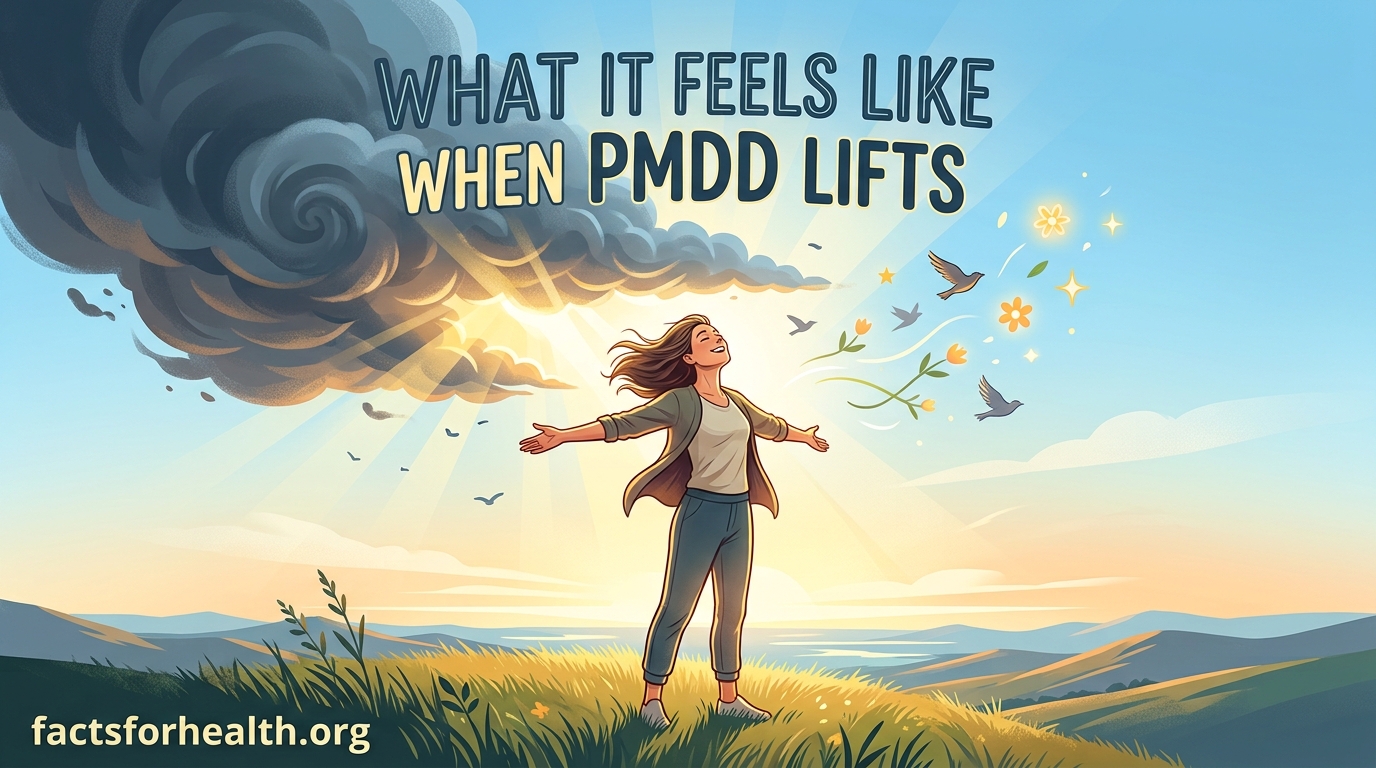
It starts as a whisper. Somewhere between the cramps and the first sign of blood, you notice something has shifted. The fog is thinning. The dark weight you have been carrying for days, maybe weeks, feels just a little less crushing. You can think a full sentence without your mind spiraling into catastrophes. You look around and the world looks slightly less hostile than it did yesterday. If you have never experienced PMDD, this might sound dramatic. If you have, you know exactly what I am describing. Understanding what it feels like when PMDD lifts the day your period starts can help you recognize the pattern, anticipate the relief, and stop doubting your own experience. If you are also navigating the broader challenges of PMS vs PMDD, this article will help you understand the key differences.
Our team has spent months researching premenstrual dysphoric disorder, reading hundreds of community discussions, and analyzing the medical literature. What we found is a massive gap between what clinical sources describe and what people actually live through. Medical sites tell you symptoms improve within a few days after your period starts. They are right, but they leave out the part everyone is actually searching for: what does that improvement feel like? For a deeper look at how serotonin affects mental health and why it plays a central role in PMDD, read our comprehensive guide.
This article fills that gap. We cover the full arc from the worst of the luteal phase to the moment the veil lifts, the recovery period that follows, and everything in between. Whether your relief hits like a light switch or creeps in slowly over hours, what you are feeling is real, documented, and shared by millions of people navigating the same cycle. If you want to better understand how to track PMDD symptoms effectively, our step-by-step guide can help you build a personalized tracking system.
Table of Contents
Quick Answer: What Happens When PMDD Lifts
For most people with premenstrual dysphoric disorder, symptoms improve within a few days after the period starts. The severe irritability, anxiety, depression, and brain fog that defined the luteal phase begin to fade as hormone levels shift. Some people experience immediate relief within hours of menstruation beginning. Others feel a gradual lifting over the first one to three days. Both patterns are considered normal. If your symptoms are severe enough to interfere with daily life, consider exploring cognitive behavioral therapy for PMDD as a treatment option.
The relief often feels like waking up from a bad dream. Colors seem brighter, thoughts feel organized again, and the emotional intensity that made everything unbearable starts to recede. Many people describe it as a veil of darkness being lifted or finally coming back to themselves after weeks of feeling like a stranger in their own mind.
PMDD (Premenstrual Dysphoric Disorder) is a severe form of PMS that causes extreme mood disturbances, anxiety, and depression during the one to two weeks before menstruation. These symptoms are triggered by hormonal changes after ovulation and typically resolve within a few days after the period begins. The condition affects an estimated 3 to 8 percent of people who menstruate.
What PMDD Feels Like Before the Relief
To understand what it feels like when PMDD lifts, you first need to understand what it feels like when it lands. The contrast is the whole story. PMDD does not arrive gradually like a fading sunset. It descends, often within a single day, like someone flipped a switch in your brain.
For most people, symptoms begin during the luteal phase, the one to two weeks between ovulation and the start of menstruation. Estrogen and progesterone levels rise after ovulation, then begin to drop sharply if pregnancy does not occur. This hormonal drop is believed to destabilize serotonin production in the brain, and for people with PMDD, the nervous system reacts to this shift as if it is a threat.
The emotional symptoms are what set PMDD apart from ordinary PMS. People describe an overwhelming sense of despair that has no logical cause. You might feel anxious about things that did not bother you a week ago. Small frustrations trigger rage that feels physical, like heat rising from your chest. Many people experience uncontrollable crying spells, intrusive thoughts, and a pervasive feeling that something is deeply wrong even when nothing in their life has changed.
Brain fog is one of the most commonly reported symptoms. You forget conversations mid-sentence. Simple decisions feel impossible. Reading a page of text three times without absorbing anything becomes routine. Many people describe feeling disconnected from themselves, as if they are watching their life through frosted glass.
The physical symptoms pile on top of the emotional ones. Bloating, breast tenderness, joint and muscle pain, headaches, insomnia, and crushing fatigue are all common. Some people experience hot flashes, body aches that feel like the flu, and a wired-but-exhausted state where they cannot sleep but also cannot function. Food cravings and binge eating can intensify feelings of being out of control.
This is the baseline for one to two weeks every single month. By the time your period is about to start, you have been living in this state long enough that it feels permanent. You start to wonder whether the PMDD version of you is the real one. That is the weight that lifts when menstruation begins.
What It Feels Like When PMDD Lifts the Day Your Period Starts
This is the section no medical source writes, and it is the reason most people search this topic. The moment PMDD lifts is not just a reduction in symptoms. It is a perceptual shift that changes how you experience yourself and the world around you. Understanding what it feels like when PMDD lifts the day your period starts requires describing something that is fundamentally difficult to put into words, but the community has developed a vocabulary for it.
The Veil of Darkness Lifting
The most common metaphor used across forums and support groups is the veil of darkness. Multiple people independently describe the exact same sensation without ever having spoken to each other. It goes like this: during PMDD, it feels like a dark veil has been draped over your perception. Everything you see, think, and feel is filtered through this heaviness. You can function, but everything requires more effort.
When your period starts, the veil begins to thin. It does not vanish all at once for most people. Instead, it slowly lifts throughout the day, and you start catching glimpses of clarity. A thought will form without spiraling. A situation will register as manageable instead of catastrophic. You will catch yourself smiling at something small and realize you have not smiled in days.
Coming Back to Yourself
Another widely shared description is the experience of coming back to yourself. During a PMDD episode, many people feel like a different person entirely. Their reactions, their emotions, and their sense of identity all shift. They might look in the mirror and feel disconnected from their own face.
When symptoms lift, there is a reunion with the self. You recognize your own thoughts again. Your emotional responses match your actual circumstances rather than the distorted version PMDD created. One community member described it as little by little being able to rationalize and come back to myself. That is the feeling. The real you was there the whole time, buried under the neurochemical storm.
Emotional Clarity and the Absence of Heaviness
The emotional clarity that returns is difficult to overstate. During PMDD, every feeling is amplified to an unbearable degree. Sadness becomes despair. Mild annoyance becomes rage. Neutral situations become sources of panic. When PMDD lifts, the volume on all of these emotions turns back down to a level you can manage.
People describe a physical sensation of the heaviness being removed. It is not just that you feel less sad. It is that the weight pressing down on your chest, your shoulders, your entire being is suddenly lighter. Breathing feels easier. Thinking feels easier. Existing feels easier.
What the First Few Hours Actually Feel Like
The first sign of relief for many people is the physical onset of menstruation itself. Cramps begin, bleeding starts, and within hours, something in the brain begins to recalibrate. You might wake up on the first day of your period and realize the anxiety that kept you awake all night has dimmed. By midday, the irritability that made every interaction feel like a battle has softened. By evening, you might feel something close to normal for the first time in weeks.
Not everyone follows this timeline. Some people feel the shift before bleeding even begins, as hormone levels start their final drop. Others do not feel meaningful relief until day two or three of their period. We cover this variation in detail in the next section.
Immediate vs Gradual Relief: What Is Normal
One of the most common questions people ask is whether their relief pattern is normal. The short answer is yes, almost certainly. Both immediate and gradual relief are well-documented experiences within the PMDD community, and neither indicates a problem.
People who experience immediate relief often describe it as a switch flipping. Within hours of their period starting, the emotional symptoms vanish almost entirely. One day they feel like they are drowning, the next they feel fine. This pattern is dramatic and can feel disorienting in its own way. The contrast between the depth of PMDD suffering and the speed of relief can make people question whether their symptoms were real.
They were real. The suddenness of the relief is actually evidence of how directly tied PMDD is to the hormonal cycle. When the hormonal trigger shifts, the brain responds quickly.
People who experience gradual relief describe a slower transition. Symptoms do not disappear overnight. Instead, they fade over the course of one to three days. The anxiety softens first, then the depression, then the brain fog. Physical symptoms like fatigue and bloating may linger even longer. One community member noted that they are usually still sad and really tired during their period, but it feels different from the suffocating heaviness of the PMDD weeks. It feels like normal tiredness rather than PMDD exhaustion.
A small percentage of people report that their symptoms do not improve reliably when their period starts. One user noted that their symptoms improve about 50 percent of the time and worsen the other 50 percent. If this is your experience, it is worth discussing with a healthcare provider. PMDD symptoms that do not follow the typical pattern of resolution may indicate a co-occurring condition that needs separate evaluation.
The key takeaway is that there is no single correct way to experience PMDD relief. Your pattern is your pattern. What matters is tracking it over time so you can anticipate what to expect and plan accordingly.
The Post-PMDD Recovery Period (The PMDD Hangover)
Here is something no medical source talks about and no one warns you about. After PMDD lifts, you might feel terrible in a completely different way. The community calls it the PMDD hangover, and it is one of the most validating concepts you will encounter if you have been through it.
The PMDD hangover is the physical and emotional depletion that follows a severe PMDD episode. Think of PMDD as a storm that your body and brain weathered for one to two weeks. When the storm passes, the damage remains. You are not in crisis anymore, but you are exhausted in a way that regular rest does not immediately fix.
Physical symptoms of the PMDD hangover include deep fatigue that sleep does not fully address. Your body aches as if you have been ill. You might feel weak, heavy, and slow. Some people describe a fuzzy, disconnected sensation in the first day or two after symptoms lift, as if their brain is rebooting after being overloaded.
Emotionally, the hangover can involve a strange flatness. After weeks of intense emotions, the sudden return to baseline can feel almost numb. You might feel relief mixed with a kind of emotional exhaustion that makes it hard to engage with life immediately. Some people describe feeling fragile, as if the relief could shatter if they move too fast.
There is often a grief component as well. During PMDD, you may have said things you regret, pushed people away, or missed important events. When clarity returns, you have to process what happened during the episode. This is one of the cruelest aspects of PMDD. It gives you back your clarity just in time to see the damage.
The PMDD hangover typically lasts one to three days. During this window, the most helpful thing you can do is treat yourself as if you are recovering from an illness, because in a real sense, you are. Hydrate, eat nourishing food, rest, and give yourself permission to move slowly. Do not expect to bounce back to full capacity the moment the veil lifts.
The PMDD Symptom Relief Timeline
While everyone’s experience differs, there is a general arc that most people with PMDD follow each cycle. Understanding this timeline can help you anticipate what is coming and recognize where you are in the process.
Days 1 to 14 (Follicular Phase): Symptoms are typically absent or minimal. This is the clear window where you feel most like yourself. Estrogen is rising, serotonin is stable, and mood is generally positive. Use this time to build coping strategies and track your baseline. Learning about how sleep affects mental health during this phase can help you establish healthy routines that support your mood throughout the month.
Ovulation (around Day 14): The hormonal trigger begins. For some, the first whispers of PMDD appear within days of ovulation. Others remain symptom-free until closer to the period.
Days 15 to 28 (Luteal Phase): This is when PMDD symptoms build. They typically peak in the three to five days before menstruation. The severity can vary month to month, but the pattern is consistent. Emotional symptoms intensify first, followed by physical symptoms.
Day 1 of Period (Relief Begins): For most people, this is when the shift begins. Hormone levels drop to their lowest point, and paradoxically, this is when the brain starts to stabilize. Serotonin sensitivity begins to normalize. The veil starts lifting.
Days 1 to 3 of Period (Relief Window): Emotional symptoms fade gradually or rapidly depending on your pattern. Physical symptoms like cramps and fatigue peak. You are simultaneously experiencing menstrual symptoms and PMDD recovery, which can feel confusing.
Days 3 to 5 of Period (Recovery): The PMDD hangover phase. Emotional symptoms are largely gone, but physical and mental depletion lingers. Energy slowly returns.
Days 5 to 7 (Return to Baseline): Most people feel back to their normal selves by the end of their period. The cycle begins again.
PMDD vs PMS: How to Tell the Difference
One of the most common questions people ask is whether what they are experiencing is PMS or PMDD. The distinction matters because PMDD is a recognized psychiatric condition in the DSM-5, while PMS is a normal physiological experience that most menstruating people encounter to some degree.
The core difference is severity and impact. PMS causes physical discomfort and mild mood changes. You might feel irritable, bloated, and tired before your period, but you can still function. PMDD causes severe mood disturbances that interfere with daily life. The emotional symptoms are not just amplified versions of PMS. They are qualitatively different, involving despair, rage, panic, and a sense of losing control.
PMDD also follows a stricter timeline. According to DSM-5 diagnostic criteria, symptoms must begin during the week before menstruation, improve within a few days after the period starts, and become minimal or absent in the weeks after. This cyclical pattern is what distinguishes PMDD from other mood disorders like generalized anxiety or depression, which do not follow a menstrual pattern. Understanding these common types of anxiety disorders can help clarify the differences.
Another key distinction is how the relief feels. With PMS, symptoms fade gradually and you might not notice a specific moment of relief. With PMDD, the shift is often pronounced enough that people can pinpoint when the veil lifted. The contrast between the depth of suffering during the luteal phase and the clarity after the period starts is one of the hallmarks of the condition.
If your premenstrual symptoms cause you to feel like a different person, interfere with your relationships or work, or include thoughts of self-harm, that is beyond ordinary PMS. Track your symptoms for two to three months and bring that data to a healthcare provider who is knowledgeable about menstrual mood disorders. If you are struggling with persistent feelings of what causes depression outside your cycle as well, this may signal a co-occurring condition worth evaluating.
Why PMDD Symptoms Lift When Your Period Starts
The mechanism behind PMDD relief is hormonal, but the full picture is still being researched. What we know is that PMDD is not caused by abnormal hormone levels. People with PMDD typically have normal estrogen and progesterone levels. The difference lies in how their brains respond to the normal hormonal fluctuations of the menstrual cycle.
Specifically, the drop in estrogen and progesterone that occurs after ovulation appears to trigger an abnormal serotonin response in susceptible individuals. Serotonin is a neurotransmitter involved in mood regulation, sleep, appetite, and cognitive function. When its activity is disrupted, the result is the cluster of emotional and cognitive symptoms that define PMDD.
When your period starts, hormone levels have reached their lowest point and begin the process of stabilizing and rising again during the follicular phase. This hormonal shift allows serotonin activity to normalize, which is why emotional symptoms begin to lift. The brain is recalibrating its neurotransmitter balance in response to the changing hormonal environment.
This also explains why relief timing varies. The speed at which your serotonin system recalibrates depends on individual neurochemistry, the severity of the episode, and other factors like stress, sleep, and nutrition. Some brains bounce back quickly. Others need a few days to fully stabilize.
What to Do When PMDD Symptoms Lift
The moment PMDD lifts is a window of opportunity. Here is how to make the most of the recovery period and set yourself up for the next cycle.
First, rest. The temptation when the veil lifts is to immediately catch up on everything you neglected during the luteal phase. Resist this urge. Your body and brain are recovering from a neurochemical storm. Give yourself at least one full day of low-demand rest before diving back into normal responsibilities.
Second, document what happened. While the experience is fresh in your mind, write down what your symptoms were, when they started, when they peaked, and when they lifted. This symptom tracking is invaluable for your own pattern recognition and for any conversations with a healthcare provider. The more data you have, the clearer the picture becomes. Check out our guide on the best PMDD symptom tracker apps to help you get started.
Third, process the emotional aftermath. If PMDD caused conflict in your relationships or led to decisions you regret, approach this work gently. Clarity does not mean you need to fix everything immediately. Acknowledge what happened, make any necessary amends when you are ready, and focus on building a plan for the next cycle.
Fourth, use your clear window to prepare for the next episode. If you have been prescribed treatment such as SSRIs or hormonal birth control, this is the time to ensure you are following your protocol consistently. If you have not yet sought treatment, this is the time to schedule an appointment while you have the energy and clarity to advocate for yourself. Learn more about evidence-based supplements for PMDD that may complement your treatment plan.
When to Talk to a Doctor About PMDD
If your premenstrual symptoms are severe enough to interfere with your daily life, relationships, or sense of safety, talk to a healthcare provider. PMDD is a recognized medical condition with effective treatment options. You do not have to just endure it.
Speak with a doctor urgently if your PMDD symptoms include suicidal thoughts, self-harm urges, or any indication that you might act on them. PMDD is associated with a significantly elevated risk of suicidal ideation during the luteal phase, and this risk is real and deserves immediate attention. If you are in crisis right now, contact a mental health helpline or emergency services in your area.
Also consult a provider if your symptoms do not follow the typical pattern of resolving within a few days after your period starts. Symptoms that persist throughout your cycle, worsen during your period, or do not follow a clear cyclical pattern may indicate a co-occurring condition such as depression, anxiety, thyroid dysfunction, or perimenopause that requires separate evaluation. Our article on when to see a doctor for PMDD provides detailed guidance on navigating the healthcare system.
FAQs
Is PMDD worse when your period starts?
For most people with PMDD, symptoms begin improving when the period starts, not worsening. However, some people experience a brief overlap where menstrual symptoms like cramps and fatigue intensify even as emotional symptoms are lifting. A small percentage report that symptoms worsen rather than improve, which warrants discussion with a healthcare provider.
How do you feel the day before your period starts?
The day before your period starts is typically the peak of PMDD symptoms for most people. You may experience severe irritability, depression, anxiety, brain fog, fatigue, bloating, breast tenderness, and a pervasive sense of emotional heaviness. This is often the most difficult day of the entire cycle before relief begins.
What does a PMDD episode look like?
A PMDD episode involves severe mood disturbances including depression, anxiety, rage, and feeling out of control, accompanied by physical symptoms like bloating, fatigue, and insomnia. It begins during the luteal phase after ovulation, peaks in the days before menstruation, and resolves within a few days after the period starts. The contrast between the person during an episode and between episodes is often dramatic.
How to tell if it’s PMS or PMDD?
The key difference is severity and impact. PMS causes mild to moderate physical discomfort and mood changes that are manageable. PMDD causes severe emotional symptoms like despair, rage, and panic that interfere with daily life, relationships, and functioning. PMDD symptoms also follow a strict cyclical pattern tied to the menstrual cycle and are recognized as a DSM-5 psychiatric condition. If symptoms disrupt your ability to function, it is likely PMDD rather than PMS.
Conclusion
What it feels like when PMDD lifts the day your period starts is different for everyone, but the core experience is shared by millions. A veil of darkness lifts. You come back to yourself. The emotional volume that was turned up to an unbearable degree finally returns to a level you can manage. The relief is real, it is physical and emotional, and it is one of the defining features of premenstrual dysphoric disorder.
If you have been wondering whether your experience is normal, whether the relief should come faster or slower, or whether the exhaustion that follows is all in your head, the answer is that your experience is valid. Track your symptoms. Talk to a healthcare provider who understands menstrual mood disorders. And remember that the clarity you feel when the veil lifts is the real you, waiting to come back every single cycle.