
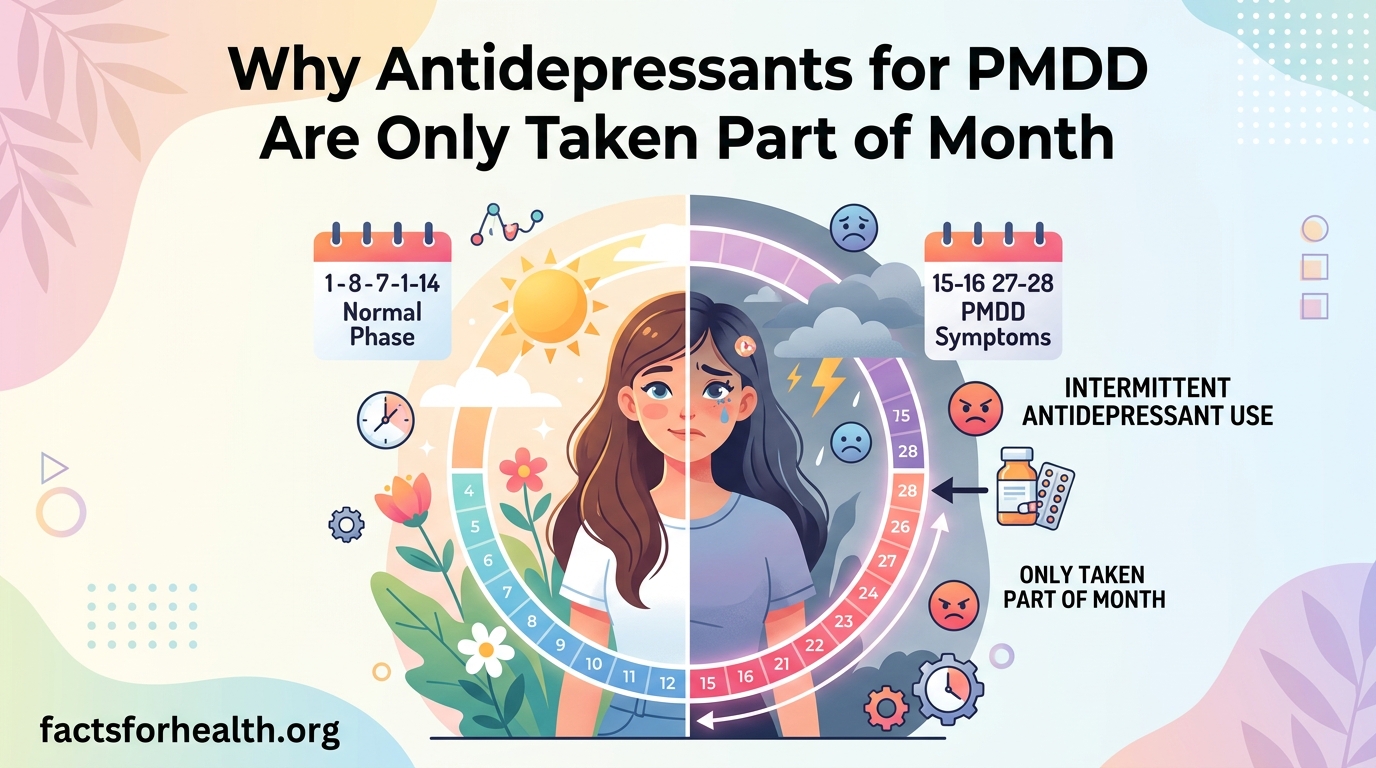
Antidepressants for PMDD are sometimes only taken part of the month because SSRIs work differently for this condition than they do for depression. In premenstrual dysphoric disorder, selective serotonin reuptake inhibitors act on symptoms within days rather than weeks, meaning they only need to cover the luteal phase when symptoms are active. This approach, called intermittent or luteal phase dosing, is backed by clinical research showing it can be just as effective as taking the medication every single day.
If you have been prescribed an SSRI for PMDD and your doctor recommended taking it only during certain parts of your cycle, you might wonder why this works. The short answer is that PMDD is not the same as depression, and the way SSRIs interact with your brain during the premenstrual phase is fundamentally different. Many women on forums like Reddit’s r/PMDD describe this approach as life-changing, while others have questions about whether it is safe or effective long-term.
In this article, our team breaks down the science behind luteal phase dosing, explains how SSRIs work differently for PMDD compared to depression, and walks you through what to expect if you and your doctor choose this treatment path.
Table of Contents
What Is PMDD and Why SSRIs Are the Go-To Treatment
Premenstrual dysphoric disorder (PMDD) is a severe form of premenstrual syndrome that affects an estimated 3 to 8 percent of women of reproductive age. Unlike typical PMS, which causes mild bloating and mood changes, PMDD triggers intense psychological symptoms during the luteal phase of the menstrual cycle. These symptoms can include rage, deep depression, anxiety, suicidal thoughts, and a sense of losing control over your own mind.
The symptoms typically appear after ovulation, when progesterone levels rise, and they vanish within a few days after menstruation begins. This cyclical pattern is what makes PMDD so different from a mood disorder like depression, which persists regardless of where you are in your cycle. PMDD is classified as a psychiatric condition in the DSM-5, but it is rooted in a sensitivity to normal hormonal fluctuations rather than a chemical imbalance that persists all month.
SSRIs are considered the first-line pharmaceutical treatment for PMDD because they target serotonin, a neurotransmitter involved in mood regulation. The most commonly prescribed SSRIs for PMDD include sertraline (Zoloft), fluoxetine (Prozac), citalopram (Celexa), and paroxetine (Paxil). What makes these medications remarkable for PMDD is that they often work within just a few days, whereas treating depression with the same drugs typically takes four to six weeks to show results.
Why Antidepressants for PMDD Are Sometimes Only Taken Part of the Month
The core reason antidepressants for PMDD are sometimes only taken part of the month comes down to timing. PMDD symptoms do not last all month. They appear during the luteal phase, which is the roughly two-week period between ovulation and the start of your period. Since SSRIs for PMDD work quickly, there is no medical need to take them during the follicular phase when you feel completely fine.
The Luteal Phase Dosing Approach
Luteal phase dosing means you start taking the SSRI shortly after ovulation and stop when your period begins. For most women, this translates to taking the medication for about 14 days per cycle. Some doctors prescribe starting around day 14 of a 28-day cycle and continuing through day 28, stopping on the first day of menstruation.
This approach significantly reduces your total medication exposure. Instead of taking an antidepressant 365 days a year, you might take it for only about 168 days total. That reduction matters for women who are concerned about long-term antidepressant use, want to minimize side effects, or simply prefer not to take medication when they feel entirely normal during the first half of their cycle.
Clinical studies have consistently shown that luteal phase dosing is effective for many women with PMDD. A systematic review and meta-analysis published in the Journal of Psychiatric Research analyzed multiple randomized trials and found that intermittent SSRI use during the luteal phase produced significant symptom improvement compared to placebo. The response rates were comparable to continuous daily dosing for a substantial portion of patients.
Symptom-Onset Dosing: Starting When Symptoms Begin
Even more flexible than scheduled luteal phase dosing is something called symptom-onset dosing. In this approach, you start the SSRI at the first sign of premenstrual symptoms rather than on a fixed calendar date. The medication is then continued until menstruation begins or symptoms resolve.
Research from the Center for Women’s Mental Health at Massachusetts General Hospital has examined this approach closely. Their findings suggest that symptom-onset dosing can be particularly effective for women whose PMDD symptoms do not follow an entirely predictable schedule. Some women ovulate later or earlier in their cycle, and rigidly starting medication on day 14 might mean starting too early or too late for their individual pattern.
For women who can reliably identify when their PMDD symptoms begin, symptom-onset dosing offers a way to take even less medication overall. If your symptoms reliably start 10 days before your period rather than 14, you could potentially take the SSRI for just 10 days per cycle instead of the full two weeks.
Why SSRIs Work Fast for PMDD But Slow for Depression
This is where the science gets genuinely fascinating. When SSRIs are used to treat major depression, they typically take four to six weeks to produce noticeable improvement. The conventional explanation is that while serotonin levels in the brain increase within hours of taking the medication, the downstream effects on mood take weeks to develop through neuroplastic changes.
But for PMDD, many women report feeling relief within two to three days of starting an SSRI. This rapid onset suggests that SSRIs are acting through a different mechanism entirely in the context of premenstrual symptoms. The medication is not slowly rebuilding serotonin pathways over weeks. Instead, it appears to be doing something much more immediate that directly counters the neurological effects of the hormonal shifts occurring during the luteal phase.
This rapid action is precisely what makes intermittent dosing possible. If SSRIs for PMDD required weeks to work, you would need to take them continuously to maintain any benefit. But because they can relieve symptoms within days, starting the medication when symptoms appear gives you enough coverage to manage the worst of the premenstrual phase.
The Science: How SSRIs Work Differently for PMDD
To understand why antidepressants for PMDD can be taken intermittently, you need to understand the role of a compound called allopregnanolone. This is a neuroactive steroid, meaning it is a hormone-like substance that acts directly on your brain. During the luteal phase, your body produces higher levels of progesterone, which gets converted into allopregnanolone.
Allopregnanolone normally has a calming effect on the brain because it modulates the GABA-A receptor, the same receptor targeted by antianxiety medications like benzodiazepines. In women without PMDD, rising allopregnanolone during the luteal phase is not a problem. But in women with PMDD, something goes wrong with how their brains process this neuroactive steroid. Instead of feeling calm, they experience severe mood disturbances.
Research suggests that in PMDD, the brain converts progesterone into a variant of allopregnanolone that actually blocks the GABA-A receptor rather than calming it. This means the brain’s natural anxiety-reducing system essentially works in reverse during the luteal phase. The result is the intense irritability, anxiety, and depression that characterize PMDD.
SSRIs appear to counteract this process by increasing levels of an enzyme called 5-alpha-reductase, which helps convert progesterone into the beneficial form of allopregnanolone rather than the harmful variant. This enzymatic effect happens much more quickly than the serotonin-related changes that take weeks to treat depression. That is why women with PMDD can feel SSRI benefits within days rather than waiting a month or more.
This dual mechanism also explains why some women find that their SSRI seems to stop working during the luteal phase even when taken daily. If the hormonal shift is strong enough to overwhelm the serotonin-balancing effect, the medication may not provide adequate relief without dose adjustments during the premenstrual period.
Intermittent vs Continuous Dosing: Which Is Right for You
Both intermittent and continuous SSRI dosing are valid approaches for PMDD treatment. The choice depends on your symptom pattern, personal preferences, and how your body responds to the medication. Here is how the two approaches compare.
Intermittent dosing, where you take the SSRI only during the luteal phase or when symptoms appear, offers several advantages. You take less medication overall, which means fewer days of potential side effects. It avoids the need for continuous daily medication, which some women prefer for personal or philosophical reasons. It also reduces the risk of antidepressant discontinuation syndrome because your body is not adapting to constant medication levels year-round.
The main downside of intermittent dosing is that some women find the on-and-off pattern difficult to manage. You need to track your cycle carefully and remember when to start and stop. Some women also report mild withdrawal-like symptoms when they stop the medication each month, although these are typically less intense than withdrawal from continuous use.
Continuous dosing, where you take the SSRI every single day, provides steady symptom control without the need to track timing. This approach tends to work better for women whose symptoms are severe and unpredictable, or for those who also have co-occurring conditions like generalized anxiety or depression that require daily treatment. Women with PMDD and ADHD, for example, may benefit from continuous dosing if they are also managing attention-related symptoms.
Forum discussions on Reddit reveal real-world experiences with both approaches. Some women report that sertraline 50mg taken daily has been life-changing, eliminating anxiety and suicidal ideation entirely. Others find that taking a daily dose plus a small additional boost during the 10 days before their period works best. Still others successfully manage symptoms with intermittent dosing alone, taking 25mg or 50mg only during their symptomatic window.
One important consideration is that intermittent dosing may not provide adequate relief for everyone. If your symptoms are severe enough that even a day or two of untreated PMDD feels dangerous, continuous dosing may be the safer choice. This is a decision that should be made with your healthcare provider based on your specific symptom profile.
How to Talk to Your Doctor About Intermittent Dosing
One of the most common frustrations expressed in PMDD support communities is feeling dismissed by doctors when requesting intermittent dosing. Not all physicians are familiar with luteal phase treatment protocols, and some may default to prescribing continuous daily use because that is what they know from treating depression. Here is how to approach the conversation effectively.
Step 1: Track your symptoms for at least two full cycles before your appointment. Use a tracking app or journal to record when symptoms start, how severe they are, and when they resolve. This data gives your doctor concrete evidence of your symptom pattern and helps determine whether intermittent dosing is appropriate for you.
Step 2: Bring information about luteal phase dosing to the appointment. You can reference the systematic review published in the Journal of Psychiatric Research that specifically examined intermittent SSRI use for premenstrual syndromes. Mentioning that this is an evidence-based approach, not just a personal preference, can help frame the conversation constructively.
Step 3: Ask your doctor directly whether luteal phase or symptom-onset dosing might work for your situation. Frame it as a question rather than a demand. A good doctor will be willing to discuss the options, explain their reasoning, and either support the approach or explain why continuous dosing may be better in your case.
Step 4: Discuss a backup plan. If you try intermittent dosing and it does not provide adequate relief, ask what the next step would be. Knowing whether your doctor would recommend switching to continuous dosing, adjusting the dose, or trying a different medication can give you confidence to experiment with the intermittent approach.
Step 5: Schedule a follow-up. Agree on a timeline for checking in, typically after two or three cycles, to evaluate whether the intermittent approach is working. This shows your doctor you are taking the treatment seriously and gives you both a structured opportunity to make adjustments.
Side Effects and Considerations
Like any medication, SSRIs for PMDD come with potential side effects. The most commonly reported side effects include nausea, especially in the first few days of each dosing period, fatigue or sleepiness, changes in appetite, and sexual side effects including reduced libido and difficulty reaching orgasm. Some women on PMDD forums report that these side effects are milder with intermittent dosing because their bodies are not adapting to constant medication levels.
Weight gain is another concern frequently raised in PMDD communities. While some women do experience weight changes on SSRIs, the research is mixed on whether intermittent dosing carries a lower risk compared to continuous use. If weight management is a concern for you, discuss this with your doctor when choosing between approaches.
Withdrawal symptoms are an important consideration with intermittent dosing. Some women report experiencing mild discontinuation symptoms each month when they stop the medication, including brain zaps, dizziness, irritability, and flu-like sensations. These symptoms are typically less severe than those experienced when stopping continuous SSRI use, but they can still be uncomfortable. If you experience withdrawal symptoms with intermittent dosing, your doctor may recommend a gradual tapering schedule rather than stopping abruptly.
It is also worth noting that intermittent dosing may not be appropriate for everyone. Women with a history of severe depression, suicidal ideation outside the luteal phase, or bipolar disorder may need continuous treatment or a different medication strategy entirely. Always discuss your full mental health history with your doctor before starting any new treatment approach.
FAQs
Do you have to take antidepressants every day for PMDD?
No, you do not have to take antidepressants every day for PMDD. Research shows that intermittent dosing, where you take the SSRI only during the luteal phase or when symptoms appear, can be just as effective as continuous daily use for many women. However, some women with severe or unpredictable symptoms may benefit more from daily dosing. The right approach depends on your individual symptom pattern and should be discussed with your doctor.
Can you take SSRIs intermittently for PMDD?
Yes, SSRIs can be taken intermittently for PMDD. Clinical studies support two intermittent approaches: luteal phase dosing, where you take the medication for about 14 days starting after ovulation, and symptom-onset dosing, where you start when premenstrual symptoms begin and stop when your period starts. Both methods have shown effectiveness in research trials, and SSRIs typically relieve PMDD symptoms within days rather than weeks.
What causes PMDD to be worse some months?
PMDD severity can vary month to month due to several factors. Stress levels, changes in diet or sleep, and natural hormonal fluctuations can all influence how intensely symptoms manifest. Some months your body may produce higher levels of progesterone, leading to more allopregnanolone and stronger neurological effects. Additionally, if your cycle length varies, the luteal phase duration changes, which can affect symptom duration and severity. Tracking your symptoms over several cycles can help identify your personal triggers.
How long does it take for sertraline to work for PMDD?
For PMDD, sertraline typically begins working within 2 to 3 days of starting the medication. This is dramatically faster than the 4 to 6 weeks required for depression treatment. The rapid onset is why intermittent dosing works for PMDD. Most women notice significant improvement in irritability, anxiety, and mood symptoms within the first few doses, making it possible to start the medication at symptom onset and get relief during the symptomatic window.
Can intermittent SSRI dosing stop working over time?
Some women report that intermittent SSRI dosing becomes less effective after several months or years of use. This can happen for several reasons, including natural hormonal changes, developing tolerance, or shifts in your underlying symptom pattern. If intermittent dosing stops working, options include switching to continuous daily dosing, adjusting the dose, or trying a different SSRI. Some women find that alternating between two different SSRIs or combining intermittent dosing with other PMDD treatments helps maintain effectiveness.
Conclusion
Understanding why antidepressants for PMDD are sometimes only taken part of the month comes down to recognizing that PMDD is fundamentally different from depression. SSRIs work rapidly for premenstrual symptoms because they influence allopregnanolone and GABA-A receptor function, not just serotonin levels. This means the medication can be taken during the luteal phase or when symptoms appear, providing relief exactly when you need it without requiring year-round daily dosing.
Clinical evidence strongly supports both luteal phase dosing and symptom-onset dosing as effective strategies for PMDD treatment. Multiple randomized trials and a systematic meta-analysis have demonstrated that intermittent SSRI use produces significant symptom improvement for many women, with response rates comparable to continuous daily dosing. The choice between approaches should be personalized based on your symptom severity, cycle regularity, and treatment goals.
If you are considering intermittent dosing, the most important next step is to have an informed conversation with your healthcare provider. Track your symptoms, bring research to your appointment, and advocate for a treatment plan that fits your life. PMDD is a real and serious condition, and you deserve a treatment approach that works for your body and your schedule. With the right dosing strategy, many women find that they can manage their symptoms effectively while taking medication for only a fraction of the month.