
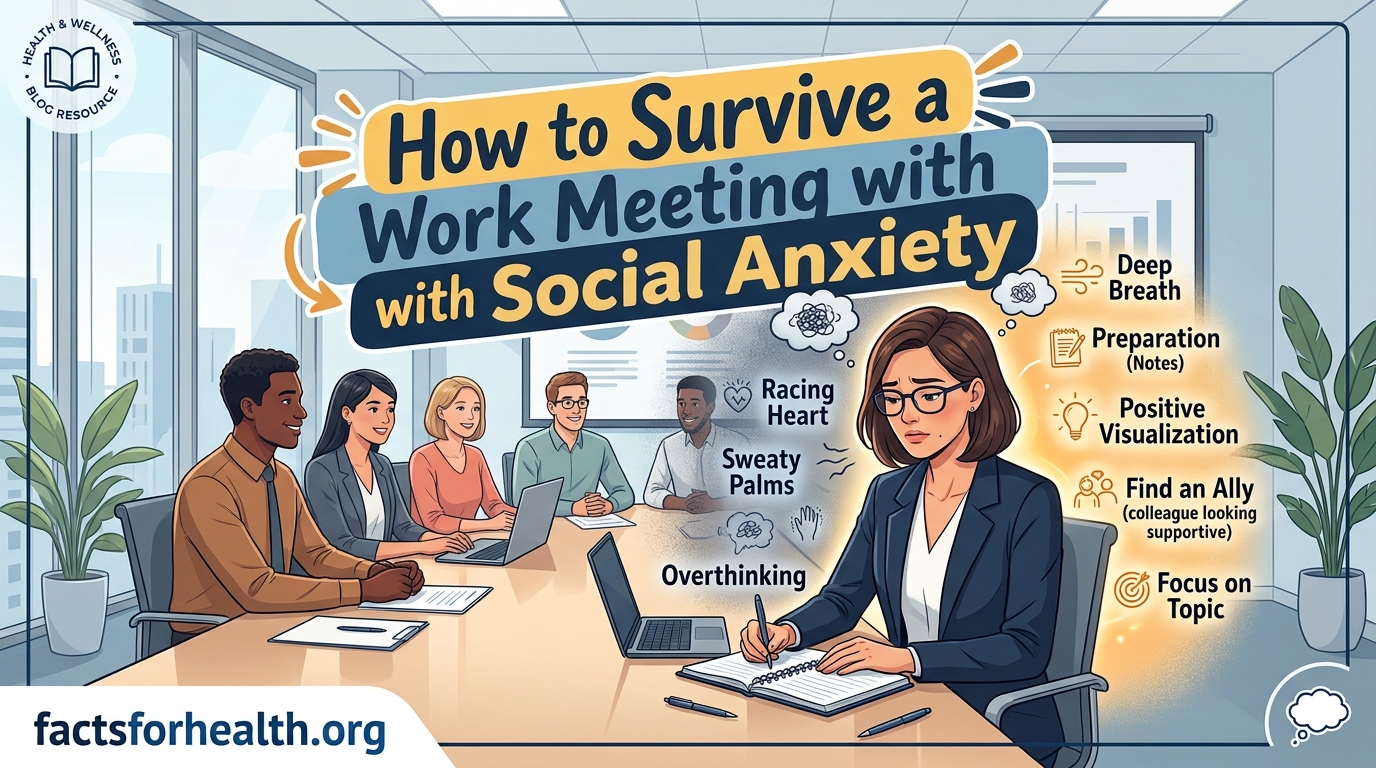
Your heart is pounding. Your palms are slick with sweat. The calendar reminder just popped up — team meeting in ten minutes. If you have ever sat at your desk feeling like you are about to face a firing squad instead of a routine status update, you are far from alone.
Learning how to survive a work meeting with social anxiety is not about forcing yourself to suddenly love the spotlight. It is about building a toolkit of practical strategies that help you show up, participate, and walk out feeling like you handled it. Social anxiety disorder affects roughly 7 percent of adults in the United States, and workplace meetings are one of the most common triggers.
In this guide, our team breaks down exactly what happens in your body and mind before, during, and after a meeting. You will get preparation strategies you can start using today, in-the-moment coping techniques backed by cognitive behavioral principles, and clear guidance on when it might be time to talk to a professional.
Whether you are dealing with weekly team standups, quarterly presentations, or the dread of speaking up on a video call, these techniques can help you manage the fear instead of letting it manage you.
Table of Contents
Understanding Social Anxiety in Work Meetings
Social anxiety in work meetings is an intense, persistent fear of being judged, scrutinized, or embarrassed while participating in professional gatherings. It goes well beyond normal nervousness. People with social anxiety disorder often experience their fear as a genuine threat response, not just a passing case of butterflies.
Meetings are a perfect storm for social anxiety because they combine multiple triggers at once. You are being observed by colleagues. You might be asked to speak unprompted. There is an implicit performance element, and the power dynamics of a workplace add pressure that a casual social setting does not have.
One person in a Reddit thread on r/socialanxiety described it this way: “I would rather do three days of solo work than sit through one thirty-minute team meeting where I might get called on.” That reaction is more common than most people realize.
Common Physical and Mental Symptoms
The physical symptoms of meeting anxiety can feel overwhelming and include:
- Rapid heartbeat or a pounding chest that feels visible to others
- Shallow breathing or the sensation of not getting enough air
- Sweating, blushing, or hot flashes that you worry everyone notices
- Shaky hands or a trembling voice when you try to speak
- Dry mouth, nausea, or a knot in your stomach
- Mind going completely blank when asked a question
The mental symptoms can be just as draining. Racing thoughts, an inner voice catastrophizing every possible scenario, and an intense urge to flee the room are all classic signs of the fight-or-flight response kicking in at the wrong time.
Why Meetings Hit Different
Social anxiety thrives on perceived evaluation, and meetings are full of it. You are sitting among people whose opinion of you could affect your career. There is often a manager or leader present. Decisions get made in real time, and if you freeze or stumble over your words, it happens in front of an audience.
This is also why post-event processing is so brutal for people with social anxiety. Long after the meeting ends, the brain replays every word, every facial expression, and every silence — searching for evidence of failure. Research on social anxiety disorder shows that this rumination cycle can last for hours or even days.
Recognizing Avoidance Behaviors
Avoidance is the engine that keeps social anxiety running. The more you avoid meetings, the scarier they become. As one forum user put it, “Anxiety feeds on avoidance — the more you avoid, the worse it gets.”
Common avoidance behaviors include:
- Dialing into meetings five minutes late to minimize face time
- Keeping your camera off during virtual meetings whenever possible
- Sitting at the far end of the table or near the door in conference rooms
- Staying silent even when you have valuable input
- Sending an email after the meeting instead of speaking during it
- Finding excuses to skip meetings entirely
These strategies feel protective in the moment, and our team understands the relief they bring. But each act of avoidance teaches your brain that the meeting was genuinely dangerous, making the next one harder to face. Breaking that cycle starts with preparation.
Before the Meeting: Preparation Strategies
Preparation is the single most effective thing you can do to reduce meeting anxiety before it even starts. When you know what to expect and have rehearsed your contribution, the unknowns that fuel anxiety shrink dramatically.
Review the Agenda and Do Your Homework
Ask for or review the meeting agenda as far in advance as possible. Knowing the topics, who will be presenting, and what is expected of you removes the element of surprise that anxiety loves to exploit. If no agenda exists, send a quick message to the organizer asking what you should prepare.
Do the relevant research beforehand. Read the documents linked in the calendar invite. Pull up the data you might be asked about. Having facts at your fingertips means that even if your mind blanks, you have notes to fall back on.
Prepare Talking Points and Notes
Write down two or three key points you want to contribute, using bullet points you can scan at a glance. Keep them short and specific. Something like: “Q3 numbers up 12 percent — highlight the retention improvement from the new onboarding process.”
Having these notes does two things. First, it gives you a safety net if your nerves spike. Second, the act of preparing them signals to your brain that you are ready, which reduces anticipatory anxiety.
Arrive Early and Settle In
Verywell Mind specifically recommends arriving early to meetings, and our team agrees with this approach. Walking into a room that is already full and in motion is far more stressful than being there as people trickle in. When you arrive early, you choose your seat, you get comfortable, and you greet people one-on-one as they enter rather than facing a wall of faces all at once.
For virtual meetings, log in a few minutes early. Test your audio and camera. Have your notes and water within reach. Small rituals like these give your nervous system a sense of control.
Build a Pre-Meeting Routine
Create a simple routine you follow before every meeting. This could include three minutes of deep breathing, reviewing your notes one final time, and silently repeating a grounding phrase like “I am prepared, and my input matters.” Routines are powerful because they become automatic, reducing the cognitive load of anxiety on top of everything else.
Avoid caffeine right before a meeting if you are prone to physical symptoms. Caffeine can mimic and amplify anxiety symptoms like rapid heartbeat and jitters, making the experience worse.
How to Survive a Work Meeting with Social Anxiety: During the Meeting
Once the meeting starts, your job shifts from preparation to management. The techniques in this section are designed to help you regulate your nervous system in real time, contribute without freezing, and handle the moments when anxiety spikes.
The 333 Rule for Anxiety
The 333 rule is a simple grounding technique that pulls your attention out of your anxious thoughts and into the present moment. It works because social anxiety lives in the future — it is always about what might happen next. Grounding forces your brain back to right now.
Here is how it works. Look around and name:
- Three things you can see — the whiteboard, a coffee mug, the clock on the wall
- Three sounds you can hear — the hum of the projector, someone typing, traffic outside
- Three things you can touch or feel — your chair beneath you, the table surface, your feet on the floor
This exercise takes about thirty seconds, and you can do it without anyone noticing. It engages your senses and interrupts the anxiety spiral, giving you a window to re-engage with the meeting.
Breathing and Relaxation Exercises
Controlled breathing directly counteracts the fight-or-flight response by activating your parasympathetic nervous system. The key is to make your exhale longer than your inhale, which signals safety to your body.
Box breathing: Inhale for four counts, hold for four, exhale for four, hold for four. Repeat four times. This technique is used by Navy SEALs and emergency responders to manage stress under pressure.
4-7-8 breathing: Inhale through your nose for four counts, hold for seven, exhale through your mouth for eight. Even two rounds of this can noticeably slow your heart rate.
Progressive muscle relaxation: Starting with your toes, tense each muscle group for five seconds, then release. Work your way up through your legs, stomach, shoulders, arms, and face. This releases the physical tension that builds up during meetings, and nobody will notice you doing it under the table.
Practical Coping Strategies for the Room
Beyond grounding and breathing, several practical strategies can make meetings more manageable:
- Use visual aids or notes — Holding a pen or notebook gives your hands something to do and provides a reference if you get flustered.
- Ask questions instead of making statements — If speaking up feels too exposing, ask a question. “Can you walk me through that last point?” buys time and counts as participation.
- Find a friendly face — Identify one or two colleagues who make you feel comfortable and direct your eye contact toward them when you speak.
- Accept pauses — Silence feels longer to you than it does to others. Take a breath before answering. It looks thoughtful, not awkward.
- Sip water — Taking a drink is a natural-feeling way to pause, reset, and soothe a dry throat.
Scripts and Phrases to Keep in Your Back Pocket
Having ready-made phrases reduces the pressure of thinking on your feet when anxiety is high. Forum users in r/socialanxiety repeatedly shared that having a script felt like a lifeline. Here are some you can adapt:
- “That is a great point. Let me build on that with…”
- “I would like to add a quick thought on this topic…”
- “I do not have the exact number in front of me, but I can follow up after the meeting.”
- “Could we circle back to that? I want to make sure I address it properly.”
- “I agree with what was said. From my perspective…”
One of the most liberating phrases you can learn is simply: “I do not know, but I will find out and follow up.” Forum users stressed that it is okay to say this. No one expects you to have every answer in real time, and admitting it builds trust rather than destroying it.
Cognitive Reframing: Changing How You Think About Meetings
Cognitive reframing is a core technique from cognitive behavioral therapy, and it targets the distorted thoughts that fuel social anxiety. The idea is not to think positively in a hollow way, but to think accurately — replacing catastrophic predictions with realistic assessments.
Common Cognitive Distortions in Meetings
Social anxiety relies on predictable thinking traps. Here are the ones that show up most often in workplace meetings:
Mind reading: “Everyone thinks I am incompetent.” You cannot actually read minds, and most people are focused on their own contributions and insecurities, not dissecting yours.
Catastrophizing: “If I stumble over this sentence, my career is over.” In reality, people stumble in meetings every single day, and it has zero long-term consequences.
Spotlight effect: “Everyone noticed my voice shake.” Research shows that people consistently overestimate how much others notice about them. Your colleagues are paying far less attention to your performance than your anxiety tells you.
All-or-nothing thinking: “If I do not speak perfectly, there is no point in speaking at all.” Partial participation still counts. One comment in a meeting is better than silence.
How to Reframe Anxious Thoughts
When you notice an anxious thought, pause and ask yourself three questions. Is this thought based on fact or on fear? What evidence do I actually have? What would I tell a friend who had this thought?
For example, instead of “Everyone is going to judge me,” try reframing to “People are here to discuss the project, not to evaluate me personally.” Instead of “I am going to embarrass myself,” try “I might feel nervous, and that is okay. I have prepared for this.”
This takes practice. Over time, reframing becomes more automatic, and the gap between an anxious thought and a realistic one shrinks.
Practice Self-Compassion
Treating yourself with the same kindness you would show a struggling colleague is not soft — it is strategic. Research from Dr. Kristin Neff and others shows that self-compassion reduces anxiety and increases resilience. When you beat yourself up after a meeting, you reinforce the fear. When you acknowledge that meetings are genuinely hard for you and that you showed up anyway, you build confidence for next time.
Virtual Meeting Tips for Social Anxiety
Virtual meetings have introduced a new layer of complexity for people with social anxiety. Video calls can be simultaneously easier (you are in your own space) and harder (your own face staring back at you, cameras, and the awkward silences of lag).
Managing Camera Anxiety
Being on camera triggers self-consciousness because you can literally see yourself in real time. This is unnatural — in a physical meeting, you never watch your own face while talking. If your workplace allows it, hide your self-view. On Zoom, right-click your video and select “Hide Self View.” On Teams, you can minimize your preview. This single change can dramatically reduce self-monitoring anxiety.
If cameras are required, position your window so your own face is not in your primary line of sight. Look at the camera lens occasionally to simulate eye contact, but spend most of your time looking at the content or other participants.
Using Chat as a Participation Tool
The chat function is a gift for people with social anxiety. You can contribute ideas, share links, and ask questions without unmuting. Many meeting leaders explicitly welcome chat input, and in some organizations, chat contributions carry the same weight as spoken ones.
Type your comment out before sending it. This gives you time to review and edit, which reduces the fear of saying something wrong. A thoughtful chat message can be more impactful than a nervous spoken comment.
Managing Virtual Meeting Fatigue
Video meetings require more cognitive effort than in-person ones because your brain works harder to read social cues through a screen. For someone with social anxiety, this amplified effort compounds the exhaustion.
Build recovery time into your schedule. If possible, avoid back-to-back video calls. Take five minutes between meetings to step away from screens, do a quick breathing exercise, or simply sit in silence. Turn your camera off during breaks, even briefly, to reduce the performance pressure.
Workplace Accommodations and Professional Help
Social anxiety disorder is a recognized medical condition, and in many workplaces, you have the right to request reasonable accommodations. You do not have to white-knuckle through every meeting alone.
How to Request Workplace Accommodations
Start by talking to your manager or HR representative. You do not need to share every detail of your condition. A simple conversation can open the door to adjustments that make a real difference.
Accommodations that can help with meeting anxiety include:
- Receiving agendas and materials at least 24 hours in advance
- Being given the option to submit written input alongside or instead of spoken contributions
- Having meetings recorded so you can review them without the pressure of real-time participation
- Attending large meetings virtually when the option exists
- Taking brief breaks during long meetings to manage anxiety symptoms
In the United States, if you work for an employer with 15 or more employees, the Americans with Disabilities Act may apply to social anxiety disorder. This means you may be entitled to reasonable accommodations, and your employer cannot discriminate against you based on your condition.
When to Seek Professional Help
Self-help strategies are powerful, but they are not always enough. Consider reaching out to a mental health professional if:
- Meeting anxiety is interfering with your job performance or career advancement
- You are regularly avoiding meetings or calling in sick to escape them
- Anxiety symptoms are spilling into other areas of your life
- You experience panic attacks before or during meetings
- Your anxiety has persisted for six months or more despite trying self-help techniques
- You are using alcohol or other substances to cope with meeting anxiety
There is no shame in getting professional support. Social anxiety disorder is one of the most treatable anxiety conditions, and the right treatment can change your relationship with meetings entirely.
Therapy and Treatment Options
Cognitive behavioral therapy is the gold-standard treatment for social anxiety disorder. CBT helps you identify and change the thought patterns that drive anxiety, and it typically includes gradual exposure exercises that help you build tolerance for anxiety-provoking situations over time. Studies show that CBT produces significant improvement in 60 to 70 percent of people with social anxiety.
Exposure therapy, a specific type of CBT, involves gradually facing feared situations in a controlled way. A therapist might start by having you imagine a meeting, then attend a small one, then work up to larger or higher-stakes meetings. Each successful exposure teaches your brain that the threat is manageable.
Other therapeutic approaches that can help include acceptance and commitment therapy, which focuses on accepting anxious feelings while still taking action aligned with your values, and mindfulness-based therapies that build present-moment awareness.
Medication Options
For some people, medication is a valuable part of the treatment plan. Common options include SSRIs (selective serotonin reuptake inhibitors) like sertraline and paroxetine, which are FDA-approved for social anxiety disorder. These medications take several weeks to reach full effect but can significantly reduce baseline anxiety levels.
Beta-blockers like propranolol are sometimes prescribed for performance anxiety situations. They target the physical symptoms of anxiety — rapid heartbeat, trembling, sweating — without affecting the mental state. Some people use them specifically for high-stakes meetings or presentations.
Medication decisions should always be made in consultation with a qualified healthcare provider who can assess your individual situation, monitor your progress, and adjust as needed.
Quick Action Checklist: Before, During, and After Meetings
Use this checklist as a quick reference guide you can scan before any meeting.
Before the meeting:
- Review the agenda and prepare two to three talking points
- Practice deep breathing for three minutes
- Write out a backup phrase like “I will follow up on that after the meeting”
- Avoid excess caffeine
- Arrive or log in five minutes early
During the meeting:
- Use the 333 rule if anxiety spikes
- Practice box breathing (4 in, 4 hold, 4 out, 4 hold)
- Find a friendly face to direct eye contact toward
- Contribute at least one comment or question — big or small
- Sip water to manage pauses and dry mouth
After the meeting:
- Avoid replaying every moment searching for mistakes
- Acknowledge what went well, even if it was small
- Remember that spotlight effect means people noticed less than you think
- Note what you want to try differently next time
- Take a genuine break to decompress
FAQs
How to stay calm with social anxiety?
To stay calm with social anxiety, use controlled breathing techniques like box breathing (inhale for 4, hold for 4, exhale for 4, hold for 4) to activate your parasympathetic nervous system. Grounding exercises like the 333 rule pull your focus back to the present moment. Preparing talking points in advance, arriving early, and identifying a friendly face in the room can also significantly reduce anxiety during stressful situations.
What is the 333 rule for social anxiety?
The 333 rule is a grounding technique where you identify three things you can see, three sounds you can hear, and three things you can physically feel or touch. This exercise takes about 30 seconds and works by pulling your attention away from anxious thoughts and into your immediate sensory environment. It interrupts the anxiety spiral and can be done discreetly during a meeting without anyone noticing.
What medication is used for social anxiety?
Common medications for social anxiety disorder include SSRIs such as sertraline and paroxetine, which are FDA-approved for the condition and reduce baseline anxiety over several weeks. Beta-blockers like propranolol are sometimes prescribed for specific performance situations like meetings or presentations, as they target physical symptoms such as rapid heartbeat and trembling. Medication should always be discussed with a qualified healthcare provider.
Why do large crowds stress me out?
Large crowds can trigger stress because they overload your sensory system and create a perceived lack of control or escape routes. For people with social anxiety, crowds amplify the fear of being watched or judged because the number of potential observers increases. This triggers the fight-or-flight response, causing physical symptoms like rapid heartbeat and shallow breathing. Gradual exposure and grounding techniques can help reduce this reaction over time.
You Can Handle This
Surviving a work meeting with social anxiety is not about eliminating fear completely — it is about having tools that work when the fear shows up. Preparation, grounding techniques like the 333 rule, breathing exercises, cognitive reframing, and knowing when to seek professional help are all proven strategies that can make meetings manageable.
Start small. Pick one technique from this guide and try it in your next meeting. Then add another. Over time, these strategies compound, and meetings that once felt unbearable become situations you can navigate with confidence. Social anxiety is a real condition, but it does not have to define your career or your experience at work.
If meeting anxiety is significantly impacting your work or well-being, reaching out to a therapist who specializes in anxiety disorders can be one of the most effective steps you take. You deserve to feel capable and present in your own professional life — and with the right tools and support, that is entirely possible.