
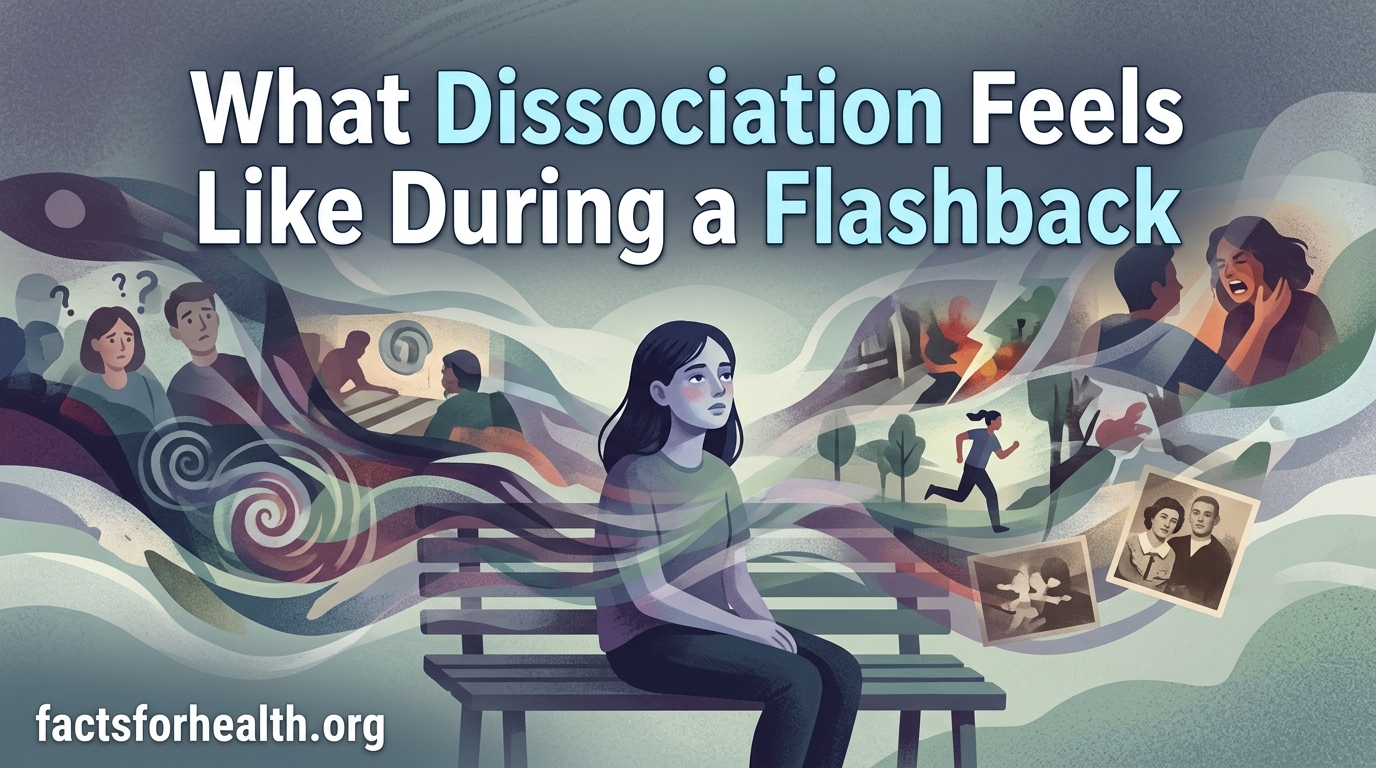
Imagine sitting at your kitchen table on an ordinary Tuesday morning. The coffee is warm in your hands. Then a specific smell drifts through the window, maybe someone’s laundry detergent, and suddenly you are somewhere else entirely. The kitchen is still there, but it feels like you are watching it through frosted glass from a thousand miles away. Your hands do not feel like your hands. The walls look like they are breathing. You know intellectually that you are safe at home, but your body is convinced that danger is here, right now, in this room.
That experience, that surreal disconnection between what you know and what you feel, is what dissociation feels like during a flashback. If you have lived through it, you probably already know how hard it is to put into words. People who have never experienced it often struggle to understand why you cannot just snap out of it.
This article exists to bridge that gap. Whether you are trying to understand your own experiences, support someone you love, or simply learn about trauma responses, you deserve a description that goes beyond clinical definitions. We will walk through exactly what happens in the mind and body, why the brain does this, and what actually helps when you are caught in the middle of it.
Understanding what dissociation feels like during a flashback matters because it is one of the most misunderstood trauma symptoms. People who experience it often feel isolated, frightened, or convinced they are losing their minds. You are not. What you are experiencing has a name, a neurological basis, and treatment options that work.
Table of Contents
Quick Answer: What Dissociation Feels Like During a Flashback
Dissociation during a flashback is a mental state where you feel disconnected from your body, your thoughts, your emotions, or your surroundings while simultaneously experiencing a traumatic memory as if it is happening right now. It can feel like watching yourself from outside your body, like the world around you is fake or dreamlike, or like you have vanished entirely behind a wall of numbness.
Some people describe it as being trapped behind glass. Others say it feels like their consciousness has been pulled out of their body and is hovering somewhere near the ceiling, watching the scene below. The flashback pulls you into the past while dissociation pushes you out of the present, and you end up suspended somewhere in between, not fully in either reality.
The experience varies widely from person to person and even from one episode to the next. Some people feel everything too intensely before the dissociation kicks in. Others go numb immediately. Both responses are your nervous system trying to protect you from an overwhelming flood of sensory and emotional information.
What Is Dissociation?
Dissociation is a protective mechanism your brain uses when something feels too overwhelming to process in real time. It is a break in the normal connections between your thoughts, your sense of identity, your memory, and your awareness of the present moment. In everyday life, mild dissociation happens to everyone. You have probably driven home on a familiar route and realized you have no memory of the last ten minutes. That is a mild form of dissociation, and it is completely normal.
Dissociation exists on a spectrum. On one end, there is everyday zoning out, highway hypnosis, or getting lost in a daydream. Moving along the spectrum, you might experience derealization, where the world around you feels unreal, or depersonalization, where you feel detached from your own body or sense of self. At the far end of the spectrum are dissociative disorders, including dissociative identity disorder and dissociative amnesia, where the disconnection is severe and persistent.
What makes dissociation during a flashback different from everyday dissociation is the combination of past and present collapsing into a single moment. You are not just zoning out. Your brain is simultaneously reliving a traumatic experience and detaching from the present, which creates a uniquely disorienting state.
Dissociation vs Daydreaming vs Zoning Out
People often confuse dissociation with simply being lost in thought. The difference comes down to control, awareness, and intensity. When you daydream, you choose to let your mind wander and you can bring yourself back at will. When you zone out, you are briefly not paying attention, but you remain loosely connected to reality.
Dissociation, especially during a flashback, is involuntary and often frightening. You do not choose to disconnect. You may not even realize it is happening until you snap back and realize time has passed. The disconnection feels more like a force pulling you away from reality than a gentle daydream. And unlike zoning out, dissociation during a flashback comes with an underlying sense of danger or emotional flooding that makes it deeply distressing.
What Is a Flashback?
A flashback is an involuntary and intense re-experiencing of a traumatic event. During a flashback, the brain replays the trauma not as a memory but as something happening in the present moment. The experience can be so vivid and immersive that you temporarily lose awareness of where you actually are and what time period you are actually in.
Flashbacks are a hallmark symptom of post-traumatic stress disorder, or PTSD, as well as complex PTSD, or C-PTSD. They are classified as a re-experiencing symptom, meaning the traumatic memory forces its way back into consciousness without warning or permission. The memory has not been properly processed and stored, so the brain treats it as a current threat rather than a past event.
Flashbacks come in several forms, and understanding the differences helps explain why dissociation shows up so often alongside them.
Types of Flashbacks
Visual flashbacks are what most people picture when they hear the word. You see the traumatic event playing out in front of you, sometimes with your eyes open, sometimes behind closed eyelids. The images can be so vivid that they completely override your actual surroundings.
Emotional flashbacks do not necessarily come with visual images. Instead, you are suddenly overwhelmed by the emotions you felt during the trauma. Shame, terror, helplessness, or grief flood your system without any obvious trigger, and you may not even realize you are having a flashback because there is nothing visual to anchor it.
Somatic flashbacks involve body sensations. You might feel pain, pressure, or physical sensations associated with the original trauma. These can be particularly confusing because they seem to come from nowhere and are often mistaken for medical symptoms.
Olfactory flashbacks involve smell. A specific scent triggers a vivid, visceral memory that can pull you back into the traumatic moment. Smell is processed in a part of the brain closely connected to memory and emotion, which is why scent-based flashbacks can be especially intense.
Each type of flashback can trigger dissociation, but the combination looks and feels different depending on the person and the type involved.
The Connection: Why Dissociation Happens During Flashbacks
Dissociation and flashbacks are deeply connected because they are both responses to the same underlying problem: unprocessed trauma. When a traumatic event occurs, the brain’s normal memory processing system gets overwhelmed. Under extreme stress, the hippocampus, which normally files memories into long-term storage with a timestamp and context, goes offline. The amygdala, the brain’s alarm system, takes over and stamps the experience as raw, fragmented sensory data without proper organization.
Think of it like a filing error. Normal experiences get filed neatly into folders with labels, dates, and context. Traumatic experiences, when they are not properly processed, get shoved into a drawer without a folder. When something triggers a reminder of that trauma, the drawer flies open and all the raw, unfiled content spills out. That is a flashback. The memory arrives without its timestamp, so your brain experiences it as happening right now.
Dissociation enters the picture as a secondary defense mechanism. The flashback is flooding your system with overwhelming sensory and emotional information. Your nervous system, already pushed past its window of tolerance, cannot handle the intensity. So the brain does the only thing it can to reduce the suffering: it pulls you out of the experience. It creates distance between your consciousness and the flooding, either by making your body feel foreign, making the world feel unreal, or shutting down emotional processing entirely.
This is why a flashback is often considered a dissociative symptom. The two experiences feed into each other. The flashback triggers the dissociation, and the dissociation makes it harder to stay grounded in the present and realize that the memory is from the past. People with the dissociative subtype of PTSD, which the DSM-5 formally recognizes, experience this combination regularly.
The fight-flight-freeze response also plays a role. When a flashback hits, your body enters survival mode. If fighting or fleeing is not possible, the nervous system defaults to freeze, which can look and feel like dissociation. Your body is present but your mind has checked out. From an evolutionary standpoint, this response may have helped humans survive overwhelming threats by reducing the experience of pain and terror when escape was not possible.
What Dissociation Feels Like During a Flashback: A Sensory Walkthrough
Clinical definitions tell you what dissociation is. They do not tell you what it actually feels like. This section fills that gap using descriptions drawn from people who have lived through dissociative flashbacks. If you have experienced this, the following descriptions may feel uncomfortably familiar. That recognition is important because it confirms you are not alone.
What Your Vision Does
During a dissociative flashback, your visual experience can change dramatically. Some people describe tunnel vision, where their peripheral vision narrows and they can only see what is directly in front of them. Others say the world looks like it is behind frosted glass or underwater. Colors may seem washed out, or everything may take on a gray, flat quality.
Some people experience visual flashbacks layered on top of their real surroundings. They see both the room they are actually in and fragments of the traumatic event simultaneously. The two images compete for dominance, creating a deeply disorienting experience where you cannot fully trust your eyes.
Others describe their vision as going slightly out of focus or developing a dreamlike quality. Objects may look like they are the wrong size, or distances may seem distorted. A person across the room might appear to be either very far away or uncomfortably close.
What Sound Becomes
Sound distortion is one of the most commonly reported sensory changes during dissociation. Voices may sound muffled, as if you are hearing them through water or from inside a glass box. Background noise might fade away entirely, leaving an unsettling silence, or it might become overwhelmingly loud and chaotic.
Some people hear sounds from the traumatic event layered over the sounds of their present environment. A car door slamming might also carry echoes of something from the past. The brain struggles to separate the two audio streams, which adds to the confusion about what is real and what is memory.
People may speak to you during a dissociative flashback and you might hear their words but be unable to make sense of them. The sounds register, but the meaning does not penetrate. It is like hearing a language you do not speak.
What Your Body Feels
The physical experience of dissociation during a flashback can be terrifying, especially the first few times it happens. Many people describe a sensation of floating or leaving their body. They feel like they are watching themselves from above, or from across the room, as if they are a spectator rather than a participant in their own life.
Your hands might not feel like they belong to you. You might look down at your arms or legs and feel no connection to them, as if they are part of someone else’s body. Some people describe their body as feeling like a suit they are wearing rather than something that is truly them.
Physical sensations can also become distorted. You might feel numbness in your extremities, tingling in your hands and feet, or a heavy weight pressing down on your chest. Some people experience involuntary trembling, a racing heart, or shallow breathing. Others go completely still, barely breathing at all, locked in a freeze response.
People in online trauma communities frequently report joint pain, back pain, and jaw clenching during dissociative episodes. These somatic symptoms are often the first clue that a flashback or dissociative episode is beginning, even before any visual or emotional changes register.
What Happens to Time
Time distortion is a hallmark of dissociation during flashbacks. Minutes can feel like hours, or hours can pass in what seems like seconds. Some people lose time entirely. They emerge from a dissociative episode with no memory of what happened during the gap, which can range from a few minutes to several hours.
The past and present can also become tangled. You might know what year it is, but it does not feel true. The traumatic event feels immediate and current, even though intellectually you know it happened years ago. This split between knowing and feeling is one of the most disorienting aspects of the experience.
What Your Emotions Do
Emotional responses during dissociative flashbacks fall into two broad categories, and some people experience both in rapid succession. The first is emotional flooding, where the feelings from the trauma arrive all at once. Terror, shame, grief, rage, or helplessness crash through you with an intensity that matches the original event. You are not remembering the emotions. You are re-experiencing them at full strength.
The second response is emotional numbness. After the flooding, or sometimes instead of it, dissociation shuts down emotional processing entirely. You feel nothing. Not calm, not sad, not angry. Just empty. Some people describe it as being behind a wall or wrapped in cotton. The emotions are still there somewhere, but they are unreachable.
This numbness can be deeply unsettling. People often fear that something is permanently wrong when they cannot feel anything. It is actually a protective mechanism. Your nervous system has decided that the emotional load is too heavy and has temporarily turned off the flow.
What Your Thoughts Become
Cognitive changes during dissociative flashbacks can be subtle or profound. Many people describe their thoughts as becoming foggy, scattered, or slow. It may feel like thinking through mud. Simple decisions become impossible because your brain is dedicating all its resources to managing the sensory and emotional overload.
Some people experience intrusive thoughts or beliefs that belong to the traumatic event rather than the present. You might find yourself believing, even briefly, that you are in danger right now or that the people around you cannot be trusted. These thoughts feel real in the moment, even if part of you knows they are not accurate.
Others describe a sense of unreality or derealization that extends to their own identity. You might wonder if you are real, if the world is real, or if you are dreaming and have not woken up yet. This philosophical-level confusion is distressing but extremely common during dissociative episodes.
Types of Dissociation During Flashbacks
Not all dissociation looks or feels the same. During a flashback, you might experience one or more of the following types. Understanding which type you tend to experience can help you identify what is happening and choose the most effective grounding strategies.
Depersonalization
Depersonalization is the feeling that you are detached from your own body or mind. You might feel like you are observing yourself from the outside, as if you are watching a character in a movie rather than living your own life. Your body may feel foreign, mechanical, or like it does not belong to you. Thoughts and emotions may feel distant, as if they belong to someone else.
One person described it this way: it felt like my body did not belong to me, like I was an outsider watching my own story unfold from somewhere above. During a flashback, depersonalization can feel like your consciousness has been ejected from your body and is floating somewhere nearby, unable to reconnect.
Derealization
Derealization is the feeling that the world around you is not real. Objects may look flat, two-dimensional, or artificially colored. Familiar places may seem strange or dreamlike. People you know well may look like strangers. The world might feel like it is behind glass, on a stage, or happening on a screen rather than in real life.
One person described their environment during a flashback as feeling like a play or a movie. Nothing felt solid. The walls looked like they were made of cardboard. This sense of unreality can be deeply unsettling because it undermines your ability to trust your own perception of reality.
Identity Alteration
Identity alteration involves a shift in your sense of who you are. During a flashback, you may feel like a different version of yourself, or like a part of you from the time of the trauma has taken over. This is more common in people with complex trauma histories or dissociative disorders. You might speak, move, or react in ways that feel unfamiliar or out of character.
Identity alteration exists on a spectrum. On the milder end, you might feel like a younger version of yourself. On the more severe end, associated with dissociative identity disorder, distinct identity states may emerge with their own patterns of thinking, feeling, and behaving.
Comparison: Depersonalization vs Derealization vs Identity Alteration
The table below summarizes the key differences between the three main types of dissociation experienced during flashbacks.
| Feature | Depersonalization | Derealization | Identity Alteration |
|---|---|---|---|
| Core Experience | Detachment from your own body and self | The external world feels unreal or dreamlike | Your sense of identity shifts or fragments |
| What It Feels Like | Watching yourself from outside; body feels foreign | World behind glass; familiar places seem strange | Becoming a different version of yourself |
| Common Sensations | Numbness, floating, robotic movements | Visual distortion, tunnel vision, muffled sound | Speaking or acting out of character |
| Emotional Quality | Numbness or emotional flatness | Confusion and disorientation | May carry emotions from the trauma period |
| Duration During Flashback | Minutes to hours | Minutes to hours | Minutes to days (in severe cases) |
| Frequency in PTSD | Very common | Very common | Less common; more typical in C-PTSD and DID |
Dissociative Amnesia
Dissociative amnesia involves gaps in memory surrounding the traumatic event or the flashback itself. You might not remember parts of the original trauma, or you might lose time during a dissociative episode and emerge with no memory of what happened. This can be frightening, especially the first few times it occurs. Dissociative amnesia is the brain’s way of walling off information that is too painful or overwhelming to hold in conscious awareness.
Physical Symptoms of Dissociation During Flashbacks
Physical symptoms during dissociative flashbacks are real, measurable, and often the first sign that something is happening. Yet they are frequently overlooked or misattributed. Many people seek medical help for physical symptoms without realizing they are connected to trauma and dissociation.
Common physical symptoms include a racing or pounding heart, shallow or rapid breathing, trembling or shaking, sweating, and muscle tension. Your jaw may clench tightly, sometimes hard enough to cause tooth pain or headaches. Joint pain, particularly in the back and neck, is frequently reported in trauma communities. Some people experience nausea, dizziness, or a feeling of being about to faint.
Numbness and tingling in the hands, feet, or face are also common. This occurs because the nervous system, caught in a freeze response, alters blood flow and nerve signaling to the extremities. Your skin might feel cold or clammy. You may experience a sensation of heaviness in your limbs, as if they are filled with lead.
Night terrors are another physical manifestation. Many people in trauma communities report that night terrors, along with jaw clenching and body pain, are their biggest clues that a flashback or dissociative episode is building. Sleep disturbances, chronic fatigue, and unexplained body aches that come and go without a clear medical cause can all be connected to unresolved trauma and dissociation.
If you have been pursuing medical explanations for physical symptoms and coming up empty, it may be worth considering whether trauma and dissociation are playing a role. This is not to say your symptoms are not real. They are absolutely real. It means the root cause may be neurological and trauma-related rather than structural or chemical.
Early Warning Signs That Dissociation Is Starting
Dissociation rarely arrives without warning, though the warning signs can be easy to miss if you do not know what to look for. Learning to recognize your personal early warning signs is one of the most valuable skills you can develop, because catching dissociation early gives you a window to use grounding techniques before you are fully submerged.
Common early warning signs include a sudden change in body temperature, such as feeling suddenly cold or flushed. Your vision might start to blur or narrow before full tunnel vision sets in. Sounds may begin to seem distant or muffled. You might notice a growing sense of unreality, as if the world around you is becoming slightly less solid.
Emotionally, the warning signs can include a sudden wave of irritability, anger, or anxiety that seems disproportionate to the situation. Some people describe a buildup of tension or pressure that intensifies until dissociation provides a release valve. Others notice the opposite, a creeping numbness or emotional flatness that signals the system is beginning to shut down.
Cognitively, you might notice your thoughts becoming scattered, foggy, or repetitive. You might find yourself staring into space without realizing it, or losing track of what someone is saying to you. A growing sense of confusion or disorientation can also signal that dissociation is approaching.
To identify your personal triggers and early warning signs, try keeping a journal or log after each dissociative episode. Note what was happening beforehand, what sensations you noticed first, and what thoughts or emotions preceded the dissociation. Over time, patterns will emerge that help you recognize future episodes earlier and intervene more effectively.
How to Ground Yourself During a Dissociative Flashback
Grounding techniques are practical strategies that help bring your awareness back to the present moment. They work by engaging your senses and giving your brain concrete, immediate evidence that you are safe here and now. The goal is not to stop the flashback entirely but to anchor yourself enough to ride it out without losing your connection to reality.
The 5-4-3-2-1 Grounding Technique
This is one of the most widely recommended and effective grounding exercises. It engages all five senses and forces your brain to process present-moment sensory information. Here is how to do it step by step.
Step 1: Name five things you can see. Look around your environment and identify five specific objects. Say them out loud if possible. The lamp on the desk. The crack in the ceiling. The blue coffee mug. Be specific. Naming details forces your visual processing system to focus on the present rather than the flashback.
Step 2: Name four things you can physically feel. Focus on tactile sensations. The fabric of your shirt against your skin. The floor beneath your feet. The chair supporting your weight. The temperature of the air on your face. If you can, actually touch these things to intensify the sensation.
Step 3: Name three things you can hear. Listen carefully and identify three distinct sounds. Traffic outside. A clock ticking. Your own breathing. Naming sounds pulls your auditory processing back to the present environment.
Step 4: Name two things you can smell. If you cannot smell anything naturally, keep grounding items nearby. Essential oils, coffee beans, or a strongly scented candle work well. Smell is processed in a part of the brain closely tied to memory, which makes it particularly powerful for interrupting flashback cycles.
Step 5: Name one thing you can taste. Keep mints, hard candy, or gum accessible. A strong taste like peppermint or sour lemon provides a sharp sensory signal that cuts through dissociation. Some people carry a small bottle of lemon juice or keep ice cubes in the freezer to bite into when they need a strong sensation.
Additional Grounding Strategies
Beyond the 5-4-3-2-1 technique, several other grounding strategies can help during a dissociative flashback. Not every technique works for every person, so it is worth trying several to find what works best for you.
Temperature changes can be highly effective. Splash cold water on your face, hold an ice cube in your hand, or step outside into cold air. The sharp temperature signal is difficult for the brain to ignore, which helps pull you back to the present.
Physical movement helps reset the nervous system. Stand up, walk around, do jumping jacks, or march in place. Movement signals to your body that the freeze response is over and helps discharge the adrenaline that has built up during the flashback.
Breathing exercises calm the nervous system directly. Try box breathing: inhale for four counts, hold for four, exhale for four, hold for four. Repeat several times. Slow, deliberate breathing activates the parasympathetic nervous system, which counteracts the fight-flight-freeze response.
Sensory objects you keep specifically for grounding can make a difference. A textured stone, a piece of velvet, a stress ball, or a weighted blanket can provide consistent, reliable tactile input. Keep these items in places where flashbacks are most likely to occur, such as your bedside table or car.
Grounding statements remind your brain of the present reality. Say to yourself, preferably out loud: My name is [your name]. Today is [current date]. I am in [your location]. I am safe. The trauma happened in the past. It is not happening now. Repeating these statements reinforces the present context that the flashback is trying to overwrite.
How to Support Someone During a Dissociative Flashback
If someone you care about experiences dissociative flashbacks, your support can make a meaningful difference. The most important thing to understand is that you cannot force someone out of a dissociative state. What you can do is create a safe environment and offer gentle, non-threatening grounding cues.
Speak in a calm, steady voice. Use their name. Remind them where they are and that they are safe. Avoid touching them suddenly or from behind, as unexpected physical contact can intensify the flashback. If you do touch them, approach from the front and let them see you first.
Do not demand that they explain what is happening or ask rapid-fire questions. Their cognitive processing is impaired during dissociation, and pressure to respond can make things worse. Instead, offer simple, grounding statements. You are here. You are safe. I am with you. This will pass.
Once the episode subsides, do not press for details about what they experienced. Let them rest, offer water or food, and check in gently later. Validate that what happened was real and difficult, and avoid minimizing it by saying things like it was just a memory.
When to Seek Professional Help
Occasional, mild dissociation in response to stress is common and usually not cause for concern. However, dissociation during flashbacks that occurs regularly, interferes with daily life, or causes significant distress warrants professional support. Trauma-informed therapy can help you process the underlying memories so they stop triggering flashbacks and dissociation.
Several evidence-based therapies have proven effective for PTSD with dissociative features. EMDR (Eye Movement Desensitization and Reprocessing) helps the brain reprocess traumatic memories so they lose their intensity. Cognitive Behavioral Therapy (CBT) and specifically trauma-focused CBT help you identify and change the thought patterns that maintain PTSD symptoms. Somatic experiencing focuses on releasing trauma that is stored in the body.
Medication may also play a role in treatment. SSRIs and SNRIs, such as sertraline and paroxetine, are sometimes prescribed to reduce the overall intensity of PTSD symptoms. While medication does not directly treat dissociation, reducing baseline anxiety and depression can make dissociative episodes less frequent and less severe.
Seek immediate help if you are experiencing dissociation that lasts for extended periods, if you are losing significant amounts of time, if dissociation is leading to self-harm or suicidal thoughts, or if you feel you cannot keep yourself safe. These are signs that professional intervention is needed urgently.
Crisis Resources and Helplines
If you or someone you know is struggling with dissociation, flashbacks, or trauma-related distress, help is available right now. You do not have to wait for an appointment to get support.
In the United States: Call or text 988 to reach the Suicide and Crisis Lifeline, available 24 hours a day, 7 days a week. The SAMHSA National Helpline at 1-800-662-4357 provides free, confidential treatment referral and information. Text HOME to 741741 to connect with the Crisis Text Line.
In the United Kingdom: Call 111 for non-emergency medical advice or 999 in an emergency. Samaritans is available 24/7 at 116 123. Shout offers crisis support via text at 85258.
In Canada: Call or text 988 to reach the Suicide Crisis Helpline. Talk Suicide Canada is available at 1-833-456-4566.
In Australia: Call Lifeline at 13 11 14 or Beyond Blue at 1300 22 4636.
If you are in immediate danger, call your local emergency number. Flashbacks and dissociation can feel overwhelming, but they are treatable. Reaching out for help is a sign of strength, not weakness.
FAQs
What does a dissociative flashback look like?
A dissociative flashback looks like a person suddenly becoming detached, unfocused, or unresponsive. Their eyes may glaze over or fix on a point in the distance. They may go pale, start trembling, or become completely still. They might speak in a different tone, repeat phrases, or not respond to their name. To an observer, it can look like the person is staring into space, daydreaming, or suddenly shutting down.
Is a flashback a dissociative symptom?
Yes, flashbacks are considered a dissociative symptom, particularly in PTSD and C-PTSD. The DSM-5 recognizes a dissociative subtype of PTSD characterized by symptoms of depersonalization and derealization that occur alongside flashbacks. During a flashback, the brain replays a traumatic memory as if it is happening now, and dissociation serves as a secondary defense mechanism that creates distance from the overwhelming experience.
What does PTSD dissociation feel like?
PTSD dissociation feels like being disconnected from your body, your thoughts, or your surroundings. You may feel like you are watching yourself from outside your body, that the world around you is unreal or dreamlike, or that your emotions have been switched off. Physical sensations can include numbness, tingling, tunnel vision, muffled hearing, and a sense of floating. Some people describe it as feeling trapped behind glass while the world moves on without them.
What does a PTSD flashback feel like?
A PTSD flashback feels like reliving a traumatic event in the present moment. The memory arrives without warning and overrides your awareness of your current surroundings. You may see, hear, smell, or physically feel aspects of the trauma. Your heart races, your body enters fight-flight-freeze mode, and the experience can feel more vivid and real than actual reality. The flashback can last anywhere from a few seconds to several hours.
Moving Forward: You Are Not Broken
If you came to this article searching for what dissociation feels like during a flashback because you have been experiencing it yourself, the most important thing to take away is this: your brain developed this response to protect you. Dissociation is not a sign of weakness or brokenness. It is a survival mechanism that worked when you needed it and has not yet learned that the danger has passed.
Understanding the experience, from the sensory changes to the physical symptoms to the emotional waves, gives you a framework for recognizing what is happening in real time. That recognition is the first step toward intervention. Grounding techniques, trigger identification, and trauma-informed therapy are all tools that can help you regain a sense of control.
Healing from trauma and dissociation is not a linear process. There will be setbacks and difficult days. But with the right support, the flashbacks become less frequent, the dissociation becomes less severe, and the moments of feeling fully present and connected become more common. You deserve to live in the present, and help is available to get you there.