
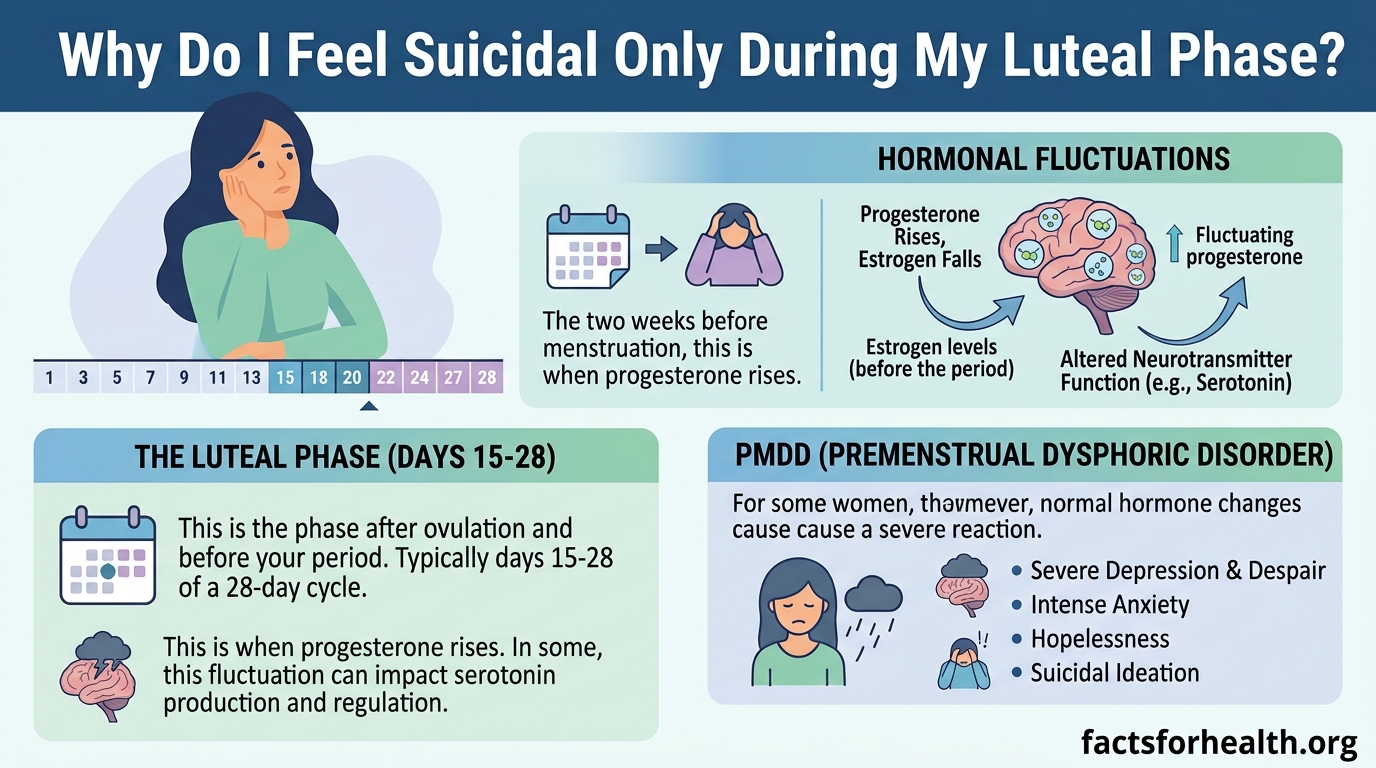
If you searched for “why do I feel suicidal only during my luteal phase,” I want you to know something first: you are not broken, and you are far from alone. What you are describing has a name, a biological explanation, and treatment options that work. The fact that these thoughts appear at a specific time in your cycle and lift at other times is one of the most important clues a doctor can have.
This pattern, where suicidal thoughts strike during the one to two weeks before your period and ease when bleeding begins, is the hallmark of Premenstrual Dysphoric Disorder (PMDD). PMDD is a recognized medical condition that affects roughly 5 to 10 percent of menstruating individuals. It causes severe emotional and physical symptoms that are directly tied to the hormonal shifts of your menstrual cycle.
In this article, we will walk through exactly what happens in your brain during the luteal phase, why those changes can produce suicidal thoughts, and what the research says about how common this experience is. We will also cover practical safety planning, how to track your symptoms for diagnosis, and treatment options that can genuinely change your life. Most importantly, we will talk about why these thoughts are what clinicians call state-dependent, meaning they are tied to a temporary biological state and will pass when that state shifts.
Please keep the crisis numbers above visible as you read. If anything in this article brings up difficult feelings, use those resources. You do not have to wait until things feel unbearable to reach out.
Table of Contents
What Is PMDD and Why Does It Cause Suicidal Thoughts During the Luteal Phase?
PMDD, or Premenstrual Dysphoric Disorder, is a severe cyclical condition recognized by the DSM-5 as a depressive disorder. Unlike general depression or anxiety, PMDD symptoms follow a strict pattern tied to the menstrual cycle. They appear during the luteal phase, which is the time between ovulation and the start of your period, and they resolve within a few days after menstruation begins.
The luteal phase typically lasts 10 to 16 days. During this window, your body produces high levels of progesterone and its metabolite, allopregnanolone. After ovulation, estrogen drops sharply, then rises again, then drops a second time just before your period. For most people, these fluctuations cause mild premenstrual symptoms. But for someone with PMDD, the brain reacts to these normal hormone levels as if they are toxic.
This is the critical distinction: PMDD is not caused by abnormal hormone levels. Blood tests of people with PMDD usually show hormones in the normal range. Instead, PMDD involves an abnormal sensitivity to normal hormonal fluctuations. Your brain essentially has an allergic reaction to the neurochemical changes that progesterone and estrogen trigger.
That sensitivity is what produces suicidal thoughts. When your brain cannot properly regulate its response to hormonal shifts, the result can include severe mood drops, intense anxiety, hopelessness, and intrusive thoughts about death or suicide. These are not character flaws or signs of weakness. They are neurological symptoms of a recognized medical condition.
People with PMDD frequently describe the experience as feeling like a different person takes over during the luteal phase. The thoughts feel absolute, permanent, and unbearable in the moment. Then, within days of starting their period, the thoughts lift and they feel like themselves again. This dramatic shift can be confusing and frightening, but it is also exactly what confirms the PMDD diagnosis.
The Science: Why Your Brain Responds This Way
Understanding the biology behind PMDD-related suicidal thoughts can be deeply validating. When you know there is a mechanism at work, it becomes easier to recognize the thoughts as symptoms rather than truths. Let me break down the science in plain language.
The Allopregnanolone Problem
After you ovulate, your body ramps up progesterone production. Progesterone gets broken down into several compounds, and one of the most important is a neurosteroid called allopregnanolone. In most people, allopregnanolone is calming. It binds to GABA-A receptors in the brain, the same receptors that anti-anxiety medications target, and produces a soothing effect.
But in people with PMDD, something goes wrong with this process. Research suggests the brain may actually become more sensitive to allopregnanolone in a paradoxical way, or that the GABA-A receptor response becomes dysregulated. Instead of feeling calm, the brain responds to allopregnanolone fluctuations with increased anxiety, irritability, and emotional pain. Think of it like a sound system where the volume knob is broken. A normal input signal produces a painfully loud, distorted output.
The GABA-A Receptor Connection
GABA is the main calming chemical in your brain. GABA-A receptors are like switches that, when activated, reduce brain activity and promote relaxation. Allopregnanolone normally enhances these receptors. But in PMDD, researchers believe the receptors may change their configuration during the luteal phase, making them respond to allopregnanolone differently.
This helps explain why the suicidal thoughts feel so overwhelming. Your brain’s primary calming system is essentially malfunctioning for a portion of every month. When the GABA-A system is not working properly, every negative emotion gets amplified. A passing worry becomes a catastrophe. A mild sadness becomes crushing despair. A fleeting thought about not existing becomes an intrusive, terrifying preoccupation.
Serotonin and the Estrogen Drop
Serotonin, a neurotransmitter involved in mood regulation, is also affected by cyclical hormone changes. Estrogen helps maintain healthy serotonin function. When estrogen levels fluctuate during the luteal phase, serotonin signaling can become unstable. This is why SSRIs, which work on the serotonin system, are one of the most effective treatments for PMDD.
The combination of disrupted GABA-A function, unstable serotonin signaling, and the emotional stress of experiencing all of this every single month creates a perfect storm for suicidal ideation. Your brain is temporarily operating without its normal emotional shock absorbers.
How Common Are Suicidal Thoughts with PMDD?
The statistics around PMDD and suicidal ideation are staggering, and they validate just how serious this condition is. If you have experienced suicidal thoughts during your luteal phase, you are part of a large and recognized group.
Research from Massachusetts General Hospital and other institutions has found that approximately 72 percent of women with confirmed PMDD experience suicidal ideation at some point in their lives. In one clinical study of women seeking PMDD treatment, 39 percent reported active suicidal thoughts at the time of evaluation. The lifetime suicide attempt rate among people with PMDD is estimated at 34 percent, a figure comparable to rates seen in major depressive disorder.
These numbers tell us something important: suicidal thoughts are not a rare or unusual symptom of PMDD. They are one of the most common and well-documented features of the condition. They also tell us that PMDD is a serious medical issue that deserves clinical attention, not something to brush off as just bad PMS.
Community data reinforces this. The International Association for Premenstrual Disorders (IAPMD) reports that suicidality is one of the primary reasons people with PMDD finally seek treatment. Many describe suffering in silence for years, believing they were simply defective or unstable, before discovering that their experience has a medical name and treatment options.
The Most Important Thing to Know: These Thoughts Are State-Dependent
Of all the information in this article, this section may be the most important. Suicidal thoughts that occur with PMDD are what mental health professionals call state-dependent. This means they are tied to a temporary biological state, the luteal phase, and they change when that state changes.
State-dependent thoughts follow a predictable pattern. They intensify as progesterone and allopregnanolone rise during the mid-to-late luteal phase. They reach their peak in the days just before menstruation. And they begin to lift, sometimes within hours, once bleeding starts. Many people with PMDD describe waking up the day after their period begins and feeling like a fog has cleared, wondering how the thoughts could have felt so real just 24 hours earlier.
This pattern is one of the strongest indicators that the thoughts are being driven by a biological process rather than representing a stable, permanent desire to die. It does not mean the pain is not real in the moment. It absolutely is. But it does mean the thoughts have an expiration date built into your cycle.
Intrusive Thoughts vs. True Suicidal Intent
Many people with PMDD struggle with a terrifying question: Are these thoughts real? Am I actually suicidal, or is this the PMDD? This is one of the most common and most under-discussed aspects of the condition, and it surfaces constantly in community forums like r/PMDD.
Here is what clinicians and researchers have observed. PMDD-related suicidal thoughts often have a different quality than suicidal ideation seen in conditions like major depression. They tend to be more intrusive, meaning they feel like they are happening to you rather than coming from you. They often feel foreign, alarming, and inconsistent with how you think and feel during other parts of your cycle.
Many people with PMDD describe a sense of being hijacked by the thoughts. They can observe that the thoughts do not match their actual values, desires, or life circumstances. One day they feel engaged with life and future-oriented. A week later, during peak luteal, the same person feels convinced that everything is hopeless. That dramatic, cyclical shift is a hallmark of PMDD, not of a stable suicidal state.
This distinction matters for safety planning. Intrusive, state-dependent thoughts still require support and can still be dangerous. But understanding that they are driven by a temporary neurochemical state, not a permanent part of who you are, can provide a lifeline of perspective during the darkest moments.
Why the Thoughts Feel Permanent in the Moment
One of the cruel ironies of PMDD is that during the luteal phase, the thoughts feel absolute and forever. Your brain, operating with a dysregulated calming system, cannot access the perspective that things will improve. This is not a personal failing. It is a feature of how the condition works.
People in PMDD communities often share a strategy of reminding themselves out loud: “This is the PMDD talking. This will pass when my period comes.” Some write notes to their luteal-phase selves during the follicular phase, when they feel clear-headed, and read them when the darkness hits. These strategies do not eliminate the pain, but they can provide a small anchor of reality when everything else feels overwhelming.
Is It PMDD or Premenstrual Exacerbation (PME)?
Not all cyclical worsening of mental health is PMDD. This distinction is critical because it determines the right treatment path. If your symptoms are caused by PMDD, specific treatments like luteal-phase SSRIs can be remarkably effective. If they are caused by something else, those treatments may not work.
Premenstrual Exacerbation (PME) refers to the worsening of an existing mental health condition, such as major depression, generalized anxiety, bipolar disorder, or PTSD, during the luteal phase. With PME, you feel symptoms throughout your cycle, but they get worse before your period. With PMDD, symptoms are absent or minimal during the follicular phase and only appear during the luteal phase.
Key Differences
In true PMDD, you feel essentially well for at least one to two weeks after your period ends. The symptoms are exclusively or predominantly tied to the luteal phase. They follow the same pattern every cycle and resolve predictably with menstruation.
In PME, you have a baseline level of symptoms that never fully goes away. The luteal phase amplifies those symptoms, but the underlying condition is present all month. Treatment for PME focuses on the underlying condition, such as treating depression or anxiety continuously, rather than targeting the cycle specifically.
When Symptoms May Indicate Another Condition
Some conditions can mimic or overlap with PMDD. Bipolar disorder can involve cyclical mood shifts, and some people with bipolar disorder experience worse symptoms during the luteal phase. This matters because SSRIs, a first-line PMDD treatment, can sometimes trigger manic episodes in people with undiagnosed bipolar disorder.
Major depressive disorder can worsen premenstrually without being PMDD. PTSD and trauma-related conditions can also intensify during the luteal phase, possibly due to the same GABA-A sensitivity mechanism. ADHD is highly comorbid with PMDD, and many people in forums like r/PMDDxADHD report that both conditions interact in complex ways during the luteal phase.
This is why proper diagnosis matters so much. A healthcare provider who understands menstrual-related disorders can help you determine whether what you are experiencing is PMDD, PME, or a combination of conditions. The most reliable diagnostic tool is prospective daily symptom tracking over at least two menstrual cycles.
How to Track Your Symptoms for Diagnosis
Daily symptom tracking is the gold standard for diagnosing PMDD. Unlike many conditions that are diagnosed through blood tests or imaging, PMDD is diagnosed by documenting the pattern of your symptoms over time. This is called prospective daily rating, and it is what researchers and clinicians use to confirm the diagnosis.
The reason tracking matters is that retrospective reporting is unreliable. When you are in the luteal phase, the symptoms feel overwhelming and permanent. When you are in the follicular phase, it can be hard to remember how bad things felt. Daily ratings capture the full picture objectively.
How to Start Tracking
You can use a paper journal, a notes app, or a dedicated period-tracking app. What matters is that you rate your symptoms daily, using a consistent scale, for at least two full menstrual cycles. Here is a simple approach:
Step 1: Each day, rate the severity of key symptoms on a scale of 0 (none) to 4 (severe). Track mood, anxiety, irritability, hopelessness, suicidal thoughts, physical symptoms like bloating or breast tenderness, and any other symptoms you notice.
Step 2: Note where you are in your cycle. Mark the first day of your period as Day 1. Track ovulation if possible, either through ovulation predictor kits or basal body temperature, since the luteal phase begins after ovulation.
Step 3: After two cycles, look for the pattern. Do your worst symptom days cluster in the 7 to 10 days before your period? Do they ease within a few days of bleeding starting? Is there a clear window after your period where you feel significantly better? If so, this pattern strongly suggests PMDD.
Step 4: Bring your tracking data to a healthcare provider. Having two or more cycles of daily ratings gives your provider the evidence they need to make an accurate diagnosis and recommend the right treatment. Tools like the DRSP (Daily Record of Severity of Problems) are validated questionnaires that some providers use, but even simple personal tracking is enormously helpful.
Building a Cycle-Aware Safety Plan
If you know your high-risk window, you can build a safety plan that anticipates the luteal phase rather than being caught off guard by it. This is one of the most practical and empowering things you can do. The goal is not to manage the crisis in the moment but to prepare for it before it arrives, when your brain is clear and capable of planning.
Phase 1: Preparation (Follicular Phase, After Your Period)
During the week or two after your period, when you feel most like yourself, use that clarity to prepare. Write a letter to your future self describing what life feels like when the fog has lifted. List the reasons you want to be alive, the things you are looking forward to, and the people who care about you. Store this where you can easily find it during the luteal phase.
Identify your support people. Tell at least one trusted friend, partner, or family member about your pattern so they can check in during your high-risk days. You do not have to explain everything. Simply saying, “I experience severe mood symptoms before my period, and I need extra support during that time,” is enough.
Pre-load crisis resources into your phone. Save 988 and the Crisis Text Line number. Download any relevant apps. Make a list of coping strategies that have helped you before, such as specific music, breathing exercises, a particular walk, or calling a specific person.
Phase 2: During the High-Risk Window (Late Luteal Phase)
When you enter the high-risk window, typically the 5 to 7 days before your expected period, activate your plan. Reduce unnecessary obligations and protect your energy. This is not the time to push through. Treat it as you would any other medical flare-up.
Read the letter you wrote during your follicular phase. Remind yourself, out loud if needed, that what you are feeling is a temporary neurochemical state. Tell yourself: “This is the PMDD. This will pass when my period comes.” People in PMDD communities report that this metacognitive awareness does not eliminate the pain but provides a critical anchor.
Stay connected. Isolation amplifies suicidal thoughts. Even if you do not want to talk, being around someone or sending a text to a friend can reduce risk. If thoughts escalate to active planning or you feel you cannot keep yourself safe, this is the moment to use crisis resources. Call or text 988. Go to an emergency room. Do not wait.
When to Seek Emergency Help
Knowing the difference between intrusive thoughts that require support and thoughts that require emergency intervention can be confusing. As a general rule, seek immediate emergency help if you experience any of the following: thoughts about specific methods or plans, a sense that you might act on the thoughts, feeling unable to keep yourself safe, or thoughts that are escalating rather than fluctuating.
Intrusive PMDD thoughts tend to fluctuate and feel foreign. They may be frequent and distressing, but they often lack a specific plan. However, PMDD is a serious condition and the risk of acting on suicidal thoughts is real. When in doubt, always err on the side of seeking help. No one will think you are overreacting.
Treatment Options That Can Help
PMDD is highly treatable. Many people experience significant improvement or complete resolution of symptoms with the right treatment approach. Because the mechanisms behind PMDD are well understood, treatments can target the specific biological processes involved.
SSRIs (Selective Serotonin Reuptake Inhibitors)
SSRIs are the most well-studied and effective treatment for PMDD. What makes them especially interesting for PMDD is that they can work much faster than they do for depression. Some people with PMDD experience symptom relief within hours or days of starting an SSRI, compared to the weeks typically needed for depression treatment.
One option that is unique to PMDD is luteal-phase dosing. Instead of taking an SSRI every day, you take it only during the luteal phase, starting around ovulation and stopping when your period begins. Research has shown this approach can be as effective as continuous dosing for many people. Common SSRIs used for PMDD include sertraline, fluoxetine, and paroxetine. Only a healthcare provider can determine the right medication and dosing schedule for you.
Hormonal Interventions
Because PMDD is driven by sensitivity to hormonal fluctuations, suppressing ovulation can eliminate the fluctuations altogether. Some hormonal birth control methods, particularly those that prevent ovulation completely, can help. Not all birth control helps PMDD, and some can make symptoms worse, so this requires careful discussion with a provider.
In more severe cases, a medication called GnRH agonists can induce a temporary medical menopause, completely shutting down ovarian hormone production. This is typically used as a last resort due to side effects, but it can confirm whether symptoms are hormone-driven and provide relief when other treatments have failed.
Cognitive Behavioral Therapy (CBT)
CBT adapted for PMDD can help you develop coping strategies for the luteal phase, reframe catastrophic thinking patterns, and build the kind of safety planning framework described above. While CBT alone may not resolve PMDD symptoms, it can be a powerful complement to medication and provide tools for managing the psychological impact of cyclical symptoms.
Lifestyle and Supportive Measures
While lifestyle changes alone are rarely sufficient for PMDD, they can play a supportive role. Regular exercise during the follicular phase, reducing alcohol and caffeine intake during the luteal phase, prioritizing sleep, and maintaining stable blood sugar through regular meals can all help reduce symptom severity. Some people find that supplements like calcium, magnesium, or vitamin B6 provide mild relief, though evidence is mixed and these should be discussed with a provider.
Working with the Right Provider
Finding a healthcare provider who understands PMDD can make an enormous difference. Unfortunately, many people with PMDD report being dismissed, misdiagnosed, or told their symptoms are just stress or normal PMS. If this happens to you, do not give up. Look for providers who specialize in menstrual mood disorders, reproductive psychiatry, or women’s mental health. The IAPMD website offers provider directories and resources that can help you find knowledgeable care.
FAQs
Is it normal to feel depressed during my luteal phase?
Mild mood changes during the luteal phase are common and affect up to 75% of menstruating individuals. However, severe depression, hopelessness, or suicidal thoughts that significantly interfere with your daily life are not normal PMS and may indicate PMDD. If your symptoms are intense enough to cause distress or impairment, and they follow a cyclical pattern tied to your menstrual cycle, talk to a healthcare provider about evaluation for PMDD.
How to stop hormonal depression?
Effective treatments for hormone-driven mood symptoms include SSRIs (which can work within days for PMDD), hormonal birth control that suppresses ovulation, cognitive behavioral therapy, and in severe cases, GnRH agonists. Luteal-phase SSRI dosing, where medication is taken only during the high-risk window, is a proven approach. Lifestyle measures like regular exercise, reduced alcohol intake during the luteal phase, and prioritizing sleep can provide additional support. Work with a knowledgeable provider to find the right combination.
How to handle pre-period depression?
Start by tracking your symptoms daily for at least two cycles to confirm the pattern. Build a safety plan during your follicular phase when you feel clear-headed, including crisis resources, support contacts, and self-care strategies. During the high-risk window, reduce obligations, stay connected with trusted people, and treat the symptoms as you would any medical flare-up. If suicidal thoughts arise, call or text 988 immediately. Seek professional evaluation for treatment options like SSRIs or hormonal interventions.
What are the 11 symptoms of PMDD?
The DSM-5 lists core PMDD symptoms across emotional and physical categories: (1) marked mood swings, (2) marked irritability or anger, (3) depressed mood with feelings of hopelessness, (4) marked anxiety or tension, (5) decreased interest in usual activities, (6) difficulty concentrating, (7) lethargy or low energy, (8) changes in appetite or food cravings, (9) hypersomnia or insomnia, (10) feeling overwhelmed or out of control, and (11) physical symptoms such as breast tenderness, bloating, or joint pain. Diagnosis requires at least 5 symptoms, including one of the first four, present during the luteal phase and confirmed through prospective daily tracking.
You Are Not Alone in This
If you have been wondering why you feel suicidal only during your luteal phase, the answer is likely PMDD, a recognized and treatable medical condition caused by your brain’s sensitivity to normal hormonal changes. The thoughts you experience during that window are real and painful, but they are also state-dependent, meaning they are tied to a temporary biological state and will pass when that phase ends.
The most important next steps are simple but powerful. Start tracking your symptoms daily to confirm the pattern. Build a cycle-aware safety plan during your clear-headed days. And reach out to a healthcare provider who understands menstrual mood disorders to explore treatment options. PMDD has effective treatments, and you do not have to live with this cycle of suffering indefinitely.
If you are in crisis right now, please call or text 988 to reach the Suicide and Crisis Lifeline, or text HOME to 741741 to connect with the Crisis Text Line. If you are in immediate danger, call 911 or go to your nearest emergency room. You deserve support, and these thoughts can and do pass with the right treatment.
Disclaimer: This article is for educational purposes only and is not a substitute for professional medical advice, diagnosis, or treatment. Always seek the advice of a qualified healthcare provider with questions about a medical condition. If you are experiencing a mental health crisis, contact emergency services or a crisis hotline immediately.