
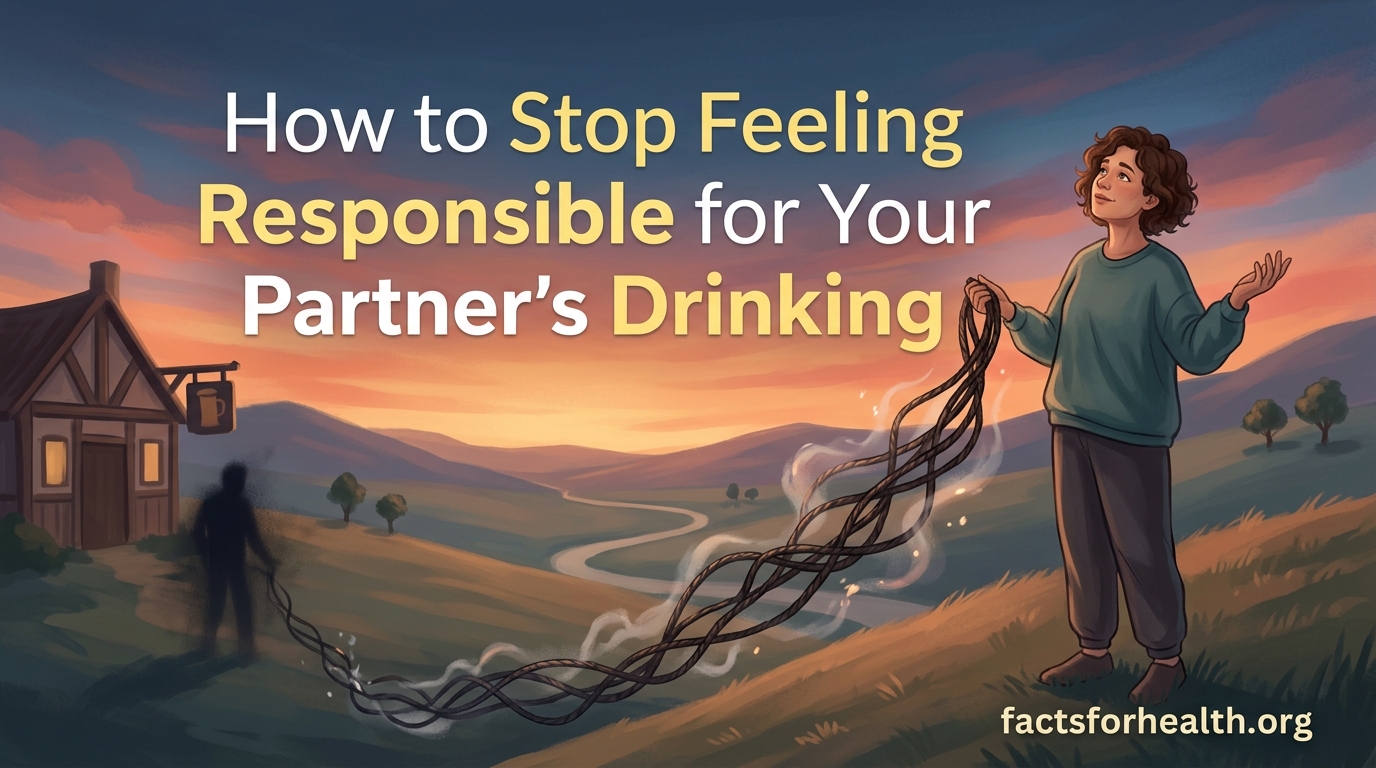
If you’ve ever stayed up waiting for the sound of the door, checked how many beers are in the fridge, or felt your stomach drop when your partner pours another glass, you already know the weight of this problem. Learning how to stop feeling responsible for my partner’s drinking starts with one uncomfortable truth: their drinking is not something you caused, can control, or can cure. That sentence is easy to read and painfully hard to believe when you’re living inside the situation.
You are not alone in feeling this way. Millions of people in relationships with partners who have alcohol use disorder (AUD) carry an enormous, invisible burden of guilt and responsibility. The anxiety creeps into every corner of your life, from your sleep to your friendships to your sense of self. It can feel like you are the only thing standing between your partner and disaster, and that belief is exhausting in ways that are hard to describe to someone who has never been through it.
This guide is written for you, not for them. We’re not going to talk about how to fix your partner’s drinking. Instead, we’re going to focus on your emotional experience, why those feelings of responsibility took root, and the concrete steps you can take to release the weight you were never supposed to carry. Our team has studied the psychology behind relationship guilt, codependency, and emotional boundaries to bring you actionable strategies that go far beyond generic advice.
Codependency is a pattern of behavior in which you prioritize another person’s needs, feelings, and choices above your own to the point of losing your sense of self. When you’re in a codependent relationship with a partner who drinks, you may unconsciously tie your emotional well-being to their sobriety. If they have a good day, you feel okay. If they drink, you feel like you failed. This is the cycle we’re going to help you break.
There are three core truths that Al-Anon and mental health professionals return to again and again. We want you to sit with these, even if they don’t feel true yet: You didn’t cause it. You can’t control it. You can’t cure it. The rest of this article will help you understand why you feel the way you do and give you practical tools to start living by those truths.
Table of Contents
Why You Feel Responsible for Your Partner’s Drinking
Feeling responsible for your partner’s drinking isn’t a character flaw. It’s a deeply human response to a situation that is confusing, painful, and often overwhelming. Understanding why those feelings exist is the first step toward releasing them, because you can’t let go of something you don’t fully understand.
The Psychology of Guilt in Relationships
Guilt in relationships with a partner who drinks is rarely rational. It doesn’t follow logic. You can know intellectually that you didn’t pour the drinks, didn’t create the triggers, and didn’t force the choices, and still feel a crushing sense of responsibility. That disconnect between what you know and what you feel is one of the most maddening parts of this experience.
Psychologists call this inappropriate guilt or guilt displacement. It happens when you absorb blame for things outside your control because the emotional environment makes you feel like you should have done more, noticed sooner, or been better. Your brain, desperate for a sense of control in an uncontrollable situation, convinces you that if you just tried harder, things would change.
This is reinforced by the unpredictable nature of alcohol use disorder. Some days your partner seems fine, and you think, “Maybe it wasn’t that bad.” Other days are terrible, and you think, “What did I do wrong?” The inconsistency keeps you off balance and makes the guilt feel justified, even when it isn’t.
Over time, guilt morphs into a kind of hypervigilance. You start monitoring your partner’s moods, counting drinks, watching for signs. You become a detective in your own home. This isn’t love gone wrong. It’s a trauma response. Your nervous system is stuck in fight-or-flight mode, scanning for danger that feels constant and unpredictable.
How Codependency Develops
Codependency doesn’t appear overnight. It builds slowly, one small accommodation at a time. Maybe you started by covering for your partner when they were hungover at a family event. Then you started hiding alcohol so they wouldn’t drink as much. Then you stopped seeing friends because you didn’t want to leave your partner alone. Each step felt like love, like loyalty, like the right thing to do.
But each of those steps was a brick in a wall that slowly trapped you. Codependency thrives on the illusion that if you just manage the situation well enough, everything will be fine. The problem is that no amount of management can control another person’s addiction. The more you try, the more entangled you become, and the harder it gets to see where their problems end and yours begin.
Codependent patterns often include putting your partner’s needs first, feeling anxious when you focus on yourself, believing your worth is tied to being needed, and struggling to identify your own feelings separate from your partner’s. These aren’t weaknesses. They’re learned survival strategies that worked at some point but are now hurting you.
When Childhood Patterns Follow You Into Adulthood
For many people, the roots of feeling responsible for others trace back to childhood. If you grew up in a household where a parent drank, was emotionally unavailable, or relied on you to meet their emotional needs, you likely learned early that love meant taking care of others. Children in these environments often become parentified, taking on adult responsibilities and emotional labor long before they’re developmentally ready.
Those children grow up. And they carry those patterns into adult relationships, often without realizing it. You may unconsciously seek out partners who need fixing because being needed feels like being loved. You may feel uncomfortable in calm, stable relationships because chaos is what feels familiar. This isn’t a conscious choice. It’s how your nervous system learned to operate.
Adult Children of Alcoholics (ACA) and similar programs exist specifically because these childhood patterns are so common and so powerful. Recognizing that your tendency to over-responsibility may have roots in your family history can be a profound and freeing realization. It means this pattern was wired into you long before your current partner came along.
That also means you can rewire it. Understanding the origin of a pattern is the first step in changing it. Therapy can be incredibly effective for this work, particularly approaches like cognitive behavioral therapy (CBT) and trauma-informed therapy that address both present behaviors and their historical roots.
The Role of Societal and Cultural Expectations
Society piles expectations onto partners, and those expectations can amplify guilt in ways that feel impossible to escape. Women in particular are often socialized to be caretakers, peacemakers, and emotional shock absorbers. Cultural messages about standing by your partner, for better or worse, can make leaving feel like failure and staying feel like duty.
Even well-meaning people contribute to the problem. Friends, family members, and even some therapists may unknowingly reinforce the idea that your partner’s behavior reflects on you. Comments like “How is he doing?” place you in the role of reporter and manager, as if your partner’s recovery is your project to oversee.
Religious and cultural communities can add another layer. Beliefs about marriage, loyalty, and redemption may keep you in a harmful situation far longer than you would otherwise stay. There’s often an unspoken message that if you were just more patient, more prayerful, or more supportive, your partner would change. That message is not just unhelpful. It’s damaging.
You did not create these expectations, and you do not have to carry them. Recognizing the external pressures that feed your guilt is an act of self-compassion. It allows you to separate what you actually believe from what you’ve been told to believe.
How External Comments Reinforce Your Guilt
One of the most isolating experiences for partners of people with AUD is dealing with comments from friends and family that seem supportive but actually pile on the pressure. No major article on this topic addresses this problem, but it comes up constantly in support forums and it deserves real attention.
Here’s a scenario that sounds familiar to many people in your position. Your partner has been sober for a few weeks. A friend or family member says something like, “He’s doing so much better. It must be because of you,” or “You’re such a good influence on him,” or “He really needs you to stay strong.” On the surface, these sound like compliments. But for someone already carrying too much responsibility, they land like a sledgehammer.
One person in an Al-Anon forum described it this way: people would tell them that the partner was staying sober for them, and it created enormous anxiety every time. The underlying message was that if they stumbled, the partner would too. When the relationship eventually ended and the partner relapsed, the guilt was crushing, even though the relapse was never their responsibility.
This is the responsibility transfer dynamic. Other people, uncomfortable with the reality of addiction, unconsciously hand the responsibility to the partner because it makes the situation feel more manageable. If someone is responsible, then someone can fix it. The randomness and powerlessness of addiction are too frightening, so people look for a narrative that makes sense. Unfortunately, that narrative puts the weight squarely on your shoulders.
How to Respond to These Comments
You don’t owe anyone an explanation, but having a few prepared responses can help you deflect the weight without being confrontational. Here are some you can use:
“He’s doing the work himself, and I’m proud of him.” This redirects the credit to your partner without accepting the responsibility yourself. It’s honest and it models healthy boundaries.
“His recovery is his journey. I’m focusing on my own growth.” This is a clear, kind statement that separates your path from theirs. It tells the other person, gently, that you are not the manager of your partner’s sobriety.
“I appreciate that, but I can’t take credit for someone else’s choices.” This works well for people who keep pushing. It’s polite but firm, and it reinforces the boundary.
“Let’s talk about something else. How are you doing?” Sometimes the best response is to redirect the conversation entirely. You are allowed to protect your peace.
Remember that these comments, while harmful, usually come from people who care. They simply don’t understand the weight their words carry. You can set the boundary without being unkind, and over time, people will learn to adjust their language.
Alcohol Use Disorder Is Not Your Fault
Alcohol use disorder is recognized by the medical community as a chronic, relapsing brain disease. It is not a moral failing, a lack of willpower, or the result of one person not being good enough. The American Medical Association, the World Health Organization, and the National Institute on Alcohol Abuse and Alcoholism all classify AUD as a medical condition with biological, psychological, and environmental causes.
Alcohol Use Disorder (AUD) is a medical condition characterized by an impaired ability to stop or control alcohol use despite adverse social, occupational, or health consequences. It ranges from mild to severe and involves changes in brain chemistry that affect decision-making, impulse control, and reward processing.
This matters because it directly confronts the belief that if you had just been better, different, more present, or less demanding, your partner wouldn’t drink. That belief assumes your partner’s drinking is a response to you. It isn’t. Your partner drinks because they have a condition that alters how their brain processes alcohol, rewards, and stress.
People develop AUD for a complex mix of reasons. Genetics account for roughly half of the risk. Trauma, mental health conditions like anxiety and depression, chronic stress, social environment, and early exposure to alcohol all play roles. Your behavior, no matter how imperfect, cannot cause or sustain an addiction in another person.
Separating Your Issues from Theirs
One of the most important shifts you can make is recognizing that you and your partner each have your own set of issues that need separate attention. Your partner has alcohol use disorder. You may have codependency, anxiety, or a pattern of over-responsibility. These are two different problems that require two different solutions.
Conflating them keeps you stuck. If you believe your partner will get better only when you become the perfect partner, you’re tying your healing to their behavior. But your healing can’t wait for their recovery. In fact, your healing may be the very thing that changes the dynamic between you, because when you stop over-functioning, the relationship has to find a new equilibrium.
This doesn’t mean your feelings aren’t real or valid. Anxiety, sadness, anger, and grief are all normal responses to loving someone with an addiction. The goal isn’t to stop feeling those things. The goal is to stop believing that your feelings are the cause of your partner’s drinking. They aren’t. They never were.
Think of it this way. If your partner had diabetes, you wouldn’t believe that your mood swings caused their blood sugar to spike. You’d support them in managing their condition, but you wouldn’t take responsibility for their insulin levels. AUD deserves the same framing. It’s a medical condition that requires professional treatment, and your role is not to manage it.
Supporting vs. Enabling: Knowing the Difference
The line between supporting and enabling is one of the most confusing aspects of loving someone with an addiction. Every caring instinct tells you to help, to smooth things over, to make life easier. But some forms of help actually make the problem worse by shielding your partner from the consequences of their drinking. Understanding the difference is one of the most powerful tools you have.
Enabling means doing things for your partner that they could and should do for themselves, particularly when those actions protect them from facing the natural consequences of their drinking. Enabling comes from love, but it inadvertently removes the very discomfort that might motivate someone to change.
Healthy support means being present and compassionate while allowing your partner to experience the consequences of their choices. It means encouraging treatment without forcing it, expressing concern without managing the problem, and maintaining your own boundaries throughout.
Here’s a side-by-side comparison to help you identify the difference in everyday situations:
Enabling vs. Healthy Support
- Enabling: Calling in sick to work for your partner because they’re hungover. Healthy Support: Letting them face their employer and deal with the consequences themselves.
- Enabling: Apologizing to friends or family for your partner’s drunk behavior. Healthy Support: Allowing your partner to make their own apologies and repair their own relationships.
- Enabling: Hiding or pouring out alcohol to control how much they drink. Healthy Support: Expressing your concern about their drinking and leaving the choice to them.
- Enabling: Paying off debts your partner incurred while drinking. Healthy Support: Refusing to financially rescue them so they face the reality of their spending.
- Enabling: Canceling your plans to stay home and monitor your partner. Healthy Support: Keeping your commitments and letting your partner manage their own evening.
- Enabling: Making excuses for their behavior (“He’s just stressed”). Healthy Support: Naming the behavior honestly (“He was drinking and acted inappropriately”).
- Enabling: Drinking with them to keep them company or control the pace. Healthy Support: Choosing not to drink and being clear about why, without lecturing.
- Enabling: Taking over all household responsibilities because they can’t. Healthy Support: Expecting them to contribute and letting natural consequences occur when they don’t.
Read through that list and ask yourself honestly how many of those enabling behaviors you’ve engaged in. If you find yourself nodding, don’t use that as ammunition for self-criticism. Nearly every partner of someone with AUD enables at some point. It comes from love and a desperate desire to help. The goal is awareness, not shame.
Here’s a quick self-check you can use in any situation: Am I doing this to prevent my partner from feeling discomfort, or am I doing this because it genuinely needs to be done? If the answer is the first one, you may be enabling. If your action only makes sense in the context of managing your partner’s drinking, that’s a strong signal to step back.
How to Stop Feeling Responsible: Actionable Steps
This is the section that directly answers your question. Learning how to stop feeling responsible for your partner’s drinking is not a single moment of insight. It’s a practice. A series of choices you make over and over until the new pattern becomes more natural than the old one. Here are the steps, grounded in psychology and the lived experience of people who have walked this path.
1. Acknowledge what is and isn’t yours to carry. Get specific. Write down everything you currently feel responsible for regarding your partner’s drinking. Then go through the list and mark each item as “mine” or “theirs.” Their decision to drink is theirs. Their recovery is theirs. Their triggers, their choices, and their consequences are theirs. Your boundaries, your self-care, your healing, and your responses are yours. This exercise, borrowed from CBT, makes the invisible visible and gives you something concrete to work with.
2. Stop monitoring your partner’s behavior. This is brutally hard, and it’s also one of the most freeing things you can do. Stop counting drinks. Stop checking the liquor cabinet. Stop tracking their mood for clues about whether they’ve been drinking. Every time you check, you reinforce the belief that their behavior is your responsibility to manage. Start small. Go one hour without checking. Then one evening. Then one day.
3. Let natural consequences play out. When you stop shielding your partner from the results of their drinking, the dynamic shifts. If they’re hungover at work, that’s between them and their boss. If they embarrass themselves at a social event, they get to feel the embarrassment. This doesn’t mean you’re being cruel. It means you’re respecting their autonomy and allowing reality to do what your interventions have been preventing.
4. Join a support group. Al-Anon is the most widely available and widely recommended resource for partners and family members of people with AUD. It’s free, it’s anonymous, and it works. You’ll meet people who have felt exactly what you’re feeling and have found their way through. If Al-Anon isn’t the right fit, SMART Recovery Family and Friends offers a science-based alternative. The simple act of being in a room (or a Zoom call) with people who get it can be transformative.
5. Seek individual therapy. A therapist who specializes in codependency, addiction in the family, or relationship dynamics can help you untangle the patterns that keep you stuck. CBT is particularly effective for addressing the guilt and distorted thinking that fuel over-responsibility. If cost is a barrier, many community mental health centers and training clinics offer sliding-scale therapy.
6. Practice saying “that’s not mine” in your mind. When the anxiety hits, when you feel the pull to check, to manage, to fix, pause. Take a breath. Say to yourself, silently or out loud, “That’s not mine.” This sounds overly simple, but it’s a technique rooted in cognitive defusion, a core CBT and ACT (Acceptance and Commitment Therapy) practice. Over time, it creates mental space between you and the automatic response to take responsibility.
7. Reconnect with yourself. When you’ve been focused on someone else’s drinking for months or years, you lose touch with your own wants, needs, and identity. What do you enjoy? What are your goals? Start small. Take a walk alone. Reconnect with a friend. Take a class. Each act of self-focus is a quiet rebellion against the belief that your purpose is to manage your partner’s life.
8. Grieve what you can’t control. There is real grief in accepting that you cannot save someone you love from themselves. Let yourself feel it. Cry, journal, talk to a therapist, sit with the sadness. Grief is not a sign of weakness. It’s the bridge between the fantasy of control and the reality of acceptance. On the other side of that grief is a version of your life that is lighter, more honest, and more yours.
These steps are not linear. You’ll move forward and fall back. You’ll have good weeks and bad ones. That’s normal. The goal isn’t perfection. It’s progress. Each time you choose not to monitor, not to enable, and not to take the blame, you’re rewiring a pattern. It gets easier, even when it doesn’t feel like it will.
Detaching with Love: What It Really Means
Detaching with love is one of the most important and most misunderstood concepts in recovery for family members of people with addiction. The phrase comes from Al-Anon, and it describes a way of relating to your partner that is both compassionate and boundaried. It is not the same as giving up, and it is not cold or uncaring.
Detaching with love means stepping back emotionally from your partner’s drinking and its consequences while maintaining your care and compassion for them as a person. It means accepting that you cannot control their choices, refusing to let their behavior dictate your emotional state, and focusing your energy on your own life and healing.
People often confuse detaching with abandoning. They worry that if they stop monitoring, worrying, and trying to fix things, they’re giving up on their partner. But detachment isn’t about your partner at all. It’s about you. It’s about reclaiming your emotional independence so that your well-being doesn’t rise and fall with someone else’s sobriety.
Detaching with love looks like this in practice. You express concern about your partner’s drinking once, calmly and clearly, and then you let it go. You don’t repeat yourself, plead, or argue. You go about your day regardless of whether they’ve been drinking. You don’t adjust your plans, your mood, or your self-worth based on their behavior. You stay in the relationship (if you choose to) as a partner, not a parent or a warden.
It also means accepting some hard realities. Your partner may not change. They may get worse. They may relapse. Detaching with love means making peace with those possibilities without letting them destroy you. You can hope for the best while preparing for other outcomes. That isn’t pessimism. It’s wisdom.
What Detaching with Love Is NOT
It is not ignoring your partner or punishing them with silence. It is not building walls or being cold. It is not abandoning the relationship (unless you choose to, which is a separate decision). It is not about giving up on your partner’s potential. Detaching with love is about giving up on the illusion that you can control their drinking, which is actually a gift to both of you.
When you stop over-functioning, your partner is forced to confront their own choices without your buffer. Some partners respond to this by getting worse before they get better. Others, faced with the reality of their behavior for the first time, begin to seek help. You can’t predict which way it will go, and that uncertainty is part of the process. What you can control is your own stability, your own peace, and your own growth.
Setting Healthy Boundaries with Your Partner
Boundaries are the practical expression of detaching with love. A boundary is not a rule for your partner. It’s a rule for yourself. It defines what you will and won’t accept, and what you’ll do if your limits are crossed. The difference between a boundary and an ultimatum is that a boundary is about your behavior, while an ultimatum is an attempt to control theirs.
Here’s how to set a boundary effectively. First, identify what you need. Maybe you need to not be around your partner when they’re drunk. Maybe you need them to not drink in the house. Maybe you need to protect your finances from their drinking-related spending. Whatever it is, get clear on it before you communicate.
Second, state the boundary simply and directly. “I’m not willing to be in the house when you’ve been drinking. If you drink, I’ll go to a friend’s house for the night.” Notice the structure. It’s clear, it’s specific, and it focuses on what you will do, not what your partner must do.
Third, follow through. This is where most boundaries fail. If you state a boundary but don’t enforce it, you teach your partner that your words don’t mean anything. Following through doesn’t require anger or drama. It just requires consistency. If they drink, you leave. Every single time. The consistency is what makes it a boundary rather than a suggestion.
Here are some examples of healthy boundaries with a partner who drinks. You will not lie or make excuses for their drinking-related behavior. You will not engage in serious conversations when they’ve been drinking. You will not provide money that could be used for alcohol. You will not cancel plans to accommodate their drinking. You will keep separate finances to protect your financial security. You will not tolerate verbal abuse or aggression, and you will leave the situation if it occurs.
Setting boundaries for the first time often triggers anxiety, guilt, and sometimes conflict. Your partner may resist, especially if they’re used to you accommodating their behavior. Stay calm. Stay consistent. Remember that a boundary isn’t a punishment. It’s a form of self-respect that ultimately creates a healthier dynamic for both of you.
Practicing Self-Care and Protecting Your Mental Health
Self-care isn’t a luxury when you’re in a relationship with someone who drinks. It’s survival. The chronic stress of monitoring, worrying, and adapting takes a real toll on your body and mind. Sleep problems, anxiety, depression, digestive issues, and weakened immune function are all common among partners of people with AUD. You cannot pour from an empty cup, and right now, your cup is likely very low.
Physical self-care matters. Prioritize sleep, even if your partner’s drinking disrupts your nights. Consider sleeping in a separate room if you need to. Eat regularly, even when stress kills your appetite. Move your body every day, even if it’s just a walk. These sound basic, but they’re often the first things to go when you’re in survival mode.
Emotional self-care matters just as much. Reconnect with friends you’ve drifted away from. Do things that are purely for your enjoyment, with no connection to your partner or their recovery. Give yourself permission to feel angry, sad, scared, and tired without judging those feelings. Your emotions are information, not character flaws.
Journaling Prompts for Processing Guilt
Journaling is a powerful tool for untangling the guilt and responsibility that feel overwhelming in your head. Try writing in response to these prompts for five to ten minutes each day:
- What specifically do I feel responsible for? Is each thing actually within my control?
- When did I first start feeling responsible for other people’s feelings or behavior?
- What would I tell a friend who was in my exact situation?
- What is one thing I did today that was just for me?
- What am I afraid will happen if I let go of responsibility for my partner’s drinking?
- Whose voice in my head says this is my fault? Is that voice telling the truth?
- What does a healthy, happy version of my life look like, independent of my partner’s sobriety?
A CBT Exercise for Releasing Responsibility
This exercise is based on cognitive restructuring, a core CBT technique for challenging distorted thinking. When you notice a guilt-driven thought, write it down. Then run it through these steps.
Step 1: Identify the thought. For example, “If I had been home last night, he wouldn’t have drunk so much.”
Step 2: Examine the evidence. Has your presence actually prevented him from drinking in the past? Has he ever drunk while you were home? Be honest with the data.
Step 3: Identify the distortion. This thought reflects “personalization,” a cognitive distortion where you take responsibility for events outside your control.
Step 4: Reframe the thought. “His drinking is his choice, regardless of whether I’m home. My presence or absence doesn’t cause his behavior.”
Step 5: Notice how the reframed thought feels. Does it bring even a small sense of relief? That relief is a sign you’re moving in the right direction. Repeat this exercise whenever a guilt-driven thought arises. Over time, the reframing becomes more automatic.
When to Seek Professional Help or Consider Leaving
There is a point where individual efforts aren’t enough, and professional intervention becomes necessary. Knowing when you’ve reached that point can save your mental health, your safety, and sometimes your life.
Seek professional help immediately if you’re experiencing symptoms of depression or anxiety that interfere with your daily functioning. If you’re having panic attacks, suicidal thoughts, or feeling emotionally numb, these are signs that your nervous system is overwhelmed. A therapist can help. You don’t need to be in crisis to benefit from therapy. In fact, the earlier you go, the more effective it is.
Couples counseling can be helpful, but only if both partners are willing and the counselor has experience with addiction. Couples therapy with a partner who is actively in denial about their drinking can sometimes do more harm than good. Individual therapy for each of you is usually the better starting point.
Consider leaving if your partner’s drinking involves any form of abuse, physical, emotional, verbal, or financial. Abuse is non-negotiable. No amount of love or commitment justifies staying in a dangerous situation. Other signs that leaving may be the healthiest choice include your partner refusing to acknowledge the problem, your mental or physical health deteriorating, your partner’s drinking escalating despite your boundaries, or you feeling like a stranger in your own life.
Making the decision to leave is deeply personal, and no one should make it for you. But you deserve to live in a situation that feels safe, respectful, and nourishing. If your current relationship cannot offer that, you are allowed to choose yourself.
If you are in immediate danger, call your local emergency services. If you need support for domestic violence, the National Domestic Violence Hotline is available 24/7.
FAQs
How to cope with a partner who drinks too much?
Start by recognizing that their drinking is not your fault and that you cannot control their choices. Set clear boundaries around what you will and won’t tolerate, join a support group like Al-Anon, seek individual therapy for yourself, and focus on your own well-being rather than trying to manage their behavior.
Can you have a healthy relationship with an alcoholic?
A healthy relationship is possible only if the person with alcohol use disorder is actively in recovery or treatment, both partners are committed to honest communication, and clear boundaries are in place. If your partner is not willing to acknowledge the problem or seek help, prioritizing your own safety and mental health may mean considering separation.
When should I be worried about my partner’s drinking?
You should be concerned when drinking causes problems in relationships, work, or health. Other warning signs include hiding or lying about drinking, being unable to stop after one or two drinks, drinking to cope with emotions, needing alcohol to function socially, or experiencing withdrawal symptoms like shaking or anxiety when not drinking.
Why do I get anxious when my partner drinks?
You may feel anxious because you have unconsciously taken responsibility for your partner’s behavior, a common pattern in codependent relationships. The anxiety stems from a combination of past negative experiences, fear of conflict or consequences, hypervigilance from living in an unpredictable environment, and a deep desire to control outcomes that are not yours to control.
Is it my fault that my partner drinks?
No, it is not your fault. Alcohol use disorder is a medical condition caused by a combination of genetic, environmental, psychological, and biological factors. No amount of being better, more supportive, or more present can cause or cure another person’s addiction. Your partner’s drinking is their responsibility, not yours.
How do I stop enabling my partner’s drinking?
Stop covering for your partner’s drinking-related mistakes, let natural consequences play out, refuse to provide money that could be used for alcohol, stop hiding or pouring out alcohol, maintain your own plans and social life instead of monitoring their behavior, and express concern honestly without trying to manage their choices.
Crisis Resources and Helplines
You don’t have to navigate this alone. The following organizations provide free, confidential support:
- SAMHSA National Helpline: 1-800-662-4357. Free, confidential, 24/7 treatment referral and information service for individuals and families facing mental and substance use disorders.
- Al-Anon Family Groups: al-anon.org. Free support groups for friends and family of people with drinking problems. Meetings available in person and online worldwide.
- SMART Recovery Family and Friends: smartrecovery.org. Science-based, secular alternative to Al-Anon with online meetings and resources.
- National Domestic Violence Hotline: 1-800-799-7233 or text START to 88788. Available 24/7 if you feel unsafe in your relationship.
- 988 Suicide and Crisis Lifeline: Call or text 988. Free, confidential support if you are in emotional distress or crisis.
Conclusion
Learning how to stop feeling responsible for my partner’s drinking is not a switch you flip. It’s a practice, a daily choice to release weight that was never yours to carry. You didn’t cause their drinking. You can’t control it. You can’t cure it. What you can do is take responsibility for your own healing, your own boundaries, and your own life.
Start with one step from this guide. Maybe it’s writing down what is and isn’t yours to carry. Maybe it’s finding an Al-Anon meeting. Maybe it’s setting one boundary this week. Small actions, repeated consistently, create real change. You deserve a life that is defined by your own choices and joy, not by someone else’s drinking. That life is possible, and it starts with the decision to put yourself first.