
You are five years sober. Maybe ten. You have built a life that looks nothing like the one you left behind. Meetings became less frequent, therapy wrapped up, and the daily fight faded into background noise. Then one Tuesday afternoon, out of nowhere, a craving hits so hard it knocks the wind out of you.
If this has happened to you, you are not alone. People in recovery forums, support groups, and therapy offices ask the same question every single week: why do cravings hit years into sobriety? The confusion is understandable. You did the work. You put in the time. You thought this part was behind you.
Here is the truth that most people in long-term recovery eventually learn. Cravings do not follow a neat timeline. They do not respect your sobriety milestones. And they are absolutely not a sign that your recovery has failed.
Cravings years into sobriety happen because addiction creates neural pathways in the brain that weaken with disuse but never fully disappear. Stress, life transitions, emotional avoidance, and even positive events can reactivate these dormant pathways. The craving you feel is not your body demanding a substance. It is your brain reaching for an old solution to a new problem.
In this guide, we will break down exactly what is happening in your brain, why cravings resurface when they do, and what you can do about it. Whether you are six months sober or sixteen years in, understanding the mechanics behind late-stage cravings can transform them from terrifying setbacks into useful information.
Table of Contents
Why Do Cravings Hit Years Into Sobriety? The Neural Pathway Explanation
Cravings hit years into sobriety because addiction physically rewires the brain, creating neural pathways in the basal ganglia that never fully erase. These pathways weaken through disuse during recovery, but the underlying circuitry remains dormant and can be reactivated by stress, familiar cues, or emotional distress even after years of sobriety. Your brain does not delete old habits. It builds new ones alongside them.
This is the core neurological explanation, and it is worth understanding in detail. When you were actively using alcohol or drugs, your brain learned a powerful association: substance equals relief, reward, escape, or celebration. The basal ganglia, a region deep in the brain responsible for habit formation and reward processing, carved a pathway so strong that it became automatic. You did not have to think about drinking or using. Your brain did it for you.
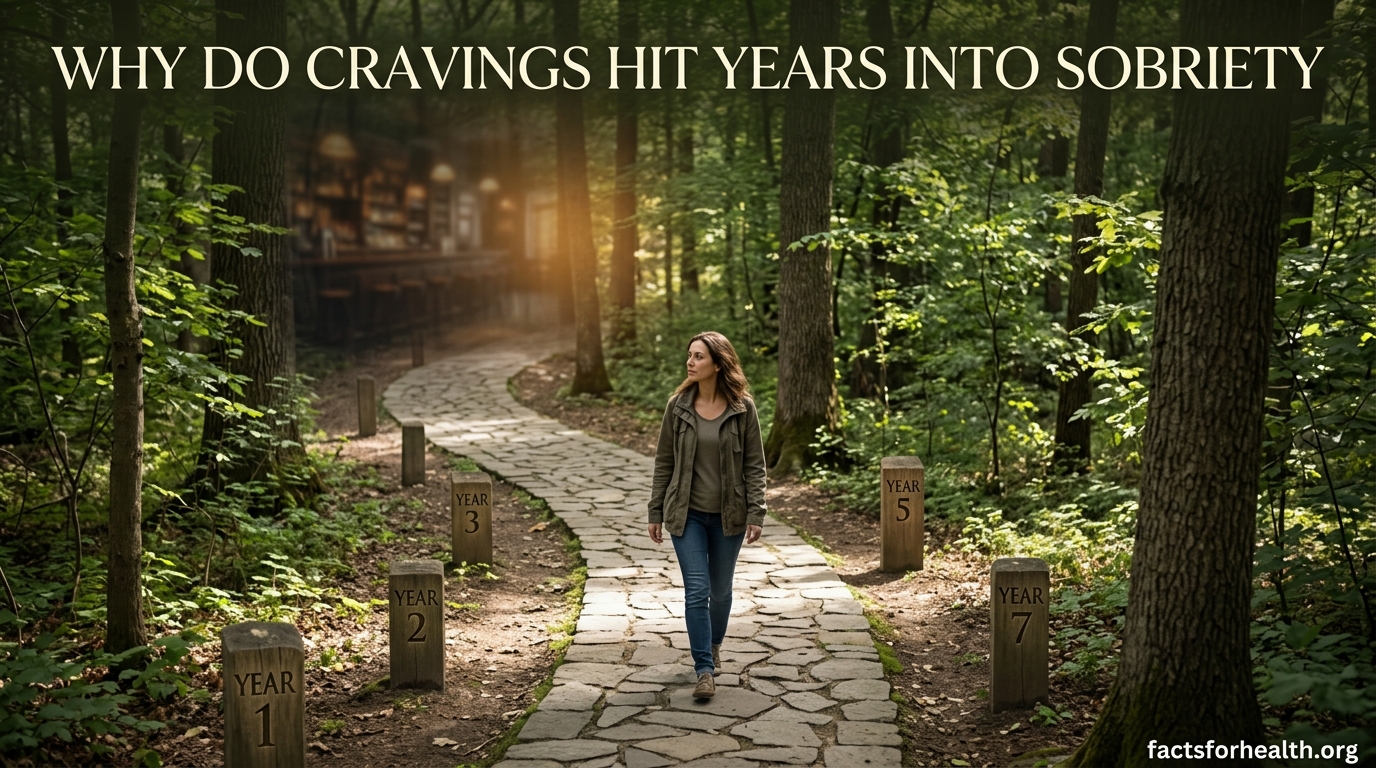
Recovery does not erase that pathway. Instead, through a process called neuroplasticity, your brain builds new pathways that compete with the old ones. Think of it like a hiking trail in the woods. The old addiction trail is overgrown now, covered in brush and hard to see. But it is still there beneath the weeds. All it takes is someone walking it again, even once, for the path to become visible again.
This is why recovery is often described as substitution, not deletion. You are not removing the old neural pathway. You are building healthier alternatives that your brain learns to prefer. The dopamine system, which was hijacked during active addiction, gradually recalibrates. Normal pleasures start to feel rewarding again. Life without substances begins to feel sustainable.
But the old pathway remains. And certain conditions can wake it up. A spike in cortisol, the stress hormone, can lower your brain’s resistance to old patterns. An unexpected emotional wave can send your brain searching for the fastest, most familiar source of relief it knows. Even positive excitement, like a promotion or a wedding, can trigger the celebration circuit that your brain once associated with drinking or using.
The key insight is this: a late-stage craving does not mean your recovery has failed or your brain is broken. It means a dormant neural pathway just got reactivated by something in your current life. Your job is to figure out what that something is.
The Incubation Effect: Why Cravings Can Get Stronger Over Time
Researchers studying addiction have identified a counterintuitive phenomenon called the incubation of craving. In multiple studies, they found that cue-induced cravings do not always weaken over time. In some cases, they actually intensify during prolonged abstinence. This research, highlighted by Psychology Today, challenges the common assumption that cravings simply fade away the longer you stay sober.
The incubation effect helps explain why someone can feel relatively craving-free during their first year of recovery, only to experience a powerful urge three or five years in. The neural pathways associated with substance use can go through periods of dormancy, during which you barely think about using. Then, when the right trigger arrives, the pathway fires with surprising intensity.
Think of it like a seed buried in soil. It can sit there for years, doing nothing. But when the right combination of moisture, temperature, and light arrives, it sprouts. The craving was not growing stronger underground. It was waiting for the right conditions.
This is why understanding your personal triggers matters so much in long-term recovery. The incubation effect means that time alone does not protect you from cravings. Awareness, tools, and ongoing maintenance do.
Common Triggers That Resurface in Long-Term Recovery
Understanding why cravings hit years into sobriety requires looking at the specific triggers that reactivate dormant neural pathways. Almost every late-stage craving can be traced back to one of the following categories.
Stress and Cortisol Spikes
Stress is the number one trigger for cravings at any stage of recovery. When you experience a stressor, your body releases cortisol, which disrupts the brain’s reward system and reduces impulse control. Even if you have been sober for years, a sudden spike in stress, whether from a work crisis, a family conflict, or financial pressure, can make the old neural pathway light up like a neon sign.
Your brain does not differentiate between types of stress. A deadline at work triggers the same chemical response as a genuine threat. And the brain’s solution, the one it learned during active addiction, was to reach for the substance. Even though you no longer use, the brain still has that emergency response stored in its circuitry.
Life Transitions and Milestones
Major life changes are one of the most common triggers for late-stage cravings. Divorce, job loss, retirement, relocation, the death of a loved one, or even positive transitions like a new job or a new baby can destabilize your emotional equilibrium. Your brain interprets the disruption as a threat and reaches for the familiar coping mechanism.
Retirement is a particularly overlooked trigger. People who maintained sobriety through decades of working life often struggle when the structure of their daily routine disappears. Without the built-in schedule of work, the brain has more idle time, and idle time is fertile ground for old pathways to reactivate.
Euphoric Recall and Nostalgia
Euphoric recall is the brain’s tendency to remember the positive aspects of past substance use while conveniently forgetting the negative consequences. Over time, your brain softens the memories of rock bottom. The hangovers, the shame, the broken relationships fade. What remains is a highlight reel of the good times, the relaxed evenings, the social bonding, the numbed pain.
This selective memory is not a character flaw. It is how human memory works with all experiences. But in the context of addiction recovery, euphoric recall can be dangerous because it makes the old pathway feel appealing again. The craving is not for the reality of addiction. It is for the romanticized version your brain has constructed.
The Depleted Nervous System State
One of the most overlooked triggers in long-term recovery is what addiction specialists call a depleted nervous system state. This happens when you have been running on empty for too long. Poor sleep, skipped meals, chronic stress, lack of exercise, and emotional suppression all drain your nervous system’s reserves.
When your nervous system is depleted, your brain’s ability to regulate impulses drops dramatically. You become more vulnerable to old pathways not because anything specific triggered them, but because your defenses are simply too low to keep them suppressed. Many people in long-term recovery report that their worst cravings came during periods when they were not taking care of their basic physical needs.
This is a pattern that competitors rarely address, but it is critical. Self-care is not a luxury in recovery. It is a relapse prevention strategy. Eating regularly, sleeping enough, moving your body, and managing stress are not optional wellness activities. They are the foundation that keeps your nervous system resilient enough to resist old neural pathways.
The Structure Erosion Pattern
Structure erosion is the gradual process of abandoning the tools and routines that supported your early recovery. It does not happen overnight. It happens slowly, one small concession at a time. You skip a meeting because you are tired. You cancel a therapy appointment because work is busy. You stop calling your sponsor because you feel fine. You stop journaling because you do not feel like you need it anymore.
Each individual decision feels reasonable. But together, they create a pattern. The structure that protected you in early recovery slowly erodes, and with it, your resistance to cravings weakens. This is what recovery communities call the complacency trap, and it is one of the most common reasons people experience intense cravings years into sobriety.
The cruel irony is that structure erosion often happens precisely because recovery is going well. You feel stable, so you let go of the tools that made you stable. The stability was never self-sustaining. It was the product of the tools. Remove the tools, and the stability begins to crack.
Ritual Absence: Missing the Routine, Not the Substance
Here is something that surprises many people in long-term recovery. Sometimes a craving is not about the substance at all. It is about the ritual. The act of pouring a drink after work, the routine of rolling a joint before bed, the ceremony of opening a bottle to mark the end of the day. These rituals were deeply embedded in your daily life, and they served a purpose beyond the chemical effect.
When you got sober, you removed the substance but you may not have replaced the ritual. Years later, your brain still recognizes the time of day, the context, or the emotional state that used to trigger the ritual. Without a replacement, the brain reaches for the old one. The craving you feel is your brain asking for structure, for a way to mark a transition, for a familiar rhythm in your day.
This is why building new rituals is so important in long-term recovery. An evening walk, a cup of tea, a phone call with a friend, a workout, a creative practice. These are not just healthy habits. They are replacement rituals that give your brain the structure it is looking for without reactivating the old pathway.
Positive Events and Celebrations
Most people understand stress as a trigger. But one of the most insidious triggers in long-term recovery is positive emotion. A promotion, a wedding, a reunion, a vacation, a holiday party. Your brain learned to associate celebration with substance use, and that association does not disappear just because you have been sober for years.
This is why cravings often hit during good times, not just bad ones. The brain’s celebration circuit fires, and it looks for the familiar way to amplify the joy. Someone hands you a champagne glass at a wedding, and your brain does the math before your conscious mind catches up. The craving can feel confusing because everything in your life is going well. Why would you want to drink?
The answer is that the craving is not about wanting to escape pain. It is about the brain’s conditioned response to a celebratory context. Recognizing this pattern can help you prepare for high-risk positive events before they catch you off guard.
The Emotional Roots: What Your Craving Is Actually Telling You
One of the biggest content gaps in addiction recovery resources is the connection between emotional avoidance and late-stage cravings. Many people in long-term recovery have addressed the physical aspects of addiction but have not fully processed the emotional landscape underneath.
Here is the framework we recommend. When a craving hits years into sobriety, treat it as a diagnostic signal, not a threat. The craving is trying to tell you something. Your job is to decode it. Ask yourself these four questions:
1. What happened in the last 24 to 48 hours? Look for both obvious stressors and subtle shifts. An offhand comment from a coworker, a change in your sleep pattern, an interaction that left you slightly unsettled. Cravings often surface a day or two after the triggering event, not immediately.
2. What emotion am I avoiding right now? This is the hardest question and the most important. Anger, grief, loneliness, boredom, fear, even joy. If you sit quietly and let yourself feel what is underneath the craving, the answer usually surfaces. The craving is your brain’s old way of not feeling that emotion.
3. What need is not being met? Connection, rest, stimulation, safety, validation, escape. Cravings in long-term recovery are often about unmet needs that you have been ignoring. The substance was a shortcut to meeting those needs. Without it, you have to find real solutions.
4. What would actually help right now? Once you identify the underlying need, you can respond directly. If the need is connection, call someone. If the need is rest, sleep. If the need is stimulation, move your body or do something engaging. If the need is escape, find a healthy way to disconnect temporarily.
This decode-and-respond framework transforms cravings from terrifying setbacks into useful data. Every craving in long-term recovery is your brain waving a flag, pointing at something that needs attention. The more you practice reading the signal, the more you trust yourself to handle whatever comes up.
PAWS and Long-Term Brain Chemistry
Post-Acute Withdrawal Syndrome, or PAWS, is a set of persistent withdrawal symptoms that can last months or even years after the acute withdrawal phase ends. Symptoms include mood swings, anxiety, irritability, sleep disturbances, and difficulty concentrating. For some people, PAWS also includes periodic cravings that come and go in waves.
PAWS occurs because the brain’s neurotransmitter systems, particularly dopamine and serotonin, take a long time to fully recalibrate after extended substance use. The timeline varies by substance, duration of use, and individual factors, but it is not uncommon for PAWS symptoms to persist for 12 to 24 months. In some cases, subtle symptoms can linger even longer.
The connection to late-stage cravings is important. If you are two or three years into recovery and still experiencing periodic waves of cravings alongside mood fluctuations or sleep issues, PAWS may be a contributing factor. Your brain is still fine-tuning its chemistry, and that process can create vulnerability windows where cravings surface.
Understanding PAWS can help normalize the experience. It is not a personal failure. It is your brain continuing to heal at a pace that does not always match your sobriety milestones.
Coping Strategies: What to Do When a Craving Hits Years Into Sobriety
Understanding why cravings hit is half the battle. Knowing what to do when one arrives is the other half. Here are the most effective, evidence-based strategies for handling late-stage cravings.
Ride the Wave (Urge Surfing)
Cravings are waves. They build, they peak, and they pass. The technique called urge surfing, popularized in mindfulness-based relapse prevention, teaches you to observe the craving without fighting it or feeding it. You notice the urge, you acknowledge it, and you watch it crest and subside.
Most cravings peak within 10 to 20 minutes. If you can ride the wave without acting on it, it will pass on its own. Fighting the craving often intensifies it. Observing it with curiosity, rather than fear, reduces its power.
The 15-Minute Rule
When a craving hits, commit to waiting 15 minutes before doing anything. Set a timer. During those 15 minutes, do something different: take a walk, call someone, take a cold shower, do pushups, listen to music. The goal is not to suppress the craving but to give your brain time to let the wave pass. After 15 minutes, reassess. Most cravings will have significantly weakened or disappeared entirely.
Check HALT First
HALT stands for Hungry, Angry, Lonely, Tired. These four states are the most common precursors to cravings at any stage of recovery. Before you do anything else, check in with yourself. Are you hungry? Eat something. Angry? Express it safely or process it. Lonely? Reach out to someone. Tired? Rest.
HALT works because it addresses the depleted nervous system state directly. Many late-stage cravings are simply your body’s alarm system telling you that a basic need is not being met. Fix the need, and the craving often resolves on its own.
Reach Out Immediately
Connection is the opposite of addiction. When a craving hits, the instinct to isolate is one of the most dangerous responses. Reaching out to another person, whether that is a sponsor, a recovery friend, a family member, or a hotline counselor, interrupts the craving circuit in your brain.
You do not need to have a profound conversation. You just need to break the isolation. Even a brief text exchange or a five-minute phone call can be enough to shift your brain out of the craving loop and back into the present moment.
Ground Yourself in the Present
Cravings pull your brain into the past, toward euphoric recall, or into the future, toward anxiety about relapse. Grounding techniques bring you back to the present moment. Try the 5-4-3-2-1 technique: name five things you see, four things you feel, three things you hear, two things you smell, and one thing you taste. This sensory engagement forces your brain to process current reality rather than replaying old patterns.
Use the Decode-and-Respond Framework
After the immediate intensity passes, use the four-question framework we outlined earlier. What happened recently? What emotion are you avoiding? What need is unmet? What would actually help? This turns every craving into an opportunity for self-understanding rather than a source of fear.
When to Pay Attention: Warning Signs of Relapse Risk
Most late-stage cravings are normal and manageable. But certain patterns should be taken seriously as warning signs of elevated relapse risk.
Increasing frequency or intensity. If cravings that were once rare start appearing weekly or daily, or if the intensity feels closer to early-recovery levels, something has shifted. This is often the first sign that your recovery structure has eroded or that a major stressor is building beneath the surface.
Romanticizing past use. Pay attention to your internal narrative. If you find yourself thinking about the good old days of drinking or using, replaying positive memories, or telling yourself you could handle just one, your brain is laying the groundwork for relapse. Euphoric recall is normal in passing, but when it becomes a recurring thought pattern, it is a red flag.
Isolating from support. If you have stopped going to meetings, stopped calling your sponsor, stopped talking to recovery friends, and stopped engaging with your support network, you are more vulnerable than you realize. Isolation removes the accountability and connection that keep old pathways suppressed.
The structure erosion pattern. We covered this earlier, but it deserves repeating here as a warning sign. If you have gradually let go of most of your recovery tools and routines, you are in a high-risk state. The fix is not complicated. Reconnect with the tools that worked in early recovery, even if you do not feel like you need them right now.
Planning around the craving. The line between a craving and a relapse is crossed when you start planning. If you find yourself thinking about how you would get the substance, when you would use it, or how you could hide it, you need to seek help immediately. Call your sponsor, your therapist, or a recovery hotline right away.
If you notice any of these patterns, reaching out for professional support is the right move. A therapist who specializes in addiction recovery can help you identify what has shifted and rebuild your recovery structure before a craving becomes a relapse. There is no shame in needing a tune-up, even years into recovery.
FAQs
Is it normal to have cravings years into sobriety?
Yes, it is completely normal. Cravings years into sobriety happen because the neural pathways addiction created never fully disappear. They weaken with disuse but can be reactivated by stress, life transitions, emotional distress, or familiar cues. Experiencing a craving after years of sobriety does not mean your recovery has failed.
Do alcohol cravings ever go away completely?
For most people, cravings become less frequent and less intense over time, but they do not disappear completely for everyone. The neural pathways associated with drinking remain dormant in the brain and can resurface under certain conditions. The goal of long-term recovery is not to eliminate cravings entirely but to build the skills and tools to manage them effectively when they arise.
What is the hardest year of sobriety?
The first year is generally considered the hardest because the brain is still going through acute withdrawal, early post-acute withdrawal syndrome, and the steepest part of the neuroplasticity curve. However, many people in recovery report that specific milestones, such as years 2 through 5, bring their own challenges as the initial novelty of sobriety fades and life stressors accumulate. There is no single hardest year for everyone.
Why do people relapse after years of sobriety?
People relapse after years of sobriety most often due to a combination of factors: gradual erosion of recovery routines and support structures, unaddressed emotional issues, major life transitions, depleted nervous system state from poor self-care, and euphoric recall that romanticizes past use. Relapse after long-term sobriety is rarely caused by a single event but rather by a slow accumulation of vulnerabilities.
Why do I crave sweets since I quit drinking?
Craving sweets after quitting drinking is very common. Alcohol affects the same dopamine reward system that sugar stimulates. When you remove alcohol, your brain seeks alternative sources of dopamine, and sugar is a readily available one. Additionally, many alcoholic beverages contain significant sugar, and your body may be missing that intake. Sugar cravings typically decrease as your brain chemistry rebalances over time.
How long do cravings last when they hit years into recovery?
Individual cravings typically peak within 10 to 20 minutes and subside on their own if not acted upon. However, the frequency of late-stage cravings varies widely depending on triggers, stress levels, and the state of your recovery maintenance. Some people experience occasional cravings months or years apart, while others may notice clusters during particularly stressful or transitional periods.
What Cravings Years Into Sobriety Really Mean
Cravings years into sobriety are not evidence that you are doing recovery wrong. They are proof that your brain was changed by addiction and continues to heal on its own timeline. Every person in long-term recovery experiences them at some point.
The question of why do cravings hit years into sobriety has a simple answer and a complex one. The simple answer is that neural pathways do not erase. The complex answer is that every craving carries information about what your brain and body need right now.
Keep your tools sharp. Stay connected to your support system. Take care of your nervous system. And when a craving arrives, treat it as a messenger, not an enemy. It is pointing at something that needs your attention. Listen to it, decode it, respond to the underlying need, and let the wave pass.
You have come too far to let a dormant pathway tell you who you are. You are someone in recovery. And cravings, even years in, are just part of that journey.