
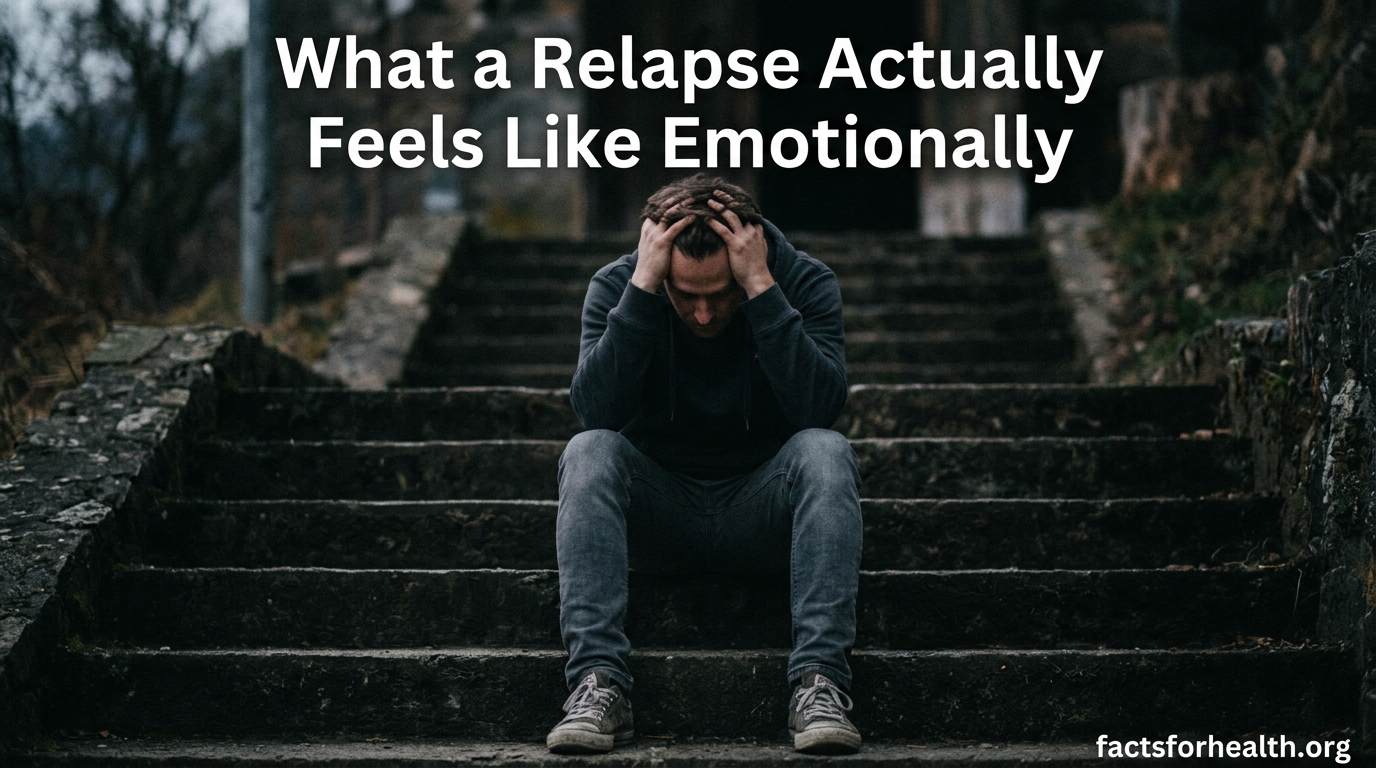
If you have ever found yourself sitting in the dark after a relapse, wondering how you got there, you are not alone. Understanding what a relapse actually feels like emotionally can help you recognize the warning signs before things spiral. The emotional experience of relapse is far more complex than most people realize, and it starts long before any substance enters your body.
Relapse is not a single moment of weakness. It is a gradual process that unfolds across three distinct stages, each with its own emotional signature. By the time most people recognize what is happening, they are already deep into the cycle. That is why we wrote this guide, to describe the feelings, thought patterns, and body sensations that accompany each stage in vivid, honest detail.
We drew from clinical research, recovery communities, and real first-person accounts to paint a picture that goes beyond textbook definitions. Whether you are in recovery yourself, supporting someone who is, or simply trying to understand the experience, this article will walk you through every layer of what relapse feels like emotionally.
Relapse is common. Research published in the Yale Journal of Biology and Medicine estimates that relapse rates for substance use disorders are similar to those for other chronic conditions like asthma or hypertension, roughly 40 to 60 percent. Almost everyone living with substance use disorder experiences a return to use at some point. It does not mean you have failed or that long-term recovery is out of reach.
Table of Contents
How Does a Relapse Feel? The Short Answer
A relapse often begins as a slow emotional drift before it becomes physical. Emotionally, it can feel like waves of guilt, anger, frustration, restlessness, irritability, and discontent building over days or weeks. Many people describe feeling “uncomfortable in their own skin” long before they consciously think about using again. There is a growing sense that something is wrong, but the feeling is hard to name, which is exactly what makes emotional relapse so dangerous.
As the process continues into mental relapse, it feels like a war inside your mind. One part of you fights to stay sober while another part whispers that you deserve relief. After physical relapse occurs, the dominant emotions are typically shame, guilt, self-loathing, and a feeling that all progress has been erased. The moment after a relapse often feels worse than the relapse itself, as many people in recovery communities have described.
Understanding Relapse: More Than a Single Moment
Before diving into the emotional experience, it helps to understand what relapse actually is. The clinical definition is straightforward: relapse is the return to substance use or the recurrence of addictive behaviors after a period of abstinence or improvement. But that definition misses the human reality.
Relapse is not an event. It is a process that plays out over days, weeks, or even months. By the time someone picks up a drink or a drug, the emotional and mental groundwork has already been laid. This is why addiction specialists describe relapse as happening in three stages: emotional, mental, and physical. Each stage has its own feelings, warning signs, and intervention points.
It is also important to understand the difference between a lapse and a full relapse. A lapse is a brief slip, a one-time use followed by an immediate return to recovery behaviors. A relapse is a sustained return to substance use. The emotional aftermath of each can differ significantly, but both can trigger intense feelings of shame and self-doubt.
Why does understanding the emotional experience matter so much? Because relapse is most preventable in its earliest stage. Most people cannot identify emotional relapse until it has already progressed to mental or physical relapse. Learning to recognize feelings of restlessness, irritability, discontent, and poor self-care can be the difference between catching the drift early or watching it become a full return to use.
Many people in recovery describe a frustrating reality: they knew something felt off, but they could not pinpoint what. They felt emotionally unregulated, lonely, stressed, angry, or depressed, sometimes even when there was “every reason to be happy.” That disconnect between external circumstances and internal feelings is one of the hallmarks of emotional relapse, and it is exactly what we will explore next.
The Three Stages of Relapse and What Each Feels Like Emotionally
The three-stage model of relapse, first widely popularized by addiction researcher Steven Melemis and rooted in earlier work by Terence Gorski, provides a framework for understanding how relapse unfolds. But clinical models rarely describe what each stage actually feels like from the inside. Here is what the emotional experience looks like at every step.
Stage 1: Emotional Relapse – The Invisible Drift
Emotional relapse is the sneakiest stage because you are not thinking about using. There is no conscious craving, no internal debate about whether to drink or use. Instead, the warning signs are entirely emotional and behavioral, and they center around one theme: poor self-care.
What does emotional relapse feel like in your body? Many people describe a vague sense of restlessness, like being unable to get comfortable in their own skin. You might feel on edge without knowing why. Sleep becomes difficult or fragmented. Appetite shifts, sometimes disappearing entirely, other times swinging toward emotional eating. Your energy may feel flat, drained, or inconsistent.
Emotionally, the dominant feelings during this stage are what recovery communities sometimes call RID: restless, irritable, and discontent. You feel restless, like you cannot settle into anything. You feel irritable, snapping at people over small things. And you feel discontent, a persistent sense that something is missing even when life is going well on paper.
There is also a characteristic pattern of emotional withdrawal. You start bottling up feelings instead of expressing them. You stop going to support meetings, or you go but sit silently and do not share. You isolate from friends, family, and accountability partners. Phone calls go unanswered. Texts pile up. The thought of reaching out feels exhausting or pointless.
Here is what makes emotional relapse so hard to catch: these behaviors often feel justified. You tell yourself you are just tired. You are just busy. You will get back to meetings next week. You do not need to call your sponsor today. The drift is slow, and there is no single moment that marks the beginning. As one recovery writer described it, emotional relapse happens “when you have not picked up, but you have checked out.”
The HALT framework offers a practical way to check yourself during this stage. HALT stands for Hungry, Angry, Lonely, Tired. These four states are the most common triggers for emotional relapse. When you notice yourself feeling any of them, it is a signal to pause and address the underlying need before it grows into something bigger.
Ask yourself these self-reflection questions if you suspect you might be in emotional relapse:
- Am I sleeping and eating as well as I was a month ago?
- Have I been to a support meeting in the past week, and did I participate?
- Am I keeping in regular contact with my sponsor, therapist, or accountability partner?
- Am I noticing and expressing my emotions, or am I bottling them up?
- Do I feel restless, irritable, or discontent more days than not?
- Am I making excuses to avoid people, places, or activities that support my recovery?
If you answered yes to several of these, you may be in emotional relapse. The good news is that this stage is entirely reversible with intentional action. Reconnecting with support, prioritizing self-care, and talking about how you feel can stop the progression before it reaches the mind.
Stage 2: Mental Relapse – The War in the Mind
If emotional relapse goes unaddressed, it progresses into mental relapse. This is where the experience becomes agonizing in a different way. Mental relapse is characterized by a war going on inside your mind, and it is one of the most psychologically painful parts of the relapse process.
Part of you wants to stay sober. Part of you wants to use. And these two forces clash constantly, creating an exhausting internal battle that can last for days or weeks. People describe feeling like they are of two minds, each pulling in opposite directions. One voice reasons with you, reminds you of consequences, and argues for your recovery. The other voice minimizes the risks, glamorizes the past, and searches for loopholes.
The mental relapse stage feels like a constant negotiation. Your addicted brain becomes a skilled debater, and it knows exactly which arguments will land. Here are some of the most common thought patterns that emerge during this stage:
Bargaining: This is one of the most insidious aspects of mental relapse. You start making deals with yourself. “Just this once.” “I can control it this time.” “I will only drink on weekends.” “I will switch to a different substance, so it does not count.” These bargains feel rational in the moment, but they are designed to lower your defenses and create permission to use.
Glamorizing the past: You find yourself remembering the good parts of using while conveniently forgetting the consequences. You recall the feeling of relief, the social aspect, the escape. You edit out the hangovers, the shame, the broken relationships, the legal problems, and the despair. This selective memory is not intentional dishonesty. It is how the addicted brain works when it wants to use.
Minimizing consequences: Alongside glamorizing, you start telling yourself that it was not that bad. Maybe you were not really that addicted. Maybe other people have it worse. Maybe you overreacted when you decided to get sober. This minimization creates emotional permission to return to use.
Thinking about people, places, and things associated with past use: Your mind drifts to old drinking buddies, favorite bars, familiar neighborhoods. You catch yourself reminiscing about the lifestyle. These thoughts can feel involuntary, like a song stuck in your head, but they are warning signs that mental relapse is deepening.
Lying and planning: In the later stages of mental relapse, you may start being dishonest with the people around you. You tell your partner you are fine. You tell your sponsor everything is going well. And beneath the surface, you start looking for opportunities. You think about when you could use without getting caught. You consider what you would use and how you would get it.
What does this internal war feel like emotionally? Imagine standing at a cliff edge while two people shout conflicting instructions. One tells you to step back. The other tells you the fall would not be that bad. You are frozen, exhausted, and starting to lose track of which voice is telling the truth. Many people describe feeling mentally drained, anxious, and increasingly desperate during this stage.
There are practical techniques that can help you survive mental relapse:
Play the tape through: When you catch yourself glamorizing past use, force yourself to remember the entire story, not just the highlight reel. Fast-forward through the experience: the first drink or hit, the false sense of control, the inevitable loss of control, the consequences. Play it all the way to the end. The goal is to remind your brain that the story never stops at the “good part.”
Wait 30 minutes: Cravings and urges are intense but temporary. If you can wait 30 minutes, the peak intensity usually passes. During that window, call someone, go for a walk, or do something physical. You do not have to commit to never using again. You just have to commit to not using right now.
Tell someone: Mental relapse thrives in secrecy. The moment you say out loud, “I am thinking about using,” the thought loses much of its power. Call your sponsor, a trusted friend, or a helpline. The simple act of speaking the thought strips it of its hold.
Change your environment: If you are sitting alone in your apartment having this internal war, get up and move. Go to a coffee shop, a park, a meeting. Changing your physical environment disrupts the thought loop and gives you a fresh context.
The key insight about mental relapse is this: having occasional thoughts about using is normal in early recovery. The problem is not the thoughts themselves but what you do with them. Acknowledging them, sharing them, and using coping strategies can prevent them from progressing to physical relapse.
Stage 3: Physical Relapse – The Aftermath Emotions
Physical relapse is the actual return to substance use. In the three-stage model, this is the point where the emotional drift and mental war culminate in action. But the emotional experience does not end here. In many ways, it intensifies.
What do the first 24 to 48 hours after a physical relapse feel like emotionally? The initial sensation is often one of shock, even if the relapse was planned. There is a disorienting sense of “how did I get here again?” followed rapidly by a wave of emotions that can feel impossible to manage.
Shame is typically the first and most overwhelming emotion. Not guilt, which says “I did a bad thing,” but shame, which says “I am a bad person.” Shame attacks your identity and your worth. It tells you that you are fundamentally broken, that you will never get better, and that you have proven this by relapsing. This is the shame that people in recovery communities describe as “intense,” “consuming,” and “the hardest part.”
Guilt follows close behind, but it is a specific kind of guilt. It is guilt about wasting progress. You think about the days, weeks, or months of sobriety you accumulated and feel like you have thrown them away. You think about the people who believed in you and feel like you have betrayed their trust. You think about the work you put into recovery and feel like it was all for nothing.
Self-loathing can set in quickly. You may find yourself speaking harshly to yourself in a voice you would never use with a friend. “You are such a failure.” “You always do this.” “You will never change.” This internal monologue is not just painful, it is dangerous, because it can push you toward using again to escape the pain it creates.
Fear is another dominant emotion. Fear that you have lost everything. Fear that you cannot stop. Fear that this time will be different and you will not make it back. Fear of facing the people you have let down. Fear of starting over from day one.
There may also be a paradoxical sense of relief in the immediate aftermath, especially if the relapse ended a period of intense craving or mental anguish. This relief is confusing and can trigger another wave of guilt, because you feel like you should only feel bad. But the relief is real and understandable. Your brain got what it was demanding. The problem is that the relief is temporary, and the emotional fallout is not.
One psychological concept that helps explain the aftermath is the Abstinence Violation Effect. When someone who has committed to abstinence breaks that commitment, the violation creates a sense of internal failure that can lead to a “what the hell” response. Instead of treating the lapse as a single event, the person concludes that the entire commitment is broken and there is no point trying anymore. This effect is what turns a single lapse into a full relapse.
Understanding the Abstinence Violation Effect is important because it reframes what happens emotionally. The shame and self-loathing are not just natural reactions. They are part of a cognitive distortion that convinces you one slip equals total failure. Recognizing this distortion is the first step toward resisting it.
Here is what you need to hear if you are in the aftermath of a relapse: you have not lost your recovery. The days, weeks, or months of sobriety before the relapse were real. The growth you experienced did not evaporate. The skills you learned are still there. Relapse is a setback, not a reset to zero. The most important thing is what you do next.
Emotional vs Mental vs Physical Relapse: What You Feel at Each Stage
Understanding the differences between the three stages can help you identify where you are in the process and what interventions might help. Here is how the emotional experience differs across each stage.
Emotional relapse is characterized by poor self-care, emotional withdrawal, and a vague sense of being “off.” You are not thinking about using. The dominant feelings are restlessness, irritability, discontent, anxiety, and emotional numbness. The behaviors include isolation, skipping meetings, poor sleep and eating habits, and bottling up emotions. The intervention is to reconnect, practice self-care, and talk about how you feel.
Mental relapse is characterized by the war in the mind. You are actively thinking about using, even if part of you fights against it. The dominant feelings are craving, internal conflict, anxiety, exhaustion from the mental battle, and a growing sense of inevitability. The behaviors include bargaining, glamorizing past use, minimizing consequences, lying, and planning. The intervention is to break secrecy, use coping techniques, and change your environment.
Physical relapse is the actual return to use. The dominant emotions in the aftermath are shame, guilt, self-loathing, fear, and sometimes paradoxical relief. The behaviors include further use, isolation, hiding the relapse, or, alternatively, reaching out for help. The intervention is to treat the lapse as a single event, resist the Abstinence Violation Effect, and immediately reconnect with support.
One question many people ask is how to tell the difference between emotional relapse and just having a bad day. The answer lies in patterns. Everyone has difficult days. Emotional relapse is a pattern of poor self-care, isolation, and emotional withdrawal that persists over time. If you have been feeling off for several days or weeks and your recovery behaviors have been slipping, that is more than a bad day. It may be the beginning of emotional relapse.
The Shame Cycle: Why the Moment After Feels Worse Than the Relapse
If there is one theme that emerges again and again from recovery communities, it is this: the moment after a relapse usually feels worse than the relapse itself. Multiple people on Reddit’s r/stopdrinking and r/REDDITORSINRECOVERY have described the post-relapse shame as “truly the most horrible feeling,” worse than any physical withdrawal. Why is that?
Part of the answer lies in the nature of shame itself. Shame is not just feeling bad about something you did. It is feeling bad about who you are. After a relapse, shame tells you that the relapse proves something fundamental about your character: that you are weak, broken, or incapable of change. This is a distortion, but it feels like truth in the moment.
The shame cycle works like this. You relapse. Shame floods in. The shame feels unbearable. To escape the shame, your brain suggests the one thing that has always provided escape: using again. So you use again. The shame intensifies. The cycle accelerates. This is how a single lapse becomes a multi-day or multi-week relapse. It is not because you do not care about recovery. It is because shame is so painful that using feels like the only way to survive it.
Breaking this cycle requires recognizing shame for what it is: a liar. Shame tells you that you are alone, that no one will understand, and that reaching out will only make things worse. None of that is true. Every person in long-term recovery has either relapsed themselves or supported someone who has. They know what it feels like. And they know that the way out of shame is connection, not isolation.
Here is a practical exercise for breaking the shame cycle. When the shame voice starts talking, imagine a friend came to you and said, “I relapsed.” What would you say to them? You would probably not call them a failure. You would not tell them they are broken. You would offer compassion, encouragement, and help. Now try offering yourself that same response. It will feel unnatural at first. Keep practicing.
The guilt about “wasting progress” also deserves attention. It is based on a false assumption: that relapse erases everything you have built. It does not. Think of recovery like a staircase. A relapse is a step down, but you are not back at the bottom. You are still many steps above where you started, because you have knowledge, skills, and experience that did not exist before. The progress is not wasted. It is the foundation you will rebuild on.
Rebuilding self-trust after a relapse is a process that no competitor article addresses, but it is one of the most common emotional challenges people face. After a relapse, you may feel like you cannot trust yourself anymore. You promised you would stay sober and you did not. How can you believe your own commitments now?
The answer is to start small. Make one promise you can keep today. Go to a meeting. Call your sponsor. Eat a real meal. Go to bed at a reasonable hour. Each kept promise rebuilds a small amount of trust. Over time, these small acts accumulate into a renewed sense of self-trust. You will not get there overnight, but you will get there.
What Triggers These Emotional States
Understanding what triggers the emotional states of relapse can help you anticipate and prevent them. Triggers fall into several categories, and they often interact in ways that amplify their effect.
External triggers are the most obvious. These include people, places, and situations associated with past use. Running into an old drinking buddy. Driving past a familiar liquor store. Attending a wedding where alcohol flows freely. Holidays are particularly difficult, as they combine social pressure with emotional intensity. Major life changes, whether positive or negative, can also destabilize recovery: a new job, a move, a breakup, a loss.
Internal emotional triggers are often harder to identify but equally powerful. Unresolved anger. Grief that resurfaces unexpectedly. Loneliness that hits on a quiet Sunday afternoon. Boredom. Stress from work or relationships. Even positive emotions can be triggering, because celebration and excitement are closely linked to substance use for many people.
Post-Acute Withdrawal Syndrome (PAWS) deserves special attention because it is one of the most misunderstood triggers. PAWS occurs after the acute withdrawal period and can last for weeks, months, or up to two years. It is characterized by emotional symptoms rather than physical ones: mood swings, anxiety, irritability, low energy, sleep disturbances, and difficulty concentrating. Perhaps the most distressing symptom is anhedonia, the inability to feel pleasure. Things that used to bring joy feel flat and meaningless.
PAWS is particularly dangerous because it creates the exact emotional conditions that lead to relapse. When you feel chronically flat, irritable, and unable to enjoy anything, the thought of using becomes more appealing. And because PAWS can last for months, people often start to believe that this emotional flatness is their new permanent reality. It is not. PAWS is temporary, even when it does not feel that way.
Isolation functions as both a trigger and a symptom. It is a trigger because being alone with your thoughts, without support or accountability, creates fertile ground for relapse. It is a symptom because emotional relapse drives people to isolate. This dual nature makes isolation one of the most dangerous factors in the relapse process. The moment you notice yourself pulling away from people is the moment to push toward them.
Poor self-care is the thread that ties many triggers together. When you are not eating well, sleeping enough, or moving your body, your emotional resilience drops. Small stressors feel overwhelming. Minor irritations become major conflicts. The emotional buffer that good self-care provides erodes, and you become more vulnerable to every other trigger on this list. This is why the HALT framework is so effective: it addresses the most basic self-care needs that, when unmet, open the door to relapse.
What to Do After a Relapse: Emotional First Aid
If you have recently relapsed, the emotions you are feeling right now are valid and understandable. But they are also temporary, and there are concrete steps you can take to manage them and get back on track. Here is an emotional first aid guide for the hours and days following a relapse.
Step 1: Stop and breathe. Before doing anything else, pause. The shame and panic you are feeling will push you toward impulsive decisions, either using again or punishing yourself emotionally. Take a few slow breaths. Remind yourself that one lapse does not erase your recovery. You are in a crisis, and crises require calm decision-making.
Step 2: Reach out immediately. This is the hardest step and the most important. Call your sponsor. Call a trusted friend. Call a helpline. The shame will tell you not to, that no one will understand, that you should handle this alone. Do not listen. Every minute you stay silent, the shame grows. Every minute you stay connected, it shrinks. If you cannot bring yourself to make a phone call, send a text. “I need help.” Those three words can change everything.
Step 3: Treat it as a lapse, not a relapse. If you have used once, your goal right now is to prevent it from becoming a pattern. The Abstinence Violation Effect will tell you that the damage is done and you might as well keep going. Resist that thought. One use is a lapse. You can stop right now, today, and prevent it from becoming a sustained relapse. The sooner you act, the easier it is to course-correct.
Step 4: Get to a meeting or support group. Whether it is a 12-step meeting, a SMART Recovery group, or another support format, get yourself into a room with other people in recovery. You do not have to share if you are not ready. Just being there interrupts isolation and reminds you that you are not alone. If an in-person meeting is not available, look for online meetings, which are widely accessible.
Step 5: Be honest with your support network. Telling people about the relapse is painful, but secrecy feeds shame. You do not have to tell everyone. But telling your core support people, your sponsor, your therapist, your closest recovery friend, creates accountability and breaks the isolation that fuels relapse. Honesty is the antidote to shame.
Step 6: Identify what happened. Once the immediate crisis has passed, take time to reflect on the relapse process. When did emotional relapse begin? What were the warning signs you missed? What thought patterns led to mental relapse? What was the final trigger? This is not about self-blame. It is about gathering information that will help you recognize the signs earlier next time.
Step 7: Adjust your recovery plan. Based on what you learn, make changes. If isolation was the problem, schedule more connection. If stress was the trigger, explore stress management techniques. If certain people or places contributed, set boundaries. A relapse is painful, but it also provides valuable data about where your recovery plan needs strengthening.
The Five Rules of Recovery, developed by Steven Melemis and published in the Yale Journal of Biology and Medicine, provide a helpful framework for getting back on track. The rules are:
- Change your life. Recovery requires creating a new life where it is easier to not use. This means changing people, places, and routines associated with past use.
- Be completely honest. Honesty with yourself and others is the foundation of recovery. Secrecy and dishonesty create the conditions for relapse.
- Ask for help. Recovery is not a solo project. Developing a support network and using it consistently is essential.
- Practice self-care. The HALT framework is a daily practice, not a one-time checklist. Prioritize physical and emotional well-being.
- Do not bend the rules. Recovery requires consistency. Looking for loopholes or negotiating boundaries is a sign of mental relapse.
When to seek professional help: If you have relapsed multiple times, if the relapse involved opioids or other high-risk substances, or if you are experiencing thoughts of self-harm, professional support is essential. This may include outpatient treatment, intensive outpatient programs (IOP), medication-assisted treatment (MAT), or inpatient rehab. There is no shame in needing a higher level of care. It is a sign of commitment to your recovery, not a sign of failure.
If you or someone you know is struggling, the SAMHSA National Helpline is available 24/7 at 1-800-662-4357. It is free, confidential, and provides referrals to local treatment facilities, support groups, and community-based organizations. You can also call or text 988 to reach the Suicide and Crisis Lifeline if you are in immediate distress.
If Someone You Love Has Relapsed
Watching someone you care about relapse is its own emotional experience. You may feel scared, angry, disappointed, or helpless. These feelings are valid, but how you respond matters enormously for your loved one’s recovery.
The most important thing is to avoid judgment and shame. Your loved one is already drowning in shame. Adding more will only push them further into isolation and increase the risk of continued use. Instead, offer compassion. You can say, “I am glad you told me. How can I support you right now?”
Avoid lecturing, threatening, or making ultimatums in the immediate aftermath. These responses may feel justified, but they rarely help and often make things worse. Focus on connection and support. Encourage them to reach out to their sponsor, therapist, or treatment provider. Offer to go to a meeting with them if that would help.
It is also important to take care of yourself. Supporting someone through relapse is emotionally taxing. Consider seeking your own support, whether through Al-Anon, Nar-Anon, a therapist, or a trusted friend. You cannot force someone into recovery, but you can be a steady, compassionate presence while they find their way back.
Remember that your loved one’s relapse is not your fault. You did not cause it, and you cannot control it. What you can do is offer support without enabling, set healthy boundaries, and maintain hope even when they cannot.
Relapse Beyond Substances: Mental Health Relapse
While most relapse literature focuses on substance use, the emotional experience of relapse extends to mental health conditions as well. People recovering from depression, anxiety, eating disorders, self-harm, and other mental health challenges also experience relapse, and the emotional patterns are strikingly similar.
In depression recovery, relapse often feels like the floor dropping out. You were making progress, feeling more stable, and then the familiar heaviness returns. The shame is similar: “I thought I was better.” The isolation pattern is similar: withdrawing from people, activities, and self-care. And the progression is similar: a gradual emotional drift that goes unnoticed until symptoms are severe.
In eating disorder recovery, relapse can feel like losing a battle you thought you had won. The old thought patterns about food, body image, and control resurface. The shame is compounded by the visibility of the behaviors. The bargaining sounds different (“just restricting today,” “I will compensate later”) but follows the same structure.
The same frameworks apply. HALT is relevant across all types of relapse. The three-stage model translates well: emotional relapse (deteriorating self-care and coping), mental relapse (return of old thought patterns), and physical relapse (return of the behavior). And the same interventions help: connection, honesty, self-care, and professional support.
If you are experiencing a mental health relapse, the same guidance applies. Reach out. Be honest with your treatment team. Do not let shame drive you into isolation. A relapse in mental health recovery is just as common and just as treatable as a relapse in addiction recovery.
FAQs
How does a relapse feel?
A relapse often begins as a slow emotional drift, marked by restlessness, irritability, discontent, and poor self-care, long before any substance is used. As it progresses, it feels like an internal war between the desire to stay sober and the urge to use. After physical relapse, the dominant emotions are typically intense shame, guilt, self-loathing, and the fear that all progress has been lost.
What does emotional relapse look like?
Emotional relapse looks like bottling up emotions, isolating from loved ones and support groups, poor eating and sleeping habits, skipping meetings or attending without participating, mood swings, irritability, defensiveness, and reluctance to ask for help. The person is not thinking about using yet, but their self-care and emotional regulation are deteriorating steadily.
Is a relapse normal?
Yes, relapse is a common and expected part of the recovery process. Research shows relapse rates for substance use disorders are similar to those for other chronic conditions like asthma or hypertension, approximately 40 to 60 percent. Almost everyone living with substance use disorder experiences a return to use at some point, and it does not mean long-term recovery is impossible.
What is mental relapse?
Mental relapse is the stage where thoughts begin drifting toward substance use, creating an internal conflict between the desire to stay sober and the urge to use. Signs include craving substances, thinking about past use, glamorizing or minimizing consequences, bargaining with oneself, lying, and planning opportunities to use. It often feels like a war going on inside the mind.
How long does the emotional stage of relapse last?
The emotional stage of relapse can last anywhere from a few days to several weeks or even months. It is a gradual process with no fixed timeline. Some people cycle through emotional relapse quickly, while others remain in this stage for extended periods. The key is recognizing the warning signs early, as emotional relapse is the most reversible stage with proper self-care and reconnection to support.
Why do I feel like I am going to relapse even after months of sobriety?
Feeling like you might relapse after months of sobriety is common and can stem from several sources. Post-Acute Withdrawal Syndrome (PAWS) can cause emotional flatness, mood swings, and irritability for up to two years. Unresolved stress, poor self-care, isolation, or complacency in recovery routines can also create emotional vulnerability. These feelings do not mean a relapse is inevitable, but they are a signal to reconnect with support and strengthen your recovery practices.
You Are Not Your Relapse
Understanding what a relapse actually feels like emotionally is not just an academic exercise. It is a survival skill. The better you can recognize the emotional drift of early relapse, the war in the mind of mental relapse, and the shame spiral after physical relapse, the better equipped you are to interrupt the process before it takes hold.
Here is what we want you to take away from this guide. Relapse is a process, not an event, and it starts in the emotions long before it reaches the body. Emotional relapse is silent and sneaky, but it is also the most reversible stage. Mental relapse is exhausting, but coping techniques like playing the tape through and reaching out can break the cycle. And if physical relapse happens, the shame that follows is a liar that can be countered with connection, honesty, and self-compassion.
You have not lost your recovery. You have not wasted your progress. You are not broken beyond repair. Every person in long-term recovery has faced setbacks, and many have used those setbacks as fuel for deeper, more resilient recovery. What a relapse actually feels like emotionally is painful, yes, but that pain is temporary. The growth you build by working through it is permanent.
If you are struggling right now, please reach out. Call the SAMHSA National Helpline at 1-800-662-4357, available 24 hours a day, 7 days a week. Call or text 988 if you are in crisis. Talk to someone who understands. The moment you break the silence, the shame begins to lose its grip.