
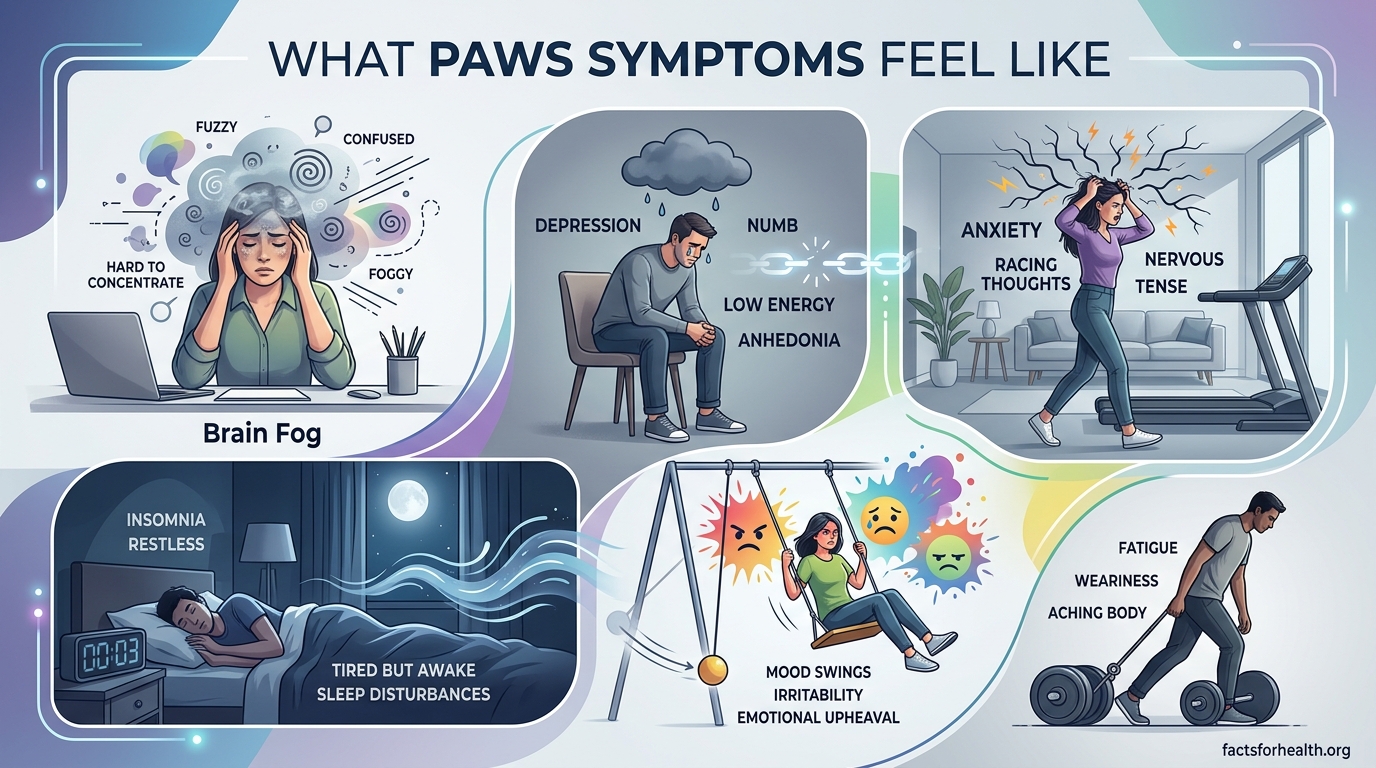
You quit drinking, using, or taking the substance. You survived the acute withdrawal. The shaking, sweating, nausea, and physical agony finally passed. You expected to feel free and clear. Instead, weeks later, you wake up one morning and feel like you are moving through wet concrete. Your brain is wrapped in cotton. Nothing brings you joy. You feel flat, irritable, exhausted, and strangely empty.
That is what post-acute withdrawal symptoms feel like. And if you are in early recovery and experiencing this, you are not broken. You are not failing. Your brain is healing.
Post-acute withdrawal syndrome (PAWS) is a set of emotional, cognitive, and physical symptoms that can persist for weeks, months, or occasionally up to two years after acute withdrawal ends, as the brain gradually recalibrates its neurotransmitter systems and neural pathways. Most people experience PAWS for 6 to 18 months depending on the substance, duration of use, and individual factors.
If you have ever wondered whether what you are feeling is normal in recovery, this article will walk you through exactly what post-acute withdrawal symptoms feel like, how long they last, what causes them, and what you can do to manage them.
Table of Contents
What Is Post-Acute Withdrawal Syndrome (PAWS)?
PAWS, also called protracted withdrawal syndrome, refers to a cluster of symptoms that appear after the initial acute withdrawal phase has ended. Acute withdrawal is the intense physical detox period that typically lasts days to a couple of weeks. PAWS is what comes after.
Where acute withdrawal is mostly physical (tremors, vomiting, seizures, sweating), post-acute withdrawal is primarily emotional and cognitive. It is the psychological shadow of addiction recovery. The physical danger has largely passed, but the brain is still recalibrating.
PAWS symptoms typically begin 1 to 4 weeks after the last use, once acute withdrawal has resolved. They can include mood swings, anxiety, depression, brain fog, sleep disturbances, fatigue, difficulty concentrating, memory problems, irritability, and anhedonia (the inability to feel pleasure).
Understanding PAWS matters because it is one of the most common reasons people relapse in early recovery. When you do not expect these symptoms, they feel like evidence that sobriety does not work. When you understand that they are temporary and are actually a sign of your brain healing, you can ride them out.
What PAWS Feels Like: The Subjective Experience
Clinical symptom lists tell you what PAWS is. They rarely tell you what it actually feels like to live through it. Based on clinical descriptions and real accounts from people in recovery communities, here is what the experience is really like.
The Emotional Flatness
Many people describe PAWS as feeling emotionally flat or numb. Things that used to bring joy, a favorite song, time with friends, a good meal, feel muted. One person in a recovery forum described it as “a heavy fog, flatness, emptiness. It is simply existing. No motivation, no joy, no direction. It is numbness.”
This is anhedonia, and it is one of the hallmark symptoms of PAWS. Your brain’s reward system has been hijacked by substances for so long that it has forgotten how to produce dopamine at normal levels. Natural pleasures barely register. Everything feels gray.
This does not mean you are depressed in the clinical sense. It means your dopamine receptors are downregulated and need time to recover. The color does come back, but it takes patience.
The Brain Fog
PAWS brain fog is not just feeling a little tired. People describe it as trying to think through a thick haze. You might walk into a room and forget why. You might struggle to follow conversations, lose your train of thought mid-sentence, or find reading a book nearly impossible.
Work becomes genuinely difficult. Simple decisions feel overwhelming. One person described it as feeling like their IQ had dropped 20 points. Another said it was like “having a computer with not enough RAM, everything runs slow and sometimes crashes.”
This cognitive impairment is real. The prefrontal cortex, which handles decision-making, attention, and working memory, is one of the last brain regions to fully recover after substance use. It will heal, but it takes months, not days.
Good Days and Bad Days: The Wave Pattern
This is one of the most confusing parts of PAWS, and almost no one warns you about it. PAWS does not improve in a straight line. It comes in waves.
You might have three good days where you feel almost normal. You start to think the worst is over. Then suddenly, on day four, you wake up anxious, depressed, and exhausted for no apparent reason. The symptoms hit you like a wave you did not see coming.
These waves are a normal part of the recovery process. Over time, the good stretches get longer and the bad stretches get shorter and less intense. But early on, the pattern can feel like an emotional rollercoaster.
One forum user described it this way: “Random anxiety for 2 to 3 days followed by a week of peace, with significant fatigue. Then back to anxiety. It feels random but it is not. It is your brain recalibrating.”
The Exhaustion
PAWS fatigue is not normal tiredness. It is a bone-deep exhaustion that does not always respond to sleep. You might sleep 10 hours and still wake up feeling drained. Simple tasks like grocery shopping or doing laundry can feel like running a marathon.
This happens because your brain is doing enormous behind-the-scenes work. Neurotransmitter systems are rebuilding. Neural pathways are rerouting. The hypothalamic-pituitary-adrenal (HPA) axis, which controls your stress response, is recalibrating. All of this requires energy your brain does not have to spare.
The Irritability and Emotional Volatility
Small things can set you off. A delayed text message, a minor inconvenience at work, a slightly critical comment, any of these can trigger disproportionate anger, frustration, or sadness. Mood swings during PAWS can be intense and feel completely out of character.
Your emotional regulation systems have been relying on substances to manage stress for months or years. Without that crutch, your amygdala (the brain’s emotional alarm system) is hypersensitive while your prefrontal cortex (the rational brake system) is still recovering. The result is emotional reactions that feel bigger than the situation warrants.
Common Post-Acute Withdrawal Symptoms by Category
PAWS symptoms fall into four main categories: emotional, cognitive, physical, and craving-related. Here is a detailed breakdown of what each category includes.
Emotional Symptoms
Emotional symptoms are usually the most prominent and the most disruptive to daily life during PAWS. They include:
- Mood swings that shift rapidly between irritability, sadness, and anger
- Anxiety that ranges from mild worry to panic-level intensity
- Depression that can feel heavy and persistent but is not necessarily permanent
- Irritability where small annoyances trigger outsized reactions
- Anhedonia, the inability to feel pleasure from activities you used to enjoy
- Emotional numbness or feeling disconnected from yourself and others
- Sudden tearfulness or crying spells without an obvious trigger
Cognitive Symptoms
These symptoms affect thinking, memory, and concentration. They can be especially distressing for people whose jobs require sharp mental performance:
- Brain fog that makes thinking feel slow and effortful
- Difficulty concentrating on tasks that used to be easy
- Short-term memory problems like forgetting conversations or appointments
- Difficulty learning new information or picking up new skills
- Trouble making decisions, even simple ones
- Racing or repetitive thoughts that are hard to control
- Reduced problem-solving ability and mental flexibility
Physical Symptoms
While PAWS is less physical than acute withdrawal, there are still real physical symptoms:
- Persistent fatigue that does not improve with rest
- Sleep disturbances including insomnia, vivid dreams, or oversleeping without feeling rested
- Appetite changes, either increased or decreased hunger
- Random physical discomforts like headaches, muscle tension, or unexplained aches
- Low energy that makes even basic tasks feel demanding
- Sensitivity to stress that feels physical, like a tight chest or stomach upset
Cravings and Substance-Related Thoughts
Cravings during PAWS tend to come in waves rather than being constant. They are often triggered by stress, emotional discomfort, or environmental cues:
- Intense cravings that feel urgent and overwhelming but usually pass within 30 to 90 minutes
- Intrusive thoughts about using that pop up without warning
- Romanticizing past substance use while minimizing the negative consequences
- “Pink cloud” periods of motivation followed by sudden urges to use
- Situational cravings triggered by people, places, or emotional states associated with past use
PAWS Timeline: How Long Do Post-Acute Withdrawal Symptoms Last?
This is the question everyone wants answered. The honest answer is that PAWS duration varies significantly by individual and substance, but most people experience meaningful improvement within 6 to 18 months, with some symptoms resolving much earlier.
Here is what the general timeline looks like for most people in recovery.
Weeks 1 to 4: The Transition Period
PAWS symptoms typically begin as acute withdrawal fades. During the first few weeks of abstinence, symptoms can be at their most intense. Emotional volatility, brain fog, and sleep disturbances are common. Many people describe this period as feeling raw and exposed.
This is also when the initial “pink cloud” effect can occur, a brief period of euphoria and motivation after detox, followed by a crash into PAWS symptoms that can feel discouraging.
Months 1 to 3: Peak PAWS
For most substances, PAWS symptoms peak during the first three months. This is when brain fog, anhedonia, mood swings, and fatigue tend to be most intense. Cravings can be frequent and powerful during this window.
This is also the highest-risk period for relapse. The contrast between the initial relief of quitting and the reality of persistent symptoms catches many people off guard. Knowing that this period is temporary can help you push through.
Months 3 to 6: Gradual Improvement
Somewhere around the 3-month mark, most people begin to notice longer stretches of good days. The waves of symptoms become less frequent and less intense. Sleep often starts to improve. Cognitive function begins to sharpen, though brain fog may still come and go.
This is when many people start to feel glimmers of their old selves returning. Small moments of genuine pleasure or interest begin to break through the flatness.
Months 6 to 12: Significant Recovery
By six months, most people have experienced substantial improvement in PAWS symptoms. Emotional regulation improves, cognitive function continues to recover, and energy levels increase. Anhedonia typically begins to lift as the dopamine system recalibrates.
That said, some symptoms, particularly sleep disturbances and occasional brain fog, may persist. Bad days still happen, but they become the exception rather than the rule.
Months 12 to 24: Near or Full Resolution
For most people, PAWS symptoms are fully resolved or barely noticeable by 12 to 24 months. The brain’s neuroplasticity allows it to continue healing and building new pathways well beyond the first year.
A small percentage of people, particularly those recovering from long-term benzodiazepine or heavy alcohol use, may experience lingering symptoms beyond two years. Even in these cases, the trajectory is toward continued improvement.
Which Symptoms Resolve First and Which Last Longest?
Not all PAWS symptoms resolve at the same rate. Based on clinical observations and recovery community reports, here is the general order of symptom resolution:
Symptoms that typically resolve earliest (1 to 3 months): acute physical discomfort, intense daily cravings, the worst of the mood swings, and initial sleep disruptions.
Symptoms that take longer to resolve (3 to 6 months): brain fog, concentration difficulties, irritability, and sleep pattern normalization.
Symptoms that take the longest to resolve (6 to 18+ months): anhedonia, emotional flatness, occasional fatigue, and stress sensitivity. These are tied to deep dopamine system recalibration and tend to be the last to fully resolve.
PAWS Symptoms and Duration by Substance Type
PAWS affects people differently depending on the substance they are recovering from. Different drugs impact different neurotransmitter systems, which means the symptom profile and timeline vary.
Alcohol-Related PAWS
Alcohol PAWS is extremely common and well-documented. Alcohol depresses the central nervous system by enhancing GABA and suppressing glutamate. When alcohol is removed, the brain experiences a rebound in excitatory neurotransmission.
Common alcohol PAWS symptoms include mood swings, anxiety, irritability, sleep disturbances (especially early waking and vivid dreams), and cognitive fog. Alcohol PAWS typically lasts 6 to 12 months for most people, though some symptoms can persist up to 18 months with heavy long-term use.
Opioid-Related PAWS
Opioid PAWS is driven by the severe dysregulation of the dopamine reward system. Opioids artificially flood the brain with dopamine, and when they are removed, natural dopamine production is severely suppressed.
Opioid PAWS symptoms include intense anhedonia, depression, fatigue, sleep disturbances (often with severe insomnia), body temperature dysregulation, and cravings. Opioid PAWS typically lasts 6 to 12 months, with anhedonia being one of the most persistent symptoms.
Benzodiazepine-Related PAWS
Benzodiazepine PAWS tends to be the most prolonged and complex. Benzodiazepines act on GABA receptors, and long-term use causes profound downregulation of these receptors. Recovery requires the brain to rebuild GABA function from scratch.
Benzodiazepine PAWS symptoms include severe anxiety, cognitive impairment, sensory hypersensitivity (sensitivity to light, sound, and touch), muscle tension, depersonalization, and waves of intense symptoms. Benzo PAWS can last 12 to 24 months, and in some cases even longer. The wave pattern is particularly pronounced with benzodiazepine withdrawal.
Stimulant-Related PAWS (Cocaine and Methamphetamine)
Stimulant PAWS is heavily dopamine-driven. Cocaine and methamphetamine cause massive dopamine release, and chronic use severely damages the dopamine reward system. Recovery requires the brain to regrow dopamine receptors, a process measured in months.
Stimulant PAWS symptoms include profound anhedonia, depression, fatigue, increased appetite, vivid and unpleasant dreams, and intense cravings. Stimulant PAWS typically lasts 6 to 12 months, with dopamine receptor recovery continuing for up to 14 months in some studies.
Marijuana-Related PAWS
Marijuana PAWS is increasingly recognized as people quit heavy cannabis use. While generally less severe than other substances, it is still very real.
Marijuana PAWS symptoms include irritability, sleep disturbances (especially vivid dreams and night sweats), anxiety, decreased appetite, and mood swings. Marijuana PAWS typically lasts 1 to 4 months, though heavy long-term users may experience symptoms for up to 6 months.
FAQs
How long does a post-acute withdrawal symptom last?
Individual post-acute withdrawal symptoms can last anywhere from a few weeks to several months. Most people experience peak symptoms during the first 3 months, with gradual improvement over 6 to 18 months. Some symptoms, like anhedonia and emotional flatness, tend to be the last to resolve and can persist for 12 to 24 months in some cases.
What are the symptoms of post-acute withdrawal syndrome?
The most common PAWS symptoms include mood swings, anxiety, depression, irritability, brain fog, difficulty concentrating, memory problems, fatigue, sleep disturbances, anhedonia (inability to feel pleasure), emotional numbness, and cravings. These symptoms come in waves rather than being constant.
How long does it take for PAWS to go away?
For most people, PAWS resolves within 6 to 18 months. Marijuana PAWS typically clears in 1 to 4 months. Alcohol and opioid PAWS usually last 6 to 12 months. Benzodiazepine PAWS can last 12 to 24 months or occasionally longer. Full dopamine system recovery continues for up to 14 months after the last use.
What does PAWS brain fog feel like?
PAWS brain fog feels like trying to think through a thick haze. You may struggle to concentrate, forget conversations, lose your train of thought mid-sentence, or find reading difficult. Many people describe it as feeling like their thinking is slowed down or like their brain does not have enough processing power.
Can PAWS symptoms come back after they go away?
Yes, PAWS symptoms come in waves. You can feel good for days or weeks and then suddenly experience a return of symptoms. This wave pattern is completely normal and does not mean you are relapsing or going backward. Over time, the good stretches get longer and the bad stretches get shorter.
Is PAWS permanent?
No, PAWS is not permanent. It is a temporary condition caused by the brain recalibrating its neurotransmitter systems after substance use. While it can last up to 2 years in some cases, the symptoms gradually resolve as the brain heals. The trajectory is always toward improvement.
How is PAWS different from acute withdrawal?
Acute withdrawal is the initial physical detox period that lasts days to weeks and involves physical symptoms like tremors, nausea, sweating, and seizures. PAWS begins after acute withdrawal ends and involves primarily emotional and cognitive symptoms like mood swings, brain fog, anhedonia, and sleep disturbances. PAWS lasts much longer but is less physically dangerous.
Does exercise help with PAWS symptoms?
Yes, exercise is one of the most effective strategies for managing PAWS. Cardiovascular exercise boosts dopamine and endorphin production, directly supporting the brain systems that are recovering. Even 20 to 30 minutes of daily walking can improve mood, energy, and cognitive function during PAWS.
What causes post-acute withdrawal syndrome?
PAWS is caused by the brain recalibrating its neurotransmitter systems after prolonged substance use. Substances hijack the dopamine reward system and disrupt the HPA axis. When substances are removed, the brain must slowly rebuild natural neurotransmitter production, regrow receptors, and restore normal neural pathway function. This process takes months and produces the symptoms of PAWS.
How do you know if symptoms are PAWS or depression?
PAWS and depression share many symptoms, but PAWS is caused by substance-induced neurochemical imbalance that gradually resolves on its own, while clinical depression is a separate condition. If symptoms persist beyond 12 to 18 months of abstinence or are severe enough to impair daily functioning, a mental health professional can help determine whether you are dealing with PAWS, a co-occurring mental health condition, or both.
When do PAWS symptoms start after quitting?
PAWS symptoms typically begin 1 to 4 weeks after the last use, as acute withdrawal symptoms fade. Some people experience a brief pink cloud period of euphoria immediately after detox, which is then followed by the onset of PAWS symptoms. The transition from acute withdrawal to PAWS can feel sudden and discouraging if you are not expecting it.
Can PAWS last more than a year?
Yes, PAWS can last more than a year, particularly with benzodiazepine withdrawal and heavy long-term alcohol use. Some people experience symptoms for 18 to 24 months. While this sounds daunting, the intensity of symptoms decreases significantly over time. By the second year, most people experience only occasional mild symptoms rather than daily struggles.
PAWS Is Temporary: You Are Healing, Not Broken
Understanding what post-acute withdrawal symptoms feel like and how long they last is one of the most important pieces of knowledge you can have in recovery. PAWS is real. It is difficult. And it is temporary.
The brain fog, the emotional flatness, the exhaustion, the mood swings, the waves of symptoms that come and go without warning, all of these are signs that your brain is doing the hard work of healing. You are not broken. You are under construction.
Most people see significant improvement within 6 months and near-complete resolution within 12 to 18 months. Exercise, sleep, nutrition, community support, and professional treatment all accelerate the process. Avoiding quick dopamine fixes and being patient with yourself make the journey more bearable.
If you are in the thick of PAWS right now, the most important thing to know is this: the symptoms will pass. Every bad day is a step closer to full recovery. Every wave that hits you and does not knock you down is proof that you are getting stronger.
Recovery is not linear, but it is directional. And the direction is forward.