
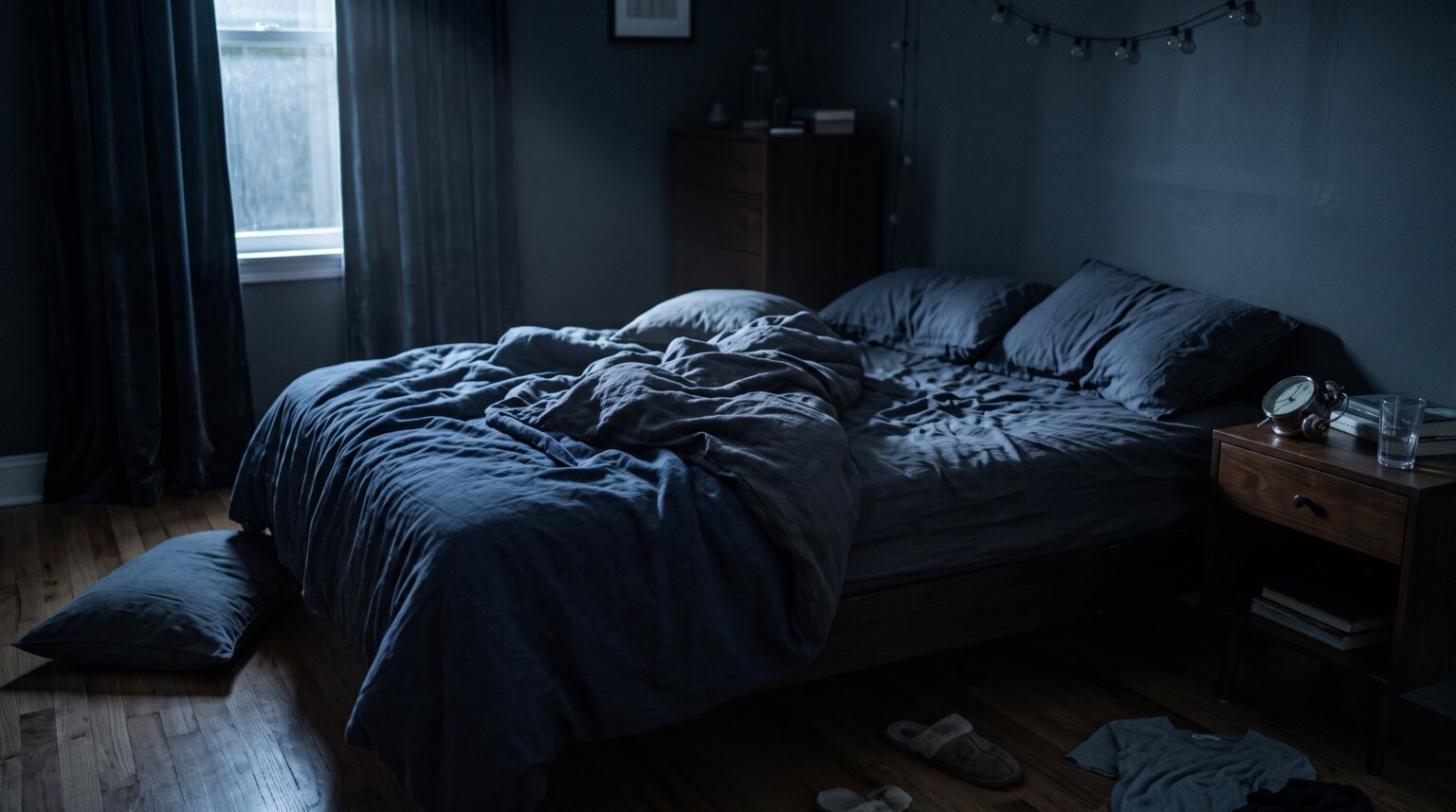
It is 2:47 a.m. You know the exact time because you have been checking the clock every twelve minutes, calculating and recalculating how many hours of sleep you could still get if you fell asleep right now. Your heart is pounding. Your jaw is clenched. Your thoughts will not stop spinning through tomorrow’s to-do list, the embarrassing thing you said in a meeting last Thursday, and the growing certainty that you are going to be a wreck tomorrow. You are exhausted, your body is begging for rest, and yet sleep feels completely out of reach.
If this scenario sounds familiar, you are experiencing what sleep anxiety feels like. Sleep anxiety is the feeling of fear, worry, or stress about falling asleep or staying asleep, and it affects millions of people who find their minds revving up precisely when they should be powering down. According to the Cleveland Clinic, anxiety is the most common mental health disorder in the United States, and the majority of people with anxiety also experience some form of sleep disruption.
In this article, we are going to walk through exactly what sleep anxiety feels like in vivid, physical detail, why your brain seems to sabotage you the moment your head hits the pillow, and the actionable, evidence-based strategies that can help you break the cycle for good. Whether you have been struggling for weeks or years, understanding this pattern is the first step toward changing it.
Table of Contents
What Sleep Anxiety Feels Like
Understanding what sleep anxiety feels like starts with recognizing that it is not just “being worried about sleep.” It is a full-body, full-mind experience that can feel overwhelming and deeply isolating. People who have never experienced it often do not understand how intensely physical and emotional it can be. Here is what it actually feels like, broken down by category.
The Physical Experience
Your body feels like it is bracing for something terrible. Your heart races or pounds in your chest even though you are lying completely still in a dark, quiet room. Your muscles are tight, especially in your jaw, shoulders, and neck. You may notice your hands trembling slightly, or you might feel suddenly too warm, breaking into a sweat under the covers.
Some people experience digestive discomfort, a churning stomach, or the sudden urge to use the bathroom. Others feel a strange buzzing or vibrating sensation throughout their body, almost like an electric hum just under the skin. This is your nervous system stuck in fight-or-flight mode, flooding your body with cortisol and adrenaline at a time when you should be producing melatonin and winding down toward rest.
The Mental Experience
The most common description from people in online anxiety communities is simple: “my brain will not shut up.” Racing thoughts at night can feel like a browser with fifty tabs open, all playing audio at the same time. One thought triggers another, which triggers another, and before you know it you are mentally replaying conversations from three years ago while simultaneously planning a presentation for next month.
You might catch yourself catastrophizing. “If I do not fall asleep in the next hour, I will get four hours of sleep, which means I will be useless at work, which means my boss will notice, which means I will lose my job.” The logic spirals quickly and feels utterly convincing in the moment. Checking the clock becomes compulsive. Each glance confirms that another fifteen minutes has passed and you are still awake, which only adds fuel to the fire.
The Emotional Experience
Emotionally, sleep anxiety feels like dread. There is a deep sense of apprehension about the night ahead, a feeling that bedtime is a battle you are probably going to lose. Some people describe a sense of impending doom, as if something terrible is about to happen, even though they cannot name what it is. Frustration builds quickly. You feel angry at yourself for not being able to do something as basic as falling asleep.
There is often shame mixed in, too. You know you should be able to sleep. Everyone else seems to do it effortlessly. The fear of how you will function the next day looms large, and that fear itself becomes one more thing keeping you awake.
Nocturnal Panic Attacks
For some people, sleep anxiety manifests as nocturnal panic attacks. These are sudden episodes of intense fear that jolt you awake, often accompanied by a racing heart, rapid breathing, sweating, and a feeling that you might be dying or losing your mind. Some people describe a hypnic jerk, a sudden physical jolt that snaps them back to full wakefulness just as they were drifting off, immediately followed by a rush of panic. These episodes can be terrifying, but they are not dangerous, and they are more common than most people realize.
Why Your Anxiety Spikes the Moment You Try to Sleep
One of the most frustrating things about sleep anxiety is the timing. You might feel relatively calm all day, only to have your anxiety spike the instant you get into bed. You are not imagining this. There are clear biological and psychological reasons why anxiety worsens at night, and understanding them can help you feel less broken and more in control.
During the day, you are constantly distracted. Work, conversations, screens, errands, and responsibilities keep your mind occupied. When you lie down in a quiet, dark room, all of those external distractions fall away. Without anything else to focus on, your brain turns inward and surfaces every worry, fear, and unresolved problem you have been suppressing all day. This is not a character flaw. It is simply how the brain works when it runs out of external input.
Anticipatory anxiety also plays a major role. If you have had several bad nights, your brain starts to associate bedtime with stress and failure. This is classical conditioning at work. Your bed, which should be a cue for relaxation, becomes a trigger for anxiety instead. Your brain essentially learns that “bed equals struggle,” and it responds accordingly by activating your stress response before you even pull back the covers. This phenomenon is called conditioned arousal, and it is one of the core mechanisms that Cognitive Behavioral Therapy for Insomnia (CBT-I) targets.
Finally, the transition from wakefulness to sleep requires a kind of surrender. You have to let go of conscious control. For someone with anxiety, that loss of control can feel deeply uncomfortable, even threatening. Your nervous system, already primed for vigilance, interprets the drifting-off sensation as a kind of danger, which triggers a spike of alertness right when you need it least.
The Vicious Cycle of Sleep Anxiety and Insomnia
Understanding what sleep anxiety feels like means understanding the cycle it creates. Sleep anxiety and insomnia feed each other in what sleep specialists call a bidirectional relationship. Anxiety makes it hard to sleep, and poor sleep makes anxiety worse. Over time, this loop strengthens and becomes harder to break.
Here is how the cycle typically works. You have a stressful day, or a stressful week, and you lie awake one night unable to fall asleep. The next day, you feel tired, irritable, and on edge. That night, you go to bed already worried about whether you will sleep. That worry keeps you awake again. The following day is even harder because you are now running on two nights of poor sleep, so your anxiety is even higher. By the third night, the mere thought of going to bed triggers a knot in your stomach.
This is the self-reinforcing loop at the heart of sleep anxiety. Each bad night makes the next night harder because it adds another layer of fear and anticipation. As one Reddit user in the r/insomnia community put it, “it is not a sleep problem, it is an anxiety problem.” That insight is more than a catchy phrase. It points to the reality that treating the anxiety component is often more effective than focusing solely on sleep mechanics.
The cycle also creates what researchers call hyperarousal, a state where your nervous system is chronically activated and unable to shift into the calm, parasympathetic state needed for sleep onset. The longer the cycle continues, the more deeply entrenched this hyperarousal becomes, which is why breaking the cycle early matters but also why it is never too late to intervene.
Common Causes and Triggers of Sleep Anxiety
Sleep anxiety rarely appears out of nowhere. It usually develops from a combination of factors that build on each other over time. Understanding your specific triggers is an important step toward addressing the root cause rather than just managing symptoms.
Here are the most common causes and triggers of sleep anxiety:
Generalized anxiety disorder and other anxiety conditions: If you already struggle with anxiety during the day, it is very likely to intensify at night when distractions fade.
Chronic stress: Work pressure, relationship conflicts, financial worries, or caregiving responsibilities can all keep your mind in overdrive at bedtime.
Past bad sleep experiences: A string of sleepless nights can condition your brain to associate bed with wakefulness and stress, creating anticipatory anxiety before you even get under the covers.
Underlying sleep disorders: Sleep apnea, restless legs syndrome, and other sleep disorders can cause frequent awakenings that trigger anxiety about sleep.
Trauma and PTSD: People with post-traumatic stress often experience nightmares, hypervigilance, and fear of sleep that directly contribute to sleep anxiety.
Substance use: Caffeine consumed late in the day, alcohol (which fragments sleep), and certain medications can worsen both anxiety and sleep quality.
Irregular sleep schedules: Inconsistent bedtimes and wake times disrupt your circadian rhythm, making it harder for your body to know when to wind down.
Sleep tracker anxiety: Obsessing over sleep scores and data from wearables can create a phenomenon called orthosomnia, which we will cover in detail shortly.
How to Break the Sleep Anxiety Cycle
This is where things shift from understanding to action. Breaking the sleep anxiety cycle is absolutely possible, and the strategies below are backed by sleep science and clinical research. None of them are quick fixes, but together they form a comprehensive approach that has helped thousands of people reclaim their nights. The key is consistency. Pick two or three strategies to start with and practice them every night for at least two weeks before judging the results.
1. Anchor Your Day with a Consistent Wake Time
If you do only one thing, make it this. Waking up at the same time every single day, including weekends, is the single most effective habit for resetting your circadian rhythm. Sleep researchers sometimes use the metaphor of a sleep balloon. Your drive to sleep inflates throughout the day based on how long you have been awake. If you wake up at the same time each morning, that balloon inflates on a predictable schedule, and sleep pressure builds reliably by bedtime. If your wake time bounces around, the balloon inflates unevenly and your body never learns when to expect sleep.
A consistent wake time also means no matter how badly you slept the night before, you get up at the same time. This feels counterintuitive, but sleeping in to “catch up” after a bad night weakens your sleep drive the following night, which perpetuates the cycle.
2. Build a Predictable Wind-Down Routine
Your brain needs a signal that it is time to shift from active mode to rest mode. A wind-down routine provides that signal. The specific activities matter less than the consistency. The goal is to do the same sequence of calming activities each night so your brain learns to associate them with approaching sleep.
Start your wind-down 60 to 90 minutes before bed. Dim the lights. Put away screens or switch them to night mode. Do something absorbing but not stressful, such as reading a physical book, listening to calm music or a podcast, doing gentle stretching, or taking a warm shower. The NPR article on sleep anxiety emphasizes focusing on wind-down time rather than obsessing over a strict bedtime, and this advice resonates with what anxiety communities report as effective.
3. Master the 20-Minute Rule
This is one of the most frequently recommended techniques by sleep specialists, and for good reason. The 20-minute rule is simple in concept but takes discipline to execute. If you have been lying in bed for roughly twenty minutes and you are not falling asleep, get up. Leave the bedroom entirely.
Go to another room with dim lighting and do something low-stimulation and mildly engaging. Read a book, do a puzzle, listen to soft music, or fold laundry. Do not look at your phone or watch television. Do not check the clock. Return to bed only when you feel genuinely drowsy, meaning your eyelids are heavy and you are having trouble keeping them open.
The purpose of this rule is to break the association between your bed and the frustration of lying awake. If you stay in bed tossing and turning for hours, your brain learns that bed is a place for stress and wakefulness. By getting up and only returning when sleepy, you retrain your brain to associate bed with actual sleep. This is a core component of CBT-I and it works, even though it feels difficult in the moment.
4. Schedule Your Worry Time
This technique is underused but highly effective. The idea is to give your brain a designated time earlier in the day to process worries so they do not surface at bedtime. Set aside 15 to 20 minutes in the late afternoon or early evening, ideally at least three hours before bed. During this time, write down everything you are worried about. Work deadlines, relationship issues, financial concerns, the fact that you have not called your mother in two weeks, everything.
Once everything is on paper, identify which items have an action you can take. Write down the next step for each one. For the items you cannot control, acknowledge that and set them aside. The goal is not to solve every problem but to externalize your worries so your brain feels like they have been addressed and does not need to surface them at midnight. When anxious thoughts do arise at bedtime, you can remind yourself that you have already dealt with them during worry time and there is nothing productive to do about them at 1 a.m.
5. Reframe Catastrophic Sleep Thoughts
Catastrophic thinking is one of the most powerful drivers of sleep anxiety. Thoughts like “if I do not get eight hours, tomorrow will be a disaster” feel absolutely true in the moment, but they are almost always exaggerated. Practice identifying these thoughts and challenging them with evidence. Have you ever survived a day on four hours of sleep? You probably have. Was it ideal? No. Was it the catastrophe you predicted? Almost certainly not.
Replace catastrophic thoughts with more realistic alternatives. Instead of “I will never sleep again,” try “I have had trouble sleeping before and it always passes.” Instead of “tomorrow is ruined,” try “I will be tired tomorrow but I can still function and get through the day.” This takes practice, but over time it reduces the emotional charge that keeps your nervous system activated at night.
6. Optimize Your Sleep Environment
Your bedroom should feel like a sanctuary, not a stress zone. Keep it cool, dark, and quiet. The ideal sleeping temperature is between 60 and 67 degrees Fahrenheit. Use blackout curtains if outside light is an issue. If noise is a problem, white noise machines or a fan can mask disruptive sounds and give your brain a consistent, neutral audio backdrop to focus on instead of anxious thoughts.
Remove visible clocks from your bedroom, or at least turn them away from your bed. Clock-watching is one of the most common behaviors that intensifies sleep anxiety, and the simple act of not knowing the exact time can significantly reduce nighttime stress.
7. Try Relaxation Techniques Tonight
Several relaxation techniques have solid evidence behind them for reducing anxiety and promoting sleep. These are not instant cures, but with regular practice they can significantly calm your nervous system.
4-7-8 Breathing: Inhale through your nose for 4 counts, hold for 7 counts, and exhale through your mouth for 8 counts. Repeat this cycle 4 times. This technique activates your parasympathetic nervous system, which is responsible for rest and digestion, and helps counteract the fight-or-flight response.
Progressive Muscle Relaxation: Starting from your toes and working up to your head, deliberately tense each muscle group for 5 seconds, then release. This helps you become aware of physical tension you may not have noticed and trains your body to let it go. Many people with sleep anxiety are holding tension they do not even realize they are carrying.
Guided Imagery: Picture yourself in a calm, safe place. Engage all your senses. What do you see, hear, smell, and feel in this place? This gives your mind something to focus on other than anxious thoughts and can help ease you toward sleep. Free guided meditation apps and podcasts are widely available and frequently recommended in anxiety support communities.
8. Adjust Your Daytime Habits
Your nighttime sleep is heavily influenced by what you do during the day. Get natural light exposure within an hour of waking up, as this helps set your circadian rhythm and reinforces your consistent wake time. Exercise regularly, but avoid intense workouts within three hours of bedtime. Limit caffeine after about 2 p.m., since caffeine has a half-life of roughly five to six hours and can keep your nervous system activated well into the evening. Avoid alcohol within three hours of bed. While alcohol may help you fall asleep faster, it fragments your sleep and worsens anxiety the next day.
Also, resist the urge to nap during the day, especially if you slept poorly the night before. Napping reduces your sleep pressure and makes it harder to fall asleep that night, which reinforces the cycle. If you must nap, keep it under 20 minutes and before 3 p.m.
What to Do During a Nighttime Anxiety Episode
Most articles focus on preventing sleep anxiety, but what do you do when you are in the middle of an anxiety spiral at 3 a.m.? This is a question we see constantly in anxiety support forums, and the answers are different from the prevention strategies above. Here is a step-by-step approach for handling acute nighttime anxiety episodes.
Step 1: Stop trying to sleep. This sounds paradoxical, but it works. The harder you try to force sleep, the more you signal to your brain that something is wrong, and the more alert you become. Many people in online communities report that surrendering to sleeplessness, telling themselves “I will just lie here quietly and rest my body for eight hours,” paradoxically allows sleep to arrive on its own. This technique is known as paradoxical intention, and it is used in CBT-I.
Step 2: Get out of bed. If you have been lying awake for more than twenty minutes, leave the bedroom. This is the 20-minute rule in action, but it applies here too. Staying in bed while anxious reinforces the association between your bed and wakefulness. Go to a comfortable spot in another room.
Step 3: Do something low-stimulation. Read a physical book under dim light. Do some gentle stretching. Listen to calm music or a podcast at low volume. The activity should be engaging enough to distract you from anxious thoughts but not so stimulating that it wakes you up further. Avoid screens, which emit blue light and tend to draw you into content that increases alertness.
Step 4: Use a grounding technique. When anxiety is intense, grounding exercises can pull you out of the spiral. The 5-4-3-2-1 method is simple and effective. Name 5 things you can see, 4 things you can physically feel, 3 things you can hear, 2 things you can smell, and 1 thing you can taste. This forces your brain to process sensory information from the present moment rather than cycling through anxious thoughts about the future.
Step 5: Return to bed only when sleepy. Wait until you feel genuine drowsiness, those heavy eyelids and nodding head that signal your body is ready. Then get back into bed. If you wake up again twenty minutes later, repeat the process. It is frustrating, but it works over time by retraining your brain’s association with your bed.
Is Your Sleep Tracker Making Things Worse? Understanding Orthosomnia
If you wear a sleep tracking ring, watch, or band, it might be contributing to your sleep anxiety. There is an emerging phenomenon called orthosomnia, which is an unhealthy obsession with achieving perfect sleep metrics driven by wearable technology. The term was coined by sleep researchers who noticed that more and more patients were developing anxiety specifically because of data from their sleep tracking devices.
Here is how orthosomnia works. You check your sleep score in the morning. It says you got a 62 out of 100, with only 12 minutes of deep sleep. Even though you felt relatively rested, the data tells you your sleep was poor. That data point creates anxiety. That night, you go to bed worried about whether you will get a good score tomorrow. The worry keeps you awake. You get an even worse score. The cycle continues, now fueled by a device that was supposed to help you.
The NPR article on sleep anxiety highlights this growing problem, and anxiety communities on Reddit increasingly recommend ditching sleep trackers entirely. The truth is that consumer sleep trackers are not perfectly accurate. They estimate sleep stages based on movement and heart rate, not brain activity. They can be useful for spotting broad patterns, but obsessing over daily scores does more harm than good for most people with sleep anxiety.
If you suspect your tracker is contributing to your anxiety, try taking it off for two weeks. Many users report that their sleep improves significantly once they stop monitoring it.
When to See a Doctor for Sleep Anxiety
Sleep anxiety is highly treatable, but there are times when self-help strategies are not enough and professional support is needed. There is no shame in seeking help. In fact, getting support early can prevent the cycle from becoming more deeply entrenched.
Consider talking to a healthcare provider if you experience any of the following:
Your sleep anxiety has lasted more than a few weeks and is not improving with self-help strategies.
Your sleep problems are interfering with your daily functioning, work performance, or relationships.
You are experiencing nocturnal panic attacks, waking up gasping for air, or having frightening nightmares.
Your anxiety is accompanied by symptoms of depression, such as persistent low mood, loss of interest in activities, or thoughts of self-harm.
You suspect you may have an underlying sleep disorder such as sleep apnea, which requires diagnosis through a sleep study.
The gold standard treatment for sleep anxiety is CBT-I, or Cognitive Behavioral Therapy for Insomnia. This is a structured, evidence-based program that typically runs 6 to 8 sessions and addresses the thoughts, behaviors, and associations that maintain the sleep anxiety cycle. Research consistently shows CBT-I to be more effective than sleep medication for long-term relief. Online communities repeatedly refer to it as the treatment that actually works when nothing else has.
Depending on your situation, your doctor may also discuss medication options. These can include anti-anxiety medications, sleep aids, or medications that address underlying conditions. Medication can be a useful short-term tool, but it works best when combined with therapy and behavioral changes rather than used as a standalone solution.
FAQs
How to break the cycle of sleep anxiety?
To break the cycle of sleep anxiety, maintain a consistent wake time every day, build a predictable wind-down routine, use the 20-minute rule (get out of bed if you cannot sleep after 20 minutes), schedule a worry time earlier in the day, reframe catastrophic sleep thoughts, and practice relaxation techniques like 4-7-8 breathing and progressive muscle relaxation. CBT-I is the gold standard treatment for persistent sleep anxiety.
What causes sleep anxiety?
Sleep anxiety is caused by a combination of factors including generalized anxiety disorder, chronic stress, past bad sleep experiences that create conditioned arousal, underlying sleep disorders like sleep apnea, trauma and PTSD, late caffeine consumption, irregular sleep schedules, and in some cases obsessive use of sleep tracking devices (orthosomnia).
How to calm anxiety at night naturally?
You can calm nighttime anxiety naturally by practicing the 4-7-8 breathing technique (inhale for 4 counts, hold for 7, exhale for 8), doing progressive muscle relaxation, using guided imagery or meditation, getting out of bed if you cannot sleep after 20 minutes, avoiding clock-watching, dimming lights an hour before bed, and using white noise to create a calm sleep environment.
Why does my anxiety spike when I try to sleep?
Your anxiety spikes at bedtime because the quiet, distraction-free environment allows suppressed worries to surface. Additionally, if you have had bad nights before, your brain develops anticipatory anxiety and conditioned arousal, associating bed with stress. The transition from wakefulness to sleep also requires a loss of conscious control that can feel threatening to an anxious nervous system, triggering a fight-or-flight response.
Can sleep anxiety be cured?
Yes, sleep anxiety can be effectively resolved for most people. CBT-I has been shown to eliminate or significantly reduce sleep anxiety in the majority of patients. While some people may experience occasional bad nights during stressful periods, the cycle of chronic sleep anxiety can be broken with consistent practice of the right strategies and, when needed, professional support.
How long does it take to break the sleep anxiety cycle?
Breaking the sleep anxiety cycle typically takes 2 to 6 weeks of consistent practice with strategies like a fixed wake time, wind-down routines, and the 20-minute rule. A full course of CBT-I runs 6 to 8 sessions. Some people notice improvements within the first week, but lasting change requires sustained effort and consistency over several weeks.
Conclusion
Sleep anxiety can make bedtime feel like a battleground, but it does not have to stay that way. Understanding what sleep anxiety feels like is the first step, and you have now seen it described in detail: the racing heart, the spinning mind, the compulsive clock-checking, the dread. These experiences are real, they are common, and they are treatable.
Breaking the cycle comes down to a handful of evidence-based strategies practiced consistently. Anchor your day with a fixed wake time. Build a wind-down routine that tells your brain it is safe to rest. Use the 20-minute rule to stop your bed from becoming a stress zone. Schedule your worries earlier in the day. Reframe the catastrophic thoughts that fuel your anxiety at night. And if self-help strategies are not enough, seek out CBT-I, the gold standard treatment that has helped countless people break free from the vicious cycle of sleep anxiety and insomnia.
You do not have to white-knuckle your way through every night alone. Start with one strategy tonight, be patient with yourself, and remember that improvement comes from consistency, not perfection. Better sleep is possible, and the cycle can be broken.