
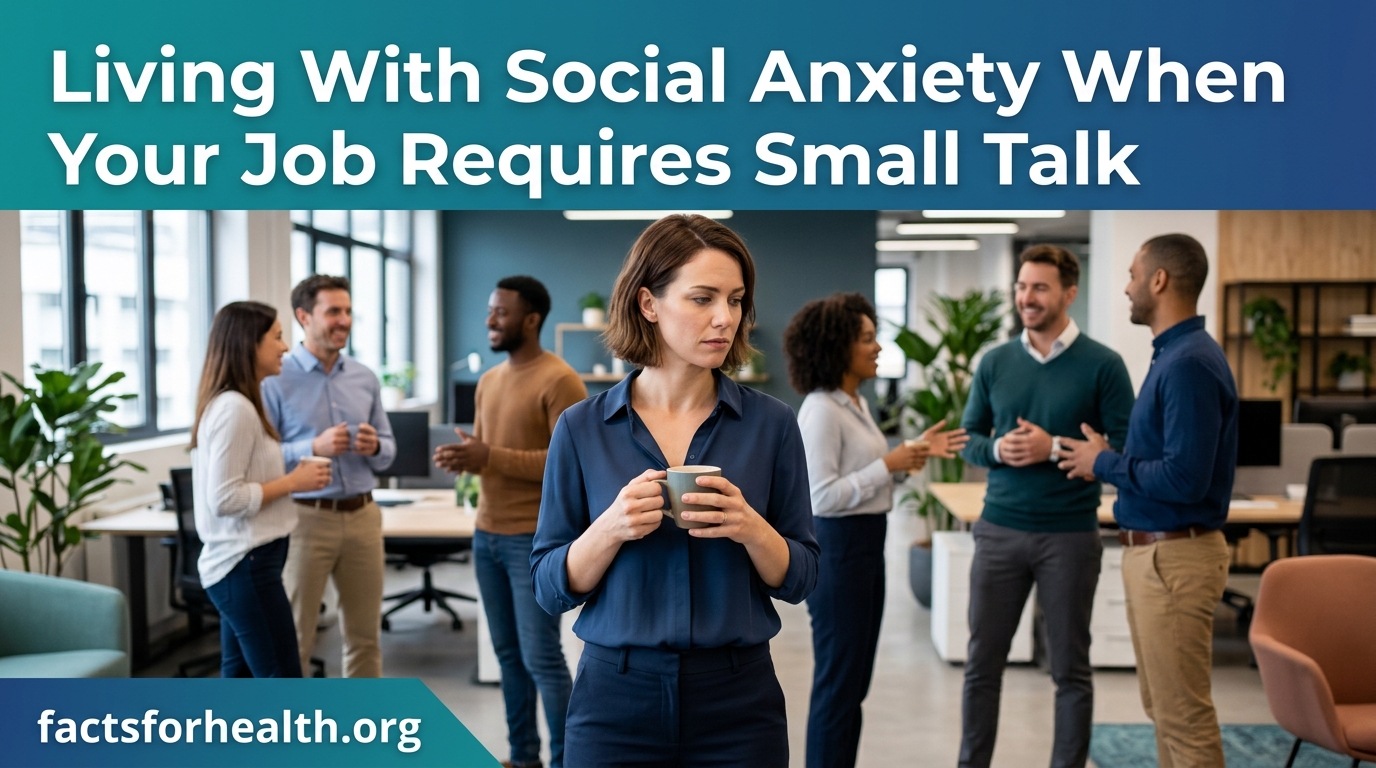
You hear the footsteps before you see them. Someone is walking toward your desk, and you already know what is coming. A casual question about your weekend. A comment about the weather. Maybe a joke you will need to respond to in real time. Your heart rate spikes, your mind goes blank, and the three seconds before they arrive feel like an eternity.
If this sounds familiar, you are far from alone. Living with social anxiety when your job requires small talk is an experience shared by millions of capable professionals. You might be excellent at your actual work, yet the informal social fabric of office life, the hallway greetings, the break room chats, the post-meeting pleasantries, can feel like an impossible mountain to climb every single day.
Here is what we want you to know right from the start: social anxiety at work is manageable. You can build a successful career while learning to handle the social demands that come with it. This guide breaks down practical strategies, conversation frameworks, and professional options that actually work, not generic advice like “just be yourself.”
To manage social anxiety at work: practice gradual exposure to feared social situations, learn a structured small talk formula, use grounding techniques like the 333 rule during acute anxiety, identify and reduce safety behaviors, challenge negative thought patterns, and seek cognitive behavioral therapy (CBT) when self-help strategies are not enough.
Whether you are dodging the break room, agonizing over what to say in meetings, or replaying conversations for hours after they end, this article will give you concrete tools you can use today.
Table of Contents
How to Fix Social Anxiety at Work: Quick Strategies
If you need immediate, actionable steps to start managing workplace social anxiety, here are eight strategies backed by mental health research and clinical practice:
- Practice gradual exposure. Start with low-pressure social interactions, like saying good morning to one coworker, and slowly work up to harder situations like speaking up in meetings.
- Learn a small talk formula. Use a structured approach (statement, question, share, repeat) so you never run out of things to say.
- Use the 333 rule. When anxiety spikes, name three things you see, three sounds you hear, and move three body parts to ground yourself in the present moment.
- Challenge negative thoughts. Ask yourself, “What is the evidence that my coworker is judging me?” Usually, there is none.
- Reduce safety behaviors. Notice habits like avoiding eye contact or rehearsing sentences, and gradually drop them. They keep anxiety alive.
- Practice deep breathing. Slow, diaphragmatic breathing activates your parasympathetic nervous system and calms the physical symptoms of anxiety.
- Shift attention outward. Instead of monitoring your own performance, focus genuinely on what the other person is saying. Curiosity kills self-consciousness.
- Seek professional support. Cognitive behavioral therapy is the gold-standard treatment for social anxiety disorder, with success rates of 70 to 80 percent.
The rest of this guide unpacks each of these strategies in detail, along with specific scripts, exercises, and advice for navigating the unique social demands of the modern workplace.
What Social Anxiety at Work Really Looks Like
Social anxiety disorder (SAD) is a persistent, intense fear of being watched, judged, or negatively evaluated by others in social situations. According to the DSM-5, this fear is out of proportion to the actual threat and lasts for six months or more. It is not just shyness, and it is not something you can simply turn off.
In the workplace, social anxiety shows up in ways that might surprise you. It is not always obvious panic attacks in the conference room. Often, it is quiet, a practiced avoidance of the break room, a tendency to send emails instead of making a quick phone call, or the decision to eat lunch alone every day because the thought of casual conversation is exhausting.
According to the National Institute of Mental Health, approximately 7 percent of U.S. adults experience social anxiety disorder in any given year. That means in a typical office of 50 people, at least three or four are dealing with some level of clinically significant social anxiety. You are not unusual. You are not broken. You are dealing with one of the most common anxiety disorders in the world.
The “Reveal”: Why Social Anxiety Feels Like Hiding a Secret
Clinical psychologist Dr. Ellen Hendriksen, author of “How to Be Yourself,” describes the core fear of social anxiety as the dread of “the reveal.” People with social anxiety live in fear that others will discover they are fundamentally flawed, that their anxiety itself, their awkwardness, their perceived lack of social skills, will be exposed and lead to rejection or humiliation.
Hendriksen identifies four areas where people with social anxiety feel their “fatal flaw” lives: social skills, the inability to hide anxiety itself, physical appearance, and character. At work, this often translates to a terror of being “found out” as socially incompetent, even when your actual job performance is strong.
“The fear is not that you will say the wrong thing. The fear is that saying the wrong thing will prove you are fundamentally defective, and everyone will finally see it.” – Paraphrased from Dr. Ellen Hendriksen’s work on social anxiety
This concept matters because it explains why social anxiety feels so personal and so overwhelming. You are not just worried about a conversation going poorly. You are worried about what a poor conversation means about you as a person. Recognizing this pattern is the first step toward breaking it.
Social Anxiety vs. Introversion: What Is the Difference?
One of the most common questions we see in forums and support communities is whether social anxiety is just extreme introversion. It is not. The distinction matters because it changes what kind of help will work.
Introversion is a personality trait. Introverts prefer smaller groups, need alone time to recharge, and may find excessive socializing draining but not frightening. They choose not to socialize sometimes, but they could if they wanted to.
Social anxiety is a clinical condition. People with social anxiety often want to connect with others but feel unable to. The avoidance is driven by fear, not preference. An introvert skips the office party because they would rather read a book. A person with social anxiety skips the office party because the thought of walking in alone makes them feel physically ill, even though part of them wishes they could go.
Understanding this difference helps because treating social anxiety is not about changing who you are. It is about removing the fear barrier so you can make genuine choices about social engagement rather than having avoidance make the choice for you.
Signs Social Anxiety Is Affecting Your Job Performance
Workplace social anxiety is sneaky. It can masquerade as diligence, professionalism, or simply being “quiet.” But underneath, it may be quietly limiting your career trajectory and draining your energy. Here are the most common signs that social anxiety is impacting your work life:
1. You Avoid Social Situations That Could Benefit Your Career
You skip networking events, office parties, and team lunches even when you know attending would help your career. You decline opportunities to present your work or lead projects because they require social visibility. Over time, this avoidance can mean missed promotions, weaker professional relationships, and fewer opportunities.
2. You Overthink and Replay Conversations
After a conversation with a coworker, you spend hours replaying what you said, analyzing your tone, and cringing at moments you perceived as awkward. This post-event rumination is a hallmark of social anxiety and can be mentally exhausting, draining energy you need for actual work.
3. You Experience Physical Symptoms During Social Interactions
Physical symptoms of social anxiety at work include a racing heart, sweating, trembling hands, a shaky voice, nausea, blushing, and a dry mouth. These symptoms often create a secondary anxiety: the fear that others will notice your physical symptoms, which then makes the symptoms worse.
4. You Overcompensate Through Perfectionism and Overworking
Many people with workplace social anxiety pour all their energy into being exceptional at the technical parts of their job. The logic is often unconscious: if I am indispensable as a worker, maybe nobody will notice my social deficits. While this can drive short-term success, it often leads to burnout and does nothing to address the underlying anxiety.
5. You Prefer Written Communication Over Talking
You send emails when a phone call would be faster. You choose text over a face-to-face conversation. You draft and redraft messages far longer than necessary. While written communication is a valid preference, when it is driven by avoidance of real-time interaction, it reinforces anxiety over time.
6. You Struggle With Authority Figures
Interactions with managers, executives, or senior colleagues trigger disproportionate anxiety. You might avoid scheduling one-on-one meetings, freeze during performance reviews, or feel unable to advocate for yourself even when you deserve recognition.
7. You Feel Exhausted at the End of Every Workday
The mental effort of managing anxiety throughout the day, monitoring your behavior, planning avoidance routes, and processing social interactions takes an enormous toll. If you come home depleted even on days when your workload was light, social anxiety may be the hidden drain.
Common Workplace Triggers for Social Anxiety
Not all social situations trigger anxiety equally. Most people with workplace social anxiety have specific scenarios that feel nearly impossible. Understanding your personal triggers helps you target your coping efforts where they matter most.
Small Talk and Casual Encounters
The elevator ride. The hallway passing. The break room. The moments before a meeting officially starts. These unstructured, spontaneous interactions are often the hardest because there is no agenda, no task to focus on, and no script to follow. The unpredictability is what makes them so anxiety-provoking.
Meetings and Group Settings
Speaking up in meetings requires performing in front of an audience. The fear of saying something wrong, sounding unintelligent, or having your voice shake can make meetings a source of dread. Even attending meetings as a silent participant can be anxiety-inducing if you fear being called on unexpectedly.
Presentations and Public Speaking
Presentations combine multiple anxiety triggers: being the center of attention, being evaluated, and performing under pressure. For many people with social anxiety, presentation days are preceded by days or weeks of mounting dread.
Phone Calls and Video Conferences
Phone calls remove visual cues, making it harder to read the other person’s reaction. Video conferences add the discomfort of seeing your own face on screen, which can intensify self-monitoring and self-consciousness. Both formats can be just as anxiety-provoking as in-person interactions.
Networking Events and Office Socials
Work parties, team-building events, holiday gatherings, and conferences are designed for socializing, which makes them a perfect storm for social anxiety. The combination of large groups, unfamiliar people, alcohol expectations, and unstructured conversation can feel overwhelming.
Interacting With Authority Figures
Conversations with managers, directors, or clients where there is a power differential can trigger intense fear of evaluation. Performance reviews, salary discussions, and one-on-one meetings with leadership are common flashpoints.
Being Put on the Spot
Being asked a surprise question in a meeting, being introduced to a visitor without warning, or being asked to share your opinion unexpectedly, these moments of sudden social demand can cause acute anxiety spikes because there is no time to prepare.
The Avoidance Cycle: Why Skipping Small Talk Makes Anxiety Worse
Here is one of the most frustrating truths about social anxiety: the strategies you use to cope with it are often the things keeping it alive. This is called the avoidance cycle, and understanding it is essential for breaking free.
The cycle works like this. First, you encounter a social situation that triggers anxiety (your coworker walks toward your desk). Second, you feel the urge to avoid (you suddenly look very busy typing). Third, you avoid, and your anxiety drops (they walk past, you feel relief). Fourth, your brain learns that avoidance equals safety, which makes the anxiety stronger next time.
Each time you avoid a social interaction, you reinforce the message to your brain that the situation was genuinely dangerous. The relief feels good in the moment, but it cements the fear. Over weeks and months, your comfort zone shrinks. Situations that used to feel manageable become impossible. This is how someone who was once somewhat shy can develop debilitating avoidance over time.
Safety Behaviors: The Hidden Anxiety Trap
Avoidance is obvious. Safety behaviors are more subtle, and they are often the hardest part of social anxiety to address. Safety behaviors are actions you take during social situations to try to prevent something bad from happening or to reduce your anxiety in the moment.
Common workplace safety behaviors include:
- Rehearsing sentences in your head before speaking
- Avoiding eye contact to reduce the intensity of interaction
- Speaking very quietly so fewer people can hear you
- Gripping a pen or cup tightly to hide trembling hands
- Standing near the exit at events so you can leave quickly
- Wearing headphones even when nothing is playing
- Checking your phone repeatedly to avoid appearing available
- Over-preparing for every interaction so nothing catches you off guard
The problem with safety behaviors is that they prevent you from learning that you can handle the situation without them. If you rehearse a comment and the meeting goes well, your brain credits the rehearsal, not your actual competence. The safety behavior becomes a crutch you depend on, and the anxiety persists because you never get to test whether you can cope without it.
Reducing safety behaviors gradually is one of the most powerful steps you can take. Start by dropping one small safety behavior in a low-stakes interaction. Notice that nothing terrible happens. Then try dropping another. This process, called behavioral experiments in CBT, teaches your brain that you are more capable than your anxiety wants you to believe.
Practical Coping Strategies for Workplace Social Anxiety
Now we get into the strategies that can genuinely change your daily experience at work. These are not quick fixes. They are tools you practice and build over time, like exercising a muscle. Pick two or three to start with rather than trying to change everything at once.
1. The 333 Rule for Acute Anxiety
When anxiety spikes in the moment (someone approaches your desk, you are called on in a meeting, you walk into a crowded break room), the 333 rule pulls your attention back to the present. Name three things you can see around you. Identify three sounds you can hear. Then move three parts of your body (wiggle your toes, clench and release your fist, roll your shoulders).
This technique works because anxiety lives in your mind’s projection of future catastrophe. Grounding brings you back to the here and now, where you are safe. It takes about 15 seconds and can be done without anyone noticing. With practice, it becomes a reliable circuit breaker for anxiety spirals.
2. Diaphragmatic Breathing for Physical Symptoms
Social anxiety triggers your sympathetic nervous system, the fight-or-flight response. Your heart races, your breathing gets shallow, and your muscles tense. Deep, slow breathing from your diaphragm activates the parasympathetic nervous system, which acts as a brake on this response.
Try the 4-6 breathing pattern: inhale through your nose for four counts, feeling your belly expand, then exhale through pursed lips for six counts. Do this five times before entering a stressful social situation. It physically cannot make anxiety worse, and for most people, it measurably reduces physical symptoms within two minutes.
3. Thought Challenging and Cognitive Restructuring
Social anxiety is fed by distorted thinking patterns. You assume people are judging you (mind reading). You catastrophize one awkward moment into proof you are socially incompetent. You set impossible standards and then beat yourself up for not meeting them.
Cognitive restructuring, a core CBT technique, teaches you to catch these thoughts and challenge them. When you think, “Everyone noticed I stumbled over my words,” ask: What is the actual evidence? Has anyone said anything? How much do I notice when other people stumble over words? Usually, the evidence for your feared outcome is minimal or nonexistent, and recognizing that reduces the anxiety.
Keep a small notebook or note on your phone where you record anxious thoughts and the evidence against them. Over time, this practice retrains your brain to interpret social situations more accurately and less threateningly.
4. Self-Compassion to Counter the Inner Critic
People with social anxiety are often incredibly hard on themselves. You would never speak to a friend the way you speak to yourself after a conversation. Self-compassion is not about letting yourself off the hook; it is about treating yourself with the same basic decency you would extend to anyone else.
When you catch yourself in harsh self-criticism after a social interaction, pause. Ask: What would I say to a coworker who told me they had this same experience? Then say that to yourself. Research by Dr. Kristin Neff shows that self-compassion is strongly associated with lower anxiety levels and greater emotional resilience.
5. Mindfulness for Reducing Self-Monitoring
Social anxiety thrives on excessive self-monitoring. You are constantly tracking your own behavior during conversations: Am I making enough eye contact? Did that sound weird? Should I smile more? This internal surveillance consumes mental bandwidth that should be going toward the actual conversation.
Mindfulness practice trains you to notice when your attention has turned inward and gently redirect it outward. Even two minutes of daily mindfulness meditation, focusing on your breath and returning when your mind wanders, builds the mental muscle to redirect attention during real conversations.
6. Preparation Without Overpreparation
Having a few go-to conversation topics ready can reduce the panic of not knowing what to say. Keep three or four reliable topics in mind: a show you are watching, a weekend plan, a mild observation about the weather, or a genuine question about the other person’s work. This is healthy preparation.
Overpreparation, on the other hand, is rehearsing entire conversations, scripting every possible response, and memorizing talking points. This backfires because it keeps your attention focused on performing rather than connecting, and it falls apart the moment the conversation goes in an unexpected direction. The goal is loose preparation, a few anchors you can rely on, not a rigid script.
7. Gradual Exposure Exercises
Gradual exposure is the single most effective technique for reducing social anxiety long-term. It involves deliberately entering anxiety-provoking situations in a planned, incremental way, starting with the least scary and working up. Each exposure teaches your brain that the feared outcome does not occur (or that you can handle it if it does).
Here is a sample workplace exposure ladder, from easiest to hardest:
- Say good morning to the receptionist or security guard
- Ask a coworker a work-related question in person instead of emailing
- Make one small talk comment in the break room (about the coffee, the weather, anything)
- Speak up once during a team meeting with a comment or question
- Invite one coworker to grab coffee or lunch
- Attend an office social event and stay for 30 minutes
- Volunteer to present a small update at a team meeting
Spend a week or two at each level. Do not move up until the current level feels manageable. The key is repetition. Your brain needs multiple positive (or neutral) experiences to start updating its threat assessment.
8. Managing Post-Conversation Rumination
The conversation ends, but for you, it is just beginning. You replay what you said, wince at perceived mistakes, and spiral into self-criticism. This post-event rumination can last hours and sap your energy.
To break the rumination cycle, set a “review window.” Give yourself two minutes to think about the conversation, then deliberately shift to another activity. When the thought returns, remind yourself: I already reviewed this. Then redirect. Over time, the window shrinks, and the rumination loses its grip.
Another effective technique is to ask: Will this matter in a week? In a month? Almost always, the answer is no. The coworker who you think noticed your awkward pause has already forgotten about it. They are thinking about their own life, not dissecting your conversation.
The Small Talk Formula: A Step-by-Step Framework
One of the most shared resources in social anxiety communities is a simple four-step framework for small talk. Originally popularized in a viral Reddit Life Pro Tip by someone who teaches social skills professionally and once struggled with social anxiety themselves, this formula gives you a reliable rhythm for any casual conversation.
The beauty of this framework is that it removes the pressure of spontaneity. You do not need to be clever, charming, or witty. You just need to follow the pattern. Here is how it works:
Step 1: Make a Statement or Ask a Question
Open with something simple and situational. Comment on the shared environment, ask a basic question, or offer a genuine compliment. The goal is just to start the engine, not to be memorable.
Examples for the workplace:
- “That meeting went longer than expected.”
- “How is your Tuesday going so far?”
- “I like your desk setup, is that a standing converter?”
- “Is the coffee any good today? I usually bring my own.”
Step 2: Affirm, Answer, or Ask
When they respond, do three things: affirm what they said, answer any question they ask you, and then ask them a follow-up question. This keeps the conversation moving and takes the pressure off you to perform.
Example: They say, “Yeah, that meeting was brutal.” You respond: “Right? I thought we would never get through the budget section” (affirm). “I had to reschedule two calls because of it” (answer/share). “Did you get anything out of it, or was it mostly status updates for you?” (ask).
Step 3: Repeat the Pattern
Continue the statement-affirm-answer-ask rhythm for two or three rounds. Most small talk interactions only last 90 seconds to three minutes. You do not need to sustain a deep conversation. You just need to exchange a few pleasant sentences and leave a positive impression.
Step 4: Graceful Exit
Knowing how to end a conversation reduces the anxiety of being trapped in one. Have exit lines ready:
- “Well, I should get back to it. Good talking with you.”
- “I need to grab some coffee before my next call. Have a good one.”
- “Looks like the meeting is about to start. Catch you later.”
- “I will let you get back to what you were doing. See you around.”
The key to a graceful exit is to state a reason and express a brief pleasantry. You do not need permission to leave a casual conversation. Most people are relieved when someone else takes the initiative to wrap things up.
Practice in Low-Stakes Environments First
Before trying this formula at work, practice with people you will never see again. Cashiers, baristas, gas station attendants, people at the gym. These are what the social anxiety community calls low-stakes interactions because the consequences of awkwardness are essentially zero.
Make one small talk comment to a barista. Ask the cashier how their day is going. Compliment someone’s jacket in the elevator. Each of these interactions builds your confidence and desensitizes your anxiety response. By the time you use the formula with coworkers, it will feel much more natural.
Conversation Tactics for Specific Workplace Situations
Different workplace scenarios require different approaches. Here are targeted tactics for the situations our community tells us are the most anxiety-provoking.
Break Room and Watercooler Encounters
The break room is unpredictable. You never know who will be there or what the dynamic will be. The key is to have a simple plan. If someone is already there, say a brief greeting, complete your task (getting coffee, microwaving lunch), and either make one formula-style comment or exit with a pleasant goodbye.
You do not need to linger. A 30-second pleasant interaction is a win. If the room is crowded and the anxiety is too high, it is okay to come back later. But try not to make avoidance your default. Aim for at least one break room interaction per day, even if it is just “Good morning” to one person.
Speaking Up in Meetings
Meetings are a performance space, and performance anxiety is real. To reduce the pressure, prepare one comment or question before the meeting starts. Write it down. When a natural opening occurs, deliver it. You do not need to speak multiple times. One thoughtful contribution is enough.
If you get called on unexpectedly, buy yourself time. It is perfectly professional to say, “That is a good question. Let me think about that for a second.” This gives your brain a moment to collect itself instead of freezing under pressure.
Phone Calls and Video Conferences
For phone anxiety, try standing up during calls. Physical movement reduces tension and makes your voice sound more confident. Have a notepad with the key points you need to cover, but do not script it word for word.
For video calls, hide your self-view. Most platforms let you turn off your own camera tile. Seeing your face during meetings amplifies self-monitoring and anxiety. Once your self-view is hidden, you can focus entirely on the conversation rather than critiquing your appearance.
Networking Events and Work Parties
Set a time limit before you arrive. Tell yourself you will stay for 30 minutes. This makes the event feel manageable because there is a defined end point. Once you are there, find one person who is also alone. They are likely grateful for someone to talk to.
Use the small talk formula to start the conversation, then shift into asking them questions about their role, their team, or how long they have been with the company. People love talking about themselves, and your job is simply to listen and ask good follow-up questions. When you are ready to leave, you have already met your goal. Exit without guilt.
When You Say Something Awkward
This is the scenario almost no article addresses, but it is one of the most common fears: what happens when you already said something awkward and the moment has passed? You cannot take it back. The conversation moved on. But your brain is stuck on repeat.
First, recognize that everyone says awkward things. Literally everyone. Your coworkers have all said something they wish they could retract. The difference is that they forgot about it by lunch, while you are still thinking about it at midnight.
Second, do not over-apologize or try to revisit the moment. Drawing more attention to it makes it worse. Let it go in the conversation, and work on letting it go in your mind. Use the review window technique from earlier: give yourself a moment, then redirect.
Third, remind yourself of the spotlight effect. Studies show that people consistently overestimate how much others notice about them. Your coworkers are not analyzing your conversation. They are thinking about their own deadlines, their own awkward moments, and what is for lunch.
Should You Tell Your Employer About Your Social Anxiety?
This is one of the most personal decisions you will face. There is no universally right answer, but there are clear factors to consider.
Is Social Anxiety a Disability at Work?
Under the Americans with Disabilities Act (ADA), social anxiety disorder can qualify as a disability if it substantially limits one or more major life activities, including the ability to interact with others, concentrate, or communicate. If your social anxiety meets this threshold, you are entitled to reasonable accommodations, and your employer cannot discriminate against you for disclosing.
This does not mean you are required to disclose. The ADA protects you whether or not you choose to tell your employer. Disclosure is a personal decision based on your specific circumstances, your relationship with your manager, and whether accommodations would meaningfully help you.
Pros of Disclosing
Disclosing can open the door to accommodations that genuinely improve your work life. It can also relieve the burden of hiding your anxiety, which itself is exhausting. If your manager understands what you are dealing with, they can support you in ways that would otherwise be impossible.
Common workplace accommodations for social anxiety include written feedback instead of impromptu verbal reviews, advance agendas for meetings, the option to present to smaller groups, flexible break times for grounding exercises, remote work options for roles that allow it, and a quiet workspace away from high-traffic areas.
Cons of Disclosing
Unfortunately, not all workplaces are equally supportive. Some managers may not understand social anxiety or may make assumptions about your competence. You might worry about being passed over for client-facing roles or leadership opportunities. These concerns are valid, and you should weigh them carefully.
If you are unsure, consider talking to a therapist or counselor first. They can help you assess whether disclosure makes sense for your situation and, if so, how to frame the conversation productively. You can also test the waters by disclosing to one trusted colleague before approaching your manager.
How to Have the Conversation
If you decide to disclose, keep it professional and solution-focused. You do not need to share your entire mental health history. Try framing it like this: “I want to let you know that I manage social anxiety, and it can sometimes make meetings and group settings challenging for me. I am actively working on strategies to manage it, and I have found that having meeting agendas in advance and the option to submit written input after meetings helps me contribute more effectively.”
This approach names the condition, shows you are taking responsibility, and proposes specific accommodations rather than leaving your manager to guess what would help.
When and How to Seek Professional Help
Self-help strategies can take you a long way, but they are not a substitute for professional treatment when anxiety is significantly impacting your life. If social anxiety is affecting your job performance, limiting your career growth, or causing ongoing distress, it is time to consider professional support.
Cognitive Behavioral Therapy (CBT)
CBT is the most widely researched and effective psychological treatment for social anxiety disorder. Studies consistently show that 70 to 80 percent of people who complete a course of CBT for social anxiety experience significant improvement. The American Psychological Association and the National Institute of Mental Health both recommend CBT as a first-line treatment.
CBT for social anxiety typically includes cognitive restructuring (challenging and changing distorted thoughts), behavioral experiments (testing feared predictions in real situations), and exposure exercises (gradually facing anxiety-provoking scenarios). A typical course lasts 12 to 16 sessions, and many people see meaningful improvement within the first month.
Exposure Therapy
Exposure therapy is often delivered as part of CBT but can also be a standalone treatment. It involves systematically and gradually facing the social situations you fear, starting with the least intimidating and building up. The process is collaborative. You and your therapist build a fear hierarchy together, and you control the pace.
Medication Options
For some people, medication is a helpful complement to therapy. The most commonly prescribed medications for social anxiety disorder are selective serotonin reuptake inhibitors (SSRIs), such as sertraline, paroxetine, and fluoxetine. These medications work over several weeks to reduce overall anxiety levels and are considered first-line pharmacological treatment for SAD.
Beta-blockers, such as propranolol, are sometimes prescribed for performance-based social anxiety (like presentation anxiety). They block the physical symptoms of adrenaline, such as a racing heart and trembling hands, without affecting mental function. They are taken as needed before specific anxiety-provoking events rather than daily.
Medication decisions should always be made with a qualified psychiatrist or primary care physician. What works for one person may not work for another, and finding the right medication sometimes involves trial and error.
Self-Help Strategies vs. Professional Treatment
Both approaches have value, and they are not mutually exclusive. Self-help strategies are ideal for mild to moderate anxiety, building daily coping skills, and maintaining progress after therapy. Professional treatment is better for moderate to severe anxiety, addressing deeply rooted thought patterns, and getting structured guidance through exposure exercises.
If your anxiety is mild, start with self-help. Practice the strategies in this guide for four to six weeks. If you see meaningful improvement, keep going. If not, that is a signal that professional support would be valuable. There is no shame in needing help. Social anxiety is one of the most treatable anxiety disorders, but only if you access the tools that work.
FAQs
How to fix social anxiety at work?
To fix social anxiety at work, practice gradual exposure to social situations starting with low-pressure interactions, learn a structured small talk formula, use grounding techniques like the 333 rule during acute anxiety, identify and reduce safety behaviors that maintain fear, challenge negative thought patterns with evidence-based thinking, and seek cognitive behavioral therapy (CBT) if self-help strategies are not enough. CBT has a 70 to 80 percent success rate for social anxiety disorder.
What is the 333 rule for social anxiety?
The 333 rule is a grounding technique for managing acute anxiety in the moment. You name three things you can see, identify three sounds you can hear, and move three parts of your body. This exercise takes about 15 seconds and works by pulling your attention away from anxious future projections and back to the present moment, where you are safe.
How to make small talk when you have social anxiety?
Use a four-step formula: make a statement or ask a question to start, then affirm their response and share something about yourself, ask a follow-up question, and repeat for two to three rounds before exiting gracefully. Practice with low-stakes people like cashiers and baristas first. Focus on open-ended questions about the other person, which takes the pressure off you to be entertaining.
What antidepressants are good for social anxiety?
SSRIs (selective serotonin reuptake inhibitors) such as sertraline, paroxetine, and fluoxetine are the most commonly prescribed and well-studied medications for social anxiety disorder. Beta-blockers like propranolol are sometimes used for performance-specific anxiety to reduce physical symptoms like trembling and rapid heartbeat. Medication decisions should always be made with a qualified healthcare provider.
How to get a job with crippling social anxiety?
Look for roles with structured interactions and clear tasks rather than unstructured socializing. Prepare thoroughly for interviews using the STAR method, practice with a trusted friend or therapist first, and consider remote or hybrid positions if available. During the job search, treat each interview as exposure practice rather than a pass-fail test. Disclosing your anxiety is optional and depends on your comfort level and the employer culture.
Does social anxiety get worse at work?
Yes, social anxiety can intensify at work due to high-stakes evaluations, power dynamics with authority figures, performance pressure, and the frequency of unstructured social interactions. The avoidance cycle can also cause anxiety to worsen over time if left unaddressed, as each avoided interaction reinforces the fear. Active management through coping strategies and professional treatment can reverse this trend.
Is social anxiety a disability at work?
Under the Americans with Disabilities Act (ADA), social anxiety disorder can qualify as a disability if it substantially limits major life activities such as interacting with others, concentrating, or communicating. If it qualifies, you are entitled to reasonable accommodations like advance meeting agendas, written feedback options, or flexible work arrangements. Disclosure is your choice and is not required.
Why is small talk so hard with social anxiety?
Small talk is hard with social anxiety because it is unstructured, unpredictable, and lacks a clear task to focus on. There is no script and no agenda, which triggers the fear of saying the wrong thing. Small talk also requires real-time performance, leaving no time to rehearse. The pressure feels high because people with social anxiety interpret casual interactions as evaluations of their social competence.
Moving Forward: You Can Build a Career With Social Anxiety
If you take away one thing from this guide, let it be this: social anxiety does not disqualify you from professional success. Some of the most accomplished people in business, science, healthcare, and the arts live with social anxiety disorder. The difference between those who thrive and those who stagnate is not whether they have anxiety. It is whether they have tools to manage it.
Living with social anxiety when your job requires small talk is a daily challenge, but it is one you can meet. The strategies in this guide, from the 333 rule to the small talk formula to gradual exposure, are proven approaches that real people use every day to show up at work despite their fear. None of them require you to become an extrovert or to love small talk. They simply help you function in situations that currently feel impossible.
Start small. Pick one strategy and practice it for a week. Say good morning to one coworker. Use the 333 rule once during a stressful meeting. Try the small talk formula with a barista. Each small step rewires your brain’s fear response a tiny bit. Over weeks and months, those tiny shifts add up to real change.
If self-help strategies are not enough, reach out for professional support. CBT is not a lifetime commitment. It is a 12-to-16-week investment that teaches you skills you will use for the rest of your career. The success rate is high, and the tools are learnable. You do not have to figure this out alone.
Your anxiety has been telling you a story: that you are not socially capable, that people are judging you, that one wrong word will reveal you as fundamentally flawed. That story is not true. The research is clear, the clinical evidence is clear, and the lived experience of millions of professionals with social anxiety is clear. You are capable. You are not being judged as harshly as you think. And the “reveal” you fear is a story your anxiety tells, not a fact about who you are.
Every conversation you survive, every break room you enter, every meeting where you speak up even once, that is evidence mounting against the anxiety narrative. Collect that evidence. Celebrate those moments, however small they seem. You are not just coping with social anxiety at work. You are proving to yourself, one interaction at a time, that you were never as limited as your fear wanted you to believe.