
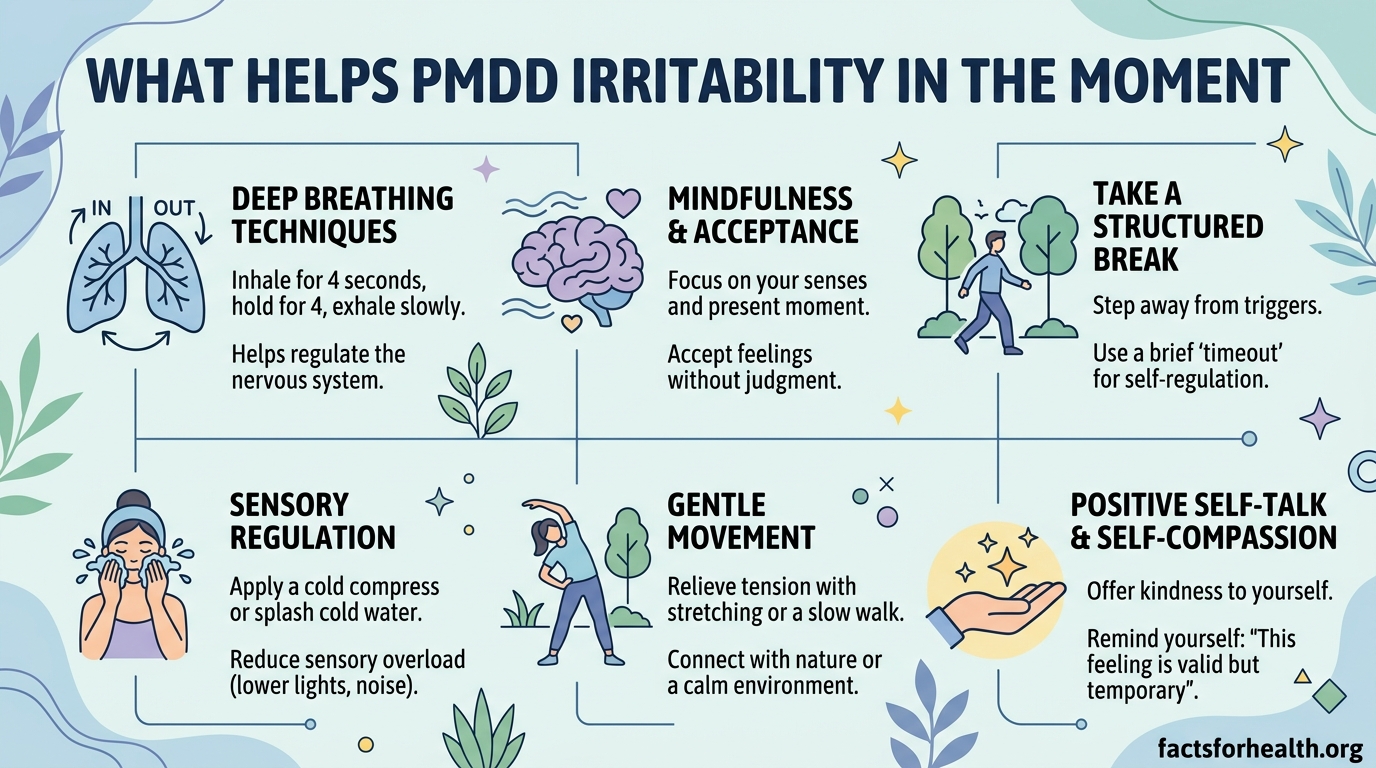
If you are reading this during your luteal phase, clenching your jaw and feeling like you might snap at the next person who breathes near you, you are not broken. That rage building in your chest is one of the most common and most disruptive symptoms of premenstrual dysphoric disorder. Finding what helps PMDD irritability in the moment can feel impossible when your nervous system is screaming, but there are real, proven techniques that can interrupt the rage cycle before it takes over.
Our team has spent years researching women’s hormonal health, analyzing clinical studies, and listening to hundreds of real experiences from people in PMDD support communities. The techniques in this guide are the ones that actually work when you feel like you are about to lose control.
You will learn why PMDD irritability feels so overwhelming compared to normal stress, seven step-by-step techniques you can use the second you feel rage building, how to recognize your personal triggers before they explode, and when it is time to talk to a doctor about medical support. Every strategy here is designed to be used in the exact moment when irritability spikes.
Table of Contents
What Is PMDD Irritability?
PMDD irritability is not regular crankiness or having a short temper. It is an intense, disproportionate emotional response triggered by hormonal fluctuations during the luteal phase of your menstrual cycle. People with PMDD often describe feeling like a completely different person for one to two weeks before their period starts.
Premenstrual dysphoric disorder affects an estimated 3 to 8 percent of people who menstruate. Unlike typical premenstrual syndrome, which might cause mild mood changes and physical discomfort, PMDD produces severe psychological symptoms that can disrupt relationships, work performance, and daily functioning.
The irritability that comes with PMDD is one of the most frequently reported symptoms. In online support communities, people describe it as rage, fury, or a feeling that their skin is crawling with anger. Small things that would normally roll off your back suddenly feel unbearable. A partner leaving a dish in the sink, a coworker asking a simple question, or even the sound of someone chewing can trigger an explosive reaction.
This is not a personality flaw. This is not you being difficult. PMDD irritability is a documented medical condition with a biological cause, and understanding that distinction is the first step toward managing it.
Why PMDD Irritability Happens
To understand what helps PMDD irritability in the moment, it helps to understand why your brain is producing this response. The answer lies in the complex interaction between reproductive hormones and neurotransmitters.
During the luteal phase, which is the time between ovulation and the start of your period, levels of estrogen and progesterone rise and then fall dramatically. For most people, this hormonal shift causes mild physical and emotional changes. But for those with PMDD, the brain reacts to these normal hormone fluctuations as if they are a threat.
Research shows that people with PMDD have a heightened sensitivity to normal hormonal changes. Their brains do not produce different hormone levels than people without PMDD. Instead, their serotonin systems respond differently to the natural rise and fall of estrogen and progesterone.
Serotonin is a neurotransmitter that regulates mood, sleep, appetite, and impulse control. When estrogen drops during the late luteal phase, serotonin activity decreases in people with PMDD more dramatically than in those without the condition. This serotonin dip is why irritability, anger, anxiety, and depression all cluster together during the days before your period.
Additionally, PMDD affects the GABA system, which is your brain’s natural calming mechanism. When GABA function is disrupted, your nervous system stays in a heightened state of alertness. This is why PMDD rage can feel so physical. Your heart races, your muscles tense, and your body prepares for conflict even when no real threat exists.
The amygdala, your brain’s emotional processing center, becomes more reactive during the luteal phase in people with PMDD. This means the part of your brain responsible for detecting danger is working overtime while the prefrontal cortex, which normally helps regulate emotional responses, is less effective at putting on the brakes.
Knowing this biological reality matters. When you understand that your rage has a neurological cause, you can stop blaming yourself and start using targeted techniques to calm an overactive nervous system.
What Helps PMDD Irritability in the Moment: Immediate Techniques
When PMDD rage hits, you need techniques that work in seconds, not after a 30-minute meditation session. The following seven steps are ordered from fastest to deepest. Start with step one and work through them until you feel the intensity begin to drop.
Step 1: Physiological Reset with Cold Water
The single fastest way to interrupt a rage spike is to activate your mammalian dive reflex. This is an involuntary response that slows your heart rate and shifts your nervous system from fight-or-flight into a calmer state.
Splash ice-cold water on your face, or hold an ice pack against your cheeks and under your eyes for 15 to 30 seconds. If you have access to a bowl of cold water, submerging your face for a few seconds works even faster. The cold stimulates the vagus nerve, which runs through your face and connects directly to your parasympathetic nervous system.
You should feel a noticeable shift within 30 to 60 seconds. Your heart rate drops, your breathing slows, and the physical sensation of rage begins to fade. This is not a cure, but it creates a window where you can think more clearly and choose your next step.
Keep ice packs in your freezer during your luteal phase so they are ready when you need them. Some people in PMDD communities keep a reusable ice roller in the refrigerator specifically for this purpose.
Step 2: Box Breathing to Downregulate Rage
Box breathing is a technique used by Navy SEALs and emergency responders to manage acute stress. It works by forcing your nervous system to slow down through controlled, rhythmic breathing.
Here is how to do it. Inhale through your nose for a count of four. Hold your breath for a count of four. Exhale through your mouth for a count of four. Hold empty for a count of four. Repeat this cycle at least four times, or until you feel the rage intensity begin to decrease.
The key is the exhale phase. When you exhale slowly and completely, you activate the vagus nerve and signal to your brain that the threat has passed. The four-count hold between breaths prevents the rapid, shallow breathing pattern that feeds anxiety and anger.
If a four-count feels too long when you are in the grip of rage, start with three. The exact count matters less than the rhythm. What matters is that each phase lasts the same amount of time and that your exhale is slow and controlled.
Many people in PMDD support forums say daily consistent meditation was the thing that helped most with anger and irritability over time. Box breathing during an acute episode is the emergency version of that practice.
Step 3: The 5-4-3-2-1 Grounding Method
When PMDD rage pulls you into a spiral, grounding techniques pull you back into your body and your present environment. The 5-4-3-2-1 method is one of the most effective because it engages all five senses and forces your brain to process external information instead of looping on internal anger.
Name five things you can see around you. Say them out loud or in your mind. Name four things you can physically feel, such as the chair under you, the fabric of your shirt, your feet on the floor, or the temperature of the air. Name three things you can hear. Name two things you can smell. Name one thing you can taste.
This exercise takes about 60 to 90 seconds and works because it redirects blood flow away from the amygdala, your emotional alarm system, and toward the sensory processing areas of your brain. It is a pattern interrupt that breaks the rage loop.
If you cannot smell or taste anything specific, that is fine. The act of trying is what matters. You can also modify this to 3-2-1 if you need something faster during an intense moment.
Step 4: Remove Yourself and Wait 10 Minutes
One of the hardest but most effective things you can do when PMDD irritability spikes is to physically leave the situation. Go to another room. Step outside. Sit in your car. Walk around the block.
The reason this works is biological. The acute neurochemical surge that creates the feeling of rage typically peaks and begins to decline within about 10 minutes. If you can ride out that 10-minute window without acting on the anger, the intensity will drop on its own.
Tell the people closest to you in advance that during your luteal phase, you may need to step away suddenly. This is not walking out on a conversation. It is a coping strategy that prevents you from saying or doing something you will regret.
People in PMDD communities frequently mention the guilt they feel after anger episodes and how they treated loved ones. Building in a 10-minute escape valve can prevent that cycle from repeating.
Set a timer on your phone when you step away. When it goes off, check in with yourself. Has the rage decreased even slightly? If yes, you may be ready to return. If not, give yourself another 10 minutes.
Step 5: Progressive Muscle Release
PMDD rage stores itself in your body. Your jaw clenches, your shoulders rise toward your ears, your fists tighten, and your stomach braces. Progressive muscle release is a technique that systematically lets go of that physical tension, which in turn signals to your brain that the threat is over.
Start at the top of your body. Clench your jaw as hard as you can for five seconds, then release. Notice the difference between tension and relaxation. Move to your shoulders. Shrug them up toward your ears, hold for five seconds, then drop them. Make fists with both hands, squeeze for five seconds, then open your fingers wide.
Work your way down through your stomach, your glutes, your thighs, your calves, and your feet. Tense each muscle group for five seconds, then release for 10 seconds before moving to the next.
This full sequence takes about three to four minutes. The release phase is where the calming happens. When your muscles let go, your nervous system interprets that relaxation as evidence that you are safe. This reduces cortisol and adrenaline levels, which are the stress hormones fueling your rage.
Step 6: The 4-7-8 Breath for Acute Rage
If box breathing feels too slow or structured for the level of rage you are experiencing, the 4-7-8 breath is an alternative that many people find more effective for acute anger spikes.
Inhale through your nose for a count of four. Hold your breath for a count of seven. Exhale completely through your mouth, making a whoosh sound, for a count of eight. Repeat this cycle four times to start.
The extended exhale is what makes this technique powerful for rage specifically. A long exhale forces your parasympathetic nervous system to engage, which is the branch responsible for rest and recovery. The seven-count hold allows carbon dioxide to build slightly, which has a naturally calming effect on the brain.
Do not do more than four cycles the first time you try this. It can make you lightheaded, which is normal. If you feel dizzy, return to normal breathing and try again later.
Step 7: Name It to Tame It
This technique comes from brain research on emotional regulation. The simple act of labeling what you are feeling reduces activity in the amygdala and increases activity in the prefrontal cortex, which is the logical, decision-making part of your brain.
When rage hits, say to yourself or out loud, “I am experiencing PMDD rage right now. This is my luteal phase. This is temporary. This is not who I am.”
Be specific. Instead of “I am angry,” try “I am feeling a surge of irritability because my hormones are fluctuating and my serotonin is low.” The more precisely you can name the experience, the more effectively your prefrontal cortex can step in and regulate it.
You can also write it down. Keep a note on your phone or a small notebook where you jot down what triggered the rage, what time it happened, and where you are in your cycle. This serves double duty. It calms you in the moment and builds a data set that helps you anticipate future episodes.
Recognizing Your PMDD Irritability Triggers
The best way to manage PMDD irritability in the moment is to catch it before it becomes full-blown rage. That requires knowing your personal triggers and early warning signs.
Start tracking your symptoms daily if you are not already. Note your mood, irritability level on a scale of 1 to 10, and any anger episodes. After two or three cycles, patterns will emerge. You may notice that your irritability always spikes four days before your period, or that certain situations consistently trigger worse reactions.
Common physical warning signs that rage is building include jaw clenching, a tight feeling in your chest, a sudden feeling of heat in your face or neck, shallow rapid breathing, and a sense that sounds or lights are suddenly overwhelming. When you notice these signs, deploy your coping techniques immediately rather than waiting for the rage to peak.
Emotional warning signs often include feeling suddenly critical of everyone around you, catastrophizing minor problems, feeling trapped or cornered in normal conversations, and experiencing an urge to pick fights or send angry messages. If you notice yourself composing a confrontational text or email, stop. That impulse is a sign that PMDD is driving your behavior, not your rational mind.
Many people in support forums describe developing PMDD in their late teens or twenties and watching it intensify over years. Tracking your cycle means you are no longer caught off guard every month. You can see the storm coming and prepare.
Communication Strategies for PMDD Irritability
One of the most painful aspects of PMDD is the damage it can do to relationships. People in support communities repeatedly mention guilt over how they treated partners, children, friends, and coworkers during luteal phase episodes. Having a communication plan in place before irritability hits can reduce that damage significantly.
Talk to your partner or close family members during a calm phase, not during your luteal week. Explain what PMDD is, that it is a medical condition with a biological cause, and that during certain days of your cycle you may become irritable or reactive. This is not making excuses. It is giving them context so they understand that your reactions during that time are not about them.
Create a code word or signal that means you are entering an irritable state and need space. This could be a specific phrase, a text message with an emoji, or simply saying you need a time-out. Agree in advance that when this signal is used, the other person will give you 10 to 15 minutes without asking questions or pressing the issue.
At work, you do not need to disclose PMDD specifically. But you can build in strategies like scheduling fewer meetings during your luteal phase, taking walks during lunch, or using email instead of phone calls on days when you feel most reactive.
Prepare what you will say when irritability strikes. Having a script ready means you do not have to think of the right words when your brain is already in overdrive. Something as simple as “I need a few minutes to myself” can prevent an exchange from escalating.
Apologize when needed, but also forgive yourself. The guilt cycle is real, and beating yourself up after an episode only adds stress, which can make next month’s symptoms worse. Acknowledge what happened, repair the relationship, and move forward with your coping plan.
Long-Term Foundations That Reduce PMDD Rage
In-the-moment techniques are essential, but they work best when supported by daily habits that reduce the overall severity of your symptoms. These foundations will not eliminate PMDD, but they can lower the baseline intensity of your irritability so your coping techniques are more effective.
Regular aerobic exercise is one of the most evidence-backed interventions for PMDD. Studies show that women who engage in consistent moderate exercise experience less severe premenstrual symptoms, including irritability. The challenge, as many in support forums note, is finding the motivation to exercise during the luteal phase when fatigue and depression are at their peak. Start before ovulation when your energy is higher and aim to maintain even a reduced version of your routine through the difficult days.
Sleep is non-negotiable. Sleep deprivation amplifies every PMDD symptom, especially emotional reactivity. Aim for seven to nine hours per night and prioritize sleep hygiene during your luteal phase. This means consistent bedtimes, no screens for an hour before bed, and avoiding alcohol and caffeine in the evening.
Dietary changes can help stabilize blood sugar, which directly affects mood stability. Focus on complex carbohydrates, adequate protein, and regular meals. Avoid sugar spikes and crashes, which can trigger irritability even in people without PMDD. Some people find that reducing caffeine during the luteal phase significantly decreases their anxiety and rage levels.
Daily meditation and mindfulness practice was cited again and again by real users in PMDD forums as the single most helpful long-term strategy for anger management. Even 10 minutes per day can change how your brain responds to stress over time. The goal is not to never feel angry but to build the neural pathways that help you notice anger earlier and respond rather than react.
Symptom tracking apps can help you see patterns and prepare. Apps like Me v PMDD, Flo, or Clue allow you to log daily symptoms and correlate them with your cycle phase. Knowing that your hardest days are coming means you can arrange your schedule, communicate with loved ones, and have your coping tools ready.
Some people in support communities report that supplements like calcium, vitamin B6, magnesium, and chasteberry (Vitex agnus-castus) helped reduce their symptoms. Research on these is mixed, but some studies support calcium and B6 for PMS and PMDD. Always talk to your doctor before starting any supplement regimen.
When to Seek Professional Help for PMDD Irritability
If your PMDD irritability is severe enough to damage relationships, interfere with work, cause you to feel unsafe, or lead to thoughts of self-harm, it is time to talk to a healthcare provider. You do not have to white-knuckle through this alone.
The most commonly prescribed medications for PMDD are selective serotonin reuptake inhibitors, or SSRIs. Research consistently shows that SSRIs are highly effective for PMDD, often working within days rather than the weeks required for depression treatment. Fluoxetine (Prozac), sertraline (Zoloft), citalopram (Celexa), and escitalopram (Lexapro) are among the most studied and prescribed.
Many people in PMDD communities mention that SSRIs like Prozac or Zoloft took the edge off their rage and allowed them to function during their luteal phase. Some doctors prescribe SSRIs only during the luteal phase rather than continuously, which is called intermittent dosing. This approach can be just as effective as continuous dosing for PMDD while reducing side effects.
Cognitive behavioral therapy, or CBT, is another evidence-based treatment for PMDD. CBT helps you identify and reframe the thought patterns that amplify irritability and teaches practical coping skills. A therapist who understands PMDD can also help you process the guilt, shame, and relationship strain that often accompany the condition.
If SSRIs and CBT are not sufficient, other options include hormonal treatments like combined oral contraceptives. The FDA has approved a specific birth control pill called Yaz for PMDD. In severe cases that do not respond to other treatments, a specialist may discuss GnRH analogues, which temporarily induce a menopause-like state to stop the hormonal cycle entirely.
If you ever have thoughts of harming yourself or others during your luteal phase, this is a medical emergency. Contact your doctor immediately, call a crisis line, or go to an emergency room. PMDD can cause severe psychological distress, and these feelings are a symptom of the condition, not a reflection of your reality.
In the United States, you can call or text 988 to reach the Suicide and Crisis Lifeline. In the UK, you can call 111 or 999. Do not wait for your period to arrive. Reach out now.
FAQs
How do you treat PMDD irritability?
PMDD irritability is treated through a combination of immediate coping techniques, lifestyle changes, and medical options. In the moment, cold water exposure, box breathing, and grounding exercises can interrupt rage spikes. Long-term, regular exercise, sleep optimization, and daily meditation reduce severity. Medical treatments include SSRIs (often prescribed for luteal-phase-only dosing), CBT, and in some cases hormonal contraceptives. The most effective approach is usually a combination of these strategies tailored to your specific symptoms.
How to stop PMDD anger?
To stop PMDD anger in the moment, try these steps: 1) Splash cold water on your face to trigger the dive reflex and slow your heart rate. 2) Practice box breathing: inhale for 4, hold for 4, exhale for 4, hold for 4. 3) Use the 5-4-3-2-1 grounding method to pull your brain out of the anger loop. 4) Physically remove yourself from the situation for at least 10 minutes. 5) Name what you are feeling to activate your prefrontal cortex. These techniques work best when practiced before you need them.
What SSRI is best for PMDD?
The most commonly prescribed and well-studied SSRIs for PMDD are fluoxetine (Prozac or Sarafem), sertraline (Zoloft), citalopram (Celexa), and escitalopram (Lexapro). Research shows that all SSRIs can be effective for PMDD, and the best choice depends on your individual response and side effect profile. Many doctors prescribe SSRIs for luteal-phase-only dosing, meaning you take the medication only during the 1 to 2 weeks before your period rather than continuously. This can reduce side effects while maintaining effectiveness.
How do you get rid of PMDD mood swings naturally?
Natural approaches to reducing PMDD mood swings include regular aerobic exercise (30 minutes, most days), prioritizing 7 to 9 hours of quality sleep, eating balanced meals with complex carbohydrates to stabilize blood sugar, reducing caffeine and alcohol during the luteal phase, daily meditation or mindfulness practice, and supplementing with calcium (1200 mg daily) and vitamin B6 (up to 100 mg daily) which have research support. Tracking your cycle helps you anticipate and prepare for difficult days. These strategies reduce severity but may not eliminate symptoms entirely.
How to get out of PMDD rage?
To get out of a PMDD rage episode quickly: immediately remove yourself from the trigger or situation. Splash cold water on your face or hold an ice pack on your cheeks for 30 seconds. Begin 4-7-8 breathing: inhale for 4, hold for 7, exhale for 8. Remind yourself that this is a hormonal response, not a rational reaction. Wait at least 10 minutes before responding to anyone or making decisions. The acute neurochemical surge that fuels rage typically peaks and begins declining within 10 minutes if you do not feed it with further conflict.
What are the 4 R’s of anger management?
The 4 R’s of anger management are Recognize, Retreat, Relax, and Resolve. Recognize means identifying the physical and emotional signs that anger is building. Retreat means removing yourself from the situation before the anger peaks. Relax means using techniques like deep breathing, progressive muscle relaxation, or cold water exposure to calm your nervous system. Resolve means returning to the situation once calm to address the issue rationally or let it go if it no longer matters. This framework works especially well for PMDD irritability because it gives you a structured plan for moments when thinking clearly is difficult.
Conclusion
PMDD irritability is one of the most challenging symptoms to live with, but you now have a toolkit of seven immediate techniques that can help you regain control when rage hits. Cold water resets, box breathing, grounding exercises, strategic withdrawal, progressive muscle release, the 4-7-8 breath, and naming your emotions are all proven methods for calming an overactive nervous system in seconds.
Understanding what helps PMDD irritability in the moment is only the beginning. Combine these emergency techniques with long-term foundations like exercise, sleep, meditation, and symptom tracking to reduce the frequency and severity of your episodes. And if your symptoms are severe enough to disrupt your life or relationships, talk to a doctor about medical options like SSRIs or CBT. You do not have to suffer through this alone.
Start with one technique from this guide. Practice it during a calm phase so it becomes automatic. Then add another. The goal is not perfection but progress, giving yourself one more tool each cycle until you have a plan that works for your body and your life.