
You started taking antidepressants to feel better. And in many ways, they worked. The crushing weight of depression lifted. The anxiety quieted down. But somewhere along the way, something else shifted. You laugh less. You cannot seem to cry. A friend shares exciting news and you nod politely, but the joy just is not there. Your partner says “I love you” and you feel… nothing.
If this sounds familiar, you are not broken and you are not alone. What you are experiencing has a name: emotional blunting from antidepressants. Research suggests it affects somewhere between 40% and 60% of people taking SSRIs and similar medications. Yet it remains one of the most underdiscussed side effects in psychiatry.
In this guide, I want to walk you through exactly what emotional blunting feels like, why it happens, and what you can do about it. Whether you are wondering if your medication is causing this or you already know and want solutions, this article covers the full picture. I have spent time reading through patient forums, clinical studies, and psychiatric resources to bring you the most complete and honest picture available.
Table of Contents
What Emotional Blunting From Antidepressants Feels Like
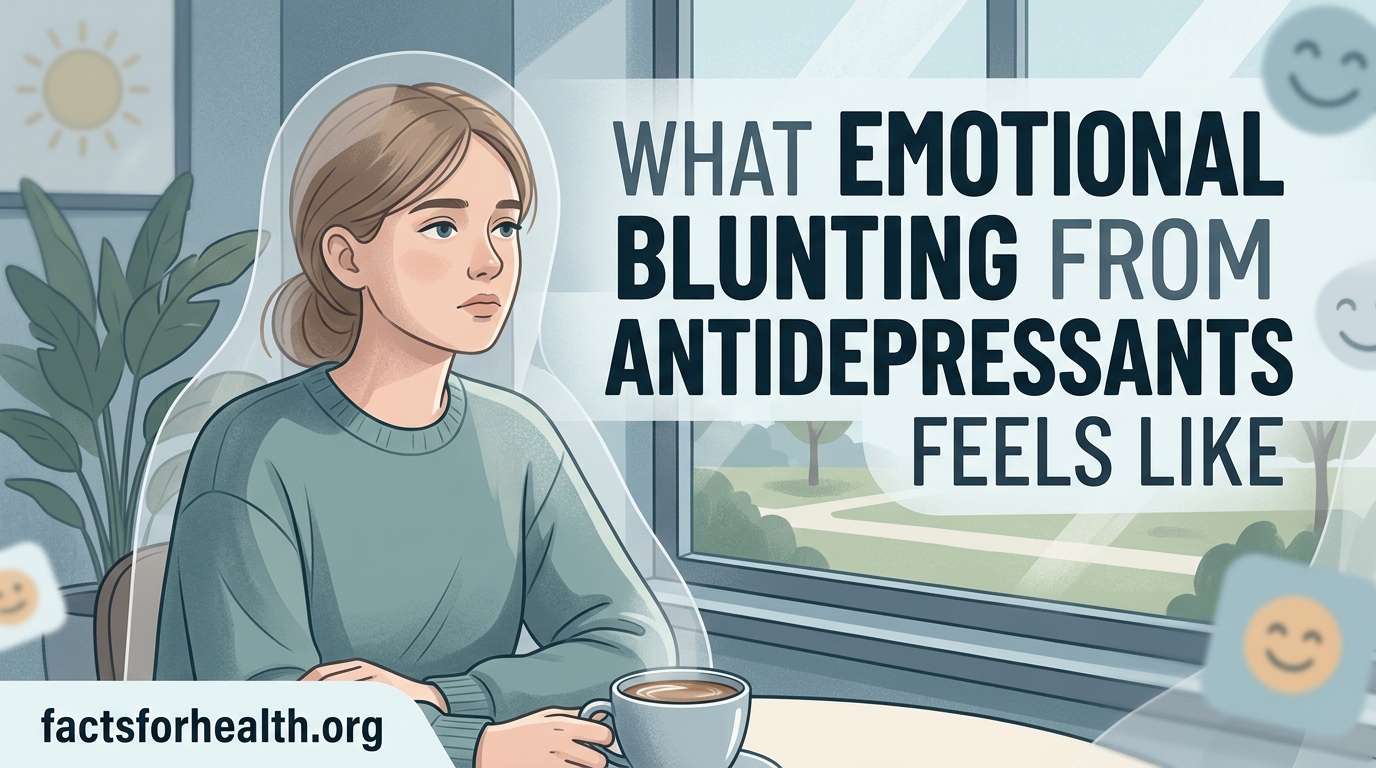
The hardest part about emotional blunting is describing it to someone who has not felt it. People often use the same metaphor without ever having read each other’s words. They say it feels like watching life through a window. You can see everything happening. You know you should feel something about it. But there is a barrier between you and the experience.
One Reddit user on r/SSRIs described it this way: “I know I love my kids. I would do anything for them. But when they run up and hug me, it is like the feeling gets stuck somewhere before it reaches my heart.” That sense of knowing an emotion should be there but being unable to access it is the hallmark of emotional blunting.
It is not sadness. It is not depression returning. It is the absence of emotional intensity across the board. The highs get lower, but so do the lows. A funny movie gets a smile instead of a belly laugh. A funeral gets quiet composure instead of tears. The entire emotional spectrum gets compressed into a narrow middle range.
Some people describe feeling like a spectator in their own life. You go through the motions. You show up to work, eat dinner, spend time with family. Everything looks normal from the outside. But internally, there is a flatness. A greyness. Colors that used to be vivid now feel muted.
Others use words like “robotic” or “zombie-like.” One person on a Mayo Clinic Connect forum wrote that after ten years on an SNRI, they realized they had not genuinely laughed in nearly a decade. They had forgotten what full emotional engagement felt like until they tapered off the medication.
Here is what makes this especially confusing: emotional blunting can feel similar to the depression you were trying to treat in the first place. That is why so many people struggle to identify it. They assume their depression is getting worse, or that the medication stopped working, when actually the opposite may be true. The medication is working too well, muting everything rather than just the pain.
Recognizing the Signs in Daily Life
Emotional blunting shows up in small, everyday moments. You might not notice it at first. It creeps in gradually over weeks or months. Many people only recognize it in hindsight, once they start paying attention to patterns.
Here are the most common signs people report experiencing:
- Movies and entertainment feel flat. You used to cry during sad scenes or laugh until your sides hurt at comedies. Now you watch and feel mildly entertained at best. The emotional payoff just does not land.
- Music does not move you the same way. A song that used to give you chills or make you feel nostalgic now sounds like background noise. The emotional connection to music is dimmed or gone.
- Good news does not spark joy. A promotion, a friend’s wedding announcement, a vacation booking. These events register as positive, but the excitement and happiness that should follow do not arrive.
- Your relationships feel distant. When your partner expresses love or affection, you may feel unable to reciprocate emotionally. This does not mean you do not care. It means the feeling is blocked or muted.
- You cannot cry even when you want to. Many people describe wanting to cry at appropriate moments but being physically unable to. The tears will not come, even when the situation warrants them.
- Your sex drive and intimate connection fade. Emotional blunting often accompanies sexual side effects. The combination can strain romantic relationships significantly.
- You feel detached from your own experiences. Events happen to you, but you do not feel fully present for them. It is like watching yourself from a slight distance.
- Your sense of humor dims. Jokes that would have had you rolling now get a polite chuckle at best. The spontaneous, genuine laugh is rare or absent.
- Motivation and drive decrease. Things you used to feel passionate about no longer pull you in. Hobbies, interests, and ambitions lose their charge.
- You feel calm but not alive. The anxiety and pain may be gone, but so is the spark. You feel stable but flatlined.
If you checked several of these boxes, emotional blunting may be part of what you are experiencing. The good news is that recognition is the first step toward addressing it.
Why SSRIs Cause Emotional Blunting
To understand why emotional blunting happens, it helps to know how SSRIs (selective serotonin reuptake inhibitors) work. Medications like Lexapro, Zoloft, Prozac, Paxil, and Celexa increase the amount of serotonin available in your brain. Serotonin is a neurotransmitter that plays a role in mood regulation.
The problem is that serotonin does not only affect negative emotions. It modulates the entire emotional system. When you boost serotonin levels across the brain, you do not just turn down sadness and anxiety. You turn down the volume on everything. Joy, excitement, love, anger, grief, passion. All of it gets dialed back.
Researchers have proposed several mechanisms to explain this. One leading theory involves serotonin’s effect on dopamine. Dopamine is the neurotransmitter most associated with reward, pleasure, and motivation. Some studies suggest that increased serotonin signaling can suppress dopamine activity in certain brain pathways. When dopamine is suppressed, the reward system does not fire as strongly. Things that should feel good do not feel as good.
Another theory focuses on what researchers call a reinforcement learning deficit. In simple terms, your brain learns from emotional feedback. When something feels good, your brain notes it and motivates you to seek it again. When something feels bad, your brain learns to avoid it. But when the emotional feedback is muted, this learning system slows down. You become less driven by emotional rewards and punishments.
Serotonin also affects the prefrontal cortex, the brain region involved in emotional regulation and decision-making. Some researchers believe that excessive serotonin activity in this area essentially applies a brake to emotional processing. Your brain becomes so efficient at keeping emotions in check that it overcorrects, leaving you with too little emotional response rather than too much.
The amygdala, which processes emotional reactions, also becomes less reactive on SSRIs. Brain imaging studies show reduced amygdala activation in people taking SSRIs. This is beneficial for anxiety and overwhelming negative emotions. But it also means your brain’s emotional alarm system and joy detector are both running at lower sensitivity.
Not every antidepressant causes the same level of blunting. SSRIs like Lexapro, Paxil, and paroxetine tend to be associated with more emotional blunting. Medications that act on different neurotransmitter systems, like bupropion (Wellbutrin), which works on dopamine and norepinephrine, are generally less likely to cause this side effect. Tricyclic antidepressants also appear to cause less blunting for some patients, according to anecdotal reports from long-term users on patient forums.
Emotional Blunting vs Depression vs Anhedonia
One of the most confusing aspects of emotional blunting is how much it resembles other conditions. Many people mistake it for returning depression, and some doctors do too. Understanding the differences matters because the solutions are different.
Emotional blunting is a medication side effect. It reduces the intensity of all emotions, both positive and negative. You feel less sad, but also less happy. The key feature is that the blunting started or worsened after beginning or increasing a medication. If your depression symptoms improved but then you noticed emotional flatness creeping in, that pattern points toward medication-induced blunting.
Anhedonia is a core symptom of depression itself. It refers specifically to the inability to feel pleasure. With anhedonia, you lose interest in things you used to enjoy. You may still feel sadness, guilt, or anxiety. The problem is specifically with positive emotions. Emotional blunting, by contrast, mutes both positive and negative emotions. If you can still feel sadness and anxiety but cannot feel joy, that may be anhedonia rather than blunting.
Apathy is a loss of motivation and concern. You simply do not care about things. There is a sense of “whatever” about everything. Apathy can be caused by depression, by medications, or by neurological conditions. It overlaps with both blunting and anhedonia but is specifically about motivation and engagement rather than the intensity of feelings.
Residual depression means your depression is not fully treated. You still have symptoms like low mood, hopelessness, fatigue, or poor concentration. Emotional blunting can mask residual depression because both involve reduced positive emotions. The difference is that with residual depression, you typically still experience negative emotions intensely. With blunting, negative emotions are also reduced.
Here is a simple way to think about it. If your depression improved but you feel emotionally flat across the board, that is likely blunting. If you still feel depressed but also cannot enjoy anything, that may be anhedonia or residual depression. If you feel emotionally fine but just cannot be bothered to do anything, that leans toward apathy.
Telling these apart matters because the treatment differs. If it is blunting, your doctor might lower your dose or switch medications. If it is residual depression or anhedonia, you may need a higher dose, a different medication, or additional treatments like therapy.
How It Affects Relationships and Creativity
Emotional blunting does not just affect your internal experience. It ripples outward into every relationship and activity in your life. The impact on relationships is one of the most painful aspects that patients report.
In romantic relationships, emotional blunting can create a wall between partners. When your partner says “I love you” and you feel nothing in response, it is deeply unsettling. You may start doubting whether you still love them. In most cases, the love is still there. The capacity to feel it in the moment is what has been muted. But your partner cannot see inside your head. From their perspective, you seem distant, cold, or disengaged. Over time, this can erode trust and intimacy.
Sexual side effects compound the problem. Many SSRIs reduce libido and interfere with sexual function. When you combine physical sexual side effects with emotional disconnection, romantic relationships can suffer enormously. Some couples report that the emotional distance caused by blunting is actually more damaging than the sexual side effects.
For parents, emotional blunting can be heartbreaking. Children are emotional beings. They express love, excitement, fear, and sadness openly. When a parent cannot match that emotional energy, children may interpret it as rejection or disinterest. One mother on a patient forum described how her young daughter stopped running to greet her at the door because the responses had become so muted. The mother knew she loved her daughter deeply. She just could not express it in a way her daughter could feel.
Friendships also take a hit. When you cannot laugh at inside jokes, cannot share genuine excitement about a friend’s good news, or cannot offer the emotional comfort they need during hard times, friendships can fade. People may start describing you as “different” or “distant” without understanding why.
The impact on creativity is a topic that almost no resource covers, yet it comes up constantly in patient discussions. Writers describe losing their ability to find the emotional core of their work. Musicians report that music that used to pour out of them now feels mechanical. Painters and artists talk about losing the visceral emotional drive that fueled their creativity. One graphic designer described it as losing access to the part of her brain where ideas lived. She could still execute designs technically, but the spark behind them was gone.
Creativity thrives on emotional sensitivity. Artists, writers, and musicians often have naturally heightened emotional awareness. When a medication flattens that sensitivity, the creative well can run dry. For people whose identity and career are tied to creative expression, this loss can be devastating.
If you are experiencing this, it is worth telling your doctor specifically how your creativity has been affected. Many prescribers focus on symptom checklists that do not include creative output. But for you, losing that may matter more than any other side effect.
What You Can Do About It
The most important thing to know is that emotional blunting is not something you just have to live with. There are several approaches that can help, ranging from simple adjustments to more significant changes. Never stop or change your medication without consulting your prescriber first. Abruptly stopping antidepressants can cause serious withdrawal symptoms and relapse.
Talk to your doctor about dose reduction. For some people, emotional blunting is dose-dependent. A lower dose may maintain the antidepressant benefit while reducing the blunting. This is often the first approach doctors try because it is the simplest. Your doctor may reduce your dose gradually and monitor how you feel over several weeks.
Consider switching medications. If dose reduction does not help or causes your depression symptoms to return, switching to a different antidepressant is the next option. Bupropion (Wellbutrin) works on dopamine and norepinephrine rather than serotonin. It is associated with significantly less emotional blunting and fewer sexual side effects. Some people switch entirely to bupropion, while others take it alongside an SSRI to counteract the blunting.
Other options with potentially less emotional blunting include vortioxetine (Trintellix), vilazodone (Viibryd), and mirtazapine (Remeron). Trintellix in particular has been studied specifically for its lower impact on emotional processing. Your doctor can help you weigh the pros and cons of each option based on your specific symptoms and history.
Add therapy to your treatment plan. Cognitive behavioral therapy, acceptance and commitment therapy, or other forms of psychotherapy can complement medication. Therapy gives you tools to manage depression and anxiety, which may eventually allow for a lower medication dose. It also helps you process the emotional impact of feeling blunted.
Practice mindfulness and emotional reconnection. Some patients find that mindfulness practices help them reconnect with subtler emotional signals. When the loud emotions are muted, you may need to train yourself to notice quieter emotional cues. Body scanning, journaling, and somatic awareness exercises can help rebuild the connection between your mind and your emotional experience.
Explore lifestyle modifications. Regular exercise, adequate sleep, and social connection all support emotional health independently of medication. Exercise in particular boosts dopamine and endorphins, which may partially counteract the blunting effect. Some people find that intense physical activity temporarily restores a sense of emotional aliveness.
Consider augmentation strategies. In some cases, doctors add a low dose of a second medication to counteract blunting. Adding bupropion to an SSRI regimen is a common approach. Adding certain atypical medications or supplements may also help, but this should only be done under medical supervision.
Every person responds differently. What works for one person may not work for another. The key is to work with a prescriber who takes your report of emotional blunting seriously and is willing to adjust your treatment until you find the right balance between symptom relief and emotional vitality.
How to Talk to Your Doctor About Emotional Blunting
Many people struggle to bring up emotional blunting with their doctors. They worry they will seem ungrateful for the medication that helped them. Or they fear their doctor will dismiss the concern as trivial compared to depression. But emotional blunting is a recognized clinical phenomenon, and any good prescriber should take it seriously.
The best approach is to be specific and concrete. Instead of saying “I feel numb,” describe exact situations where you noticed the blunting. Tell your doctor about the movie that did not make you laugh. The good news that did not spark joy. The moment your partner expressed love and you felt nothing. Specific examples help your doctor understand the severity and impact.
Here are some questions you can ask your doctor:
- Could my current dose be causing emotional blunting, and would a lower dose help?
- Are there alternative medications that cause less emotional numbing?
- Would adding bupropion or another medication help counteract the blunting?
- How can we tell if this is emotional blunting versus residual depression?
- What is the plan if reducing my dose causes my depression symptoms to return?
- Are there non-medication approaches we should add to my treatment?
- How long should we trial a change before deciding if it is working?
Some clinicians use screening tools like the Oxford Depression Questionnaire, which includes specific questions about emotional blunting. You can also ask your doctor to complete a side effect assessment. If your doctor dismisses your concerns, it may be worth seeking a second opinion from a psychiatrist who specializes in medication management.
One important point: do not stop your medication on your own. Sudden discontinuation of SSRIs and SNRIs can cause withdrawal symptoms including brain zaps, dizziness, nausea, mood swings, and a rebound of depression or anxiety. Any changes should be done gradually and under medical supervision.
FAQs
Can antidepressants cause emotional blunting?
Yes. Emotional blunting is a well-documented side effect of antidepressants, particularly SSRIs like Lexapro, Zoloft, Prozac, Paxil, and Celexa. Research indicates that 40-60% of people taking these medications experience some degree of emotional numbing, including reduced ability to feel both positive and negative emotions.
How long does emotional blunting last on antidepressants?
Emotional blunting typically persists as long as you are taking the medication at the current dose. It is not a temporary side effect that fades over time like nausea or sleepiness. For most people, blunting continues throughout treatment. However, it often improves or resolves when the dose is reduced, the medication is switched, or the medication is discontinued under medical supervision.
What is the difference between emotional blunting and anhedonia?
Emotional blunting is a medication side effect that reduces the intensity of all emotions, both positive and negative. Anhedonia is a symptom of depression that specifically involves the inability to feel pleasure while negative emotions may still be experienced fully. If you feel less sad but also less happy, that points toward emotional blunting. If you still feel depressed but also cannot enjoy anything, that is more consistent with anhedonia.
Does Lexapro make you feel numb?
Lexapro (escitalopram) is one of the SSRIs most commonly associated with emotional blunting. Because it is a potent and selective serotonin reuptake inhibitor, it can effectively reduce anxiety and depression but may also mute the full range of emotional responses. Not everyone experiences this side effect, but if you do, options include dose reduction, switching to a medication like bupropion, or adding a second medication. Talk to your prescriber before making any changes.
Conclusion
Emotional blunting from antidepressants is real, common, and treatable. If you have been feeling emotionally flat, watching your life through a window, or struggling to connect with the people and activities you love, your medication may be part of the picture. Recognizing what is happening is the first and most important step.
You do not have to choose between mental stability and emotional vitality. Dose adjustments, medication changes, therapy, and lifestyle strategies can all help restore your ability to feel fully. The key is working with a doctor who listens and takes your experience seriously.
Your emotions matter. Feeling alive matters. If your current treatment is muting the full range of your emotional experience, talk to your doctor about what emotional blunting from antidepressants feels like for you. There is a path forward that does not require choosing between feeling nothing and feeling everything.