
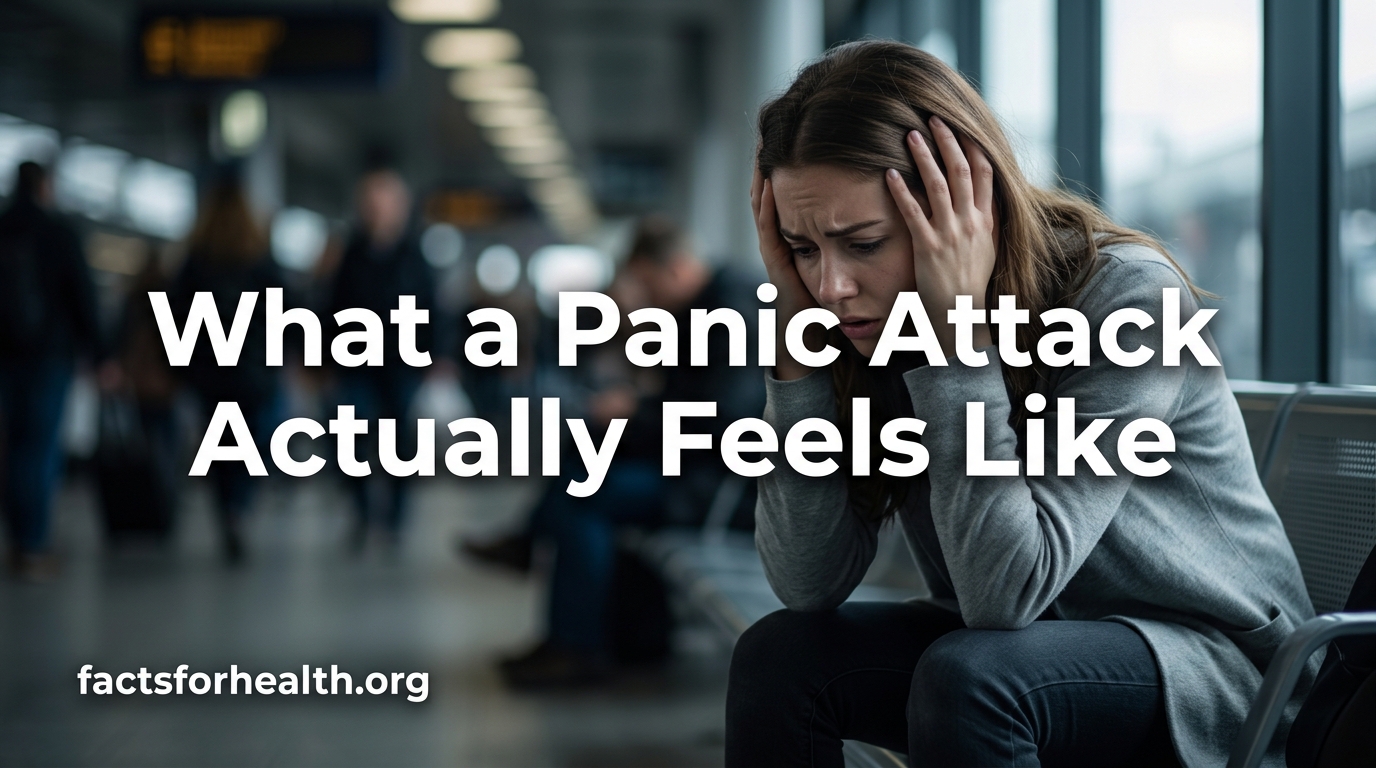
Imagine sitting at your desk on an ordinary Tuesday when, without warning, your heart starts slamming against your ribs like it is trying to escape. Your breathing turns shallow. The room feels like it is closing in. A wave of heat floods your body and a thought crashes through your mind: I am dying.
That is what a panic attack actually feels like for millions of people. It arrives suddenly, peaks within minutes, and leaves you exhausted and shaken. If you have experienced something like this, you are not alone and you are not broken.
In this guide, we walk through exactly what a panic attack actually feels like, from the first warning signs to the moment it fades. We cover the physical sensations, the emotional overwhelm, the body’s fight-or-flight response, and the coping techniques that genuinely help.
Table of Contents
Quick Summary: What a Panic Attack Actually Feels Like
A panic attack is a sudden surge of intense fear or discomfort that peaks within minutes. Here is what people most commonly experience during one:
- Racing or pounding heartbeat that can feel like your heart is beating out of your chest
- Shortness of breath or a feeling of being smothered or unable to get enough air
- Chest pain or tightness that many people mistake for a heart attack
- Sweating, trembling, or shaking that you cannot control
- Dizziness or lightheadedness, sometimes with a spinning sensation
- Hot flushes or chills, sometimes alternating rapidly
- Numbness or tingling in your hands, feet, lips, or face
- An intense fear of dying, losing control, or going crazy
People around you may not even notice anything is happening, which is part of what makes panic attacks so isolating.
What Is a Panic Attack?
A panic attack is a sudden episode of intense fear or discomfort that triggers severe physical reactions when there is no real danger. It is essentially your body’s alarm system going off at full volume for no apparent reason.
Panic attacks are incredibly common. The National Institute of Mental Health estimates that around 11 percent of Americans experience a panic attack each year. Most happen for the first time in adolescence or early adulthood, though they can begin at any age.
It helps to understand the difference between a panic attack and panic disorder. A panic attack is a single episode. Panic disorder is diagnosed when someone experiences recurrent, unexpected attacks and develops persistent worry about having another one. Having a panic attack does not automatically mean you have panic disorder.
The Physical Symptoms: What Your Body Feels
The physical sensations of a panic attack are what make it so terrifying. They are real, intense, and feel anything but imagined. Here is a closer look at what each one actually feels like.
Racing or pounding heart: Your heart rate can spike dramatically. Many people describe it as feeling like their heart is beating out of their chest or skipping beats. One person on Reddit described it as “bombs of adrenaline going off in my chest.”
Shortness of breath: Breathing becomes rapid and shallow, a process called hyperventilation. You may feel like you cannot get a full breath no matter how hard you try. One forum user wrote that “breathing is no longer automatic, you become aware of it.”
Chest pain or pressure: A tight, squeezing, or aching sensation in the chest is one of the most frightening symptoms. It is also why so many people end up in the emergency room during their first panic attack, convinced they are having a heart attack.
Sweating and trembling: Your body may break into a sudden sweat, and your hands or legs may shake uncontrollably. This is your nervous system dumping adrenaline into your bloodstream.
Dizziness and lightheadedness: You may feel faint, unsteady, or like the room is spinning. Rapid breathing changes the oxygen and carbon dioxide balance in your blood, which triggers this sensation.
Tingling and numbness: Hyperventilation can cause tingling in your fingers, toes, lips, and tongue. One person described “waves of overheating and chills, tingling in hands, feet, and tongue.”
Hot flushes and chills: Many people cycle between feeling burning hot and freezing cold during a single attack. Temperature regulation goes haywire as your body responds to the adrenaline surge.
Nausea and stomach distress: Your digestive system reacts too. You may feel nauseous, have a dry mouth, or feel a knot in your stomach.
The Emotional Experience: What Your Mind Goes Through
The physical symptoms grab your attention, but the emotional experience of a panic attack is just as overwhelming. This is where panic attacks do their deepest damage.
Fear of dying: This is the hallmark emotional symptom. During a panic attack, you genuinely believe you might die. The fear is not a thought you reason through. It is a felt certainty that takes over completely.
Fear of losing control or going crazy: Many people worry they are about to lose their mind, scream, or do something embarrassing. This fear feeds the panic, creating a vicious cycle.
Impending doom: A heavy, wordless sense that something terrible is about to happen. One person described it as “an impending feeling of non-specific existential dread.”
Dissociation and derealization: This is one of the most disorienting symptoms. You may feel detached from your body, like you are watching yourself from the outside. The world may seem unreal, distant, or dreamlike. One user wrote that it feels like “being disconnected from mind, body, and surroundings.”
Helplessness: A sense that you cannot stop what is happening and cannot escape it. This is especially intense if the attack happens in public or in a place where you feel trapped.
The Timeline: What a Panic Attack Feels Like From Start to Finish
One thing most resources skip is the actual timeline of a panic attack. Understanding the phases can help you recognize where you are in the experience and remind you that it will end.
Phase 1: The warning signs (minutes before). Some attacks strike with zero warning, but many begin with subtle cues. You might notice a slight tightness in your chest, a skipped heartbeat, a flash of heat, or a vague sense that something is wrong. These early sensations can trigger anxiety about having an attack, which then accelerates the cycle.
Phase 2: The escalation (first 1 to 5 minutes). Symptoms build rapidly. Your heart rate climbs, breathing quickens, and the physical sensations intensify. This is when fear of dying or losing control typically sets in. The cascade of adrenaline makes everything feel urgent and dangerous.
Phase 3: The peak (around 10 minutes in). This is the most intense point. Every symptom reaches its maximum. You may feel like you are outside your body, unable to think clearly, and completely consumed by fear. This phase usually lasts only a few minutes, though it can feel much longer.
Phase 4: The gradual decline (next 10 to 20 minutes). Your body cannot sustain the adrenaline surge indefinitely. Symptoms slowly begin to ease. Your heart rate comes down, breathing normalizes, and the sense of doom starts to fade.
Phase 5: The aftermath (hours after). This is the part almost no one talks about. After a panic attack, you may feel completely drained, shaky, emotionally raw, and exhausted. Some people describe feeling like they have run a marathon. Others feel a strange calm or emotional flatness. Lingering anxiety about having another attack is very common during this phase.
Most panic attacks peak within 10 minutes and resolve within 20 to 30 minutes, though some can last longer. Knowing this timeline can be a powerful tool. When you are in the middle of one, reminding yourself that it has a finite endpoint can reduce the terror.
What Happens in Your Body During a Panic Attack
To understand what a panic attack actually feels like, it helps to understand why your body is doing this. The answer lies in the fight-or-flight response.
Your nervous system has an ancient survival mechanism designed to protect you from physical threats. When you encounter danger, your brain releases a flood of adrenaline and cortisol. Your heart races to pump blood to your muscles. Your breathing quickens to deliver oxygen. Your muscles tense so you can fight or run.
This response is lifesaving when you are facing a predator. During a panic attack, it fires off when there is no actual threat. Researchers sometimes describe this as a false alarm. Your body’s smoke detector is going off even though nothing is burning.
The physical symptoms you feel, the racing heart, the rapid breathing, the sweating, the trembling, are all your body preparing for a fight that never comes. Because there is no real threat to exhaust yourself against, the energy has nowhere to go. That is why the experience feels so overwhelming and why you feel so depleted afterward.
Understanding this does not make a panic attack pleasant, but it does make it less mysterious. What you are feeling is your body doing exactly what it evolved to do. It is just doing it at the wrong time.
Panic Attack vs Anxiety Attack vs Heart Attack
One of the most common questions people have is how to tell a panic attack apart from other experiences. The confusion is understandable because the symptoms overlap significantly. Here is a clear breakdown.
Panic attack: Comes on suddenly, often with no clear trigger. Peaks within 10 minutes. Symptoms include racing heart, shortness of breath, chest pain, sweating, dizziness, tingling, and fear of dying. Typically resolves within 30 minutes. The intensity is extreme but short-lived.
Anxiety attack: This is not an official clinical term, but people use it to describe a gradual buildup of anxiety that intensifies over hours or days. Symptoms are similar but usually less intense and longer-lasting. Anxiety tends to build in response to a specific stressor, while panic attacks strike suddenly.
Heart attack: Chest pain from a heart attack is usually described as a crushing or squeezing pressure that may radiate to the left arm, jaw, or back. It tends to come on more gradually and persist. Shortness of breath, nausea, and cold sweats can accompany it. If you are unsure whether you are having a panic attack or a heart attack, especially if it is your first episode, seek emergency medical attention. It is always better to be safe.
A general rule: panic attack symptoms peak quickly and fade, while heart attack symptoms persist or worsen. But never gamble with chest pain. Let a doctor make that call.
How to Know If You Are Having a Panic Attack
If you are wondering whether what you experienced was a panic attack, here is a quick checklist. You may have had a panic attack if you experienced a sudden surge of intense fear that peaked within minutes and included four or more of the following:
- Pounding or racing heart
- Sweating
- Trembling or shaking
- Shortness of breath or feeling smothered
- Feeling of choking
- Chest pain or discomfort
- Nausea or abdominal distress
- Feeling dizzy, unsteady, or faint
- Chills or hot flushes
- Numbness or tingling sensations
- Feeling detached from yourself or reality
- Fear of losing control
- Fear of dying
If four or more of these hit you at once and peaked within minutes, a panic attack is the most likely explanation. This does not replace a medical evaluation, but it can help you make sense of what happened.
What to Tell Yourself During a Panic Attack
What you say to yourself during a panic attack matters. The right internal dialogue can shorten the attack and reduce its intensity. Here are reminders to repeat:
- “This is a panic attack, not a heart attack.” Naming it correctly reduces the fear that drives the cycle.
- “My body is having a false alarm.” Remind yourself that this is your fight-or-flight response misfiring, not a real emergency.
- “This has happened before and I survived every time.” Draw on your track record.
- “This will pass in a few minutes.” Panic attacks are temporary. They always end.
- “I am safe right now.” Look around and confirm there is no actual danger.
- “I do not need to fight it. I can let it pass.” Resisting panic often makes it worse. Acceptance helps it fade faster.
Practice these phrases when you are calm so they come more easily when you need them.
How to Cope With a Panic Attack: Step-by-Step Techniques
You cannot always prevent a panic attack, but you can shorten it and reduce its intensity. Here are the most effective techniques, drawn from cognitive behavioral therapy and clinical recommendations.
Step 1: Focus on your breathing. Panic makes you hyperventilate, which makes every symptom worse. Slow your breathing deliberately. Try box breathing: inhale for 4 seconds, hold for 4 seconds, exhale for 4 seconds, hold for 4 seconds. Repeat until your heart rate starts to come down.
Step 2: Use the 5-4-3-2-1 grounding method. This pulls your attention out of your body and into your surroundings. Name 5 things you can see, 4 things you can physically feel, 3 things you can hear, 2 things you can smell, and 1 thing you can taste. This interrupts the panic cycle by forcing your brain to process external information.
Step 3: Try the Accept, Breathe, Connect method. Developed by the mental health charity Mind, this involves three steps. First, accept that you are having a panic attack rather than fighting it. Second, breathe slowly and deliberately. Third, connect with something around you, a texture, a sound, or a person.
Step 4: Change your temperature. Splash cold water on your face or hold an ice cube. Cold activates the mammalian dive reflex, which slows your heart rate and interrupts the panic response.
Step 5: Move your body. Stamping your feet on the spot, walking briskly, or doing jumping jacks burns off the adrenaline your body has released. This can help bring the attack to a faster close.
Step 6: Remind yourself it will end. Talk yourself through the timeline. You are in the peak phase and it will start fading soon. Every panic attack you have ever had ended. This one will too.
No single technique works perfectly every time. The goal is to have a toolbox so you can try different strategies until you find what works for that particular attack.
Common Myths About Panic Attacks
There is a lot of misinformation about panic attacks. Let us clear up the most common myths.
Myth: Panic attacks can kill you. Fact: Panic attacks feel life-threatening, but they are not physically dangerous. Your body is responding to a false alarm. No one dies from a panic attack itself, though the fear it causes is very real.
Myth: Panic attacks are just in your head. Fact: The physical symptoms are entirely real. Your heart is genuinely racing, you are genuinely hyperventilating, and your body is genuinely flooding with adrenaline. Panic attacks are a full-body experience, not an imagined one.
Myth: You can just snap out of it. Fact: You cannot simply decide to stop a panic attack. The fight-or-flight response is involuntary. However, you can use techniques to shorten and manage it.
Myth: Panic attacks mean you are weak. Fact: Panic attacks are a physiological response that can happen to anyone. They are linked to genetics, brain chemistry, life stress, and temperament. They have nothing to do with strength of character.
Myth: If you have one panic attack, you will have them forever. Fact: Many people have a single panic attack and never have another. Even those who experience recurrent attacks can often find relief through therapy, medication, or both.
When to See a Doctor
If this was your first panic attack, schedule an appointment with your doctor. They can rule out physical conditions that mimic panic symptoms, such as thyroid issues, heart arrhythmias, or asthma. Knowing your symptoms are panic and not something else provides enormous peace of mind.
Seek help from a mental health professional if you are having recurrent attacks, if you are changing your behavior to avoid situations where an attack might happen, or if fear of the next attack is interfering with your daily life. These are signs of panic disorder, and it is highly treatable.
Go to an emergency room immediately if you experience chest pain for the first time, if symptoms are different from your usual panic attacks, or if you are unsure whether it is panic or a medical emergency. When in doubt, get checked out.
If you are having thoughts of suicide or self-harm, call or text 988 (the Suicide and Crisis Lifeline in the United States) immediately. Help is available right now.
FAQs
How to tell if it’s a panic attack or something else?
A panic attack comes on suddenly, peaks within 10 minutes, and typically resolves within 30 minutes. Key signs include a racing heart, shortness of breath, chest pain, sweating, dizziness, tingling, and an intense fear of dying or losing control. If symptoms are new, different from your usual episodes, or include persistent chest pain, seek emergency medical care to rule out a heart attack or other physical condition.
What to tell yourself during a panic attack?
Remind yourself: This is a panic attack, not a heart attack. My body is having a false alarm. This has happened before and I survived. It will pass in a few minutes. I am safe right now. I do not need to fight it; I can let it pass. Repeating these phrases helps break the fear cycle that fuels the attack.
What happens to your body during a panic attack?
Your body’s fight-or-flight response activates without a real threat, flooding your system with adrenaline. Your heart races, breathing quickens, muscles tense, and you sweat or tremble. Blood shifts away from your digestive system, causing nausea. Rapid breathing alters oxygen and carbon dioxide levels, causing dizziness and tingling. Your brain interprets these physical sensations as danger, creating a cycle of escalating fear.
How to get yourself out of a panic attack?
Try these steps: 1) Slow your breathing using box breathing (inhale 4 seconds, hold 4, exhale 4, hold 4). 2) Use the 5-4-3-2-1 grounding method by naming things you can see, feel, hear, smell, and taste. 3) Splash cold water on your face to trigger the dive reflex. 4) Move your body to burn off adrenaline. 5) Remind yourself the attack is temporary and will end soon. No single technique works every time, so build a toolkit.
You Are Not Alone in This
Understanding what a panic attack actually feels like is the first step toward taking back control. The racing heart, the shortness of breath, the fear of dying, the dissociation, all of it is real, all of it is terrifying, and all of it is also temporary and survivable.
Panic attacks thrive on fear and uncertainty. The more you understand the mechanics behind them, the less power they hold. Knowing the timeline, recognizing the false alarm for what it is, and having concrete coping strategies in your back pocket changes the experience from something unknowable to something manageable.
If panic attacks are recurring or interfering with your life, reach out to a doctor or therapist. Treatments like cognitive behavioral therapy and medication are remarkably effective. You do not have to white-knuckle through this alone.
What a panic attack actually feels like is different for everyone, but the most important thing to know is this: it ends, you survive it, and help is available.