
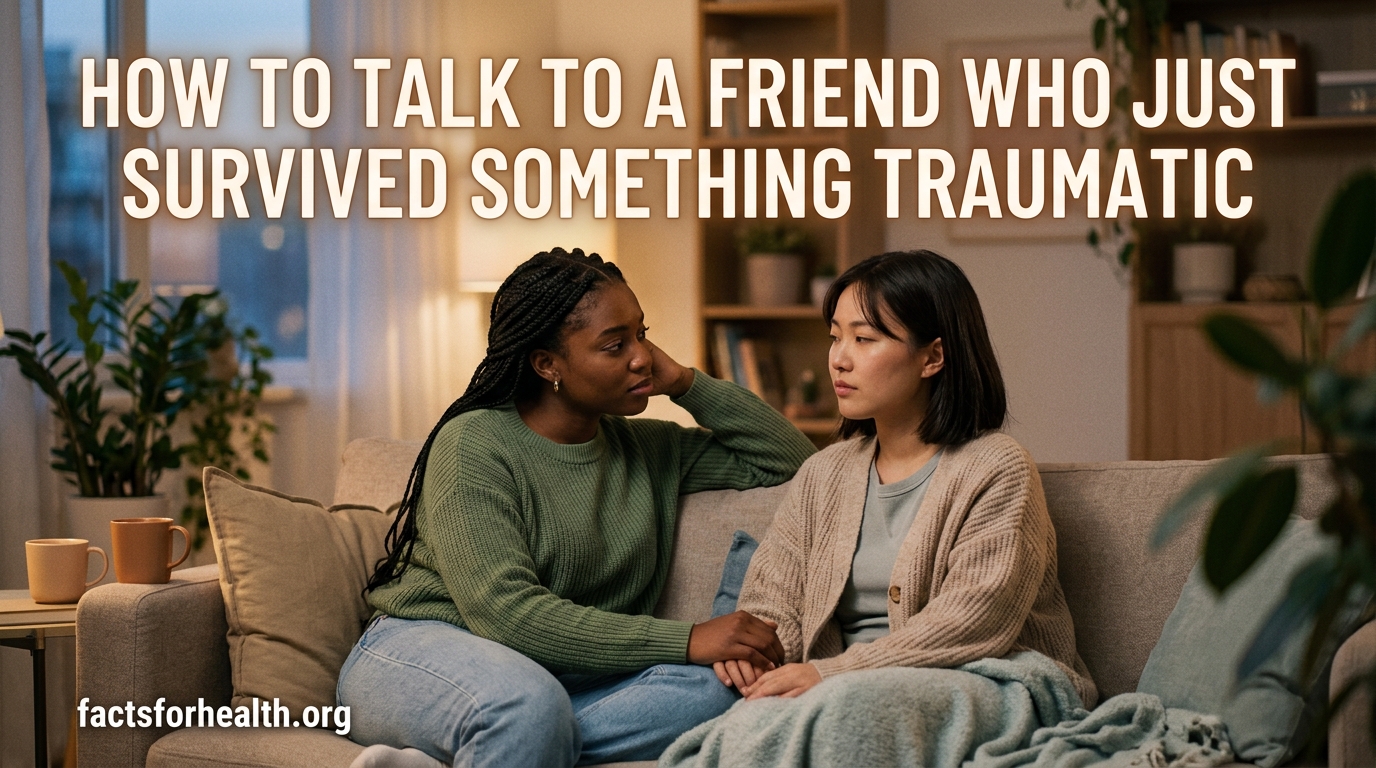
When someone you care about survives something traumatic, the silence that follows can feel unbearable. You want to say the right thing, but the fear of saying the wrong thing can leave you frozen. Learning how to talk to a friend who just survived something traumatic is one of the most important skills you will ever develop, and the good news is that you do not need to be perfect at it.
What your friend needs most is not a perfectly crafted speech or expert-level therapy language. They need presence, patience, and someone who will let them set the pace. Research from mental health organizations consistently shows that social support is one of the strongest predictors of trauma recovery, which means your role as a friend matters more than you might realize.
In this guide, we will walk through exactly what to say, what to avoid, and how to show up for someone processing trauma. You will learn a simple framework you can remember in the moment, specific phrases that actually help, and how to take care of yourself in the process. By the end, you will feel more confident stepping into that conversation instead of avoiding it.
Table of Contents
What Trauma Does to Your Friend’s Brain and Body
Trauma is not just a bad memory. It is a full-body experience that changes how someone processes the world around them. When your friend went through something overwhelming, their brain’s threat detection system shifted into overdrive, and that system does not simply switch off once the event is over.
The amygdala, which acts as the brain’s alarm system, stays heightened after trauma. This means your friend might startle easily, feel constantly on edge, or react intensely to sounds and situations that seem normal to you. The prefrontal cortex, responsible for logical thinking and emotional regulation, can temporarily go offline during triggering moments. This is not a choice they are making. It is biology.
This matters for you as a supporter because it explains behaviors that might otherwise seem confusing or distant. If your friend cancels plans suddenly, seems detached, or has trouble following a conversation, these are common trauma responses, not signs that they do not value your friendship. Understanding this can help you respond with patience instead of taking things personally.
The words you choose matter deeply in this window of heightened sensitivity. A dismissive comment that would normally roll off someone’s back can feel like a gut punch when their nervous system is already on high alert. That is why this conversation requires more thoughtfulness than your everyday check-ins.
Understanding Trauma Responses: The 5 F’s Explained
When people experience trauma, their body activates a survival response that researchers describe using the 5 F’s framework. Understanding these responses will help you make sense of your friend’s reactions and respond with compassion rather than confusion.
Fight is the response where the person confronts the threat head-on. After trauma, this can look like irritability, anger outbursts, or defensiveness that seems out of character. Flight involves escaping the danger, which later may show up as avoidance, pulling away from people, or staying constantly busy to outrun difficult feelings.
Freeze is when the person becomes unable to move or act. In everyday life after trauma, this can manifest as dissociation, going blank mid-conversation, or feeling stuck and unable to make decisions. Fawn is the people-pleasing response, where the survivor tries to appease others to stay safe. This can look like your friend being overly agreeable, apologizing excessively, or putting everyone else’s needs before their own.
Flop is the least discussed but equally important response. The body essentially collapses or loses muscle tone as a last-resort survival mechanism. After trauma, this can relate to extreme exhaustion, fainting spells, or a sense of physical heaviness that makes even simple tasks feel impossible.
Your friend may cycle through several of these responses in a single day, or even a single conversation. None of these responses mean something is wrong with them. They are all signs that their nervous system is working to protect them in the only ways it knows how.
Why Trauma Survivors Sometimes Smile or Seem Detached
One of the most confusing things for friends is when someone who just survived something traumatic smiles, laughs, or seems completely unaffected while talking about it. This is actually very common, and it does not mean they are in denial or making light of what happened.
Smiling or laughing during difficult conversations is often an involuntary nervous system response. It is sometimes called a affect incongruence, where the outward expression does not match the internal experience. The brain uses this as a pressure release valve when emotions become overwhelming. Some survivors also smile because they have learned socially that it makes other people more comfortable, even when they are hurting inside.
Detachment or emotional flatness is another protective mechanism. If your friend seems numb or is speaking about their experience in a detached, matter-of-fact way, this is called dissociation. Their brain is creating distance from the pain because feeling it fully all at once would be too much. Do not interpret this as them not caring or not being affected. It is their mind doing what it needs to do to survive.
Recognizing Triggers and Flashbacks
A trigger is anything that reminds the survivor’s nervous system of the original trauma, causing them to feel as though the danger is happening again. Triggers can be obvious, like a loud noise or a specific location, or surprisingly subtle, like a smell, a song, a time of day, or even a particular tone of voice.
Flashbacks go beyond a passing memory. During a flashback, the person may genuinely feel like they are back in the traumatic moment. They might lose awareness of their current surroundings, experience physical sensations from the event, or react to threats that are not actually present. If your friend seems to zone out, becomes suddenly panicked, or starts responding to something you cannot see, they may be experiencing a flashback.
The best response is to stay calm, speak in a gentle and grounding voice, and remind them where they are and that they are safe now. Say something like, You are here with me in the kitchen. You are safe. It is [current year] and that event is over. Do not touch them without asking first, as unexpected physical contact can intensify the experience.
The TALK Framework: A Simple Way to Remember What to Do
When you are sitting across from a friend who has just survived something traumatic and your mind goes blank, having a simple framework can be a lifeline. I developed the TALK framework as an easy-to-remember approach based on what trauma survivors consistently say they need most.
T stands for Thank them. If they have chosen to share their experience with you, start by acknowledging that trust. Saying Thank you for telling me this. I know that took a lot validates their courage and sets a tone of respect. You are not thanking them for the story. You are thanking them for trusting you with something deeply personal.
A stands for Ask, not assume. Do not assume what they need or how they want to be supported. Instead of guessing, ask directly: Do you want to talk more about it, or would you rather we just sit together? or What feels most helpful right now? Giving them control over the conversation is one of the most healing things you can do, because trauma strips away a person’s sense of control.
L stands for Listen more than you speak. This is the hardest part for most people, because our instinct is to fill silences, offer solutions, or share our own stories. Resist that urge. Active listening means giving your full attention without planning what to say next, allowing pauses, and reflecting back what you hear. Nodding, making eye contact, and saying That sounds incredibly hard is often enough.
K stands for Keep showing up. Support is not a one-time conversation. Check in days and weeks later, not just in the immediate aftermath. Send a text that does not require a response, like Thinking of you today. No need to reply. Consistent, low-pressure presence over time communicates that you are a safe person who will not disappear when things get heavy.
How to Talk to a Friend Who Just Survived Something Traumatic: What to Say
Specific words matter more than general advice, so here are concrete phrases you can use. These are drawn from what trauma survivors themselves report finding genuinely helpful when others said them.
“I am so glad you are okay.” This is a powerful opener because it centers their survival rather than the details of what happened. It communicates relief and care without demanding information. Follow it with “I am here for whatever you need right now” to keep the door open without pressure.
“That sounds incredibly difficult, and I am sorry you went through it.” This phrase works because it does two things simultaneously. It acknowledges the magnitude of what happened without minimizing it, and it expresses empathy without trying to fix anything. Avoid the temptation to add qualifiers like “but at least…” because that immediately undercuts the validation.
“It makes complete sense that you are feeling that way.” Survivors often worry that their reactions are abnormal or that they should be handling things better. Hearing that their response is understandable and expected can be deeply relieving. This phrase tells them that nothing is wrong with how they are processing this.
“You do not have to talk about the details unless you want to.” Giving explicit permission to not share is just as important as being willing to listen. Many people feel pressured to recount their experience because someone asked. Make it clear that they are in control of what they share and when.
“What happened to you was not your fault.” Many survivors carry guilt or shame, even when they had no control over what happened. Hearing this from someone they trust can begin to loosen that burden. Say it simply and directly, without caveats or conditions.
Helpful Phrases vs Harmful Phrases
To make this even clearer, here is a side-by-side comparison of common responses. The left column contains phrases people say with good intentions that can actually cause harm, while the right column offers better alternatives that survivors find genuinely supportive.
Instead of “Everything happens for a reason,” try “I cannot imagine how hard this is, and I am here with you.” The first phrase dismisses their pain by implying the trauma served a purpose. The second acknowledges the reality of their suffering and offers your presence.
Instead of “I know exactly how you feel,” try “I want to understand what this is like for you, if you want to share.” Even if you have been through something similar, no two experiences are identical, and claiming to understand fully can make the survivor feel unseen.
Instead of “At least you are alive,” try “I am so grateful you are here, and I know this is still incredibly painful.” The word at least minimizes their loss. The revised version holds both truths at once: gratitude and acknowledgment of ongoing pain.
Instead of “You need to stay strong,” try “You do not have to be strong right now. You can just be.” Telling someone to be strong implies that showing emotion is weakness. Giving them permission to fall apart is one of the most caring things you can do.
Instead of “Let me know if you need anything,” try “I am going to drop off dinner on Tuesday. Is that okay?” The first phrase puts the burden on the survivor to ask for help, which most people will not do. The second offers something specific and lets them simply say yes or no.
FAQs
What to say to someone who just went through something traumatic?
Start with simple, validating statements like “I am so glad you are okay” and “That sounds incredibly difficult.” Avoid asking for details, comparing their experience to others, or using phrases like “everything happens for a reason.” Let them know you are there for whatever they need, give them control over what they share, and follow up consistently in the days and weeks that follow.
What does retraumatization feel like?
Retraumatization happens when a trigger causes the survivor to feel as though the traumatic event is happening again. It can involve intense physical sensations, emotional flooding, flashbacks, panic, or dissociation. The person may feel physically present but emotionally transported back to the original event, with their nervous system responding as though the threat is real and current.
What are the 5 F’s of trauma responses?
The 5 F’s are Fight, Flight, Freeze, Fawn, and Flop. Fight involves confronting the threat through anger or defensiveness. Flight involves escaping through avoidance or busyness. Freeze involves becoming stuck or dissociating. Fawn involves people-pleasing to stay safe. Flop involves the body collapsing or shutting down as a last-resort survival mechanism. Survivors may cycle through several of these responses.
How to talk to trauma survivors?
Listen more than you speak, validate their feelings without judgment, let them control what and how much they share, use their own words to describe their experience, and offer specific practical help rather than vague offers. Avoid pressing for details, comparing their trauma to others, telling them how to heal, or using toxic positivity phrases that minimize their pain.
Is it best to make someone talk about trauma right away?
No. Forcing someone to talk about trauma before they are ready can actually cause more harm and potentially retraumatize them. Survivors should control what, when, and how much they share. Offer the opportunity to talk without pressure, and let them set the pace. Some people need time before they can put words to what happened, and that timeline is different for everyone.
Why do trauma survivors smile or seem detached?
Smiling or laughing while discussing trauma is often an involuntary nervous system response, not a sign that the person is unaffected. It can be a pressure release valve when emotions overwhelm. Emotional detachment or flatness is usually dissociation, where the brain creates distance from the pain because feeling it all at once would be too much. Both are normal protective mechanisms.
Conclusion: You Do Not Need to Be Perfect
Learning how to talk to a friend who just survived something traumatic is not about memorizing the perfect script. It is about showing up with genuine care, being willing to listen without fixing, and offering consistent presence over time. The TALK framework gives you a starting point when words fail, and the specific phrases in this guide give you language that trauma survivors themselves have found helpful.
Your friend does not need you to be a therapist. They need you to be a friend who is willing to sit with them in the hard parts without running away. Trust that your presence matters more than your words, and remember that taking care of your own wellbeing is part of being able to show up for them long-term. Start with one conversation, one check-in, one small act of practical help. That is how healing begins.