
Medical disclaimer: This article is for informational and educational purposes only. It is not a substitute for professional medical advice, diagnosis, or treatment. Always consult a qualified healthcare provider or mental health professional with questions about your symptoms or condition.
If you have ever felt like two completely different people depending on the time of month, you are not alone. Many women and people assigned female at birth spend years wondering how to know if your mood swings are PMDD or bipolar disorder. The confusion is understandable because these two conditions share surprising overlap in how they feel day to day.
Severe irritability, deep sadness, anxiety that hits like a wave, and feeling out of control emotionally are hallmarks of both premenstrual dysphoric disorder and bipolar disorder. Yet they are fundamentally different conditions with different causes, different timelines, and critically different treatments. Getting the right diagnosis can take years, and the journey is often frustrating.
Research suggests that a significant percentage of women with mood disorders are initially misdiagnosed. In online communities like Reddit’s r/PMDD and r/bipolar, countless women describe being treated for bipolar disorder for years before discovering their symptoms followed a strict monthly pattern tied to their menstrual cycle. Others report the opposite: assuming their symptoms were hormonal when an underlying bipolar disorder was the real driver.
This guide breaks down everything you need to understand about the differences between PMDD and bipolar disorder. We will cover symptoms, timing patterns, underlying causes, the often-overlooked concept of premenstrual exacerbation, how diagnosis works, and practical steps you can take right now to start tracking your symptoms. By the end, you will have a clearer picture of what might be going on and what to discuss with your doctor.
Table of Contents
The Quick Answer: PMDD vs Bipolar Disorder at a Glance
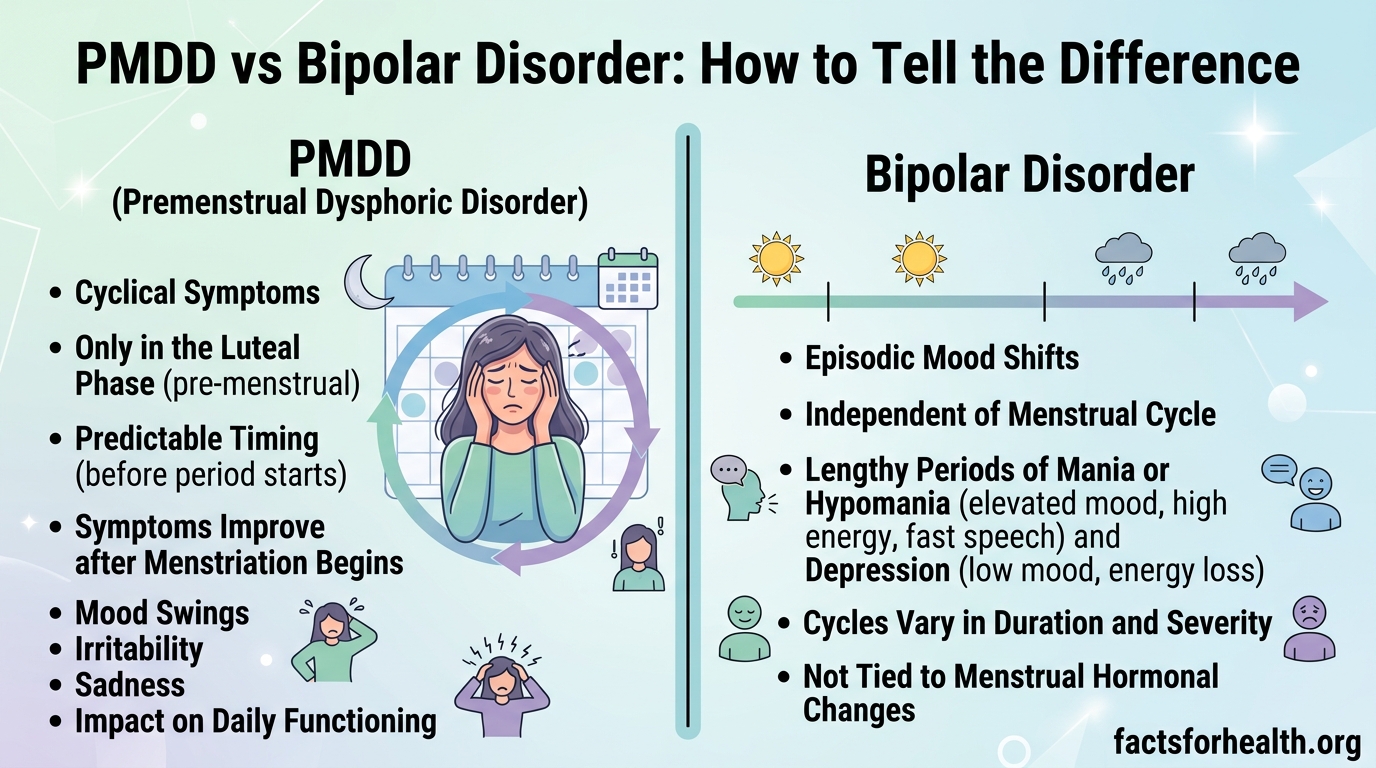
The single most important difference between PMDD and bipolar disorder comes down to timing. PMDD symptoms occur in a strict, predictable cycle during the luteal phase of the menstrual cycle, which is the one to two weeks before your period begins. These symptoms resolve within a few days after menstruation starts. Bipolar disorder, on the other hand, involves episodes of mania, hypomania, or depression that occur independently of the menstrual cycle and can last anywhere from several days to weeks or even months.
If your mood symptoms appear like clockwork before your period and then vanish after you start bleeding, that pattern points strongly toward PMDD or a related premenstrual condition. If your mood episodes happen at random times of the month, last longer than a week, or include periods of unusually high energy and reduced need for sleep, bipolar disorder becomes more likely.
Here is the simplest way to think about it. PMDD is tied to a calendar, bipolar disorder is not. This distinction matters enormously because the treatments are different. SSRIs, which are commonly prescribed for PMDD, can actually trigger manic episodes in someone with bipolar disorder. That is why getting the diagnosis right is so important.
What Is PMDD?
Premenstrual dysphoric disorder, or PMDD, is a severe form of premenstrual syndrome. The DSM-5 classifies it as a depressive disorder with a specific cyclical pattern. Unlike typical PMS, which causes mild discomfort and mood changes, PMDD produces severe emotional and physical symptoms that can disrupt relationships, work, and daily functioning.
PMDD affects an estimated 1.6 to 3.8 percent of women and people assigned female at birth who are of reproductive age. While that percentage may sound small, it represents millions of individuals worldwide who experience significant distress month after month. Research from Oxford University and other institutions has helped refine these numbers, but many experts believe PMDD is underdiagnosed due to lack of awareness among both patients and providers.
The condition is triggered by the body’s sensitivity to normal hormonal fluctuations during the menstrual cycle. After ovulation, progesterone and estrogen levels shift as the body prepares for potential pregnancy. In people with PMDD, the brain does not respond normally to these hormonal changes. It is not that hormone levels are abnormal. Rather, the brain’s reaction to perfectly normal hormone shifts is what causes symptoms.
This sensitivity appears to involve the serotonin system. Serotonin is a neurotransmitter that regulates mood, sleep, appetite, and pain perception. When progesterone and estrogen fluctuate during the luteal phase, they affect how serotonin functions in the brain. For people with PMDD, this interaction produces intense mood disturbances that are not present during the rest of the cycle.
To meet the DSM-5 criteria for PMDD, a person must experience at least five of the designated symptoms during most menstrual cycles over the past year. These symptoms must occur during the week before menstruation, begin to improve within a few days after the period starts, and become minimal or absent in the weeks after the period ends.
PMDD Symptoms: What to Look For
PMDD symptoms fall into three categories: emotional, physical, and behavioral. What makes PMDD distinct from bipolar disorder is that all of these symptoms follow the same monthly rhythm. They appear during the luteal phase and disappear after menstruation begins.
Emotional and mood symptoms include:
- Severe mood swings, sometimes described as feeling like a different person
- Intense irritability, anger, or rage that feels disproportionate to the situation
- Feelings of deep sadness, despair, or hopelessness
- Sudden tearfulness or crying spells
- Anxiety, feeling on edge, or a sense of being overwhelmed
- Emotional sensitivity to perceived rejection or conflict
- Suicidal thoughts in severe cases, which typically resolve after the period starts
Physical symptoms include:
- Breast tenderness or swelling
- Bloating and weight gain
- Joint or muscle pain
- Headaches or migraines
- Fatigue or low energy
- Sleep disturbances, including insomnia or sleeping too much
- Changes in appetite, including food cravings or overeating
Behavioral and cognitive symptoms include:
- Difficulty concentrating or feeling mentally foggy
- Loss of interest in normal activities, including social withdrawal
- Feeling out of control or overwhelmed by routine tasks
- Conflict with partners, friends, or coworkers during the luteal phase
Some women report that their PMDD symptoms feel worse in the morning during the luteal phase, particularly anxiety and irritability upon waking. However, morning worsening is not a diagnostic criterion. Symptoms can strike at any time of day and vary from person to person. Tracking when your symptoms peak during the day can still be valuable information to share with your healthcare provider.
Many people with PMDD describe the experience as feeling completely normal for half the month, then transforming into someone unrecognizable for the other half. This dramatic contrast between the follicular phase, when symptoms are absent, and the luteal phase, when symptoms are severe, is one of the most telling signs of PMDD.
What Is Bipolar Disorder?
Bipolar disorder is a chronic mental health condition characterized by significant shifts in mood, energy, and activity levels. These shifts go far beyond normal mood variation. They involve distinct episodes of mania, hypomania, or depression that occur independently of the menstrual cycle and last for days to weeks at a time.
The National Institute of Mental Health estimates that approximately 2.8 percent of adults in the United States have bipolar disorder. The condition affects men and women at roughly equal rates, unlike PMDD which only affects people who menstruate. Bipolar disorder typically emerges in late adolescence or early adulthood, with the average age of onset around 25 years old.
There are two main types of bipolar disorder that are most relevant when comparing it to PMDD.
Bipolar I Disorder involves at least one manic episode lasting at least seven days, or manic symptoms severe enough to require hospitalization. Depressive episodes are also common, typically lasting at least two weeks. Some people experience mixed episodes that feature symptoms of both mania and depression simultaneously.
Bipolar II Disorder involves at least one major depressive episode and at least one hypomanic episode. Hypomania is a less severe form of mania that does not cause the level of impairment seen in full manic episodes. People with Bipolar II never experience a full manic episode. This distinction matters enormously when comparing to PMDD because Bipolar II can be particularly easy to confuse with PMDD. The depressive episodes of Bipolar II can look similar to the mood symptoms of PMDD, and hypomania can be subtle enough to go unnoticed.
Bipolar disorder is rooted in complex interactions between genetic vulnerability, neurotransmitter regulation, and brain structure. It is not caused by hormonal fluctuations. While hormones can influence how bipolar symptoms manifest, the menstrual cycle does not create or control bipolar episodes the way it does with PMDD.
Bipolar Disorder Symptoms: Mania, Hypomania, and Depression
Understanding the three types of mood episodes in bipolar disorder helps clarify why this condition differs from PMDD. PMDD never involves mania or hypomania. If you have ever experienced a manic or hypomanic episode, PMDD alone cannot explain it.
Manic episode symptoms may include:
- Extremely elevated, expansive, or irritable mood
- Decreased need for sleep, feeling energetic after very little rest
- Racing thoughts or jumping quickly between topics
- Talking much faster or louder than usual
- Grandiose thinking, or believing you can do extraordinary things
- Impulsivity, such as spending large sums of money or making risky decisions
- Difficulty focusing on one task due to excessive energy
- In severe cases, psychotic symptoms like delusions or hallucinations
Hypomanic episode symptoms are similar to mania but less intense:
- Elevated or irritable mood lasting at least four consecutive days
- Increased energy and productivity
- Reduced need for sleep without feeling tired
- Heightened creativity or sociability
- Noticeable change in behavior that others can observe
- No severe impairment or hospitalization needed
- No psychotic symptoms
Depressive episode symptoms may include:
- Persistent sadness, emptiness, or hopelessness lasting at least two weeks
- Loss of interest in almost all activities
- Significant weight loss or gain, or changes in appetite
- Insomnia or hypersomnia nearly every day
- Fatigue or loss of energy
- Feelings of worthlessness or excessive guilt
- Difficulty thinking, concentrating, or making decisions
- Recurrent thoughts of death or suicidal ideation
The duration of these episodes is a critical distinguishing factor from PMDD. A bipolar depressive episode lasts at minimum two weeks. Mania lasts at minimum one week. PMDD symptoms, by contrast, last roughly one to two weeks during the luteal phase and then resolve completely once menstruation begins. If your symptoms vanish reliably within days of your period starting, that resolution pattern strongly favors PMDD over a bipolar depressive episode.
How to Know if Your Mood Swings Are PMDD or Bipolar Disorder: Key Differences
Now that we have covered what each condition looks like on its own, let us put them side by side. The following comparison highlights the six most important dimensions that distinguish PMDD from bipolar disorder.
1. Timing and Cycle Pattern
PMDD is tied to the menstrual cycle with predictable precision. Symptoms begin during the luteal phase, typically five to fourteen days before menstruation. They improve within a few days after the period starts and remain absent during the follicular phase. If you track your symptoms and see this exact pattern repeat month after month, PMDD is the likely explanation.
Bipolar disorder episodes have no required relationship to the menstrual cycle. They can occur at any point during the month. While some people with bipolar notice patterns related to their cycle, episodes do not consistently follow a monthly rhythm tied to ovulation and menstruation.
2. Duration of Mood Episodes
PMDD symptoms last for a defined window each month, usually the week or two before your period. Once menstruation begins, symptoms resolve. Bipolar episodes are measured in weeks, not days. A depressive episode lasts at least two weeks. Mania lasts at least one week. If your mood disturbance consistently lasts longer than your luteal phase or continues well past your period, that points toward bipolar disorder.
3. Types of Mood Changes
PMDD primarily involves depressive symptoms, irritability, anxiety, and emotional volatility. The mood changes are always in a downward or agitated direction during the luteal phase. PMDD never causes euphoria, grandiosity, or a decreased need for sleep.
Bipolar disorder involves both highs and lows. The presence of any manic or hypomanic symptoms rules out PMDD as the sole diagnosis. If you have experienced periods of feeling euphoric, needing very little sleep, having racing thoughts, or engaging in impulsive behavior, those symptoms point toward bipolar disorder, not PMDD.
4. Underlying Causes
PMDD is caused by an abnormal brain response to normal hormonal fluctuations. Your hormone levels are not the problem. The problem is how your neurotransmitter system, particularly serotonin, reacts to those hormonal shifts. This is why PMDD is considered a brain-based sensitivity to reproductive hormones.
Bipolar disorder is caused by dysregulation in the brain’s neurotransmitter systems, including dopamine, serotonin, and norepinephrine, combined with genetic vulnerability and environmental factors. Hormones may influence symptom severity but are not the root cause.
5. Who Can Be Affected
PMDD only affects people who menstruate, specifically women and people assigned female at birth of reproductive age. Bipolar disorder affects all genders and can persist throughout life, including after menopause when PMDD symptoms would naturally cease.
6. Treatment Approaches
PMDD is often treated with SSRIs, which can work quickly even when taken only during the luteal phase. Hormonal birth control, particularly drospirenone-containing pills, can also help. Bipolar disorder is treated with mood stabilizers like lithium or lamotrigine, antipsychotic medications, and psychotherapy. Giving someone with bipolar disorder an SSRI without a mood stabilizer can trigger manic episodes, which is one of the most dangerous consequences of confusing these two conditions.
Bipolar II vs PMDD: A Particularly Tricky Distinction
The comparison between Bipolar II and PMDD deserves special attention because this is where misdiagnosis most often occurs. Bipolar II involves hypomania, which can be subtle enough to miss entirely. Many people with Bipolar II interpret their hypomanic periods as simply having good days or feeling productive and energized. They only seek help during depressive episodes, which can resemble PMDD mood symptoms.
The key to distinguishing Bipolar II from PMDD is still timing and the presence of hypomania. If you have had periods lasting four or more days where you felt unusually energetic, needed less sleep, talked faster, or felt unusually creative or confident, and these periods did not consistently align with a specific menstrual cycle phase, that pattern suggests Bipolar II rather than PMDD. A psychiatrist can help evaluate these subtle but important distinctions.
Can You Have Both PMDD and Bipolar Disorder?
Yes, you absolutely can have both conditions simultaneously. In fact, research indicates that the overlap is significant. Studies referenced by Healthline and supported by a 2021 systematic review suggest that between 27 and 76 percent of people with bipolar disorder also experience PMDD symptoms. This means that having one condition does not rule out the other.
When both conditions coexist, they can interact in complex ways. Many women with both PMDD and bipolar disorder report that their bipolar symptoms become noticeably worse during the luteal phase. Depression deepens, irritability spikes, and emotional stability becomes harder to maintain. The hormonal fluctuations of the menstrual cycle act as an amplifier on top of existing bipolar symptoms.
This overlap is one reason why diagnosis can be so difficult. If you have bipolar disorder, your symptoms may worsen before your period, making it look like PMDD is the primary issue. If you have PMDD, the severity of your mood swings may be mistaken for bipolar episodes. Only careful tracking over multiple cycles, combined with professional psychiatric evaluation, can sort out what is really happening.
Premenstrual Exacerbation (PME): The Critical Third Option
There is a third possibility that most articles never mention, and it may be the most important one for you to understand. It is called premenstrual exacerbation, or PME.
PME is not a separate condition. It is a pattern in which a pre-existing mood disorder like bipolar disorder, major depression, or anxiety gets noticeably worse during the luteal phase. With PME, you have an underlying condition that is present all month, but your symptoms intensify in the days before your period. Research suggests that about 60 percent of people with mood disorders experience this pattern.
The distinction between PMDD and PME is critical for treatment. In PMDD, you are symptom-free during the follicular phase. Your mood is stable and normal for two to three weeks of each cycle. In PME, you have symptoms throughout the month, but they flare up before your period. If you have ongoing mood symptoms between your periods that simply get worse during the luteal phase, you may have PME of an underlying condition rather than PMDD.
This matters because PME and PMDD are treated differently. PMDD responds well to SSRIs and hormonal treatments. PME requires treating the underlying condition, whether that is bipolar disorder, depression, or anxiety. Treating PME as if it were PMDD can delay proper treatment and prolong your suffering.
If you are tracking your symptoms and notice that you never feel completely well, even during the first half of your cycle, mention this to your doctor. This pattern is a strong indicator that PME rather than PMDD may be at play, and it changes the treatment conversation significantly.
How to Track Your Symptoms: A Practical Guide
Symptom tracking is the single most powerful tool for figuring out whether your mood swings are PMDD or bipolar disorder. No quiz, no online test, and no single doctor visit can replace the value of daily tracking over two to three menstrual cycles. Here is how to do it effectively.
Step 1: Choose your tracking method. You can use a dedicated app like Me v PMDD, Life cycle, or a general period tracking app with a mood feature. You can also use a simple notebook or a printed mood chart. The method matters less than the consistency. Pick whatever you will actually use every day.
Step 2: Record these key data points daily.
- Overall mood rating on a scale of 1 to 10
- Specific emotions experienced, such as sadness, irritability, anxiety, anger, euphoria, or calm
- Energy level on a scale of 1 to 10
- Hours of sleep and sleep quality
- Whether you felt a decreased need for sleep, meaning you functioned well on unusually little rest
- Physical symptoms like bloating, breast tenderness, headaches, or fatigue
- Any impulsive behaviors or decisions
- Menstrual cycle day or whether you are on your period
- Any medication taken
Step 3: Track for at least two to three complete cycles. One cycle is not enough to establish a pattern. PMDD requires symptoms to be present in most cycles over the past year, but even two to three months of data can reveal a clear pattern that helps your doctor make an initial assessment.
Step 4: Look for these patterns. If your mood symptoms consistently appear during the one to two weeks before your period and resolve within a few days after it starts, and you feel well during the first half of your cycle, that pattern suggests PMDD. If your symptoms occur randomly throughout the month with no clear cycle connection, or if you notice periods of elevated mood and reduced sleep need at any cycle phase, that points toward bipolar disorder or PME.
Step 5: Bring your data to your appointment. Your tracking records are invaluable for any healthcare provider. A psychiatrist or gynecologist can use this information alongside their clinical evaluation to make a much more accurate diagnosis. Many women report that bringing detailed symptom charts to their appointment was the turning point in finally getting the right diagnosis after years of confusion.
Red Flag Symptoms Checklist
Before your doctor visit, review this checklist. These symptoms warrant prompt professional evaluation regardless of whether you suspect PMDD or bipolar disorder:
- Suicidal thoughts or self-harm urges at any time
- Periods of feeling extremely euphoric or powerful with little to no sleep
- Impulsive or risky behaviors that feel out of character
- Mood episodes lasting more than two weeks
- Symptoms that interfere with your ability to work, attend school, or maintain relationships
- Feeling out of control emotionally for extended periods
- Symptoms that do not improve after your period starts
How Are These Conditions Diagnosed?
Diagnosis of PMDD requires prospective daily symptom tracking over at least two menstrual cycles. The DSM-5 specifies that a person must experience at least five of the designated PMDD symptoms during the luteal phase in most cycles over the past year. Your doctor or gynecologist may ask you to complete standardized rating scales, such as the Daily Record of Severity of Problems, to document symptom patterns over time.
Bipolar disorder is diagnosed through a comprehensive psychiatric evaluation. A psychiatrist or other qualified mental health professional will assess your symptoms, personal and family medical history, and the duration and pattern of mood episodes. There is no blood test or brain scan that confirms bipolar disorder. The diagnosis is clinical, based on meeting specific DSM-5 criteria for manic, hypomanic, or depressive episodes.
What to expect at your appointment: Whether you see a gynecologist, primary care provider, or psychiatrist, come prepared with your symptom tracking data. Be honest about all your symptoms, including any periods of elevated mood or reduced sleep need, even if they felt good at the time. Mention any family history of mental health conditions, as bipolar disorder has a strong genetic component. Ask specifically about the possibility of PMDD, PME, or bipolar disorder rather than waiting for the provider to bring them up.
Misdiagnosis happens for several reasons. PMDD awareness is still growing among healthcare providers, and many medical schools provide limited education on the condition. The cyclical nature of PMDD means that if you happen to see your doctor during the follicular phase when you feel fine, they may underestimate the severity of your symptoms. On the other hand, if you present during a severe luteal phase or during a depressive episode without cycle context, bipolar disorder may seem like the obvious explanation. This is why symptom tracking data is so valuable.
Many women in online PMDD communities recommend seeking a provider who is familiar with premenstrual disorders. The International Association for Premenstrual Disorders maintains a provider directory that can help you find knowledgeable practitioners in your area.
Treatment Options: Why the Right Diagnosis Matters
The treatment pathways for PMDD and bipolar disorder are very different, which is why accurate diagnosis directly affects your quality of life. Treating the wrong condition can not only fail to help but can actively make things worse.
PMDD treatment typically involves SSRIs, which work remarkably well for many people. Unlike depression treatment where SSRIs take weeks to build up, SSRIs for PMDD can be effective within hours to days. Some people take them only during the luteal phase rather than continuously. Hormonal birth control, particularly pills containing drospirenone, can also help by suppressing ovulation and stabilizing hormone fluctuations. Cognitive behavioral therapy has shown effectiveness for managing PMDD-related mood symptoms and developing coping strategies.
Bipolar disorder treatment centers on mood stabilizers such as lithium, lamotrigine, or valproate. Antipsychotic medications may be prescribed for manic episodes or as maintenance therapy. Psychotherapy, including cognitive behavioral therapy and interpersonal and social rhythm therapy, helps people manage episodes and maintain stable routines. Bipolar disorder requires lifelong management in most cases.
The SSRI danger: This is where the distinction between PMDD and bipolar disorder becomes truly critical. If someone with undiagnosed bipolar disorder is prescribed an SSRI for what appears to be PMDD or depression, the SSRI can trigger a manic episode. This is one of the most well-documented risks in psychiatric treatment. A responsible prescriber should screen for bipolar disorder before starting any antidepressant, specifically by asking about any history of elevated mood, reduced sleep need, or impulsive behavior.
If you have both conditions, treatment becomes more complex but is entirely possible. A psychiatrist can coordinate medications to address both the bipolar disorder and the premenstrual symptoms without triggering mania. This may involve mood stabilizers plus carefully managed approaches to the luteal phase symptoms.
Frequently Asked Questions
Can bipolar be mistaken for PMDD?
Yes, bipolar disorder can be mistaken for PMDD. Both conditions involve mood disturbances and share overlapping symptoms like depression, irritability, and anxiety. Because PMDD symptoms occur cyclically before menstruation, they can mimic the depressive episodes of bipolar disorder. The key to accurate diagnosis lies in tracking whether symptoms follow a strict monthly pattern tied to the menstrual cycle and whether any manic or hypomanic episodes have occurred.
How to explain what PMDD feels like?
PMDD often feels like an intense, uncontrollable version of PMS that dramatically affects your daily life. Many women describe feeling like a completely different person during the luteal phase, experiencing severe mood swings, extreme irritability or rage, deep sadness, overwhelming anxiety, difficulty concentrating, and physical symptoms like bloating and breast tenderness. Symptoms typically resolve within a few days of menstruation starting.
Do I have bipolar or just mood swings?
The key difference is timing and pattern. Bipolar disorder involves distinct episodes of mania or depression that last days to weeks and occur independently of your menstrual cycle. Regular mood swings are shorter and less disruptive. If your mood changes follow a predictable monthly pattern appearing one to two weeks before your period and resolving after it starts, this suggests PMDD. A healthcare provider can help determine the correct diagnosis.
Is PMDD worse in the morning?
Some women with PMDD report that symptoms like anxiety, irritability, and mood disturbances feel more intense in the morning during the luteal phase. However, PMDD symptoms can occur at any time of day and vary from person to person. Morning worsening of mood is not a definitive diagnostic criterion, but tracking when your symptoms are most intense can help your healthcare provider with diagnosis.
Can you have both PMDD and bipolar disorder?
Yes, you can have both conditions. Research suggests that 27 to 76 percent of people with bipolar disorder also experience PMDD symptoms. When both conditions coexist, bipolar symptoms often worsen during the luteal phase. Having both conditions requires coordinated treatment by a psychiatrist who can manage mood stabilization while addressing cyclical premenstrual symptoms.
How is PMDD diagnosed?
PMDD is diagnosed through prospective daily symptom tracking over at least two menstrual cycles. A healthcare provider will look for at least five specific symptoms that occur during the luteal phase, improve shortly after menstruation begins, and are absent in the weeks after the period. Standardized tools like the Daily Record of Severity of Problems may be used. There is no blood test for PMDD.
Conclusion: Taking the Next Step
Understanding how to know if your mood swings are PMDD or bipolar disorder starts with one simple but powerful tool: tracking your symptoms daily over multiple cycles. The timing pattern is the single most important clue. If your mood symptoms arrive like clockwork before your period and vanish after it starts, PMDD is the most likely explanation. If your episodes occur unpredictably, last longer than your luteal phase, or include periods of elevated mood and reduced sleep, bipolar disorder or PME may be involved.
You do not have to figure this out alone. If your mood symptoms are affecting your daily life, your relationships, or your sense of self, please reach out to a healthcare provider. Bring your symptom tracking data with you. Ask specifically about PMDD, PME, and bipolar disorder. Organizations like the International Association for Premenstrual Disorders and the National Alliance on Mental Illness offer resources and provider directories that can help you find knowledgeable support.
The right diagnosis can change everything. Many women describe the relief of finally understanding what is happening in their bodies as life-changing. Whether the answer turns out to be PMDD, bipolar disorder, PME, or a combination, knowing what you are dealing with is the first step toward effective treatment and feeling like yourself again.