
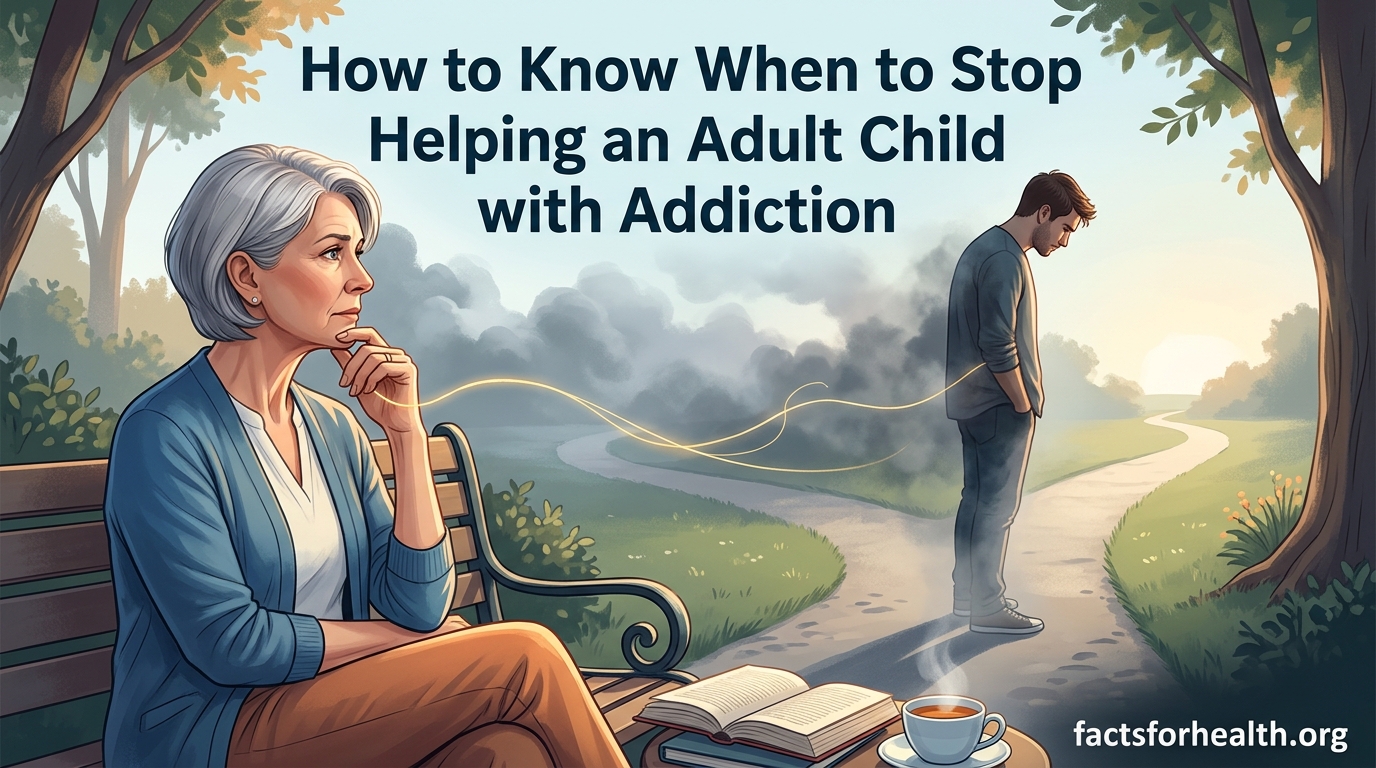
If you are reading this, you have probably been losing sleep over your adult child’s addiction for months or even years. You have tried everything you can think of. You have paid for treatment, offered housing, lent money, made excuses, and worried yourself sick. And nothing has changed, or things have gotten worse.
You are not alone in this. Parents across the country are asking the same painful question: how do I know when to stop helping an adult child with addiction? The guilt, the fear, the exhaustion, it can feel like you are trapped in a cycle with no exit.
Here is what our team wants you to understand right away: stopping the kind of help that enables addiction is not the same as giving up on your child. It is one of the hardest and most loving things you can do.
In this guide, we walk you through a clear framework for recognizing when your help has become enabling. We cover the warning signs, the difference between supporting and enabling, how to set boundaries that work, and how to cope with the grief of letting go. You will also find practical scripts, grounding techniques, and professional resources to help you take the next step.
Our team drew on insights from addiction specialists, family therapists, and parents who have navigated this exact situation. We also incorporated real experiences shared in parent support communities to make sure this guide addresses the questions you are actually asking.
Table of Contents
Understanding the Line Between Helping and Enabling
The hardest part of knowing when to stop helping an adult child with addiction is that most enabling behaviors start as genuine acts of love. You pay rent because you do not want your child homeless. You lend money because they promise this time is different. You bail them out because you are terrified of what happens if you do not.
The problem is that addiction thrives on this kind of help. When you shield someone from the natural consequences of their substance use, you remove one of the most powerful motivators for change. This is the core distinction between helping and enabling.
What Is Enabling?
Enabling is any behavior that protects an addicted person from experiencing the consequences of their addiction. It feels like support, but it actually makes it easier for the addiction to continue.
Common enabling behaviors include paying their bills, covering their rent, lying to employers or family members about their condition, bailing them out of legal trouble, lending money with no accountability, and letting them live in your home while actively using substances.
Enabling is not malicious. Most parents enable because they are terrified of what will happen if they stop. The fear is real. But continuing to enable can prolong the addiction, delay treatment, and increase overdose risk over time.
What Real Support Looks Like
Supporting an addicted adult child means offering help that is tied to their recovery, not their addiction. Real support encourages treatment, respects boundaries, and allows natural consequences to happen.
Examples of genuine support include driving them to therapy appointments, helping them research treatment programs, listening without judgment when they want to talk, attending family therapy sessions, and offering emotional encouragement when they take steps toward recovery.
The key difference is this: enabling protects the addiction. Supporting protects the person. One shields them from reality, the other helps them face it.
If you are not sure where your behaviors fall, ask yourself one question after each action: Is this action making it easier for them to keep using, or is it making it harder? That single question can be a powerful filter.
How to Know When to Stop Helping an Adult Child with Addiction
This is the question that keeps parents up at night. There is no single moment or magic sign that tells you it is time to step back. Instead, there is a pattern of behaviors and outcomes that, taken together, signal that your help is no longer helping.
Based on guidance from addiction specialists and family therapists, here are the warning signs that it may be time to stop enabling your adult child.
1. Your Help Has Not Led to Any Sustained Change
If you have been financially supporting, housing, or rescuing your adult child for months or years and their addiction has only progressed, your help is not working. This is the most important indicator of all.
Continuing the same actions while expecting different results is a pattern that addiction specialists see repeatedly. When help produces no forward movement, it has crossed into enabling territory.
2. Your Own Health Is Deteriorating
If your child’s addiction is causing you to lose sleep, skip your own medical appointments, develop anxiety or depression, or turn to substances yourself, the situation has become unsustainable.
Caregiver stress is a serious medical issue. Parents of addicted children show significantly higher rates of chronic health problems, anxiety disorders, and depression. You cannot help anyone if you are running on empty.
3. Your Financial Resources Are Depleted
Many parents drain retirement savings, take on credit card debt, or refinance their homes to support an addicted adult child. If you are spending money that you need for your own survival and future, that is a clear sign your help has gone too far.
Financial depletion does not just hurt you. It also reduces your ability to help fund actual treatment when your child is ready for it.
4. Your Marriage or Other Family Relationships Are Suffering
Addiction affects the entire family system. Parents in our research communities repeatedly described marital strain, often because one parent wants to keep enabling while the other wants to set limits. Siblings also suffer when an addicted adult child consumes all the family’s emotional and financial energy.
If your other relationships are being damaged by your attempts to help one child, that imbalance needs to be addressed.
5. Your Child Becomes Angry or Manipulative When You Set Limits
If your adult child responds to your boundaries with rage, guilt trips, threats, or manipulation, that reaction tells you something important. It means they have come to expect your help as an entitlement, not a choice.
This is a sign that the dynamic has shifted from a parent-child relationship to something more like a dependency. Healthy relationships can survive boundaries. Addiction-driven relationships often cannot, and that difference is revealing.
6. You Are Lying or Keeping Secrets to Protect Them
If you find yourself lying to family members, employers, or friends about your child’s situation, you have entered enabling territory. The isolation that comes from keeping these secrets is one of the most damaging aspects of this cycle.
Parents in support forums describe hiding the problem for years out of shame. Secrecy allows the addiction to continue unchallenged and cuts you off from the support you need.
7. Your Child Refuses Treatment or Repeatedly Drops Out
Offering continued support to an adult child who refuses treatment, or who enters treatment only to leave early and relapse repeatedly, is a sign that your help may be removing the pressure they need to take recovery seriously.
This does not mean you stop caring. It means you redirect your energy toward protecting yourself and being ready to help when they are genuinely ready to commit to recovery.
If several of these signs resonate with your situation, it is likely time to change your approach. Stopping does not mean abandoning your child. It means shifting from enabling behaviors to treatment-focused support.
Recognizing Codependency Patterns
Codependency is a pattern where your sense of identity, self-worth, and emotional stability becomes entangled with another person’s behavior. For parents of addicted children, codependency often develops gradually until you cannot tell where their problems end and yours begin.
Understanding codependency is essential because it explains why stopping enabling feels so impossibly hard, even when you know intellectually that you should.
Signs You May Be Codependent
You might be caught in a codependent dynamic if you feel responsible for your adult child’s choices, if your mood is entirely determined by whether they are using or sober, if you have stopped pursuing your own interests, or if you feel that you cannot be happy while they are struggling.
Other signs include difficulty saying no, a persistent need to fix other people’s problems, and feeling empty or purposeless when you are not actively rescuing someone.
Codependency often stems from a deep and genuine love. But it keeps both you and your child stuck. Breaking free requires recognizing that you cannot control their addiction, no matter how hard you try.
Breaking the Codependent Cycle
Breaking codependency starts with shifting your focus back to your own life and well-being. This does not make you selfish. It makes you a healthier person who is better equipped to support recovery when the opportunity arises.
Practical steps include setting boundaries (covered in the next section), reconnecting with your own interests and relationships, seeking therapy or a support group, and practicing the grounding techniques we describe below.
Many parents find that working with a therapist who specializes in family addiction is the single most effective step they can take. Professional guidance helps you identify patterns you may be too close to see on your own.
How to Set Boundaries That Actually Work
Boundaries are not punishment. They are the rules you set to protect your own well-being while leaving the door open for your child’s recovery. The difference between a boundary and a threat is that a boundary is about what you will do, not about what you demand they do.
Effective boundaries have three components: they are specific, they include a clear consequence, and they are enforceable. Vague boundaries like “I need you to respect me” do not work. Specific ones like “I will not give you money under any circumstances” do.
Financial Boundaries
Money is one of the most common forms of enabling and one of the most important areas to set limits. A clear financial boundary might be: “I will not pay your rent, bills, or debts. If you want financial help, it must go directly toward a treatment program.”
This boundary is specific, enforceable, and tied to recovery. It does not abandon your child. It redirects your resources toward the only kind of help that can actually change their situation.
Housing Boundaries
If your adult child lives with you, housing rules are essential. A common boundary is: “You may live here only if you are actively in treatment or a verified recovery program. If you use substances in my home, you will need to leave.”
This type of boundary requires you to be prepared to follow through. Setting a boundary you cannot enforce is worse than not setting one at all, because it teaches your child that your words do not carry weight.
Conversation Scripts for Setting Boundaries
Parents in support communities consistently ask for exact words to use. Here are scripts that addiction counselors recommend.
For setting a financial limit: “I love you, and because I love you, I can no longer give you money. I know this is hard to hear. I am willing to help you find a treatment program and I will pay for that directly.”
For responding to manipulation: “I understand you are upset. My decision stands. I am here when you are ready to talk about treatment.”
For responding to threats or anger: “I will not continue this conversation while you are yelling. We can talk again when things are calm. I love you and my boundaries are not changing.”
For re-establishing contact after a break: “I have missed you. I want you in my life. The boundaries I set are still in place. I would love to spend time together that does not involve money or enabling.”
What to Expect After Setting Boundaries
When you first set boundaries, expect pushback. Your adult child may react with anger, guilt trips, escalation, or temporary compliance followed by relapse. This is a normal part of the process.
The most important thing is consistency. If you set a boundary and then break it under pressure, you teach your child that pushing hard enough will get them what they want. Each time you hold firm, you reinforce that the boundary is real.
Many parents report that the period immediately after setting boundaries is the hardest. It can feel like you are making things worse. In reality, you are creating the conditions that may eventually motivate your child to seek help.
The 3-3-3 Rule and Grounding Techniques for Parents
When you are in the middle of a crisis with your adult child, anxiety can overwhelm you completely. The 3-3-3 rule is a simple grounding technique that helps you regain control of your nervous system in stressful moments.
Here is how the 3-3-3 rule works.
Step 1: Name three things you can see around you. Look at objects in your environment and say their names either out loud or in your mind. This pulls your attention out of your racing thoughts and into the present moment.
Step 2: Name three sounds you can hear. Focus on sounds near and far, from a clock ticking to traffic outside. This further anchors you in your physical surroundings.
Step 3: Move three parts of your body. Wiggle your toes, roll your shoulders, clench and release your fists. Physical movement helps discharge the stress hormones flooding your system.
The 3-3-3 rule takes less than a minute, but it can break the cycle of panic that makes it hard to think clearly. Parents who practice grounding techniques regularly report feeling more capable of holding boundaries during confrontations.
Other effective grounding techniques include deep breathing (inhale for four counts, hold for four, exhale for four), splashing cold water on your face to trigger a calming response, and taking a brief walk outside.
These tools do not solve the underlying problem, but they keep you functional enough to make good decisions in moments of high stress.
Self-Care and the Grief of Letting Go
One of the most under-discussed aspects of this journey is grief. When you stop enabling your adult child, you are not just changing a behavior. You are grieving the relationship you thought you would have, the future you imagined for them, and the version of parenthood you expected to be living.
This grief is real and it deserves attention. Parents in support forums describe feeling like they are mourning a child who is still alive. That feeling, sometimes called ambiguous loss or anticipatory grief, can be just as painful as mourning a death.
Your Health Is Not Optional
If you have been neglecting your own health while trying to save your child, now is the time to reverse that. Schedule the medical appointments you have been putting off. Resume the exercise routine you abandoned. Eat meals at regular times. Sleep.
This is not self-indulgence. Chronic stress weakens your immune system, raises your blood pressure, and increases your risk of serious illness. You are no good to your child or anyone else if you are physically broken down.
When Parents Disagree
One of the most common stressors parents describe is disagreement between partners about how to handle the addicted adult child. One parent often wants to keep enabling out of love and fear, while the other wants to set firm limits.
If you and your partner are in conflict, seek professional help together. A family therapist can mediate these conversations and help you find a unified approach. Working at cross purposes undermines both partners and confuses your child.
Building a Support System
Isolation is one of the most damaging effects of loving someone with addiction. Shame keeps parents silent, and silence keeps them alone. Breaking that isolation is one of the most powerful steps you can take.
Support groups like Al-Anon and Nar-Anon exist specifically for family members of people with addiction. Connecting with other parents who understand exactly what you are going through can be life-changing. You do not have to explain yourself there. They already know.
Getting Professional Help and Treatment Resources
You do not have to navigate this alone. Professional resources exist to help both you and your adult child. The challenge is knowing what is available and how to access it.
The CRAFT Approach
Community Reinforcement and Family Training (CRAFT) is an evidence-based approach specifically designed for family members of people with addiction. Studies show that CRAFT helps roughly 65 to 75 percent of resistant individuals enter treatment.
CRAFT teaches families how to communicate effectively, reward positive behaviors, allow natural consequences for negative ones, and guide their loved one toward treatment without confrontation or coercion. It is one of the most effective approaches available for families in this situation.
You can find CRAFT-trained therapists through organizations like the Center for Motivation and Change or by asking any addiction treatment center if they offer family programs based on this model.
Family Therapy
Family therapy focused on addiction helps the entire family system heal, not just the person using substances. A trained family therapist can help you set boundaries, improve communication, and address the codependency and enabling patterns that have developed.
If your adult child refuses to attend, you can still go on your own or with your partner. Family therapy is valuable even when the addicted person is not in the room.
Helplines and Support Organizations
The SAMHSA National Helpline (1-800-662-4357) is a free, confidential, 24/7 service that provides information and referrals to treatment programs. It is available in English and Spanish.
Al-Anon and Nar-Anon offer free support groups specifically for family members and friends of people with alcohol or drug addiction. Meetings are available in person and online.
The Partnership to End Addiction (drugfree.org) offers a parent helpline, text support, and extensive resources specifically for parents of children with substance use disorders.
If you or your child is in immediate danger, call 911 or go to the nearest emergency room. If your child is experiencing an overdose, administer naloxone (Narcan) if available and call emergency services immediately.
FAQs
How to deal with an addict adult child?
Deal with an addicted adult child by focusing on what you can control: your own boundaries, your emotional well-being, and the type of help you offer. Avoid arguing when they are using, set clear limits tied to treatment, and seek professional guidance through family therapy or a CRAFT-trained counselor. You cannot force them to stop, but you can change the environment around them.
When to stop helping adult children?
Stop helping when your assistance is not producing any change in their behavior, when your own health or finances are suffering, when your relationships are being damaged, or when your child refuses treatment and reacts with manipulation to any limits you set. Helping becomes enabling when it shields the person from consequences without leading toward recovery.
When do I give up on my drug addict son?
You do not give up on your child. You give up on the behaviors that enable the addiction. Stopping financial support, housing while actively using, or constant rescuing is not abandonment. It is a redirection toward treatment-focused support. You stay emotionally available while removing the protective layers that allow the addiction to continue. Many parents find that this shift is what eventually motivates their child to seek help.
How to stop enabling your grown child with addiction?
Stop enabling by replacing rescue behaviors with clear boundaries, consistent consequences, and treatment-linked support. Concrete steps include stopping all direct financial help, requiring participation in a treatment program as a condition of housing, refusing to lie or cover for them, and seeking support through Al-Anon, Nar-Anon, or a family therapist trained in the CRAFT approach.
What is the 3 3 3 rule for addiction?
The 3-3-3 rule is a grounding technique for managing anxiety in stressful moments. You name three things you can see, three sounds you can hear, and move three parts of your body. This exercise takes under a minute and helps calm your nervous system so you can make clear decisions during confrontations or crises with your addicted loved one.
How to deal with adult child syndrome?
Adult child syndrome in the context of addiction refers to patterns of emotional dependency, irresponsibility, and entitlement that persist into adulthood. Addressing it requires setting firm boundaries with real consequences, refusing to rescue the person from their own choices, encouraging professional treatment, and often seeking family therapy to break the codependent patterns that keep both parent and child stuck.
Moving Forward
Deciding when to stop helping an adult child with addiction is one of the most painful choices a parent can face. But as we have seen throughout this guide, stopping the kind of help that enables is not giving up. It is changing your strategy because the current one is not working.
The signs are clear when you know what to look for: no progress despite your efforts, your own deteriorating health, financial depletion, damaged relationships, manipulation when you try to set limits, secrecy, and repeated refusal of treatment. If these describe your situation, the most loving thing you can do is shift from enabling to treatment-focused support.
Start with one boundary. Pick up the phone and call the SAMHSA helpline at 1-800-662-4357. Find an Al-Anon or Nar-Anon meeting this week. Talk to a therapist who understands family addiction. You do not have to do everything at once, but you do need to start.
Your child’s recovery is ultimately their journey. But your healing, your boundaries, and your well-being are yours to protect. And you deserve that protection just as much as they deserve the chance to recover.