
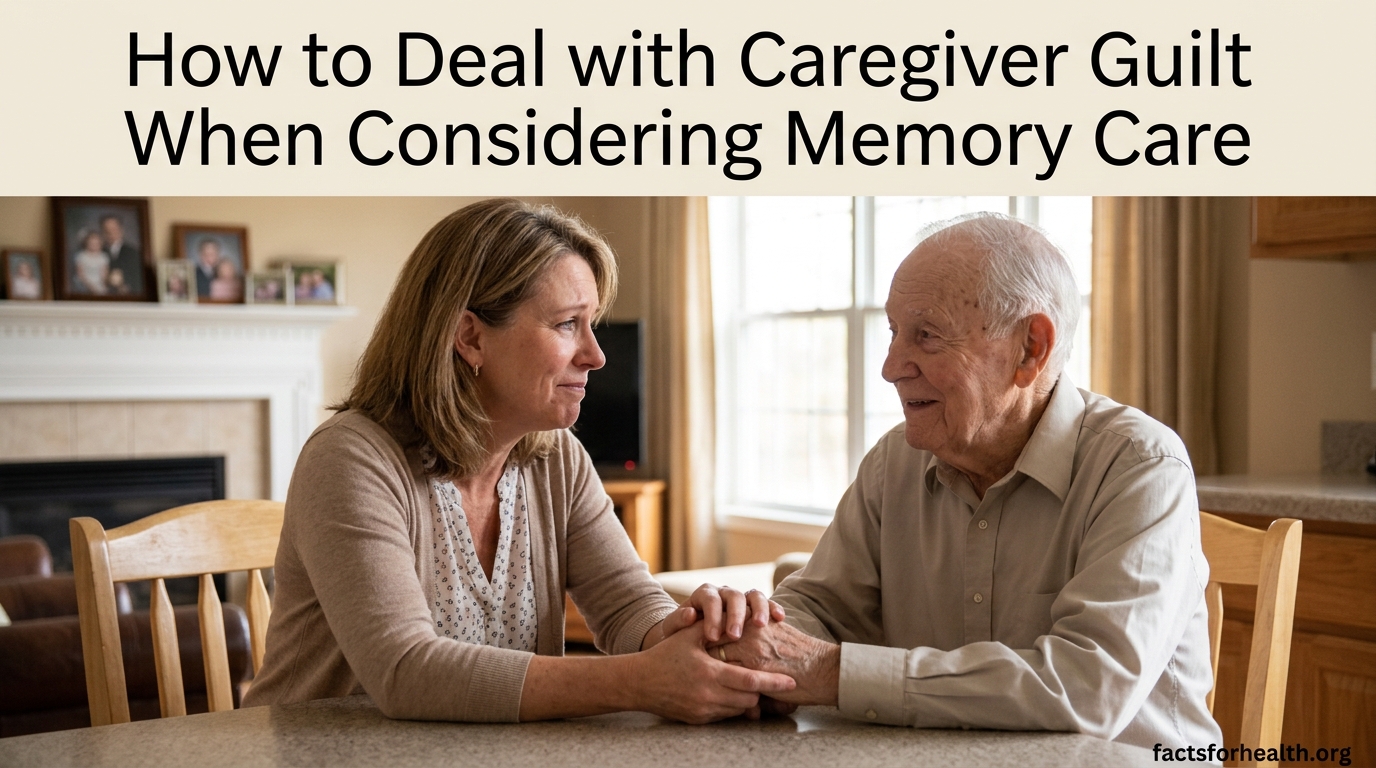
If you are reading this at 2 a.m. after another exhausting night of worrying about your parent or spouse, I want you to know something first. What you are feeling is not weakness. It is love wearing a heavy coat of guilt, and nearly every family caregiver who has walked this path has felt the exact same way.
Learning how to deal with caregiver guilt when considering memory care is not about silencing the voice in your head that says you should be doing more. It is about understanding where that voice comes from, recognizing when it is lying to you, and finding practical ways to move forward without letting guilt paralyze your decisions.
Our team has spent months reading caregiver forums, reviewing research from the National Institutes of Health, and listening to the real stories of families navigating dementia and Alzheimer’s disease. What we found is that caregiver guilt is nearly universal, but almost nobody talks about how to actually handle it, especially when the memory care question enters the picture.
In this guide, you will find a clear definition of caregiver guilt, the root causes behind it, a step-by-step framework for coping, guidance on how to talk to your loved one and family about memory care, a self-assessment questionnaire, and real insights from caregivers who have been where you are right now.
You will also learn what to expect after the transition, how to handle financial guilt, what to do when siblings disagree, and where to find support when the weight feels too heavy to carry alone. Nothing here is sugar-coated, because you deserve honesty, not platitudes.
Table of Contents
Quick Summary: Key Takeaways
Here are the most important things to understand about caregiver guilt and the memory care decision, drawn from research, expert guidance, and the lived experiences of thousands of family caregivers.
- Caregiver guilt is normal. Nearly every family caregiver experiences it, and feeling guilty does not mean you are doing anything wrong.
- Guilt does not mean you made the wrong choice. Choosing memory care is often the safest, most responsible decision you can make for a loved one whose needs exceed what you can provide at home.
- Unrealistic expectations are the primary driver of guilt. Most caregivers hold themselves to impossible standards that no human could meet alone.
- Feeling relief after placement is also normal. Many caregivers feel guilty about the relief they experience, but relief is a natural response to the end of an unsustainable situation.
- Guilt may never fully disappear. The honest truth is that some degree of guilt may linger, and the goal is learning to live alongside it, not eliminate it entirely.
- Support groups reduce isolation. Connecting with other caregivers who understand your experience is one of the most effective guilt-reduction strategies available.
- Memory care is an act of love. Choosing professional, round-the-clock care for someone whose cognitive decline has made home care unsafe is not abandonment. It is protection.
What Is Caregiver Guilt?
Caregiver guilt is the persistent feeling that you are not doing enough, not doing it well enough, or making the wrong decisions for your loved one with dementia or Alzheimer’s disease. It is often accompanied by shame, self-doubt, second-guessing, and a sense that you are failing someone who once cared for you.
According to research published by the National Institutes of Health, guilt is one of the most common and distressing emotions reported by family caregivers of adults with cognitive impairment. A study cited in PMC found that more than 50 percent of caregivers entering a loved one into residential long-term care experienced significant guilt related to the decision.
It is important to distinguish guilt from shame, because the two often travel together but require different responses. Guilt says, “I did something wrong.” Shame says, “I am something wrong.” Guilt can motivate positive change, while shame attacks your identity and worth as a person and as a caregiver.
One caregiver on the Reddit r/Alzheimers community described it this way: “I also feel so much guilt over putting my dad in memory care. He misses my mom.” That single sentence captures the heart of caregiver guilt. It is the gap between what we wish we could do and what is actually possible.
Why Caregivers Feel Guilty (Root Causes)
Understanding why caregiver guilt arises is the first step toward loosening its grip. The causes are complex, deeply personal, and often intertwined.
Unrealistic self-expectations. Most caregivers carry a mental image of what a “good” son, daughter, or spouse should do. That image rarely accounts for the 24-hour reality of managing incontinence, medication schedules, wandering risk, sleep deprivation, and behavioral changes.
Grief over who the person used to be. Dementia and Alzheimer’s disease progressively change the person you love. Guilt often masks the grief of losing the relationship you once had, even while the person is still physically present.
Family and cultural pressure. Many cultures and families hold strong expectations that adult children will care for aging parents at home. When you cannot meet that expectation, guilt rushes in to fill the gap between what society expects and what is realistically possible.
Comparing yourself to other caregivers. Social media and family stories make it easy to believe that someone else is handling the same situation better than you are. The truth is that you are likely comparing your private struggles to someone else’s curated highlight reel.
Feeling like you are not doing enough. This is perhaps the most common source of caregiver guilt. No matter how much you do, there is always more that could be done, and the gap between what is possible and what is ideal becomes a breeding ground for guilt.
Common dementia caregiver mistakes that fuel guilt include not setting boundaries early enough, refusing to ask for help until burnout hits, neglecting your own physical and mental health, trying to handle everything alone, and expecting yourself to remain patient and composed at all times. Recognizing these patterns is not about assigning blame. It is about understanding the trap so you can step out of it.
How Memory Care Decisions Trigger Guilt
The decision to consider memory care carries a unique weight that other caregiving choices do not. It feels final, formal, and loaded with meaning about what you can and cannot provide.
For many caregivers, the memory care decision triggers guilt because it forces an admission that home care is no longer sufficient. After months or years of pouring everything into keeping your loved one at home, acknowledging that you need professional help can feel like a personal failure.
But here is the reframing that changes everything. Memory care is not an admission that you failed. It is a recognition that your loved one’s needs have grown beyond what any single person can safely manage. Dementia is a progressive disease that eventually requires specialized, round-the-clock care. No amount of love or willpower can substitute for trained staff, secured environments, and structured programming designed specifically for cognitive decline.
One caregiver on Reddit r/dementia put it powerfully: “Choose the guilt of knowing it might cause temporary adjustment to new surroundings. However, you know that you are beyond the carer role.” This is the heart of the matter. You are choosing between two difficult paths, and the one that keeps your loved one safe is the right one, even when it hurts.
Guilt around memory care also stems from worry about how your loved one will feel. You may fear they will feel abandoned, betrayed, or frightened. These are valid fears, but research and caregiver experience consistently show that most residents adjust to memory care communities within a few weeks to a few months, and many actually thrive with the structure, social interaction, and professional attention they receive.
Signs That Memory Care Might Be the Right Choice
Clarity is one of the most powerful antidotes to guilt. When you can see objectively that memory care is the right step, the emotional decision becomes easier to bear. Here are the signs that it may be time.
- Safety concerns are escalating. Your loved one has wandered, fallen, left the stove on, or had near-misses that could have resulted in serious injury.
- Care needs exceed your physical capacity. You are struggling with lifting, transferring, or managing incontinence, and your own health is suffering as a result.
- You are experiencing caregiver burnout. You feel emotionally depleted, chronically exhausted, irritable, or numb. Burnout is not a character flaw. It is a signal that the current situation is unsustainable.
- Your loved one’s behavioral symptoms are intensifying. Agitation, aggression, sundowning, paranoia, or repetitive behaviors are beyond what you can manage safely at home.
- Home care is no longer enough. Even with in-home aides, your loved one’s needs have surpassed what home-based care can reasonably provide.
- Your relationships, career, and health are deteriorating. Caregiving is consuming every aspect of your life, and the collateral damage is mounting.
- You have already tried respite care and it is insufficient. Short-term relief helps temporarily, but the underlying need for full-time specialized care remains.
If you recognize three or more of these signs, memory care is likely the appropriate next step. Recognizing these signs is not giving up. It is stepping up to make a difficult but necessary decision.
How to Deal with Caregiver Guilt When Considering Memory Care
This is the heart of what you came here for. The following strategies are drawn from caregiver research, expert recommendations, and the hard-won wisdom of families who have navigated this exact journey. Work through them in order, but return to whichever ones resonate most with your situation.
Step 1: Name the Guilt Specifically
Vague guilt is the hardest kind to address. Instead of saying “I feel guilty,” try to articulate exactly what the guilt is about. Is it guilt about not being able to do more? Guilt about feeling relieved? Guilt about what others might think? Guilt about the cost? Naming the specific guilt gives you something concrete to work with.
Try this journaling prompt: “The specific thing I feel most guilty about right now is _____, and the reason is _____.” Write it down. Seeing it on paper often reveals that the guilt is based on an expectation no reasonable person could meet.
Step 2: Examine the Expectation Behind the Guilt
Behind every guilt feeling is an expectation, usually an impossible one. “I should be able to handle this alone.” “A good daughter would never put her mother in a facility.” “I should have noticed the symptoms sooner.” Ask yourself honestly where each expectation came from. Did you choose it, or did you absorb it from family, culture, or social media?
Once you identify the expectation, hold it up against reality. Is it physically possible for one person to provide 24-hour specialized dementia care indefinitely without breaking? No. That is not an expectation. It is a setup for failure.
Step 3: Replace “I Should” with “I Could”
The word “should” is guilt’s favorite weapon. Every time you catch yourself thinking “I should be doing more,” try replacing it with “I could be doing more, and I am choosing to do what I can within the limits of my energy, resources, and mental health.” This shift moves you from self-punishment to self-awareness.
A caregiver on Reddit r/dementia shared this wisdom: “Be kind to yourself. Do some things that you have always wanted to do but put off. Spend time with good friends.” This is not selfish. It is sustainable. You cannot pour from a depleted cup.
Step 4: Reframe Memory Care as Specialized Medical Care
You would not feel guilty about taking a loved one to a cardiologist for heart disease or an oncologist for cancer. Dementia is a progressive brain disease that requires specialized care. Memory care communities are not nursing homes of the past. They are specifically designed environments with trained staff who understand dementia behaviors, secured spaces that prevent wandering, and programming that supports cognitive function and emotional well-being.
Reframing memory care as medical care, not abandonment, is one of the most powerful guilt-reduction shifts you can make. You are not sending your loved one away. You are connecting them with the level of professional care their condition requires.
Step 5: Talk to Other Caregivers Who Have Made the Decision
Isolation feeds guilt. Connection dissolves it. When you talk to other caregivers who have gone through the memory care transition, you hear a consistent message: the anticipatory guilt was far worse than the reality. Most caregivers report that their loved one adjusted better than expected, and that they themselves experienced a profound sense of relief mixed with lingering sadness.
Support groups, both in-person and online, are where you will find people who understand without needing explanation. The Alzheimer’s Association, local senior centers, and online communities like Reddit’s r/Alzheimers, r/dementia, and r/CaregiverSupport are filled with people ready to listen and share.
Step 6: Practice Self-Compassion Over Self-Forgiveness
Self-forgiveness implies you did something wrong. Self-compassion simply means treating yourself with the same kindness you would offer a friend in your situation. If your best friend told you she was drowning in guilt over considering memory care for her mother, what would you say to her? You would probably tell her she is doing her best, that her mother is lucky to have her, and that making a hard decision out of love is not something to punish yourself for.
Now say those same words to yourself. Out loud if necessary. Repeat as needed.
Step 7: Accept That Some Guilt May Remain
This is the part that most articles skip. Some guilt may never fully go away, and that is okay. One caregiver on Reddit r/AgingParents offered this blunt perspective: “Just move him. Get him assessed and admitted to a locked memory care if you can. He will NEVER be reasonable or agree to move. Don’t be gentle with yourself about this.”
The goal is not to eliminate guilt entirely. The goal is to prevent guilt from driving your decisions, destroying your health, or making you believe you are a bad person for doing the best you can in an impossible situation. Learning to live alongside guilt without letting it control you is not a failure of coping. It is mature acceptance of a complex emotional reality.
Step 8: Take Action Before You Reach Crisis
Guilt often delays action until a crisis forces it. A fall, a wandering incident, a hospitalization, or a complete caregiver breakdown becomes the catalyst. Acting before crisis hits is not premature. It is responsible. If you wait until you have no choice, the transition will be more traumatic for everyone involved, including your loved one.
How to Talk to Your Loved One About Memory Care
This is one of the hardest conversations you will ever have, and almost no resource covers it adequately. The approach depends heavily on the stage of dementia and your loved one’s level of awareness, but these principles apply across situations.
Choose the right time and setting. Have the conversation when your loved one is rested, calm, and most lucid. Avoid times of day when sundowning or confusion typically worsen. Choose a quiet, familiar, private space.
Frame it as a positive, not a punishment. Instead of saying “you need to go to a facility,” try “I found a place where you will have people around all day, activities you enjoy, and help whenever you need it.” Focus on safety, companionship, and specialized support.
Do not argue about the diagnosis. If your loved one does not believe they have dementia, arguing will only create conflict and distress. Focus on specific, concrete benefits rather than abstract reasons related to their condition.
Involve them in the decision if possible. Tour communities together if they are willing and able. Let them see the space, meet the staff, and ask questions. Even limited participation can reduce the feeling that the decision is being forced on them.
Accept that they may not agree. In mid-to-late stage dementia, your loved one may lack the cognitive capacity to understand why memory care is necessary. A caregiver on Reddit r/AgingParents was blunt about this: “He will NEVER be reasonable or agree to move.” When insight is impaired by the disease itself, you may need to make the decision without their agreement. That is not cruel. It is the reality of progressive cognitive decline.
Get professional support for the conversation. A doctor, social worker, or geriatric care manager can help facilitate the discussion. Their involvement lends medical authority to the recommendation and can reduce resistance.
When Family Members Disagree
One of the most painful sources of caregiver guilt is judgment or disagreement from siblings and other family members. The primary caregiver usually bears the daily weight, while distant family members weigh in with opinions from the sidelines.
This dynamic is so common that it ranks among the top pain points in caregiver forums. If you are facing family conflict, these strategies can help.
Share the full picture. Family members who are not involved in daily care often do not understand the severity of the situation. Document specific incidents, behaviors, and safety concerns. Share them in writing so the reality cannot be minimized or dismissed.
Invite them to participate. Ask disagreeing family members to take over caregiving for a weekend or a week. Direct experience is often the fastest path to understanding. If they decline, their opinions carry less weight.
Involve a neutral third party. A family mediator, geriatric care manager, or social worker can facilitate discussions and help the family reach consensus. Professional guidance shifts the conversation from emotional arguments to practical planning.
Accept that you may need to decide alone. If family members remain unsupportive, you may need to proceed with the decision you know is right. The person doing the daily caregiving is the person with the most complete information. Trust your judgment, even when others do not share it.
Financial Guilt: The Hidden Burden
Almost no resource addresses this, but financial guilt is one of the heaviest burdens caregivers carry. Memory care is expensive, and the cost can feel like a betrayal of other family priorities, other children’s needs, or your own retirement security.
Here is the perspective shift that helps. The cost of memory care is the cost of specialized medical care for a progressive disease. You would not feel guilty about paying for cancer treatment or heart surgery. Dementia care is no different. The money is serving the same purpose: getting your loved one the professional care their condition requires.
If guilt about the cost is overwhelming, talk to a financial advisor or elder care planner who specializes in long-term care financing. There are often options families do not know about, including veterans’ benefits, long-term care insurance, Medicaid planning, and bridge loans designed specifically for senior care transitions.
You are not a bad person for worrying about money. You are a responsible person facing a genuinely difficult financial reality. Both things can be true at once.
What to Expect After the Transition
Post-placement guilt is real, and it catches many caregivers off guard. After months of agonizing over the decision, the move happens, and then the feelings do not simply disappear. Here is what to realistically expect.
An adjustment period. Your loved one may be confused, upset, or angry in the first few weeks. This is normal and expected. Most residents begin to adjust within 2 to 6 weeks as they settle into the routine and environment.
Relief mixed with guilt about the relief. Many caregivers feel a profound sense of relief when the daily caregiving burden lifts, and then immediately feel guilty for feeling relieved. Both emotions are valid. Relief does not mean you did not love the person enough to continue. It means you were carrying an unsustainable load and it has finally been set down.
Difficulty visiting. Visiting your loved one in memory care can trigger intense guilt and sadness. You may struggle with how often to visit, what to do during visits, and how to handle it when your loved one asks to go home. Start with short, frequent visits and adjust based on how your loved one responds. Quality of connection matters more than duration.
A gradual shift in your role. After the transition, your role changes from primary caregiver to advocate, visitor, and family member. This shift can feel disorienting. Give yourself time to grieve the old role and grow into the new one. You are still their family. You are still their person. You are just no longer their only line of defense.
Caregiver Guilt Self-Assessment
This self-assessment is designed to help you identify the specific types and intensity of guilt you are experiencing. There are no right or wrong answers. Be honest with yourself.
For each statement below, answer yes or no based on how you have felt in the past two weeks:
- I feel like I am not doing enough for my loved one, no matter how much I do.
- I compare myself to other caregivers and feel like I fall short.
- I feel guilty when I take time for myself or do something I enjoy.
- I have delayed making care decisions because of guilt about the outcome.
- I worry that my loved one feels abandoned or betrayed by me.
- I feel guilty about the financial cost of care.
- I feel judged by family members or friends for my care decisions.
- I have experienced physical symptoms of stress such as exhaustion, insomnia, or frequent illness.
- I feel guilty about feeling relieved when I get a break from caregiving.
- I believe that if I tried harder, I could handle caregiving without outside help.
If you answered yes to 1-3 questions, you are experiencing a typical level of caregiver guilt that can likely be managed with self-compassion, peer support, and the strategies in this guide.
If you answered yes to 4-6 questions, your guilt is significant and may be affecting your mental health and decision-making ability. Consider joining a caregiver support group, speaking with a therapist who specializes in caregiver issues, and talking to your doctor about your stress levels.
If you answered yes to 7 or more questions, your guilt is at a level that warrants professional support. Please reach out to a therapist, your primary care physician, or a caregiver support hotline. You are carrying a heavy load, and you do not have to carry it alone.
Support Resources
You do not have to navigate caregiver guilt without support. These resources can provide guidance, connection, and professional help.
Caregiver support groups. The Alzheimer’s Association offers free support groups both in-person and online, specifically for families dealing with dementia and Alzheimer’s disease. Local senior centers, hospitals, and memory care communities often host groups as well.
Individual therapy. A therapist who specializes in caregiver issues, grief, or family dynamics can help you process guilt, develop coping strategies, and work through the emotional weight of your decisions. Many therapists now offer telehealth appointments, making it easier to fit sessions into a caregiving schedule.
Respite care. Short-term respite care gives you a break while ensuring your loved one is safe and cared for. Respite can range from a few hours of in-home aide support to a short stay at a memory care community.
Online communities. Forums like Reddit’s r/Alzheimers, r/dementia, and r/CaregiverSupport, as well as Mayo Clinic Connect and AgingCare, offer 24-hour access to other caregivers who understand exactly what you are going through.
Professional guidance. Geriatric care managers, elder care attorneys, and social workers can help with care planning, financial navigation, and family mediation. If the logistics feel overwhelming, these professionals can take much of the weight off your shoulders.
The 988 Suicide and Crisis Lifeline. If caregiver stress has reached a point where you are experiencing thoughts of self-harm or hopelessness, please call or text 988 immediately. Caregiver depression is real, common, and treatable. Reaching out for help is a sign of strength.
FAQs
Is it normal to feel guilty about putting a parent in memory care?
Yes, it is completely normal. Research from the National Institutes of Health shows that more than 50 percent of caregivers experience significant guilt when placing a loved one in residential care. Guilt does not mean you made the wrong decision. It reflects the depth of your love and the weight of the responsibility you have been carrying.
Why do caregivers feel guilty about considering memory care?
Caregivers feel guilty because of unrealistic self-expectations, cultural and family pressure to provide care at home, grief over the progression of dementia, fear of abandoning the loved one, and the financial cost of professional care. These feelings are universal among dementia caregivers and do not indicate a wrong decision.
How do I stop feeling guilty after moving a loved one to memory care?
You may not stop feeling guilty entirely, and that is okay. Instead, focus on naming the specific guilt, examining the expectation behind it, connecting with other caregivers who have made the same transition, practicing self-compassion, and accepting that some guilt is a natural response to a painful situation. The goal is managing guilt, not eliminating it.
What are common dementia caregiver mistakes that increase guilt?
Common mistakes include not setting boundaries early, refusing to ask for help until burnout occurs, neglecting personal health, trying to handle everything alone, holding unrealistic expectations of patience and energy, and delaying professional care until a crisis forces the decision. Recognizing these patterns helps caregivers make healthier choices.
How often should I visit my parent in memory care?
There is no universal answer. Start with short, frequent visits and adjust based on how your loved one responds and how you feel emotionally. Some families visit daily, others visit weekly. Quality of connection matters more than frequency. If visits trigger overwhelming guilt or distress, shorter visits or breaks are perfectly acceptable.
What if my family member with dementia refuses memory care?
In mid-to-late stage dementia, your loved one may lack the cognitive capacity to understand why specialized care is necessary. When insight is impaired by the disease itself, you may need to make the decision without their agreement. Involve a doctor or social worker to lend medical authority to the recommendation, and remember that prioritizing safety over agreement is an act of love, not cruelty.
Is feeling relieved after placing a loved one in memory care normal?
Yes, feeling relieved is entirely normal and very common. Relief does not mean you did not love the person enough to continue caregiving. It means you were carrying an unsustainable load that has finally been set down. Many caregivers feel guilty about the relief, but relief is a natural and healthy response to the end of a crisis-level situation.
Where can I find support for caregiver guilt?
Support is available through the Alzheimer’s Association support groups, individual therapy with a caregiver-focused therapist, online communities like Reddit’s r/Alzheimers and r/dementia, local senior centers, respite care programs, and professional geriatric care managers. If you are experiencing thoughts of hopelessness or self-harm, call or text the 988 Suicide and Crisis Lifeline immediately.
You Are Not Failing. You Are Loving Someone Through an Impossible Situation.
If you take only one thing from this guide, let it be this. The guilt you feel about considering memory care is evidence of how deeply you love the person you are caring for. People who do not care do not feel guilty. Your guilt is not a character flaw. It is a reflection of your commitment.
Learning how to deal with caregiver guilt when considering memory care is not about reaching a place where the decision feels easy. It will probably never feel easy, and that is okay. The goal is reaching a place where you can act despite the guilt, because you know in your heart that specialized care is what your loved one needs to stay safe.
Here are your next steps. Talk to someone who understands, whether that is a support group, a therapist, or another caregiver. Tour a memory care community and see what it actually looks like, rather than imagining the worst. Document the specific safety concerns and care needs that brought you to this point in the first place. And give yourself permission to feel whatever you feel without judging yourself for it.
You have been carrying a weight that most people cannot imagine. The fact that you are still here, still trying, still searching for the right path forward, tells me everything I need to know about the kind of person you are. Be gentle with yourself. You are doing far more than you give yourself credit for.