
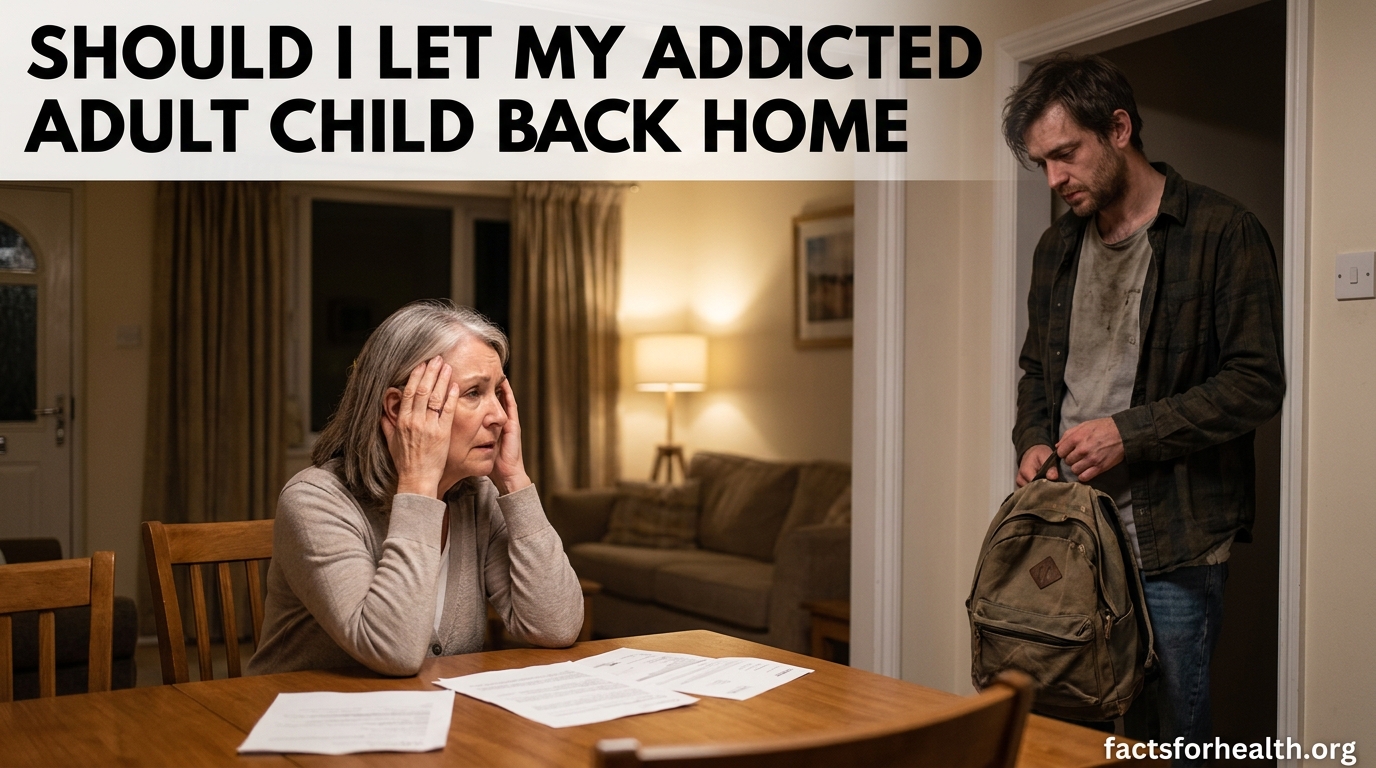
If you are reading this, you are likely standing at one of the most painful crossroads a parent can face. The question of whether you should let your addicted adult child move back home is not just a logistical decision. It is an emotional, financial, and moral dilemma that can keep you awake at night for weeks. You love your child deeply, and the thought of them being homeless or in danger feels unbearable. At the same time, you may have been through this before, and you know that opening your door can sometimes make things worse instead of better.
This guide walks you through every angle of this decision so you can make a clear, informed choice. We cover the difference between supporting and enabling, how to assess whether your child is genuinely ready, what boundaries to set, the legal risks you need to understand, and what to do when the answer needs to be no. You will also find a step-by-step decision framework that you can work through at your own pace.
Whether your child is fresh out of rehab, between jobs, or asking for one more chance after a relapse, the information here applies. Our team has drawn on expert guidance from family therapists, addiction counselors, legal professionals, and the real lived experiences of parents who have navigated this exact situation. The goal is not to tell you what to do. The goal is to give you the tools, language, and confidence to make the decision that is right for your family.
Table of Contents
Quick Overview: The Core Decision at a Glance
The short answer to whether you should let your addicted adult child move back home is this: it depends on their readiness, your capacity, and the safety of your household. There is no universal right answer. But there are clear factors that tilt the decision in one direction or the other.
Here is a side-by-side look at the main arguments on both sides.
Potential Benefits
- Provides a stable environment for early recovery
- Allows you to monitor behavior and support treatment attendance
- Keeps your child away from dangerous living situations
- Reduces financial pressure that can trigger relapse
- Offers emotional support during a vulnerable period
Potential Risks
- Can enable continued substance use if boundaries are weak
- Disrupts the safety and peace of your household
- Creates financial strain on you and your retirement
- Carries legal risks if residency is established and eviction becomes necessary
- Takes a severe toll on your mental and physical health
- Can damage relationships with your spouse or other children
The decision comes down to one fundamental question: will living in your home support their recovery, or will it shield them from the natural consequences that might finally motivate change?
Understanding the Question: Should I Let My Addicted Adult Child Move Back Home?
When you ask whether you should let your addicted adult child move back home, you are really asking several questions at once. Can I trust them? Will this help or hurt their recovery? Am I prepared for what happens if things go wrong? What will this do to my marriage, my other children, my own wellbeing?
Many parents carry deep guilt about this decision. Society tells us that good parents never turn their children away. But addiction changes the equation in ways that most people who have never lived through it simply do not understand. Substance use disorder is a disease that can turn a loving child into someone who lies, manipulates, steals, and puts everyone around them at risk.
The parents we have heard from, both in support groups and through research interviews, describe the same painful tension. They want to help, but they have learned that sometimes helping means saying no. One mother on a Reddit support thread put it this way: “I love my son more than anything, but I finally realized that letting him live with me was not saving him. It was just making it easier for him to keep using.”
There is no shame in either choice. What matters is that your decision is based on honest assessment, clear boundaries, and an understanding of what you are and are not capable of handling.
Enabling vs. Supporting: The Critical Difference Every Parent Must Understand
Before you make any decision, you need to understand the difference between supporting and enabling. This single distinction will shape everything that follows.
Supporting means providing help that moves your child toward recovery and independence. Enabling means providing help that shields your child from the consequences of their addiction, making it easier for them to continue using without hitting bottom.
The line between the two is not always obvious, especially when you are in the middle of it. Here are some clear examples of each.
What Supporting Looks Like
- Paying treatment program fees directly to the facility
- Driving them to therapy appointments or support group meetings
- Providing housing tied to strict conditions (treatment attendance, drug testing, curfew)
- Listening without fixing, and encouraging them to solve their own problems
- Researching resources and offering information without pushing
What Enabling Looks Like
- Giving cash that may be spent on substances
- Paying their rent, phone bill, or debts repeatedly with no conditions
- Letting them live with you without rules or accountability
- Making excuses for their behavior to family, employers, or law enforcement
- Bailing them out of every crisis so they never face consequences
- Lying or covering for them to protect them from reality
One of the hardest truths for parents to accept is this: enabling feels like love, but it often prolongs the addiction. When you remove every obstacle from your child’s path, you also remove the friction that might push them toward getting help. This does not mean you should be cruel. It means you should be intentional about the kind of help you offer.
A helpful test to use is this question: “If I do this, will it make it easier for my child to keep using, or harder?” If the honest answer is easier, you are probably enabling.
Potential Benefits of Letting Your Addicted Adult Child Move Back Home
Under the right conditions, having your child at home can genuinely support their recovery. The key phrase is “under the right conditions.” Here are the real benefits that can come from this arrangement.
Stability During Early Recovery
The first weeks and months of recovery are fragile. A stable, safe home environment gives your child a foundation to rebuild their life without the chaos that often surrounds active addiction. If they have just completed a treatment program or detox, having a predictable place to sleep, eat, and return to each evening can reduce the risk of relapse significantly.
Accountability and Structure
When you set clear expectations, your presence provides accountability that a young person in recovery often cannot provide for themselves. Knowing that someone cares whether they come home, whether they are sober, and whether they are following through on commitments can be a powerful motivator. This works best when the accountability is built on rules and consequences that are clearly defined and consistently enforced.
Financial Breathing Room
For a child who is genuinely working toward recovery, living at home can give them time to find work, save money, and build toward independence without the crushing pressure of paying rent while also trying to stay sober. This bridge can be the difference between sustained recovery and a rapid return to old patterns.
Protection From Dangerous Environments
If your child has been living in a place where substance use is rampant, moving them out of that environment can be life-saving. Recovery is hard enough without constant exposure to triggers and people who are still actively using. Your home, if it is substance-free and structured, can serve as a genuine sanctuary.
Emotional Connection
Recovery can be deeply isolating. Knowing that their family has not given up on them, that they are welcome and loved even after everything they have put the family through, can give a person in recovery the emotional strength to keep going. That said, emotional support must come with boundaries, not an open-ended commitment to tolerate anything.
Risks and Drawbacks You Need to Honestly Face
Now for the hard truth. The risks of letting an addicted adult child move back home are real, and they are significant. Many parents who agreed to this arrangement without adequate preparation ended up in situations worse than the one they were trying to fix. Here is what you need to weigh.
The Risk of Enabling
Without rock-solid boundaries, having your child at home can become a form of enabling. A warm bed, meals, laundry, and a safe place to stay can unintentionally make it comfortable enough for your child to continue using without facing consequences. Parents who have been through this often say they did not realize they were enabling until months had passed and nothing had changed.
Impact on Other Household Members
This is one of the most under-discussed aspects of this decision. If you have a spouse or partner, their feelings matter equally. If you have other children at home, especially younger ones, the impact on them must be a primary consideration, not an afterthought.
Parents in support forums frequently describe marriages cracking under the strain of an addicted adult child living at home. One parent described how her husband moved into a separate bedroom and eventually threatened divorce because he could no longer tolerate the chaos. Another described how her younger child began having anxiety attacks after witnessing the addicted sibling’s behavior.
You cannot make this decision alone if other people share your home. Their safety, peace, and wellbeing are just as important as your desire to help your struggling child.
Financial Drain
The financial impact goes far beyond groceries and utilities. Parents report spending thousands on their addicted adult children, often from savings they could not afford to lose. Money meant for retirement, home repairs, or emergency funds gets redirected to bail, legal fees, treatment copays, and daily living expenses for a child who contributes nothing and may never repay a dime.
Relapse Inside Your Home
Relapse is a common part of the recovery process. If your child relapses while living with you, you may discover drugs or paraphernalia in your home. You may find yourself dealing with intoxicated behavior, overdoses, or people coming to your door looking for your child. This puts everyone in the household at risk.
Legal Residency Complications
In most jurisdictions, once someone has lived in your home for a certain period (often 30 days, but it varies by state), they may be legally considered a tenant, even without a lease. This means you cannot simply ask them to leave. You may need to go through a formal eviction process that can take months and cost thousands of dollars. We cover this in more detail in the legal section below.
Parent Burnout
The emotional toll of living with an addicted adult child is enormous. Parents describe losing sleep, gaining or losing weight, developing anxiety or depression, and feeling a constant low-grade terror that never fully goes away. You cannot be an effective support for your child if you are running on empty yourself.
Trust Assessment: How to Know If They Are Truly Ready
One of the most powerful insights from parents who have been through this comes from the Partnership to End Addiction: “My eyes can hear much better than my ears.” In other words, do not just listen to what your child says. Watch what they do. Trust is built through consistent, observable behavior over time, not through promises and apologies.
Focus on the Family’s guidance on this topic offers a useful framework for evaluating trustworthiness. They recommend checking three types of consistency before making your decision.
Test 1: Do Their Words Match Their Actions?
If your child says they are committed to recovery but keeps missing meetings, hanging around with old friends, or coming home late, there is a mismatch. Words are cheap. Actions tell you the truth. A person who is genuinely ready to live at home and work on recovery will demonstrate it through behavior, not just promises.
Test 2: Do Their Actions Match Their Actions Over Time?
One good week does not mean your child is ready. Look for sustained, consistent behavior over weeks or months. Are they attending treatment or support group meetings regularly? Are they looking for work or working? Are they respecting boundaries even when it is inconvenient? Consistency over time is the real indicator.
Test 3: Do Their Words Match Their Words?
Does your child tell the same story to you, to their counselor, and to other family members? If details keep shifting or if you catch them in lies, even small ones, trust has not been rebuilt. Dishonesty is a core symptom of active addiction, and it does not disappear overnight.
Signs Your Child May Be Ready
- They have completed a treatment program or are actively enrolled in one
- They are attending regular support group meetings (12-step, SMART Recovery, etc.)
- They have a sponsor or counselor they meet with consistently
- They have been honest about past behavior without minimizing or blaming
- They accept that conditions and boundaries are reasonable
- They have a plan for their recovery, not just a desire to move back
- They have demonstrated sustained sobriety (experts often suggest 30 to 90 days minimum)
Remember that readiness is not a feeling or a wish. It is an observable pattern. If you are not seeing it, you are not seeing it.
Setting Boundaries and House Rules Before They Move In
If you decide to let your child move back home, boundaries are not optional. They are the foundation that determines whether this arrangement supports recovery or enables continued addiction. Boundaries should be agreed upon, written down, and signed before your child crosses the threshold.
The Written Agreement
A verbal agreement is not enough. Addiction impairs memory, judgment, and honesty. You need a written document that both of you sign. This does not need to be a legal contract drawn up by a lawyer (though you can certainly consult one). It needs to clearly spell out the rules, the expectations, and the consequences of violations.
Here is what a written agreement should cover.
Core House Rules to Include
- Zero substances: No drugs, alcohol, or drug paraphernalia in the home, no exceptions
- Treatment requirement: Must attend treatment, therapy, or support group meetings (specify frequency)
- Drug testing: Agree to random drug screenings at your discretion (discuss what happens if they refuse or fail)
- Curfew: Set a reasonable time for being home each evening
- Visitors: No visitors who are using substances or who are connected to your child’s drug-using past
- Rent or financial contribution: Even a small amount establishes responsibility and prevents total dependency
- Chores and household participation: They are a contributing member of the household, not a guest
- Honesty: Lying about whereabouts, activities, or substance use is grounds for consequences
- Respect for others: No abusive, manipulative, or threatening behavior toward any household member
Consequences for Violations
Rules without consequences are just suggestions. Each rule should have a clearly defined consequence, up to and including having to leave. This sounds harsh, but it is actually compassionate. Your child needs to know exactly where the lines are and what happens when they cross them. Ambiguity creates anxiety for everyone.
One approach parents have found effective is a graduated system. A first violation might result in a written warning and a conversation. A second might mean increased restrictions. A third, or any single violation involving violence, theft, or bringing substances into the home, means immediate termination of the living arrangement.
Whatever consequences you set, you must be prepared to enforce them. Setting boundaries you will not follow through on is worse than setting no boundaries at all, because it teaches your child that your words do not mean anything.
When to Say No: Red Flags That Mean You Should Refuse
Not every situation calls for a conditional yes. Sometimes the right answer is no, and saying no can be the most loving thing you do. Here are the clear red flags that indicate you should not let your addicted adult child move back home.
Clear Signs the Answer Should Be No
- Active addiction with no treatment intention: They are currently using and have no plan or willingness to enter treatment
- History of violence or threats: If your child has been violent toward you or anyone in the household, safety comes before everything
- Theft or financial exploitation: If they have stolen from you or other family members and shown no genuine remorse or restitution
- Refusal to accept conditions: If they will not agree to a written agreement, drug testing, or house rules, they are not ready
- Other household members are opposed: If your spouse, partner, or children feel unsafe or strongly opposed, their wellbeing takes priority
- Your mental or physical health is already at risk: If you are already struggling with anxiety, depression, or health issues, adding this stress may break you
- Repeated failed attempts: If your child has lived with you before under similar circumstances and it ended badly each time, doing the same thing again and expecting a different result is not wisdom
- They are facing criminal charges: Legal trouble can bring law enforcement to your door and create dangerous situations for everyone in the home
Saying no does not mean you are abandoning your child. It means you are recognizing your own limits and refusing to create a situation that will harm both of you. You can still offer support in other ways: helping them find treatment, connecting them with resources, or being emotionally present without providing housing.
Many parents in recovery support groups report that the moment they finally said no was the turning point. Not always immediately. Sometimes it took months. But the natural consequence of losing the safety net finally pushed their child toward getting real help.
Legal Considerations: Residency, Eviction, and Written Agreements
This is the section most parents wish they had read before they opened their door. Once your adult child establishes residency in your home, removing them can become a legal process that is lengthy, expensive, and emotionally devastating.
How Residency Gets Established
In most states, a person can establish legal residency in your home by living there for a specific period (commonly 30 days, but it varies). However, residency can sometimes be established even faster if your child receives mail at your address, uses your address on their driver’s license, keeps belongings there, or has a key and comes and goes freely.
Once residency is established, your child is legally considered a tenant, and you become a landlord, even without a lease agreement. This means you generally cannot just change the locks or pack up their belongings. You must follow your state’s formal eviction process.
The Eviction Process
Formal eviction typically involves serving a written notice to vacate, waiting the legally required period (often 30 to 90 days), and if the person refuses to leave, filing an eviction lawsuit. This process can take months and cost thousands of dollars in legal fees. During that time, your child continues to live in your home.
For volatile situations involving threats or violence, you may be able to obtain a restraining order or emergency protective order, which can force immediate removal. But this requires documented evidence and involvement of law enforcement.
How to Protect Yourself Legally
- Use a written agreement: Clearly state that this is a temporary arrangement, not a tenancy, and include the expected duration
- Limit residency markers: Discuss with a local attorney about keeping their official address elsewhere
- Set a move-out date: Include a specific end date or timeline in the agreement
- Consult an attorney: Before your child moves in, talk to a local landlord-tenant attorney about your state’s specific laws
- Document everything: Keep records of agreements, violations, and any incidents that occur
This is not about being cold or legalistic. It is about protecting yourself so that if things go wrong, you have options. Too many parents have found themselves trapped in their own homes with no legal recourse because they did not understand these risks beforehand.
Financial Considerations: Avoiding Financial Enabling
Money is one of the most common sources of conflict when an addicted adult child moves home. It is also one of the most poorly addressed topics in most guidance on this subject. Financial enabling is real, and it can destroy your own financial future while doing nothing to help your child recover.
Basic Financial Rules
- Never give cash: Cash is the easiest thing to spend on substances. If your child needs something, pay for it directly
- Charge rent: Even a modest amount (some parents suggest a percentage of income) creates accountability and prevents total dependency
- Require financial transparency: If you are supporting them financially, you have the right to know where their money goes
- Set a cap: Decide in advance how much you are willing to spend in total support, and do not exceed it
- Protect your retirement: Do not deplete retirement savings or take on debt to support your child. You cannot help them if you become financially unstable yourself
One approach parents have found effective is to collect “rent” from their child and set it aside in a savings account. When the child is ready to move out, that money is returned to help with a security deposit or first month’s rent. This creates a financial incentive to save and plan for independence while also reinforcing the principle that living at home is not free.
Financial boundaries are not punishment. They are preparation for the real world your child will eventually need to navigate on their own.
Protecting Your Household and Other Family Members
Your home belongs to everyone who lives in it. The decision to bring an addicted adult child into that space affects every person under your roof, and their voices deserve equal weight.
Your Spouse or Partner Comes First
If you are married or in a committed relationship, your partner must be fully on board with this decision. Not reluctantly. Not begrudgingly. Fully. If your partner has reservations, listen to them. They may see things you cannot see because your parental love is filtering your perception.
Marriages suffer badly under the strain of an addicted adult child at home. Spouses report feeling sidelined, overruled, and resentful when one parent insists on helping the child against the other’s wishes. This is not a situation where you can compromise by splitting the difference. Both adults must agree, or the arrangement should not happen.
Impact on Other Children
If you have other children living at home, especially minors, their safety and wellbeing are your primary responsibility. Exposure to addiction behavior, paraphernalia, intoxicated episodes, or conflict can cause lasting psychological harm.
Talk to your other children honestly, in age-appropriate terms, about what is happening. Give them permission to come to you if they feel unsafe or uncomfortable. And be willing to change the arrangement if it is hurting them.
Parent Self-Care: Support Resources You Should Not Ignore
You cannot pour from an empty cup. If your own mental, emotional, and physical health collapses under the weight of this situation, you will not be able to help anyone, including yourself. Self-care is not selfish in this context. It is survival.
Support Groups for Parents
No competitor in this space covers these resources, and they are absolutely essential. These organizations exist specifically for people who love someone struggling with addiction.
- Al-Anon: A worldwide fellowship for family and friends of people with alcohol problems. Al-Anon meetings are free, available in person and online, and follow a 12-step model adapted for loved ones. Al-Anon teaches you how to set boundaries, let go of trying to control the addicted person, and focus on your own recovery from the effects of someone else’s drinking
- Nar-Anon: Similar to Al-Anon but specifically for families and friends of people addicted to drugs. Nar-Anon offers the same free, peer-led support model and is an invaluable resource for parents dealing with a child’s drug addiction
- SMART Recovery Family and Friends: A science-based alternative to 12-step programs, SMART Recovery offers online and in-person meetings for people affected by someone else’s addiction. Their approach is grounded in cognitive behavioral therapy (CBT) and rational emotive behavior therapy (REBT)
Professional Help
Individual therapy with a counselor who specializes in addiction and family systems can be life-changing. Look for a therapist trained in approaches like Community Reinforcement and Family Training (CRAFT), which is specifically designed to help family members communicate with and support a loved one struggling with substance use.
Warning Signs of Parent Burnout
- Chronic sleep problems or insomnia
- Increased anxiety, irritability, or depression
- Neglecting your own health, friendships, or hobbies
- Feeling numb or emotionally flat
- Using alcohol or other substances to cope with stress
- Feeling trapped, hopeless, or unable to see a way forward
If you are experiencing several of these signs, reach out for help immediately. You are not weak for needing support. You are human.
A Step-by-Step Decision Framework for Parents
Now that we have covered all the factors, here is a practical framework to help you work through the decision. Take your time with each step. Do not rush this.
Step 1: Assess Your Child’s Readiness Honestly
Apply the three consistency tests described earlier. Has your child demonstrated sustained, observable change over time? Are they actively engaged in treatment or recovery activities? Are they honest and accountable? Write down the evidence on both sides, not just what you hope is true.
Step 2: Consult All Household Members
Talk to your spouse, partner, and any other children living at home. Do not frame the conversation as asking permission. Frame it as gathering input and making a shared decision. If anyone strongly opposes the arrangement, take that opposition seriously.
Step 3: Evaluate Your Own Capacity
Are you physically, emotionally, and financially able to take this on? Are you already burned out? Do you have a support system in place? Are you willing and able to enforce boundaries even when it hurts? Be brutally honest with yourself here.
Step 4: Create a Written Agreement If Proceeding
If you decide to move forward, draft a written agreement that covers all the rules, expectations, and consequences outlined in the boundaries section above. Have your child read it, discuss it, and sign it before they move in. Consider having an attorney review it.
Step 5: Set a Timeline and Exit Plan
Build an exit plan into the arrangement from day one. How long is this expected to last? What milestones does your child need to hit to extend the arrangement or transition to independent living? Without a timeline, temporary becomes permanent.
Step 6: Establish Monitoring and Consequences
Decide how you will monitor compliance with the agreement. Will there be regular check-ins? Drug tests? How will violations be handled? Make sure both you and your child understand exactly what will happen if rules are broken.
Step 7: Commit to Your Own Support System
Before your child moves in, commit to attending Al-Anon, Nar-Anon, SMART Recovery, or individual therapy. You will need support throughout this process, not just at the beginning. Having that support in place from day one is essential.
FAQs
What does the Bible say about adult children moving back home?
The Bible does not specifically address adult children moving back home, but it emphasizes both family responsibility and personal accountability. Verses like 1 Timothy 5:8 speak to providing for your family, while Proverbs and the writings of Paul stress that adults should work, be responsible, and bear the consequences of their own actions. Many faith leaders interpret this as a call to help family members in genuine need while also allowing them to face the consequences that lead to growth and change.
What to say to your drug addicted daughter?
Speak with honesty and love, not accusation. Express your concern using specific observations rather than labels. Say something like, ‘I love you and I am worried about you. I have noticed specific changes and I want to help, but I also need to protect myself and our family.’ Focus on what you are willing to do (help find treatment, attend meetings with her, listen without judgment) and what you are not willing to do (provide cash, tolerate dishonesty, allow substances in your home). Avoid arguing when she is intoxicated. Save important conversations for when she is sober and relatively calm.
Should adult children move back home?
There is no universal answer. For adult children actively working on recovery, maintaining employment, and respecting household rules, moving home can provide a valuable bridge to independence. For those in active addiction with no willingness to change, moving home often enables the problem rather than solving it. The decision should be based on the individual circumstances, the child’s readiness, the household’s capacity, and whether clear boundaries can be established and enforced.
When adult children move back home, are they considered tenants?
In most states, yes. Once an adult child has lived in your home for a certain period (commonly 30 days, though it varies by jurisdiction), they may be legally considered a tenant even without a signed lease. Factors that establish residency include receiving mail at the address, using it on official documents, keeping belongings there, and having free access to come and go. Once tenant status is established, you must follow formal eviction procedures to remove them, which can take months. Consult a local attorney before allowing anyone to move in.
How to deal with a drug addicted adult child?
Focus on what you can control, which is your own behavior and boundaries. Educate yourself about addiction as a disease. Join a support group like Al-Anon, Nar-Anon, or SMART Recovery Family and Friends. Avoid giving cash. Set clear, written boundaries with defined consequences. Encourage treatment without forcing it, since motivation for recovery must ultimately come from within. Practice self-care consistently. Consider working with a therapist trained in CRAFT (Community Reinforcement and Family Training). Accept that you cannot fix this for them, but you can create an environment that supports recovery while protecting yourself.
What is the 7 7 7 rule for parents?
The 7 7 7 rule for parents is a general parenting concept that encourages caregivers to consider three timeframes when making decisions: how will this affect the child in 7 days, 7 months, and 7 years. Applied to the question of whether to let an addicted adult child move back home, it asks you to think beyond the immediate crisis. Will this decision help or hurt their recovery in the coming week, the coming months, and over the next several years? This framework helps parents avoid short-term emotional decisions that may create long-term harm.
Conclusion: Making the Right Decision for Your Family
The decision of whether you should let your addicted adult child move back home is one of the hardest choices a parent can make, and there is no one-size-fits-all answer. What we hope you take away from this guide is that your decision should be based on honest assessment, not fear or guilt. Assess your child’s readiness through their actions over time. Consult every member of your household. Understand the legal and financial risks. And if you decide to proceed, do so with a written agreement, clear boundaries, and an exit plan.
If the answer is no, that is not a failure of love. It may be the most powerful thing you can do for your child’s recovery. Natural consequences are not cruelty. They are often the catalyst that finally breaks through denial and motivates real change. And regardless of your decision, you deserve support. Reach out to Al-Anon, Nar-Anon, SMART Recovery Family and Friends, or a therapist who understands addiction in the family system. You do not have to carry this alone.
Whatever you decide, know that thousands of other parents are facing the same agonizing question right now. You are not alone, you are not a bad parent for struggling with this, and there is no timeline on finding the answer that is right for your family.