
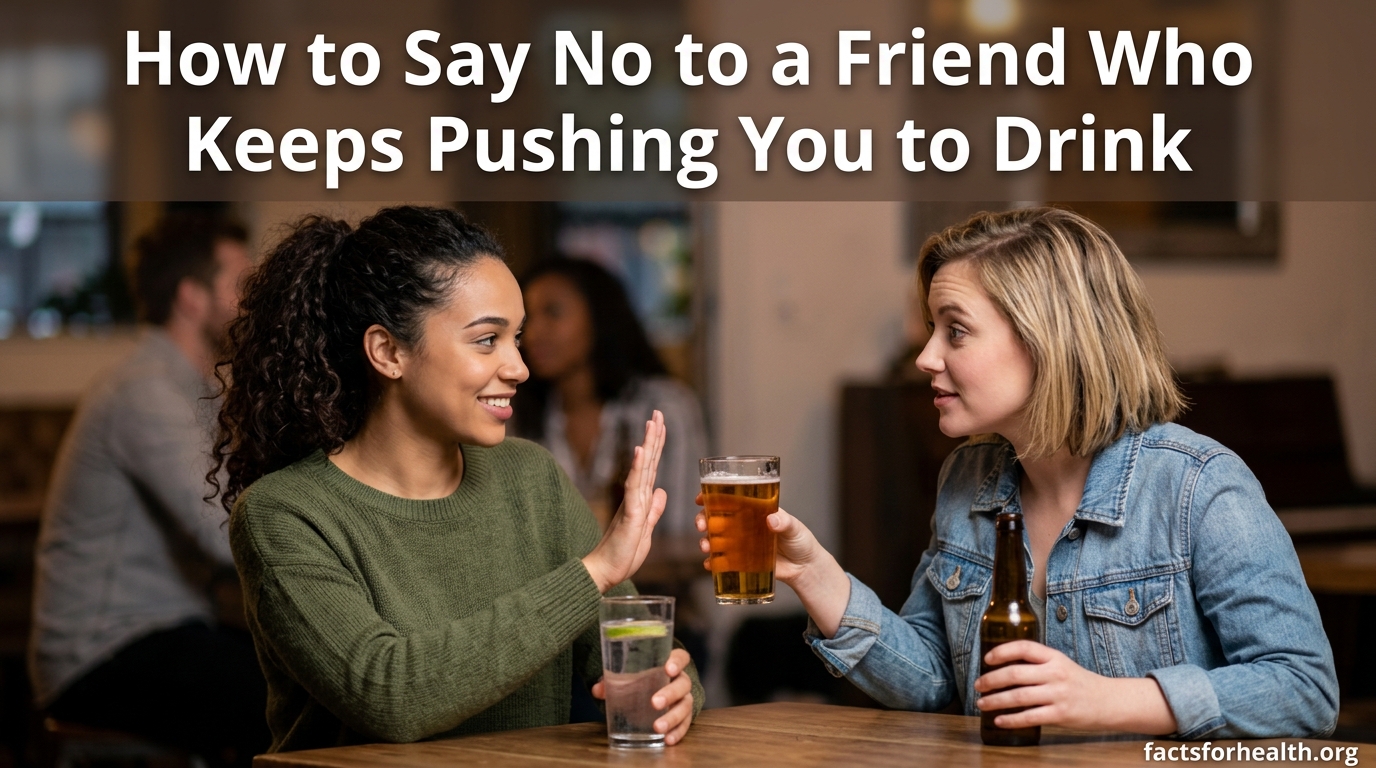
You are at a dinner with friends, having a perfectly good time with your sparkling water, when it starts again. “Come on, just have one drink. One won’t kill you.” You smile, shake your head, and say no thanks. Five minutes later, they are back at it. If this sounds familiar, you are far from alone. Learning how to handle a friend who keeps pressuring you to have one drink is one of the most common social challenges people face, whether you are sober, cutting back, on medication, pregnant, or simply not in the mood.
The pressure often comes from someone close to you. It is not a stranger at a bar. It is a friend you have known for years, a coworker you see daily, or a family member who thinks they are being generous by buying you a round. That closeness makes saying no feel more complicated than it should be. You worry about the friendship, the awkwardness, and whether you are overreacting.
You are not overreacting. Nobody owes anyone an explanation for not drinking. No is a complete sentence. But getting to a place where that feels true in the moment takes preparation, the right words, and a clear understanding of why this keeps happening. This guide breaks it all down with practical strategies, exact scripts, and real advice from people who have been exactly where you are.
Table of Contents
Quick Answer: How to Handle a Friend Who Keeps Pressuring You to Have One Drink
The best approach is a direct, calm, and firm response followed by an immediate topic change. Say something like, “I am not drinking tonight, and I am happy with what I have,” then move the conversation forward. If the pressure continues, address it privately by telling your friend their repeated pushing makes you uncomfortable. Set a clear boundary: if they cannot respect your choice, you will leave the situation or spend less time together at drinking events.
Here is the quick breakdown of what works:
1. Be clear and brief in your refusal. Do not over-explain.
2. Hold a non-alcoholic drink in your hand to reduce follow-up offers.
3. Change the subject immediately after declining.
4. Have a private, honest conversation before the next social event.
5. Use humor if it fits your personality, but keep the boundary firm.
6. Reassess the friendship if the pressure continues after clear boundaries are set.
Why Your Friend Keeps Pressuring You to Drink
Understanding why your friend keeps pushing alcohol on you does not excuse the behavior. But it does help you respond calmly instead of taking it personally. People who pressure others to drink almost always have reasons rooted in their own relationship with alcohol, not yours.
They feel judged by your choice. When you decline a drink, some people hear an unspoken criticism of their own habits. Your friend might think your abstinence means you disapprove of their drinking, even if you have never said a word about it. This is one of the most common dynamics described by people in recovery communities and by anyone who has chosen to drink less. Your no makes them reflect on their own yes, and that reflection is uncomfortable.
They want to protect the dynamic. If your friendship has historically revolved around drinking together, your friend may genuinely fear that the relationship is changing. They might worry that sober you will be less fun, that you will judge them, or that you will drift apart. This fear often shows up as pushiness rather than honesty. They are not trying to sabotage you. They are grieving a version of the friendship they were comfortable with.
They think one drink is harmless. The phrase “just one drink” reveals a fundamental misunderstanding. For someone who drinks regularly, one drink is genuinely no big deal. They project that onto you. They cannot understand why you are making such a fuss over something so small, because from their perspective, it is small. What they miss is that for you, one drink might be a very big deal, whether because of recovery goals, health concerns, medication interactions, or simply the principle of having your choices respected.
They feel insecure about drinking alone. There is a well-documented social phenomenon where people feel more comfortable drinking when everyone around them is drinking too. Your sobriety or moderation makes them confront the fact that they might be drinking more than they need to. Pressuring you to join in is a way to normalize their own behavior.
They do not understand addiction or recovery. If your friend has never struggled with alcohol, they may genuinely not comprehend why “just one” is dangerous for some people. They are not being malicious. They are being ignorant. This is especially common in long-term friendships where one person has recently decided to stop drinking and the other has not caught up to what that means.
Habit and social conditioning play a role too. In many cultures, offering a drink is equated with hospitality, friendship, and celebration. Your friend might be operating on autopilot, repeating a social script they have never thought to question. The pressure feels personal, but it is often just a reflex.
How to Handle a Friend Who Keeps Pressuring You to Have One Drink: Practical Strategies
The strategies below are ordered from easiest to most assertive. Start with what feels natural to you, and escalate only if the pressure continues. You do not need to use all of them. Pick the ones that fit your personality and your friendship.
1. Master the quick, confident refusal. The key is to say no quickly and confidently, without leaving room for negotiation. Hesitation invites more pushing. A response like, “No thanks, I am good with this,” said with a smile and a tone that signals the topic is closed, works better than a long explanation about why you are not drinking. Practice saying it until it feels automatic.
2. Always have a drink in your hand. This is one of the simplest and most effective tricks. If you are holding a sparkling water, a soda, or a mocktail, people are far less likely to offer you alcohol. An empty hand is an invitation for someone to fill it. A full hand signals that you are already taken care of. Multiple Reddit users in sober communities swear by this technique. Order a club soda with lime, and it even looks like a cocktail if you want to avoid questions entirely.
3. Redirect the conversation immediately. After you decline the drink, change the subject without missing a beat. Ask a question, bring up a shared interest, or comment on something happening around you. This sends the signal that the drink refusal is not a big deal and that you are focused on enjoying the conversation, not on the fact that you are not drinking. The faster you move past it, the less room there is for your friend to linger on the topic.
4. Prepare a go-to reason ahead of time. You are not obligated to give a reason, but having one ready can make the moment easier. Choose something you are comfortable with and that tends to shut down follow-up questions. “I am driving tonight,” “I have an early morning,” “I am on medication that does not mix with alcohol,” and “I am doing a health challenge” are all effective. The key is picking one and sticking with it. Changing your story makes people curious. Consistency makes them stop asking.
5. Have the honest conversation outside of a drinking setting. This is the strategy most people skip, and it is often the most effective for a persistent friend. Invite your friend for coffee or a walk, somewhere alcohol is not part of the picture. Tell them directly: “I have noticed you push me to drink when we go out, and it makes me uncomfortable. I need you to stop.” Frame it as something that matters to you and as a request from a friend, not an accusation. Most people respond well to this when it comes from a place of care rather than confrontation.
6. Be prepared to leave. If your friend continues to pressure you after you have clearly said no, you are allowed to leave. You do not owe anyone your time if they are making you uncomfortable. Having an exit plan, whether that is your own car, a ride-share app, or another friend who can pick you up, gives you the confidence of knowing you are not trapped. Simply standing up and saying, “I am heading out, great seeing you,” is a complete and acceptable response.
Exact Phrases and Scripts to Use in the Moment
Having the right words ready removes the panic of being caught off guard. Below are specific phrases organized by tone. Pick the ones that match your personality and the specific situation.
Direct and brief (for casual pressure):
“No thanks, I am good.”
“I am not drinking tonight.”
“I will stick with what I have, thanks.”
“Not tonight, but appreciate the offer.”
“I am all set, thanks.”
Honest and personal (for close friends):
“I have decided to cut back on drinking, and I would appreciate your support.”
“I feel better when I do not drink, so I am sticking with that.”
“I am not drinking anymore. It was a personal decision, and I am happy to talk about it another time, but tonight I just want to enjoy hanging out.”
“Drinking does not work for me anymore. I hope you can respect that.”
Practical excuses (for people you do not know well):
“I am the designated driver tonight.”
“I have a really early morning tomorrow.”
“I am on medication, so no alcohol for me.”
“I am training for an event and not drinking during it.”
“My doctor told me to take a break from drinking.”
Humorous deflections (if humor is your style):
“This sparkling water is my wild choice tonight.”
“I have reached my lifetime quota, thanks.”
“Trust me, I am much more entertaining sober.”
“I am saving my calories for dessert.”
“My liver asked for a night off.”
Firm boundary-setters (for repeat offenders):
“I have said no a few times now. Please stop asking.”
“I love hanging out with you, but the drink pushing needs to stop.”
“My decision is final. If you cannot respect that, I would rather talk about something else.”
“I am not going to change my mind tonight, so let us move on.”
The phrase that works best depends entirely on who is pressuring you and how close you are. For a coworker you barely know, a practical excuse is usually enough. For a best friend who keeps crossing a line, the firm boundary-setter paired with a private conversation is what actually changes the behavior.
Common Scenarios and Exactly How to Handle Them
Different settings call for different approaches. Here are the most common situations where a friend might pressure you to have one drink, and exactly what to do in each one.
At a party where everyone is drinking. This is the hardest scenario because the social momentum is all moving in one direction. Arrive with a plan. Bring or order a non-alcoholic drink immediately upon arriving so you start with something in your hand. Position yourself near people who are not clustered around the bar or drinking games. If your persistent friend approaches with a drink, use your quick refusal and immediately redirect. If they push harder, physically move to another area or another conversation. Parties are about socializing, not about monitoring what is in your glass.
After-work drinks with colleagues. Work events add a layer of complexity because there are professional dynamics at play. You might worry that not drinking will make you seem antisocial or hurt your career. It will not. Order a non-alcoholic drink and participate fully in the conversation. If a coworker pressures you, a practical excuse like “I have a big day tomorrow” or “I am on a health kick” works well without making anyone uncomfortable. If a specific colleague repeatedly pushes, that is worth noting and potentially addressing with HR if it becomes a pattern. Workplace drinking pressure is a recognized issue, and most companies have policies against it.
Dinner with one persistent friend. One-on-one situations are actually easier to manage because you have the friend’s full attention and can be more direct. If they keep pushing, you can look them in the eye and say, “I am not drinking tonight and I need you to stop asking. Can we just enjoy dinner?” The intimacy of a one-on-one setting makes boundary-setting conversations more natural. This is also the ideal setting to have the deeper conversation about why they keep pressuring you.
At a bar or nightclub. Bars are designed around drinking, which makes them the most challenging environment. If you choose to go, have a clear exit strategy. Arrive late and leave early to minimize exposure. Always have a drink in your hand, even if it is just water. If someone buys you a drink without asking, thank them graciously and either quietly do not drink it or hand it to someone else. If the pressure becomes relentless, leave. No bar is worth your peace of mind.
Weddings and celebrations. These events come with a built-in excuse that works almost every time: toasting. You can raise a glass of anything. Champagne, sparkling cider, or water all work for a toast. Beyond that, celebrations usually have enough food, dancing, and activities that drinking is only one part of the event. Focus on the parts you enjoy. If a friend pushes, celebrations are the perfect time for a humorous deflection because everyone is in a festive mood.
When your entire friend group drinks and you do not. This is the scenario that generates the most anxiety, but it is also the one where preparation pays off the most. Talk to at least one friend in the group beforehand. Let them know you are not drinking and ask for their support. Having one ally changes the entire dynamic. When the persistent friend starts pushing, your ally can step in with something like, “Leave them alone, they are good.” You do not have to fight every battle alone.
How to Set and Maintain Boundaries with a Friend Who Will Not Stop
Setting a boundary is not a one-time event. It is an ongoing process of deciding what you will and will not accept, communicating it clearly, and following through with consequences when the boundary is crossed. Here is a step-by-step approach for a friend who keeps pressuring you despite your refusals.
Step 1: Get clear on your boundary before you communicate it. Decide what you need. Is it that they never offer you a drink again? Is it that they accept your first no without pushing? Is it that they stop commenting on your not drinking at all? Be specific. Vague boundaries lead to vague compliance. “I need you to respect my choice not to drink” is a good start, but “I need you to stop offering me alcohol and stop commenting on what I am drinking” is clearer and easier to enforce.
Step 2: Have the conversation in a neutral setting. Do not try to set a boundary in the middle of a drinking event when emotions are high and alcohol is flowing. Choose a time when you are both sober, relaxed, and able to have an honest conversation. Coffee, a walk, or a phone call all work. Start with appreciation: “I value our friendship, and that is why I want to be honest with you about something.”
Step 3: Be direct and specific. Say what you have observed, how it makes you feel, and what you need going forward. For example: “I have noticed that every time we go out, you push me to have a drink even after I say no. It makes me feel like you do not respect my choices. Going forward, I need you to accept my first no and not bring it up again.” Use “I” statements rather than accusations. You are describing your experience, not attacking their character.
Step 4: Define what happens if the boundary is crossed. A boundary without a consequence is a suggestion. Decide what you will do if they continue to pressure you, and communicate it. “If you keep pushing me to drink after I have said no, I am going to leave the event early.” Or, “If this continues, I am going to need to take a break from going to bars with you.” You are not threatening them. You are telling them what you will do to protect yourself.
Step 5: Follow through. This is the hardest part and the most important. If you set a boundary and then do not enforce it, you teach your friend that your boundaries are negotiable. The first time they cross the line after your conversation, follow through with the consequence you described. Leave the event. Decline the next invitation. You do not have to be angry about it. You just have to be consistent.
Most friends will adjust after a clear, caring boundary conversation. They may push back at first because they are not used to the new dynamic, but if they value the friendship, they will come around. The ones who do not are showing you something important about how much they actually respect you.
Signs It Is Time to Reconsider the Friendship
Not every friendship survives a change in drinking habits, and that is okay. If you have communicated your boundaries clearly and your friend continues to pressure you, mocks your choice, or makes you feel bad for not drinking, those are red flags. A friend who respects you might not understand your decision, but they will respect it.
Watch for these specific warning signs. They pressure you in front of others to embarrass you into compliance. They lie about whether a drink contains alcohol. They dismiss your concerns as overreacting. They tell you that you are no fun anymore. They only want to spend time with you in drinking settings. They make your sobriety or moderation about them and their feelings.
If several of these signs are present, it may be time to create distance. You do not have to dramatically end the friendship. You can simply start declining invitations to drinking events, spending more time with friends who support your choices, and investing your energy in relationships where you feel respected. Protecting your well-being is not selfish. It is necessary.
Frequently Asked Questions
What is a good strategy if a friend is pressuring you to drink?
The best strategy is to give a clear, brief refusal without over-explaining, then immediately change the subject. Say something like, u0022No thanks, I am good with this,u0022 and redirect to a new topic. If the pressure continues, address it directly by saying, u0022I have said no, and I need you to stop asking.u0022 For ongoing pressure, have a private conversation outside of a drinking setting to set a firm boundary.
What to do if someone pressures you to drink?
Decline firmly and confidently, keep a non-alcoholic drink in your hand, and redirect the conversation. If they persist, use a practical excuse like driving or an early morning. If the pressure continues after you have clearly said no, you are justified in leaving the situation. No one is obligated to drink or to explain why they are not drinking.
How do you deal with a friend that peer pressures you?
Start by addressing it privately in a neutral setting. Tell them directly that their repeated pressure makes you uncomfortable and that you need them to respect your choice. Set a specific boundary, such as accepting your first no without further comment. Define what will happen if they continue, such as leaving events early or declining drinking-related invitations, and follow through consistently.
Why do friends push you to drink?
Friends push you to drink for several reasons rooted in their own relationship with alcohol. They may feel judged by your choice, fear the friendship is changing, think one drink is harmless, feel insecure drinking alone, or simply not understand your decision. In most cases, the pressure reflects their own discomfort rather than any problem with your choice.
How do you enforce saying you do not want a drink?
Be clear and brief, avoid over-explaining, and keep a non-alcoholic drink in your hand. If someone asks again after your first refusal, say firmly, u0022I have already said no, please stop asking.u0022 If they continue, follow through with a predetermined consequence such as leaving the event. Consistency is key. If you give in after repeated pressure, you teach them that persistence works.
What are the 4 Ds of addiction?
The 4 Ds are a relapse prevention tool often used in recovery programs. They stand for Delay (wait 15 minutes and the urge usually passes), Distract (do something else to occupy your mind), De-stress (use relaxation techniques to reduce the emotional trigger), and De-catastrophize (remind yourself that a craving is temporary and not an emergency). The 4 Ds can help you handle moments of pressure by managing your own response internally.
Is having one drink a relapse?
For someone in recovery from alcohol use disorder, yes, having one drink is generally considered a relapse. The danger of one drink is that it often leads to more, reigniting the cycle of addiction. If you are in recovery and have had a drink, the most important thing is to reach out for support immediately rather than letting shame take over. Talk to a sponsor, counselor, or support line. A slip does not erase your progress.
How do you stay sober when all your friends drink?
Prepare before every event by deciding what you will drink and how you will respond to pressure. Bring an ally who knows your goals. Always hold a non-alcoholic beverage. Have an exit plan so you can leave if needed. Build a support network that includes at least some sober or low-drinking friends. Consider attending support groups where you can connect with others facing the same challenges. Most importantly, remember that your sobriety is your decision and your right, regardless of what anyone around you is doing.
Moving Forward with Confidence
Handling a friend who keeps pressuring you to have one drink gets easier with practice. The first time you hold firm, it feels uncomfortable. By the tenth time, it is second nature. The strategies, scripts, and boundary-setting steps in this guide give you a complete toolkit for any situation. Start with the approach that feels most natural to you and build from there.
Your choice not to drink is valid. It does not need justification, explanation, or apology. True friends may need time to adjust, but they will respect your decision once they understand it matters to you. If someone cannot do that, you have learned something valuable about that friendship.
If you or someone you know is struggling with alcohol use or pressure around drinking, help is available. The SAMHSA National Helpline at 1-800-662-4357 offers free, confidential support 24 hours a day. You can also visit their website at findtreatment.gov to find local resources. You deserve friendships that support your choices, not ones that test them.