
Walking into a room and forgetting why you came. Blank on someone’s name mid-conversation. Misplacing the car keys for the third time this week. We have all been there, and the first thought that crosses many minds is the scary one: is this early Alzheimer’s?
Understanding the early signs of Alzheimer’s versus normal forgetfulness can bring clarity and peace of mind. The distinction matters enormously. Normal age-related forgetfulness happens to nearly everyone as they get older and does not disrupt daily life. Alzheimer’s-related changes are persistent, progressive, and interfere with your ability to function independently.
Nearly half of adults aged 40 and older believe they will develop dementia at some point, according to data from the CDC. That statistic reveals something important: a lot of people are worried, and much of that worry may be unnecessary. At the same time, early detection of actual cognitive decline opens doors to treatments, planning, and support services that can make a real difference in quality of life.
Our team put together this guide to walk you through what normal aging memory changes look like, what the 10 recognized early warning signs of Alzheimer’s are, and how to tell the difference. We also cover Mild Cognitive Impairment, reversible causes of memory problems, and exactly when to pick up the phone and call your doctor.
Whether you are concerned about your own memory, worried about a parent or spouse, or simply want to understand what is happening in your brain as you age, this article gives you clear, practical, and science-based information to help you take the right next step.
Table of Contents
Quick Overview: What Is the Difference in Plain Terms?
The core difference between Alzheimer’s and normal aging comes down to three things: frequency, impact, and awareness. Normal forgetfulness is occasional, does not interfere with daily tasks, and is something you can usually recall later. Alzheimer’s-related memory loss is frequent, disrupts your ability to live independently, and involves information that may never come back to you.
Here is the fastest way to think about it. If you forget where you parked your car at the mall, that is normal. If you forget you even drove to the mall, that warrants a conversation with your doctor.
What Normal Forgetfulness Looks Like
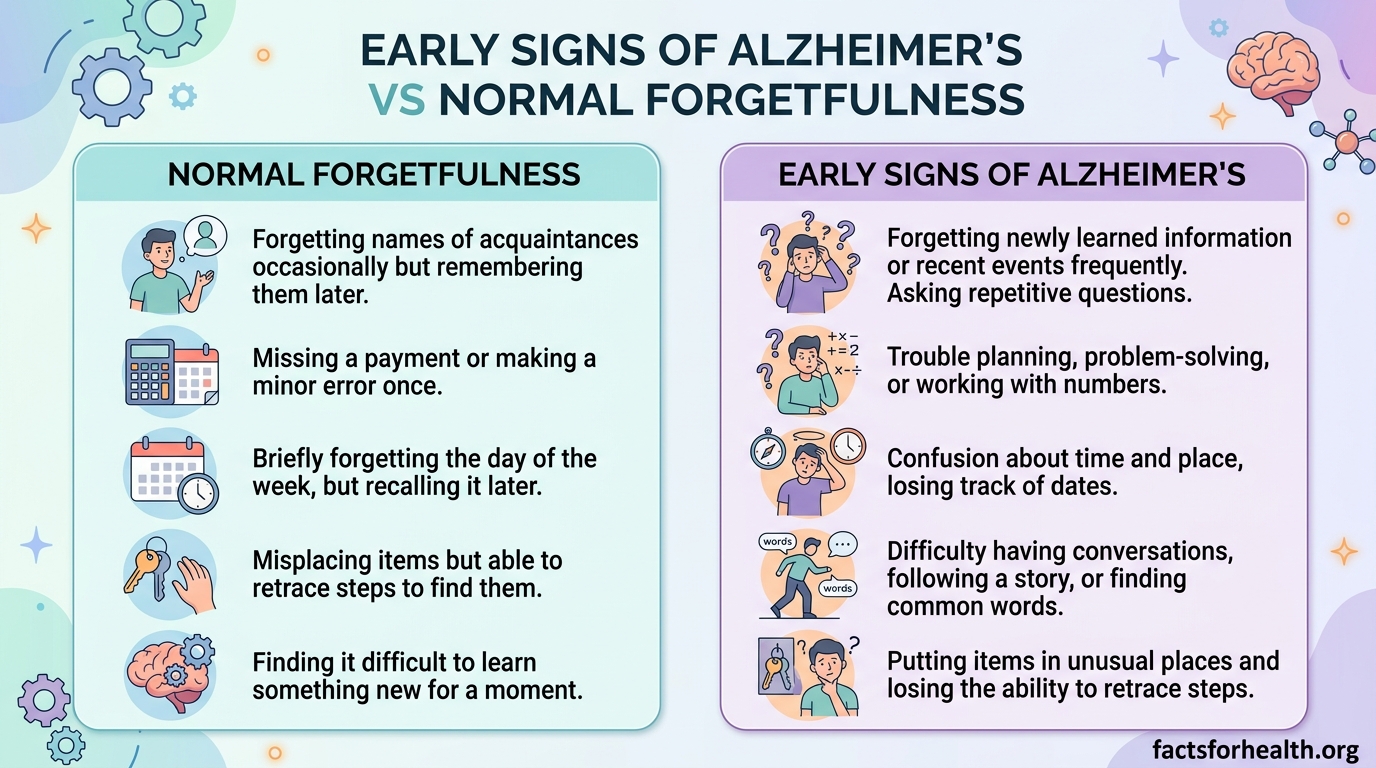
Sometimes you forget a name but remember it ten minutes later. You might misplace your phone but find it by retracing your steps. You occasionally walk into a room and forget what you needed. These experiences are annoying but completely normal.
What Alzheimer’s-Related Changes Look Like
You forget a conversation entirely, even when reminded. You put items in unusual places like keys in the refrigerator and cannot retrace your steps to find them. You get lost in a neighborhood you have known for decades. You struggle to complete tasks you have done hundreds of times, like following a familiar recipe.
If those descriptions sound concerning, the information below will help you understand each sign in detail.
What Counts as Normal Age-Related Forgetfulness?
As we age, our brains go through natural changes. Processing speed slows down slightly. It may take a bit longer to learn something new or to recall a specific word. These changes are expected, predictable, and do not mean anything is wrong.
Research from the National Institute on Aging confirms that mild forgetfulness can be a normal part of growing older. The key question is always whether the memory changes are getting in the way of your normal activities and relationships.
Common Examples of Normal Age-Related Memory Changes
You occasionally forget a name or an appointment but remember it later. Sometimes you need a hint or a cue to trigger the memory, but the information is still there once prompted.
You sometimes walk into a room and forget why. Usually you remember within a few seconds, or you go back to where you started and it comes to you.
You misplace items like glasses, keys, or the TV remote. However, you can usually find them by thinking through where you last had them and retracing your steps.
You occasionally struggle to find the right word in conversation. It feels like the word is on the tip of your tongue. This happens more often with names of people or places, and it is a universal experience.
You get distracted and forget something you were supposed to do. This often happens when you are multitasking or stressed. Once you refocus, the task comes back to mind.
Why These Changes Happen
The brain’s hippocampus, which handles memory formation, naturally shrinks a little with age. Blood flow to the brain can decrease. Hormones change. And decades of accumulated information mean the brain simply has more data to search through. All of these factors contribute to occasional lapses that are perfectly normal.
The Important Detail Most People Miss
Normal forgetfulness has a defining feature that separates it from Alzheimer’s every time. When memory is normal, you eventually remember. The information is retrievable, even if it takes a moment. With Alzheimer’s, the memory of the event or conversation may be gone entirely, and reminders do not bring it back.
Stress, poor sleep, and anxiety can all make normal forgetfulness worse. Many people experience worse memory during periods of high stress, then find their recall improves when life settles down. This pattern is reassuring and does not indicate dementia.
10 Early Signs of Alzheimer’s Versus Normal Forgetfulness
The Alzheimer’s Association identifies ten warning signs of Alzheimer’s disease. Below, each sign is explained with what makes it different from normal aging, along with real-life examples drawn from medical literature and caregiver reports from communities like r/Alzheimers and Mayo Clinic Connect.
1. Memory Loss That Disrupts Daily Life
This is the most common early sign of Alzheimer’s and usually the first one people notice. The key difference is that the forgetfulness interferes with your ability to function day to day.
In Alzheimer’s, you forget recently learned information. You ask the same question repeatedly because you do not remember the answer you just received. You increasingly rely on notes, calendars, or family members for things you used to handle on your own.
Normal aging equivalent: You sometimes forget names or appointments, but you remember them later without needing a reminder.
Real-life example: A daughter on the Mayo Clinic Connect forum shared that her mother started calling her multiple times a day asking the same question about an upcoming doctor’s appointment. Each call, the previous conversation was completely gone from her memory. That kind of repetitive questioning is very different from occasionally forgetting an appointment time.
2. Challenges in Planning or Solving Problems
Alzheimer’s can make it difficult to develop and follow a plan or work with numbers. You might have trouble following a familiar recipe or keeping track of monthly bills. Concentrating takes longer, and tasks that involve multiple steps become overwhelming.
Normal aging equivalent: You occasionally make an error when balancing the checkbook or forget an ingredient while cooking, but you catch it and correct it.
Real-life example: A Reddit user described their father, who had managed the family finances for 40 years, suddenly unable to understand a credit card statement he used to breeze through. He also started leaving stove burners on because he could not track the steps of meal preparation.
3. Difficulty Completing Familiar Tasks
People with Alzheimer’s often find it hard to complete daily tasks that have been routine for years. This might include driving to a familiar location, managing a budget at work, or remembering the rules of a favorite game.
Normal aging equivalent: You occasionally need help setting up a new electronic device or figuring out the settings on a new appliance.
Real-life example: Caregivers on r/dementia frequently mention the moment their loved one could no longer make a meal they had cooked hundreds of times. The steps that once felt automatic became confusing and impossible to sequence correctly.
4. Confusion with Time or Place
People with Alzheimer’s can lose track of dates, seasons, and the passage of time. They may forget where they are or how they got there. Sometimes they become confused about the future and prepare for events that are not happening.
Normal aging equivalent: You sometimes forget what day of the week it is but figure it out quickly. You might momentarily feel disoriented waking up from a deep nap.
Real-life example: A forum member shared that their spouse became convinced it was time to go to work at 3:00 AM on a Sunday. Another reported their mother getting lost driving home from the grocery store she had visited weekly for 20 years. Getting lost in familiar surroundings is a significant red flag.
5. Trouble Understanding Visual Images and Spatial Relationships
For some people, vision problems can be an early sign of Alzheimer’s. This is not about needing stronger glasses. It involves difficulty with depth perception, reading, judging distance, and determining color or contrast. These issues can make driving dangerous.
Normal aging equivalent: You develop cataracts or need a new prescription for your glasses, which corrects the problem.
Real-life example: A person with early Alzheimer’s might repeatedly bump into furniture, misjudge steps, or have trouble parking the car despite having driven for decades. Some people also struggle to recognize their own reflection.
Emerging research has also explored whether changes in the retina and blood vessels at the back of the eye could serve as early biological markers for Alzheimer’s. While this is not yet a diagnostic tool, studies suggest that certain eye changes may appear before noticeable cognitive symptoms.
6. New Problems with Words in Speaking or Writing
People with Alzheimer’s may have trouble following or joining a conversation. They might stop in the middle of a sentence and have no idea how to continue. They may repeat themselves or struggle to find the right vocabulary, sometimes calling things by the wrong name.
Normal aging equivalent: You sometimes have trouble finding the right word and may use a filler like “whatchamacallit” until it comes to you.
Real-life example: Reddit users in r/Alzheimers described family members who started calling a watch a “hand clock” or referring to the refrigerator as “the cold closet.” Using made-up words or substituting incorrect words for familiar objects is a hallmark of language changes in Alzheimer’s.
7. Misplacing Items and Losing the Ability to Retrace Steps
Everyone misplaces things. The difference with Alzheimer’s is that the person puts items in unusual places and then cannot go back through their steps to find them. Over time, they may start accusing others of stealing the lost items.
Normal aging equivalent: You misplace the TV remote or your reading glasses. You look in the obvious places, retrace your steps, and eventually find them.
Real-life example: Multiple forum members described finding purses in the freezer, car keys in the silverware drawer, and wallets in the bathroom cabinet. Their loved ones could not explain how the items ended up there and often suspected someone had moved them. The inability to retrace steps is what separates this from normal misplacement.
8. Decreased or Poor Judgment
Changes in judgment or decision-making can be an early sign of Alzheimer’s. This might show up as giving large amounts of money to telemarketers, paying less attention to personal grooming, or making impulsive decisions that are out of character.
Normal aging equivalent: You make a bad decision once in a while, like overspending on a purchase, but it is an isolated incident.
Real-life example: Caregivers frequently describe a sudden vulnerability to scams. A previously financially savvy parent might suddenly wire money to a stranger, fall for phone fraud repeatedly, or start neglecting personal hygiene in ways they never did before. Some families only realize something is wrong when they discover unpaid bills piling up or large unexplained withdrawals.
9. Withdrawal from Work or Social Activities
A person developing Alzheimer’s may start to remove themselves from hobbies, social activities, work projects, or sports. This often happens because they are aware that something has changed and feel embarrassed or anxious about their difficulties. They may avoid conversations because they cannot keep track of the topic.
Normal aging equivalent: You sometimes feel like staying home instead of going to a social event, or you lose interest in a hobby that no longer excites you.
Real-life example: A longtime bridge player who started withdrawing from weekly games because she could no longer remember the rules. A devoted church choir member who stopped attending because he kept losing his place in the hymnal. Withdrawal is often a coping mechanism for the person, not a loss of interest.
10. Changes in Mood and Personality
People with Alzheimer’s can become confused, suspicious, depressed, fearful, or anxious. They may be easily upset at home, with friends, or in situations that take them out of their comfort zone. Personality changes can be subtle at first, and family members often notice them before the person does.
Normal aging equivalent: You develop a specific way of doing things and feel mildly irritable when your routine is disrupted.
Real-life example: Forum discussions reveal a consistent pattern: families notice a previously patient, easygoing parent becoming suspicious, argumentative, or unexpectedly hostile. One caregiver described her mother becoming convinced that neighbors were stealing from her. Another noticed a once-social father becoming deeply apathetic and withdrawn. These personality shifts are often the first thing families flag, sometimes before memory issues become obvious.
Mild Cognitive Impairment: The Middle Ground Nobody Talks About
Between normal age-related forgetfulness and dementia sits a condition that most articles skip entirely. It is called Mild Cognitive Impairment, or MCI, and understanding it could make a world of difference for millions of people.
MCI involves cognitive changes that are more significant than normal aging but not severe enough to interfere with daily independence. A person with MCI can still manage their daily activities, but they or their family notice a decline in memory, language, thinking, or judgment that goes beyond occasional forgetfulness.
What MCI Looks Like in Real Life
You forget important events like a family member’s birthday, not just where you left your keys. Conversations feel harder to follow. You lose your train of thought more often. You might struggle to navigate a new route or make decisions that used to feel easy.
The critical distinction is that these changes are noticeable but do not yet prevent you from living independently. You can still cook, clean, pay bills, and manage your medications, even if these tasks take more effort than before.
How Common Is MCI?
According to the Alzheimer’s Association, approximately 12 to 18 percent of people aged 60 and older have MCI. Not everyone with MCI goes on to develop Alzheimer’s disease. In fact, some people with MCI remain stable, and a small percentage even return to normal cognitive function.
However, having MCI does increase the risk of developing dementia. Research suggests that about 10 to 20 percent of people with MCI over age 65 will develop dementia within a one-year period. This makes MCI an important early warning signal that should not be ignored.
Why MCI Matters
Identifying MCI gives you a critical window of opportunity. It allows you to work with your doctor on reversible causes like medication side effects or vitamin deficiencies. It opens the door to early intervention strategies that may slow progression. And it gives you time to plan for the future while you are still fully capable of making important decisions.
If you or a family member notice cognitive changes that go beyond normal forgetfulness but have not yet affected daily independence, ask your doctor specifically about MCI screening. Many healthcare providers do not bring it up unless you do.
Side-by-Side Comparison: Alzheimer’s Versus Normal Aging
The table below summarizes how each common scenario differs between normal aging and Alzheimer’s disease. This is based on the framework developed by the Alzheimer’s Association and supplemented with real-world examples from clinical practice and caregiver communities.
| Situation | Normal Aging | Possible Alzheimer’s |
|---|---|---|
| Forgetting names | Occasionally forget a name but recall it later or with a hint | Forget names of close family members or friends and do not recall even with reminders |
| Misplacing items | Put keys somewhere normal but temporarily forget where | Put items in unusual places like keys in the freezer and cannot retrace steps |
| Conversations | May forget part of a conversation but recall the gist | Have no memory of the conversation even when reminded of details |
| Familiar tasks | Occasionally need a refresher on something rarely done | Cannot complete everyday tasks like cooking a familiar recipe or paying bills |
| Navigation | Take a wrong turn but quickly realize and correct course | Get lost in familiar neighborhoods and feel disoriented about location |
| Time awareness | Forget the day of the week briefly but figure it out | Lose track of seasons, years, or whether it is morning or evening |
| Words and language | Have tip-of-the-tongue moments but find the word | Stop mid-sentence, repeat phrases, or call objects by wrong names |
| Decision-making | Make the occasional questionable choice | Show a pattern of poor judgment, like falling for scams or neglecting hygiene |
| Social engagement | Choose to stay home sometimes | Withdraw from activities because of confusion, fear, or embarrassment |
| Mood | Feel irritable when routines change | Develop persistent suspicion, fear, anxiety, or personality shifts |
Use this comparison as a starting point for honest self-reflection or as a conversation guide if you are worried about a loved one. Remember that only a qualified healthcare professional can diagnose Alzheimer’s or any form of dementia.
Reversible Causes of Memory Problems
Here is something that many articles do not tell you. A significant number of people who fear they have Alzheimer’s are actually experiencing memory problems from treatable, reversible causes.
Before jumping to worst-case conclusions, consider whether any of these common culprits might be affecting your memory.
Medication Side Effects
Many common medications can cause memory problems, confusion, or cognitive fogginess. Antihistamines, sleep aids, antidepressants, anti-anxiety medications, and some blood pressure drugs are frequent offenders. If your memory issues started after a medication change, talk to your doctor or pharmacist about alternatives.
Sleep Problems
Poor sleep directly impairs memory consolidation, the process by which your brain stores new information. Sleep apnea, chronic insomnia, and restless legs syndrome can all produce symptoms that mimic early dementia. One study found that treating sleep apnea in older adults improved cognitive performance significantly within months.
Stress, Anxiety, and Depression
Chronic stress floods the brain with cortisol, which over time can shrink the hippocampus and impair memory formation. Anxiety can make it difficult to focus and absorb new information. Depression often presents as forgetfulness, slowed thinking, and difficulty concentrating in older adults, a condition sometimes called pseudodementia.
Forum users consistently emphasize this point. Many report that their “Alzheimer’s symptoms” resolved completely once their stress levels decreased or their depression was treated.
Vitamin Deficiencies
Vitamin B12 deficiency is one of the most common reversible causes of memory problems in older adults. Your body’s ability to absorb B12 decreases with age, and deficiency can cause symptoms nearly identical to early dementia. A simple blood test can check your levels, and supplementation often reverses the cognitive effects.
Thyroid Disorders
An underactive thyroid, or hypothyroidism, can cause memory problems, confusion, and slowed thinking. Thyroid function tests are standard during a memory evaluation because the condition is easily treated with medication.
Infections and Dehydration
Urinary tract infections, pneumonia, and other infections can cause sudden confusion and memory problems, particularly in older adults. Dehydration has a similar effect. These causes are typically acute, meaning the confusion comes on quickly rather than gradually.
This is why a thorough medical evaluation is so important. Many people who fear the worst discover that the cause is treatable and fully reversible.
When to See a Doctor: Your Next Steps
Deciding when to seek medical advice about memory concerns is one of the most common questions people have. The forum research is clear: people want a simple checklist, not vague reassurance.
Schedule a Doctor’s Appointment If You Experience
You forget the same information repeatedly, even after being reminded. You get lost in places you know well. You cannot complete familiar tasks like cooking, driving, or managing finances. Family members or friends have expressed concern about your memory or behavior.
You notice personality changes such as new suspiciousness, unusual aggression, or significant withdrawal from activities. You start putting things in unusual places and cannot find them. You struggle to follow conversations or lose your train of thought frequently.
You feel anxious or frightened about changes you are noticing. Even if the cause turns out to be stress or poor sleep, your doctor can help you address it.
What to Expect During a Memory Evaluation
Knowing what happens during a memory evaluation can reduce anxiety about making that appointment. The process typically involves several steps.
First, your doctor will take a detailed medical history and ask about your symptoms, when they started, and how they have progressed. They will review all your medications and ask about your lifestyle, sleep, and mental health.
Next, you will likely complete cognitive screening tests. These are simple paper-and-pencil or verbal assessments that take 10 to 20 minutes. The Mini-Cog, the Montreal Cognitive Assessment (MoCA), and the Saint Louis University Mental Status exam are common tools. These tests check memory, attention, language, and problem-solving.
Your doctor may order blood tests to check for reversible causes like vitamin B12 deficiency and thyroid problems. They might also recommend a brain imaging study such as an MRI or CT scan to rule out tumors, strokes, or other structural issues.
In some cases, your primary care doctor will refer you to a specialist. This might be a neurologist, a geriatric psychiatrist, or a neuropsychologist who can perform more detailed cognitive testing that takes several hours.
How to Approach a Loved One About Memory Concerns
If you are worried about a family member, having that conversation can feel daunting. Forum members who have been through it offer consistent advice.
Choose a calm, private moment when neither of you is rushed or stressed. Use specific examples rather than vague statements. Instead of saying “your memory is getting bad,” try “I noticed you seemed confused about the way home from the store yesterday, and I want to make sure you are okay.”
Frame the conversation around health and well-being, not accusations. Offer to help schedule the appointment and go together. Many people are relieved when a family member brings up the topic because they have been privately worried but did not know how to start the conversation.
Remember that denial is common, especially in early stages. If the first conversation does not go well, try again later. Sometimes hearing concern from a trusted physician carries more weight than hearing it from family.
Brain Health Tips That May Reduce Your Risk
While there is no guaranteed way to prevent Alzheimer’s disease, research suggests that certain lifestyle choices may help protect your brain and reduce your risk of cognitive decline.
Physical Exercise
Regular aerobic exercise is one of the most evidence-based ways to support brain health. Activities like brisk walking, swimming, dancing, and cycling increase blood flow to the brain and promote the growth of new brain cells. Aim for at least 150 minutes of moderate exercise per week.
The MIND Diet
The MIND diet, a hybrid of the Mediterranean and DASH diets, was specifically designed to support brain health. It emphasizes vegetables, berries, nuts, olive oil, whole grains, fish, beans, and poultry. Studies suggest that strictly following the MIND diet may reduce Alzheimer’s risk by up to 53 percent, and even moderate adherence shows benefits.
Quality Sleep
Your brain clears out waste products, including amyloid proteins associated with Alzheimer’s, during deep sleep. Aim for 7 to 8 hours per night. If you snore heavily or feel exhausted despite sleeping, ask about a sleep apnea evaluation.
Social and Mental Engagement
Staying socially active and mentally stimulated helps build cognitive reserve, which is your brain’s ability to compensate for age-related changes. Learning new skills, reading, doing puzzles, volunteering, and maintaining friendships all contribute to cognitive resilience.
Manage Cardiovascular Risk Factors
What is good for your heart is good for your brain. Control high blood pressure, manage cholesterol, keep blood sugar in a healthy range, and do not smoke. Diabetes and heart disease both increase the risk of cognitive decline.
Frequently Asked Questions
Do I have Alzheimer’s or am I just forgetful?
The key difference is whether your forgetfulness disrupts daily life. If you occasionally forget names but remember them later, misplace items but find them by retracing steps, or need a moment to recall something but eventually do, that is likely normal age-related forgetfulness. If you forget important information repeatedly even when reminded, cannot complete familiar tasks, or get lost in familiar places, those warrant a medical evaluation.
What is one of the 10 warning signs of Alzheimer’s?
One of the most common early warning signs is memory loss that disrupts daily life. This includes forgetting recently learned information, asking the same question repeatedly, and increasingly relying on reminders or family members for things you used to handle independently.
What is the first thing you forget with Alzheimer’s?
The first thing most people forget with Alzheimer’s is recently learned information. This typically shows up as forgetting recent conversations, repeating questions, or losing track of what was just discussed. Long-term memories of events from decades ago often remain intact in the early stages.
How to tell the difference between normal memory loss and Alzheimer’s?
Normal memory loss involves occasional lapses that you eventually recall on your own or with a hint. Alzheimer’s involves persistent forgetting that cannot be retrieved, disrupts daily activities, and progressively worsens. If you can retrace your steps to find misplaced items, that is normal. If items are placed in bizarre locations and cannot be found, that may signal a problem.
Can stress cause memory problems that look like Alzheimer’s?
Yes. Chronic stress, anxiety, and depression can cause significant memory problems, difficulty concentrating, and cognitive fog that mimic early dementia. These symptoms are often reversible with treatment. A medical evaluation can help distinguish stress-related cognitive issues from neurodegenerative causes.
Does mild forgetfulness always lead to dementia?
No. Most people who experience normal age-related forgetfulness will never develop dementia. Even people diagnosed with Mild Cognitive Impairment, which involves more noticeable cognitive changes, do not always progress to dementia. Some remain stable, and a small percentage return to normal cognitive function.
Conclusion
Telling the difference between the early signs of Alzheimer’s versus normal forgetfulness comes down to one guiding principle. If your memory lapses are occasional, do not interfere with daily life, and can eventually be recalled, they are most likely a normal part of aging. If forgetting becomes persistent, progressive, and disruptive, it is time to talk to a doctor.
We know that worrying about memory changes can feel overwhelming. But knowledge is power. Understanding what normal aging looks like, recognizing the warning signs, and knowing that many memory problems have reversible causes can replace fear with action. Early detection, whether the cause is Alzheimer’s, MCI, or something treatable, leads to better outcomes and more options.
If you or a loved one are noticing changes that concern you, do not wait. Schedule an appointment with your healthcare provider. The peace of mind that comes from a proper evaluation, whatever the result, is worth every minute.