
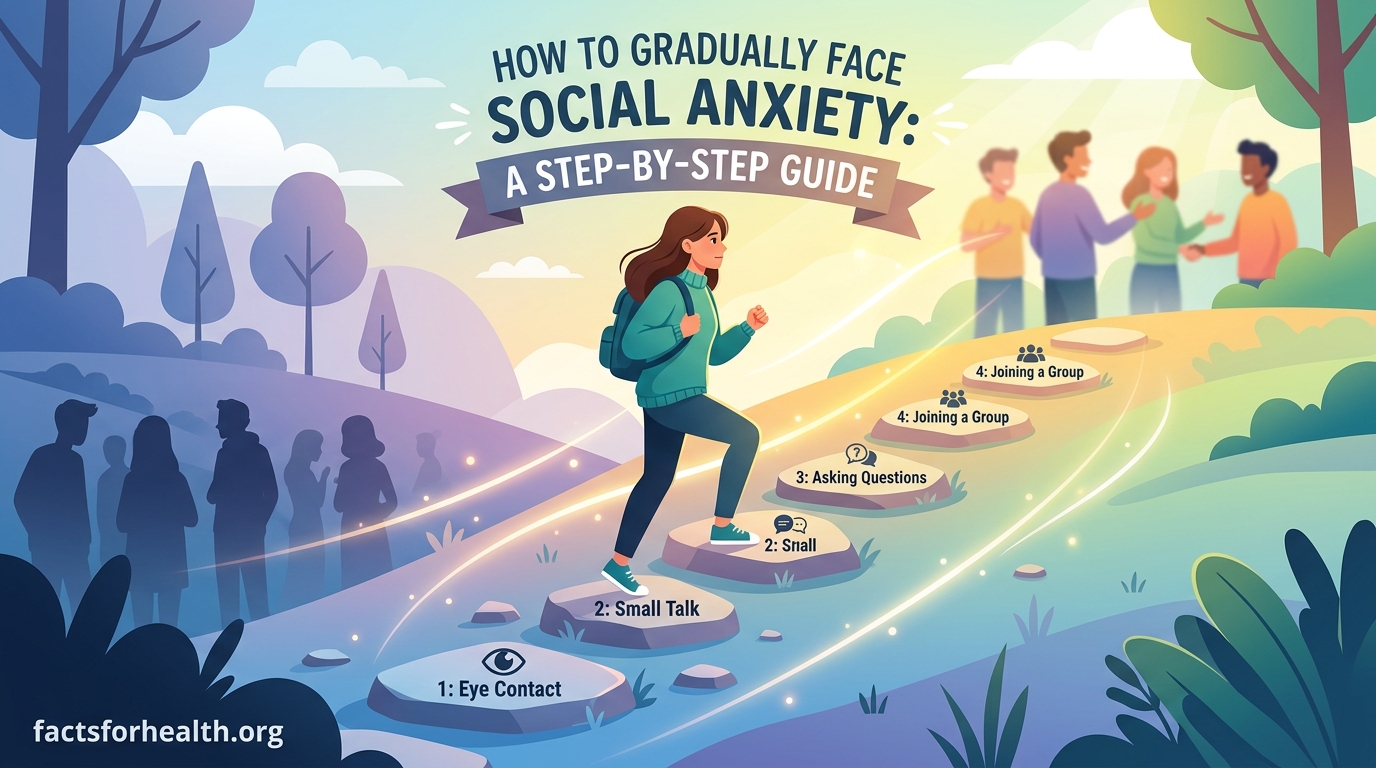
If you have ever turned down a party invitation because the thought of walking into a room full of people made your chest tighten, you are not alone. Social anxiety affects roughly 7 percent of adults in the United States, and many more people deal with situational social fears that hold them back from the life they want. Learning how to gradually face the social situations you fear most is one of the most effective ways to break free from that cycle of avoidance and dread.
The approach I am going to walk you through is based on a well-researched psychological technique called gradual exposure therapy. It is the gold standard treatment for social anxiety disorder, and it works whether your fear is about public speaking, meeting new people, eating in front of others, or any other social scenario. The core idea is simple but powerful: instead of avoiding what scares you, you face it in small, controlled, manageable steps.
In this guide, you will learn a complete five-step framework for building what psychologists call a fear hierarchy, challenging the negative thoughts that fuel your anxiety, mastering coping techniques you can use in the moment, and working through your fears systematically. I will also cover how to handle setbacks, identify sneaky safety behaviors that hold you back, and know when it is time to bring in a professional.
This is not about throwing yourself into the deep end. That approach usually backfires. Instead, think of this as climbing a ladder where each rung is just slightly more challenging than the last. By the time you reach the top, you will have built genuine evidence that you can handle social situations without falling apart. That evidence is what creates lasting confidence.
Table of Contents
Understanding Social Anxiety and Why Avoidance Makes It Worse
Social anxiety disorder is more than just being shy. It is a persistent, intense fear of being watched, judged, embarrassed, or humiliated in social or performance situations. The fear is strong enough that it interferes with your daily life, relationships, career, or goals. People with social phobia often know their fear is irrational, but that intellectual understanding does not stop the physical and emotional reaction.
The physical symptoms can be intense. Racing heart, sweating, trembling, nausea, dry mouth, blushing, and a shaky voice are all common. Some people experience full panic attacks in social situations. Others feel a lingering dread for days before a feared event. These symptoms are real, and they are driven by your body’s fight-or-flight response, which kicks in even when there is no actual danger.
Here is where the real problem begins: avoidance. When you avoid a social situation that scares you, your anxiety drops immediately. That relief feels good in the short term. But your brain interprets the avoidance as proof that the situation was genuinely dangerous. So the next time a similar situation comes up, your brain sounds the alarm even louder. This is called the avoidance cycle, and it is the engine that keeps social anxiety alive and growing.
Every time you skip a social event, stay quiet in a meeting, or leave a situation early, you strengthen the neural pathway that says “this is dangerous, escape now.” Over time, your comfort zone shrinks. Situations you used to handle become impossible. You start organizing your life around avoiding fear rather than pursuing what you actually want.
The good news is that this cycle can be reversed. Gradual exposure works because it teaches your brain the opposite lesson. When you enter a feared situation and nothing terrible happens, your brain updates its threat assessment. This process is called habituation. Over repeated exposures, your anxiety naturally decreases. You also build what psychologists call self-efficacy, which is the evidence-based belief that you can handle difficult situations.
Social Anxiety vs Normal Shyness: What is the Difference?
Many people wonder whether what they are experiencing is social anxiety or just normal shyness. The distinction matters because the approach to each is different. Shyness is a personality trait that may cause mild discomfort in new situations but does not significantly interfere with your life. Social anxiety disorder is a clinical condition that causes significant distress and impairment.
Here is a comparison to help you tell the difference:
Duration and intensity: Shyness typically fades as you warm up to a situation. Social anxiety persists throughout the event and often for hours or days afterward. Shyness feels like mild awkwardness. Social anxiety feels like a alarm bell going off in your body.
Impact on daily life: A shy person might prefer smaller gatherings but still attends events when they want to. Someone with social anxiety will turn down opportunities, avoid promotions that involve presentations, or drop classes that require participation. The fear drives their decisions.
Anticipatory anxiety: Shy people rarely dread events days in advance. People with social anxiety often experience intense anxiety starting days or weeks before a social situation. The anticipation can be worse than the event itself.
Physical symptoms: Shyness might cause a few butterflies. Social anxiety triggers full physiological responses like sweating, racing heart, nausea, dizziness, and panic attacks.
If you recognize yourself in the social anxiety descriptions, gradual exposure is exactly the right tool. Even if you fall somewhere between shyness and social anxiety, the techniques in this guide will help you build confidence and expand your comfort zone.
Step 1: Identify Your Specific Social Fears and Build a Fear Hierarchy
A fear hierarchy, also called an anxiety ladder, is the foundation of gradual exposure. It is a ranked list of social situations that scare you, ordered from least anxiety-provoking to most anxiety-provoking. Building this list gives you a clear roadmap so you always know what step comes next.
Start by brainstorming every social situation that triggers anxiety for you. Be specific. Instead of writing “parties,” write “walking into a party where I only know the host.” Instead of “work interactions,” write “speaking up in the weekly team meeting with eight colleagues present.” The more specific you are, the easier it will be to design exposure exercises around each item.
Once you have your list, rank each situation using the SUDS rating. SUDS stands for Subjective Units of Distress Scale, and it is simply a number from 0 to 100 that represents how anxious you expect to feel in that situation. Zero means completely calm. One hundred means the worst anxiety you can imagine. Assigning SUDS ratings helps you see which items are genuinely easy starting points and which ones should wait until later.
A well-constructed fear hierarchy typically has 10 to 15 items with SUDS ratings spread across the full range. You want some items in the 20 to 40 range (mild anxiety), some in the 40 to 60 range (moderate), some in the 60 to 80 range (high), and a few in the 80 to 100 range (maximum). Here are three sample hierarchies for common social fears to give you an idea:
Sample Fear Hierarchy for Social Gatherings and Parties:
SUDS 20: Texting a friend to ask about their day instead of avoiding the conversation.
SUDS 30: Making brief small talk with a cashier while buying groceries.
SUDS 40: Attending a small gathering of three to four close friends at someone’s home.
SUDS 55: Going to a casual meetup group where you know nobody but share a common interest.
SUDS 65: Attending a coworker’s birthday party where you know only one or two people.
SUDS 75: Walking into a large party alone where you know only the host.
SUDS 85: Attending a formal event or wedding reception where you must mingle with strangers for several hours.
SUDS 95: Hosting a party at your own home and being the center of attention.
Sample Fear Hierarchy for Public Speaking:
SUDS 20: Reading a short paragraph aloud to yourself in front of a mirror.
SUDS 30: Asking a question in a small group discussion of four to five people.
SUDS 40: Presenting a brief update in a small team meeting of six to eight colleagues.
SUDS 55: Giving a five-minute prepared talk to a group of 10 to 15 people.
SUDS 70: Speaking on a panel or leading a training session for 20 or more coworkers.
SUDS 85: Giving a 20-minute presentation to 50 or more people, some of whom you do not know.
SUDS 95: Delivering a keynote speech to a large audience of 200 or more people.
Sample Fear Hierarchy for Workplace Interactions:
SUDS 20: Making a phone call to a restaurant to place a takeout order.
SUDS 35: Sending an email to a coworker you have never met to ask a work question.
SUDS 45: Calling a colleague on the phone instead of emailing them.
SUDS 55: Scheduling and attending a one-on-one meeting with your manager to discuss your performance.
SUDS 65: Speaking up unprompted during a department-wide meeting.
SUDS 75: Initiating a casual conversation with a senior leader in the break room.
SUDS 85: Disagreeing with a coworker or raising a concern during a group discussion.
SUDS 90: Presenting a new idea to the leadership team and fielding their questions.
Notice how each hierarchy starts with genuinely easy items and builds gradually. Your hierarchy will look different because your fears are unique to you. The key is to be honest about your SUDS ratings so you do not accidentally start with something too challenging.
Step 2: Challenge the Negative Thoughts Fueling Your Anxiety
Before you start exposure work, it helps to understand what is driving your fear. Social anxiety is powered by negative thoughts and beliefs about social situations. These thoughts are usually automatic, meaning they pop into your head without conscious effort. They feel true, but they are almost always distorted or exaggerated.
Psychologists call these cognitive distortions. Here are the most common ones that fuel social anxiety:
Mind reading: You assume you know what other people are thinking, and it is always negative. “Everyone at this party thinks I am boring.” “My coworker thinks I am incompetent because I stumbled over my words.” In reality, people are usually thinking about themselves, not about you.
Fortune telling: You predict that something terrible will happen. “If I speak up in the meeting, I will say something stupid and everyone will laugh.” “If I go to that event, I will stand alone in the corner the entire time.” These predictions feel certain, but they are guesses, not facts.
Catastrophizing: You assume the worst possible outcome. “If I blush during my presentation, my career is over.” “If I say something awkward on this date, I will never find a partner.” Catastrophizing blows small mistakes into life-altering disasters.
Personalizing: You take responsibility for things that have nothing to do with you. “That person did not smile back at me, they must hate me.” “The conversation died, it must be because I am terrible at talking.” You ignore other explanations like the other person being tired, distracted, or shy themselves.
The technique for dealing with these distortions is called cognitive restructuring, and it is a core part of cognitive behavioral therapy (CBT). Here is how to do it:
First, notice the thought. When you feel anxiety spiking, ask yourself what was just going through your mind. Write it down. Getting the thought out of your head and onto paper makes it easier to examine objectively.
Second, look for evidence. What facts support this thought? What facts contradict it? If your thought is “everyone will judge me,” ask yourself: Has anyone actually said they judge you? Have you ever been to an event where everyone was harshly evaluated? Most of the time, you will find zero evidence for the thought.
Third, generate an alternative explanation. Instead of “everyone thinks I am boring,” try “most people are focused on their own conversations, and even if someone does not find me fascinating, that does not mean anything is wrong with me.”
Fourth, ask the double-standard question. If a good friend had this exact thought about themselves, what would you say to them? You would probably be much kinder and more rational. Apply that same compassion to yourself.
Challenging negative thoughts is not about forced positivity. It is about accuracy. When your thoughts are more realistic, your anxiety naturally decreases, which makes exposure exercises more manageable.
Step 3: Master In-the-Moment Coping Techniques
Even with a well-built hierarchy and reframed thoughts, you will still feel anxiety when you enter a feared situation. That is expected and normal. The goal is not to eliminate anxiety before exposure. The goal is to have tools that help you stay in the situation long enough for habituation to occur. Here are the most effective coping techniques.
4-7-8 Breathing: This technique activates your parasympathetic nervous system, which counteracts the fight-or-flight response. Inhale through your nose for four counts. Hold the breath for seven counts. Exhale slowly through your mouth for eight counts. Repeat this cycle three to four times. The long exhale is what triggers the calming effect. Practice this technique when you are calm so it becomes automatic when you need it.
The Physiological Sigh: This is a faster technique you can use discreetly during a conversation. Take two quick inhales through your nose (one deep, followed by a shorter top-up breath), then one long exhale through your mouth. Research from Stanford University shows this pattern rapidly lowers anxiety. You can do it in seconds without anyone noticing.
The 333 Rule for Social Anxiety: The 333 rule is a grounding technique that pulls your attention away from anxious thoughts and into the present moment. When you feel anxiety rising, name three things you can see, identify three sounds you can hear, and move three parts of your body (such as wiggling your toes, rolling your shoulders, and pressing your feet into the floor). This simple exercise engages your senses and interrupts the anxiety spiral. It is especially helpful during social events when your mind starts racing with self-critical thoughts.
Grounding Through Your Feet: Press your feet firmly into the floor. Notice the sensation of the ground supporting you. This simple physical anchor reminds you that you are safe and present. It works well during conversations when you need something subtle to steady yourself.
Shift Your Attention Outward: Social anxiety turns your attention inward. You become hyperaware of your own heartbeat, your own facial expression, your own voice. Deliberately shift your focus to the other person. What are they saying? What is their body language communicating? What questions could you ask them? Turning your attention outward reduces self-consciousness and actually makes you a better conversationalist.
Acceptance Over Resistance: This one surprises many people. Fighting anxiety tends to make it stronger. Instead of telling yourself “stop being anxious, calm down, you need to relax,” try acknowledging the feeling. Say to yourself: “I am feeling anxious right now, and that is okay. I can feel anxious and still do this.” Forum communities like r/socialanxiety consistently report that accepting anxiety rather than fighting it is one of the most powerful shifts you can make. Let the anxiety be there and do the thing anyway.
Practice these techniques before you need them. The more familiar they are, the easier it will be to access them when your anxiety is high.
Step 4: Begin Gradual Exposure Starting with the Easiest Situations
Now you are ready to start the actual exposure work. This is where the real change happens. The rule is simple: start with the lowest item on your fear hierarchy and work your way up. Never jump to a high-item before you have mastered the lower ones.
Pick the first item on your hierarchy, the one with the lowest SUDS rating. Before you enter the situation, take a moment to prepare. Remind yourself of your reframed thoughts. Do a few rounds of breathing. Set a clear behavioral goal that is within your control. For example, instead of “make everyone like me” (which you cannot control), set the goal “ask the cashier how their day is going and listen to their response” (which you can control).
Enter the situation and stay until your anxiety drops by at least half. This is important. If you leave at the peak of your anxiety, you reinforce the avoidance pattern. If you stay and let your anxiety naturally decrease, you teach your brain that the situation is manageable. This is called habituation, and it is the mechanism that makes gradual exposure work.
Use your SUDS rating during the exposure. When you first enter the situation, rate your anxiety from 0 to 100. Check in with yourself every few minutes. You will likely notice that your anxiety peaks and then gradually subsides. That drop is the habituation curve in action. Seeing it happen with your own body is one of the most powerful experiences in overcoming social anxiety.
After the exposure, take notes. What happened? How high did your anxiety get? How much did it drop? Did the feared outcome actually occur? What did you learn? This record becomes powerful evidence against your anxious predictions. Over time, you will build a notebook full of proof that you can handle far more than your anxiety told you could.
Here are some tips for your first exposures. Choose a time when you are relatively rested and not under unusual stress. If possible, rehearse the situation first through visualization or role-playing with a trusted friend. Keep the first few exposures short, five to ten minutes. You can always extend the duration as you get more comfortable. And remember that partial progress counts. If your goal was to talk to three strangers at a meetup and you only managed one, that is still a win.
Many people on social anxiety forums recommend a technique called “warming up” for performance situations. Before a big presentation or social event, do two or three smaller social interactions. Compliment a stranger’s shoes. Make small talk with the barista. Call a friend. These warm-up exposures activate your social circuits and reduce the intensity of anxiety when the bigger moment arrives.
How do you know when to move to the next item on your hierarchy? The general rule is to advance when your SUDS rating for the current item has dropped to 30 or below. If an item that used to rate 60 now feels like a 25, you are ready to move up. If you attempt the next item and your anxiety is unmanageably high, go back and repeat the previous level a few more times.
Step 5: Work Through Your Hierarchy Systematically
Once you have successfully completed your first exposure, the process repeats for each subsequent item on your hierarchy. The key principles are consistency, patience, and self-compassion. Here is how to keep the momentum going.
Schedule your exposure exercises. Treat them like appointments you cannot cancel. People who leave exposure to “whenever I feel ready” rarely make progress because readiness comes from doing, not from waiting. Aim for at least three to four exposure sessions per week. More frequent practice leads to faster habituation.
Repeat each exposure multiple times. A single successful exposure is a great start, but repetition is what creates lasting change. If your hierarchy item is “ask a question in a team meeting,” do it in three different meetings before moving to the next item. Repetition cements the new learning in your brain.
Track your progress visually. Keep a simple log with the date, the situation, your starting SUDS, your peak SUDS, your ending SUDS, and any notes. Over weeks and months, you will see a clear pattern: items that used to rate 70 eventually drop to 30, and eventually to 15. Watching that progress is incredibly motivating.
Reward yourself after every exposure, regardless of the outcome. The reward is for showing up and trying, not for performing perfectly. Reddit users in the r/socialanxiety community frequently mention that building a reward system, even small ones like a favorite snack or watching an episode of a show, helps maintain consistency. Your brain learns to associate exposure with positive outcomes, which further reduces avoidance motivation.
Expect variability. Some days your anxiety will be lower than expected. Other days, a situation you handled fine last week will feel overwhelming. This is normal. Progress with gradual exposure is not linear. You will have good weeks and bad weeks. What matters is the overall trend, which, if you stay consistent, will always point downward.
As you advance to higher items on your hierarchy, you may need to get creative. Some situations are hard to recreate on demand. If your feared situation is a job interview, you can practice with mock interviews. If it is a wedding toast, you can rehearse at a local Toastmasters club. If it is eating in front of others, you can start by eating alone in a food court, then progress to eating with one trusted friend, then in a small group.
Safety Behaviors: What They Are and Why You Need to Drop Them
Safety behaviors are subtle actions you take during social situations to reduce your anxiety or prevent a feared outcome. They feel helpful, but they actually undermine the exposure process. Here is why: when you use a safety behavior and your anxiety stays manageable, your brain credits the safety behavior, not the fact that the situation was never dangerous. This means the fear stays intact.
Common safety behaviors include: rehearsing every sentence before you speak, gripping a cup tightly to hide shaking hands, wearing high-collared clothing to hide blushing, standing near the exit so you can escape, checking your phone constantly to avoid conversation, only attending events with a trusted friend, using alcohol to take the edge off, staying silent to avoid saying something wrong, wearing makeup specifically to cover blushing, and mentally rehearsing escape plans.
Some safety behaviors are more obvious than others. You might not even realize you are using them. Ask yourself: what would I be afraid of if I could not do this thing? If the answer reveals a fear (such as “people would see my hands shaking” or “I would not know what to say”), then it is likely a safety behavior.
The goal is not to drop all safety behaviors at once. That would be overwhelming. Instead, gradually reduce them as you move up your hierarchy. Start by dropping the least important ones during low-SUDS exposures. As you build confidence, tackle the more ingrained ones. Eventually, you want to enter feared situations without any safety net, relying on your own ability to handle whatever happens.
Pay special attention to alcohol and medication used as safety behaviors. A drink may take the edge off at a party, but if you cannot socialize without it, it is preventing true habituation. Similarly, anti-anxiety medication taken only before social events can become a crutch. This does not mean prescribed medication is bad. It means you should discuss your usage with your doctor or therapist to make sure it is supporting your progress, not hindering it.
How to Handle Setbacks and Bad Days During Exposure Work
Setbacks are not just possible during gradual exposure. They are guaranteed. You will have days when anxiety is higher than expected, when a feared outcome actually happens, or when you cannot bring yourself to attempt the exposure at all. Knowing how to handle these moments is what separates people who overcome social anxiety from those who give up.
First, normalize setbacks. Every single person who has overcome social anxiety experienced setbacks along the way. Forum users across r/socialanxiety, r/socialskills, and 7 Cups consistently report that progress comes in waves. Good weeks followed by bad weeks is the standard pattern. A bad day does not erase the progress you have made.
Second, resist the urge to analyze a setback as evidence that exposure does not work or that you are broken. A setback is data, not a verdict. Ask yourself what contributed to it. Were you sleep-deprived? Stressed about something else? Was the situation harder than you expected? Did you skip your coping techniques? Use this information to adjust your approach, not to beat yourself up.
Third, practice self-compassion. The shame and self-criticism that follow a failed exposure attempt can be more damaging than the failure itself. Treat yourself the way you would treat a friend who is going through the same thing. Say: “That was hard, and I am disappointed, but I tried, and I will try again.” Self-compassion is not weakness. Research shows it is associated with greater resilience and faster recovery from setbacks.
Fourth, return to exposure as soon as possible. Do not wait until you feel ready. Take a day or two to recover if needed, then get back to your hierarchy, possibly dropping down a level temporarily. The longer you wait after a setback, the harder it becomes to restart. Momentum works both ways.
Fifth, reframe the setback as evidence of courage. You put yourself in a scary situation. That takes bravery, regardless of the outcome. Someone who never tries has zero chance of improving. You showed up, and that counts.
If you experience a genuine panic attack during exposure, do not force yourself to stay. Leave the situation, use your coping techniques, and try again another day. There is a difference between productive discomfort and a crisis. Learn to tell them apart, and never push yourself past the point of genuine psychological safety.
When to Seek Professional Help
Self-directed gradual exposure can be highly effective, especially for mild to moderate social anxiety. But there are times when professional help is the right call. There is no shame in working with a therapist. In fact, research consistently shows that therapist-guided exposure produces better outcomes than self-directed approaches, particularly for severe cases.
Consider seeking professional help if any of the following apply to you. Your anxiety is so severe that you cannot complete even the easiest items on your hierarchy. You have been trying self-directed exposure for several months without noticeable improvement. Your anxiety is accompanied by depression, substance use, or other mental health concerns. You experience regular panic attacks in social situations. Your anxiety is interfering with your ability to work, attend school, or maintain relationships.
The most effective professional treatment for social anxiety is cognitive behavioral therapy, or CBT. A CBT therapist will help you identify cognitive distortions, build a structured fear hierarchy, guide you through exposure exercises, and teach coping skills. Many therapists offer exposure sessions where they accompany you into feared situations or role-play them in the office.
Medication can also be helpful, either alone or in combination with therapy. SSRIs (selective serotonin reuptake inhibitors) are the most commonly prescribed medications for social anxiety disorder. They work over several weeks to reduce overall anxiety levels. Beta blockers are sometimes used for performance anxiety because they block the physical symptoms of adrenaline, like racing heart and trembling. Benzodiazepines may be prescribed for short-term use, but they carry a risk of dependence and are generally not recommended as a long-term solution.
The combination of CBT plus medication often produces the best results for moderate to severe social anxiety. Talk to your primary care doctor or a mental health professional about what options might be right for your situation. You do not have to do this alone.
FAQs
How to gradually reduce fear of social situations?
To gradually reduce fear of social situations, build a fear hierarchy listing social scenarios from least to most anxiety-provoking, then expose yourself to each situation starting with the easiest. Stay in each situation until your anxiety drops by at least half before moving to the next level. Practice regularly, challenge negative thoughts, and use breathing or grounding techniques to manage in-the-moment anxiety. This process, called gradual exposure therapy, works through habituation, where repeated exposure teaches your brain the situation is not dangerous.
What is the 333 rule for social anxiety?
The 333 rule is a grounding technique for managing anxiety in the moment. When you feel anxiety rising, name three things you can see, identify three sounds you can hear, and move three parts of your body. This exercise pulls your attention away from anxious thoughts and anchors you in the present, interrupting the anxiety spiral during social situations.
What is the best way to face your fears?
The best way to face your fears is through gradual exposure: start with the least scary version of what frightens you, stay in the situation until your anxiety decreases, and systematically work your way up to more challenging scenarios. Avoid jumping straight into your biggest fear, as this often reinforces anxiety. Build a ranked list of feared situations, practice regularly, and celebrate each step forward. This method is backed by decades of research in cognitive behavioral therapy.
Why am I so scared of social situations?
You may be scared of social situations due to social anxiety disorder, which involves an intense fear of being judged, embarrassed, or humiliated. This fear is maintained by a cycle of avoidance: every time you avoid a social situation, your brain learns that the situation is dangerous, making the fear stronger. Other factors include genetic predisposition, past negative social experiences, cognitive distortions like mind reading and catastrophizing, and overactive threat-detection systems in the brain.
Conclusion
Learning how to gradually face the social situations you fear most is a journey, not a one-time event. The process comes down to five core steps: identify your specific fears and build a ranked fear hierarchy, challenge the negative thoughts that fuel your anxiety, master coping techniques for in-the-moment support, begin exposure at the easiest level and stay until your anxiety drops, and work through your hierarchy systematically with consistency and self-compassion.
The most important thing to remember is that avoidance is what keeps social anxiety alive. Every time you face a feared situation instead of running from it, you weaken that fear. The first step is always the hardest, but it is also the most important. Pick one small social situation from your hierarchy today, use your coping tools, and stay until your anxiety decreases. Then do it again tomorrow.
You do not have to do everything perfectly, and you do not have to do it alone. If self-directed exposure feels too overwhelming, reach out to a therapist who specializes in CBT. The combination of professional guidance and your own consistent effort can transform your relationship with social situations. The fear you feel right now is not permanent. With gradual exposure, it can shrink, step by step, until the social situations you once dreaded become situations you can handle with confidence.