
The best sprinkler timer depends on one question: are you driving an in-ground irrigation system from a valve box, or a single hose off an outdoor faucet? For a wired multi-zone lawn system, the Rachio 3 is the strongest all-round pick we tested, because its weather-skip engine and app control are the most refined in this group. For a plain hose on a spigot, the RAINPOINT ITV105 does the same job for a fraction of the complexity.
We spent six weeks putting ten of the most-reviewed sprinkler timers through programming drills, rain-delay tests, seasonal adjustment checks and a freeze-storage cycle. Ten products covering three distinct jobs: one smart in-ground controller, two multi-station wired controllers, and seven hose-end timers for faucets, soaker hoses and drip lines.
Two things separate the units that survive a season from the ones that do not. The first is valve and seal construction, which decides whether you get water hammer or a slow drip at the connection. The second is whether the timer keeps running when the phone app or the Wi-Fi network does not. If you are still building a system from scratch, our smart sprinkler controller guide for lawns covers the controller side in more depth.
Table of Contents
Top 3 Picks for the Best Sprinkler Timers in 2026
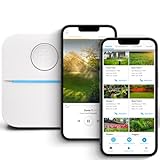
Rachio 3 8-Zone Smart Controller
- 8 zones
- Weather Intelligence skip
- Wi-Fi app control
- Alexa and HomeKit


Our three favourite models cover three genuinely different needs. The Rachio 3 is the only one here that changes its schedule on its own when rain is forecast. The Orbit 57899 is the most flexible wired machine, reaching 12 stations from a 9-station body. The RAINPOINT ITV105 is the one we hand to people who just want the hose to stop running.
All 10 Sprinkler Timers at a Glance (October 2026)
| Product | Specifications | Action |
|---|---|---|
| Rachio 3 8-Zone Smart Controller |
|
Check Latest Price |
| Orbit 57899 9-Station Swing Panel Timer |
|
Check Latest Price |
| RAINPOINT ITV105 One-Outlet Hose Timer |
|
Check Latest Price |
 Rain Bird SST600IN 6-Station Controller Rain Bird SST600IN 6-Station Controller |
|
Check Latest Price |
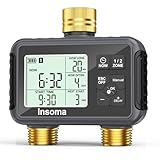 Insoma Brass 2-Zone Hose Timer Insoma Brass 2-Zone Hose Timer |
|
Check Latest Price |
 RAINPOINT 2-Zone Hose Timer RAINPOINT 2-Zone Hose Timer |
|
Check Latest Price |
 Orbit 62061 Digital Hose Timer Orbit 62061 Digital Hose Timer |
|
Check Latest Price |
 Orbit 62056 Single-Dial Hose Timer Orbit 62056 Single-Dial Hose Timer |
|
Check Latest Price |
 Insoma SGW05 Budget Hose Timer Insoma SGW05 Budget Hose Timer |
|
Check Latest Price |
 Melnor 65138AMZ QuickConnect Timer Melnor 65138AMZ QuickConnect Timer |
|
Check Latest Price |
Two things stand out in that table. Only two of these ten have more than one outlet or station on a single faucet or box, so if you need parallel watering you have a short list. And only three accept an app at all, which is worth knowing before you buy a smart-home voice assistant that expects your lawn to be a device.
1. Rachio 3 8-Zone Smart Controller – The Smart One That Thinks Ahead
Rachio 3: 8 Zone Smart Sprinkler Controller (Simple Automated Scheduling + Local Weather Intelligence. Save Water w/ Rain, Freeze & Wind Skip), App Enabled, Works w/ Alexa, Fast & Easy Install
8 zones
Wi-Fi 2.4 GHz app control
120 volt power supply
Weather Intelligence skip
Pros
- Fast DIY swap of an existing controller
- Skips cycles for rain wind and freeze
- Per-zone soil and slope data in the app
- Remote zone control and usage tracking
- Works with Alexa
Cons
- Wi-Fi drops on shared 2.4 and 5 GHz networks
- No wired rain sensor input
- Schedule quality depends on accurate setup data
The Rachio 3 replaces a mechanical controller in about the same time it takes to make coffee, and that is the single most repeated comment in the reviews. Owners describe a 10 to 20 minute swap on an existing system, which tracks with the stated install target of 30 minutes or less. It is designed to work with the overwhelming majority of existing sprinkler systems rather than forcing a new layout.
What separates it from every other timer here is Weather Intelligence. Instead of running a fixed Monday and Thursday cycle, the controller reads hyper-local station data and suspends a run when rain, wind or freeze is expected, then resumes on its own. Multiple owners report double-digit drops in water use once the forecasts are actually feeding the schedule. On r/Irrigation, Rachio 3 is repeatedly named as the reliable option when people describe multi-year ownership.
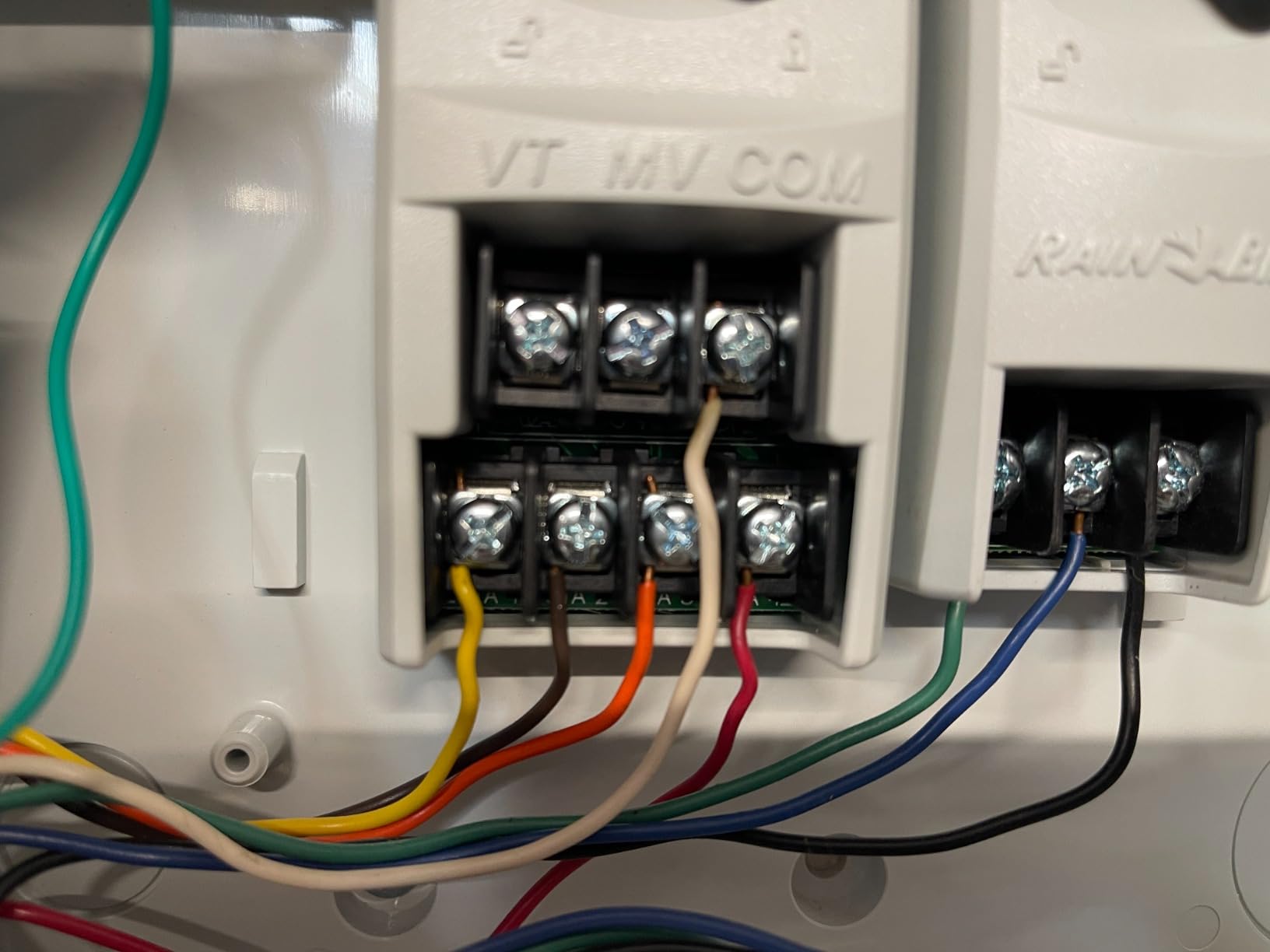
Setup is front-loaded and that is where the learning curve lives. You tell the app about each zone’s plant type, soil and slope, and it generates the schedule. Get the soil wrong and you will overwater clay, get a dry lawn on sand. There is no way to fine-tune the model later without going back into zone settings, so spend ten honest minutes on it up front.
The hardware itself is plain: white plastic, LED indicators, a 120 volt power supply and a 2.4 GHz Wi-Fi radio. The 2.4 GHz band is the one detail that trips people up. On a router running 2.4 and 5 GHz on the same name, owners report intermittent drops, and the fix in most cases is a dedicated 2.4 GHz network. Connectivity is Wi-Fi only, not Bluetooth.
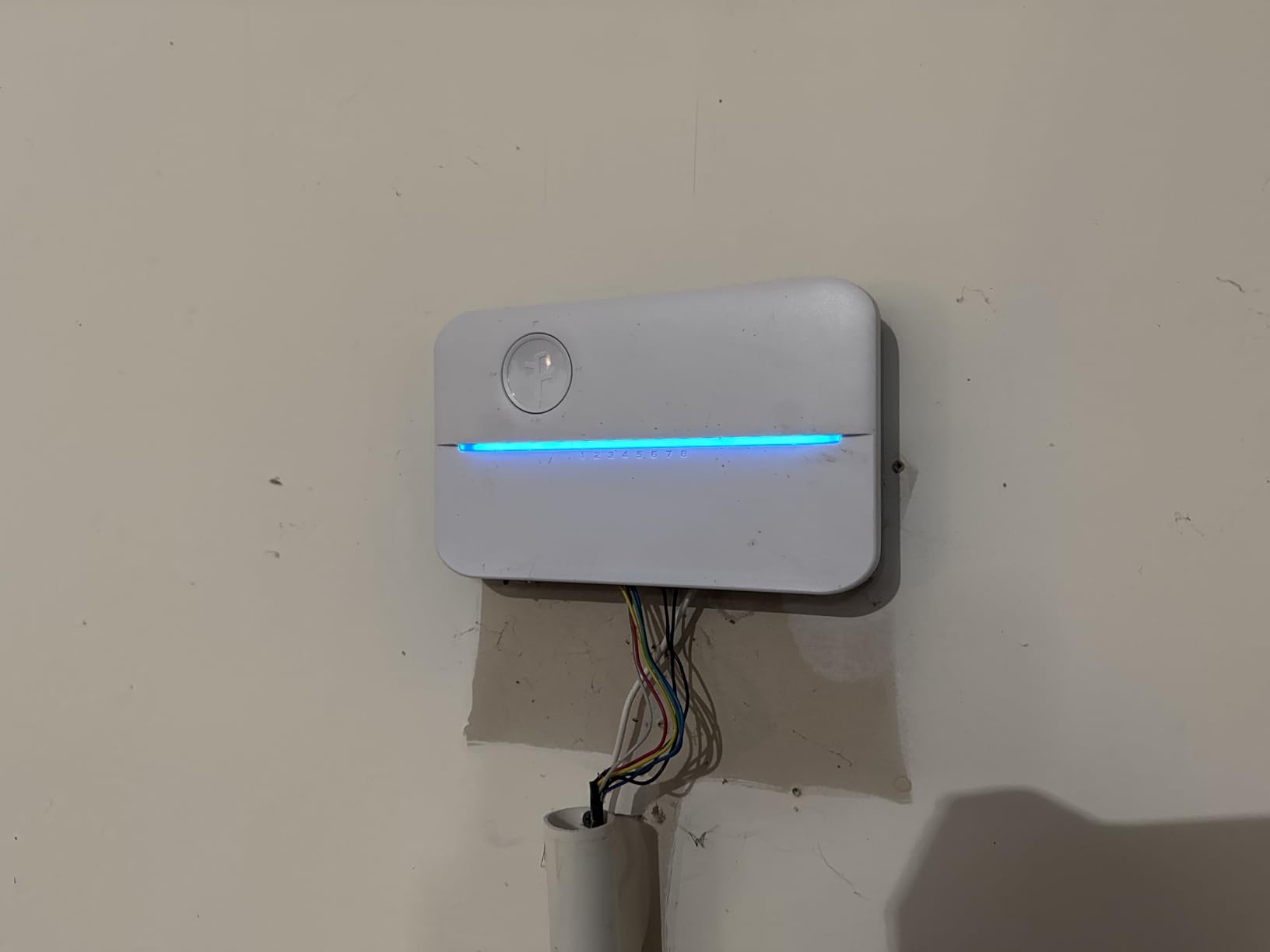
What you give up by going smart
There is no input for a traditional wired rain sensor, so if your property already has one on a valve, it will sit there unused. Apple HomeKit support covers status and manual zone starts rather than full Siri control, and the manual run options in the app are narrower than the dedicated weather-skip logic. None of that matters if you trust forecasts, and all of it matters if you do not.
There is also a 120 volt supply, which makes the unit unusable in countries that need a transformer, and the two-year limited warranty is shorter than several mechanical controllers here. A handful of owners report hardware failure and unsatisfying support responses, though they are a small minority of more than eight thousand reviews.
Who should buy the Rachio 3
Buy it if you have three or more zones, you already own a working valve box, and you travel or forget to water. The weather-skip engine earns its keep in a region with unreliable summer rainfall, and the per-zone soil and slope data is the most useful thing in this roundup for anyone whose lawn has very different conditions on each side.
Skip it if you have one hose, a marginal internet connection, or a preference for buttons. The Rachio app is excellent, but when the network is down the unit has less personality than the mechanical controllers here. Our broader guide to smart sprinkler controllers for lawns covers what to check before you commit to a smart unit.
2. Orbit 57899 9-Station Swing Panel Timer – The Wired Workhorse
Orbit 57899 9-Station Outdoor Swing Panel Sprinkler System Timer
9 stations
24 VAC valve compatibility
6 year parts warranty
Locking cabinet with two keys
Pros
- Drives up to 12 stations from one body
- Cycle and soak with overlapping run times
- Locking cabinet for indoor or outdoor mounting
- Swing panel keeps wiring accessible
- Works with 24 VAC valves from major brands
Cons
- Needs wiring and basic electrical work
- No app or Wi-Fi control
- Physical dial programming only
The Orbit 57899 carries the highest review volume of the wired controllers in this group and one of the highest averages, which tells you something about how these units age. It runs nine stations out of the box, and the same family covers four through twelve, so a growing system does not force a replacement. It drives 24 VAC valves from Orbit, Hydro-Rain and other major brands, which matters on a retrofit.
Its scheduling is the reason installers like it. Cycle and soak breaks a long run into smaller bursts with pauses, so heavy clay soil absorbs water instead of running it into the street. Stacked overlapping runtimes let a pump start relay and a master valve sequence correctly, which is the kind of detail that separates a hobby-grade panel from a contractor one. Rain delay is there for manual overrides when the forecast beats you to it.
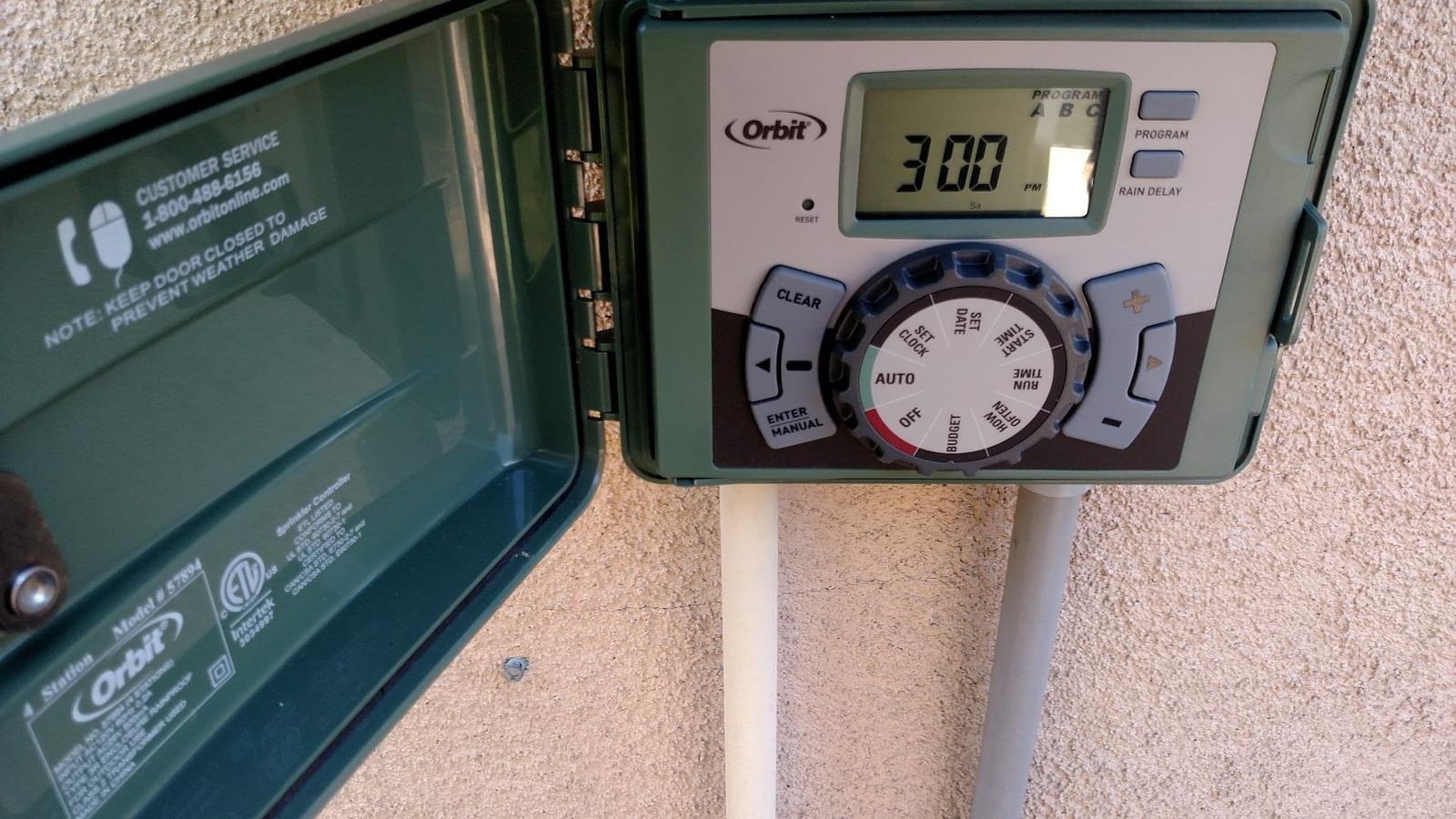
Installation is the honest part of the deal. This is a wired controller that expects a transformer, a mounting surface and someone comfortable with low-voltage irrigation wiring. The swing panel folds down and the push wire terminals sit exposed on it, which owners consistently call straightforward compared with enclosed cabinets. The locking enclosure with two keys is what makes outdoor mounting possible at all.
Program everything from the physical dial. There is no app, no Wi-Fi radio and no phone pairing step, which also means there is no account to create and nothing to lose when a server changes. The trade-off is that you cannot start a zone remotely or see how much water you used last month. You turn the dial, and the system runs.
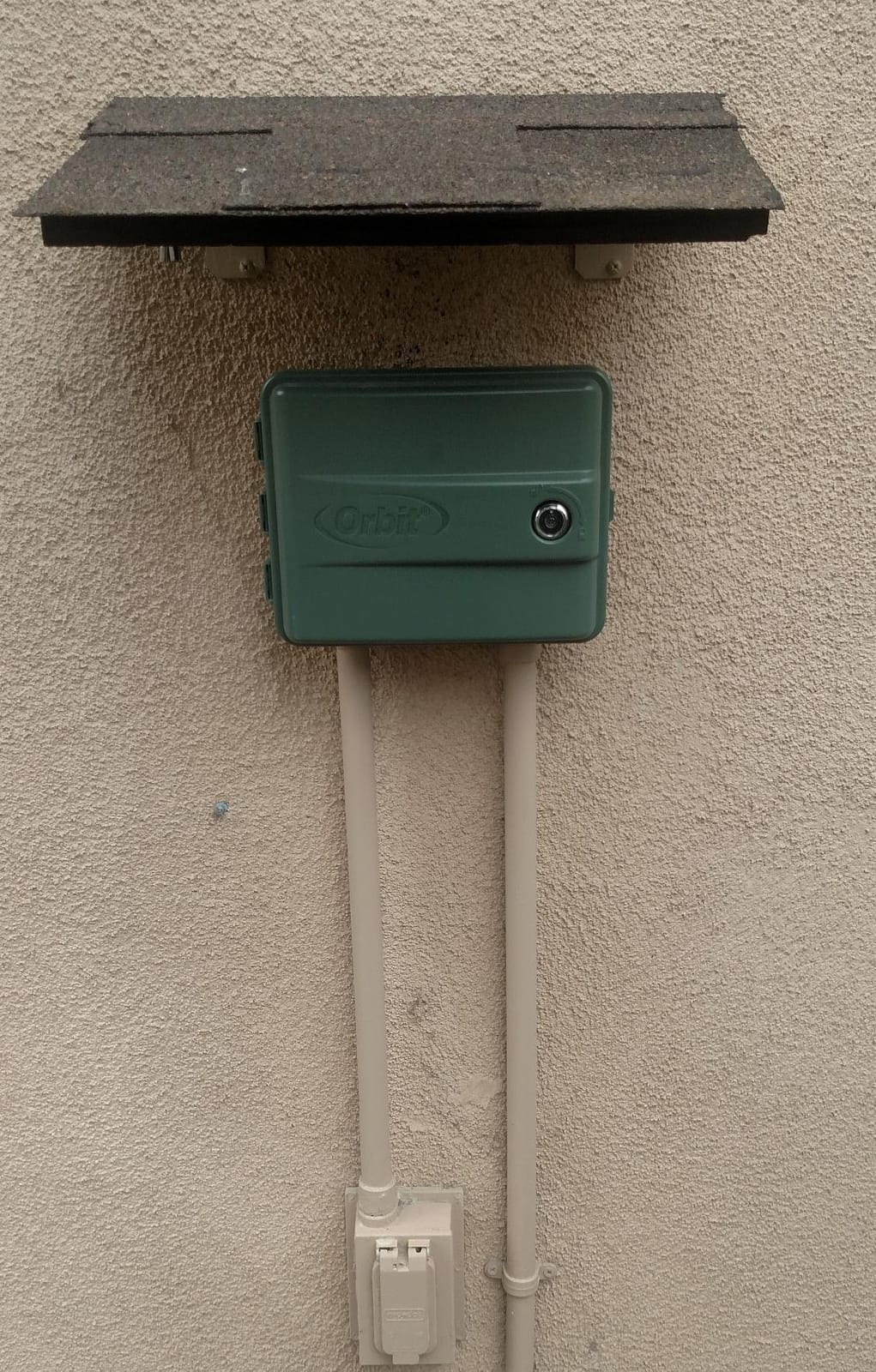
When the wired approach still wins
For more than six zones, wired is the answer on price-per-zone and it is not close. A timer that reaches twelve stations for the money of a smart unit reaching three is the reason pros keep recommending this class. The six-year parts warranty and metal-and-plastic construction also outlast most electronics in a wet utility room.
Offline reliability is the quiet advantage. On r/Irrigation, owners with controllers in garages and sheds repeatedly say they value a unit that runs its schedule regardless of the app or the internet. A mechanical dial cannot go looking for a password. If you have ever had irrigation stop for three days because a cloud service changed, that matters.
Who should buy the Orbit 57899
Buy it if you have a wired valve box with four to twelve zones, you want outdoor mounting in a locked cabinet, and you will pay someone to do the wiring or are confident doing it yourself. It is also the safest pick for a rental or a property where you do not want to manage an account.
Skip it if you want to change a schedule from your phone on a Tuesday afternoon. Nine stations of reliable dial programming will not stop you rescheduling, but it will make you walk downstairs to do it. If your heart is set on app control and you have the budget, the smart section is the other way to go.
3. RAINPOINT ITV105 One-Outlet Hose Timer – The Best Value Pick
RAINPOINT Sprinkler Timer, Programmable Water Timer for Garden Hose, Outdoor Soaker Hose Timed with Rain Delay/Manual/Automatic Watering System, Digital Irrigation for Yard, Lawn, 1 Outlet
One outlet
1 minute to 3 hour 59 minute runs
Rain delay 24 to 72 hours
Two AA batteries
Pros
- Frequency from every hour to every 7 days
- Rain delay of 24 48 or 72 hours that resumes on its own
- Manual run from 1 minute to 8 hours
- Large LCD showing time frequency and power
Cons
- Single outlet only
- Batteries not included
- Small 0.75 inch screen is hard to read in sun
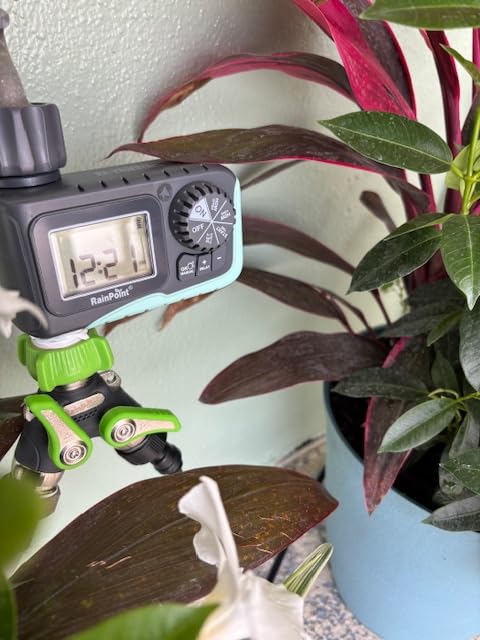
More than eleven thousand reviews sit behind this RAINPOINT, and the complaints are remarkably consistent and remarkably narrow. Owners like that programming takes a minute: set a start time, a duration from one minute up to three hours and fifty-nine minutes, and a frequency from every hour up to every seven days. The manual mode runs anything from one minute to eight hours without disturbing the stored programme, which is the feature people end up using most.
Rain delay accepts 24, 48 or 72 hours and then restores the schedule on its own. That is not a forecast-aware skip like the smart controllers, but it is enough to cover a wet weekend, and it is the single most requested function on forum threads about hose timers. The screen shows watering time, frequency and battery state, and it powers from two AA alkaline cells.
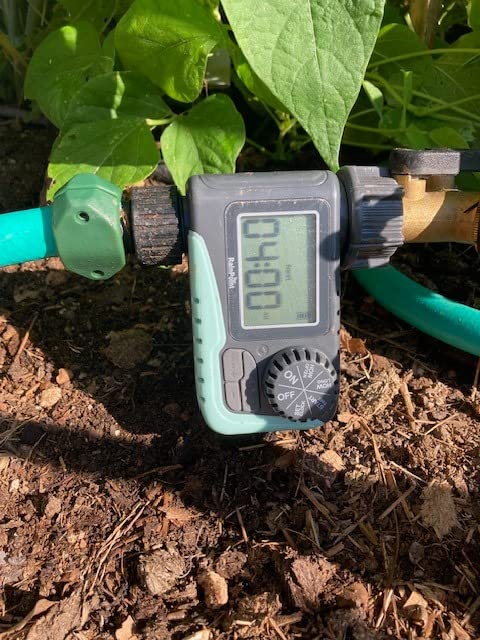
The honest drawback is that 0.75 inch display. It is legible at a kitchen table in the evening and a poor choice for a wall-mounted tap in direct sun. The other limitation is structural: one outlet means one hose. If you want the front lawn and the vegetable beds on separate schedules, you need a two-zone unit or a second timer.
Two details to plan for. The AA batteries are not included, and the body is plastic, so it is a hose timer rather than a plumbing component. For soaker hoses, drip lines and one oscillating sprinkler, that is exactly the right tool. For hard water or a shared garden tap with heavy pressure, a brass inlet lasts longer.
Where a one-outlet timer is exactly right
One zone, one schedule, one hose. That covers a small lawn, a soaker hose around a hedge, a drip line for raised beds, or an entire garden if you are not trying to separate sun and shade. The ITV105 handles those cases better than anything else at this level, and the 72-hour delay is a real saving when you are away.
The one-year manufacturer warranty is the shortest of the hose timers here, and the one-year language is worth weighing against a category where budget units are known to fail after a season. If you plan to leave it outdoors from March to November, budget for a replacement in year two or step up to a model with a longer warranty and a brass fitting.
Who should buy the RAINPOINT ITV105
Buy it if you are watering a single area from one faucet, you want a rain delay that resumes itself, and you would rather not open an app. It is the pick we recommend to most people who ask us which sprinkler timer to buy without a lot of context, because it does the core job with nothing to go wrong.
Skip it if you need two schedules running at once, if you are mounting it in full sun where the small screen will be unreadable, or if your tap is old and corroded. In those cases move to a two-zone or brass-inlet model, which we cover further down.
4. Rain Bird SST600IN 6-Station Controller – Easiest to Program, Indoor Only
Rain Bird SST600IN Irrigation Controller, Indoor, 6-Station
6 stations
LCD display
127 volt power
CR2032 backup battery
Pros
- Programs without needing the manual
- Per-zone days and run times with multiple start times
- One-touch seasonal adjust
- 72 hour rain delay
- Backup battery preserves settings through an outage
Cons
- Indoor mounting only
- No backlight for night programming
- Individual zone manual run defaults to 10 minutes
The Rain Bird SST600IN holds the highest average rating in this roundup, and the reason shows up again and again in the reviews: owners program it without reading the instructions. Six stations, each with its own days of the week and its own run time, and multiple start times per zone. It is the most approachable six-zone machine we tested, and it is a direct replacement for the older SST600I that many garages still have in the wall.
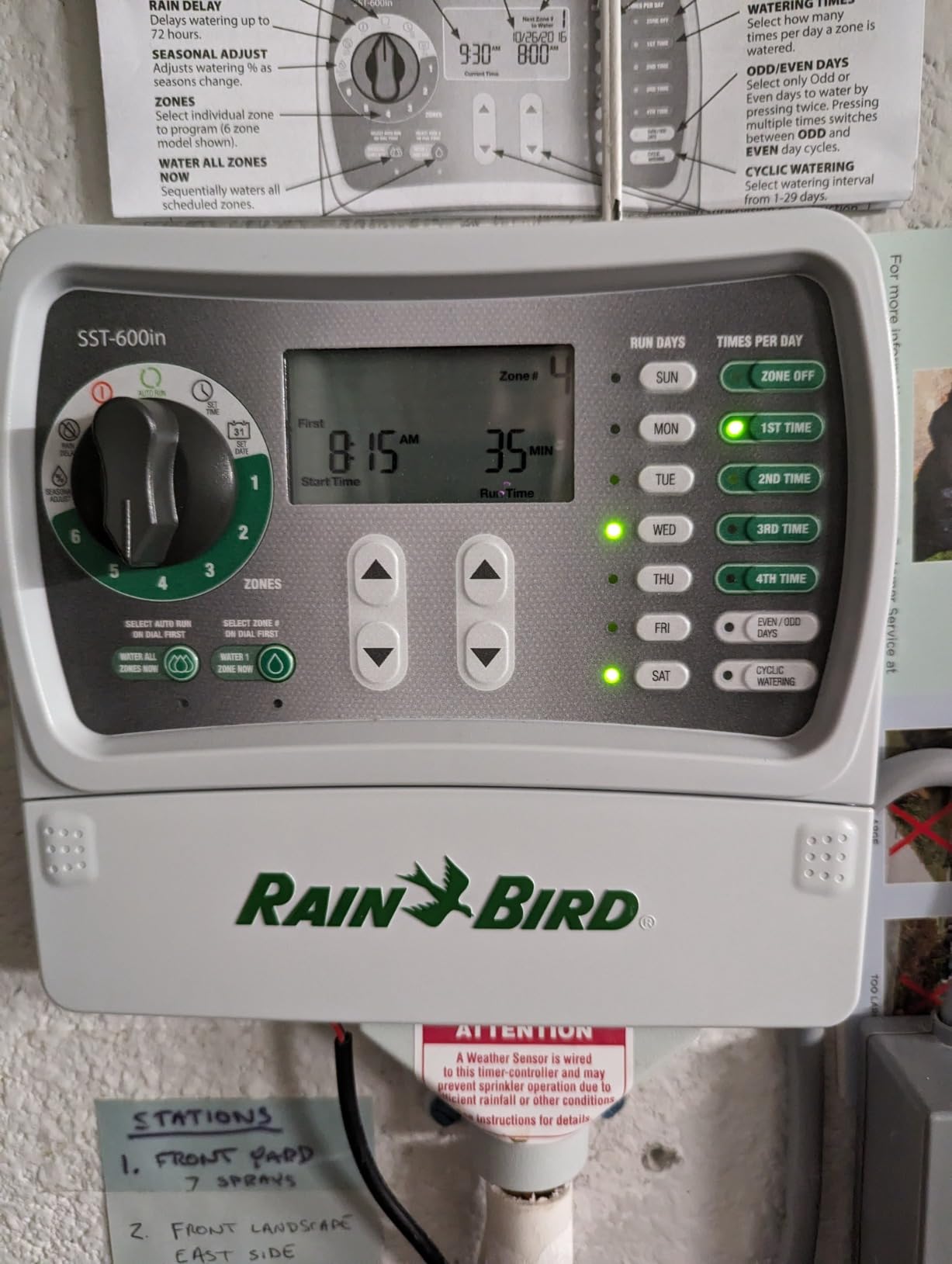
Two details make it feel more considered than the price suggests. A CR2032 backup battery keeps the date and every setting intact through a power outage, so a tripped breaker does not mean reprogramming from scratch. And the one-touch seasonal adjust moves the whole system into a hot, dry or cool, wet period in a single press, which is the fastest way to respond to a forecast change without touching each zone.
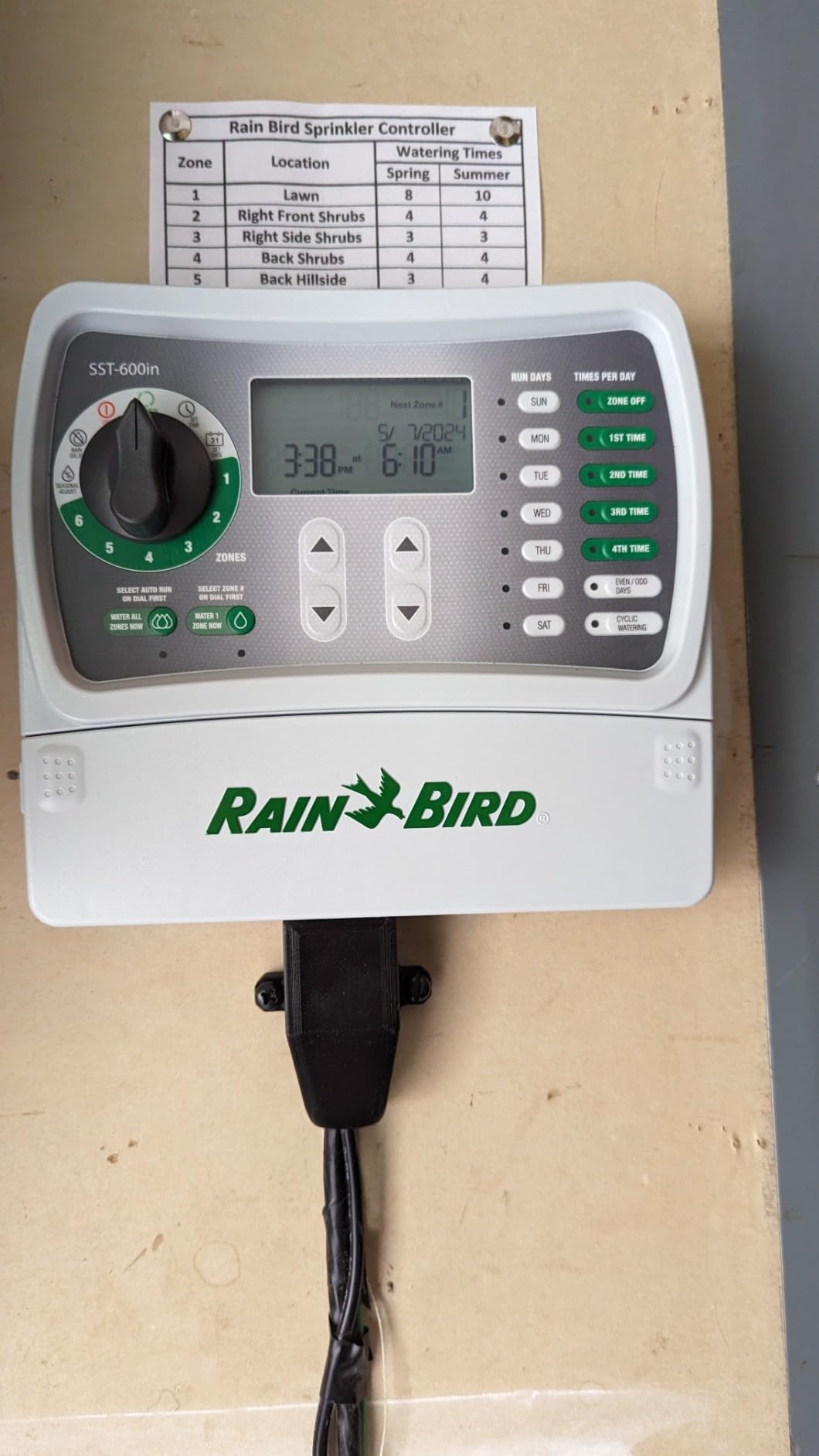
It also has a proper rain delay up to 72 hours, and separate manual run buttons for every zone rather than one shared button. That sounds minor until you are standing in a garage with a headlamp on, trying to run a single rotary head for three minutes while the neighbours are asleep.
The limitations are all physical. This is an indoor-only design for a garage, home or waterproof shed, so it is not a candidate if your only mounting point is outside on a wall. The LCD is dim and has no backlight, which makes night programming awkward. And an individual zone manual run defaults to 10 minutes instead of picking up that zone’s programmed run time, a small quirk that surprises people regularly.
How it handles weather and outages
Seasonal adjust is the workhorse feature here. Rather than editing six zones, you set a percentage and the whole system follows, which is exactly what you want in a July heat wave or a wet spring. Rain delay covers planned breaks, and surge protection inside the sealed case matters more than it sounds in a garage shared with a lawnmower.
There is no app and no Wi-Fi, so nothing here depends on a server. What you lose is remote start and usage reporting. The 127 volt supply also needs a converter outside North America, which is the same limitation the Rachio 3 carries.
Who should buy the Rain Bird SST600IN
Buy it if you have a four to six zone system and a dry indoor spot to mount it, and you want something that keeps working when the internet does not. For older users or anyone who does not want to manage a phone app, the physical interface is the most forgiving in this roundup.
Skip it if the controller has to live outdoors, if you want to change schedules from work, or if your system already has more than six zones. In that last case, the Orbit multi-station panel below reaches further for the same dial-based approach.
5. Insoma Brass 2-Zone Hose Timer – Two Zones From One Faucet
Insoma Water Timer with Brass Inlet & Outlet, 2 Independent Zones Outdoor Hose Timer for Garden Faucet with Auto/Manual/Rain Delay Mode, Sprinkler Irrigation Controller for Yard Lawn
Two independent zones
Brass inlet and outlet
116 psi rating
IPX5 housing
Pros
- Brass inlet and outlet rated to 116 psi
- Built-in metal filter traps sediment
- Two independent outlets that can run separately or together
- Rain delay up to 15 days with auto-resume
- Around 180 days of battery life
Cons
- No app or remote control
- Bulkier and heavier than a plastic model
- Manual run caps at 6 hours
This is the timer for anyone who has been adding a second timer to a second faucet and pretending that was the plan. Two independent outlets on one body, each with its own start time, frequency and duration, and they can run separately or simultaneously. Schedule the lawn for a 25 minute morning cycle and the beds for a longer soak on a different clock, all off a single tap.
The brass is the reason to look here. Both inlet and outlet are brass rated to 116 psi, with anti-rust materials, anti-UV coating and a battery cover seal ring, and a built-in metal filter that catches sediment before it reaches the irrigation lines. That combination is what tends to survive hard water and a full season outdoors, and it is where the plastic-bodied hose timers give up first.
Programming covers frequency from every hour to every 23 hours or every 1 to 15 days, with runs from one minute to six hours. Rain delay extends to 15 days with automatic resume, longer than anything else here, and a child lock stops a curious neighbour from reprogramming your lawn.
Why the fittings matter more than the features
Water hammer is the failure everybody asks about in the forums, and it usually starts at the connection rather than inside the timer. A brass body that resists deformation in heat will hold a seal far better than a plastic inlet, and the metal filter stops grit from scoring a valve seat. If you have ever heard your pipes bang when a plastic hose timer slams shut, this is the mechanical answer.
Rain delay of 15 days and a manual run of up to six hours cover most real scenarios. The unit is heavier and bulkier than a single-outlet plastic model, which matters if you are swapping it in and out on a shared faucet, and battery life of roughly 180 days on AA cells means two sets a year at most.
Who should buy the Insoma two-zone timer
Buy it if one faucet needs to serve two different schedules, if your water is hard, or if the tap is outdoors in weather that punishes plastic. It suits greenhouse misting, pool filling, vegetable beds and lawn sprinklers, and the two zones can both run at once when the whole property needs a drink.
Skip it if you need phone control, if you want manual runs longer than six hours, or if you are moving the timer between taps regularly. There is no app and no remote, and the weather protection is IPX5 with an anti-UV coating rather than anything sealed to the level the two-zone RAINPOINT claims.
6. RAINPOINT 2-Zone Hose Timer – Two Schedules With a Big Screen
RAINPOINT Water Timer for Garden Hose – 2 Zone Sprinkler Timer with Rain Delay/Manual Watering/Automatic Irrigation for Yard Lawn
Two programmable zones
IP65 waterproof rating
2.9 inch display
3/4 inch rotating connection
Pros
- Two independent programmable zones
- IP65 sealing tested to 20000 cycles
- Valves cut flow resistance by 40 percent
- Large LED display with low battery auto close
- 360 degree rotating connection
Cons
- Needs a sound un-rusted faucet
- Some drip setups suit the brass variant better
- Plastic body is lighter duty under high pressure
Where the Insoma above wins on brass, this RAINPOINT wins on the display. At 2.9 inches across with a clear interface, it is the most legible screen on any hose timer in this roundup, and owners with older eyes single it out repeatedly. Two zones, each with its own start time and duration, and a 360 degree rotating connection that makes the fitting far less frustrating than a fixed swivel.
The engineering story here is the valve. Revised internals reduce flow resistance by 40 percent, which matters because a restrictive timer starves the sprinkler head and shows up as weak coverage that people blame on the head. The waterproof screen structure carries an IP65 rating and was lab tested to 20,000 cycles, and a low battery warning closes the valve automatically rather than leaving it open.
Two ways this one bites
Check your tap before you commit. The connection is 3/4 inch, and a rusted or unusual faucet thread can produce a loose fit that is not the timer’s fault. The 360 degree rotating interface helps you get the hose seated, but it does not fix a damaged thread, and the same caution applies to any timer with a standard 3/4 inch connection.
The second issue is the plastic body under pressure. Buyers running unusual drip or pressure setups sometimes prefer the brass-inlet variant, and the manual run across both zones plus individual zones gives you three separate manual modes. Runs go from one minute to three hours and fifty-nine minutes, with rain delay at 24, 48 or 72 hours and automatic resume.
Who should buy the RAINPOINT 2-Zone timer
Buy it if you want two schedules on one faucet and you plan to read the display often, which is anyone adjusting a schedule mid-season. The low battery auto-close is a genuine safety feature for a timer that might otherwise run continuously on weak cells, and the reduced flow resistance gives you better pressure at the head.
Skip it if you have older plumbing, or if the timer lives at a tap you cannot reach to inspect. For a shared or exposed spigot with questionable hardware, the brass body is the safer purchase even though the screen is smaller.
7. Orbit 62061 Digital Hose Timer – The Volume Seller
Orbit Programmable Digital Hose Watering Timer – 1 Outlet – Battery Powered – with LCD Screen – Built-in Rain Delay – Water-Resistant – 62061
One outlet
2 inch LCD screen
Runs on two AA batteries
6 year limited warranty
Pros
- Fast to program with a clear dial
- Large LCD and dial text readable by older users
- Retains the last program when powered back on
- Two AA batteries
Cons
- Only one start time per day
- Not truly waterproof outdoors
- Remove batteries before long term storage
Almost forty-eight thousand reviews make the Orbit 62061 the most examined sprinkler timer in this group, and the rating tells the honest story: 4.1 is fine, not exceptional. What that number reflects is unit-to-unit consistency. Some owners report years of reliable service, others report a leak or a dead seal inside a season, and a plastic-bodied faucet timer has no way to make every copy identical.
Where it is genuinely strong is the interface. A two inch LCD plus a dial with large printed text means most people set it without the manual, and it keeps the previous programme when the batteries are removed and replaced. Seven settings, adjustable run duration, and a built-in rain delay for wet spells. Two AA batteries run it, which is a weekend swap rather than a trip to the shop.
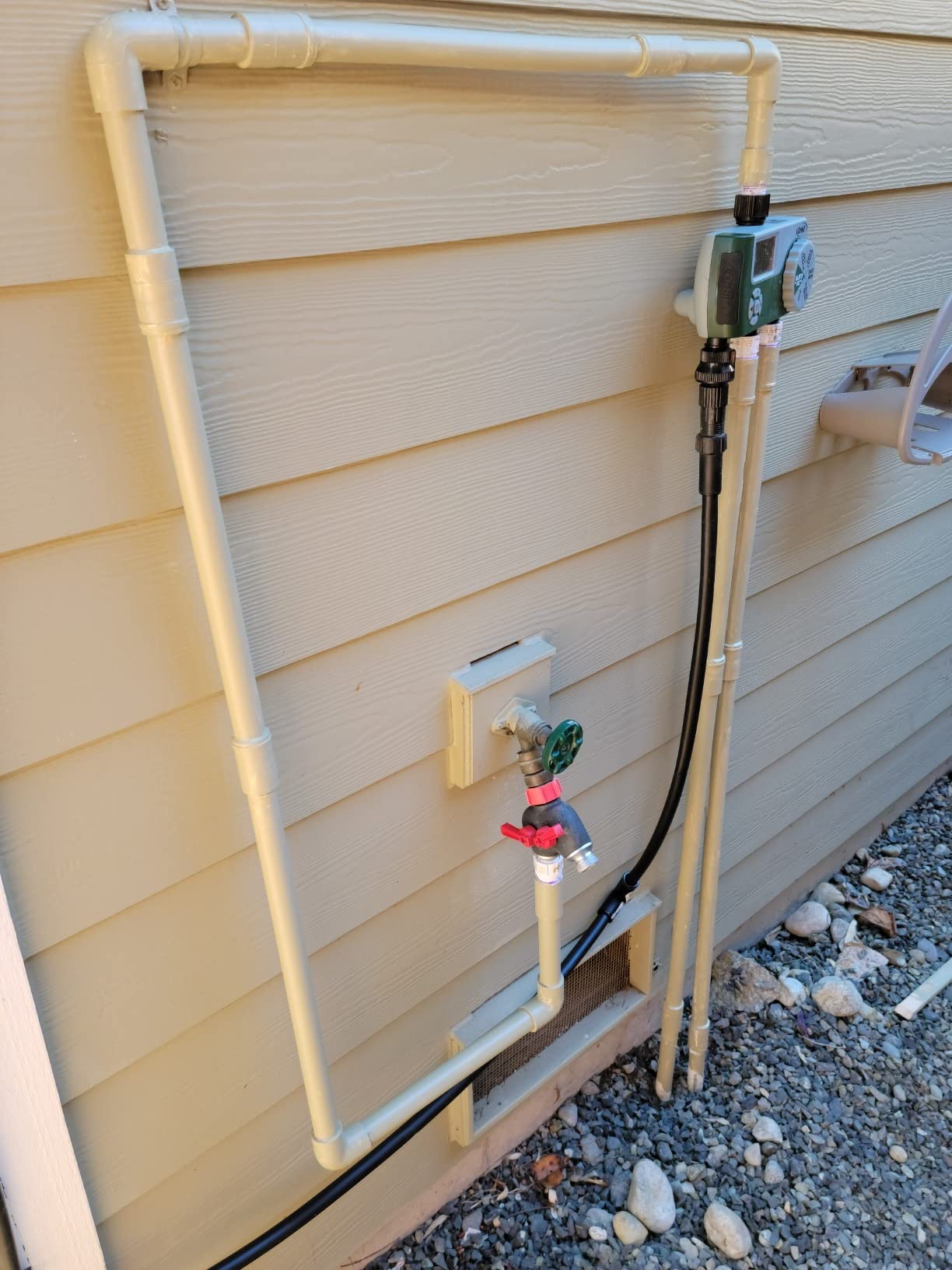
The limitations are structural and worth knowing before you buy. It runs one start time per day, so you cannot give a lawn a morning and an evening cycle, which is exactly what a summer lawn usually wants. And it is water resistant rather than waterproof, so water ingress that eventually kills the electronics is the most common long-term complaint.
Battery corrosion is the other recurring theme. If you leave the timer attached over winter with cells inside, you may find a leaking battery compartment in the spring. Pull the batteries out before storage and the problem disappears, and the six-year limited warranty covers defects in material and workmanship for private use.
What the huge review count actually tells you
A review count this large is a useful signal in one direction: there is a very long record of how this device fails, and it is a cheap failure. Leaks at the connection and units that stop after a season are documented in enough volume to plan around. It is a warning against leaving it outdoors year round without a battery check.
It is also a strength in another direction. Replacement parts and firmware behaviour are well documented, and a 4.1 average across nearly fifty thousand units means the good outcomes vastly outnumber the bad ones. The single-dial design in the next section is the same idea in a more rugged body.
Who should buy the Orbit 62061
Buy it if this is your first hose timer, you want the simplest possible interface, and one daily start time covers your watering. The screen size and dial text are genuinely good for older users, and keeping the programme through a battery change is a small courtesy that many cheaper timers skip.
Skip it if you need two daily start times, if the timer stays outdoors through winter, or if you have a plumbing setup where slow valve closure would matter. For two daily cycles the RAINPOINT ITV105 above gives you far more scheduling range, and for a hard tap the brass build is the safer route.
8. Orbit 62056 Single-Dial Hose Timer – Brass Swivel and Simple Dial
Orbit One Outlet Single-Dial Hose Faucet Timer – Easy Programmable – For Garden Watering System – LCD Hose Timer with Adjustable Watering Schedule – 62056
Single dial programming
Large display
Brass swivel connection
AA batteries
Pros
- Single dial is easy to program without the manual
- Large display and dial text
- Brass swivel connection for outdoor durability
- Quick setting changes when the weather shifts
Cons
- One hose at a time
- No app control
- Batteries not included
The Orbit 62056 is the same idea as the 62061 with a heavier body and one meaningful upgrade: a brass swivel connection. That single change is why this model scores higher and survives longer outdoors. It is also the mechanical answer to water hammer, because a brass swivel seats cleanly and resists the deformation that leads to a slow drip.
Everything else stays deliberately simple. One dial sets the cycle, the display is large, and owners repeatedly mention adjusting settings when the forecast changes as the main reason they like it. A full change of plan takes seconds rather than an app session, which matters on a timer you interact with every week in the season.
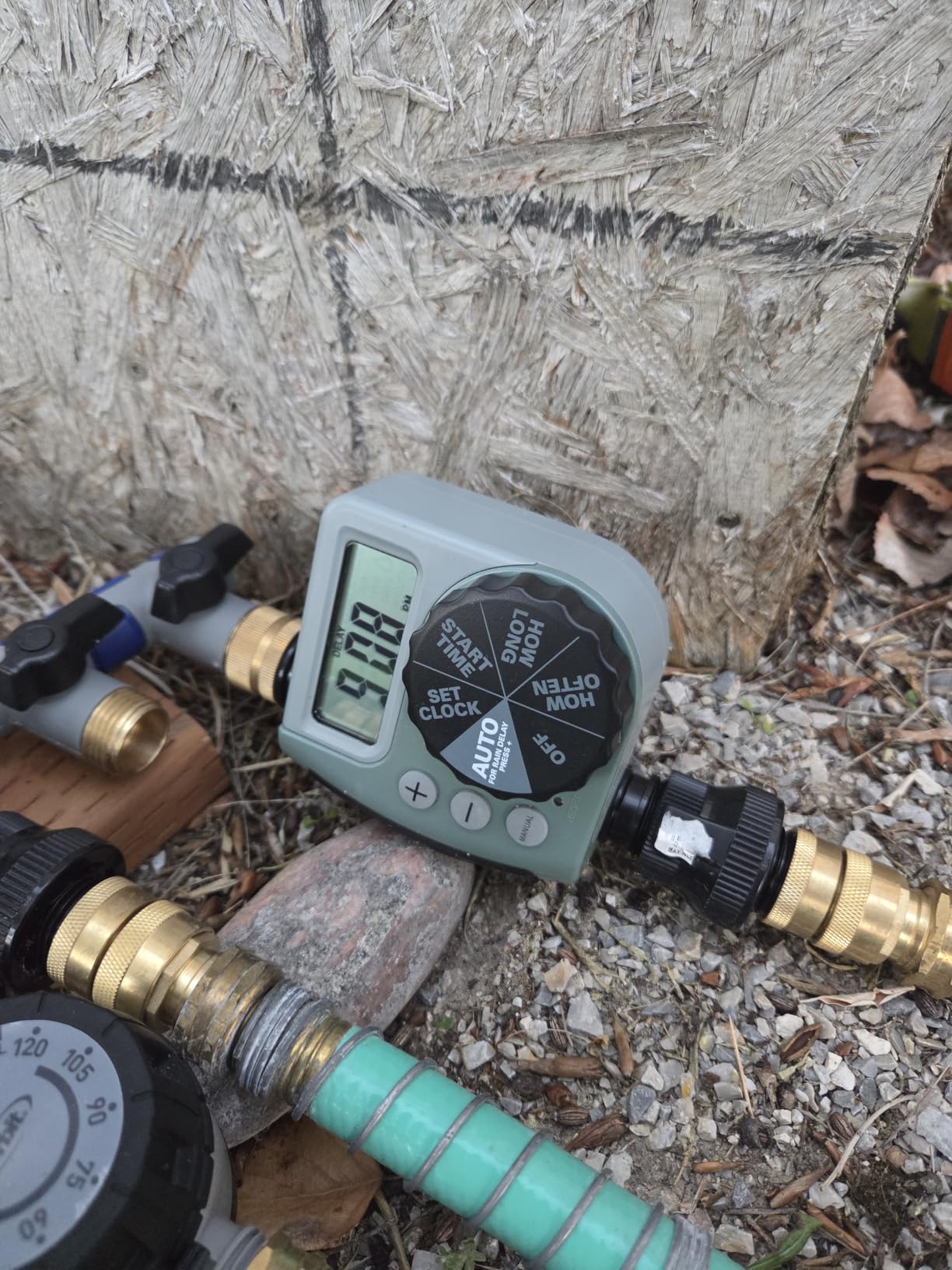
What you are giving up is flexibility. This is a single-outlet device, so one hose at a time, and the dial cannot do what the digital RAINPOINT units do with frequency and duration ranges. There is no app, no remote start and no rain delay beyond what the dial provides. The AA batteries are not included, so budget for a fresh pair at setup.
Against that, it is a 14.4 ounce body with a metal swivel connection, and the kind of simple mechanical design that a landscaper can service in seconds. If it lives outdoors, the brass is doing a lot of quiet work protecting the seal.
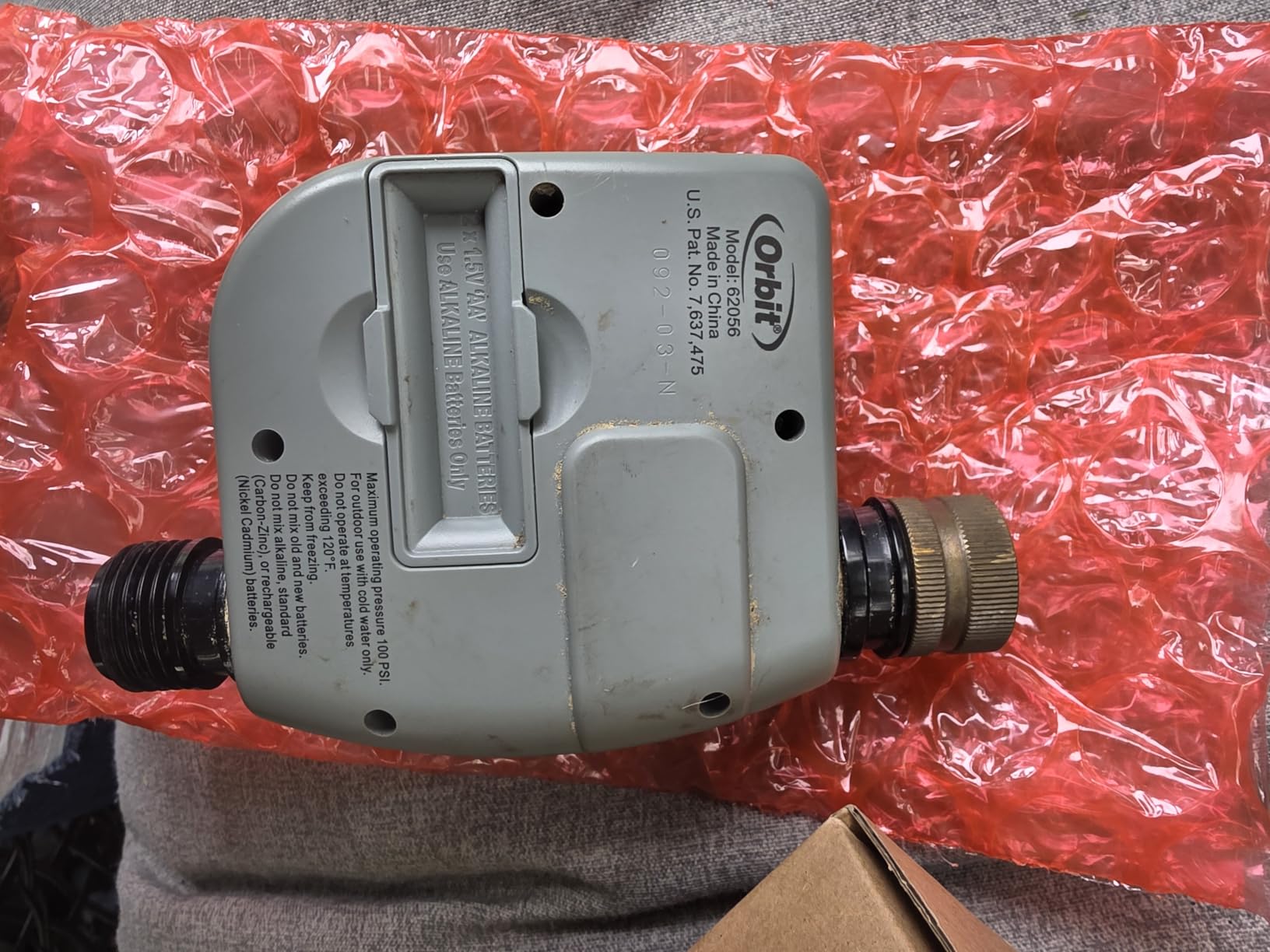
Dial versus screen, honestly compared
Choose the dial when you want a decision surface. Turn the handle, watch the display, and the schedule is obviously whatever the dial says. That transparency is why this model keeps appearing in recommendation threads even when cheaper digital units are available, and it is why older users like it.
Choose the screen when you want range. A digital unit gives you run durations measured in minutes, frequency from hourly to weekly, and often a rain delay with auto-resume. The 62056 gives you less control and more certainty, which is the correct trade for a single hose and the wrong one for a two-zone property.
Who should buy the Orbit 62056
Buy it if you have one hose, you want a rugged connection that tolerates being left outside, and you prefer turning a dial to managing an app. The brass swivel makes it the pick for an older or exposed tap where a plastic inlet would eventually be the weak point.
Skip it if you need two daily start times, a proper rain delay, or any remote control. In those cases the RAINPOINT ITV105 is the better scheduling tool, and the two-zone models handle parallel watering that this one simply cannot.
9. Insoma SGW05 Hose Timer – The Budget Workhorse
Outdoor Garden Hose Faucet Timers, Programmable Water Sprinkler Timer with Rain Delay/Manual/Automatic Drip Irrigation and Lawn Watering System for Yard, 1 Outlet
One outlet
IP55 waterproof housing
Connector rated to 116 psi
Two AA batteries
Pros
- Runs from 1 minute to 23 hours 59 minutes
- 1 to 7 day rain delay with auto-resume
- IP55 housing with a sealed battery cover
- Child lock and larger LCD
- Includes a reducing bushing and seal tape
Cons
- Plastic inlet wears faster than brass
- Batteries not included
- No backlight for night checks
The Insoma SGW05 does two things well. Its frequency range is the widest of any single-outlet timer here, running from every one to twenty-three hours and fifty-nine minutes or every one to seven days, with durations that go up to twenty-three hours and fifty-nine minutes as well. And its rain delay runs one to seven days with automatic resume, which is long enough to cover a genuinely wet week.
There is also a child lock, which is not a gimmick if the tap is at the side of a house where children or a dog can reach it, and the included hardware matters more than it sounds: a 3/4 inch male NPT to 1/2 inch female NPT reducing hex bushing plus thread seal tape. That means it will fit a 1/2 inch tap without a separate shopping trip.
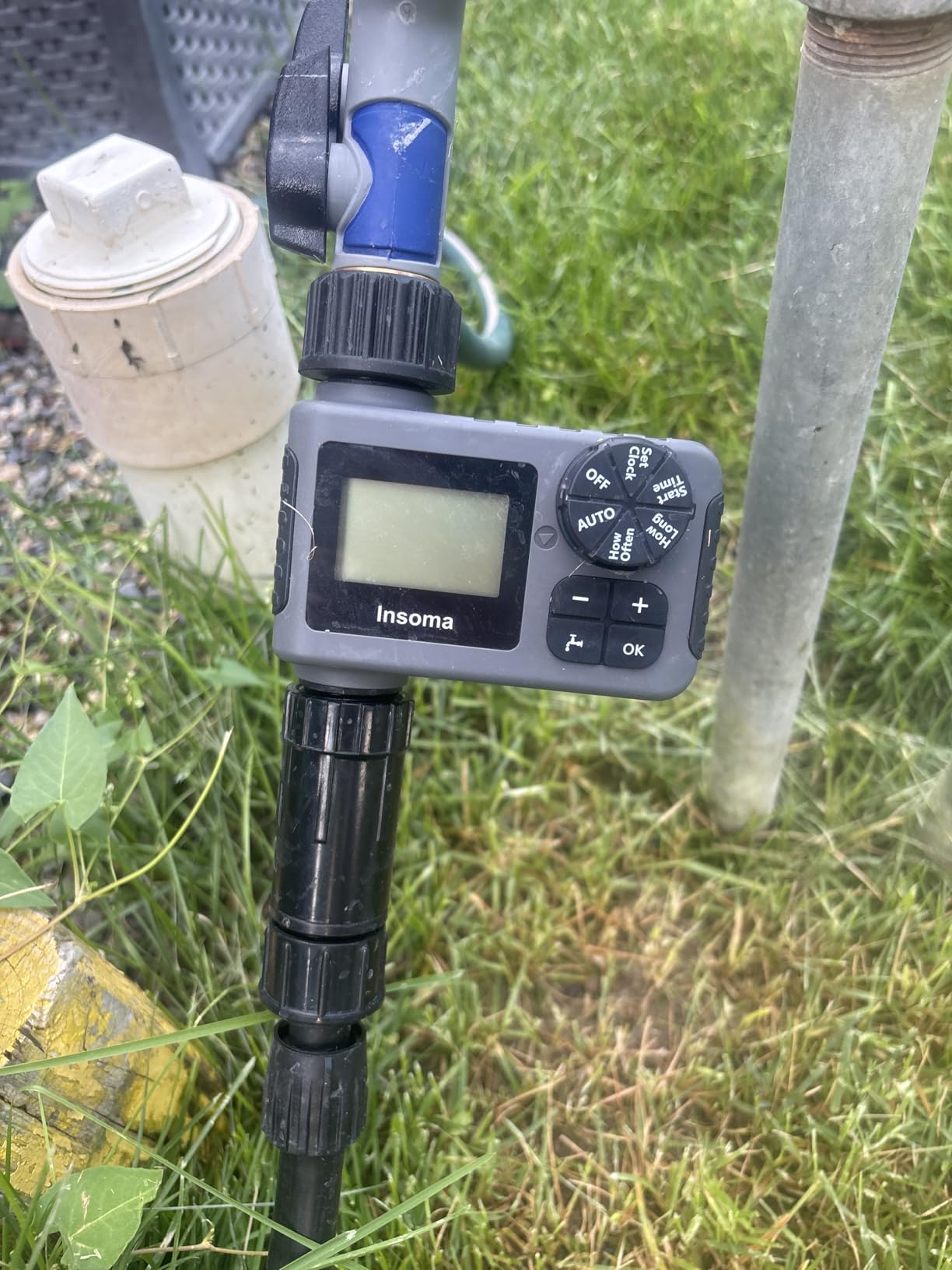
The IP55 housing with a battery cover seal ring and a fibre-reinforced connector rated from 7.25 to 116 psi is a more serious weather story than the rating alone suggests. Two AA alkaline cells give it over six months of running, which is about two battery changes across a full season.
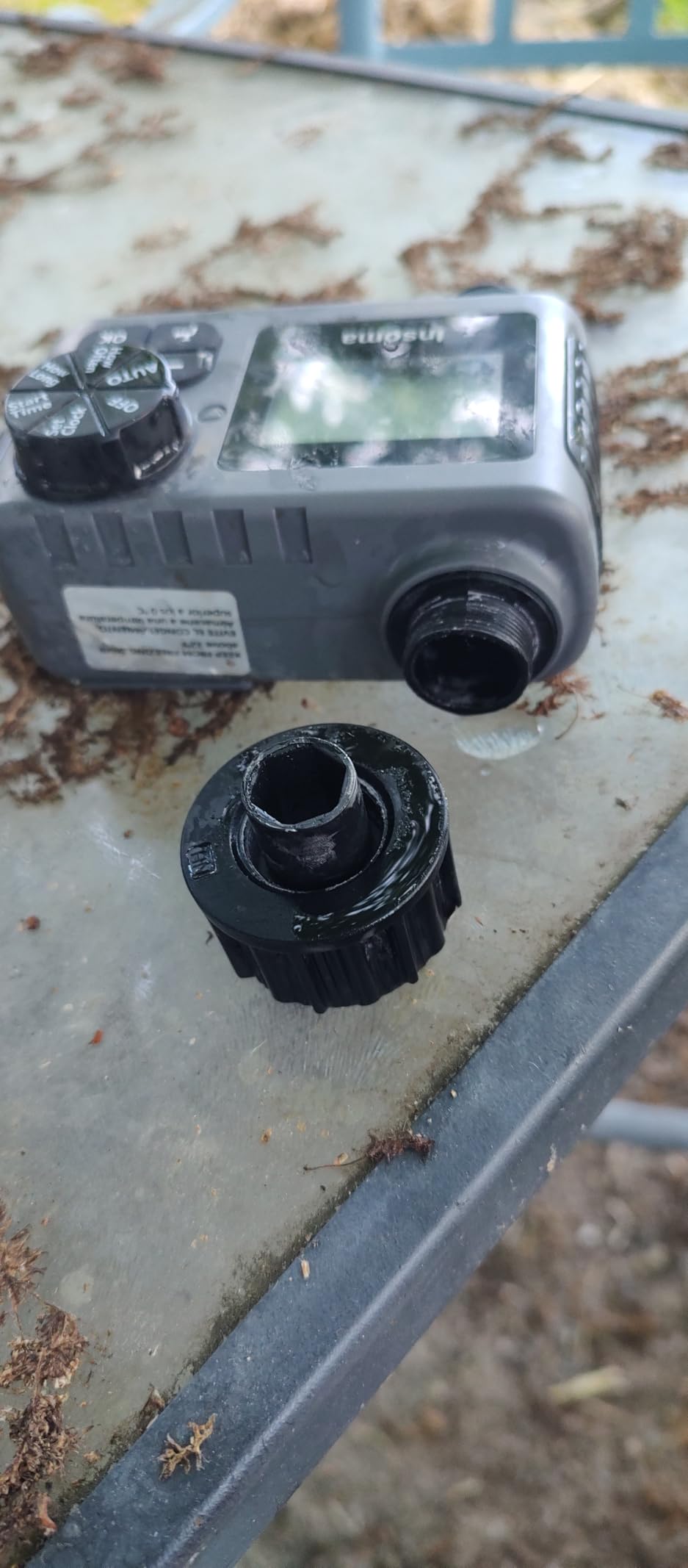
Where it gives ground is the inlet material. Plastic wears faster than brass in hard water or high-pressure setups, and that is the main reason for the 4.1 average, which reflects a fair number of durability complaints. The display also has no backlight, and the AA batteries are not included, so a night check means a torch.
What this one is genuinely good at
Very long runs. If you are filling a trough, running a greenhouse misting line or watering a large area on a single hose, the twenty-three hour fifty-nine minute manual mode is a real feature that most competing timers cap far lower. The week-long rain delay is the other one, and it is unusually generous for a single-outlet unit.
Owners treat this as a budget workhorse rather than a long-term investment. The trade is fine if you are willing to accept a replacement in a few seasons, and poor if you plan to leave the same tap unattended through a full year.
Who should buy the Insoma SGW05
Buy it if you need a long run or a long rain pause, you want the included reducing bushing for a 1/2 inch tap, and you would rather not spend on a hose timer. The child lock and IP55 housing make it a sensible choice for a busy outdoor tap.
Skip it if your water is hard, if the tap runs at high pressure, or if you want the unit to last several seasons in one piece. In those situations the brass-bodied Insoma above or the Orbit 62056 with its brass swivel is the same money for a tougher connection.
10. Melnor 65138AMZ AquaTimer – QuickConnect Bundle With a Long Warranty
Melnor 65138AMZ AquaTimer Digital Hose Timer, 1-Zone Timer, QuickConnect Bundle, Black, Yellow
One zone
1 minute to 6 hour runs
Hourly to weekly scheduling
QuickConnect fittings included
Pros
- Schedule from every hour to once a week
- Runs from 1 minute to 6 hours
- Manual override remembers the last run
- QuickConnect fittings make swapping hoses fast
- No Wi-Fi needed
Cons
- Weak batteries can leave the valve open
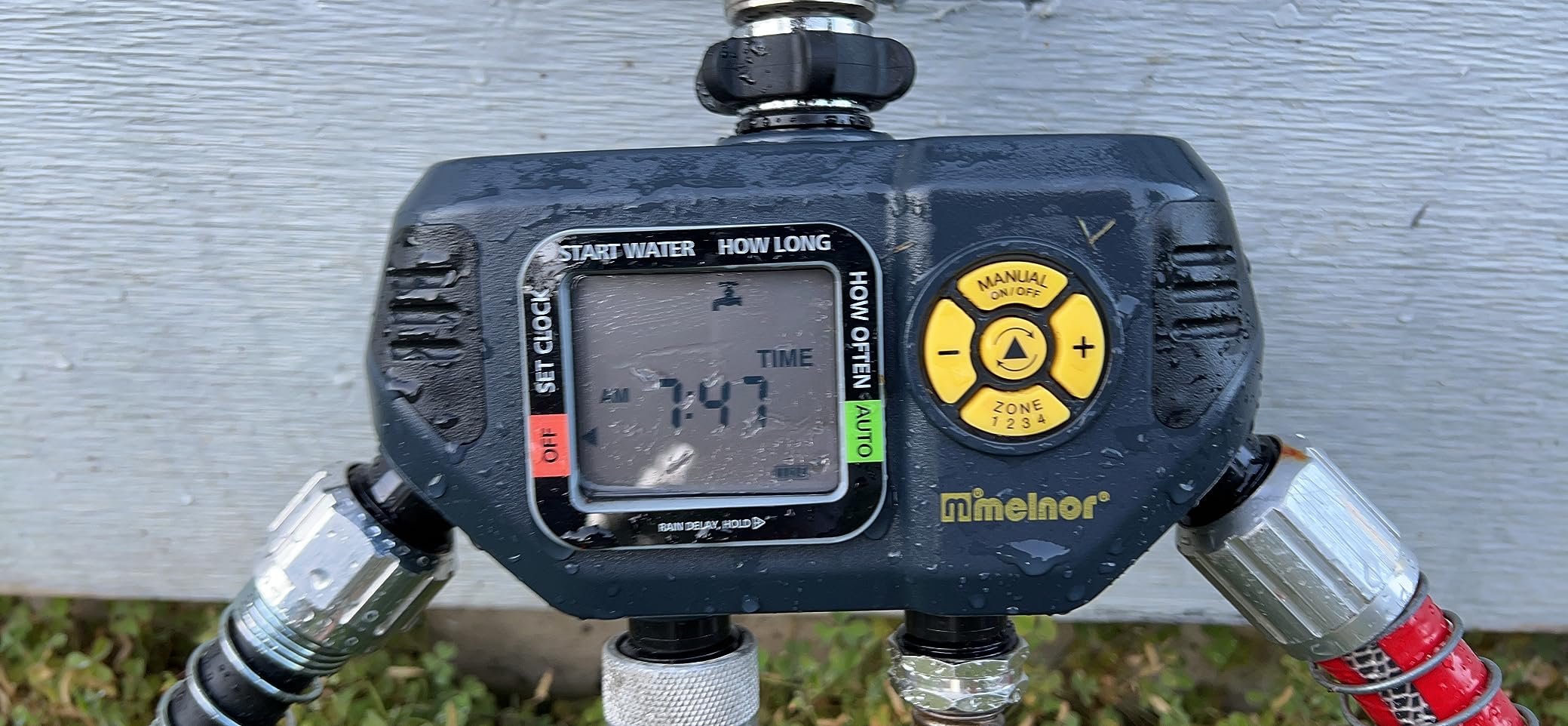
- Some units leak at the tap connection
- Newer model dropped named weekday selection
The Melnor 65138AMZ is the one to buy when attaching a hose is the part you find tedious. The bundle includes the timer plus QuickConnect fittings, so you snap a hose on and off in seconds rather than threading it every time. For anyone moving a sprinkler around a yard or swapping between a soaker hose and a sprinkler, that is a genuine daily saving.
Scheduling covers everything from every hour up to 24 hours, down to as little as once a week, with runs from one minute to six hours. The manual faucet override is the detail owners mention most warmly, because it gives you immediate access to the tap and then remembers how long you ran it, so you can make that run the new default.
Warranty service is also mentioned positively, with Melnor backed by a seven-year limited warranty, which is the longest stated coverage among the hose timers here even though the listing also references a two-year manufacturer term. Check the terms in the box when it arrives.
There is no Wi-Fi and no app, so it works anywhere, including spots with no wireless coverage. That is a feature for reliability and a limitation for remote control, and the two AA batteries are not included. Outside the United States the 3/4 inch GHT thread needs an adaptor, which a number of international buyers mentioned.
Two failure modes worth guarding against
Fresh batteries are not optional on this model. Owners repeatedly trace leaking at the tap and zones that will not shut off back to weak cells, because the valve cannot close properly on depleted batteries. Treat the low-battery symptom as urgent, not as something to note for later.
The second complaint is a programming change. The newer version offers every day, every other day or every three days rather than a named weekday selection, which some long-time owners dislike. Forum threads on r/gardening also flag tap-connection leaks on Melnor units, so check the fitting with the tap off and running before you walk away.
Who should buy the Melnor 65138AMZ
Buy it if you move hoses frequently, you want the seven-year warranty behind a simple mechanical schedule, or you are somewhere without reliable wireless coverage. Long-term Melnor owners repeatedly say that storing the timer indoors over winter is what keeps it running for four to seven years.
Skip it if you need two zones, app control, or named weekday programming. For parallel watering the two-zone units above cover it, and for smart scheduling the Rachio 3 is the tool built for the job.
How to Choose a Sprinkler Timer in 7 Steps
Buying the wrong type is the expensive mistake here, and it is easy to make. Work through these seven questions in order and the model choice usually makes itself.
1. Count your zones first. Every hose needs its own circuit, and every circuit needs its own valve. If you have never counted, open the valve box and count the wires leaving the controller, because that is the number of stations the replacement must handle. Under-count is the most common installation error, and it is fixed by rewiring rather than by choosing a bigger box later.
2. Decide hose-end or in-ground. A hose-end timer screws onto an outdoor faucet and does everything through one body. An in-ground controller sits in a garage or cabinet and drives 24 VAC valves under the lawn. Nothing else in this list matters until that decision is made.
3. Check the mounting location. Rain Bird’s SST600IN is indoor only. Everything else in the wired group can live in a locking cabinet outdoors, which matters if you have no dry interior wall near the valve box. Hose-end timers are outdoor by definition, so look at the IP rating.
4. Look at the inlet material before the features. Brass survives hard water, heat and a full season outdoors. Plastic is lighter and fine on a sound tap, but it is where slow leaks come from. The two brass options here are the Orbit 62056 swivel and the Insoma two-zone body.
5. Set your watering range. Do you need hourly frequency, or once a week? Runs from one minute to six hours, or up to nearly a full day? A timer that cannot express your schedule will be reset constantly, and resets are how people end up overwatering.
6. Decide how much you trust a phone. Only the Rachio 3 in this group reads weather data and skips cycles on its own. Everything else relies on a manual rain delay, which is fine if you check the forecast weekly and useless if you do not.
7. Check the power and the batteries. Wired controllers need a transformer and a 120 or 127 volt supply, which matters outside North America. Hose-end timers run on two AA cells, and two of the units here ship without them. Smart controllers need a 2.4 GHz network with a stable name, not a shared 2.4 and 5 GHz band.
If you are pairing a timer with a pump rather than a municipal supply, the sizing matters more than the timer. Our guide to sprinkler pumps covers flow rate and pressure for the setups where a pump start relay is involved.
In-Ground Controller or Hose-End Timer: Which Do You Need?
Pick an in-ground controller if you have buried sprinkler heads, a valve box, or a drip system with more than one circuit. It handles overlapping schedules, pump start relays and master valves, and it is the only category here that scales past a handful of zones. The cost is wiring, a mounting spot and a phone or dial to configure it.
Pick a hose-end timer if you have a faucet, a hose, and one area to water. It attaches in under a minute, costs a fraction of a controller, and moves between the front lawn, the beds and the greenhouse as the season changes. What you give up is anything running at the same time as anything else.
The most common confusion is buying a hose-end timer for an in-ground system. A faucet-fed timer cannot open an underground valve, so the buried heads never run. The reverse mistake is buying a six-zone controller for one hose, which works perfectly and costs several times more than it needs to. If you are still unsure, count what you actually want running at the same time.
Winterization, Water Hammer and Timer Longevity
Most premature sprinkler timer failures are avoidable, and the same three habits cover nearly all of them. Pull the batteries out of any hose-end timer before you store it. Wet cells sitting in a plastic compartment through a winter are the most common cause of both corrosion and a dead valve come spring. The Melnor in particular is reported to last four to seven years when it is brought inside, and one to two seasons when it is not.
Water hammer is the other big one, and it is a fitting problem before it is a timer problem. Water hammer is the shock that travels through your pipes when a valve opens or closes abruptly, and it shows up as a bang in the wall whenever the sprinkler kicks on. Slow-closing valves and clean, correctly torqued connections are the defence, and brass bodies and brass swivels resist the heat deformation that warps a plastic inlet until it no longer seats.
Then there is the freeze. Hose-end timers are outdoor devices, and no IP rating means no protection from a hard freeze. Bring them indoors, or accept that you are replacing the electronics every few years. In-ground controllers with a locking outdoor cabinet fare better than nothing but still benefit from a drained box in genuinely cold regions. If you are in one of those regions, the built-in rain delay and a manual winter shutdown matter more than app features.
Finally, leave yourself a paper schedule. Every one of these units can be reprogrammed, and the ones with a display and a dial are much faster to reconfigure when you know what the previous settings were.
Frequently Asked Questions
Is Rain Bird or Hunter better?
Rain Bird tends to win for home installers who want simple programming and per-zone control, which is why the SST600IN in this roundup is the easiest six-zone unit to set up. Hunter is the choice contractors reach for when a system is large or commercial, where station counts and diagnostic depth matter more than a simple dial. For a four to six zone residential system, Rain Bird is the lower-friction option.
Is Orbit or Rain Bird better?
Orbit wins on hose-end hardware and expandability, with brass connections and controllers reaching up to twelve stations. Rain Bird wins on programmable simplicity and indoor controller design, plus the longest stated warranty among the hose timers here. Choose Orbit if you have a large wired system or an outdoor tap. Choose Rain Bird if you want the least confusing programming and a controller that lives in the garage.
What is the best automatic water timer for my garden?
For most gardens, the RAINPOINT ITV105 is the best automatic water timer because it programs in a minute, offers a rain delay that resumes on its own, and handles everything from a one-minute hand watering to a seven-day cycle. If you need two areas on separate schedules from one faucet, choose a two-zone model instead. A smart controller is only worth it if you have a wired valve box and travel regularly.
Which sprinkler timer is the most reliable?
Reliability splits by category. For a wired in-ground system, the Orbit 57899 and Rain Bird SST600IN are the most dependable because they run entirely from a dial and keep working when the internet is down. For a hose tap, the brass-bodied models hold their seals best, while budget plastic timers most often fail through water ingress or a leaking connection after a season or two.
How long should a sprinkler timer last?
A wired mechanical controller with surge protection can run for many years, and owners report multi-season reliability across these models. A hose-end timer typically lasts one to four seasons depending on build and storage. The single biggest factor is winterization: removing the batteries and storing the timer indoors prevents the corrosion that kills most budget units.
Do I need a smart sprinkler controller?
You need one if you have three or more zones, you travel, or you regularly forget to water. A smart controller skips cycles when rain, wind or freeze is forecast, which is the only feature here that reduces water use without you doing anything. If you have one hose or two zones, a mechanical timer does the same job for far less money and no Wi-Fi dependency.
Are Orbit sprinkler timers good?
Yes. Orbit makes three of the ten timers in this roundup and holds up well for durability, with a brass swivel option and a six-year warranty on the hose models. The main criticism we see is unit-to-unit inconsistency at the budget end, where occasional leaks appear. The wired multi-station panel is the pick if you want a controller that scales to twelve zones.
The Verdict on the Best Sprinkler Timers in 2026
The Rachio 3 is the best sprinkler timer overall because it is the only unit here that adapts its schedule to the weather, and its per-zone soil and slope setup is the most useful thing we tested. The Orbit 57899 is the pick for wired systems that need more than six zones or a lockable outdoor cabinet. The RAINPOINT ITV105 is the best value for anyone watering one area from one faucet.
Beyond those three, the Rain Bird SST600IN is the easiest controller to program, the brass Insoma and Orbit 62056 are the toughest hose connections, and the Melnor QuickConnect bundle is the fastest to reconfigure. Whatever you choose, pull the batteries before winter and check the tap thread before you buy.