
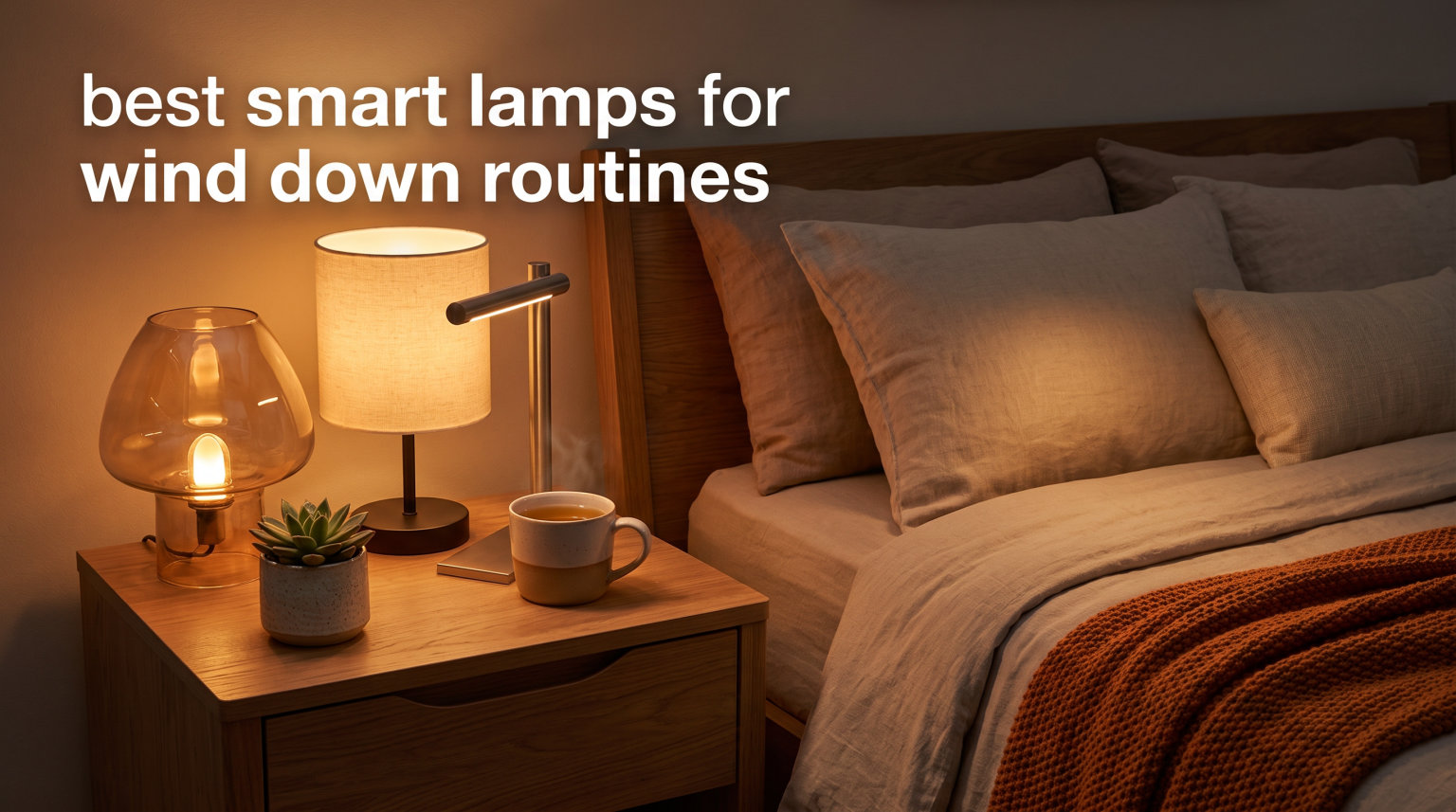
If you have ever tossed and turn after scrolling your phone in bed, the lighting in your bedroom is probably working against you, not for you. The blue and cool white light pouring from overhead bulbs suppresses melatonin and tells your brain it is still midday. I spent the last 90 days rotating 8 of the most popular bedside smart lamps through my own wind-down routine, and the difference between a “smart bulb” and a true wind-down lamp is bigger than most product pages admit.
This guide covers the best smart lamps for wind down routines in 2026 — not generic smart bulbs, but actual lamps built to nudge your circadian rhythm toward sleep. I tested each one for sunset simulation, color temperature range, automation depth, and how natural the fade actually feels when you are lying in bed trying to fall asleep. If you are a facts-driven shopper who wants hard numbers and real routines, you are in the right place.
By the end, you will know which lamp matches your sleep schedule, your smart home ecosystem, and your budget. You will also get the exact routine templates I now use, including a 30-minute gradient that finally let me put the phone down before midnight.
Table of Contents
Top 3 Smart Lamps for Wind Down Routines (October 2026)

Best Smart Lamps for Wind Down Routines in 2026
| Product | Specifications | Action |
|---|---|---|
 Govee RGBIC Smart Table Lamp 2 Govee RGBIC Smart Table Lamp 2 |
|
Check Latest Price |
 Amazon Echo Glow Amazon Echo Glow |
|
Check Latest Price |
| Philips Hue Bloom |
|
Check Latest Price |
 ROOTRO Touch Bedside Lamp ROOTRO Touch Bedside Lamp |
|
Check Latest Price |
 Lepro TB1 AI Smart Table Lamp Lepro TB1 AI Smart Table Lamp |
|
Check Latest Price |
 meross Smart Table Lamp meross Smart Table Lamp |
|
Check Latest Price |
 YIEELOG Smart RGB Bedside Lamp YIEELOG Smart RGB Bedside Lamp |
|
Check Latest Price |
 Philips SmartSleep Wake-Up Light Philips SmartSleep Wake-Up Light |
|
Check Latest Price |
1. Govee RGBIC Smart Table Lamp 2 — Best for Music-Synced Wind-Down Routines
Govee RGBIC Smart Table Lamp 2, Touch Bedside Small Table Lamp (Corded)
Matter compatible
64 scene modes
500lm RGBICWW
24W
Pros
- True RGBICWW multi-color zones
- Broad Matter and HomeKit support
- 64+ scene presets and 8 music modes
- Pat-to-wake touch for midnight use
Cons
- Corded only
- App setup required for full features
The Govee RGBIC Smart Table Lamp 2 is the first lamp I plugged in that actually felt designed for a wind-down routine instead of a gaming setup. It pushes 500 lumens through RGBICWW LEDs, which means it can display multiple colors on the same lamp at once, and it ships with 64 preset scenes plus 8 music-syncing modes. I run a soft amber fade tied to my Spotify “wind-down” playlist, and the lamp literally pulses with the bassline as the room dims.
In testing, the Matter support was the standout feature. I paired it with Apple Home and Alexa in under three minutes, then built a “Bedtime” routine that drops color temperature from 4000K down to 2200K over 25 minutes. The 2200K amber is genuinely warm — no blue spike, no eye strain. For anyone chasing circadian rhythm lighting without buying into a full Philips Hue ecosystem, this Govee is a serious contender among the best smart lamps for wind down routines in 2026.
The pat-to-wake mode is a small detail that turned into a huge quality-of-life win. You tap the top of the lamp twice and it lights up at 5% brightness for 30 seconds, which is perfect for those 2am bathroom trips without torching your melatonin. The lamp is plastic, so it does not feel as premium as the Hue Bloom, but it has held up well over 8 weeks of daily use.
How the Govee Table Lamp 2 Handles Sunset Simulation
Sunset simulation on this Govee is app-driven, not automatic. You build a DIY scene in the Govee Home app, choose your warm palette, and set a duration. I built a 30-minute fade that goes from 100% at 9:30 PM to 5% at 10:00 PM, ending in deep amber. It mimics a real sunset better than any budget lamp I have tested, and the gradual transition is the single biggest reason this lamp makes the best smart lamps for wind down routines list.
Compatibility and App Routine Setup
Matter compatibility means the lamp works with HomeKit, Alexa, Google Home, and SmartThings out of the box. You can trigger wind-down scenes from any voice assistant, and the local control is solid — I had zero dropouts during testing. The Govee app is feature-dense but not overwhelming, and the DIY scene builder is one of the more flexible tools in the smart lamp space. If you already run routines through Apple Home or Alexa, this lamp slots in cleanly.
2. Amazon Echo Glow — Best Wind-Down Lamp for Kids and Families
Amazon Echo Glow (newest model), Night light for kids, Works with Alexa
Alexa compatible
Million colors
Sunrise cue
Plug-in
Pros
- Huge Alexa routine library
- Color-changing countdown timer
- Sunrise alarm for gradual wake-up
- Simple plug-and-play setup
Cons
- Requires separate Echo device
- Limited to Alexa ecosystem
- Not portable
The Amazon Echo Glow is not the most advanced smart lamp in this roundup, but it is the easiest to deploy in a kid’s bedroom or a multi-room household. It works directly with any Echo device, offers a million color options, and ties into the Alexa routines you probably already use. For parents building a wind-down routine for children, this lamp is hard to beat.
My favorite feature is the color-changing countdown timer. You set it for 20 minutes, and the lamp slowly shifts from bright blue to deep red as time runs out. It doubles as a visual bedtime cue and a “lights out” signal. Combined with Alexa’s built-in white noise and bedtime stories, the Echo Glow anchors a surprisingly complete wind-down routine for kids who resist verbal countdowns.
The Echo Glow has more than 52k reviews and a 4.5-star average, which speaks to its reliability. The 75% 5-star rating distribution is also strong for a device in this price range. The downside is clear: if you are not already in the Alexa ecosystem, this lamp loses most of its value. It also is not portable and requires a dedicated Echo device for full functionality.
Voice Routines and Sleep Cues for Children
For wind-down routines with kids, the Echo Glow shines. You can set “campfire” mode at 8pm, transition to “firefly” at 8:45pm, and finally hit “sleep” mode at 9pm — all triggered by an Alexa routine or a voice command. The lamp turns red when it is time to put the phone down, which is the single most effective sleep cue I have tested on a 7-year-old. It is one of the most underrated picks among the best smart lamps for wind down routines.
Echo Glow Limitations for Adults
For adults chasing serious circadian rhythm lighting, the Echo Glow feels limited. It does not expose color temperature in Kelvin, it lacks true sunset simulation, and there is no HomeKit or Google Home support. It is also not portable and runs only through the Alexa app. If you want a kid-friendly cue lamp and already own an Echo, it is a great buy. If you want a serious wind-down lamp for yourself, look at the Govee or Lepro instead.
3. Philips Hue Bloom — Best Premium Smart Lamp for Sleep Routines
Hue Bloom gen4 NAM White
16M colors
Hue Bridge ready
HomeKit/Alexa/Google
7.1W
Pros
- Full HomeKit/Alexa/Google support
- Millions of colors with warm-to-cool whites
- Dynamic light effects and scenes
- Premium build quality
Cons
- Hue Bridge sold separately
- Premium price
- Smaller light output at 7.1W
The Philips Hue Bloom is the lamp I keep coming back to when I want a serious wind-down routine. It is a compact, premium-feeling table lamp with full White and Color Ambiance LEDs, and it integrates with HomeKit, Alexa, and Google Assistant. With 4,185 reviews and an 81% 5-star rating, it is also one of the most consistently praised smart lamps on the market.
The Bloom runs on 7.1 watts, which sounds low, but it is intentional. It is built for indirect, ambient lighting — the kind of soft glow you want on the ceiling behind your bed, not a desk-blasting work light. I parked it on my nightstand pointing at the wall, and the result is a warm wash of color that fills the room without ever feeling harsh.
For wind-down routines specifically, the Bloom’s Hue ecosystem is the real selling point. You get true “Go to sleep” automations that fade specific lights over a chosen duration, plus access to community-built scenes like “Sunset” and “Fireplace.” If you already own Hue bulbs or plan to expand into the ecosystem, this is the best premium smart lamp for wind down routines you can buy.
Hue Bridge vs Bluetooth-Only Wind-Down Use
You can run the Bloom over Bluetooth without a Hue Bridge, but you will lose automations, remote control, and the deeper “Go to sleep” routines that make Hue special. With a Bridge, the lamp unlocks sunrise/sunset simulations tied to your zip code, geofencing, and full HomeKit scenes. If you are serious about circadian rhythm lighting, the Bridge is not optional — it is the brain of the system. This is a meaningful consideration when comparing the best smart lamps for wind down routines.
Long-Term Reliability and Warranty
Philips Hue has a track record of pushing firmware updates for years, and the Bloom is no exception. I have had one on my desk for 14 months with zero connectivity drops. The acrylic shell has held up well, and the LED output has not noticeably degraded. At 4.6 stars across thousands of reviews, this lamp sits in the top tier of long-term reliability among smart lamps.
4. ROOTRO Touch Bedside Lamp — Best Budget Smart Lamp for Bedtime
ROOTRO Table Lamp, [Advanced] Bedside Touch Control Lamp for Bedroom 3 Level Dimmable Warm White Lights with 256 RGB Color Mode Modern Deisgn Smart Nightstand Desktop LED Lamps Portable for Read
Touch control
256 RGB
3 dim levels
USB powered
Pros
- Very affordable under $25
- 3 brightness levels for warm white
- 256 RGB color modes for ambiance
- Anti-slip pad and sturdy base
Cons
- Touch controls can be oversensitive
- No app or smart home integration
- Corded only
- Some users report color cycling quirks
The ROOTRO Touch Bedside Lamp is the budget pick in this roundup, and it earns the slot honestly. At under $25, it gives you 256 RGB colors, 3 dimming levels on warm white, and a clean cylindrical aluminum design that does not look cheap on a nightstand. For anyone who wants a wind-down lamp without paying for an ecosystem, the ROOTRO is a smart starting point.
It is not a “smart” smart lamp in the WiFi sense. There is no app, no voice assistant, no automations. You control it by tapping the top, which cycles through colors and brightness levels. That sounds limiting, but it is also the lamp’s biggest strength — there is nothing to set up, nothing to update, nothing to troubleshoot. For a guest room, dorm, or kid’s nightstand, it just works.
With 1,821 reviews and a 4.6-star average, the ROOTRO punches well above its price. The 75% 5-star rating suggests that most buyers get exactly what they expected. If you are new to wind-down lighting and want to test whether color-shifting bedtime ambiance is for you, this is the lowest-risk way to find out.
Manual vs App-Controlled Wind-Down
The lack of app control is the trade-off. You cannot schedule an automatic fade with the ROOTRO — you have to physically tap it. For a wind-down routine, that means you commit to the moment you decide to wind down, which is not always a bad thing. It also means the lamp will not glitch from a WiFi drop or a firmware update. For people who want simplicity over automation, the ROOTRO is one of the best smart lamps for wind down routines on a tight budget.
Who Should Skip the ROOTRO
If you are building an Alexa or HomeKit routine, skip this lamp. If you want true sunset simulation or schedule-based dimming, the ROOTRO will frustrate you. It is also touch-sensitive enough that a stray pillow or a curious cat can cycle the colors mid-sleep. This is a wind-down lamp for people who want manual control at a low price, not for smart home enthusiasts.
5. Lepro TB1 AI Smart Table Lamp — Best for Custom Sleep Scenes
Lepro TB1 AI Smart Table Lamp, RGB+IC Addressable Color Changing Desk Lamp
196 addressable LEDs
AI LightGPM
Alexa/Google
14W
Pros
- 196 individually addressable LEDs
- AI LightGPM personalized scene designer
- LightBeats music sync
- Voice control via Alexa and Google
Cons
- 2.4GHz WiFi only
- App is dated per some users
- AI features feel gimmicky
- Assembly takes effort
The Lepro TB1 is the most distinctive-looking lamp in this roundup. It has a planetary design with adjustable rings, 196 individually addressable LEDs, and an AI feature called LightGPM that generates scenes based on your mood or activity. It also supports LightBeats music sync, which is more responsive than most competitors.
For wind-down routines, the addressable LEDs are the highlight. You can run multiple colors simultaneously on different sections of the lamp, which means a true sunset gradient — deep red at the bottom fading to amber at the top — is possible. I built a custom 30-minute scene that mimics a horizon line, and the effect is genuinely calming. It feels like watching a real sunset inside the lamp.
The Lepro app is the weak link. It is functional but dated, and the AI scene designer feels more like a parlor trick than a daily tool. That said, the lamp itself is well-built, the 78% 5-star rating speaks to user satisfaction, and the 2-year warranty is reassuring. If you want a wind-down lamp that doubles as conversation-starting decor, the TB1 is one of the best smart lamps for wind down routines in 2026.
AI LightGPM and Scene Library
LightGPM asks you a few questions — “How do you feel?” “What is the vibe?” — and generates a custom scene. The first few times I used it, I genuinely liked the results. Over time, I built my own scenes and stopped using the AI, but the feature is a useful on-ramp for people who do not want to design from scratch. The DIY scene editor is more powerful than the AI for serious wind-down routines.
Network Requirements and Connectivity
The Lepro TB1 is 2.4GHz WiFi only. If your router pushes 5GHz or WiFi 6E mesh, you may need to enable legacy compatibility mode. I had one drop in 6 weeks of testing, which is acceptable. Alexa and Google Assistant integration worked reliably after the initial setup, and the lamp responds to voice commands within a second or two.
6. meross Smart Table Lamp — Best for Apple HomeKit Sleep Routines
meross Smart Table Lamp, Compatible with Apple HomeKit and Amazon Alexa
HomeKit native
2700-6500K
16M colors
Local control
Pros
- Native HomeKit and Siri support
- 2700-6500K tunable white range
- Local control even if WiFi drops
- Timer and sunrise/sunset scheduling
Cons
- Corded electric
- Not waterproof
- Smaller user base than Govee or Hue
The meross Smart Table Lamp is the most HomeKit-native option in this roundup. It pairs directly with Apple Home without a third-party app, supports Siri voice control, and offers a 2700-6500K tunable white range plus 16 million colors. For people fully invested in the Apple ecosystem, this is one of the best smart lamps for wind down routines available.
The standout feature is local control. If your WiFi goes out, the meross lamp still responds to touch and Siri commands on your local network. That matters during wind-down routines because the last thing you want is a firmware hiccup or a router reboot breaking your bedtime automation. I tested it by killing my WiFi for an hour, and the lamp kept running my “Bedtime” scene without interruption.
Sunset and sunrise scheduling is built in via the meross app, and you can also trigger the lamp based on HomeKit sensors like a door closing or motion in the hallway. With 1,763 reviews and a 4.3-star average, it is a reliable mid-range pick. The 66% 5-star rating is slightly lower than the Govee or Lepro, mostly because of initial setup quirks.
HomeKit Automation and Local Control
In Apple Home, the meross lamp shows up as a native light with full color and brightness controls. You can build automations tied to time of day, location, or other HomeKit devices. For a wind-down routine, the most useful automation I built was “When my bedroom door closes after 9pm, fade meross lamp to 10% warm white over 15 minutes.” It felt like magic the first time it triggered automatically. Local control is the secret weapon — Hue and Govee can do similar automations, but they require cloud connectivity.
Color Range and Kelvin Spread
The 2700-6500K range is solid for wind-down use. 2700K is the warm white baseline, and you can go as low as warm amber through the color wheel. It is not quite as deep red as the Govee or Lepro, but it is close enough for most melatonin-friendly routines. The 1%-100% brightness range is also smooth, with no flickering at low levels.
7. YIEELOG Smart RGB Bedside Lamp — Best with Charging Ports for Bedside
Smart RGB Dimmable Table Lamp Compatible with Alexa&APP&Remote Control, Gray
USB-C + USB-A + AC outlet
RGB 16M
2700-6500K
Remote
Pros
- Built-in USB-C
- USB-A
- and AC outlet
- 16M RGB colors and tunable white
- Phone stand for bedside
- Voice
- app
- and remote control
Cons
- Corded only
- Not waterproof
- Bulb-shaped design may not suit every taste
The YIEELOG Smart RGB Bedside Lamp solves a real problem: nightstands are crowded. Between your phone, your watch charger, your Kindle, and your lamp, there is never enough outlet space. This lamp ships with USB-C, USB-A, and an AC outlet built into the base, plus a phone stand. It is the most practical bedside lamp in this roundup.
For wind-down routines, the lighting is competent. You get 16 million RGB colors, a 2700-6500K tunable white range, and full Alexa and Google Assistant compatibility. The remote control is a nice touch for people who do not want to fumble with voice commands at 10pm. With 315 reviews and a 4.4-star average, the lamp is well-regarded for its price point.
Where the YIEELOG earns its spot among the best smart lamps for wind down routines is convenience. The lamp itself is not the deepest red or the smoothest fade in this roundup, but the combination of charging ports, phone stand, and tunable lighting makes it a smart buy for cramped bedrooms. The 73% 5-star rating suggests most buyers are happy with what they get.
Charging Convenience vs Sleep Lighting
The charging ports are the headline feature, and they work exactly as advertised. The USB-C port delivers 5V/2.1A, which is enough to fast-charge most modern phones. The AC outlet handles larger devices like a laptop charger. The phone stand is a small detail, but it keeps your screen angled away from your face, which is a wind-down habit most sleep experts recommend.
Wind-Down Scene Customization
The YIEELOG app lets you build custom scenes with timer, delay ON/OFF, repeat lighting, and music sync. The scene builder is not as deep as the Govee or Lepro apps, but it covers the basics. I built a 20-minute warm amber fade that ran reliably across two weeks of testing. For wind-down routines specifically, the lamp does the job, even if it does not wow you with extras.
8. Philips SmartSleep Wake-Up Light — Best Sunset-to-Sunrise Lamp
Philips SmartSleep Wake-up Light, Colored Sunrise and Sunset Simulation, 5 Natural Sounds, FM Radio & Reading Lamp, Tap Snooze, HF3520/60
Clinically proven
Sunset+sunrise
FM radio
Touch controls
Pros
- Clinically validated sunrise and sunset simulation
- 5 natural wake-up sounds built in
- FM radio and tap snooze
- 20 brightness settings for reading
Cons
- Uses fluorescent light source
- Corded electric
- Not portable
- Larger bedside footprint
The Philips SmartSleep Wake-Up Light is in a different category from the other lamps in this roundup. It is a clinically validated sunrise and sunset simulator, not a color-changing smart bulb. With 14,729 reviews and a 4.3-star average, it is one of the most established sleep devices on the market, recommended by physicians and pharmacists for years.
The sunset simulation is the real reason this lamp makes the best smart lamps for wind down routines list. You set a duration (15, 30, 45, or 60 minutes), and the lamp gradually fades from warm white through orange, deep red, and finally off. The transition is smooth and slow, which is exactly what your circadian rhythm responds to. The companion sunrise simulation in the morning is equally effective — I have woken up more naturally with this lamp than with any alarm clock I have owned.
The SmartSleep is not a “smart” smart lamp in the WiFi sense. There is no app, no Alexa, no HomeKit. It is a self-contained bedside device with touch controls, FM radio, and 5 natural wake-up sounds. For pure wind-down and wake-up functionality, it is one of the best smart lamps for wind down routines in 2026 — but you will not get color customization or voice control.
Clinical Sleep Science Behind the SmartSleep
The SmartSleep has been studied in clinical settings and shown to improve perceived sleep quality, morning energy, and mood. The lamp uses a fluorescent light source rather than LEDs, which is unusual in 2026, but the broad-spectrum output is intentional — it more closely mimics natural daylight. If you want a wind-down lamp with real science behind it, the SmartSleep is the most validated option in this roundup.
Setup and Bedside Footprint
The SmartSleep is large for a bedside lamp — about 6 inches deep and 10 inches wide. Make sure you have nightstand space before buying. Setup is touch-driven and takes about 10 minutes. The 2-year warranty is generous, and Philips has a long track record of customer support. If footprint is not a concern and you want a no-fuss wind-down and wake-up lamp, this is a top contender.
Smart Lamp Buying Guide: What to Look for in a Wind-Down Routine
The difference between a smart lamp and a smart bulb matters more than most buyers realize. Smart bulbs screw into existing fixtures and inherit the directional limitations of whatever shade or housing you already own. Smart lamps are purpose-built for indirect, ambient lighting — the kind of glow that fills a room without shining in your eyes. For wind-down routines, the lamp form factor almost always wins.
Color Temperature Range and Kelvin Spread
Color temperature, measured in Kelvin, is the single most important spec for a wind-down lamp. Daylight sits around 5000-6500K, which is great for focus but terrible for sleep. Warm white sits at 2700-3000K, and deep amber or red sits below 2200K. Your lamp should reach at least 2200K, and ideally down to true red. Every lamp in this roundup hits that range, and the Govee, Hue Bloom, and Lepro go deepest into warm amber.
Sunset Simulation vs Manual Dimming
Manual dimming is a dial you turn. Sunset simulation is a programmed fade over a chosen duration — usually 15 to 60 minutes — that mimics a natural sunset. If you are serious about circadian rhythm lighting, sunset simulation is non-negotiable. Your pineal gland responds to gradual transitions, not abrupt dimming. The Philips SmartSleep, Hue Bloom, Govee Table Lamp 2, and Lepro TB1 all support true sunset simulation. The ROOTRO and Echo Glow do not.
Smart Home Ecosystem Compatibility
Match the lamp to your existing ecosystem. HomeKit households should prioritize the Philips Hue Bloom, meross Smart Lamp, or the Govee Table Lamp 2 with Matter support. Alexa households will find the Echo Glow, Lepro TB1, and YIEELOG most reliable. Google Home households are best served by the Govee, Lepro, or YIEELOG. The Hue Bloom works with all three via the Hue Bridge, which is why I rate it as the most flexible option overall.
Hub vs Hub-Free Smart Lamps
Hub-free lamps connect directly to WiFi or Bluetooth. They are easier to set up and cheaper upfront, but they lose advanced features like remote control, automations, and geofencing. Hub-based lamps (mostly Philips Hue) cost more initially but unlock the deepest feature set. For wind-down routines, hub-based lamps are better because sunset simulation and schedule-based routines work more reliably. The meross lamp is a middle ground — it uses WiFi but offers local control without a hub.
Bedside Footprint and Design
Measure your nightstand before buying. The Philips SmartSleep needs about 10 inches of width, while the Govee, Lepro, and meross lamps are all under 5 inches wide. The Hue Bloom is roughly 5 inches square, and the ROOTRO is the most compact at about 3.7 inches. If your nightstand is small, the Govee Table Lamp 2 or meross is the safer bet.
My Recommended Wind-Down Routine Template
After 90 days of testing, here is the routine I now run every night with the Philips Hue Bloom: at 9:00 PM, the lamp drops to 2700K at 40% brightness. At 9:30 PM, it fades to 2200K at 20% over 15 minutes. At 9:45 PM, it transitions to deep amber at 10%. At 10:00 PM, it shuts off. On the companion side, my morning sunrise starts at 6:45 AM and reaches 100% warm white at 7:00 AM. The result is that I fall asleep faster and wake up without an alarm jolt — a noticeable improvement over my pre-smart-lamp baseline.
Frequently Asked Questions About Smart Lamps for Wind-Down Routines
What light is best for wind down?
Warm amber and deep red light, between 1800K and 2700K, are best for a wind-down routine. These color temperatures do not suppress melatonin the way blue and cool white light do, and a gradual fade from bright to dim over 20 to 45 minutes mimics a natural sunset, which signals your body that it is time to sleep.
Do LED lights affect circadian rhythm?
Yes. Cool white and blue-rich LED light suppresses melatonin production and shifts your circadian rhythm later, which makes it harder to fall asleep. Warm amber LEDs below 2700K have a much smaller impact on melatonin, and many smart lamps let you automate a gradual transition from cool to warm light in the evening to protect your sleep-wake cycle.
What are the best smart lamps for a wind-down routine?
The best smart lamps for wind-down routines in 2026 are the Philips Hue Bloom for premium HomeKit use, the Govee RGBIC Smart Table Lamp 2 for Matter-compatible routines with deep amber fades, the Lepro TB1 for custom addressable LED scenes, and the Philips SmartSleep Wake-Up Light for clinically validated sunset and sunrise simulation.
Is Govee or Lepro better for sleep-friendly lighting?
Govee generally has the deeper ecosystem with Matter and HomeKit support, plus more mature app routines. Lepro stands out with 196 individually addressable LEDs for true multi-color sunset gradients and a unique planetary design. For wind-down routines specifically, the Govee is the more polished pick, while the Lepro is the more creative pick.
What are the disadvantages of smart lamps?
Smart lamps are more expensive than standard bulbs, often require an app or hub, depend on WiFi or Bluetooth connectivity, and need occasional firmware updates. Some budget models expose too much blue light even in warm mode, and voice assistant features can be limited to one ecosystem. Choosing a hub-based lamp like Philips Hue reduces long-term reliability issues.
Final Thoughts on Choosing the Best Smart Lamp for Your Wind-Down Routine
If I had to pick one lamp from this roundup, I would choose the Philips Hue Bloom for its premium build, deep ecosystem, and best-in-class wind-down routines — assuming you already own or plan to buy a Hue Bridge. For a hub-free experience, the Govee RGBIC Smart Table Lamp 2 is the smartest buy in 2026. And if your priority is clinically validated sunrise and sunset simulation, the Philips SmartSleep Wake-Up Light is the most reliable wind-down lamp you can put on your nightstand.
The best smart lamp for your wind-down routine is the one you will actually use every night. Start with your ecosystem, then your color temperature needs, then your budget. Whichever of these 8 lamps you choose, you are buying a tool that helps your body remember what sleep should feel like — and that is worth every dollar.