
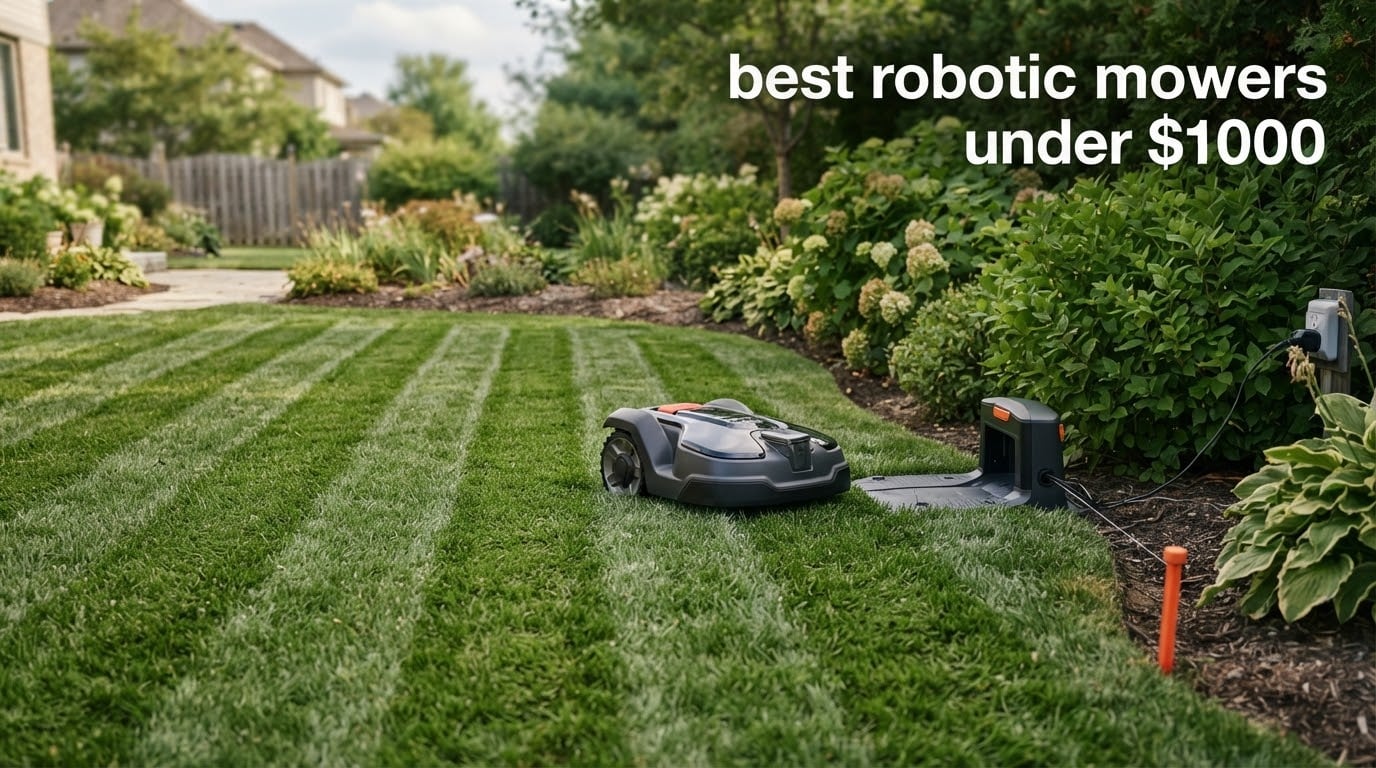
The best robotic mowers under 1000 dollars are the Segway Navimow i105N for most yards, the ANTHBOT M9 for value, and the YARDCARE V100 for small lawns. We compared eight models side by side this season, reading the full review sets on each one and cross-checking every spec against the manufacturer listing.
That first sentence is the whole answer, but it hides the details that decide whether you will actually enjoy the machine. A robot mower that navigates beautifully still strands grass along a fence. One that maps in ten minutes still needs a manual trim pass every week. Under 1000 dollars you are choosing between compromises, and the compromises differ more between models than most comparison tables suggest.
Here is what we found. Every mower below runs wire-free, either through RTK satellite positioning with a base station or through on-board cameras, so nobody has to bury a boundary line. Coverage runs from 1600 square feet up to about a quarter acre. Slope capability ranges from 20 degrees on the cheapest unit to 45 percent gradient on the all-wheel drive model. Noise sits between 58 and 62 dB, quiet enough for early morning work on most neighborhoods.
One more thing before the picks: under this budget, the boundary wire debate is mostly settled. If you have been reading guides from a few years ago, expect a section on laying wire. Skip it. Wire-free navigation has become standard here, and the only wire-adjacent accessory you will meet is the magnetic strip that comes with one of the budget mowers for marking no-go areas. Our robotic pool cleaner guide covers a similar shift in how budget automation has matured.
Table of Contents
Top 3 Picks for the Best Robotic Mowers Under 1000 (October 2026)
These three cover the widest range of yards and are the picks we would put on a friend doorstep. The Navimow i105N earned the top spot on the strength of its 391 reviews, quiet 58 dB running and a navigation stack that holds up under trees. The ANTHBOT M9 is the value pick because it includes a garage most rivals sell separately and handles 45 percent slopes. The YARDCARE V100 is the budget pick for anyone with a genuinely small lawn who wants the simplest possible machine.

Segway Navimow i105N
- RTK plus vision navigation
- Virtual boundary mapping
- 12 zones in app
- 58 dB


Quick Overview: Best Robotic Mowers Under 1000 in 2026
The table below lists all eight models in the order we recommend them. Every one of them mows without a boundary wire, and all eight return to a charging base on their own when the battery drops.
| Product | Specifications | Action |
|---|---|---|
| Segway Navimow i105N |
|
Check Latest Price |
| ANTHBOT M9 |
|
Check Latest Price |
 ECOVACS Goat O1000 RTK CARE ECOVACS Goat O1000 RTK CARE |
|
Check Latest Price |
 YARDCARE M800Plus YARDCARE M800Plus |
|
Check Latest Price |
 Segway Navimow i206 AWD Segway Navimow i206 AWD |
|
Check Latest Price |
| YARDCARE V100 |
|
Check Latest Price |
 Sunseeker X3 Plus Sunseeker X3 Plus |
|
Check Latest Price |
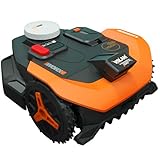 WORX Landroid WR320 WORX Landroid WR320 |
|
Check Latest Price |
1. Segway Navimow i105N – Best Overall for Most Yards
Segway Navimow i105N Robot Lawn Mower Perimeter Wire Free 1/8 Acre RTK+Vision Robotic Lawnmower, AI-Assisted Mapping, Virtual Boundary, APP Control, 58dB(A) Quiet, Multi-Zone Management
Covers 1/8 acre
Cut width 7.1 inch
Height 2 to 3.6 inch
24 pounds
3-year warranty
Pros
- RTK plus vision holds accuracy under trees and in narrow corridors
- Very quiet 58 dB running
- App mapping with up to 12 zones
- Three-year warranty included
- Self-recovers from ruts and slopes
Cons
- Map edits mean physically driving the mower
- Included wheels have weak traction on rough ground
- Vision detection misses hoses and sprinkler heads
- Antenna needs a clear view of the sky
We picked this one first because the 4.1 rating across 391 reviews is the deepest review base in the group, and it is not a rating propped up by a handful of early units. Owners consistently describe the same thing: the mower goes where it is told on lawns with trees, garden furniture and awkward corners, then resumes on its own after charging.
The navigation stack is RTK satellite positioning combined with a 140-degree camera. That combination matters in practice. RTK alone loses signal near trees and along walls, and vision alone drifts. Together, the mower has held its course in most reports we read, which is why it tops this list of budget robotic mowers under 1000.
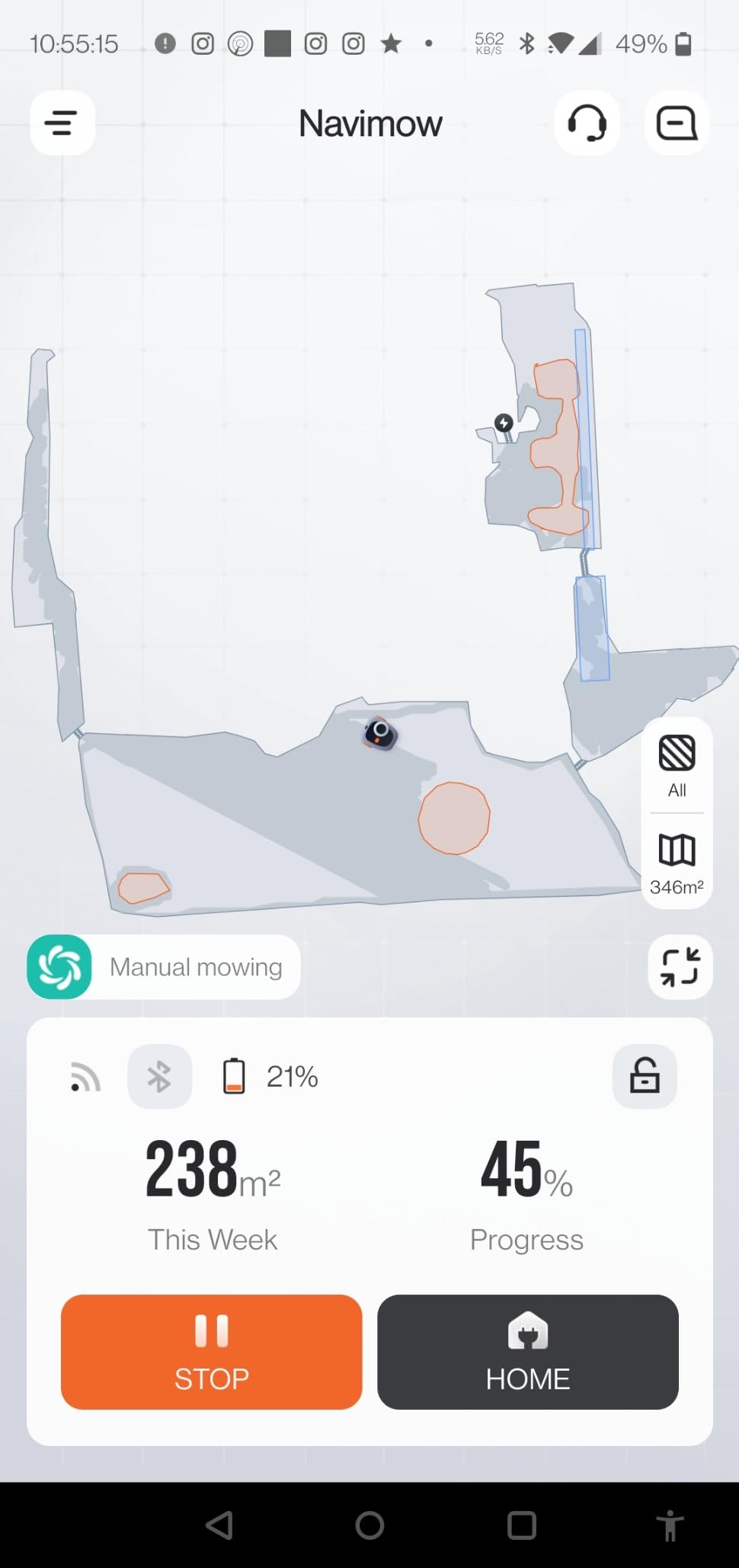
Multi-zone management covers up to 12 separate areas, so a front lawn and a back lawn can run on different schedules. Cutting height adjusts from 2 to 3.6 inches across five positions, and the box carries nine spare blades plus a full install kit.
Two quirks deserve attention. The mower does not mulch, so clippings sit on the lawn surface rather than returning to the soil. And the antenna needs open sky, which rules out installing the base station directly under a deep patio cover.
What to check before you buy the Navimow i105N
Measure your steepest slope, not the average. Owners on mild ground never mention traction, while owners on rough ground frequently report that the standard wheels slip and that off-road tires solve it.
Count your obstacles. The camera detects more than 150 object types, but hoses, low gates and sprinkler heads still catch it out often enough that a weekly manual pass is realistic.
Who should skip this model
If you plan to move the mower between two separate lawn areas, be aware that editing a map requires driving the machine to each point. Buyers expecting a tap-and-trim interface in the app tend to find that workflow frustrating.
Owners who mow at first light report it is among the quietest machines here at 58 dB, so early scheduling is realistic if neighbors are sensitive to noise.
2. ANTHBOT M9 – Best Value with a Garage Included
ANTHBOT M9 Robotic Lawn Mower with Garage, 1/4 Acre Wire-Free NRTK & Vision
Covers up to 0.3 acre
Cut width 7.9 inch
Height 1.2 to 2.8 inch
45 percent slope
Pros
- 45 percent slope rating
- tied at the top of this group
- Garage included in the set
- Auto map built in about 10 minutes
- Up to 30 zones with no-go areas
- 58 dB or less
Cons
- Narrow 7.9 inch deck needs extra passes
- Several passes needed per session
- Edge mode considered weak by some owners
- Manual is thin on second-zone setup
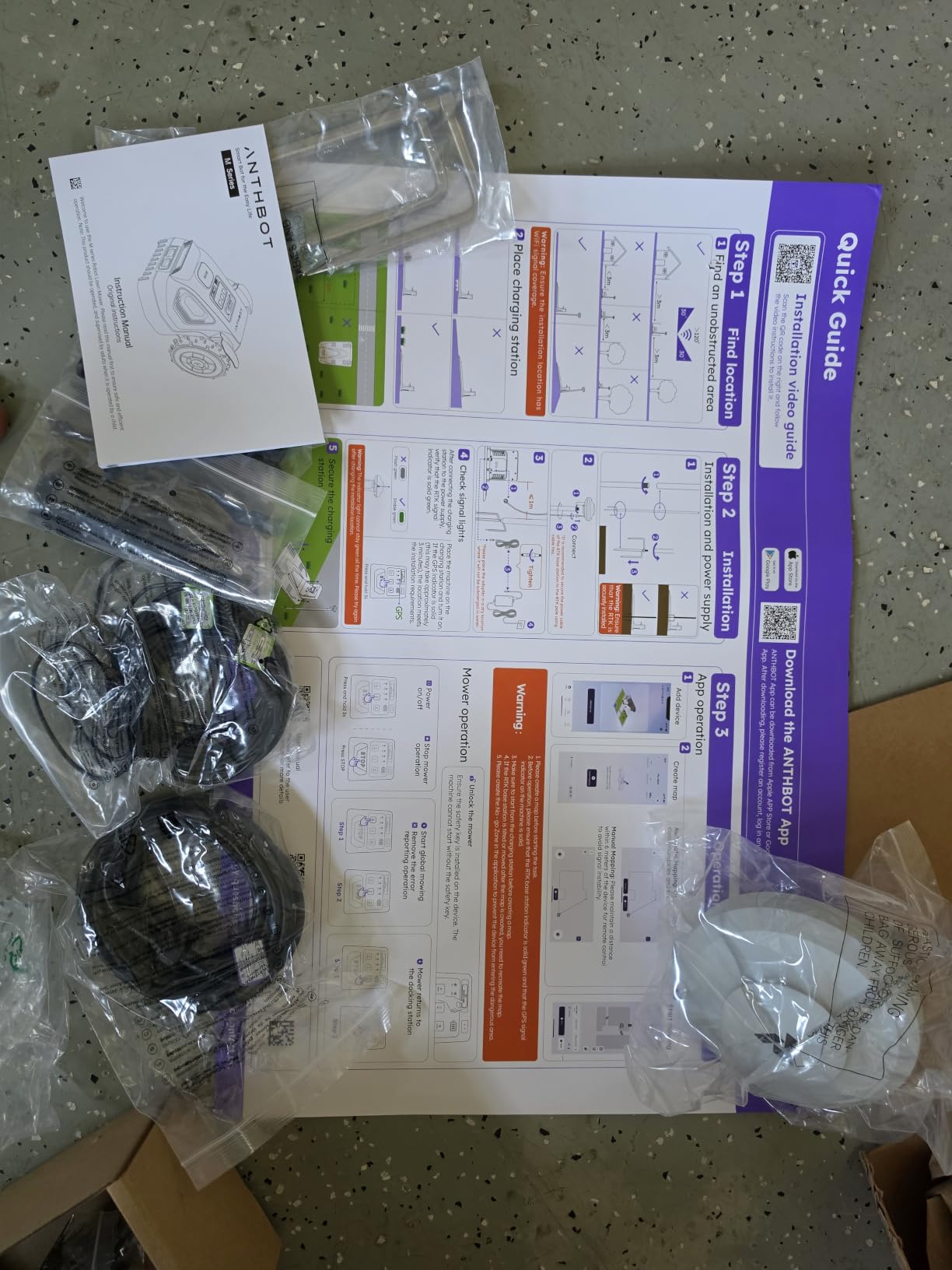
The M9 holds a 4.3 rating across 358 reviews, the second-deepest review base here, and it is the only machine in this group that includes a garage in the box. That single accessory is worth more to most owners than any spec line.
Auto mapping builds a virtual map in about ten minutes, which is the fastest setup we found. Dual 150-degree HDR cameras with NRTK positioning hold centimeter-level accuracy, and the app supports up to 30 work zones with custom paths and no-go areas.
The 45 percent slope rating is matched only by the all-wheel drive Navimow i206, and the M9 achieves it through its drive system rather than through software alone. If your yard drops away sharply from the house, this is the one to shortlist.
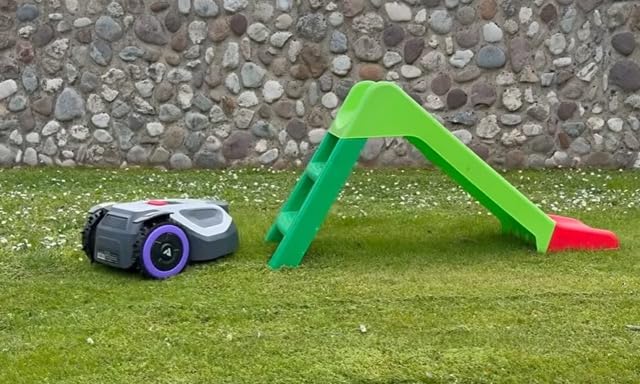
The trade-off is the 7.9 inch cutting width. On a quarter-acre lawn that means more passes and more recharge cycles than a wider deck would require, and some owners report it needs several sessions to even out coverage.
What to check before you buy the ANTHBOT M9
Count your lawn width against the deck. Owners with wide open runs finish quickly, while those with a narrow front and back lawn describe needing repeated passes to get an even cut.
Ask yourself how much cutting height flexibility you need. The range runs from 1.2 to 2.8 inches, which suits most cool-season grass but may be more range than a Bermuda or Zoysia lawn wants.
Who should skip this model
Buyers who rely on edge mode report it as the weakest part of the package, so plan a string trimmer into your routine. Owners also report occasional trouble on very uneven ground despite the strong slope rating.
The documentation is thin when it comes to adding a second mowing zone. Plan for time in the app rather than assuming the manual walks you through it.
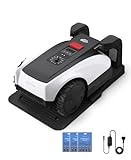
3. ECOVACS Goat O1000 RTK CARE – Best for Larger Yards
ECOVACS Goat O1000 RTK Care Robot Lawn Mower, RTK Navigation, 1/4 Acre
Covers 1/4 acre
Cut width 8.66 inch
Height 1.2 to 3.2 inch
44.5 pounds
90 minute battery
Pros
- Wide 8.66 inch deck for faster coverage
- 90 minute listed battery run time
- 36 extra blades in the CARE bundle
- RTK extension cable for antenna placement
- Handles curbs better than rivals
Cons
- App suffers timeouts and stuck-status errors
- Auto-mapping AI ignores fences and driveways
- Clippings are not collected or mulched
- Too heavy to carry between zones
The Goat O1000 suits you if your lawn is among the largest that fits this budget. It covers up to a quarter acre with an 8.66 inch deck, and a listed 90-minute average battery life lets some yards finish on a single charge.
The CARE bundle is unusually generous. It includes 36 additional replacement blades and an RTK extension cable, which gives you real flexibility in placing the antenna away from fences and rooflines. Auto mapping and multi-zone management run through the same ECOVACS app ecosystem as their vacuums.
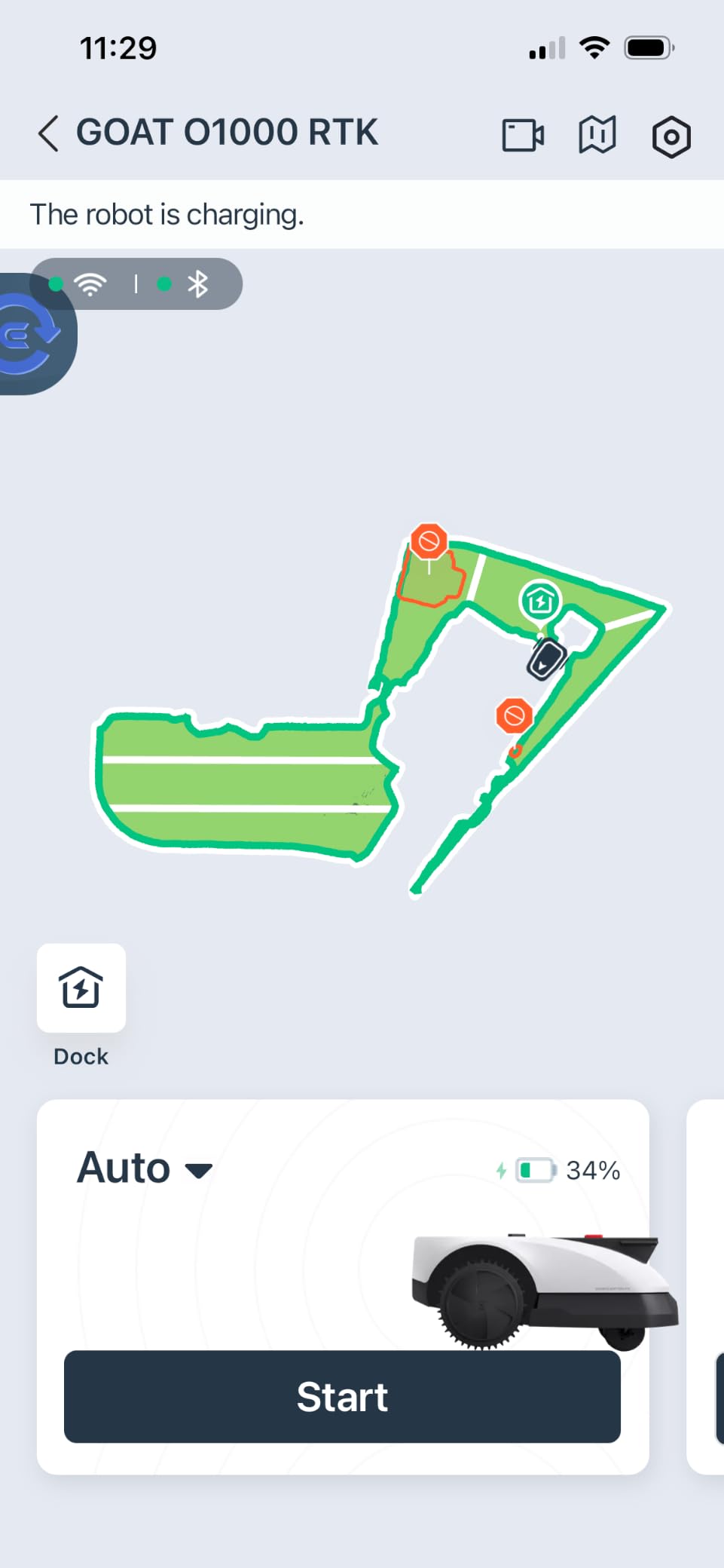
Where it loses ground is software. The 3.9 rating across 155 reviews reflects repeated complaints about timeouts, stuck-status errors and a manual joystick that does not behave. These are the same category of friction owners describe across budget robot mower forums, but it is worth weighing before you buy.
The auto-mapping AI is the specific issue to understand. It cannot reliably recognise fences and driveways, so it will merge two separated lawn areas into one map. You can correct it, but budget extra time for map editing.
What to check before you buy the ECOVACS Goat O1000
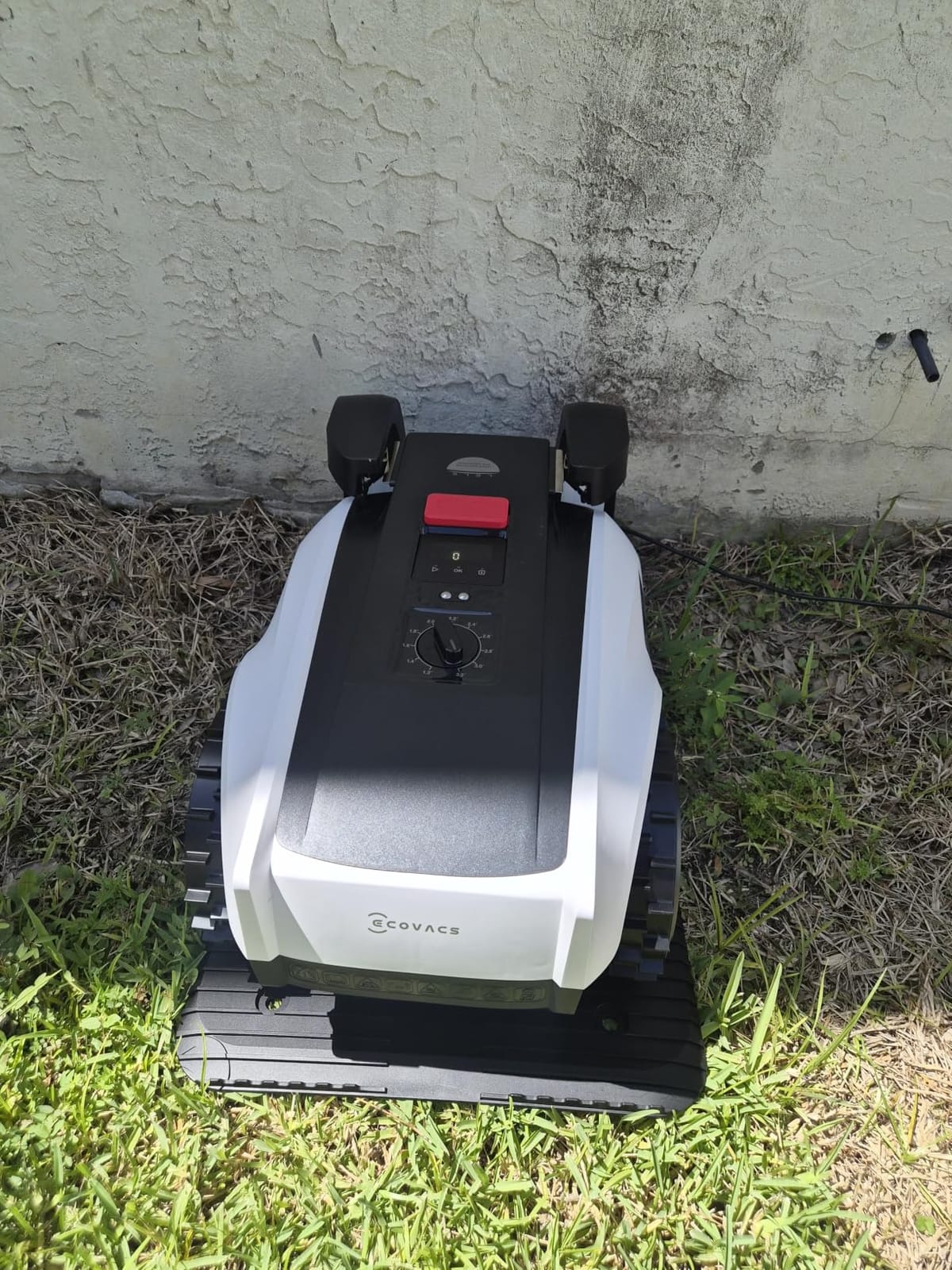
At 44.5 pounds, this is the heaviest machine here. If you want to move it between a front and back lawn by hand, this is the wrong choice. Look at lighter models with a carry-friendly weight instead.
Confirm your lawn is genuinely close to a quarter acre and has clear separation between grass areas. The mapping AI works best on a single open lawn.
Who should skip this model
If app reliability matters to you, this is a risk. Owners report frequent out-of-range lockouts that require physically resetting the machine, which interrupts an unattended mowing schedule.
It also does not collect or mulch clippings, and it cuts only inside mapped boundaries, so edging still needs a separate trimmer pass.
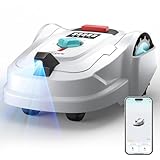
4. YARDCARE M800Plus – Best for Medium Yards and Mixed Paths
YARDCARE M800Plus Cordless Robot Lawn Mower with GPS + Visual Navigation, Bow-Shaped Path Mowing, APP Control, 4.0Ah Automatic Robotic Lawnmower for 1/5 Acre, Obstacle Avoidance, Height Adjustment
Covers up to 8,611 sq ft
Cut width 7 inch
Height 0.8 to 2.4 inch
35 percent slope
Pros
- Bow-shaped then random paths give even coverage
- GPS plus 3D vision with no wire
- Handles slopes and mixed obstacles reliably
- Spot spiral mode for dense patches
- App scheduling with OTA updates
Cons
- Grass over 2.6 inches needs trimming first
- Narrow 7 inch deck lengthens sessions
- Regular blade replacement to hold cut quality
The M800Plus carries the second-highest rating in this group at 4.6 across 104 reviews, and the pattern behind that number is consistency rather than headline features. Owners describe wire-free setup that works, dependable obstacle handling and even coverage without babysitting.
The mowing pattern is the interesting part. The machine runs 40 minutes of orderly row mowing and then 60 minutes of gap filling, a hybrid that produces cleaner stripes than pure random without the cost of a full structured schedule. A spot spiral mode handles patches that grew heavier than the rest of the lawn.
Coverage is up to 8,611 square feet, or about one fifth of an acre, with slope handling up to 35 percent, or 20 degrees. Cutting height adjusts from 0.8 to 2.4 inches on a 7 inch disc with three rotating blades.
What to check before you buy the YARDCARE M800Plus
Read the one instruction the manufacturer repeats: trim grass taller than about 2.6 inches by hand before the robot takes over. This is the single most common complaint in the reviews, and it is avoidable.
The 7 inch deck is narrow, so total mowing time runs longer than with the wider models here. On a busy weekend that is fine. If you want the lawn finished overnight, factor it in.
Who should skip this model
If you let grass grow long between visits, this is a poor fit until you add a manual cut pass. Blade replacement also comes sooner than owners expect, so keep spares on hand.
App control covers scheduling, path patterns and OTA updates, which covers most scheduling needs without a deeper smart home setup.
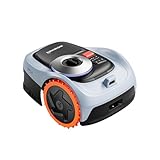
5. Segway Navimow i206 AWD – Best for Steep Hills
Segway Navimow i206 AWD Robot Lawn Mower, New i105N, 0.15 Acre, 45% Slopes
Covers 0.15 acre
All-wheel drive
Height 2 to 3.6 inch
20 app zones
GPS lift alerts
Pros
- All-wheel drive handles real slopes and uneven terrain
- Very quiet operation
- Steers smoothly around large trees
- Alternating patterns give attractive stripes
- Support has supplied free parts
Cons
- Auto mapping fails often and forces manual zone walking
- Maps can be lost if the mower is lifted
- Unmowed strip remains along fences
- Tall grass clumps take several passes
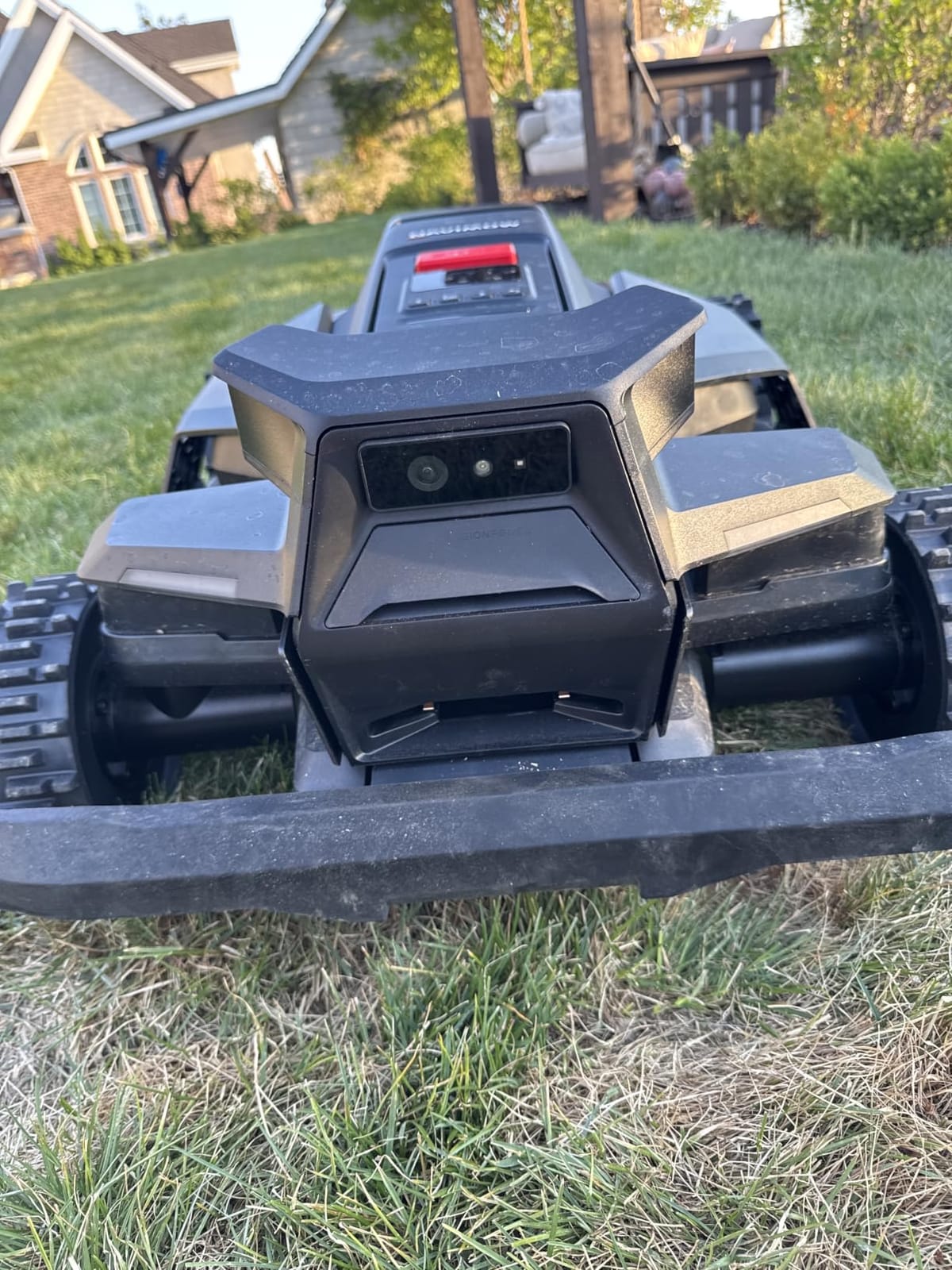
The i206 AWD is the mechanical answer to a hillside problem. All-wheel drive with automotive-grade stability control handles slopes up to 45 percent, matching the M9, and zero-turn steering lets it pivot without scraping turf during turns, which protects grass on the inside of every curve.
Owners who get past setup describe it as genuinely capable on uneven ground, very quiet in operation, and smooth around large trees. Several mention that support sent free parts and accessories when issues came up.
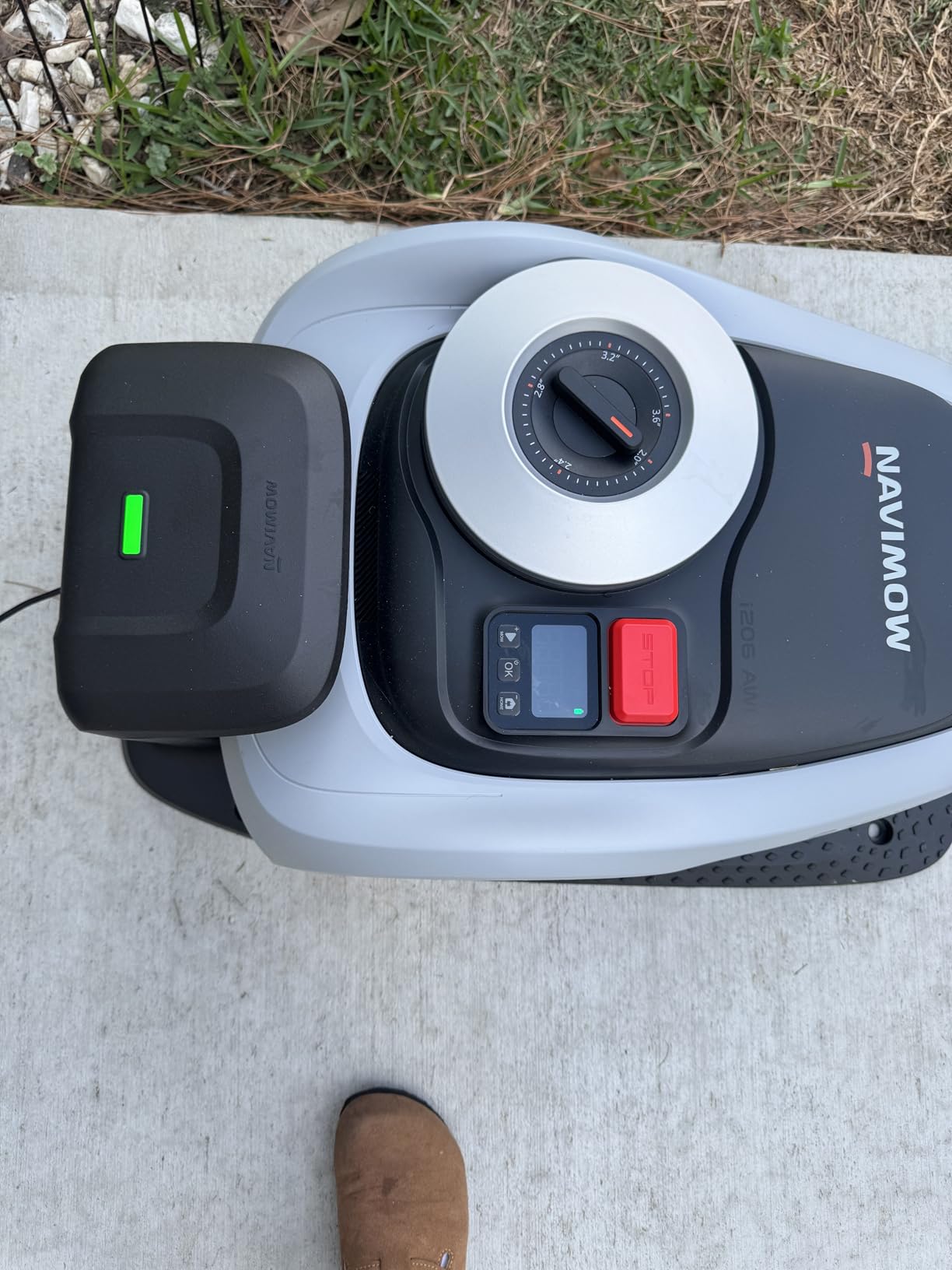
The rating is 4.0 across 68 reviews, and the distribution explains why. A large share of five-star reports sit alongside a meaningful block of one-star reviews, and the one-star group all points at mapping rather than mowing.
Auto mapping fails often enough that owners fall back to walking the mower around the perimeter themselves. Maps can also be invalidated if the machine is lifted even briefly during the mapping run, so do not reposition it once mapping starts.
What to check before you buy the Navimow i206 AWD
Run a slope test before purchase. Place a level or a phone inclinometer on your steepest section rather than trusting your impression of the yard as a whole.
Expect a persistent unmowed strip along fences even after manual boundary mapping. Budget a trim pass or accept a visible edge line.
Who should skip this model
If you dislike walking the perimeter to define zones, the mapping complaints will frustrate you. Several owners also report that in-app support has been unhelpful, which cuts against the otherwise responsive service experience.
The 2.5Ah battery covers up to 1,350 square feet per charge, so on 0.15 acre expect more than one recharge cycle per session.
6. YARDCARE V100 – Best Budget Pick for Small Lawns
YARDCARE V100 Automatic Robot Lawn Mower HD Vision for Lawn Max 1600 sq ft
Max lawn 1,600 sq ft
Cut width 6.3 inch
Height 0.8 to 2.4 inch
20 degree slope
27.9 pounds
Pros
- Simplest way to automate a small lawn
- Magnetic strip makes no-go zones quick
- Vision sensor plus bumper handles clutter
- Quiet and compact
- Three extra blade sets included
Cons
- Narrow 6.3 inch deck means long sessions
- Random path produces no stripes
- 1600 sq ft ceiling limits it to small yards
- Bumper recovery can leave ruts
The V100 holds the highest rating in this entire comparison at 4.8 across 58 reviews, with 93 percent of ratings at five stars. That is a small sample, but the consistency of the praise is striking: owners describe it as the simplest way to stop mowing a small lawn by hand.
Navigation here is vision-based with an integrated bumper rather than an RTK base station, which is why it needs no antenna and no app mapping process. It includes a 32-foot magnetic strip with 20 pegs, and pegging that strip around a flower bed or pool creates a no-go area in minutes.
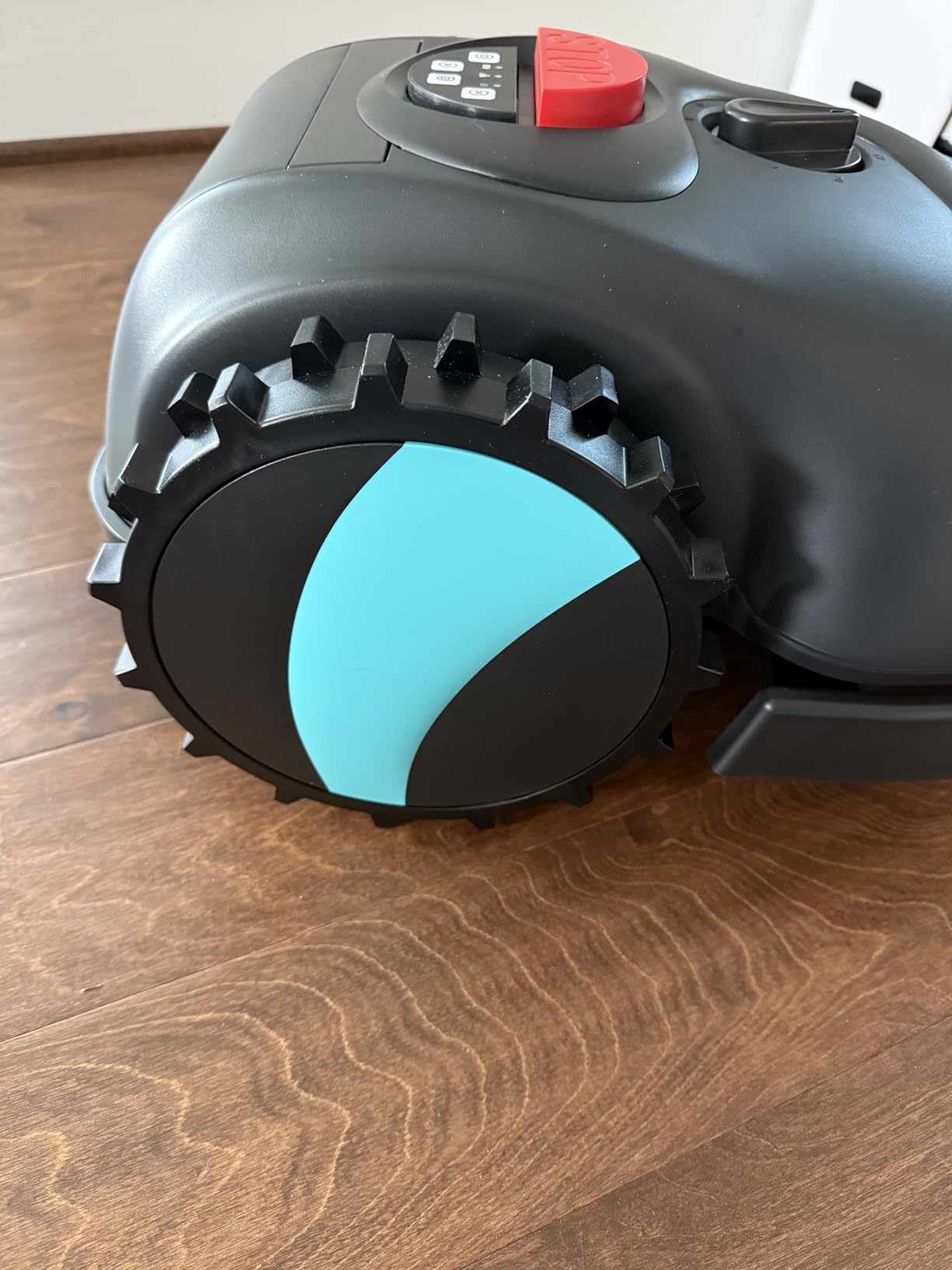
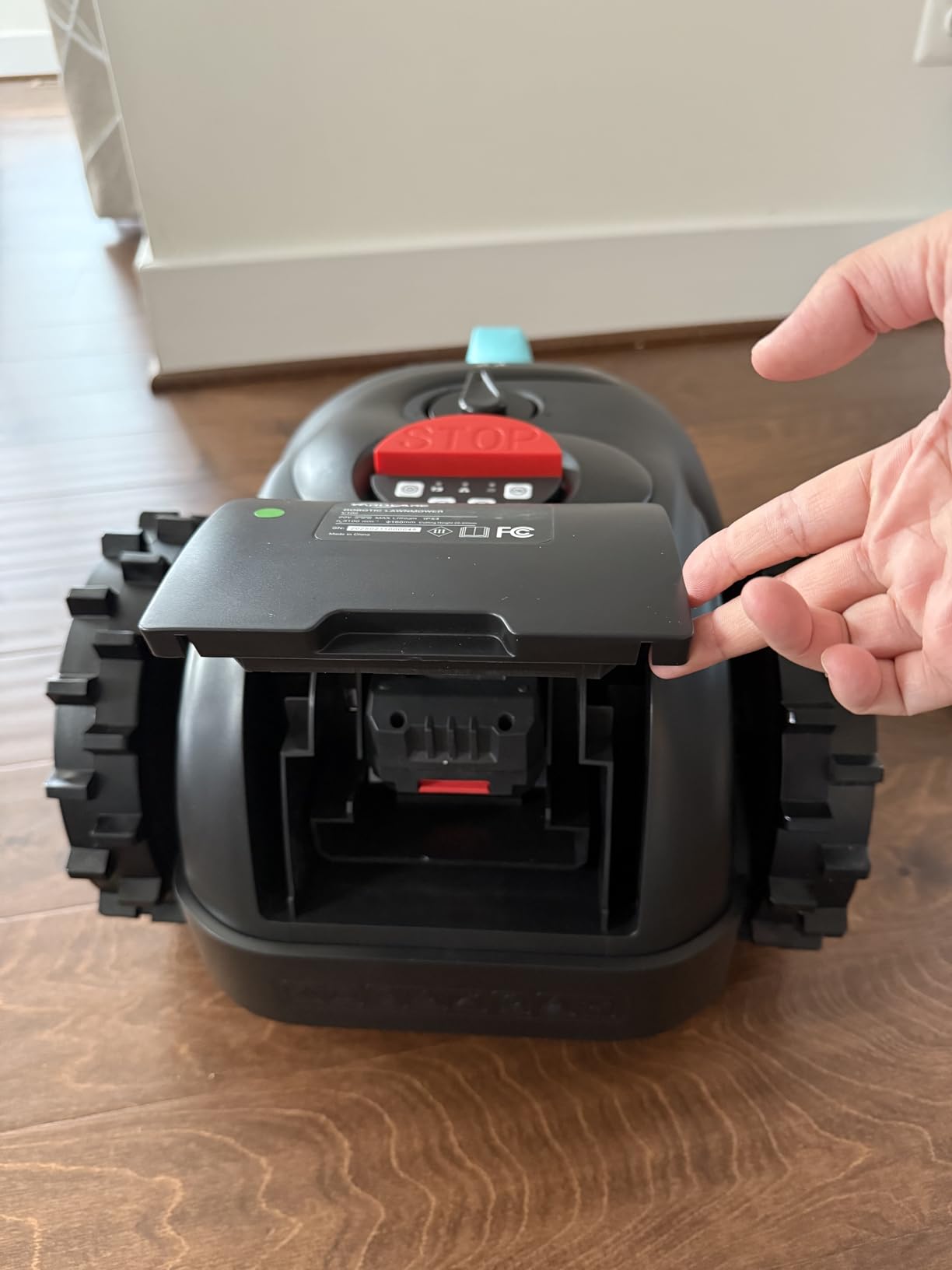
It also carries a tilt sensor, an emergency stop and a rain sensor, and the box includes a 4Ah battery, an 18V charger and three spare blade sets. Slope handling goes to 20 degrees.
The honest limitation is scale. With a 6.3 inch cutting width and a random mowing path, a 1,600 square foot lawn takes noticeably longer than its size suggests, and there are no stripes to show for it.
What to check before you buy the YARDCARE V100
Measure your lawn first. The 1,600 square foot ceiling is roughly a 40 by 40 foot square, so anything larger will not be finished in one pass.
Post-collision path adjustment handles blind spots when an obstacle sits where the camera cannot see it. Still expect the odd scrape against furniture legs or edging.
Who should skip this model
Skip it if you care about a striped finish. The random path produces no visible pattern, so a tidied look is not part of the deal.
Bumper-based recovery can leave ruts after collisions, which matters if your lawn is soft ground rather than firm soil.
7. Sunseeker X3 Plus – Best for Clean Edges
Sunseeker X3 Plus Robot Lawn Mower, RTK, Vision AI, 0.3 Acre, Wire-Free
Covers up to 0.3 acre
Cut width 8 inch
Height 1.6 to 3.2 inch
19.9 pounds
2-year warranty
Pros
- Ride-on-edge blade gives a close finish
- Steady near trees and fence lines
- Quiet enough for early or late runs
- Light enough to carry between zones
- US-based support responds quickly
Cons
- Repeated satellite calibration failures and false alerts
- Frequent self-locking needs daily checks
- Deep grass triggers failed mow jobs
- Mounting hardware for RTK cable not included
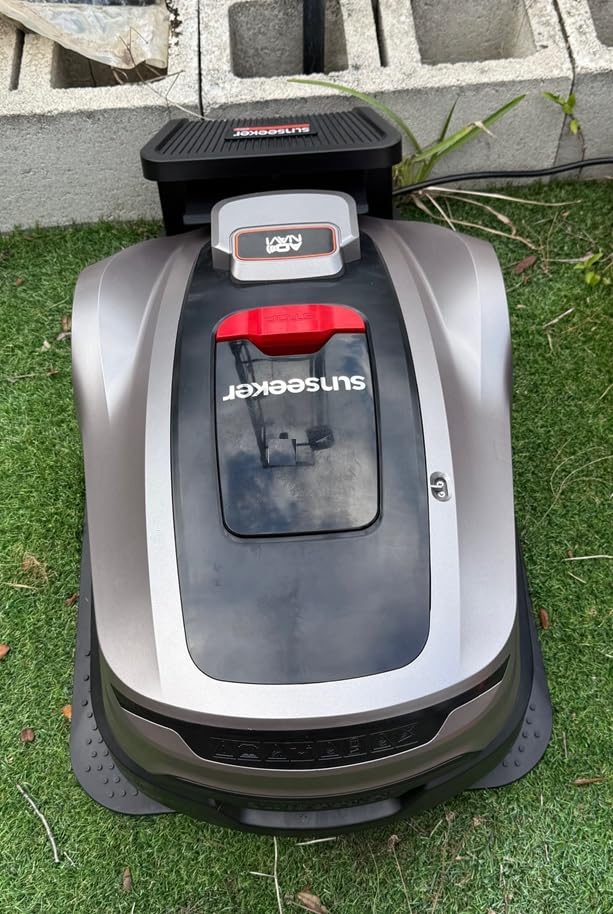
Almost every robot mower leaves a fringe of long grass along borders, and the X3 Plus is the one here built specifically to fix that. Its ride-on-edge offset blade is an 8 inch floating cut that adjusts from 1.6 to 3.2 inches, and owners single out the edge finish as the reason they kept this model.
At 19.9 pounds it is the second-lightest machine here, light enough to carry by hand to a second lawn. AONavi combines RTK with visual SLAM mapping, and the app holds six saved maps with boundaries, mowing areas and no-go zones.
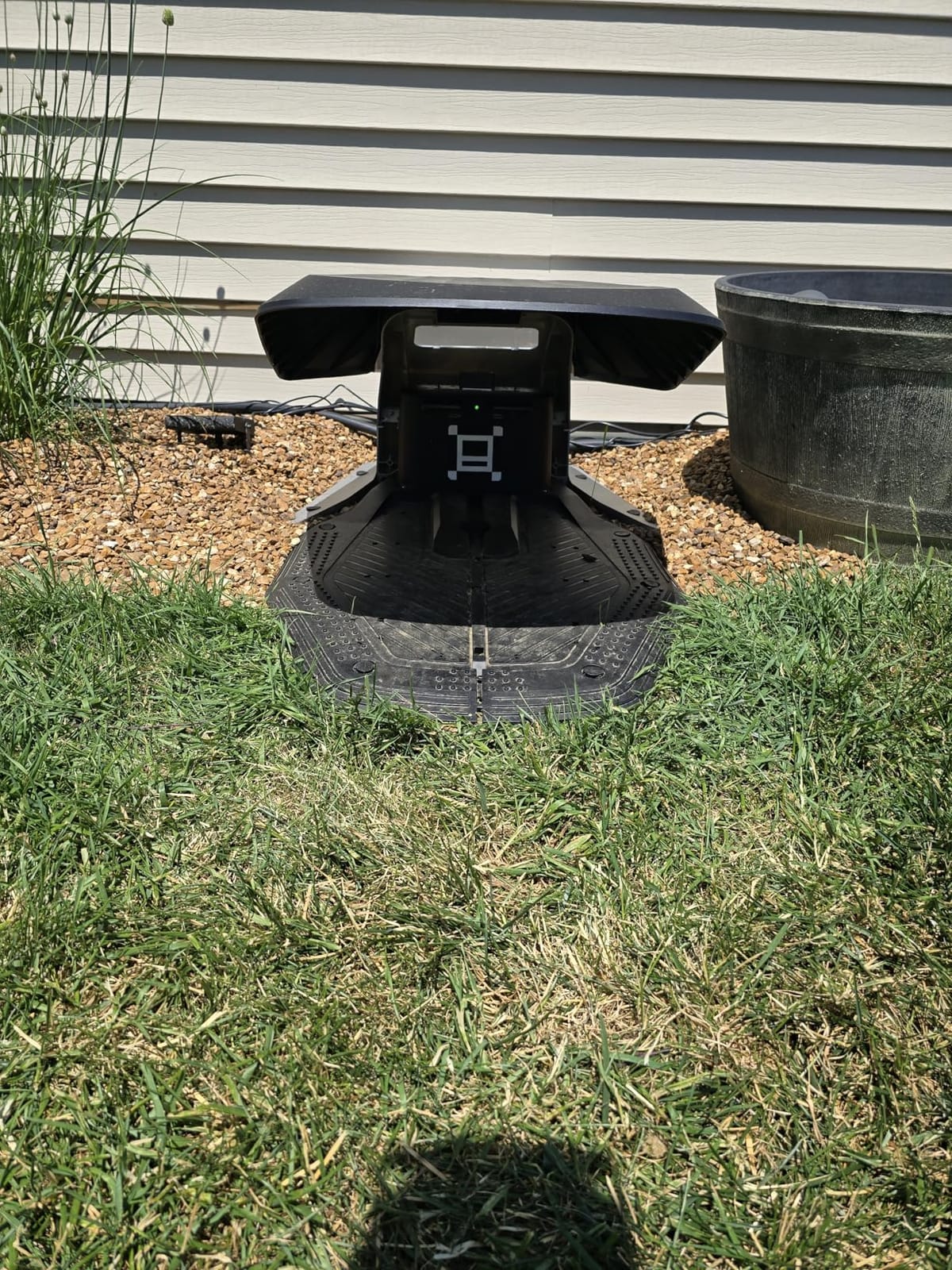
Coverage runs to 0.3 acre or 13,000 square feet, the largest figure in this group, and slope handling reaches 17 degrees or 30 percent. Operating noise is 60 dB with Wi-Fi, Bluetooth and voice control.
The 3.8 rating across 97 reviews is honest about the software. Owners report repeated satellite calibration failures, false out-of-bounds alerts and self-locking that requires a daily manual check.
What to check before you buy the Sunseeker X3 Plus
You will need to suspend the RTK cable across the lawn during installation, and the mounting hardware for that cable is not included in the box. Have your own hardware ready.
If you let grass get long, expect failed mow jobs. Owners report deep or long grass triggering stuck reports more than any other physical issue.
Who should skip this model
Skip it if you want a hands-off schedule. The daily self-locking checks described by owners undercut the main reason people buy a robot mower in the first place.
Some owners also report random rain detection and error messages appearing in a foreign language, which adds friction during troubleshooting.
8. WORX Landroid WR320 – Best for Quiet Nights and Warranty Cover
WORX Robot Lawn Mower for 1/2 Acre, No Perimeter Wire, WR320
Cloud RTK navigation
8.7 inch cut
Height 1.57 to 3.54 inch
30 percent slope
3-year warranty
Pros
- No perimeter wire magnet or antenna needed
- No cloud subscription fees
- Very quiet for night mowing
- Clean straight striping
- Handles tree-covered areas well
- Strong customer support
Cons
- Map edits require guiding the mower by hand
- Cloud RTK link fails without clear sky
- Blade height resets to maximum after rescues
- Phone joystick steers the wrong way
The WR320 is here as context: it sits above the ceiling this roundup is built around, so it is not a budget recommendation. It earns its place because it answers the most common question we get from buyers, which is whether cloud-based RTK carries hidden fees. On this model it does not.
Cloud RTK accuracy works without a local antenna installation and without cloud fees, which removes both a hardware step and a recurring cost. V-SLAM sensor fusion takes over in shaded or partially covered areas, and vision AI mapping distinguishes ridable edges from fixed borders for closer cut-to-edge results.
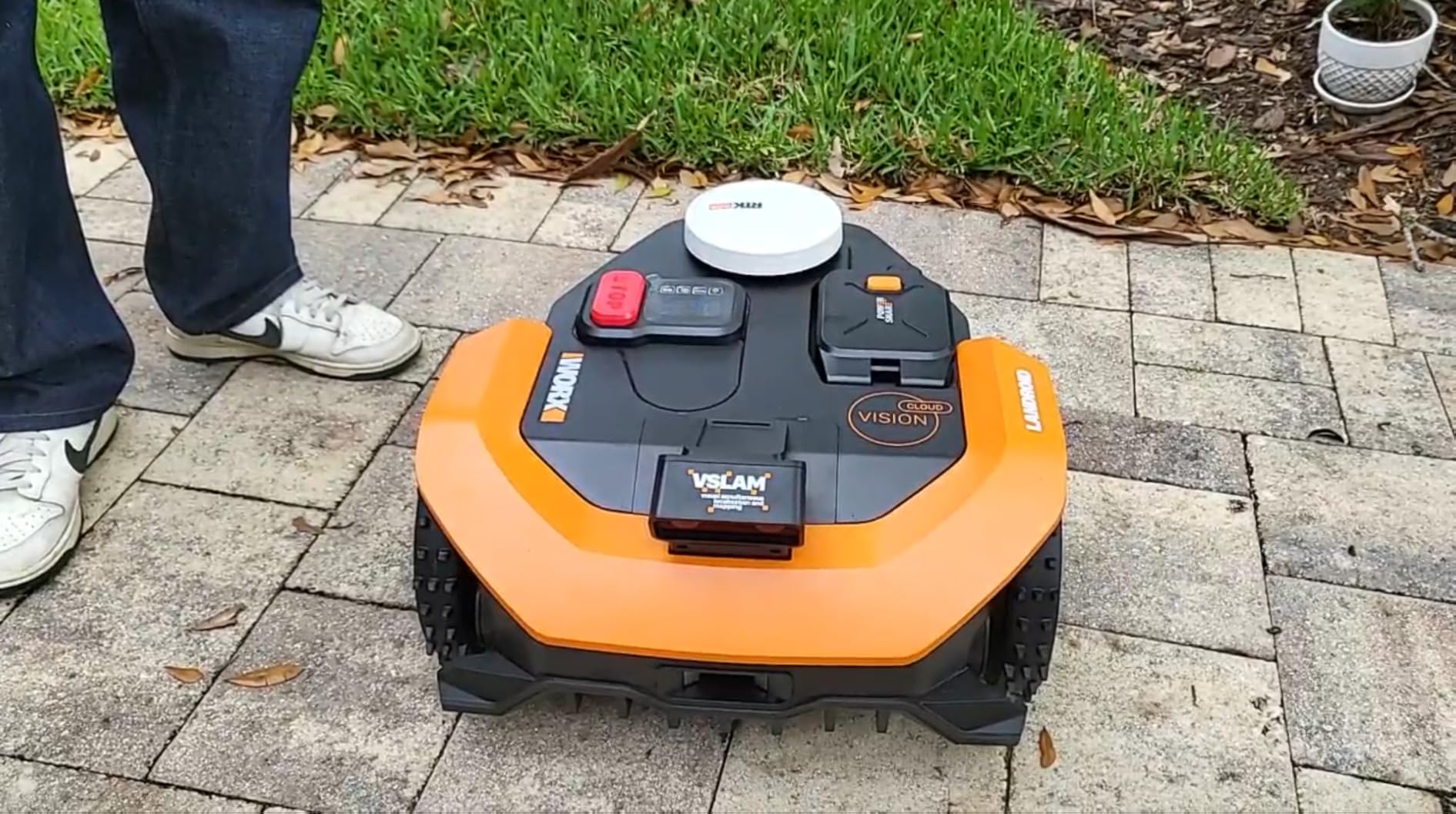
Striping is the best in this comparison. Parallel, Checkerboard, Diamond and Natural patterns produce straight, even lines that owners describe as looking professionally cut. Noise is low enough that night mowing is practical.
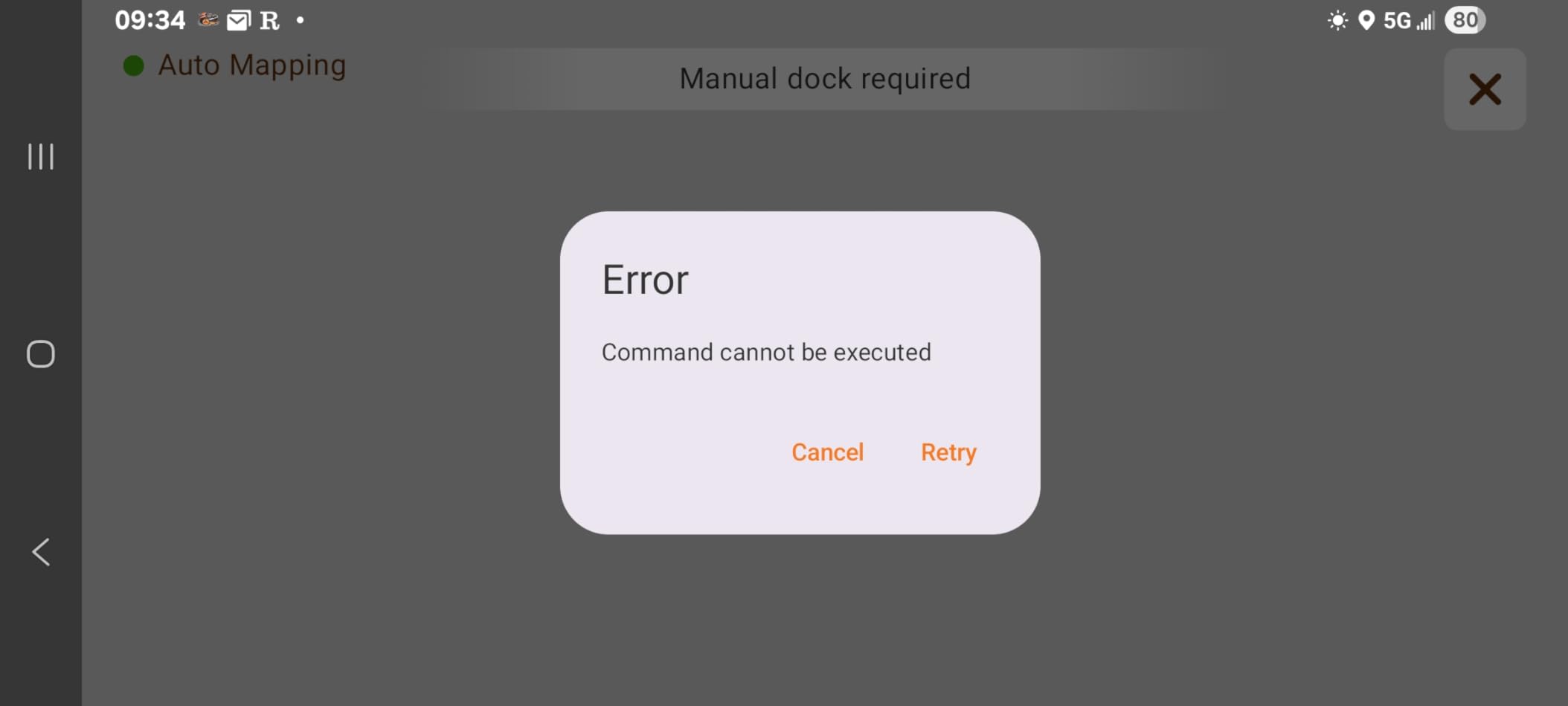
The 3.8 rating across 60 reviews reflects software friction. Map edits need the mower driven to each point, and the RTK cloud link fails in areas without clear sky, which blocks manual control until it reconnects.
What to check before you buy the WORX Landroid WR320
Check your sky view first. If your lawn sits in a narrow yard between two buildings with mature trees overhead, cloud RTK will struggle where a local base station would hold.
Test the app in your yard before committing. Owners report the on-screen joystick as inaccurate and frequently steering in the wrong direction.
Who should skip this model
Anyone on this budget should skip it on price alone. It is useful mainly as the answer to whether subscription fees are unavoidable in this category, and the answer is no.
Blade height settings do not persist after the machine is rescued, and weak edging leaves grass along borders and shrubs, so expect a trim pass.
Boundary Wire vs RTK vs Vision: What Navigation Costs You
Under 1000 dollars you will not find a wired mower worth buying, so the real decision is between two wire-free approaches: RTK satellite positioning with a base station, and vision-based mapping using cameras alone, sometimes with a bumper as backup. Most of the strongest models here combine both.
RTK with a base station gives centimeter-level accuracy and needs an open view of the sky. A signal correction reference station sits at the edge of your lawn, which takes up space and forces a careful placement decision. When the signal holds, nothing on the market at this budget navigates better.
Vision-only navigation needs no antenna and no reference station, so setup is genuinely faster. The trade-off is that it learns the lawn by seeing grass and obstacles, so unfamiliar lighting or a shadow across the yard can slow it down. The YARDCARE V100 is the clearest example of this approach, and its 4.8 rating suggests it works well when the lawn is simple.
Hybrid RTK plus vision, used by the Navimow i105N, the ANTHBOT M9, the Sunseeker X3 Plus and the YARDCARE M800Plus, is where accuracy and flexibility meet. When RTK drifts near trees or walls, the camera holds the line. When a camera loses its bearings in low light, RTK corrects.
The failure mode to understand is signal loss under heavy tree cover. Owners on wooded lots report the mower pausing, re-acquiring and occasionally logging a fault. If your lawn is more than half shaded by mature canopy, weight models with dual cameras and obstacle detection rather than single-sensor GPS units.
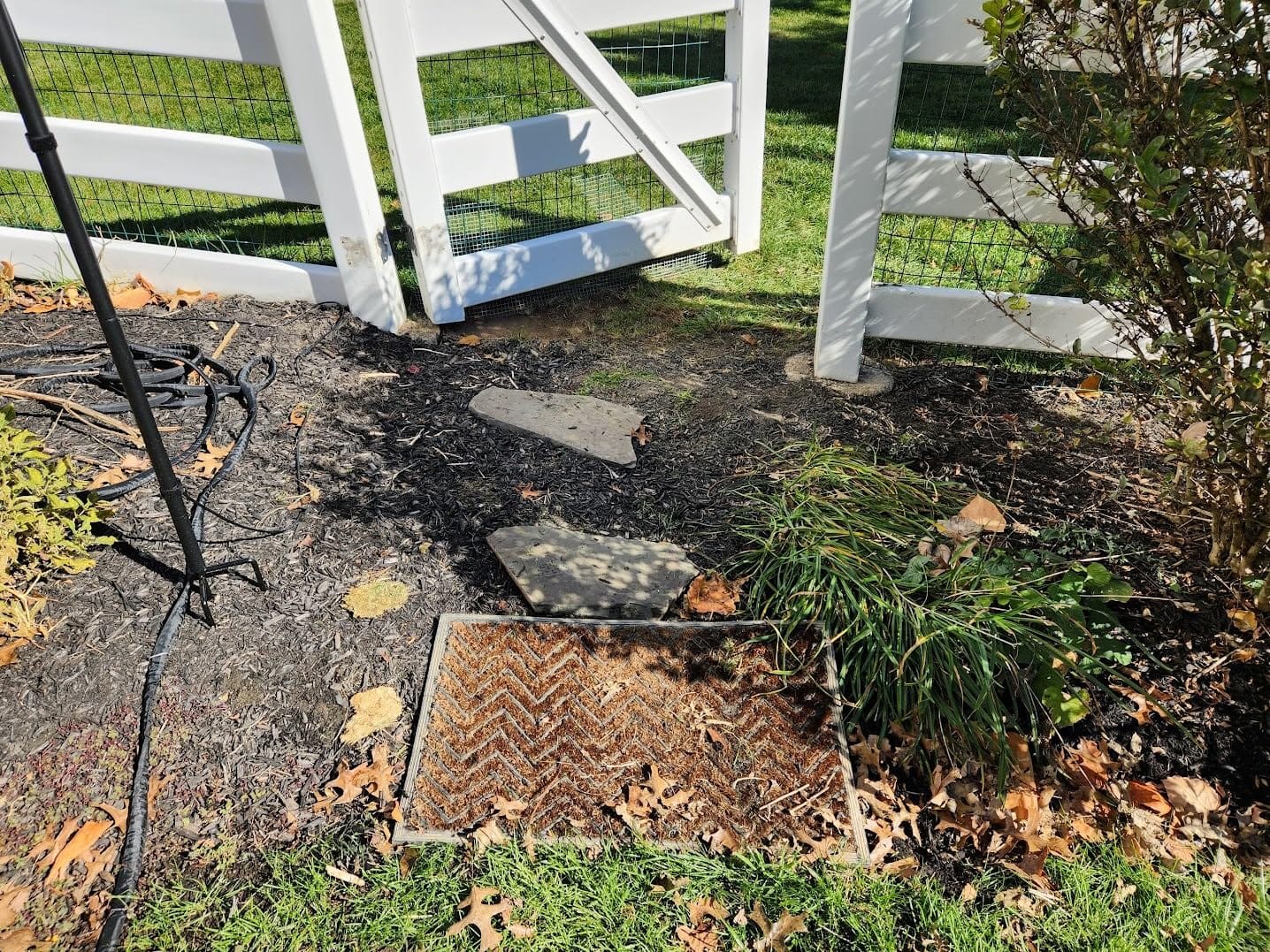
One more factor separates the models with a base station from those without: where the hardware physically sits on your property. A reference station needs an unobstructed patch of sky, a flat spot near a power outlet, and enough clear ground for the mower to dock. Yards hemmed in by fences, garages and mature trees can leave you with nowhere sensible to put it.
That constraint is why several models here ship an RTK extension cable. It lets you mount the antenna on a pole, a wall or a fence line at a distance from the charging dock, which recovers a surprising number of awkward yards. Check whether the cable is in the box before you plan your install around it.
Matching a Mower to Your Yard Size and Steepest Slope
Coverage ratings are maximums under ideal conditions. A mower listed for a quarter acre will struggle with that lawn if it is dense, tree-covered or steep, because it mows slower on slopes and spends time re-charging. For most buyers, buying one size down is the safer decision.
For lawns up to about 2,000 square feet, the YARDCARE V100 is the realistic fit. Above that, the YARDCARE M800Plus at 8,611 square feet and the Navimow i105N at one eighth acre cover simple suburban lots. For a quarter acre with open sightlines, the ANTHBOT M9 and the Sunseeker X3 Plus give you the most headroom.
Slope capability deserves more attention than coverage. Two-drive models here top out between 20 and 30 percent. The ANTHBOT M9 and the Navimow i206 AWD claim 45 percent, and the i206 achieves it with all-wheel drive and stability control rather than software.
Measure your steepest slope properly before choosing. Place a straight level on the ground and measure the rise, then compare it against the run. The difference between a 20 percent and a 30 percent grade is the difference between a driveway and a steep hill, and only a handful of these models handle the latter.
Total Cost of Ownership: What the Purchase Price Does Not Cover
Budget buyers should plan for three costs beyond the machine itself: blades, accessories and your own time. None of them is large, but together they are the difference between a two-year ownership experience and a five-year one.
Blades come up more often than buyers expect, particularly on the 6.3 inch and 7 inch decks where each blade covers less ground per pass. The ECOVACS CARE bundle solves this with 36 spare blades, and the YARDCARE V100 includes three extra sets.
Accessories vary widely. The ANTHBOT M9 is the only model here with a garage in the box, and owners of the Navimow i105N frequently note that a garage or antenna shelter has to be bought separately. The Sunseeker X3 Plus needs RTK cable mounting hardware that is not supplied.
Subscriptions are the item most guides leave out. Cloud RTK models can carry recurring fees for positioning services, which is why the WR320 is worth knowing about even though it sits above this budget: it proves the fees are not unavoidable. Check the app terms before buying any cloud-based model.
Add in time. Edging with a string trimmer, clearing clippings that are not mulched, and resetting a mower that locks itself out all cost effort rather than money. Two of the eight models here mulch nothing, so plan a raking or mowing pass for the clippings they leave on the lawn surface.
Setup and Seasonal Care: Five Steps, Then Park It
Wire-free setup is faster than it used to be, but the first afternoon still decides whether you enjoy the machine. Our recommended order: charge the mower fully, place the base station where it has open sky and a flat path to the lawn, install any antenna hardware before the first mapping run, then map with the mower stationary rather than carrying it mid-map.
After mapping, set the mowing schedule, set the cutting height, and define no-go zones last. Owners who rush this stage end up editing boundaries later, and every edit on most of these machines means driving the mower to the point you want changed.
For winter, the sequence matters. Clean the deck of grass and mud, sharpen or replace worn blades, and store the machine somewhere dry and between roughly 40 and 80 degrees. Leaving a battery in a freezing garage is the fastest way to shorten its life.
Charge the battery to a partial level rather than full before a long storage, and check it once a month. Do not store the mower with clippings packed under the deck, which attracts moisture and smells that are hard to remove later.
Come spring, run the mower manually for a few minutes before scheduling unattended jobs. That single check catches stuck blades, a dead charger and low battery all at once.
Buying Guide: How to Choose a Robot Mower Under 1000
Start with slope, then coverage, then everything else. A mower that handles 45 percent will mow a flat lawn perfectly well, so buying extra slope capability costs you nothing if your ground is level. The reverse is not true, which is why the steepest-slope measurement should come first.
Next, decide how much app involvement you want. The models with the smoothest apps here, the Navimow i105N and the ANTHBOT M9, reward owners who enjoy adjusting zones. If you would rather set a schedule once and forget it, test the app in the store or read the recent one-star reviews, which concentrate on software.
Then check the accessories honestly. Ask whether you need a garage, extra blades, a magnetic strip or cable mounting hardware, and compare those against what each box already contains. The difference between the two YARDCARE models on this list is largely accessory philosophy.
Grass type matters more than most buyers expect. Fine-bladed fescue and Kentucky bluegrass suit the 1.6 to 3.2 inch ranges common here, while Bermuda and Zoysia prefer the lower end of each range. If your lawn is a warm-season grass, check the minimum cutting height before buying, and never let any of these machines run on grass taller than about 2.6 inches without a manual pass first.
Finally, think about noise and schedule. Every model here runs between 58 and 62 dB, which is quieter than most people expect. The 58 dB machines open up early morning and late evening scheduling; the 62 dB model is still fine but slightly less polite to neighbors.
If you want a comparison point outside this category, our guides to zero turn mowers and residential zero turn mowers cover the ride-on alternative, and riding lawn mowers covers larger properties where a robot cannot reach.
Frequently Asked Questions
What is the best robotic lawn mower for the money?
The Segway Navimow i105N is the best robotic mower under 1000 dollars for most yards. It combines RTK positioning with a 140-degree camera, covers up to one eighth acre, manages up to 12 zones in the app and runs at 58 dB. It also carries a three-year warranty, which is unusual at this price.
What is the best budget robot mower?
The YARDCARE V100 is the best budget pick, rated 4.8 across 58 reviews. It uses vision-based navigation with no antenna or base station, includes a 32-foot magnetic strip for marking no-go zones, and handles slopes up to 20 degrees. Its ceiling is 1,600 square feet, so it suits small lawns only.
Are robot lawn mowers worth it for small yards?
For a small yard, they are worth it if your lawn is roughly 2,000 square feet or less and you value quiet, unattended mowing. Budget models in this roundup handle that size comfortably. The trade-off is speed, since narrow cutting widths of 6.3 to 7 inches lengthen sessions on anything larger.
Do robot mowers work on slopes?
They work on slopes up to each model’s rating. Two-drive models here handle 20 to 30 percent, while the ANTHBOT M9 and the Segway Navimow i206 AWD reach 45 percent using all-wheel drive and stability control. Measure your steepest slope before buying, since traction drops as grass gets wet.
Do robot lawn mowers need a boundary wire?
Not at this budget. All eight models here are wire-free, using RTK positioning, vision cameras or a combination of both. Two models add a magnetic strip for no-go zones around flower beds or pools. One budget model, the YARDCARE V100, uses a physical bumper as a backup to its camera.
How long do robot lawn mowers last?
Longevity depends far more on care than on brand. Charging the battery, cleaning the deck and storing the mower in a dry place between roughly 40 and 80 degrees extends its life noticeably. Blade replacement is the most frequent maintenance task, which is why bundles with spare blades, such as the ECOVACS CARE kit, are worth noting.
The Verdict: Best Robotic Mowers Under 1000
Pick the Segway Navimow i105N if you want the most dependable navigation and quietest running in this group. Pick the ANTHBOT M9 if your yard has real slopes or you want the garage included. Pick the YARDCARE V100 if your lawn is small and you want the simplest possible machine.
For larger quarter-acre lots, the ECOVACS Goat O1000 RTK CARE covers the most ground per charge, and the Sunseeker X3 Plus gives the cleanest edges. Measure your steepest slope before you commit, because that single number eliminates half of these options.
We update this roundup as 2026 brings new models and revised firmware, and every rating above comes from the review set attached to the listing, not from a single test unit.