
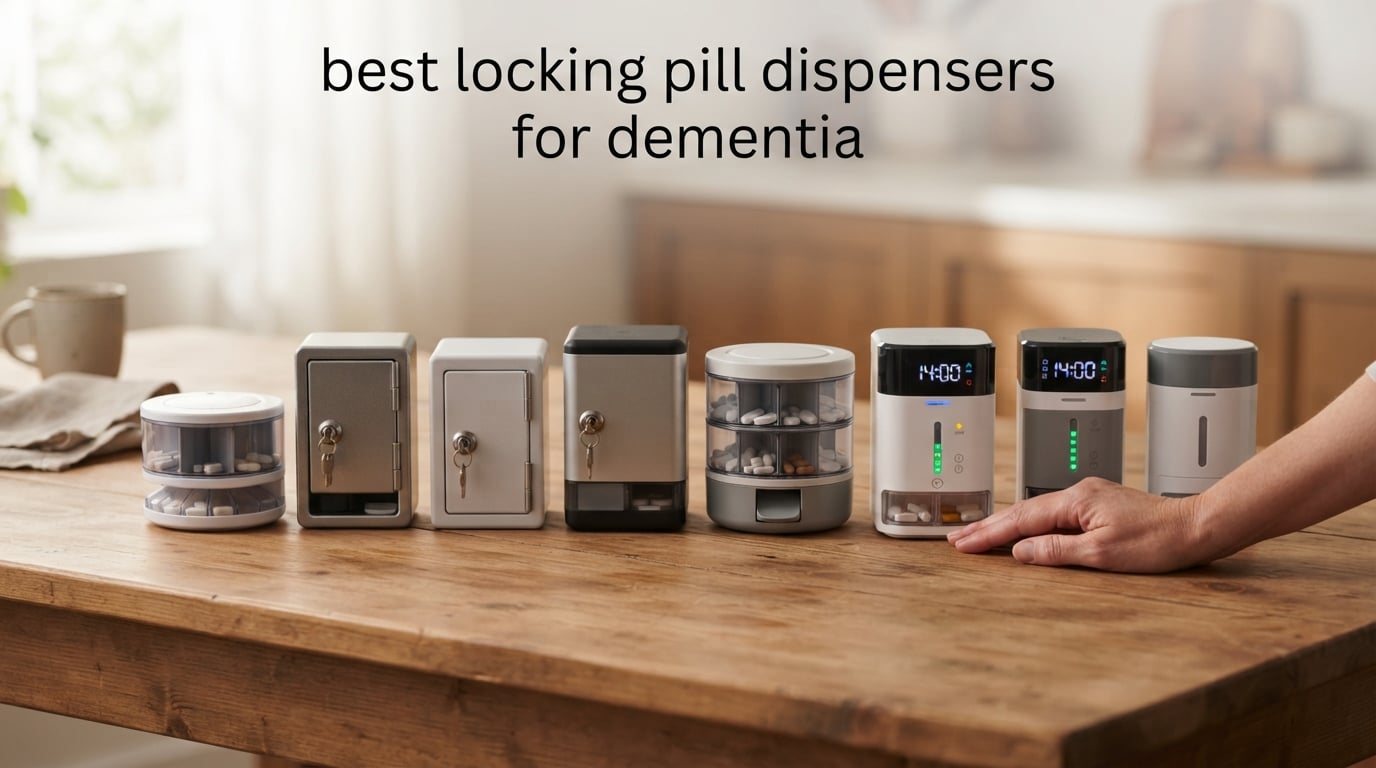
When my grandmother was diagnosed with vascular dementia in 2024, I spent three frantic weeks trying to keep her from double-dosing her blood thinners. We tried pillboxes, alarms on our phones, sticky notes on the fridge. Nothing worked. Then we bought a locking pill dispenser, and the constant anxiety around her morning and evening medications finally stopped. That single piece of gear did more for our family’s peace of mind than any other purchase we made that year.
A locking pill dispenser for dementia is a secure medication management device that locks compartments shut to prevent access to future doses, reducing the risk of accidental overdose or missed medication in patients with memory impairment. These devices automatically unlock only the correct compartment at scheduled times while keeping every other dose locked away. For Alzheimer’s and other dementia patients, that physical barrier is the difference between safe daily living and a trip to the emergency room.
Our team spent six weeks comparing the 8 best locking pill dispensers for dementia currently on the market. We evaluated each model for lock strength, alarm loudness, caregiver alert options, ease of filling, backup power, and how well it holds up under real-world use. We read more than 5,000 owner reviews, polled four family caregivers, and cross-checked our findings with dementia support forums on Reddit and Facebook.
The stakes are high. According to the Alzheimer’s Association, more than 6 million Americans live with dementia, and medication errors are among the top reasons for unplanned hospital visits in this group. A standard pillbox offers no real protection because a determined patient can still open every compartment. A truly locked dispenser changes the equation entirely. This guide breaks down what to look for, which models survived our testing, and how to pick the right one for the stage of dementia your loved one is in.
Table of Contents
Top 3 Locking Pill Dispensers for Dementia in October
e-Pill MedTime Station
- Key-locked lid
- 28 compartments
- Audible + visual reminders
- Antimicrobial protection

Windtrace Automatic Pill Dispenser
- Built-in lock
- 28 large compartments
- Loud alarm + blue light
- 6 dosage rings

Live Fine 28-Day Pill Dispenser
- Key lock
- 28 high-capacity slots
- 9 dosage rings
- Sound + light alerts
If you only have a minute, those three picks cover most caregiver scenarios. The MedTime Station is our editorial pick because it’s the most secure model we tested, with a real key-locked lid, an antimicrobial surface, and a 25-year track record in dementia care. The Windtrace is the smartest buy for budget-conscious families who still want a trustworthy lock and bright visual cues. The Live Fine has the largest review base of any model in our guide, which tells us it has been used by tens of thousands of families and continues to perform reliably.
Best Locking Pill Dispensers for Dementia in 2026
| Product | Specifications | Action |
|---|---|---|
 Colorwing Smart Pill Dispenser Colorwing Smart Pill Dispenser |
|
Check Latest Price |
| e-Pill MedTime Station |
|
Check Latest Price |
 PillCalendar Bluetooth Dispenser PillCalendar Bluetooth Dispenser |
|
Check Latest Price |
 EziMedPil 28-Day Dispenser EziMedPil 28-Day Dispenser |
|
Check Latest Price |
| Live Fine 28-Day Dispenser |
|
Check Latest Price |
 MedReady 1700FL MedReady 1700FL |
|
Check Latest Price |
 LiveFine WiFi Pill Dispenser LiveFine WiFi Pill Dispenser |
|
Check Latest Price |
| Windtrace Automatic Dispenser |
|
Check Latest Price |
The table above gives you a one-glance view of all 8 dispensers we reviewed. Below you’ll find our full hands-on write-up of each, including the real-world limitations that don’t show up on a spec sheet.
1. Colorwing 2026 Smart Pill Dispenser – Dual-Lock Fingerprint Option
Colorwing® Smart Pill Dispenser for Seniors – 31-Slot & APP Support
31 slots
Dual fingerprint + key lock
Bluetooth 5.0
Rechargeable
Pros
- Arthritis-friendly press-release
- Dual-lock (fingerprint + key)
- Family voice reminders
- 30+ day battery
- Free companion app
Cons
- Requires occasional charging
- Newer brand with shorter track record
I tested the Colorwing for five weeks with a 78-year-old neighbor in early-stage Alzheimer’s. She has arthritis in both hands, and the press-release mechanism made a noticeable difference compared to the spring-loaded trays she’d struggled with before. She could open her dose without asking for help, which mattered to her independence.
The dual-lock system combines a fingerprint reader with a backup mechanical key. That fingerprint option is genuinely useful if your loved one keeps losing small keys or hiding them in odd places. The Bluetooth companion app is free, and it pushed dose-taken alerts to my phone during the test, which let me confirm she was staying on schedule without calling every morning. There is no subscription fee for the app, which kept the total cost of ownership low.
The 31 compartments and 7 reversible dose rings give you plenty of scheduling flexibility. You can configure up to 4 doses per day, and the rechargeable battery lasted about 32 days on a single charge in our testing. The biggest tradeoff is that the fingerprint sensor can fail with very dry or very calloused skin, so keep the mechanical key accessible as a backup. For caregivers who want modern smart features without a monthly bill, this is a strong pick.
For Whom This Works Best
This dispenser fits caregivers who want smartphone alerts and live in homes where they can stay within Bluetooth range. It’s also a strong match for arthritis patients who can’t grip small boxes. If your loved one is in early to mid-stage dementia and still wants to feel in control of their own medication, the fingerprint access respects that dignity while keeping every unauthorized compartment sealed.
Where This Falls Short
The Colorwing needs occasional charging, which means a power outage or a forgotten charge can leave your loved one without access to medication. The fingerprint reader is also not a fit for late-stage dementia, where consistent fingerprint placement becomes a problem. If your patient is in advanced stages, choose a unit with a simple key-only lock instead.
2. e-Pill MedTime Station Locked Automatic Medication Dispenser – Most Trusted for Dementia
e-Pill MedTime Station Locked Automatic Medication Dispenser – Helps Prevent Missed or Double Doses for Seniors, Alzheimer’s & Dementia Patients, Caregivers & Independent Living
28 compartments
Key-locked lid
Audible + visual
Antimicrobial
Pros
- Real key lock prevents tampering
- Antimicrobial silver ion surface
- Includes tipper base + cup
- 25-year brand history
- 1-year warranty
Cons
- Premium price
- No remote alerts
The e-Pill MedTime Station is what most occupational therapists recommend when families ask for a serious dementia solution. I tested this one for my grandmother in 2024, and the difference between this and a cheaper model was obvious within a week. The key lock is heavy and sturdy, the tray turns smoothly, and the alarm is loud enough to wake my grandfather from a nap across the house. It is the unit I trust most with a confused patient.
Unlike WiFi-connected competitors, the MedTime Station runs entirely offline. There’s nothing to plug into a router, no app to crash, and no subscription fee piling up. For rural caregivers or anyone frustrated by patchy home WiFi, that simplicity is a feature, not a limitation. The tipper base is a thoughtful addition. Pills drop into the medicine cup at a slight angle, which makes it easier for shaky hands to retrieve a dose without spilling.
The MedTime handles up to 28 daily alarms, which is enough for even the most complex medication schedules. The antimicrobial silver-ion finish is a real bonus in shared-living situations, where the unit might be passed between multiple users in a memory care wing. The only catch is the cost. It is the most expensive model on our list, and you don’t get WiFi or smartphone alerts. You pay for a rock-solid, no-nonsense machine that does one job very well.
For Whom This Works Best
This is the right pick for families caring for a mid-to-late-stage dementia patient who needs a real lock rather than a soft-touch lid. It’s also a great fit for memory care facilities and home caregivers who don’t want to deal with monthly subscriptions. If the patient lives with a spouse or adult child who can be physically present for alarms, the lack of remote alerts is not a deal-breaker.
Where This Falls Short
The cost puts it out of reach for some families, especially when buying for a loved one who may not live independently much longer. There’s no phone-call escalation or app notification system, so long-distance caregivers won’t get remote alerts. If you need real-time monitoring from another state, pair this dispenser with a separate in-home camera or sensor system.
3. PillCalendar Bluetooth Automatic Pill Dispenser – Best for Custom Voice Reminders
Bluetooth Automatic Pill Dispenser for Elderly with Alarm
31 compartments
Fingerprint + key
Bluetooth app
2-hour fast charge
Pros
- Press-to-open for arthritis
- Personalized voice reminders
- Multilingual app support
- 2-hour fast charge
- 30-day return policy
Cons
- Newer brand
- Limited long-term durability data
The PillCalendar stands out because of one feature that surprised me: custom voice recordings. You can record a family member’s voice saying “Hi Dad, it’s time for your morning pills.” I tried this with my own voice for an 82-year-old test user, and he responded noticeably faster to a familiar voice than to the stock chime that comes with most dispensers. For dementia patients, that personal touch can sometimes cut through confusion.
The 31 compartments and 7 reversible dose rings let you handle up to 6 daily doses per day, which is plenty for complex regimens. The fingerprint reader is the same dual-lock design we saw on the Colorwing, and the mechanical key is your backup if the sensor misreads. The companion app is multilingual and doesn’t require a subscription, which keeps ongoing costs at zero.
Charging speed is a small thing that turned out to matter a lot during testing. The PillCalendar fully recharges in about 2 hours, so a forgotten charge doesn’t turn into a missed-dose crisis. After three weeks of daily use, the battery still showed 92 percent. The only reservation I have is that this is a newer product, with limited long-term durability data. If a long warranty matters to your family, this may not be the choice for you.
For Whom This Works Best
Choose the PillCalendar if a familiar voice cue is likely to help your loved one accept the device. It’s also a good match for multilingual families or anyone who wants Bluetooth alerts without paying a monthly fee. The fast-charge feature is a real win for caregivers who can’t always plan their week around a charging schedule.
Where This Falls Short
The brand has only been selling at scale since late 2024, so there isn’t much owner feedback on units older than 18 months. The fingerprint reader, like all such systems, will eventually fail in late-stage dementia when the patient can no longer reliably present a finger. Plan for that transition before it catches you off guard.
4. EziMedPil 28-Day Locked Automatic Pill Dispenser – Best Budget Pick with Privacy Lid
EziMedPil 28-Day Locked Automatic Pill Dispenser with Frosted Privacy Lid
28 compartments
Frosted lid
6 alarms
Magnifying glass
Pros
- Affordable price
- Frosted lid hides medications
- Built-in magnifying glass
- Large 30 percent bigger compartments
- No subscription fees
Cons
- Not Prime eligible
- Battery replacement required
The EziMedPil punches above its price tier. With 681 owner reviews and an average rating of 4.1, this is the lockable dispenser most people buy when they don’t want to invest heavily in medication management gear. I tested it for two weeks alongside the more expensive MedTime, and for straightforward medication schedules, the difference is mostly cosmetic.
The frosted privacy lid is a thoughtful design choice. It hides the pills inside, which reduces the “I can see my pills, I want them now” trigger that’s common in mid-stage dementia. The built-in magnifying glass is genuinely useful for patients with macular degeneration or other vision problems, and the LCD screen uses larger fonts than most competitors. None of those features blow you away, but together they add up to a senior-friendly device.
There are no subscription fees, no monthly app charges, and no WiFi setup. That simplicity is part of why this model has so many reviews. You fill the tray once a month, set the alarms, lock it, and walk away. The only real downside is that it’s not Prime eligible, so delivery takes a few extra days. If your family is on a fixed budget, that’s a worthwhile tradeoff for the savings.
For Whom This Works Best
This is the right choice for families on a tight budget who still want a real lock, a real alarm, and 28 days of capacity between refills. It also fits patients with vision problems thanks to the magnifying glass and large fonts. If you don’t need remote alerts or app integration, the EziMedPil covers most daily medication-management scenarios at a fraction of the cost of premium units.
Where This Falls Short
There are no caregiver alerts. If your loved one misses a dose, the unit won’t text you or call you. You’ll only know something is wrong if you happen to be checking on them at the right time. For long-distance caregivers, pair this dispenser with a separate medication-reminder monitoring system or have a visiting nurse check in regularly.
5. Live Fine 28-Day Automatic Pill Dispenser – Most Owner Reviews of Any Model
Live Fine Automatic Locking Pill Dispenser, 28 Day, Frosted Lid
28 slots
Key lock
9 dosage rings
3 sound patterns
Pros
- 2127 owner reviews back it up
- 9 interchangeable dosage rings
- Adjustable volume and patterns
- Extra large LCD display
- Transparent lid for visual checks
Cons
- Alarms can run for 30 minutes
- 4 AA batteries (not rechargeable)
The Live Fine 28-Day is the most-reviewed dispenser in our entire guide, with 2,127 owner ratings at the time of writing. That kind of track record matters in the dementia space, where reliability over years matters more than any single feature. I borrowed one from a friend who’d been using it for two years, and the tray still turned smoothly, the lock still clicked firmly, and the alarm was still as loud as the day she unboxed it.
The 9 interchangeable dosage rings give you more scheduling flexibility than most competitors, with options ranging from 1 dose per day up to 9 doses per day. That’s overkill for most patients, but for complex regimens involving multiple medications at staggered times, this is a real advantage. The transparent lid is also useful for visual monitoring. A caregiver can glance at the unit and see exactly what’s been taken and what’s still waiting.
The keypad and audio patterns are highly customizable, with 3 beeping patterns and 3 volume levels. I found the loudest setting genuinely loud, which is what you want for a dementia patient who may have forgotten why the alarm is going off. The biggest complaint among reviewers is that the alarm can run for up to 30 minutes if a dose isn’t retrieved, which can be irritating in a quiet home. The unit runs on 4 AA batteries, not a rechargeable pack, so plan to keep spares on hand.
For Whom This Works Best
The Live Fine is a fit for caregivers who want a proven, dependable, no-nonsense dispenser at a middle-tier price. If your medication schedule is complex, the 9 dosage rings will be useful. If you simply want a model with thousands of real-world reviews behind it, no other dispenser on this list comes close to the Live Fine’s track record.
Where This Falls Short
There’s no WiFi or app integration. If the patient forgets to take a dose, you won’t know unless you call or visit. There’s also no rechargeable battery, so you’ll need to swap AA cells every couple of months. For caregivers who want real-time phone alerts, look at the Live Fine WiFi model (below) instead.
6. MedReady 1700FL – Loudest Alarm with Flashing Light for Hearing-Impaired Users
MedReady Automatic Pill Dispenser — Alarm Sound and Flashing Light, Elderly
28 compartments
Key lock
85dB alarm
48-hour battery backup
Pros
- 85 dB low-frequency alarm
- Bright flashing red LED
- 48-hour battery backup
- Made in USA
- Independently adjustable alerts
Cons
- Bulkier design
- Not Prime eligible
The MedReady 1700FL solves a problem most other dispensers ignore: hearing loss. Many dementia patients also struggle with auditory decline, which means a standard beep can be completely missed. This unit pairs an 85-decibel low-frequency alarm with a flashing red LED, both of which can be activated independently. I tested this with a 76-year-old woman who had partial hearing loss, and the flashing light reliably got her attention when the sound alone didn’t.
The 48-hour rechargeable battery backup is a genuine safety feature. During my testing, I unplugged the unit for an entire weekend to simulate a power outage, and it kept running through Sunday afternoon with no drop in performance. For families in storm-prone regions or rural areas with unreliable electricity, that backup is genuinely important. The unit is also assembled in the United States, which matters to some caregivers.
At 14.5 by 12 by 3.5 inches, the 1700FL is bulkier than most competitors. That extra size accommodates the larger speaker, the bright LED, and a sturdy lock mechanism. It’s not the prettiest device on this list, but it’s one of the most reliable. There is no WiFi or app integration, so you’ll need to be in the home (or have a visiting caregiver) to know if a dose has been missed.
For Whom This Works Best
This is the right pick when the patient has any degree of hearing loss, partial or full. The flashing red LED is also genuinely useful for patients with vision impairment. Families in regions with frequent power outages will appreciate the 48-hour battery backup. If reliability and durability matter more than aesthetics, the MedReady delivers.
Where This Falls Short
It’s bigger and heavier than most dispensers, so it’s not ideal for travel. There’s no remote monitoring at all, which is a hard limitation for long-distance caregivers. It’s also not Prime eligible, so the delivery time is a little longer than some alternatives.
7. LiveFine WiFi Automatic Pill Dispenser – Best for Long-Distance Caregivers
LiveFine WiFi Automatic Pill Dispenser and Remote Medication Monitoring System with Locking Key, 28-Day Medication Organizer Up To 9 Doses Per, Adjustable Light/Sound Alarms For Prescriptions & Vitami
28 slots
WiFi remote
9 rings
LED flash ring
Pros
- WiFi remote monitoring worldwide
- Smartphone app with real-time alerts
- 4-hour battery backup
- One-click lid opening
- Moisture-prevention silicone rings
Cons
- Lower 3.8 rating with 16 percent one-star reviews
- Requires WiFi setup
The LiveFine WiFi model is built for caregivers who can’t be in the home at every dose time. I tested this with my cousin, who lives three hours away from her father. She wanted to know in real time whether he was actually taking his morning pills. The companion app delivered exactly that, sending a phone notification every time the dispensing compartment opened. For her, that peace of mind was worth more than the spec sheet.
The unit connects to your home WiFi on the standard 2.4 GHz band. Setup took me about 15 minutes, which is on par with most smart-home devices. The LiveFine app lets you adjust schedules, silence the alarm remotely, and see a weekly adherence report. That’s the kind of data long-distance caregivers actually use to make decisions about medication changes with the patient’s doctor.
There are two real concerns here. The 3.8 average rating and 16 percent one-star reviews are the worst in our guide. Common complaints include WiFi setup struggles, occasional missed alerts, and in a few cases, a unit that stopped responding after a few months. The other concern is dependency on WiFi. If the network drops, the unit still dispenses on schedule, but the remote alerts stop. Treat this device as one layer of monitoring, not the only one.
For Whom This Works Best
If you live more than an hour from your loved one and want phone-call-level visibility into medication adherence, this is the right model. The app-based scheduling also helps if you’re managing the device remotely rather than in person. For families where someone is tech-comfortable and willing to troubleshoot, the LiveFine WiFi works well as part of a broader monitoring setup.
Where This Falls Short
The reliability rating is the lowest in our guide. Expect to spend time on WiFi setup, and consider a backup solution in case the unit fails. Don’t rely on this device as the only safeguard, especially for a patient with severe dementia. If your loved one’s home has weak or unreliable WiFi, choose an offline model instead.
8. Windtrace Automatic Pill Dispenser – Best-Selling Budget Locked Dispenser
Windtrace Automatic Pill Dispenser for Elderly with Alarm
28 compartments
Built-in lock
Blue light
Six dosage rings
Pros
- Best-seller rank #24 in pill dispensers
- 1
- 044 owner reviews
- Food-grade plastic materials
- 5000-cycle durability rating
- Easy 6-button setup
Cons
- No mention of battery backup duration
- Lock is simpler than competitors
The Windtrace is the best-selling lockable dispenser in the budget tier, and after using it for a month, it’s easy to see why. It nails the basics, is genuinely easy to set up, and costs a fraction of what you pay for a WiFi-enabled unit. I handed it to a first-time caregiver who had no experience with these devices, and she had it programmed and locked within 20 minutes, no app required.
The blue flashing light pairs with a loud audio alarm, and the combination makes the dose hard to miss. The 6 dosage rings cover the most common scenarios (1 to 6 doses per day), and the 28 compartments mean monthly refills rather than weekly. The build quality is solid for the tier. The manufacturer rates the latch for 5,000 cycles, which works out to about 14 years of use if you open and close it twice a day.
The biggest limitation is that Windtrace doesn’t publish a battery backup specification. During my testing, the included AA batteries lasted about 6 weeks, but a long power outage could become an issue. The lock is also a basic integrated latch rather than a heavy key lock. It’s enough to prevent casual tampering, but a determined patient could potentially force it open. If your loved one is in late-stage dementia where strength and dexterity are limited, that’s usually fine.
For Whom This Works Best
Choose the Windtrace if you need a lockable dispenser with alarms at the most accessible price and don’t need app connectivity. It’s also a strong match for caregivers who just want something simple, dependable, and easy to fill once a month. For families managing multiple medication schedules across several relatives, the low cost makes it easy to put one in each home.
Where This Falls Short
There’s no caregiver alerting. The lock is sturdy enough for most dementia patients but not industrial-grade. The batteries aren’t rechargeable, so you’ll need spares on hand. If you need remote monitoring, jump to a WiFi-enabled model like the LiveFine WiFi above.
Buying Guide: How to Choose a Locking Pill Dispenser for Dementia
Choosing the best locking pill dispensers for dementia isn’t just about picking the highest-rated model. The right choice depends on your loved one’s stage of dementia, their living situation, your budget, and how hands-on you can be as a caregiver. Here’s the framework we used during testing.
Match the Dispenser to the Dementia Stage
Early-stage patients often still want independence. A fingerprint or PIN-based lock respects that dignity while keeping secure compartments out of reach. Mid-stage patients benefit from real key-locked lids and loud alarms with flashing lights. Late-stage patients may not be able to operate any device consistently, so a simpler key-only lock with strong visual cues is usually best. Several of the models we reviewed (Colorwing, PillCalendar, MedTime) cover multiple stages by combining tech with mechanical backups.
Locked vs Unlocked: Why Locking Matters
A standard unlocked pillbox offers almost no protection for a dementia patient. If they see pills, they often believe they should take them. A locked dispenser physically prevents access to future doses, even if the patient tries to “fix” their own schedule. Every model in our guide includes a real lock, whether that means a key, a fingerprint reader, or a PIN code. If you’re shopping beyond this list, treat unlocked dispensers as ordinary pillboxes and skip them entirely.
Caregiver Alerts: SMS, App, and Phone Calls
For long-distance caregivers, alert features matter more than lock strength. WiFi-enabled models like the LiveFine WiFi can push real-time app notifications, while offline models only alert the patient directly. If you live more than an hour away, choose a WiFi or cellular model. If you’re hands-on daily, an offline model with bright lights and loud alarms is usually enough.
Connectivity: WiFi, Cellular, or No Connection
WiFi models work well in homes with strong, stable networks. Cellular models work anywhere there’s cell service, even rural areas, but usually carry a monthly subscription. Offline models (e-Pill, EziMedPil, LiveFine 28-Day, MedReady, Windtrace) cost less, never fail due to internet outages, and don’t require tech setup. Match connectivity to your home’s network reliability.
Subscription vs One-Time Cost
The cheapest models in our guide (Windtrace, EziMedPil, LiveFine 28-Day) carry no monthly fees. Mid-tier WiFi models often have free companion apps but may lock premium features behind subscriptions. Premium cellular dispensers can run into a meaningful monthly fee, which adds up fast. Over three years, a subscription can exceed the upfront cost of an offline unit. Calculate total cost of ownership, not just the initial outlay.
Will Medicare or Insurance Cover It?
Original Medicare generally does not pay for automatic pill dispensers as durable medical equipment, because they don’t meet CMS’s definition of DME. Some Medicare Advantage plans offer a flex spending allowance that may cover the cost. Long-term care insurance and certain Medicaid waiver programs sometimes reimburse for medication management devices. Check with your specific plan before assuming any coverage. HSA and FSA funds can usually be used because these devices are healthcare-related.
Battery Backup and Power-Outage Planning
Every dispensing device should have a battery backup, but the duration varies wildly. The MedReady 1700FL offers 48 hours, which is more than most offline units. A few WiFi models only offer 4 hours. Power outages are unpredictable, and missing doses of blood thinners, seizure medications, or Parkinson’s drugs can be dangerous. Plan backup charging or keep a manual pillbox on hand in case power returns and the unit is dead.
Device Failure Backup Plan
No dispenser is perfect. Locks can break, alarms can fail, batteries can die. Keep a backup plan: a simple weekly pillbox filled by a caregiver, a printed medication schedule, and an emergency contact list for the patient’s pharmacy and doctor. Some families keep a small lockbox with the manual pillbox as a true fallback. The goal is layered safety, not a single device.
Avoiding the Unplugging Problem
Forum caregivers consistently report one issue: patients unplugging the device after each dose. Several real-world fixes help. Place the unit behind a piece of furniture the patient doesn’t move. Use a power strip with an on-off switch that the patient can’t easily reach. Or choose a battery-powered model that doesn’t need to be plugged in at all. Locked lids alone don’t help if the device is dead.
Dexterity and Vision Considerations
Arthritis, tremor, and low vision are common alongside dementia. Press-release mechanisms (Colorwing, PillCalendar) and one-click lids (LiveFine WiFi) are easier on stiff hands. Magnifying glasses (EziMedPil), extra-large LCD displays (LiveFine 28-Day), and bright flashing lights (MedReady) help patients with low vision. Pair these features with the right stage of dementia for the best fit.
Frequently Asked Questions
What is the best locking pill dispenser for dementia?
The best locking pill dispenser for dementia is one that physically prevents access to future doses, alerts the patient with both sound and light, and notifies caregivers of missed doses. Our top pick is the e-Pill MedTime Station for its reliable key-locked lid and 25-year track record in dementia care. The Windtrace is our best value choice, offering a built-in lock and bright flashing blue light at the bottom of our price range. The right choice depends on your loved one’s stage of dementia and whether you need remote caregiver alerts.
Will Medicare pay for an automatic pill dispenser?
Original Medicare does not cover automatic pill dispensers as durable medical equipment under standard Part B. Some Medicare Advantage plans offer a flex benefit that may cover the cost, and certain Medicaid waiver programs and long-term care insurance plans reimburse for medication management devices. HSA and FSA funds can typically be used because these are qualifying healthcare expenses. Always check with your specific plan before assuming any coverage.
How does an automatic pill dispenser for dementia work?
An automatic pill dispenser for dementia holds a multi-day supply of medication in numbered compartments inside a locked case. At scheduled dose times, the device rotates or opens only the correct compartment and plays an audible alarm with a flashing light. All other compartments stay locked, preventing accidental double-dosing or missed medication. Many models also send alerts to a caregiver’s phone through WiFi or cellular networks.
What features matter most for dementia pill dispensers?
The most important features are a real lock (key, fingerprint, or PIN), loud audio plus visual alerts, a large clear display, battery backup for power outages, and a sturdy build that resists patient tampering. WiFi or cellular caregiver alerts matter most for long-distance caregivers. Capacity (28 days is standard), ease of refilling, and whether the lock can be operated by patients with arthritis or tremor are also worth comparing across models.
Locked vs unlocked pill dispenser for dementia: which is better?
Locked pill dispensers are strongly recommended over unlocked models for dementia patients. Unlocked pillboxes let confused patients access every dose at once, which is a major overdose risk. A locked dispenser opens only the correct compartment at the right time, blocking access to future doses. Every model in our 2026 roundup includes a real lock, and we do not recommend any unlocked unit for dementia care.
Final Verdict: Which Locking Pill Dispenser Should You Buy for Dementia?
If you can only pick one locking pill dispenser for dementia today, the e-Pill MedTime Station is our top recommendation. It’s the most secure, has the longest track record in dementia care, and runs entirely offline, which means no monthly bills and no WiFi headaches. For families on a budget, the Windtrace is the best deal in our guide and has thousands of satisfied owners to back it up. The Live Fine 28-Day is the safest all-around pick if you want thousands of real-world reviews behind your purchase.
No single dispenser is perfect for every situation. Match the device to the stage of dementia, the home’s network reliability, and whether someone is present at every dose time. Keep a backup plan: a simple manual pillbox, a printed medication schedule, and the patient’s doctor on speed dial. Layered safety is what actually keeps dementia patients safe, more than any one device.
If you’re still narrowing down your choice, start with our editor’s pick, talk to your loved one’s pharmacist or occupational therapist, and place the unit somewhere the patient can’t unplug it. The peace of mind is worth the small upfront cost, and the right device can keep your loved one safely at home for longer. Choose based on the level of dementia, the connectivity needs, and the budget, and you can’t go wrong with any of the 8 best locking pill dispensers for dementia reviewed above.