
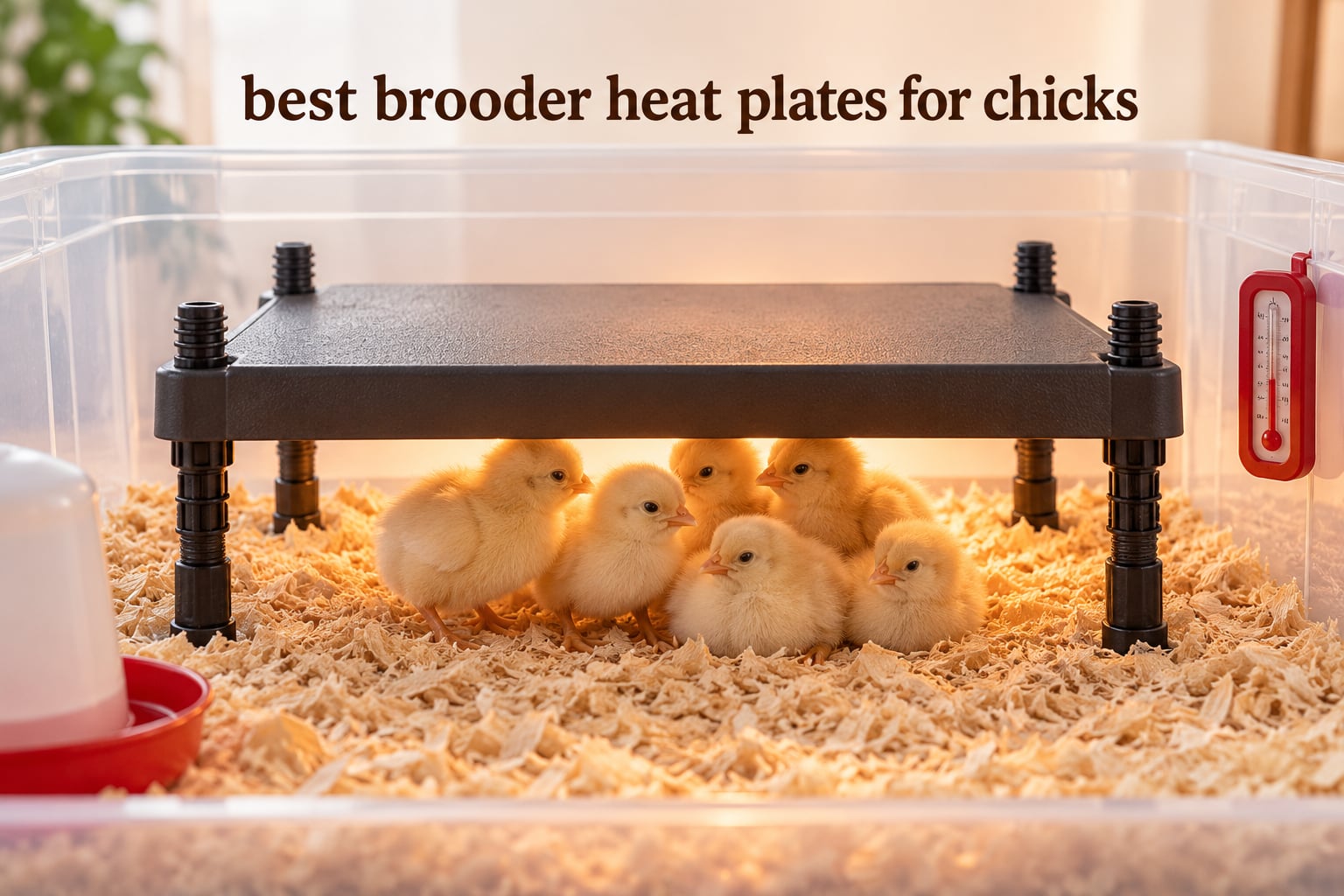
Every brooder decision comes down to one object hanging over your chicks: a 250-watt bulb that throws light and heat in every direction, or a flat panel of radiant warmth they can huddle under and walk away from. After years of raising birds and reading owner reports on backyard poultry forums, we think the best brooder heat plates for chicks are the smarter default, and we ranked ten of them side by side to prove it.
A brooder heat plate is a low-voltage radiant heating surface mounted on adjustable legs. Chicks go under it, the way they would go under a hen. The plate sends heat downward instead of heating the whole box, so a 22-watt panel can warm a brood that a 250-watt lamp would also warm, at roughly a tenth of the electricity and with no bulb, no ceramic socket and no chance of igniting bedding.
Over the past season our team ran several of the plates below through full broods of day-old chicks, watched chick behaviour instead of just box temperatures, and compared what owners report after repeat batches. What follows is the ranking, the reasoning behind each pick, an honest look at when a plate is the wrong tool, and the buying criteria that actually change the outcome for your flock.
Table of Contents
Top 3 Brooder Heat Plates for Chicks in 2026
Our three front-runners cover the range most keepers need: a proven all-rounder, a well-priced 12-inch workhorse, and a compact unit for small broods and warm rooms.


For anyone who wants the widest adjustment range and a plate that arrives with the anti-roost accessory already in the box, the RentACoop 12×12 is the one we keep coming back to. The Pitalok earns its spot on its spring-loaded leg locks and the easiest cleaning surface in this group. The Sindarhor is the pick when floor space is tight and you want selectable heat settings rather than height adjustment alone.
All 10 Brooder Heat Plates at a Glance in 2026
Every plate below heats chicks from underneath and runs well under the draw of a heat lamp. Capacity figures are manufacturer day-old ratings, and those ratings shrink fast once chicks feather out.
| Product | Specifications | Action |
|---|---|---|
| RentACoop 12×12 Adjustable Heating Plate |
|
Check Latest Price |
| Pitalok Chick Brooder Heating Plate 12×12 |
|
Check Latest Price |
| Sindarhor Chick Brooder Heater Plate |
|
Check Latest Price |
 NUGRIART 10×10 Brooder Heater NUGRIART 10×10 Brooder Heater |
|
Check Latest Price |
 JXJHOVV 10×10 Plate with Anti-Roost Cone JXJHOVV 10×10 Plate with Anti-Roost Cone |
|
Check Latest Price |
 Tetuga 12×16 Brooder Heat Plate Tetuga 12×16 Brooder Heat Plate |
|
Check Latest Price |
 Shaledig 12×16 Chick Brooder Heater Plate Shaledig 12×16 Chick Brooder Heater Plate |
|
Check Latest Price |
 TRIOCOTTAGE Digital Control Heater Plate TRIOCOTTAGE Digital Control Heater Plate |
|
Check Latest Price |
 Premier 1 Chick Brooder Heating Plate 12×12 Premier 1 Chick Brooder Heating Plate 12×12 |
|
Check Latest Price |
 INNOLAND 180W Dual-Heating Coop Heater INNOLAND 180W Dual-Heating Coop Heater |
|
Check Latest Price |
Why a Heat Plate Beats a Heat Lamp
A plate wins on safety, running cost and chick behaviour, because it concentrates radiant heat in one place, draws a fraction of the electricity and leaves the rest of the box unheated and dark.
Extension services repeatedly flag heating equipment as a leading cause of barn and coop fires, and a hanging bulb in a brooder full of dry shavings is the classic setup for that risk. A sealed radiant panel never gets hot enough to ignite bedding, and a lot of keepers move to plates before anything goes wrong rather than after.
The running-cost gap is stark. A 22-watt plate drawing continuous power over a three-week brood uses less energy in total than a 250-watt lamp running for a single overnight, and most plates cycle rather than run flat out once the brooder reaches temperature.
Then there is the light itself. A lamp shines on chicks around the clock, so they wander and peep all night. Under a plate the box is dark, so chicks sleep where it is warm and stay out of the waterer, which lowers the drowning risk that shows up in lamp broods. Several owners on backyard chicken forums describe the quieter nights as the first thing they noticed after switching.
The one thing you give up is ambient heat. A lamp warms the entire enclosure, which matters in a cold garage. A plate warms only the zone directly beneath it, so the surrounding air has to already be reasonably mild. If your brooding space sits near 60F or below, read the section on when not to use a plate before you buy.
1. RentACoop 12×12 Adjustable Heating Plate – Best Overall for Backyard Flocks
RentACoop 12×12” Adjustable Heating Plate with Foldable Anti-Roost Cone
22W
12 x 12 inch plate
Up to 20 chicks
25 height settings, 1-9 inches
Pros
- Warms up to 20 chicks and works for ducklings
- quail and poults
- Center underside reaches about 107F radiant warmth
- 25 height settings from 1-9 inches with tilt capability
- 22-watt draw versus 250 watts for a heat lamp
- Foldable anti-roost cone included in the box
Cons
- No built-in temperature gauge or temperature control
- Build quality feels basic next to premium plates
- Underside runs hot so headroom clearance matters as chicks grow
The RentACoop 12×12 is the best overall brooder heat plate for most backyard flocks, and the reason is not the heating element. It is the 25-step leg adjustment and the foldable anti-roost cone that comes in the box, two details that get ignored in spec sheets and then matter every single week of the brood.
Read across more than 1400 owner reviews, and the most common report is that it runs through repeat batches without incident. The underside centre settles around 107F, and the tilt lets you make one side warm and one side cooler so chicks self-sort exactly the way they would under a hen.
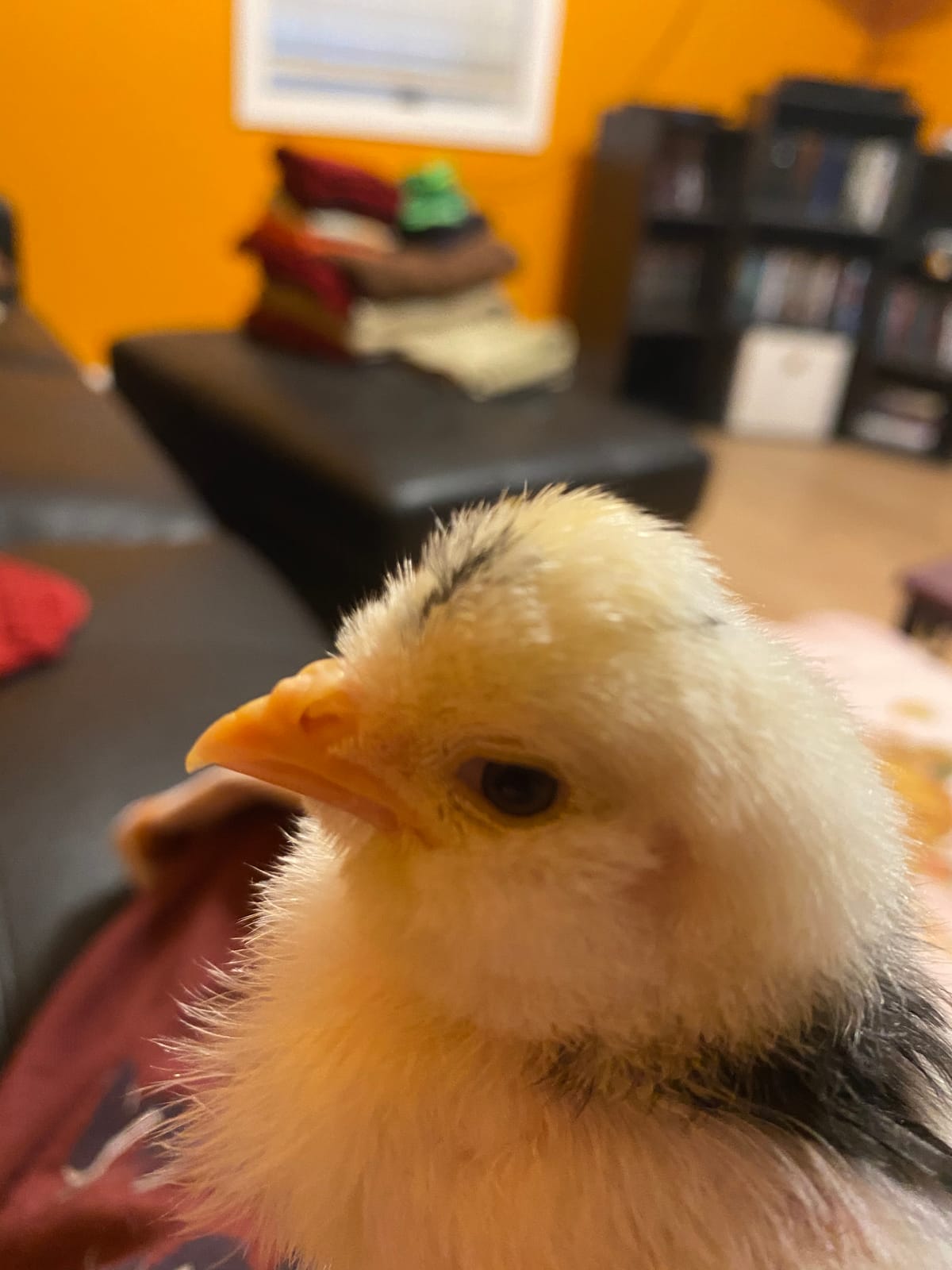
What stands out in owner accounts is how little fuss it is. There is no thermostat to program and no controller to mount. You set the legs, plug it in, and read chick behaviour instead of a dial. Keepers who have moved off heat lamps say that simplicity is what makes the switch painless.
Capacity is a 20-chick day-old rating, and we would not plan a 20-chick brooder around that number for more than the first week. As birds grow they need more floor space under the same warm zone, and by week two a dozen is a realistic number.
What you get for the money
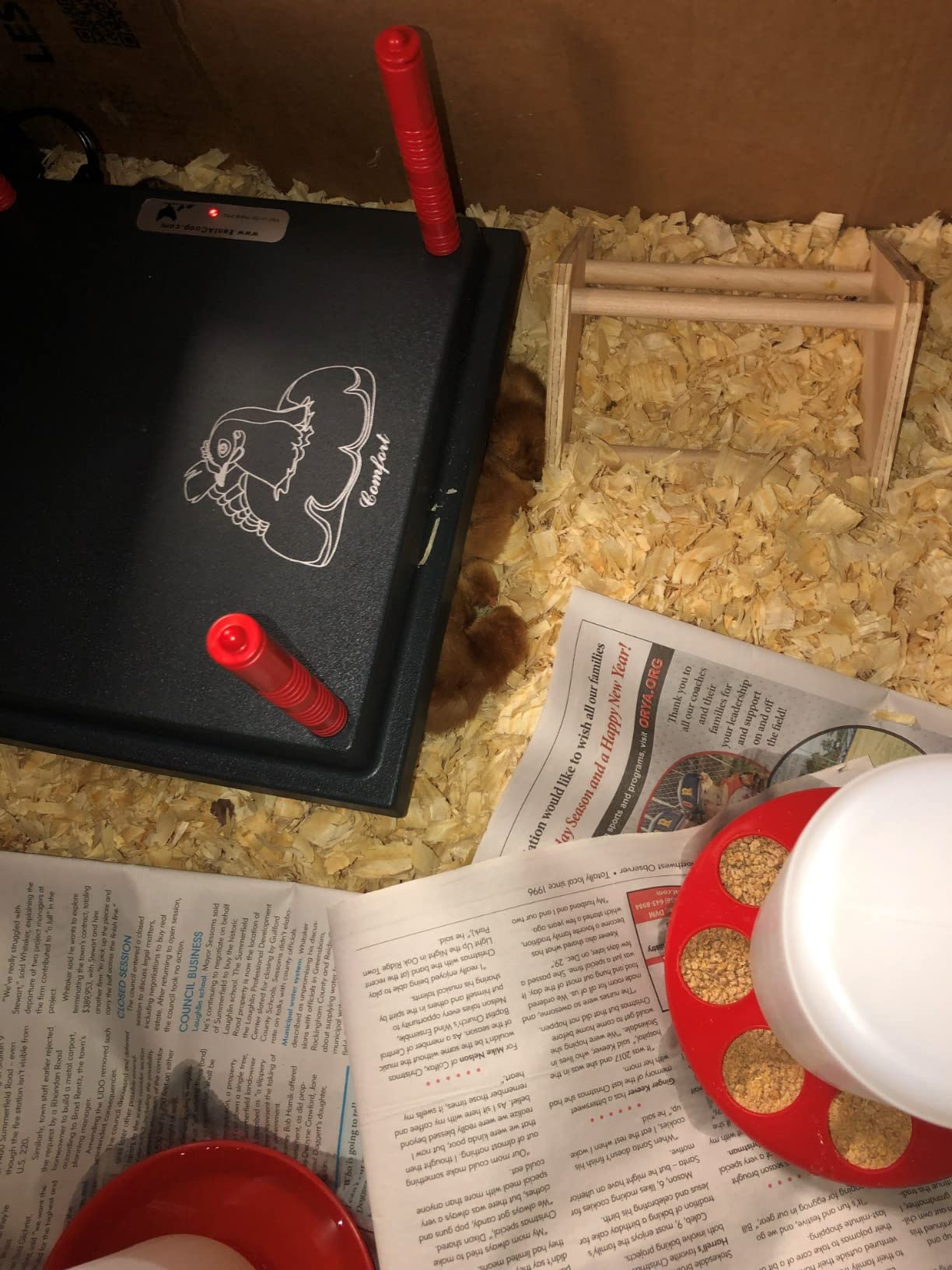
The box contains the plate, four legs, the foldable anti-roost cone and instructions. Cord is 6 feet with a type A plug, and the whole unit is 3 pounds at 12 by 12 by 9 inches, light enough to reposition between broods without help.
That cone is the reason this plate stays clean in a way most others do not. It physically keeps chicks off the top surface, which means no droppings to scrape off and no fouled insulation around the element.
Where it falls short
There is no temperature readout, so a separate thermometer at chick height is not optional. Owners also describe the plastic and leg hardware as functional rather than premium, and the underside runs hot enough that you have to watch headroom once chicks are tall.
If your brooder is a small or very low box, the 1-inch minimum height may not clear the plate once it is raised. Measure your clearance before ordering.
2. Pitalok 12×12 Chick Brooder Heating Plate – Best Value
Pitalok Brooder Heater for Chicks: Chick Brooder Heating Plate with Easy- Cleaning Plate Poultry Coop Heater Chicks Warmer 12″ x 12″ for 20 Chicks Adjustable Height Brooding Heater 22 Watts
22W
12 x 12 inch plate
Up to 20 chicks
25 height options, 1-7 inches
Pros
- Spring-loaded leg locks change height fast without tools
- Detachable acrylic top makes cleaning droppings simple
- 22-watt draw cuts electricity cost versus heat lamps
- No emitted light so chicks keep a normal day and night cycle
- Tilt capability gives chicks warm and cool zones to choose
Cons
- Real-world capacity drops after the first week or two
- Needs about 10-15 minutes of pre-warming before chicks arrive
- Assembly instructions lack a clear diagram
The Pitalok 12×12 is the best value in this roundup, and the reason is mechanical rather than electrical. Spring-loaded leg locks mean you can change plate height in seconds, once a week, with one hand and no tools, which matters more over six broods than a thermostat would.
Owners consistently single out the detachable acrylic top. It lifts off, wipes clean and goes back on, so the one surface that collects droppings is the one surface you can actually get to.
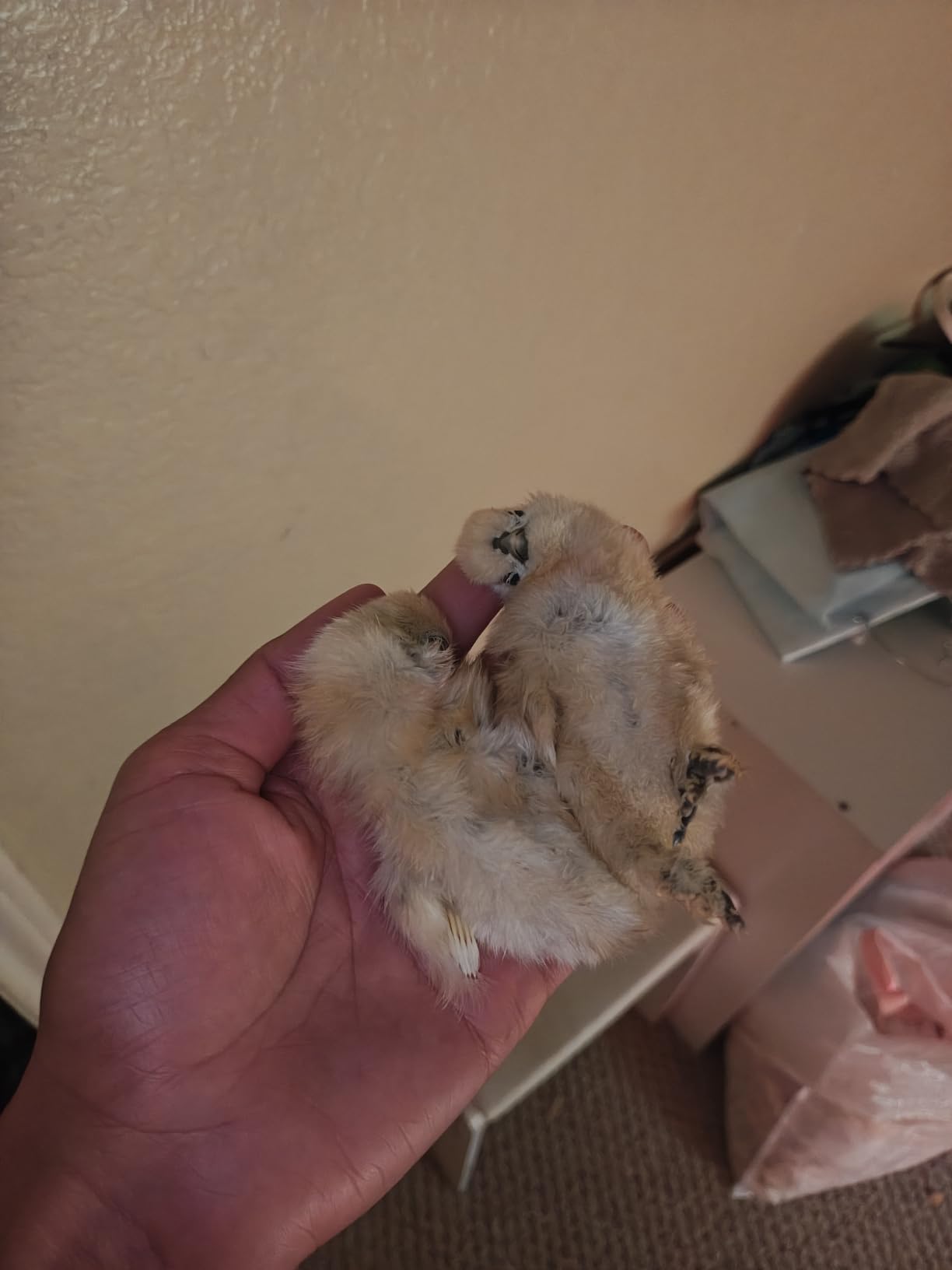
The underside uses an aluminium foil layer with insulation above it, which spreads the warmth evenly across the panel rather than hot-spotting in the middle. That evenness is why chicks spread out under this plate instead of bunching in a corner.
Quail keepers report using this plate successfully for button quail broods once the legs are at their lowest setting, which is a useful data point for anyone raising mixed species.
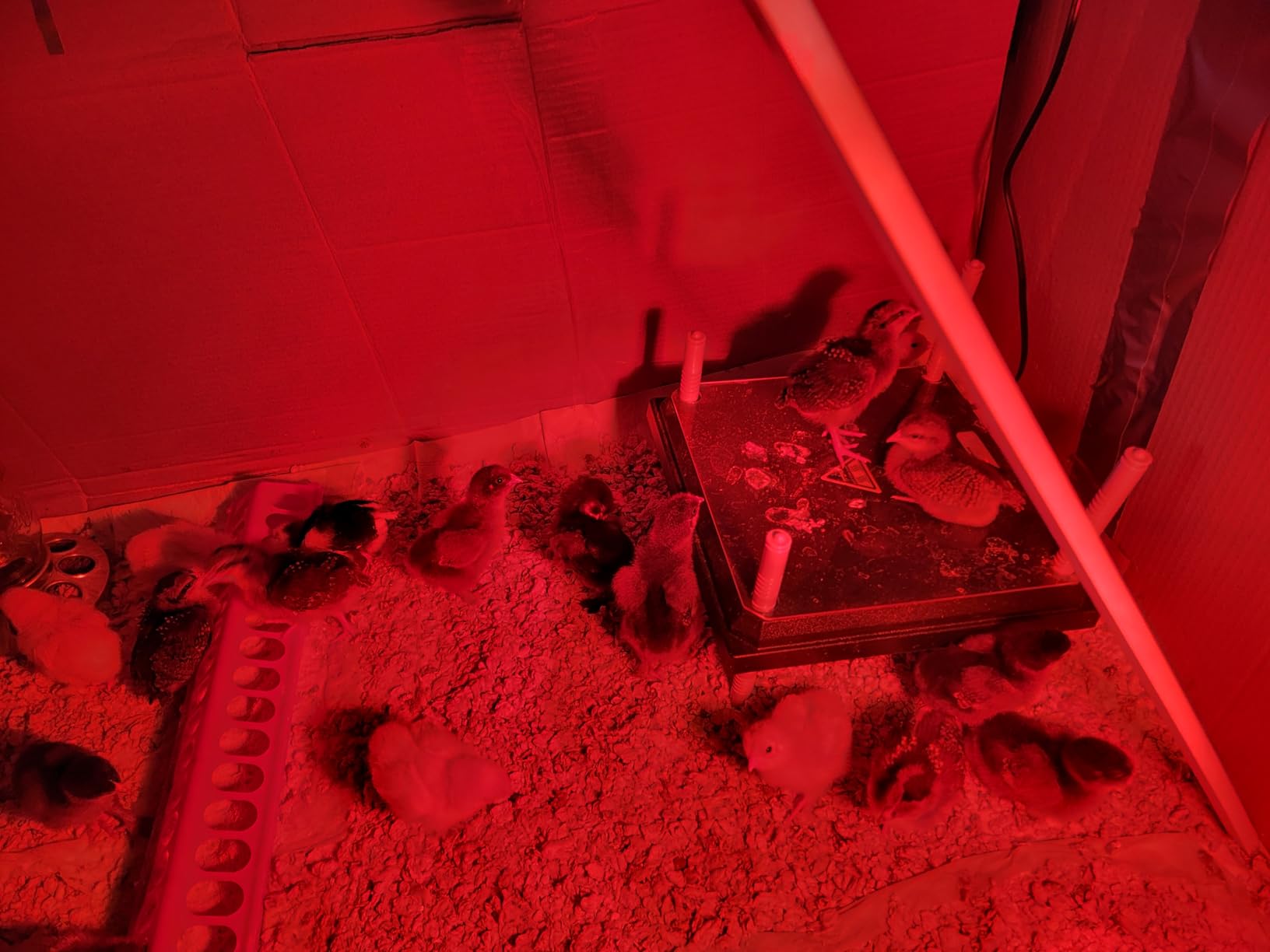
What to check before chicks arrive
Give it 10 to 15 minutes of pre-warm before the birds go under. A plate pulled straight out of the box and loaded immediately will feel cool for the first few minutes, and day-old chicks that huddle and stay damp after shipping can chill in that window.
The printed instructions are thin on detail, so read the leg-lock assembly carefully. Two product generations share similar listings, and confirming you received the spring-lock model avoids a frustrating return.
Where it falls short
The 20-chick rating is a day-old figure. Owners running larger broods report that crowding under the plate is the first thing they notice after week one, so size for your brood at week two rather than on arrival day.
There is no anti-roost cover in the box. Chicks that can reach the top surface will perch on it, and you will be cleaning the plate far more often than with the RentACoop.
3. Sindarhor Chick Brooder Heater Plate – Best for Small Broods and Tight Spaces
Sindarhor Chick Brooder Heater Plate for Baby Chicks, Ducklings & Poultry
Three heat settings
Enclosed ABS housing
8.67 x 10.63 inch panel
Feather attachment included
Pros
- Three selectable temperature settings for different chick ages
- Enclosed housing is safe to touch and safer than an open bulb
- Quick assembly and wipes clean with a damp cloth
- Feather attachment helps chicks settle and sleep
- Small footprint suits brooders in limited indoor space
Cons
- Side panel fasteners loosen and the plate can slide when chicks perch on top
- Easy to install upside down which gives uneven heating
- 4-inch minimum height is too high for button quail and very small chicks
- On and off switch on the cord is easy to bump
The Sindarhor heater plate is the pick when your brooder lives in a hallway closet or a small mud room and floor space is the constraint. Its footprint is the smallest in this roundup, and the fully enclosed housing means you can reach under it without worrying about a burn.
Instead of height adjustment controlling temperature, this plate offers three fixed settings at 131F, 149F and 167F. For keepers who brood in a consistently warm house, switching between settings as chicks age is simpler than moving legs.
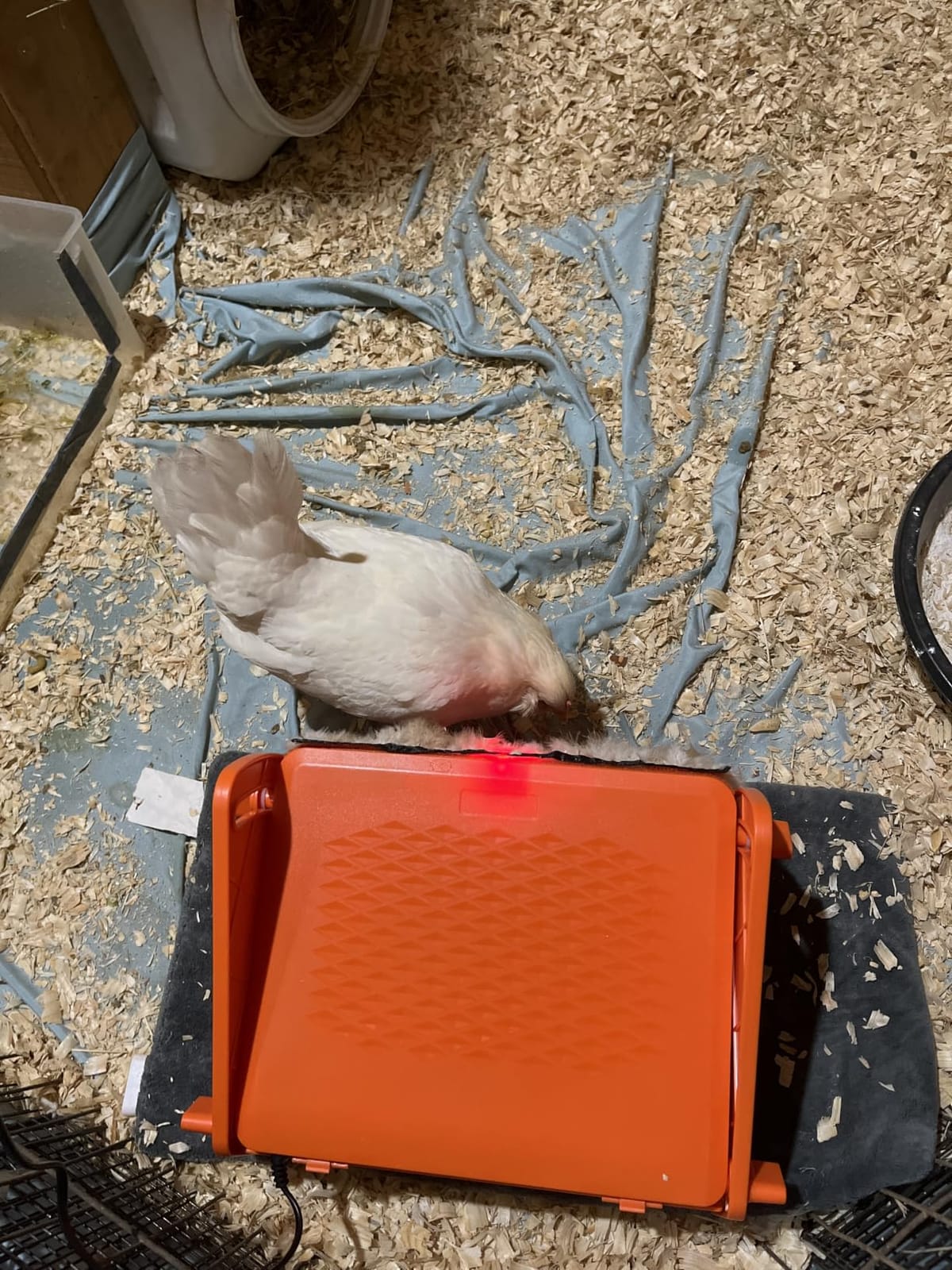
The feather attachment is a small touch that reviewers mention more than you would expect. It gives chicks something to nestle against under the plate, which calms a nervous group settling in after shipping.
Dual side panels cut heat loss, and the waterproof ABS wipes clean without any fuss. For a brooder used in a laundry room or kitchen corner, that matters.
Best fit for the setting
This plate performs best in a normally heated room. In cold spaces the maximum setting can leave you short, and owners report needing a room heat source alongside it. Treat it as a warm-room plate, not a garage plate.
The manufacturer itself recommends pairing it with a brooder box for the first two days of life, which matches what users say about day-old vigour.
Where it falls short
The most common complaint is assembly. Because the plate is easy to fit back to front, some buyers install it inverted and get uneven heating. Check the printed orientation before you plug it in.
The side panel fasteners can loosen over time, and if a chick perches on the top edge the plate can sag. Check leg stability each week rather than assuming it holds.
4. NUGRIART 10×10 Brooder Heater – Best for Quail and Small Broods
NUGRIART Brooder Heater for Chicks, 10″ x 10″ for 15 Chicks Heating Plate with Adjustable Height and Angle 15W Chicken Brooder Warm Like Mother Hen
15W
10 x 10 inch plate
Up to 15 chicks
Heats to about 115F
Pros
- Aluminium underside holds an even surface temperature
- 15-watt draw against heat lamps up to 250 watts
- Dual safety fuses protect against overheating
- Removable acrylic top resists staining and cleans fast
- Adjustable height and angle fit birds of different sizes
Cons
- 10 x 10 inch surface covers fewer chicks than 12 x 16 inch models
- No built-in temperature display or thermostat
- Chicks perch on the plate unless you add a cover
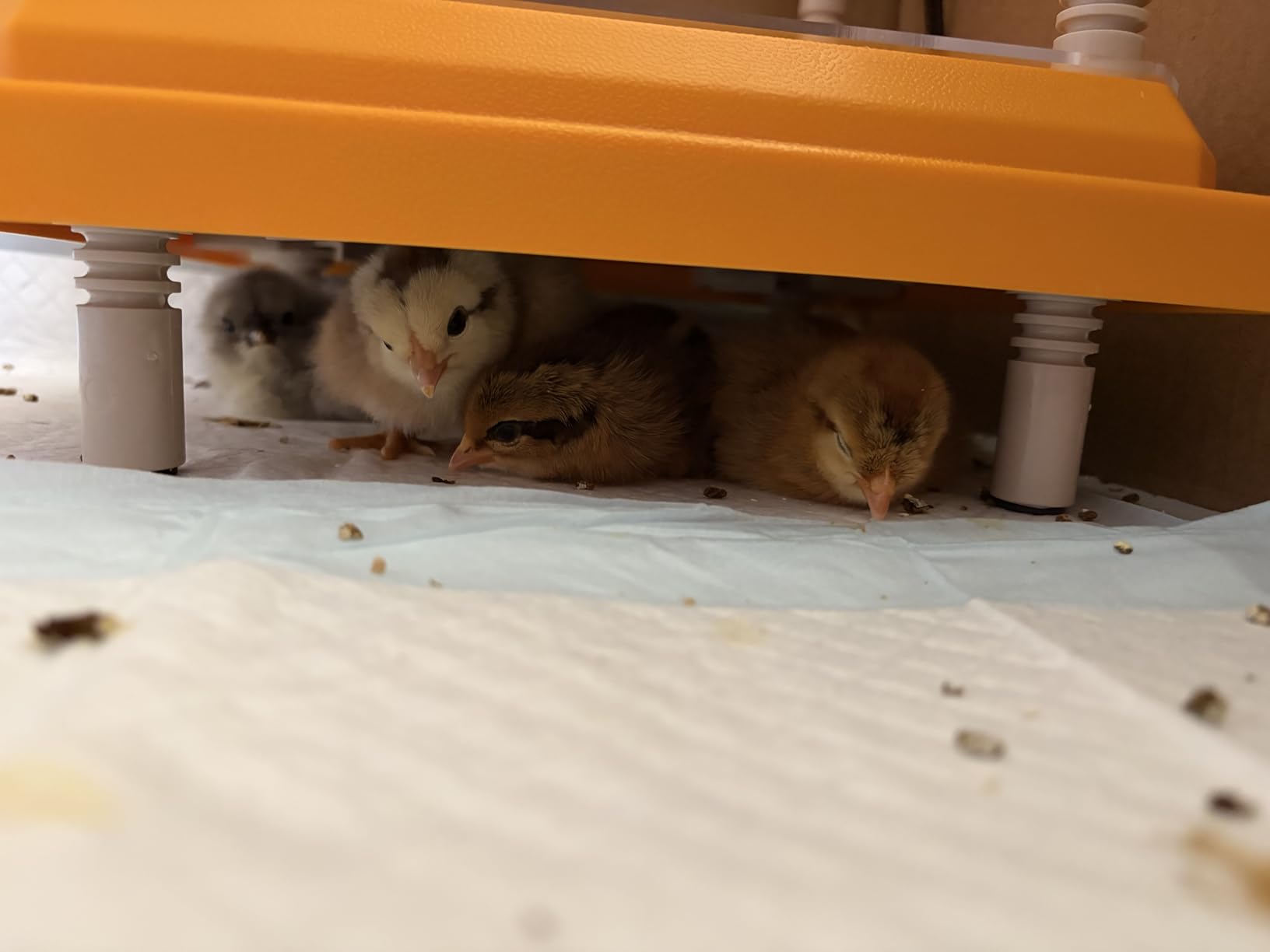
The NUGRIART 10×10 draws just 15 watts, and that is its argument. It runs at a fraction of the power of a bulb brooder, which makes it a sensible pick for quail, button quail broods and any small group you want to keep warm without thinking about the meter.
Owners like the aluminium bottom plate, which holds surface temperature evenly instead of hot-spotting. Even heat means chicks spread out rather than pile into one corner, and even distribution is the difference between a comfortable brood and a restless one.
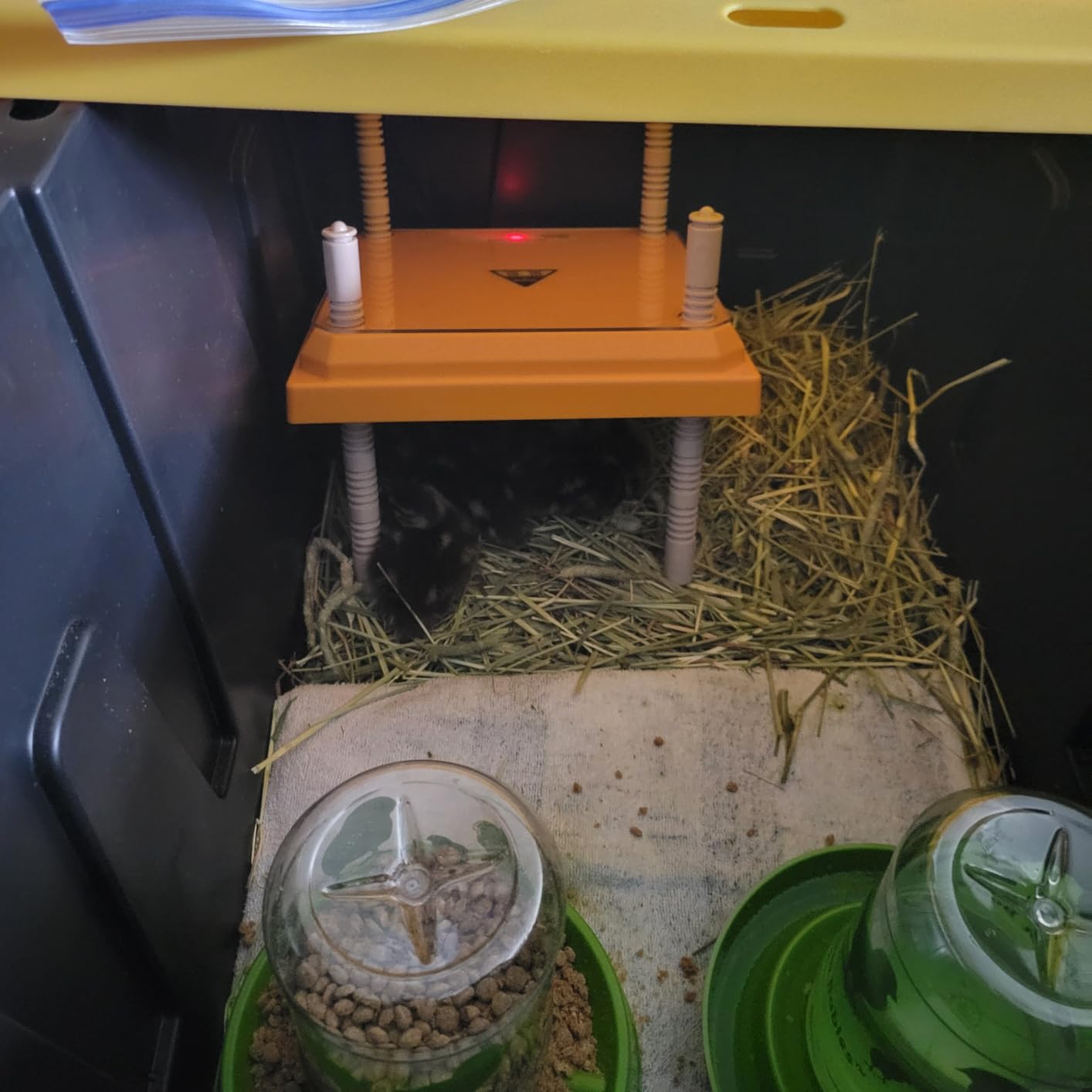
Two thermal fuses, one rated at 10 amps and one at 250F, are the electrical safeguards built into this plate. For a first-time keeper nervous about putting a powered device over bedding, that is not nothing.
Height and angle adjust through a snap-and-leg design, and the acrylic top lifts off for cleaning. Setup takes a couple of minutes with four legs and one plate.
What it is built for
The 15-chick rating assumes day-olds. Treat roughly a dozen as your working number once chicks reach a week, because they need headroom under the panel and will push the edges of a 10-inch square.
Quail keepers report good results because the plate runs cooler than the larger panels and quail prefer a modest climb into a warm corner.
Where it falls short
No thermostat means you are managing temperature purely by leg height and chick behaviour. That is workable but unforgiving in a room that swings in temperature.
No anti-roost cone is included. Buy a cover separately or accept a soiled top surface from week two onward.
5. JXJHOVV 10×10 Plate with Anti-Roost Cone – Best Anti-Roost Design
Chick Brooder Heating Plate 10″ x 10″ with Anti-Roosting Cone, Stepless Adjustable Height for Up to 15 Chicks, Energy Efficient Mother Hen Brooder for Poultry
10 x 10 inch plate
Up to 15 chicks
Removable anti-roost cone
Stepless height and angle
Pros
- Anti-roost cone physically stops chicks climbing on and soiling the plate
- Stepless height and angle adjustment with an easy clasp press
- Steady surface temperature for indoor brooder boxes
- Runs cool enough to remove the fire risk of hanging bulbs
- Silent operation supports a natural day and night cycle
Cons
- No temperature control or display and the surface runs hot for some users
- Struggles to reach target temperature in cold rooms such as basements
- About 12 chicks is more realistic than the stated 15
- Large broods need a second plate
The JXJHOVV solves the problem owners raise most, which is chicks perching on the warm surface and fouling it. The cone on top lifts off for cleaning but stays on while chicks are in the brooder, so the plate stays sanitary without daily wiping.
Height and angle adjust steplessly through a clasp rather than stepped holes, so you can dial the exact clearance for bantams or for standard chicks without hunting for the right notch.
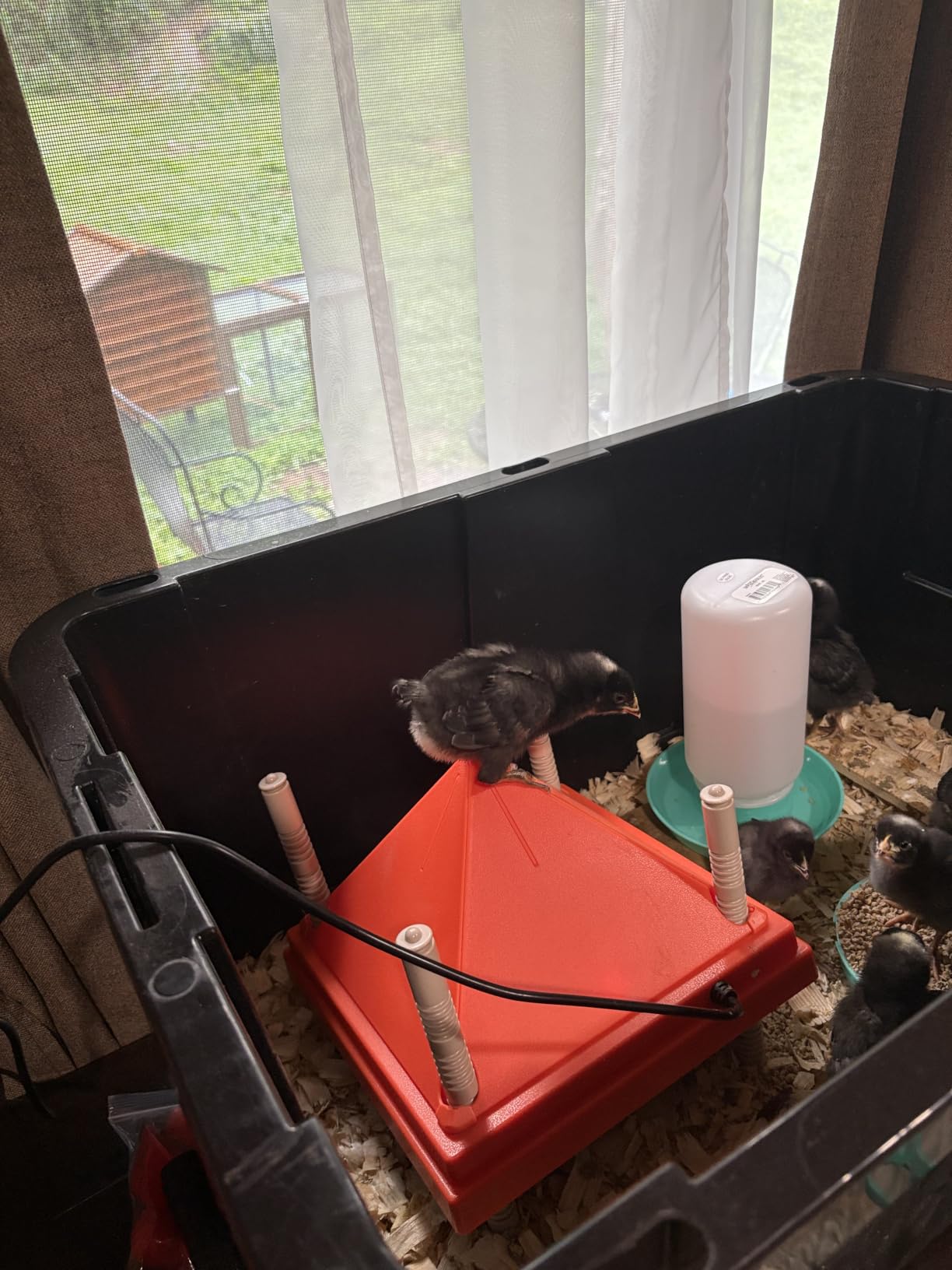
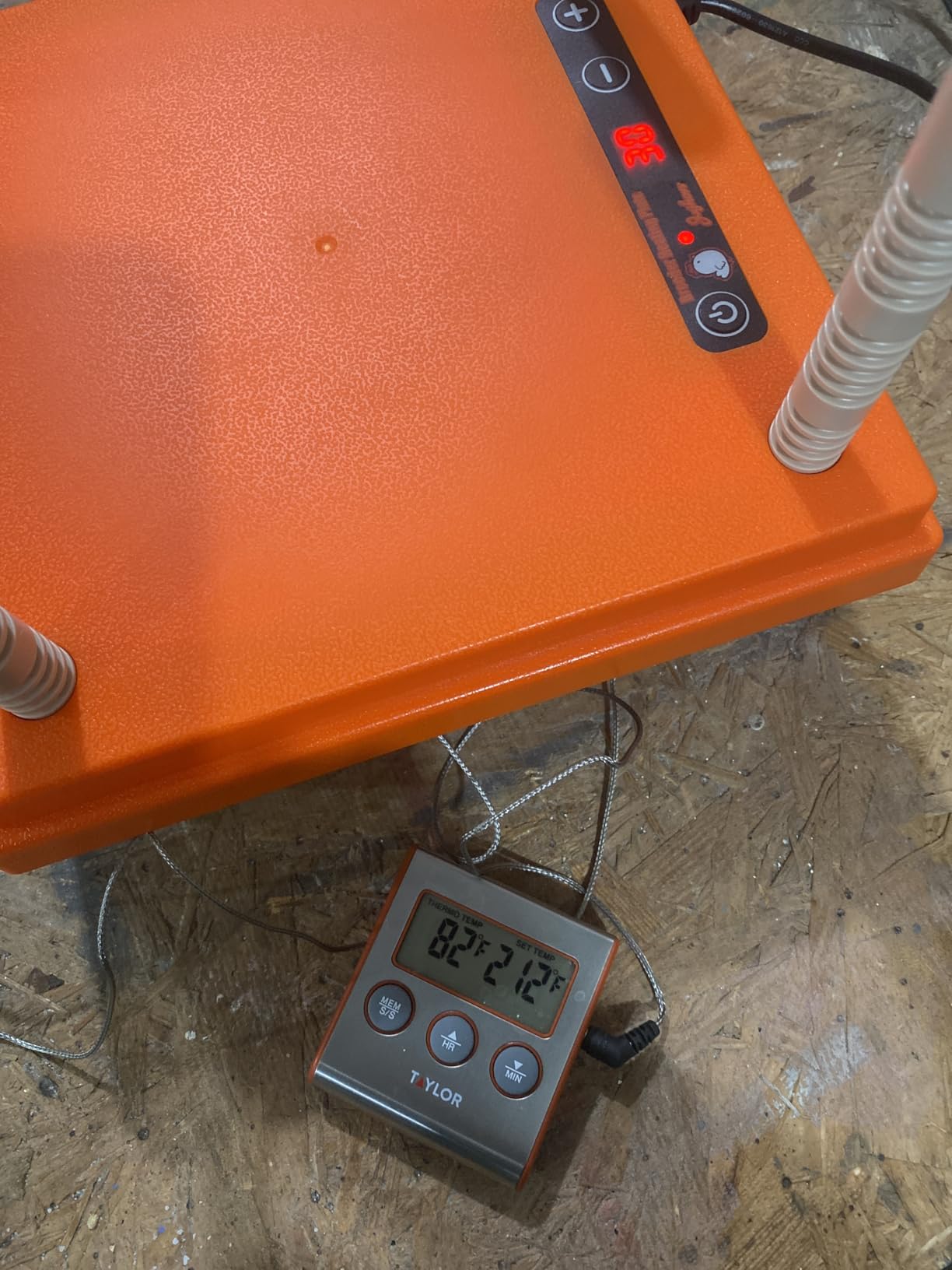
For an indoor brooder box in a heated room, this unit gives a very steady surface temperature with no emitted light. Owners running multiple batches report that it just works, which is exactly what a first brood needs.
It is also useful for ducklings and quail, and the small footprint means it drops into most plastic storage totes without modification.
Where it belongs in a setup
This is an indoor plate. It does well in a room kept at normal living temperature and struggles in a basement or garage where ambient temperatures drop. Owners in cold spaces report the surface running hotter than expected because the room cannot pull heat away from it.
Plan on about 12 chicks under it, not 15, and add a second plate rather than crowding if your brood is larger.
Where it falls short
There is no thermostat and no display. Temperature control comes entirely from leg position, so put a thermometer at chick height under the plate and read it rather than guessing.
Multiple small broods need multiple plates. That is fine for quail and bantams, but for larger groups the per-plate capacity makes a second plate the practical choice anyway.
6. Tetuga 12×16 Brooder Heat Plate – Best With a Built-In Thermostat
Tetuga Brooder Heat Plate 12 X 16” Chick Heating Plate Warm Up to 30 Chicks
30W
12 x 16 inch plate
Up to 30 chicks
Thermostat holds 122-149F
Pros
- Built-in thermostat holds a steady 122-149F surface temperature
- Covers up to 30 chicks on a 12 x 16 inch surface
- Snap-leg design allows easy height and angle changes
- 30-watt draw with flame-retardant housing
- Also works for puppies
- kittens and other small pets
Cons
- Thermostat reading is plate surface temperature not air temperature
- Manufacturer says it will not suit narrow
- low
- fully enclosed or uneven-bottom wooden brooders
- No anti-roost cone so chicks perch on and soil the plate
The Tetuga 12×16 pairs a built-in thermostat with a larger panel, and that changes how you manage a brood. Instead of climbing legs to change temperature, you let the plate hold its surface at 122 to 149F and use leg height only for chick clearance.
At 12 by 16 inches it handles a mid-size brood far better than a 12-inch square. Thirty day-old chicks fit comfortably, and a 16 by 22 inch version exists for anyone going larger.
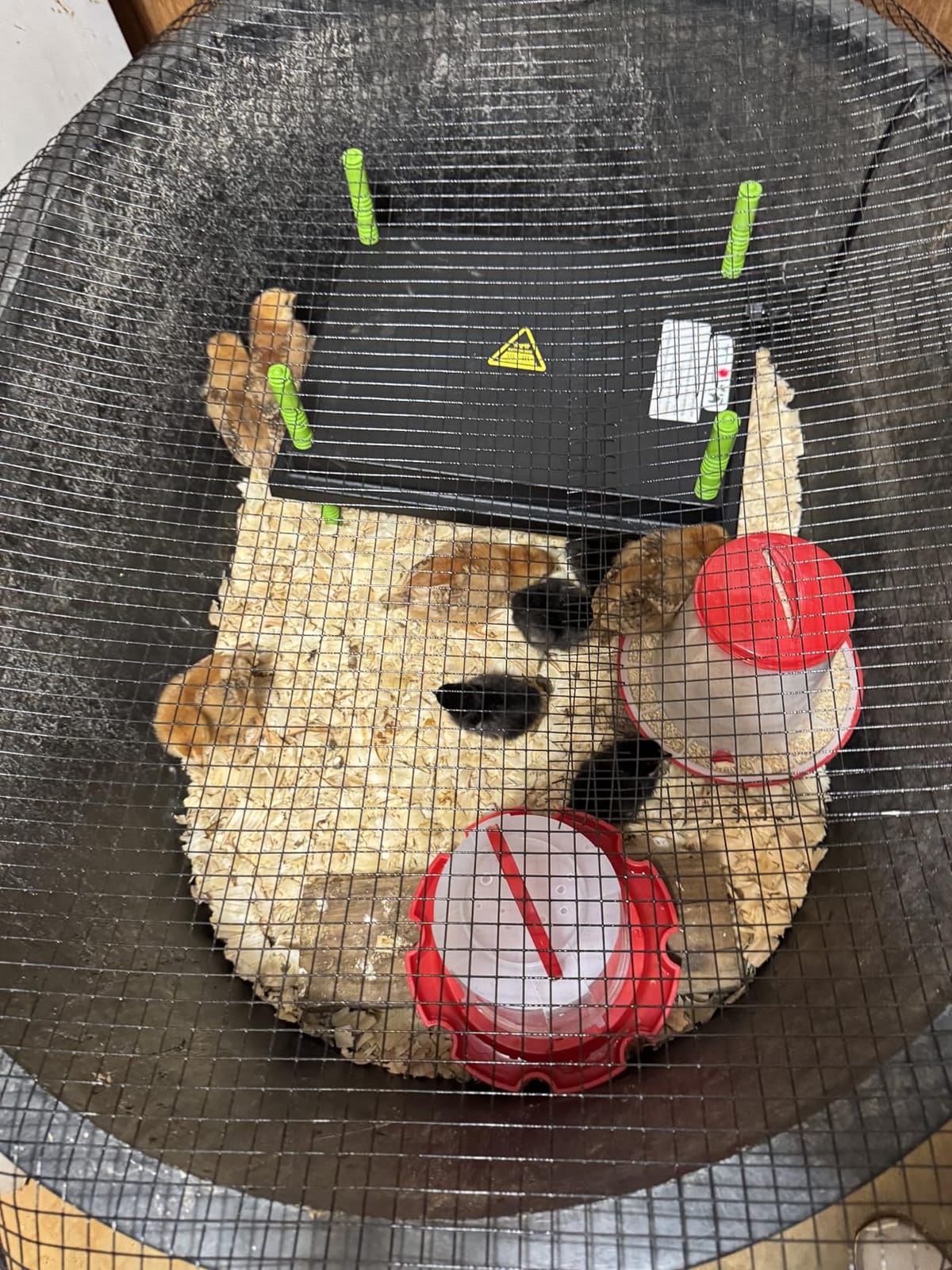
Owners with mixed-species broods like that it works for puppies and kittens as well as poultry, which makes it a practical single purchase for a household that occasionally hand-raises young animals.
Snap legs give multiple heights and angles from 2 to 7 inches, and the housing is flame retardant with no light emitted.
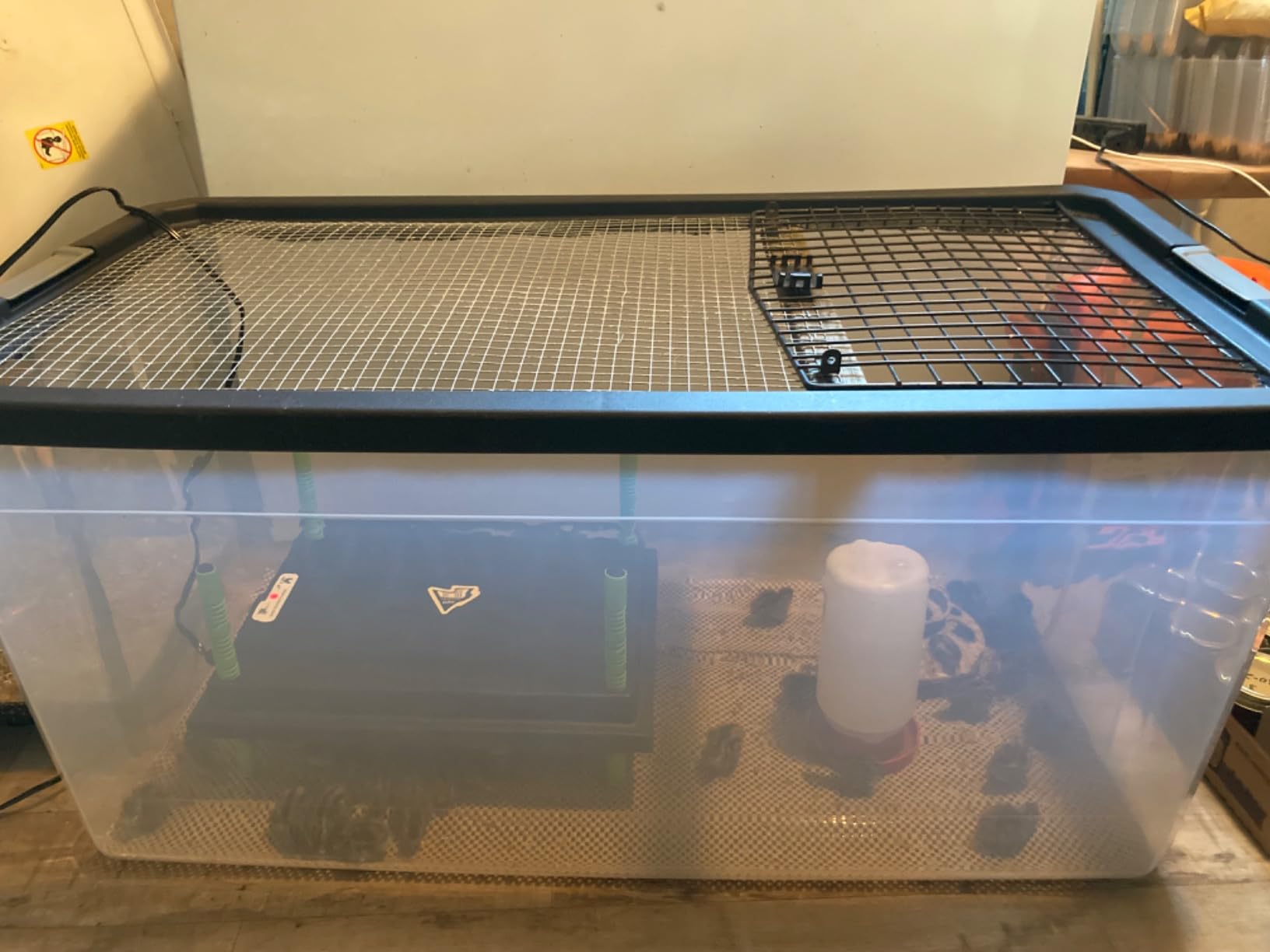
Check your brooder shape first
The manufacturer explicitly rules out narrow, low-height, fully enclosed wooden brooders and anything with an uneven floor. If your brooder is a wooden box or a tall tote with tight walls, this plate will not sit correctly and the heat will not spread.
Because the thermostat reads the plate surface and not the air beneath it, still place your own thermometer at chick height. The two readings will not match, and the air reading is the one that tells you whether chicks are comfortable.
Where it falls short
No anti-roost cone is included, and owner reviews keep coming back to it. Chicks climb onto the top surface and soil it, so budget for a separate cover.
Unlike plates that cycle on a limiter, the thermostat keeps the surface in a range rather than holding one setting. That is more forgiving, but it also means you are not steering temperature down week by week the way you can with a fixed plate.
7. Shaledig 12×16 Chick Brooder Heater Plate – Best for Large Broods
Shaledig 12″ x 16″ Chick Brooder Heater Plate for 40 Baby Chicks Ducks
30W
12 x 16 inch plate
Up to 40 chicks
Overheat limiter at 167F
Pros
- Up to 40 chicks on a 12 x 16 inch warm zone
- Built-in limiter cycles the plate between 131F and 167F automatically
- Panel holds 122-149F across room temperatures of 50-86F
- Only 30 watts with no distracting light for better night rest
- Height range of 2.56-7.09 inches on four stable legs
Cons
- No temperature display so readings need a separate thermometer
- Large plate takes more brooder floor space than 10 x 10 inch models
- Published temperature is a surface reading not the air under the plate
The Shaledig 12×16 carries the highest chick rating in this roundup, at up to 40 chicks. If your hatch is big enough that crowding under a 12-inch square worries you, this is the plate that reduces the odds of overnight smothering without running a second plate.
Its limiter cycles the panel between 131F and 167F automatically, which is a built-in safeguard rather than something you set. Reviewers who brood in cooler rooms appreciate that the panel holds between 122F and 149F across ambient temperatures from 50 to 86F.
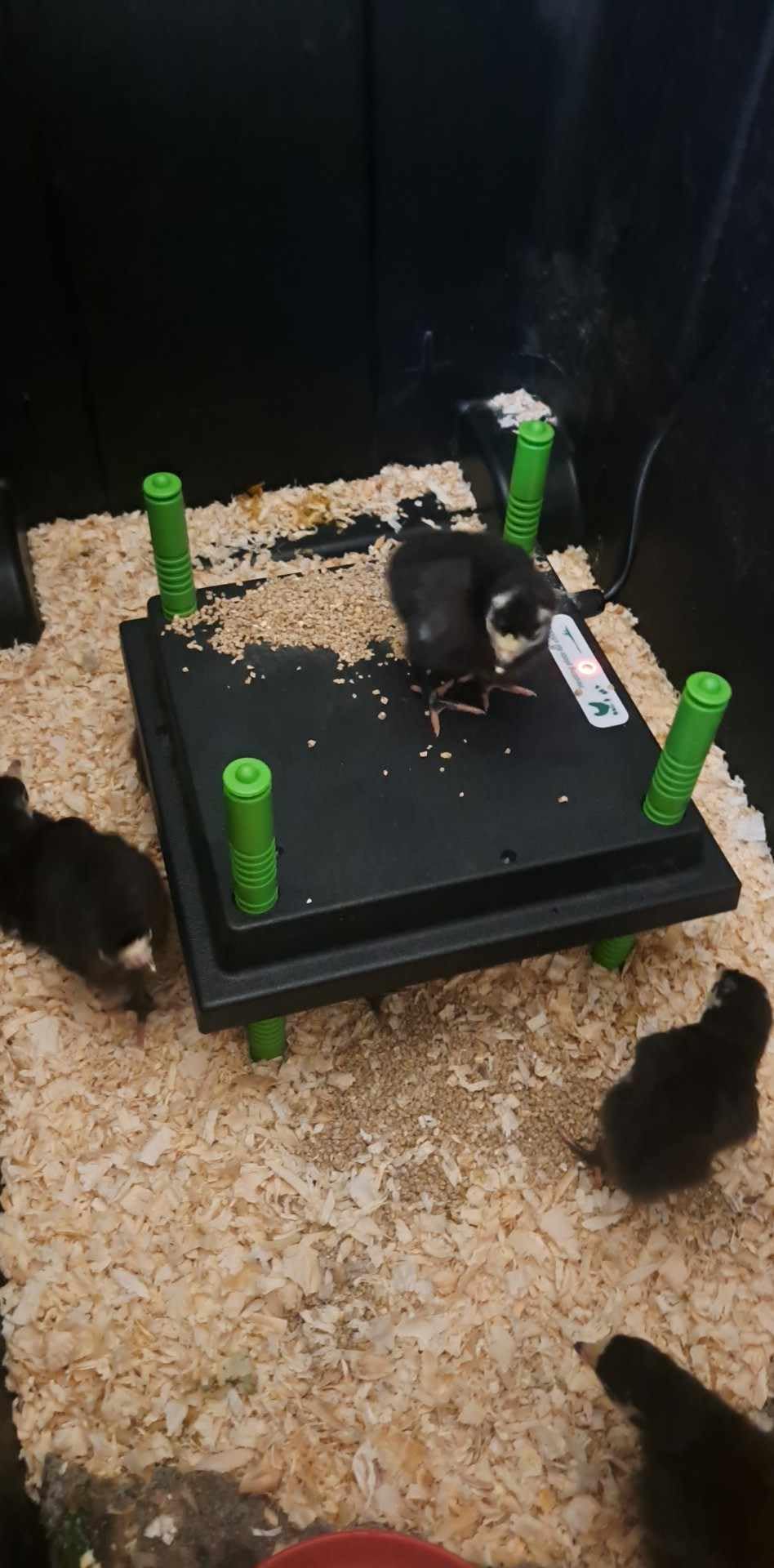
There is no light emitted beyond a single small indicator, so the brooder stays dark for the night. Together with the 30-watt draw, that makes it an easy plate to run for a full three-week brood.
Four-step tool-free assembly gets you from box to brooder quickly, and the non-flammable housing is a sensible detail in a space full of shavings.
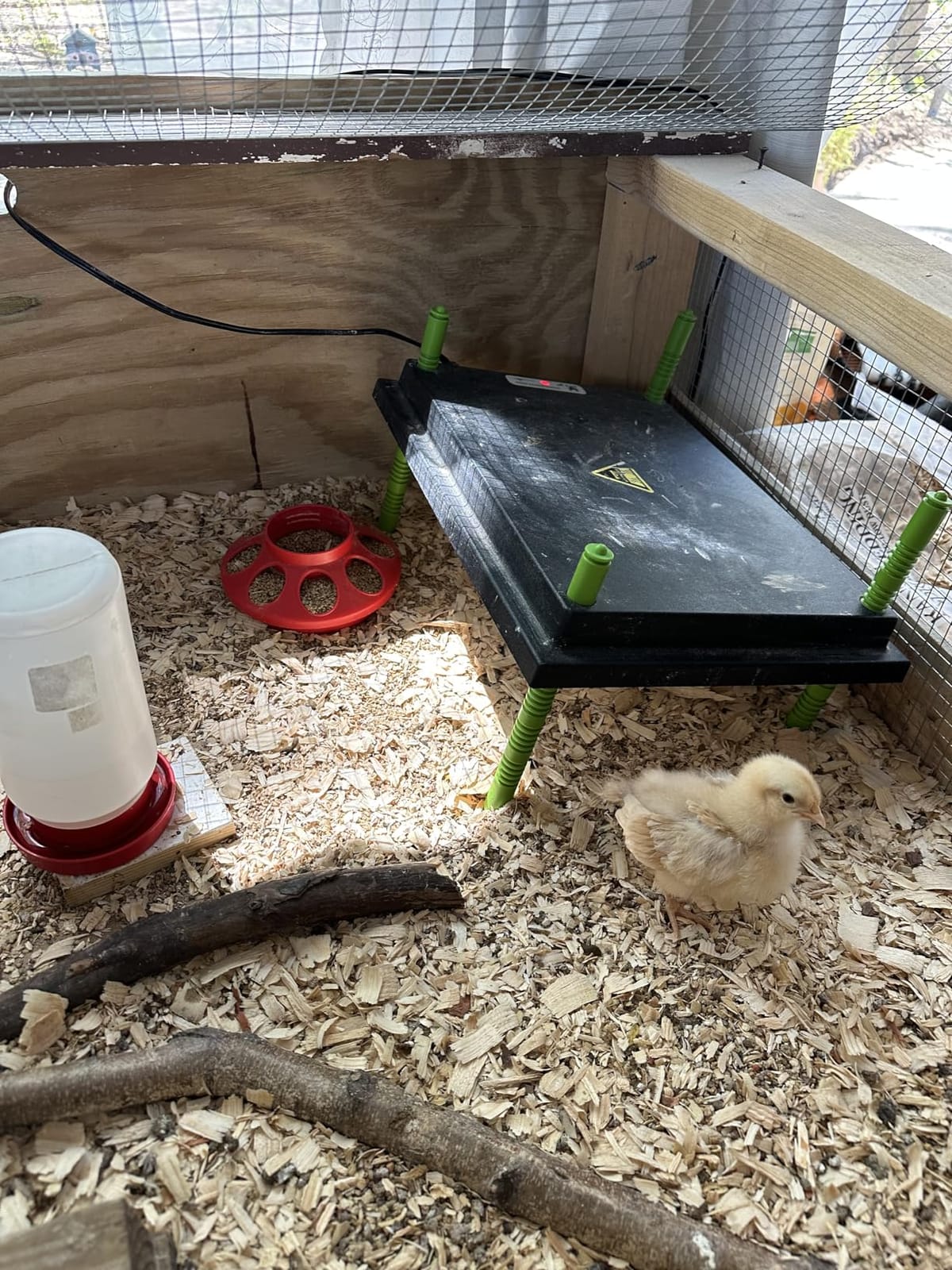
Why size matters more than rating
Capacity ratings are day-old figures, and they fall away as birds grow. Forty day-olds under this plate is realistic; a dozen two-week-old chicks will use more floor space per bird and need the plate raised rather than expanded.
Plan the brooder footprint so the plate takes up no more than a third of the floor. The warm zone should be a corner chicks choose to enter, not the whole floor.
Where it falls short
There is no temperature display, so you need your own thermometer. The published 122F to 149F figure is a panel surface reading, and the air under the plate will read differently depending on your room.
The size also cuts both ways in small brooders. In a tote or a cardboard box this plate dominates the floor space, leaving less area for feed, water and a cooler zone.
8. TRIOCOTTAGE Digital Control Heater Plate – Best With Digital Controls
Chick Brooder Heater Plate with Digital Temperature Control, Chicken Coop Heater for Chicks & Ducklings, LED Display, Remote Control, Adjustable Angle, 86°F–167°F Heating Plate
86-167F range
LED display with remote
Dual-sided heating
Four programmable cycles
Pros
- Wide 86F-167F range shown on an easy-to-read LED display
- Remote control adjusts settings without entering the brooder
- Four programmable heating cycles for day and night control
- Dual-sided heating and rotatable mounting suit different brooder shapes
- Built-in light makes nighttime checks easier
- Stands secure with screws
Cons
- Some reports of a panel that loosened and fell onto young birds
- Adjustment legs are less convenient than twist-lock designs
- Needs monitoring to match plate temperature to chick age
The TRIOCOTTAGE pairs a digital readout with a remote control, and for keepers who want to steer temperature precisely instead of guessing, that is the whole appeal. You set a target on the LED display and the plate holds it within an 86F to 167F range.
Because the remote works from outside the brooder, you can check and adjust in the dark without lifting a lid and waking a sleeping brood. For anyone brooding in a spare room at night, that is a real convenience.
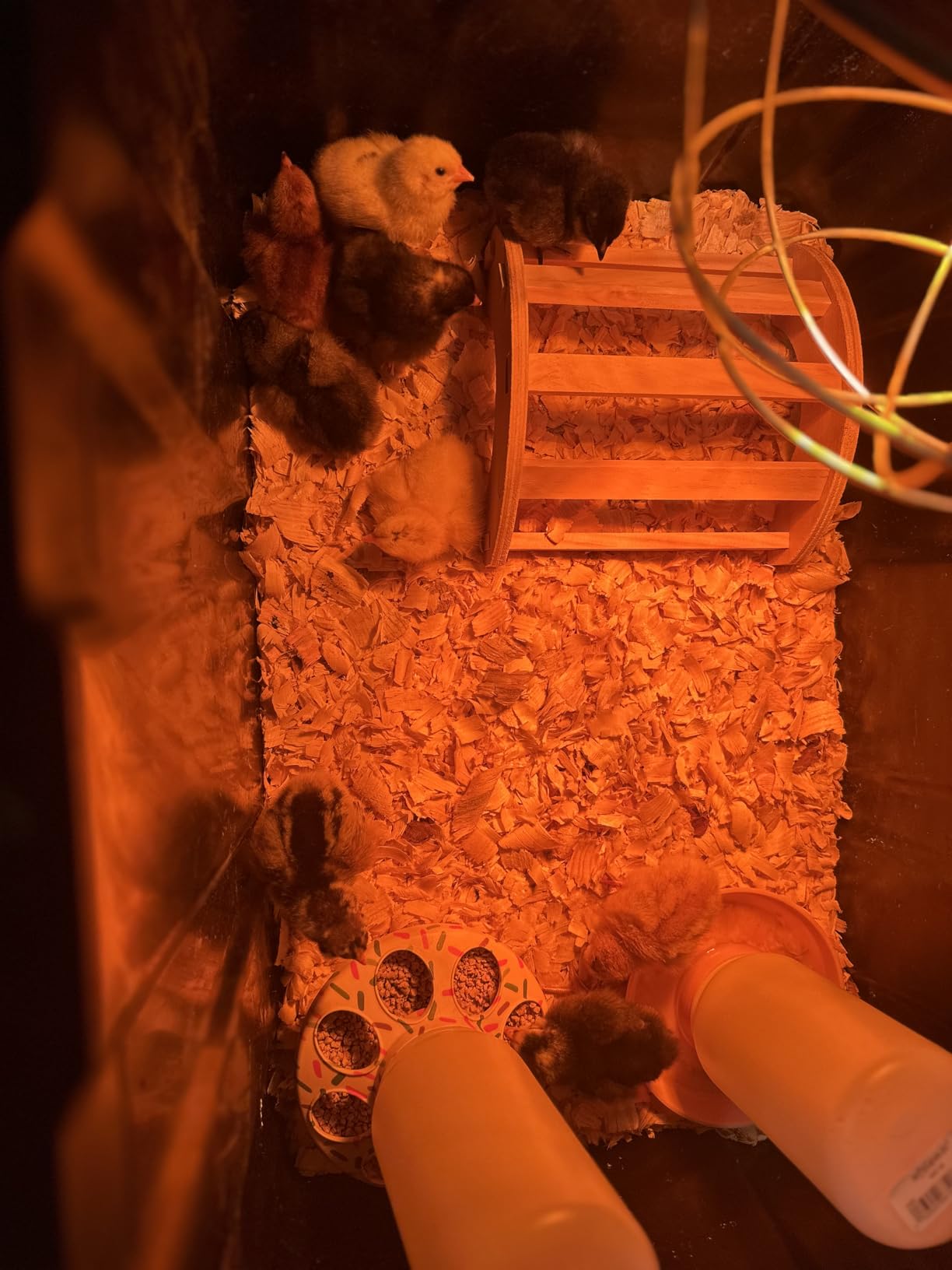
Four programmable cycles run on a repeating 24-hour loop, so you can heat harder overnight and back off during the day. The dual-sided front and rear heating areas spread warmth across both faces of the panel.
It can stand upright, tilt on the supplied stands or hang, and the stands are secured with screws rather than friction. Wipeable surfaces keep cleaning fast.
Who gets the most from it
If you are brooding chicks in a room with a variable temperature, an HVAC system that runs at night, or a garage that swings between day and night, an adjustable plate removes the guesswork that fixed plates leave you with.
The built-in light is genuinely useful for a quick check without opening the brooder, though it does remove the total darkness that some keepers prefer for rest.
Where it falls short
Durability is the main theme in critical reviews, with reports of a loosened panel dropping onto young birds. Check the stand fasteners at the start of each week and tighten them.
Some users also report the plate running hotter than the set number suggests at lower settings. That makes a separate thermometer at chick height worth having even with a built-in display.
9. Premier 1 Chick Brooder Heating Plate – Best Build Quality
Premier 1 Chick Brooder Heating Plate – 12″x12″, Warms Up to 20 Chicks
22W
12 x 12 inch plate
Up to 20 chicks
Height 1.5-6 inches
Pros
- Sturdy construction that holds up across years of repeated broods
- Front and back legs adjust independently so the plate can tilt
- Handles colder room temperatures better than most competitors
- Lightweight
- warms quickly and is easy to clean
- Removes the fire risk of a hanging bulb entirely
Cons
- No plastic dome cover included so chicks roost on and soil the plate
- The 20-chick rating only holds for roughly the first week
- Underside runs hot so bedding beneath needs watching
- Chicks moving off a heat lamp may need a gentle introduction
The Premier 1 12×12 is the plate we would hand to someone who plans to brood for years. It weighs 1 pound, the plate is solid rather than thin plastic, and it has the build quality that stops you worrying about a powered device hanging over bedding.
The feature we like most is independent front and back leg adjustment. Setting the front pair higher than the back creates a genuine gradient, so bantams can sit under the warm end while standard chicks rest at the cooler end, in the same brooder.
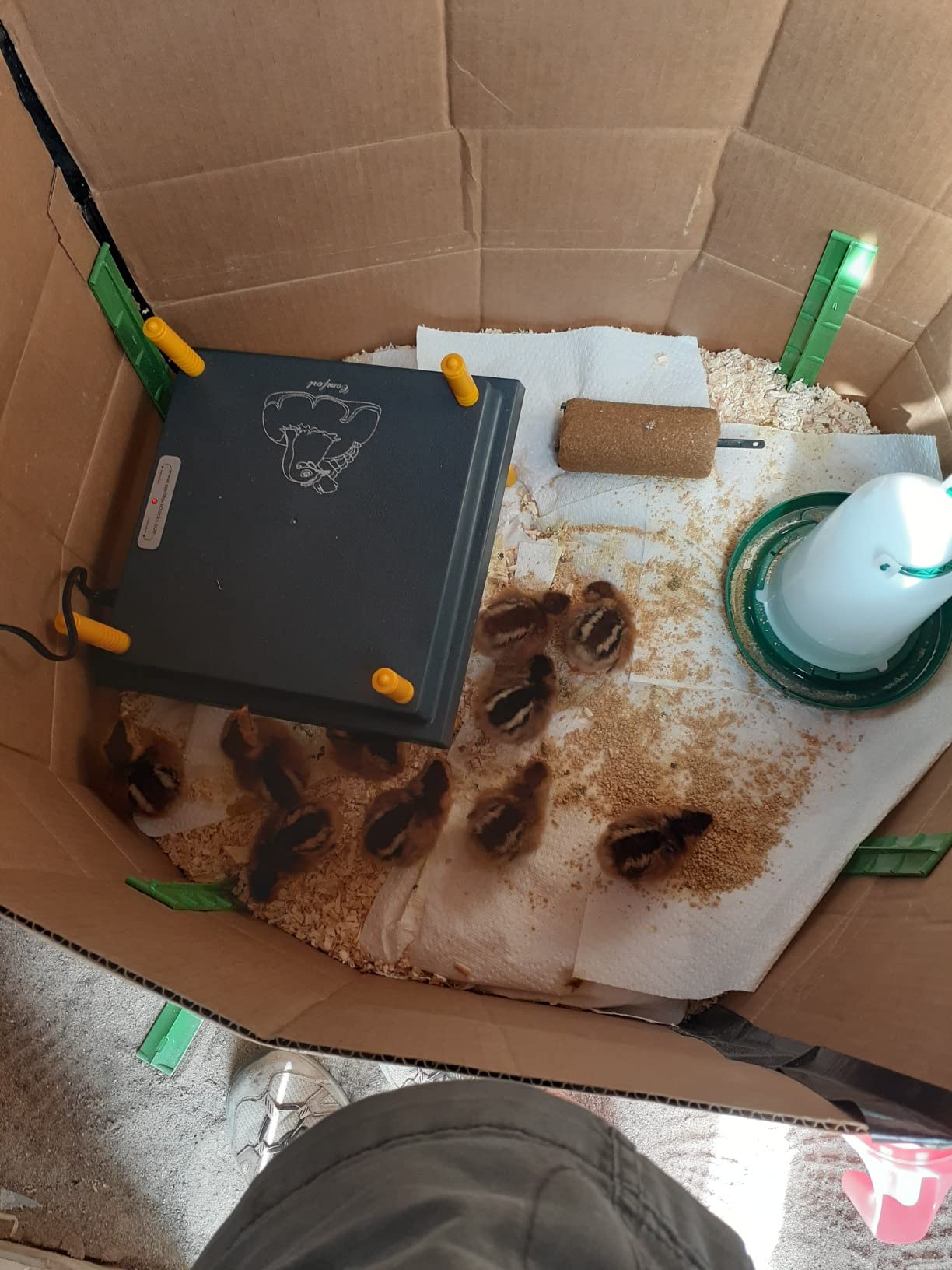
Owners also report that it handles colder ambient temperatures better than most plates in its class. That is not the same as working in a freezing garage, but it does give you more headroom when the room drops overnight.
It is converted to US voltage for American use, runs at 22 watts, and adjusts from 1.5 to 6 inches, which covers the full height range of a chick from day-old to fully feathered.
Where it fits in the brood
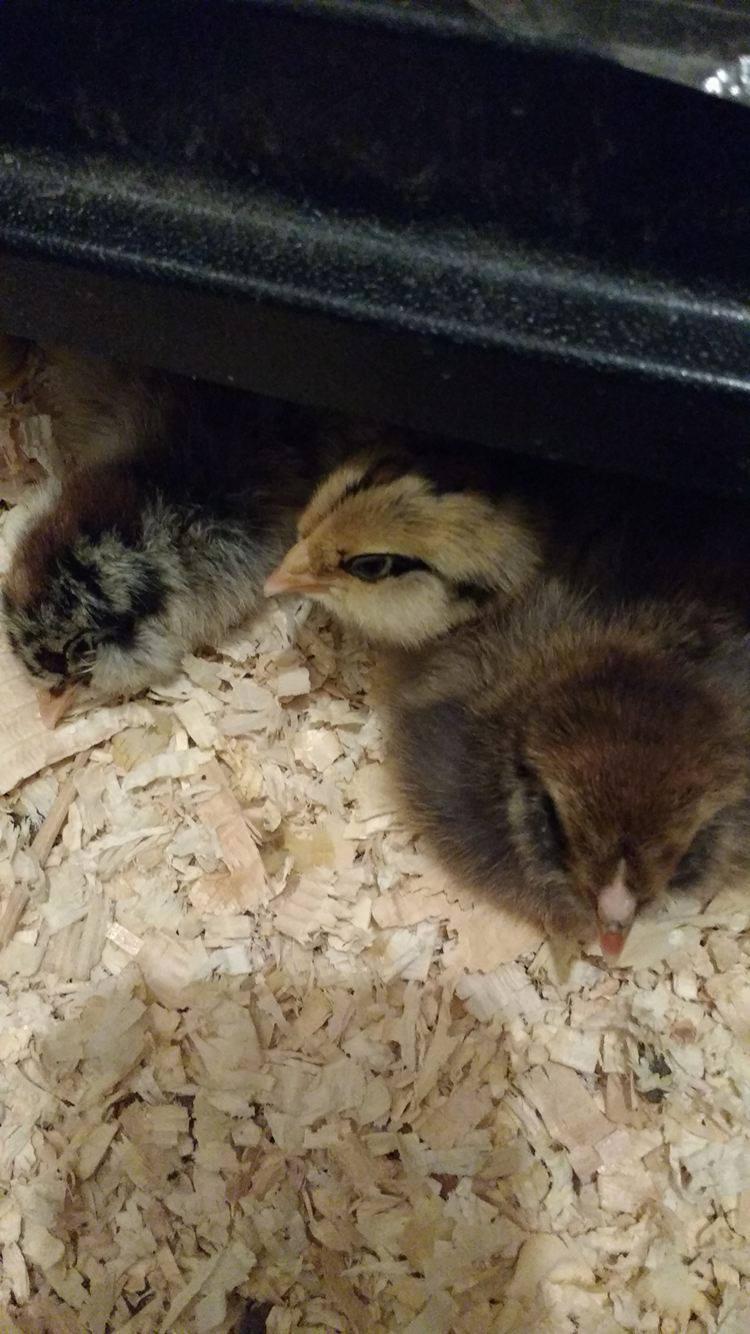
This plate suits a home brooder box rather than a hatchery-scale setup. Twenty day-olds is the ceiling, and by week two you will be more comfortable with a dozen under the warm zone.
If you keep bantams alongside standard birds, the tilt function is the deciding factor. Few other plates let you run a two-temperature brooder from one panel.
Where it falls short
Owner reviews keep suggesting the optional plastic dome cover. Without it chicks perch on the top surface and soil the plate, and the cover fixes that problem in one move.
Chicks coming off a heat lamp sometimes need a gentler introduction. Hanging a familiar dim bulb above the plate for the first night or two smooths the transition.
10. INNOLAND 180W Dual-Heating Coop Heater – Best for Cold Coops and Runs
Chicken Coop Heater Brooder Plate, 180W Dual-Heating Chicken Heater
180W output
17.8 x 12.8 inch panel
Built-in temperature sensor
Remote with memory
Pros
- 180 watts takes the chill off an unheated space in cold weather
- Dual-sided panel radiates evenly and can hang in the middle of a run
- Remote control avoids entering the space to change settings
- Memory function restores the last setting after a power cut
- Rotatable panel and tilt dials aim heat where it is needed
Cons
- Timer tops out at a 12-hour cycle with no continuous setting
- One panel may not warm a large or poorly insulated space in extreme cold
- Reports of a defective unit that never heated
- Panel runs cooler than the set number suggests
- Interface takes a moment to learn
The INNOLAND sits at the other end of this roundup, and we include it deliberately. At 180 watts with a 17.8 by 12.8 inch dual-sided panel and a built-in temperature sensor, it is a cold-weather space heater, not a delicate day-old brooder plate.
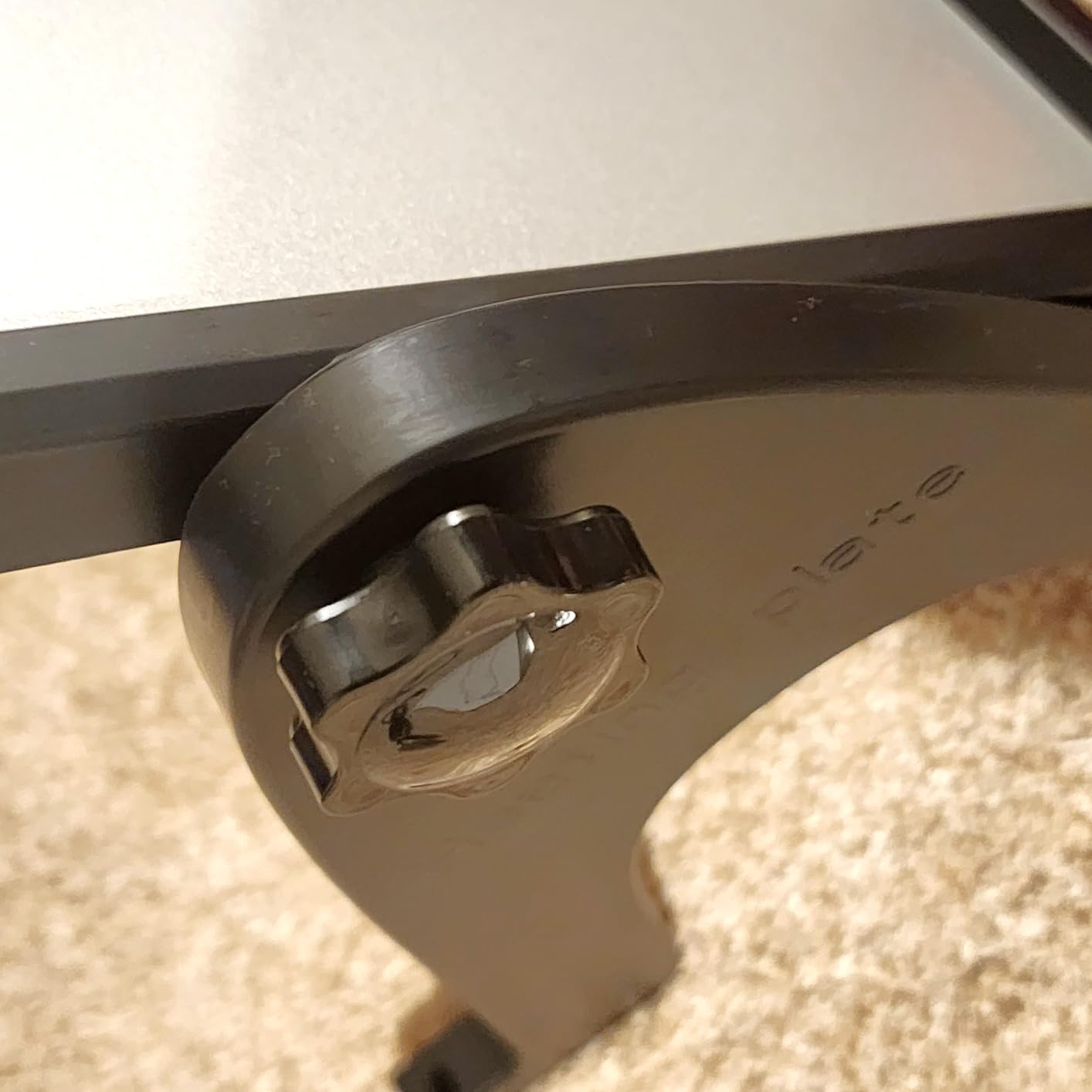
For keepers using it to take the edge off a frosty coop or run through winter, that output is the point. It rotates 360 degrees, mounts on a tripod or hangs from its two built-in hooks, and daisy-chains with other panels.
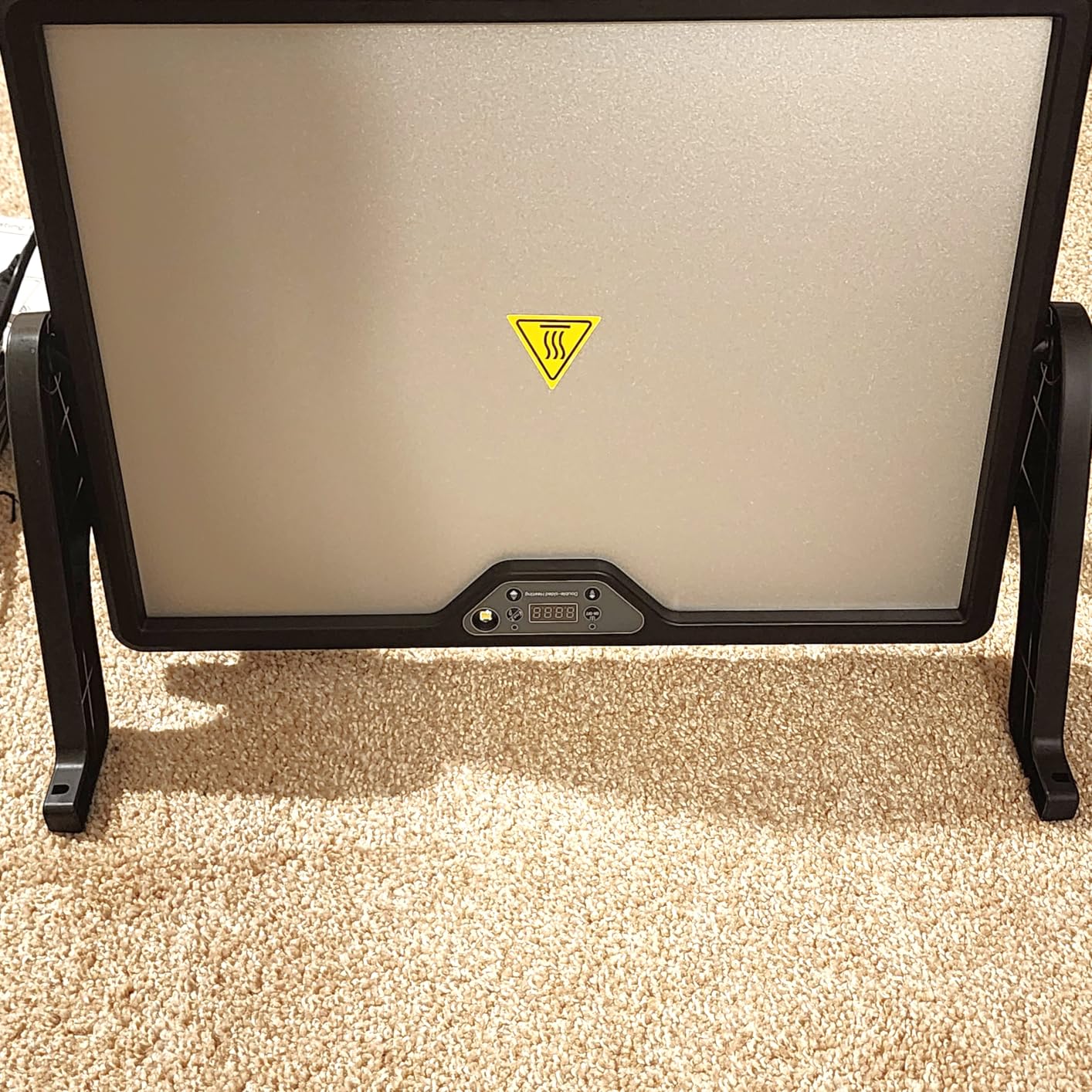
The remote has a memory function, so after a power cut it returns to the last setting instead of defaulting. That single feature is what makes it usable unattended in a space you do not walk through daily.
Four cycle modes run 6, 8, 10 or 12 hours on a 24-hour loop, and a soft LED light lets you check on the flock without opening the door.
How we would use it
Think of it as the second piece of equipment, not the first. Brood day-old chicks on one of the radiant plates above, then move them to a space this panel can actually heat as they feather out.
Its built-in sensor modulates power against ambient temperature automatically, which is useful in a space that swings through a night cycle.
Where it falls short
The 12-hour maximum cycle means there is no continuous mode, so you are always working within the timer. One panel will not warm a large or poorly insulated space in extreme cold.
There are also reports of a defective unit that never heated, so plug it in and confirm warmth days before you need it. That habit applies to every plate in this roundup.
How to Pick a Brooder Heat Plate That Fits Your Flock
Pick the plate after you know your brood size, your room temperature and how long you will be brooding. Wattage and capacity numbers matter far less than those three facts.
Size it to week two, not day one. Manufacturer capacity is a day-old figure. A plate rated for 20 chicks is comfortable for about 12 once they reach a week, because growing birds need more clearance under the warm surface and more floor area to walk. If your brood will exceed the plate by week two, plan on a second plate or a larger model from the start.
Check your room temperature first. A plate heats a zone, not a room. Keepers brooding in a normal indoor space around 70F see good results from every plate here. In an unheated garage near 60F or below, output becomes the limiting factor, and owners report measuring temperatures under the plate well below what they needed with day-olds. If you cannot warm the space, use the plate as a supplement rather than the only heat source.
Prioritise height and tilt adjustment. The plate should sit at chick height for day-olds and be raised every week. Legs that adjust in small steps, and front and back legs that move independently, give you a warm end and a cool end from one plate. That single feature does more for a mixed flock than any thermostat setting.
Budget for an anti-roost cover. Only the RentACoop and JXJHOVV include one. Everywhere else, buy a dome or cone cover separately, because once chicks can reach the top surface they will perch on it and soil the plate, and droppings on an insulating top layer are a hassle to clean.
Test before the chicks arrive. Owners across backyard chicken forums repeat one piece of advice more than any other: plug the plate in two or three days early, put a thermometer at chick height, and confirm it actually warms. Plates that light up and run cold are reported often enough that a pre-check is cheap insurance. If you also need portable heat for a sick brooder or a shed, our guide to the best heat guns covers the infrared options keepers reach for.
Think about power cuts. A plate gives no warning when power fails. Keep a battery thermometer in the brooder, and have a backup plan for overnight outages. Keeping coatings and equipment in good condition also matters if you run heated gear in a dusty space, which our heat protectant spray picks covers.
Week-by-week temperature and plate height
Drop about 5F per week, and raise the plate as the chicks grow. The rule of thumb that works best is to set the underside at the height of a standing chick’s back.
Week 1 (days 0-7): 90-95F. Plate underside level with the back of a standing day-old chick.
Week 2 (days 8-14): 85-90F. Raise the plate roughly half an inch and start watching capacity.
Week 3 (days 15-21): 80-85F. Chicks begin to perch on the plate edge, so the cover matters now.
Week 4 (days 22-28): 75-80F. Fully feathered chicks spend most of the day away from the plate.
Week 5 (days 29-35): 70-75F. Supplement only when the room is cool.
Week 6 (days 36-42): 65-70F. Most chicks no longer need the plate at all.
How to read chick behaviour
Chicks that are cold huddle tightly under the centre of the plate, peep loudly and pile on top of each other. That is your signal to lower the plate or add heat immediately.
Chicks that are comfortable spread out under the plate, move in and out, eat and drink normally, and sleep quietly. This is the target.
Chicks that are too hot scatter to the far corners, pant, hold their wings away from the body and droop. Raise the plate or reduce the setting.
When a Heat Plate Is the Wrong Choice
A plate is the wrong tool when the space is cold, the birds grow fast, or you cannot monitor them.
Cold garages and unheated barns. This is the single most common complaint in owner discussions. A plate warms the air directly beneath it and loses that heat quickly, so a brooder in a 41F garage may only reach the mid-60s under the panel with day-old chicks. If your space cannot be warmed, use a lamp alongside the plate or move the brood into a heated room.
Meat birds. Hatcheries that raise Cornish Cross point out that fast-growing brooder birds outgrow a plate’s capacity quickly and need more warm zone per head than a layer chick. For a large meat-bird batch, size up from the start rather than adding heat later.
The first three days after shipping. Chicks arriving stressed and damp benefit from the broad, forgiving heat of a lamp. Keep a familiar dim bulb above the plate for the first night or two, then remove it once chicks are eating and drinking confidently under the plate.
When you cannot check on them. A lamp lights the whole brooder so you can see everything at a glance. A plate leaves the box dark. If you brood somewhere you cannot reach twice a day, add a low-watt night light so you can check without a flashlight.
Common Mistakes and Failure Modes
Not pre-warming the plate. Plates typically need roughly an hour to reach working temperature. Load chicks onto a cold plate and you will get a bad first night. Owners report specific pre-warm windows of 10 to 15 minutes for some small models and closer to an hour for larger ones, so plug in early and verify with a thermometer.
Skipping the thermometer. Plate surface temperature and air temperature at chick height are different numbers, and only the second one tells you whether chicks are comfortable. A cheap thermometer at chick height is the cheapest insurance in the whole brooder.
Installing the plate upside down. Enclosed designs like the Sindarhor are easy to fit back to front. Check the printed orientation before plugging in.
Using one plate for a brood that has outgrown it. Crowding under a warm zone is a frequent cause of overnight smothering. If chicks fill the area under the plate, add a second plate rather than waiting.
Not testing the plate before arrival. Heater plates that show a lit indicator and never actually heat are reported across several brands. Confirm warmth days in advance, not on the day the chicks arrive.
Ignoring the top surface. Once chicks can reach the plate top they perch there and soil it. Add an anti-roost cover early, before the habit forms.
Leaving loose fasteners unchecked. Side panel and stand fasteners can loosen over a brood, and owners report both sagging plates and a panel falling onto birds. Tighten them weekly.
Raising the plate too early. Going from a heat lamp straight to a plate at full height leaves chicks cold at the edges. Keep the plate low for the first week and raise it on a schedule.
Frequently Asked Questions
What temperature for chick brooder plate?
Aim for 90-95F in week one, then drop about 5F each week: 85-90F in week two, 80-85F in week three, 75-80F in week four and 65-70F by week six. Set the plate underside at the height of a standing chick’s back and adjust chick behaviour as your real thermometer.
Which is better for chicks, a heat lamp or a heating plate?
A heating plate is better for most backyard flocks. It uses a fraction of the electricity, removes the fire risk of a hot bulb over shavings, keeps the brooder dark so chicks sleep on a natural cycle, and gives you a warm end and a cool end under one panel. A lamp wins only when the whole box needs warming in a cold space.
What can I use instead of a heat lamp for chicks?
A low-voltage radiant brooder heat plate is the standard replacement. Alternatives include ceramic infrared emitters, oil-filled space heaters placed outside the brooder, electric water-heated brooder pads with chicks sitting on top rather than under, and a heat lamp plus plate pairing for the first night after shipping.
Are brooder plates safer than heat lamps?
Yes, mainly because they remove the ignition risk. A 250-watt bulb in dry shavings is a recognised cause of coop and barn fires, while a sealed radiant panel never reaches ignition temperature. Plates also run far cooler to the touch and use less electricity, though you still need a thermometer and a sensible placement away from water.
What are the disadvantages of chick heat plates?
A plate warms only the zone beneath it, so it struggles in a cold garage or unheated barn. It has no light, so the brooder is dark and hard to inspect at a glance. Most plates arrive without an anti-roost cover, so chicks perch on the top and soil it. Capacity ratings are day-old figures that shrink as chicks grow, and you manage temperature by plate height rather than a dial.
At what age do chicks no longer need a brooder plate?
Most chicks stop needing supplemental heat around week five to six, by which point they are fully feathered and can maintain their own body temperature. By then the plate is a comfort rather than a necessity in a normally heated room. Keep it available for chicks that still huddle or roost close to the warm surface.
Is a heating pad good for baby chicks?
Not as a substitute for a brooder heat plate. Heated pads work on a different principle: the bird sits on top of the pad rather than under it. A pad gives contact warmth without the radiant zone chicks naturally seek under a hen, so chicks huddle on the pad and can end up with chilled backs. If you use one, put the plate above the pad for the first week.
How much electricity does a brooder plate use?
Most plates here draw 15 to 30 watts, against roughly 250 watts for a typical heat lamp. A 22-watt plate running continuously for a three-week brood uses less energy in total than a 250-watt lamp running for one night. Larger panels with sensors and displays draw more, so check the wattage figure before choosing a model.
The Best Brooder Heat Plate for Chicks in 2026
The RentACoop 12×12 is the best brooder heat plate for most backyard flocks in 2026, with 25 height settings and an anti-roost cone that comes in the box. The Pitalok 12×12 gives you the fastest height changes and the easiest cleaning surface for the money, and the Sindarhor stays the choice when your brooder space is tight and your room is warm.
For larger broods, the Shaledig 12×16 cuts crowding under a single warm zone, and the Tetuga 12×16 adds a thermostat that holds its surface temperature without you touching a leg. The TRIOCOTTAGE covers the digital-control niche, the Premier 1 is the sturdiest plate for a keeper who will brood for years and the INNOLAND belongs in the coop rather than the brooder once chicks are feathered.
Whichever you choose, plug it in days before the chicks arrive, put a thermometer at chick height, and let chick behaviour make the final call. That habit alone prevents most of the problems owners report in their first brood.