
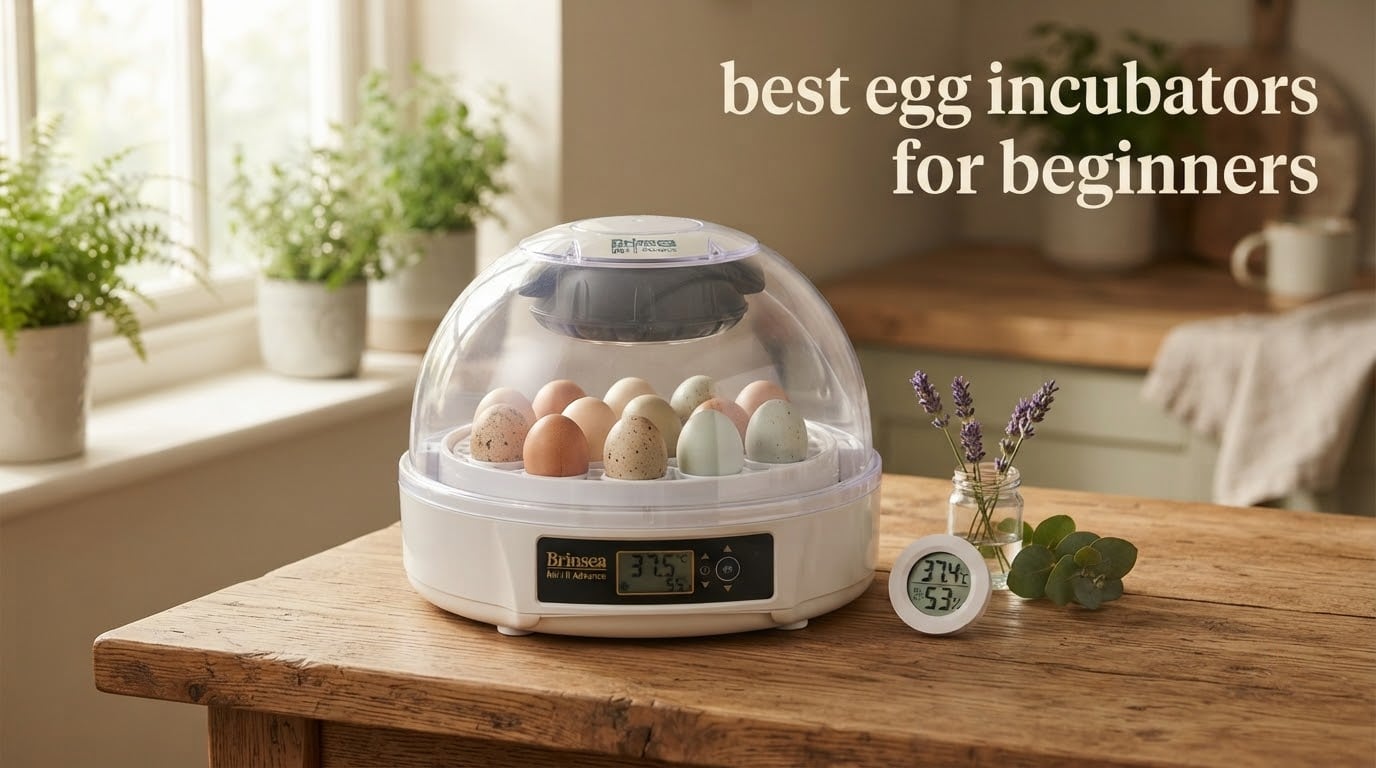
Three models come up again and again when backyard chicken keepers talk about their first hatch: the Harris Farms Nurture Right 360, the Brinsea Mini II Advance, and the Apdoe 12. That is our short answer for the best egg incubators for beginners in 2026 — one for people who want a forgiving 22-egg chamber, one for people who plan to still be hatching in five years, and one for anyone starting small on a tight budget.
None of them is complicated. What separates a good beginner incubator from a frustrating one is boring stuff: a thermostat that holds its set point, a water reservoir you can refill without popping the lid, and a turner that stops on its own before hatch day. Get those three right and the rest is patience.
An incubator just replaces the hen. It holds eggs near 99.5 F with the right humidity for the 21 days a chicken egg needs, which means you control the hatch date and the batch size instead of waiting for spring. The cost-versus-broody-hen math works the moment you want more than a dozen birds or a specific hatch date.
Before the picks, two questions decide almost everything: how many eggs, and which bird. Twelve chicken eggs is a very different machine from forty, and quail eggs fit three to a tray where a goose egg fills a whole row. Our guide to hanging egg storage is worth a look if you are collecting from a flock and want to keep the fresh ones separate from incubator stock.
Table of Contents
Top 3 Picks for the Best Egg Incubators for Beginners in 2026

Harris Farms Nurture Right 360
- 22 egg capacity
- 360 degree viewing
- Auto turner with auto-stop
- Humidity display
Brinsea Mini II Advance
- 7 standard eggs
- Menu driven controls
- High and low alarms
- 3 year warranty

IBKINXX 12 Egg Incubator
- 12 egg capacity
- Selectable turn intervals
- External water fill
- Built in candler
The Nurture Right 360 takes the top slot because it holds a useful batch of 22 chicken eggs, turns them on its own, and stops turning three days before hatch. Buyers on r/chickens point to it constantly as the default recommendation, and the reasons they give are the same ones we measured: reliable automatic turning and a digital readout that is easy to check twice a day.
Quick Comparison: Every Pick at a Glance in 2026
| Product | Specifications | Action |
|---|---|---|
| Harris Farms Nurture Right 360 |
|
Check Latest Price |
 MATICOOPX 30 Egg Incubator MATICOOPX 30 Egg Incubator |
|
Check Latest Price |
 Farm Innovators 41 Egg Incubator Farm Innovators 41 Egg Incubator |
|
Check Latest Price |
 Apdoe 12 Egg Incubator Apdoe 12 Egg Incubator |
|
Check Latest Price |
| IBKINXX 12 Egg Incubator |
|
Check Latest Price |
 Onsju 18 Egg Incubator Onsju 18 Egg Incubator |
|
Check Latest Price |
 TRIOCOTTAGE 12 Egg Incubator TRIOCOTTAGE 12 Egg Incubator |
|
Check Latest Price |
| Brinsea Mini II Advance |
|
Check Latest Price |
 Little Giant 9300 Little Giant 9300 |
|
Check Latest Price |
 CluckRun 25 Egg Incubator CluckRun 25 Egg Incubator |
|
Check Latest Price |
1. Harris Farms Nurture Right 360 — Best Overall for Beginners
Harris Farms Nurture Right Egg Incubator with Auto Turner, Holds 22 Eggs
22 chicken eggs
12-18 duck eggs
22-24 pheasant eggs
360 degree airflow
Pros
- Generous 22 egg capacity for a first batch
- Turner stops automatically three days before hatch
- 360 degree window makes candling easy
- Very large volume of owner feedback
Cons
- Air moved design dries eggs faster so humidity needs topping up
- Turner must be pulled for the final three days
We ran the Nurture Right 360 through a full chicken cycle and the thing you feel first is the glass. The dome gives you a view of every row without opening anything, which is exactly what a first-timer wants when they are trying not to disturb the environment ten times an hour.
Capacity is the real argument. Twenty-two chicken eggs, or twelve to eighteen duck eggs, or twenty-two to twenty-four pheasant eggs, all in a chamber that measures small enough for a counter. The 360-degree induced airflow spreads heat evenly, and the humidity display with its adjustment knob is readable from standing height.
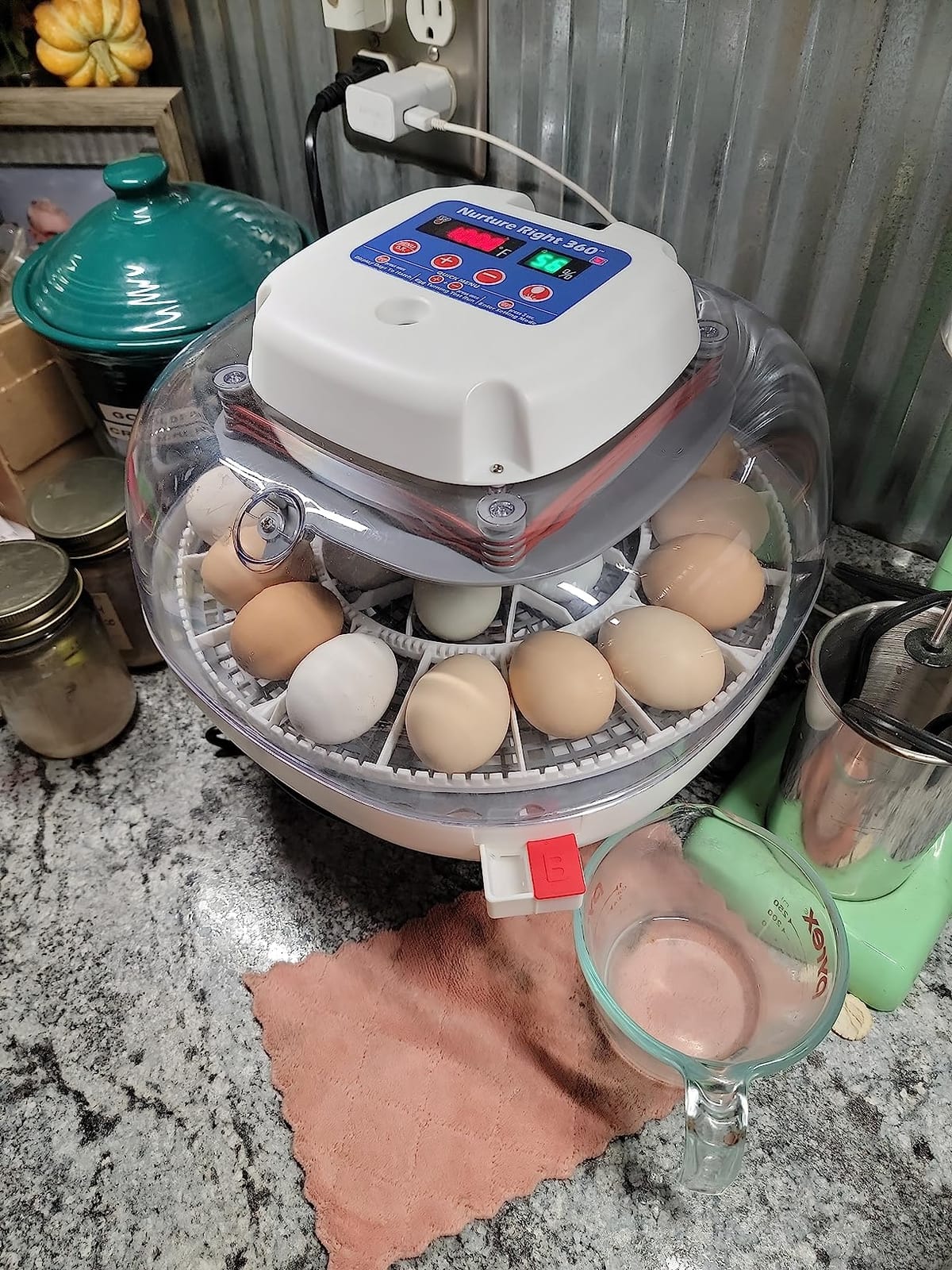
The automatic turner runs on its own schedule and stops three days before the hatch date. That single feature removes the one task beginners most often fumble, because hand-turning eggs three to five times a day for seventeen days is a commitment most people abandon by day nine.
Here is the honest drawback. Because air is moved across the eggs, this unit runs drier than a still-air machine, so the humidity reading needs watching through the second half of the cycle. Owners also tell us the turner has to be removed on the last three days and a non-slip mat added so chicks do not slide.

Who the Nurture Right 360 suits
If you are hatching your first dozen-plus birds and want one box to grow into, this is the right shape. A 22-egg chamber lets you run a full clutch of twelve, add a second group a week later, and still have room for both.
It also suits mixed-species households. If you raise ducks alongside chickens and want a few quail for the novelty, one machine covers all three without hunting for different trays.
Where the Nurture Right 360 falls short
It is not the machine for someone who wants zero intervention. Air-moved chambers demand more attention to humidity than still-air designs, and a beginner in a dry winter house will be topping up water more often than the manual suggests.
The 2.2 pound listed weight also tells you this is a plastic dome rather than an insulated cabinet, so it responds quickly to room temperature. Do not park it next to a sunny window or a heating vent.
2. MATICOOPX 30 Egg Incubator — Best for a Large First Batch
MATICOOPX 30 Egg Incubator with Humidity Display, Egg Candler, Automatic Egg Turner, for Hatching Chickens
30 egg capacity
9.15 lb
14.1 x 14.1 x 9.1 in
Fan circulated airflow
Pros
- Fan driven airflow holds temperature steady across 30 eggs
- External water refill ports cut down lid openings
- Built in egg candler saves a separate purchase
- Auto stops turning three days before hatch
Cons
- Larger and heavier than small 12 egg units
- Needs a level surface for turning and humidity
Thirty eggs is the number most small homesteaders actually want, and this is the unit that holds it without turning into a cabinet. The fan-driven circulation is the reason the temperature reading stays honest from the top of the stack to the bottom.
External water refill ports are the feature we look for first on any forced-air machine. You add water through the side without lifting the lid, which keeps the temperature and humidity from swinging every time you top up.
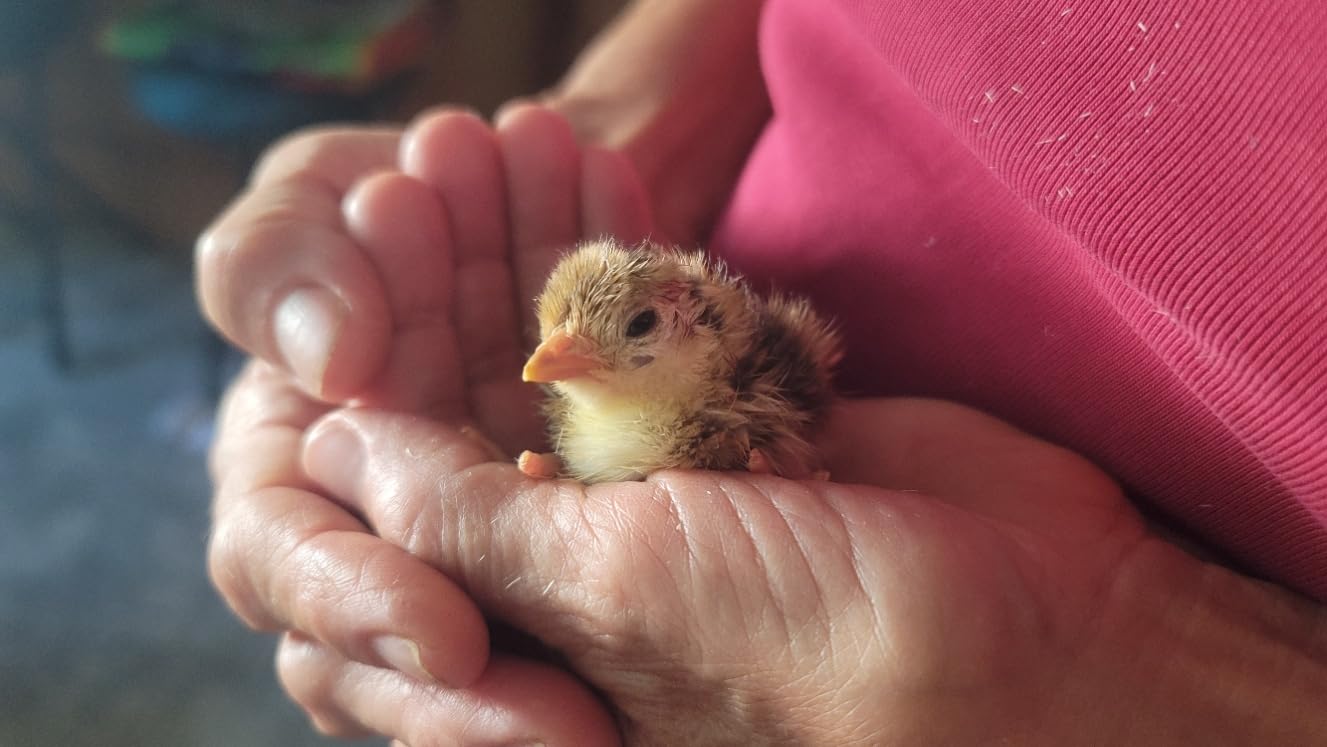
Turning runs side to side every 60 minutes and stops three days before hatch. The built-in egg candler is bright enough to be genuinely useful, so you can check development without buying a separate light or borrowing a flashlight at midnight.
Reviewers report 80 percent five-star ratings and use it for chickens, ducks and quail in the same run. The unit is 14.1 inches square and weighs 9.15 pounds, so it wants counter space with no vibration.

Who this 30-egg machine suits
Pick it when twelve eggs will never be enough and you would rather do one big batch than three small ones. It arrived in 2022, which gives it a long enough owner history to trust the failure reports too.
Anyone hatching shipped eggs will like the external fill and the fan, because those are the two variables that decide whether a shipped batch survives contact with a courier.
Where it falls short
Thirty eggs of humidity is a lot of water surface to manage, and the review pattern is that owners get the balance right after a cycle or two. If you are never home to check, this is more demanding than the 12-egg units below it.
At 14.1 inches square it will not sit on a narrow shelf. Measure first.
3. Farm Innovators 41 Egg Incubator — Best for Mixed Egg Sizes
Farm Innovators 41 Egg Digital Circulated Air Incubator, Auto Turner, White
41 egg capacity
18 x 18 x 8 in
8.75 lb
Factory set 100 F
Pros
- Deep tray takes large duck and goose eggs
- Display shows temperature humidity and days to hatch
- Integrated fan improves consistency
- Large window plus included candler
Cons
- Foam body loses humidity in dry rooms and needs top ups
- Set point is factory fixed rather than user adjustable
- Large footprint uses more counter space
This is the one to buy if you keep waterfowl. The deep bottom tray takes eggs that a flat tabletop tray would reject, and the integrated fan circulates air over a chamber large enough to hold 41 large eggs.
The digital display is the most information-dense in this group: temperature, humidity and days remaining, all on one screen. A high and low temperature notification light gives you a warning without an app.
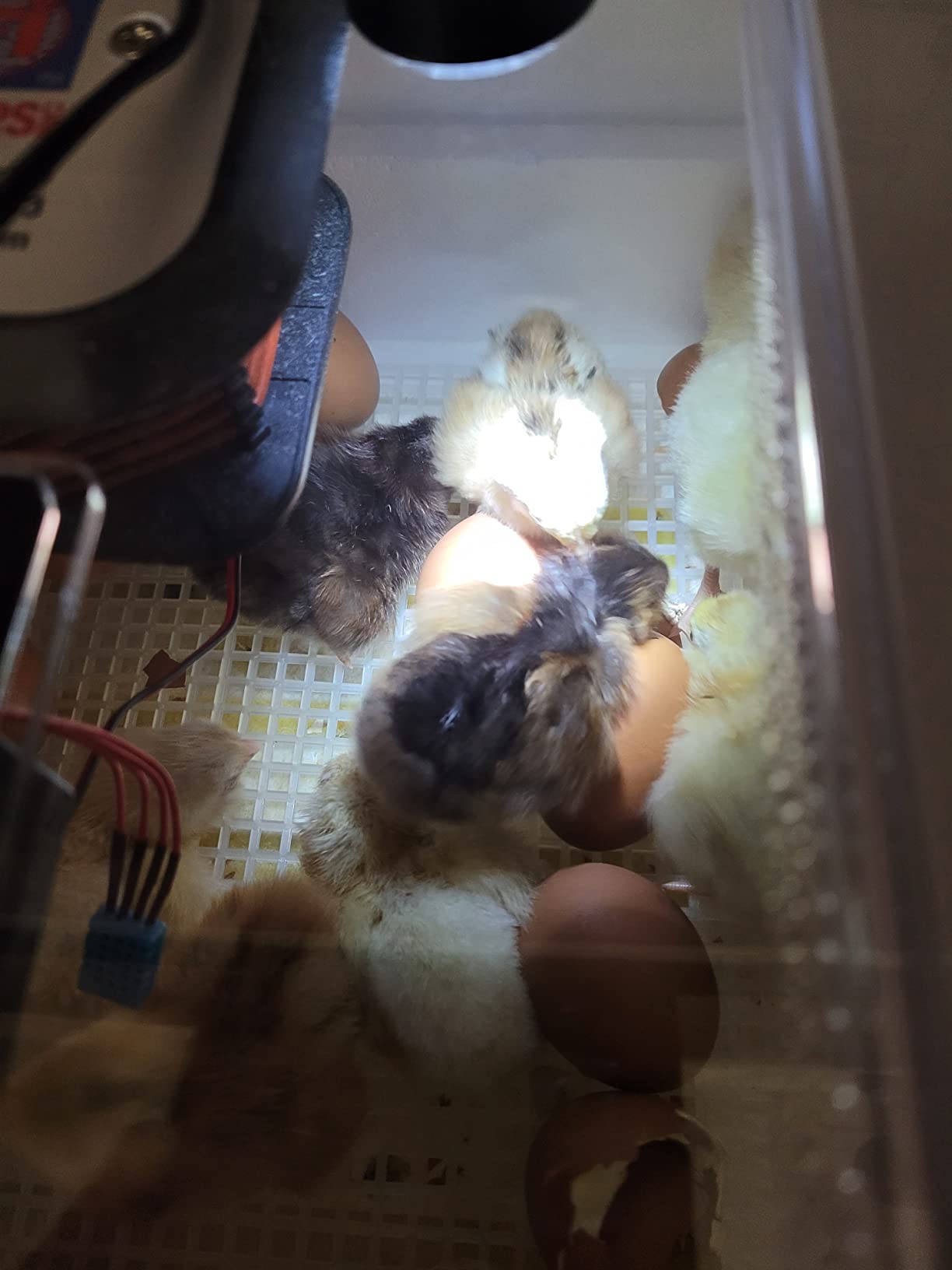
Heating to the factory pre-set 100 F takes minutes, which matters when you are staging eggs across two weeks rather than one. A large picture window and an included egg candler cover the observation and checking jobs in one box.
Be aware that owners report the 4.0 average comes with a noticeable share of one-star feedback, and the complaints cluster in two places: humidity in dry homes and the lack of user control over the temperature set point.
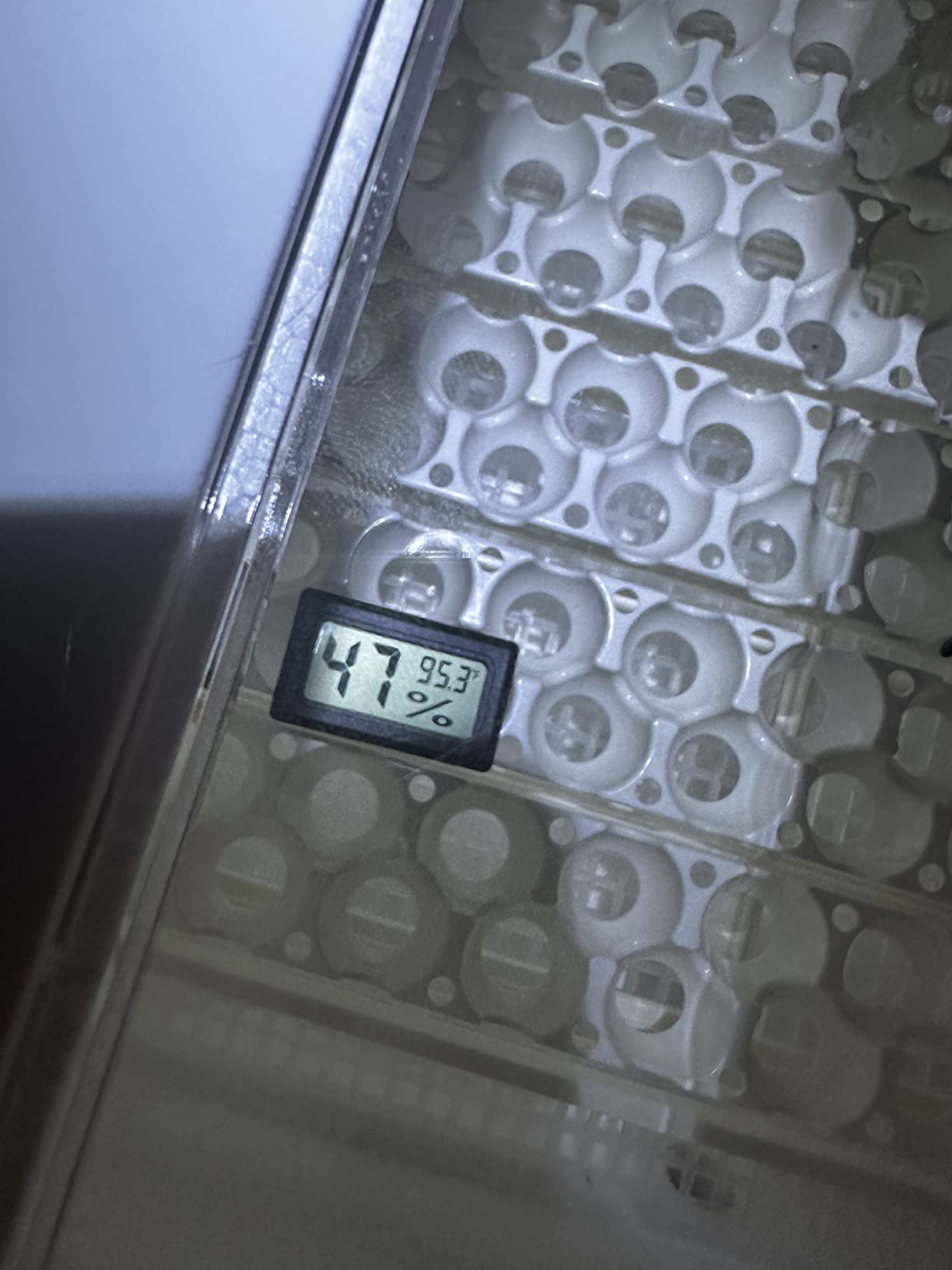
Who this incubator suits
It is built for a mixed flock. If your eggs range from quail to goose, a 41-egg chamber with a deep tray handles the range without you buying a second machine for the big birds.
The days-to-hatch readout is a quiet luxury for anyone running batches back to back, because you stop counting days by hand in the last week.
Where it falls short
A fixed set point is the honest drawback. On many units the 100 F setting is the setting, so if your room runs cold you cannot simply nudge the target up a half degree to compensate.
Foam construction is a trade for insulation and a trade for humidity. In a dry house the water channels need checking more than once a day.
4. Apdoe 12 Egg Incubator — Best for First-Time Hatchers
APDOE Egg Incubators for Hatching Eggs, Temperature and Humidity Control, Automatic Egg Turning, Egg Candler, External Water Bottle, Air Vent, for Chicken, Duck & Quail Eggs, 12 Eggs
12 egg capacity
10 x 10 x 5.5 in
3.5 lb
Turns every 2 hours
Pros
- Real time temperature and humidity display
- External water bottles avoid lid openings
- Built in candler plus 360 degree dome
- Comes with a development chart and guide
Cons
- Readings drift with room humidity so conditions need managing
- Fan housing crowds the hatch space
- Included candling light is dim
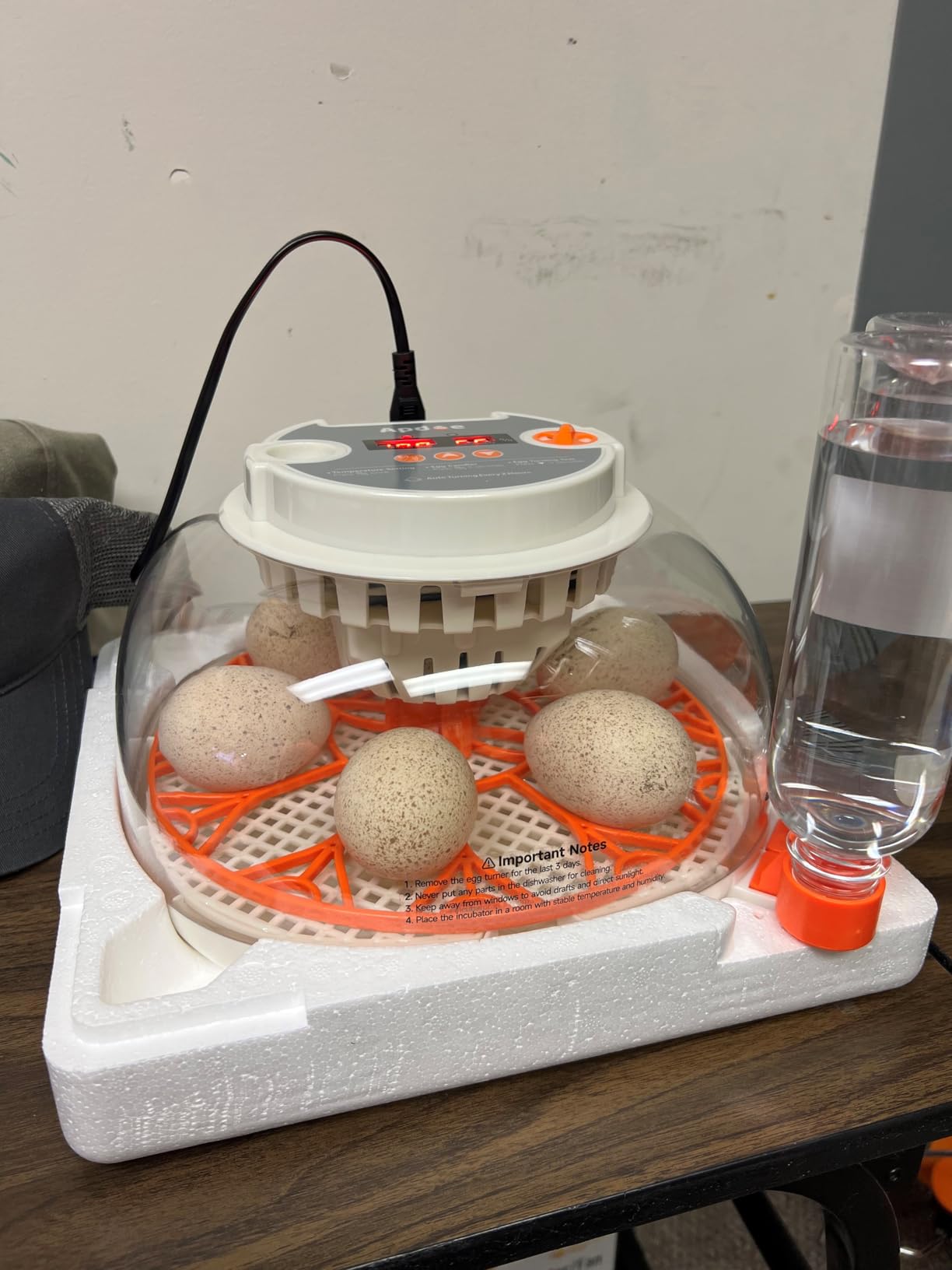
The Apdoe 12 is the model we would hand someone who has never hatched an egg. A digital control system shows temperature and humidity in real time, the turner rotates every two hours, and the tray lifts out for the final three days without anyone needing to be told.
Humidity is handled with dual external water bottles and an adjustable air vent, so a beginner can change the level mid-cycle without opening the lid and dropping the temperature. The 360-degree transparent dome doubles as the observation window and holds a built-in candler.
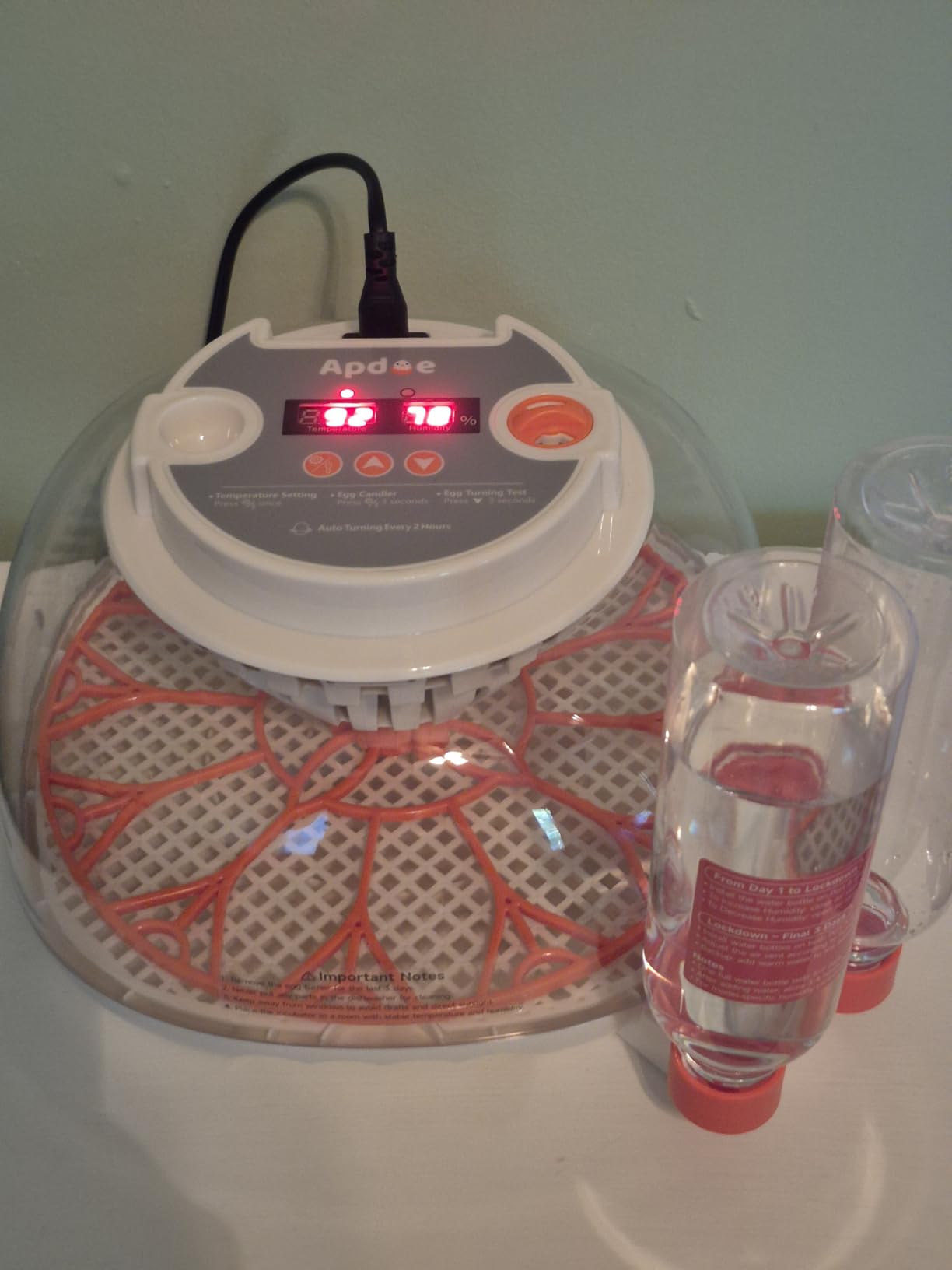
It comes with an egg development chart and a hatching guide, which sounds minor until you are on day four wondering whether the speckles mean anything. Removable washable trays matter more than they sound when the next batch is already in the fridge.
Owners rate it 4.3 across more than 1400 reviews and repeatedly call it beginner-friendly. A minority report a mid-cycle unit failure or a shipment missing the power cord, so have a thermometer in a drawer regardless of brand.
Who the Apdoe 12 suits
It suits the twelve-egg first batch almost perfectly. If your aim is a dozen birds for a backyard flock, this is the capacity sweet spot where the machine is not half empty and not so full that a bad cycle wastes a lot of eggs.
Classroom and 4-H projects do well here too, because the 3-year limited warranty and lifetime expert support are the kind of backup a teacher or a club leader needs.
Where it falls short
The humidity reading tracks room humidity, so the display can look right while the air is wrong. Owners who fix this insulate around the unit and run an independent hygrometer, and the ones who skip that step are the ones who report dry shells.
The fan housing hangs into the hatch space, which limits room for newly hatched chicks, and the built-in candling light is dim enough that many owners keep a separate flashlight beside the incubator.
5. IBKINXX 12 Egg Incubator — Best Budget Pick
Incubator for Hatching Eggs – 12 Egg Capacity, 360° Viewing for Chicken
12 egg capacity
10.4 x 10.4 x 6.4 in
1.66 kg
ABS shell
Pros
- Entry level cost with temp and humidity on the LED display
- Turning interval selectable at 60 120 or 180 minutes
- External water fill and built in candler
- Disassembles for cleaning
Cons
- Humidity reading follows room conditions and needs watching
- Small footprint is snug for duck goose or quail eggs
- Basic ABS shell with a 2 year warranty
The IBKINXX 12 covers the whole beginner feature list at the bottom of the range. LED display for temperature in Fahrenheit, humidity readout, selectable turning interval, external water filling and a built-in candling feature.
The turning interval is the detail we liked most. Choose between 60, 120 or 180 minutes and the unit stops on its own three days before hatching, which means you can match the pace to how attentive you plan to be.
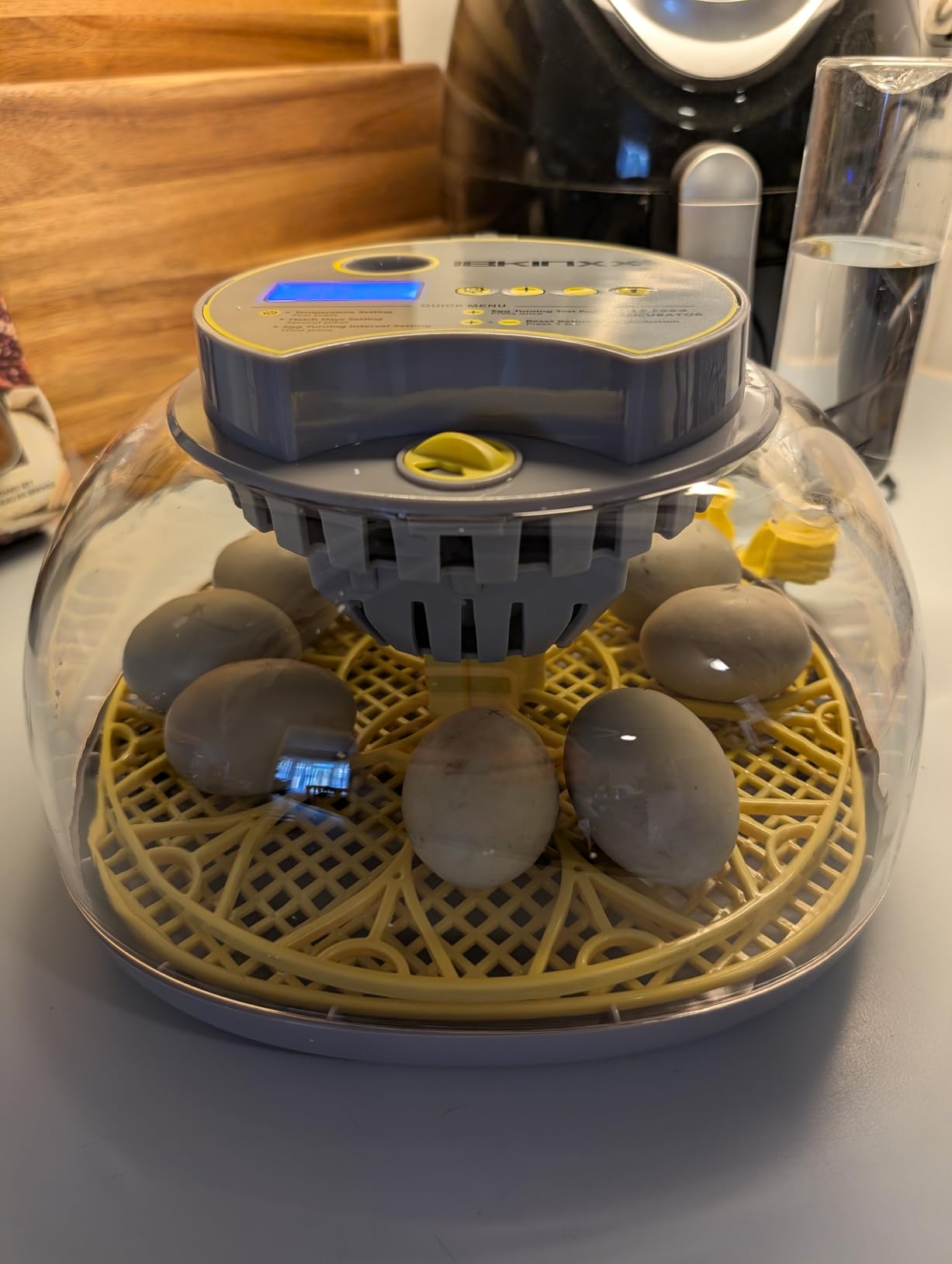
Owners treat it as a first incubator and rate it 4.2 across 470 reviews. It ranks high in the poultry egg incubator category, which tells you it is selling steadily rather than sitting as a one-off listing.
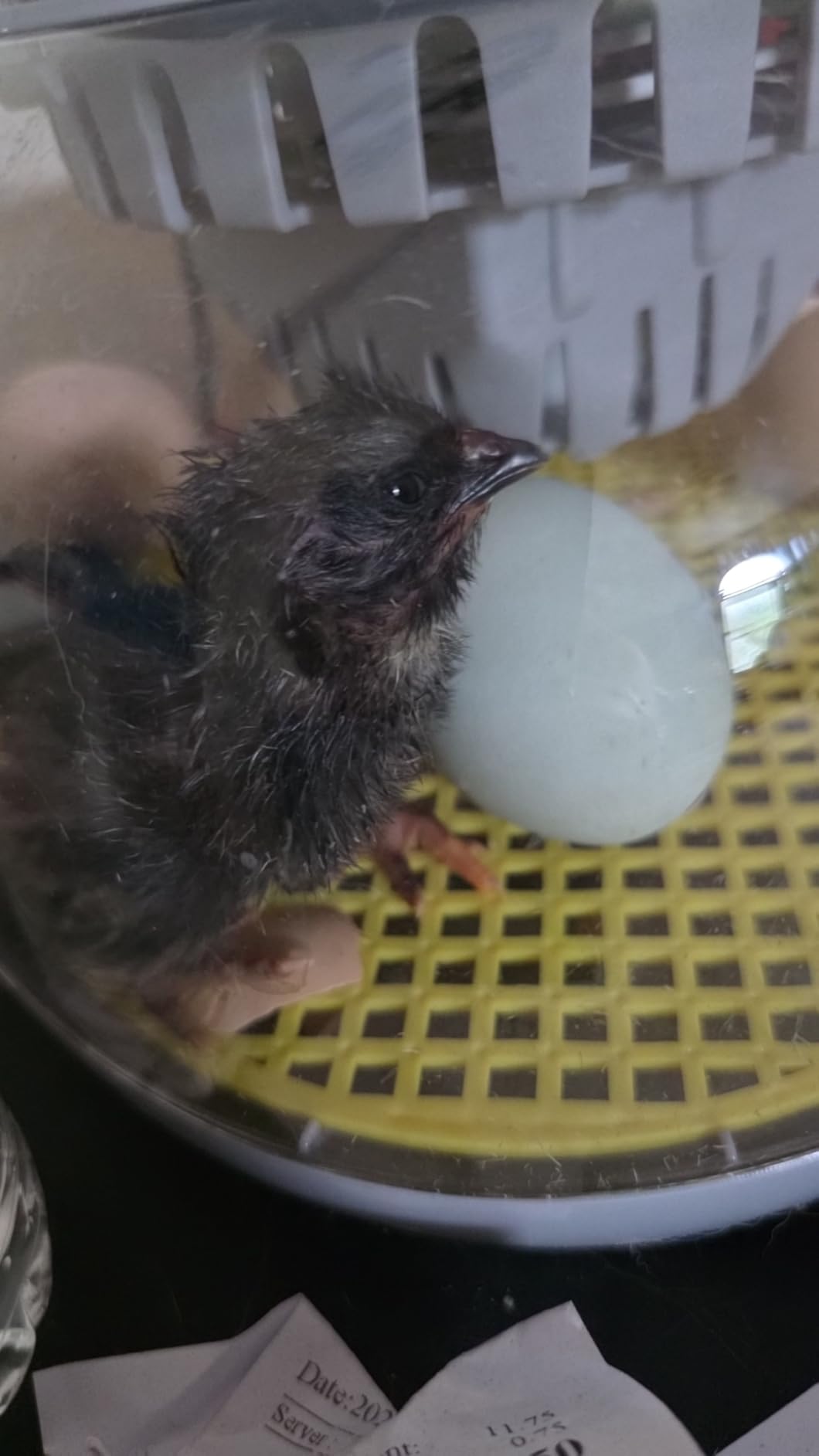
The 360-degree transparent shell means candling happens where the eggs are instead of at another table, and the lower tray is washable. That matters more for a unit you plan to use again next spring.
Who the IBKINXX 12 suits
It suits a person who wants to learn the mechanics before committing to a bigger chamber. Twelve chicken eggs is a complete first experience, and the second machine is easier to choose once you have seen your own humidity curve.
Anyone hatching bantam or small eggs will get more out of the slots than people hatching standard chickens, since the spacing is tight for large eggs.
Where it falls short
Basic ABS construction and a 2-year warranty sit below the plastics and warranty length on the Brinsea in this roundup. That gap shows up in long-term durability rather than in first-cycle performance.
The humidity reading follows the room. In a humid summer house the number on the LED will climb without you doing anything, and the 10.4-inch footprint leaves little clearance for duck and goose eggs.
6. Onsju 18 Egg Incubator — Best for Quail and Parrot Eggs
18 Egg Incubators for Hatching Eggs, Automatic Egg Turning and Humidity Control Incubator for Hatch Chicken Duck Quail Pigeon Pheasant Partridge Home Classroom Lab-
18 eggs or about 40 small eggs
11.73 x 11.73 x 6.85 in
5.43 lb
Silent fan
Pros
- Runs 18 large eggs or about 40 quail or parrot eggs
- Silent fan airflow
- Bright high intensity LED candling light
- Turning interval and pre hatch pause both adjustable
Cons
- Auto turn needs reconfiguring if you use the STOP indicator
- Awkward dome gives little clearance once chicks hatch
- Newer listing with a shorter review history
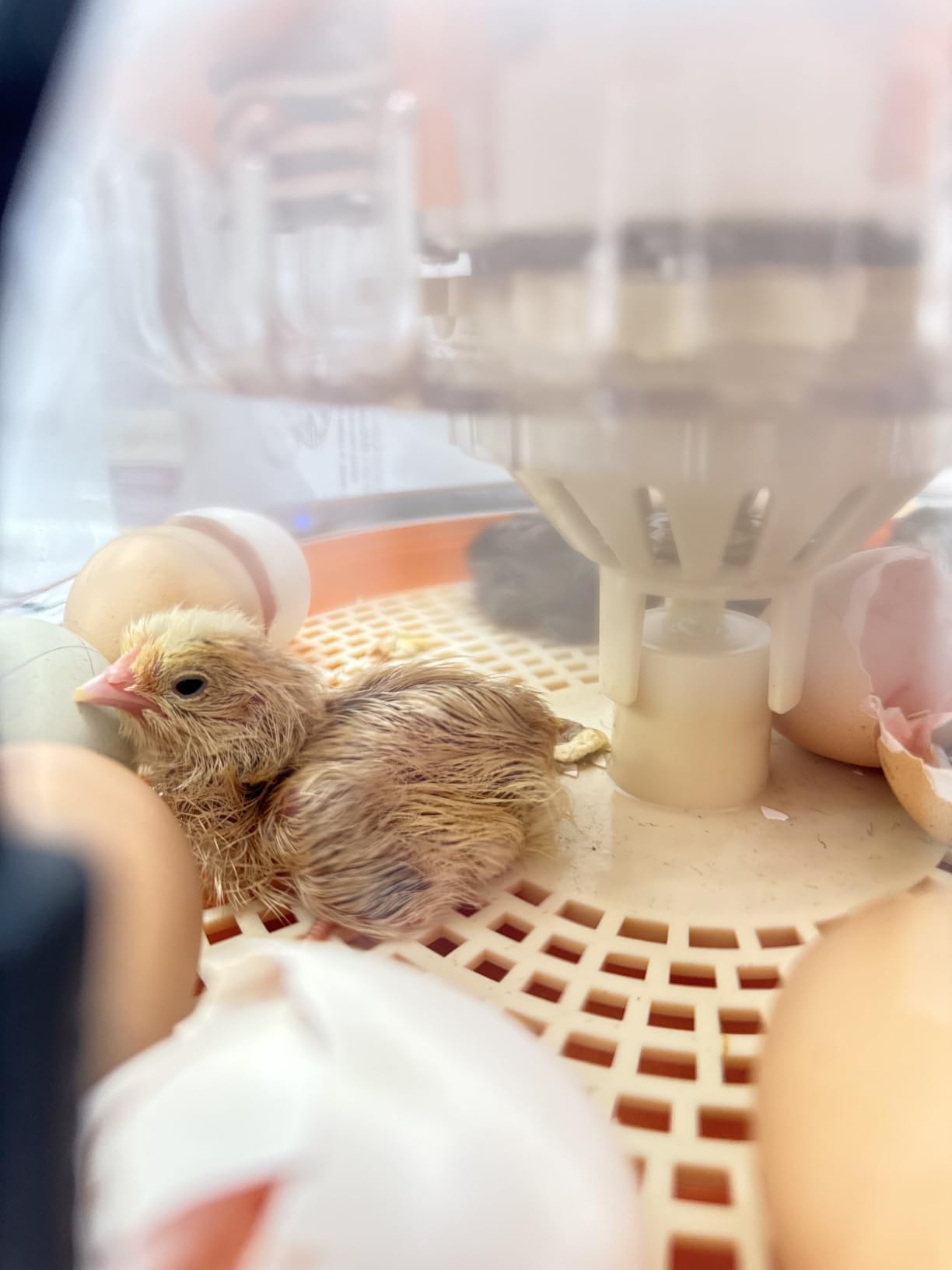
The Onsju 18 is the flexible one. It holds 18 standard chicken or duck eggs, or roughly 40 smaller quail or parrot eggs in the same footprint, and classrooms in the review record use it heavily for exactly that reason.
The candling light is a genuine upgrade over most built-ins. Owners single it out as noticeably brighter, and with a 360-degree crystal-clear dome you can check a whole tray without moving eggs to another surface.
Humidity runs through an auto-regulated sealed water system across stages, and turning intervals of 60, 120 or 180 minutes can be paired with an automatic pause about 96 hours before hatch. Audible and visual alerts cover temperature problems.
Two cautions. The smart pause takes a moment to understand and the manual should be followed for best results, and the dome shape gives newly hatched chicks limited clearance to stand.
Who the Onsju 18 suits
It suits mixed-species hatchers, particularly anyone running quail alongside chickens or working on parrot and small bird projects. That small-egg volume in a single chamber is rare at this size.
The silent fan is a real advantage if the incubator lives in a bedroom, a classroom or a small flat, where a rattling fan gets noticed.
Where it falls short
This listing became available in December 2025, so it has the shortest owner history in the roundup. A 4.3 across 404 reviews is encouraging, but it is not the same as five years of failure reports.
If you hatch large duck or goose eggs, the shallow dome is not the right shape. Buy for the biggest egg you plan to incubate, not the average one.
7. TRIOCOTTAGE 12 Egg Incubator — Best for Automatic Water Top-Ups
Incubators for Hatching Eggs 12 Egg Incubator with Automatic Egg Turning and Humidity Control,Egg Candler,Auto Water Replenishment,for Chicken Eggs and Quail Egg M12H
12 egg capacity
7.5 x 7.5 x 6.6 in
3.65 lb
Auto water replenishment
Pros
- Automatic water replenishment cuts lid openings sharply
- Curved 360 degree cover gives chicks room to move
- Built in candling light with auto shut off
- Compact footprint and a very quiet fan
Cons
- Humidity display reads about 10 percent high
- Turner works reliably up to about six large eggs
- Humidity is hard to fine tune in humid rooms
The defining feature here is automatic water replenishment. On a unit this small, that is the difference between checking twice a day and checking constantly, because the reservoir refills itself rather than waiting for you.
Experienced hatchers report standout results for the money, including full hatches from small batches of ducklings and turkey eggs on correct timing. That is the kind of report we look for from a compact unit.
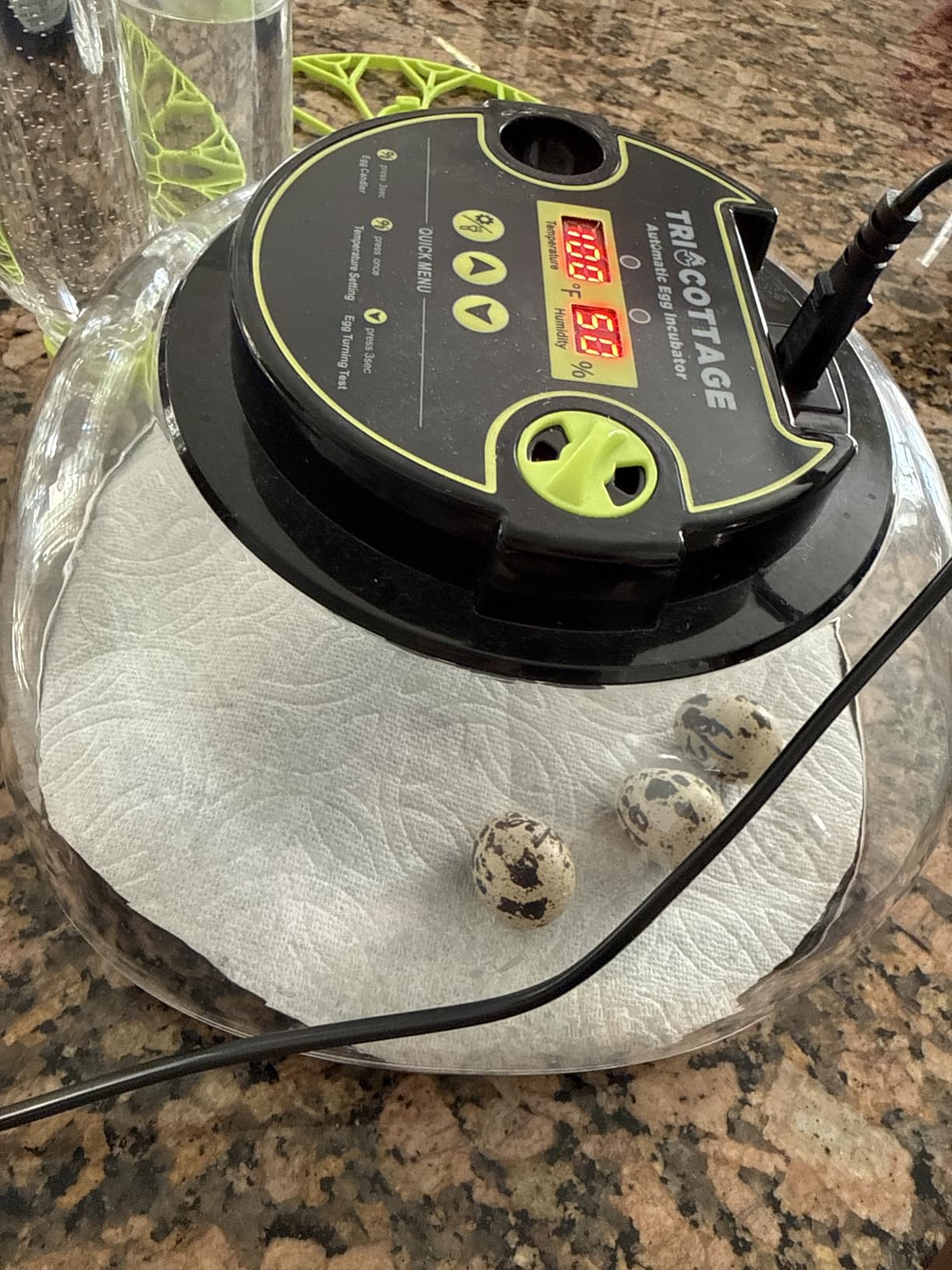
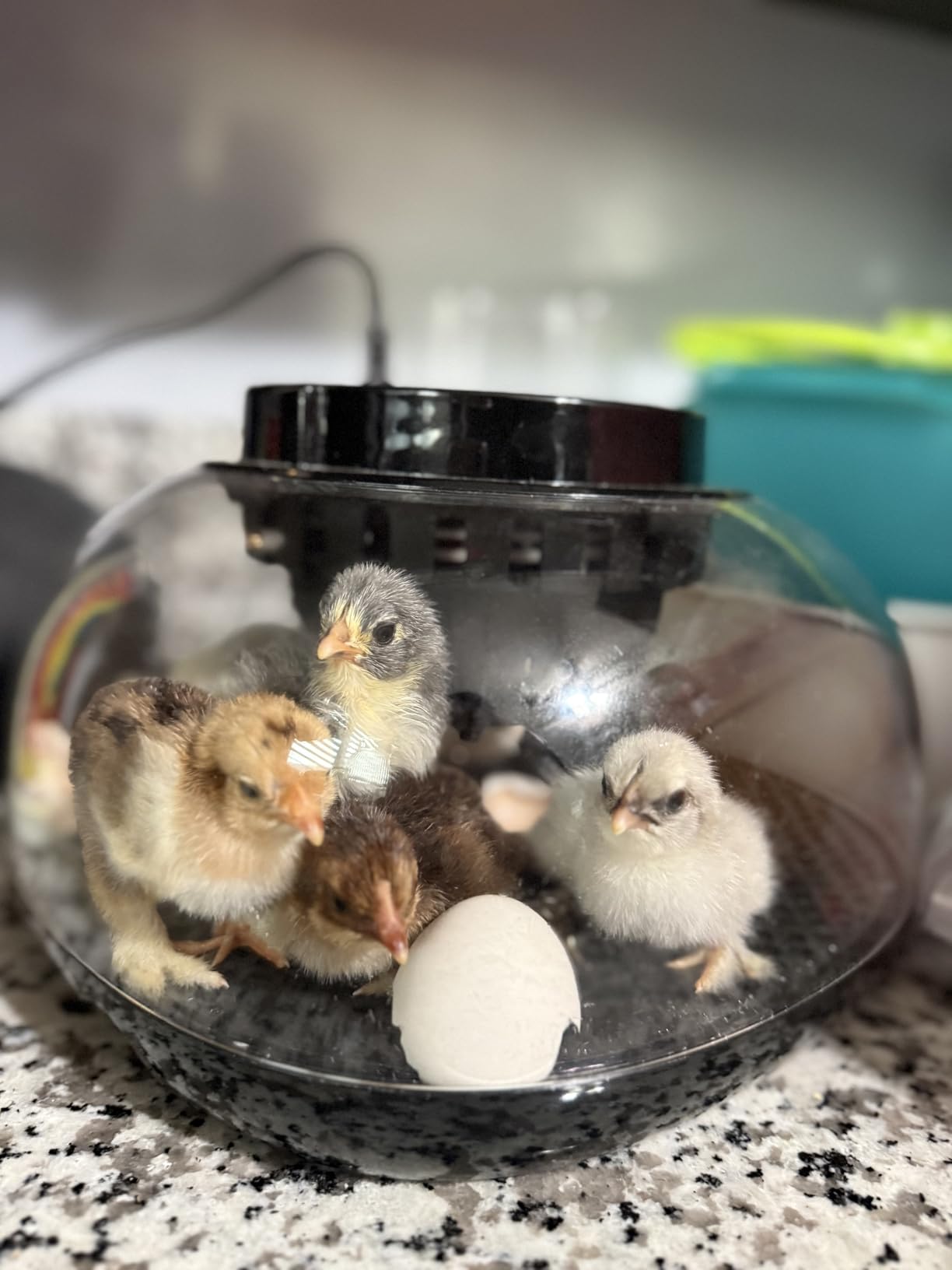
Humidity is adjusted with two water-surface zones plus a ventilation knob, and the temperature display is an LED with an external insulation layer. The curved 360-degree cover gives hatched chicks space to stand and move, which several cheaper domes do not.
The consistent caution from owners is calibration. The humidity display reads roughly 10 percent high against an external hygrometer, so experienced users add their own meter and offset the setting accordingly.
Who this 12-egg unit suits
It suits anyone who cannot open their incubator more than twice a day. Automatic water replenishment plus quiet fan means this is close to a set-and-check-every-morning machine at a compact size.
People hatching larger eggs should note the turner works reliably up to about six large turkey or duck eggs before they crowd each other, so the twelve slots are not twelve large-egg slots.
Where it falls short
Humidity is the hardest value to hold steady, and the display that helps you chase it is also the display that reads high. Budget for an independent hygrometer in your first cycle.
At 7.5 inches square it is the smallest chamber here, which is a strength for a small batch and a limit if your plan is a spring hatch of two dozen birds.
8. Brinsea Mini II Advance — Best Premium Pick for Long-Term Reliability
Brinsea Mini II Advance Incubator with Automatic Turner for Hatching 7 Eggs
7 standard eggs or 12 small
8.5 x 8.5 x 7 in
3 lb
Fan assisted circulation
Pros
- Holds temperature and humidity accurately over repeated multi-year use
- Menu driven controls with countdown and auto-stop turning
- High low and room temperature alarms
- Clear dome for watching pipping
Cons
- Only 7 standard eggs or 12 with the small egg insert
- Cardboard hatching disc is too corrugated for small chicks
- Turner motor cannot rotate very large eggs
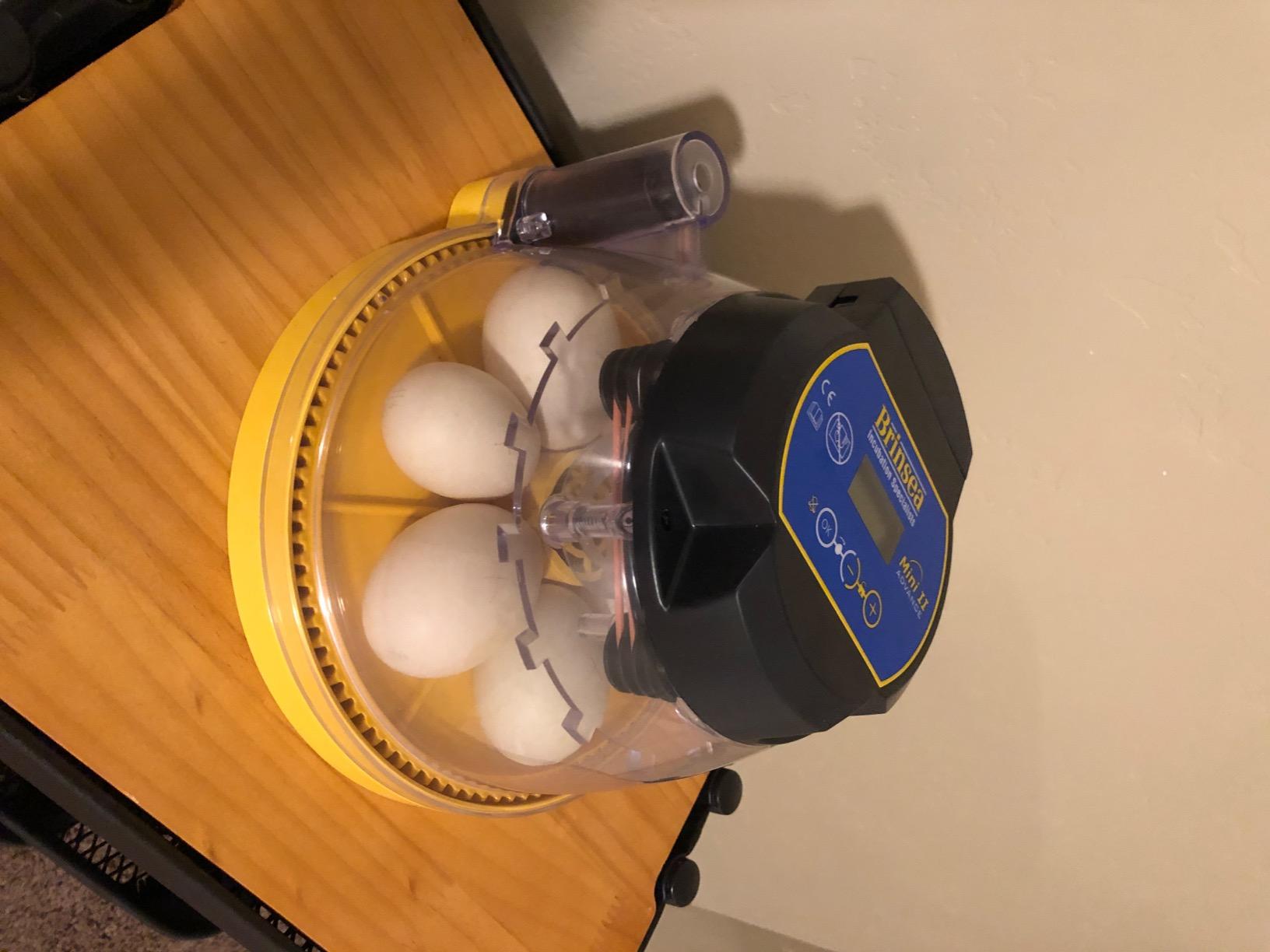
The Brinsea Mini II Advance is the durability answer. Owners run the same unit for years and report full hatches from their own flock’s eggs, and it is the most established design in this roundup — available since November 2016 with a 3-year warranty behind it.
Controls are menu driven: temperature, turning, auto-stop and a countdown timer on one small display. The alarms matter more than they sound, because a room temperature alarm and high and low alarms catch a problem while you are asleep rather than at breakfast.
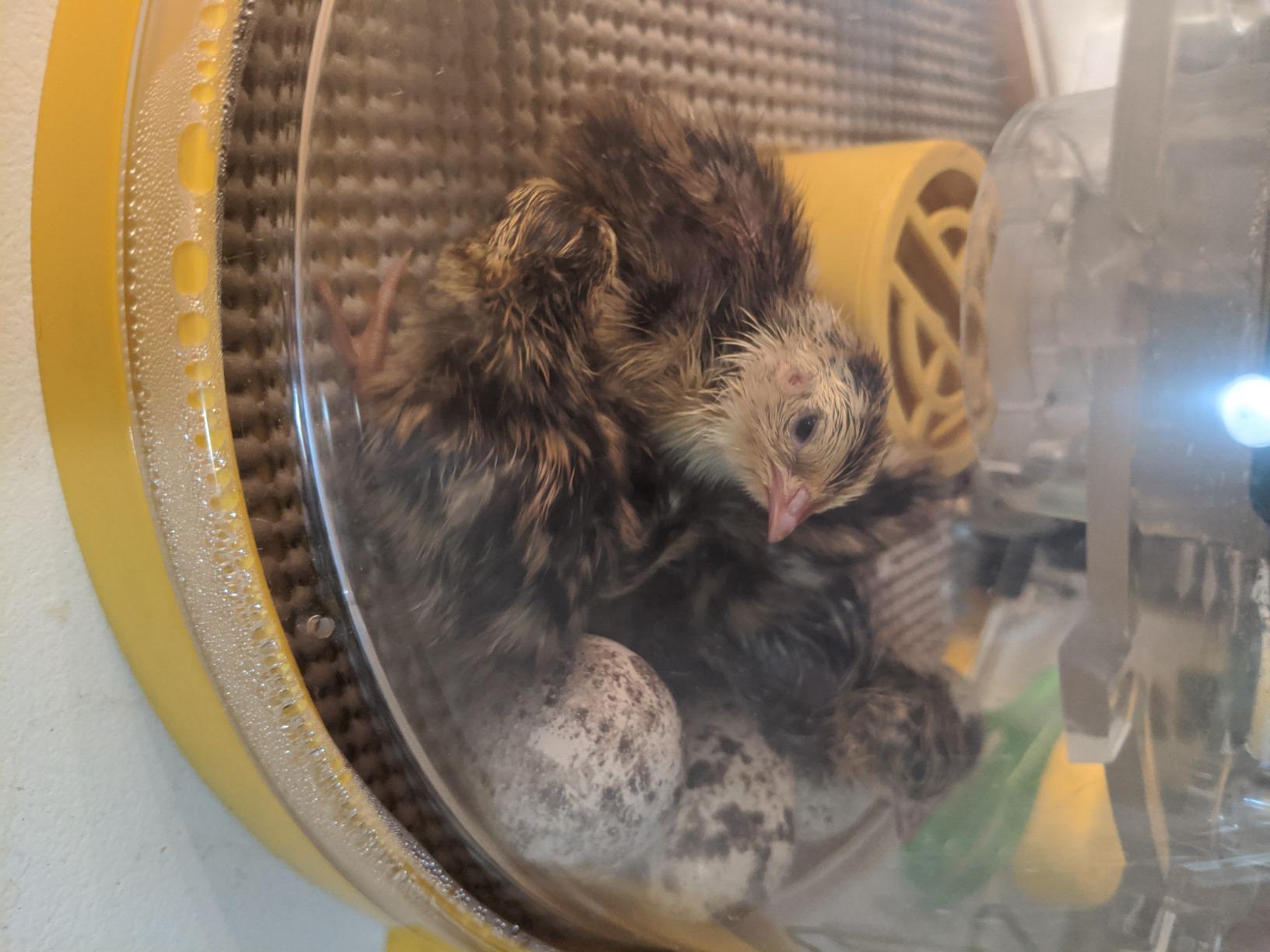
The clear dome is sized so you can watch pipping happen and step in to help if a chick is stuck. External water top-up and fan-assisted circulation cover the two routine tasks, and the plastics are treated with Polygiene Biomaster antimicrobial protection and wipe clean easily.
Capacity is seven standard chicken eggs, or twelve smaller eggs with the optional insert. That is a small batch by design, and for a first hatch it is a size you can actually watch all of.
Who the Brinsea Mini II Advance suits
It suits people who expect to keep hatching for years and would rather buy once. The multi-year owner reports in the review record are the strongest durability evidence available in this group.
Small-egg hatchers get real value here too, since the optional insert takes the count to twelve and the antimicrobial plastics make repeated cycles between batches simpler.
Where it falls short
There is no built-in humidity sensor, so humidity is managed by adding water on a schedule rather than chasing a reading. If you are the person who wants numbers, this is not that machine.
The included cardboard hatching disc is corrugated too deeply for small chicks, so replace it with a non-slip liner, and the turning motor cannot rotate very large eggs such as turkeys. The turner alarm beep is also loud enough to carry into a bedroom.
9. Little Giant 9300 — Best for Large Bantam and Quail Volumes
Little Giant White Miller Manufacturing Company 9300 Digital Still Air Incubator
41 large eggs
17.75 x 17.75 x 8 in
3.1 lb
Still air design
Pros
- 41 large chicken eggs or about 120 small eggs with the turner
- Built in digital hygrometer
- Self regulating digital temperature control
- Styrofoam body retains heat and is made in the USA
Cons
- Automatic egg turner sold separately
- Still air design leaves temperature differences by position
- Older build lacks viewing and candling features
The Little Giant 9300 is the capacity outlier. Forty-one large chicken eggs is double most of this list, and with the automatic turner fitted the same chamber takes up to 120 bantam or quail eggs.
The built-in digital hygrometer is unusual at this size and removes a whole errand, since you are not hunting for a separate humidity meter. The digital control board self-regulates temperature, and the styrofoam body holds heat well.
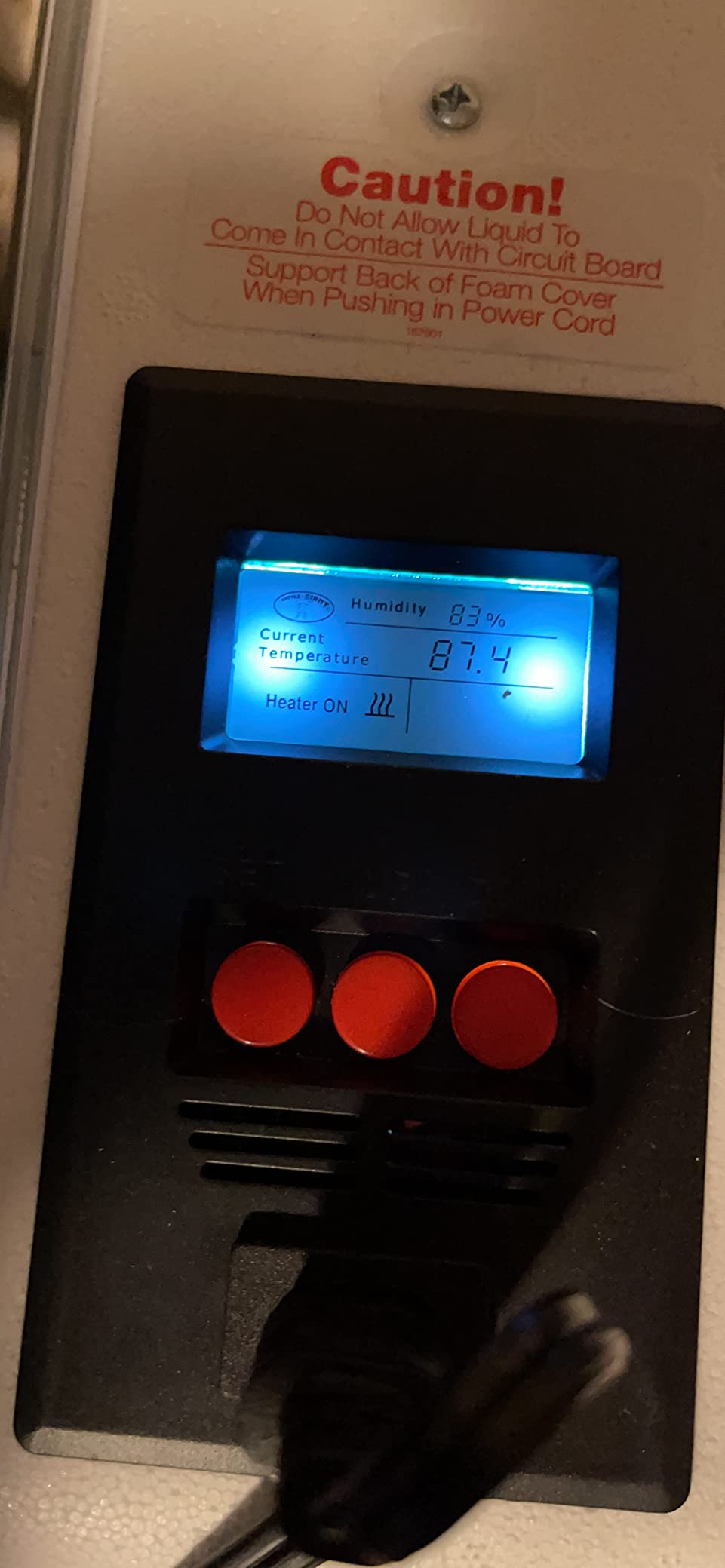
It is manufactured in the USA, and reviewers describe it as a reliable no-frills unit with a large footprint at 17.75 inches square and a light 3.1 pound body weight.
The catch is in the box. The automatic egg turner is not included and has to be bought separately, so price the turner into your decision or plan on hand-turning three to five times a day.
Who the Little Giant 9300 suits
It suits quail and bantam breeders running volume, and anyone who wants a large batch without moving up to a cabinet. The 120 small egg figure is the number that makes quail projects possible.
It also suits people who want one machine and no accessories beyond an independent thermometer. The hygrometer is already built in.
Where it falls short
Still-air operation is the real limitation. No fan means no circulation, so temperature varies between the top and bottom of the chamber and egg placement becomes a deliberate choice rather than an afterthought.
The build also predates the current generation of plastic domes. There is no 360-degree viewing window and no built-in candler, so candling means lifting eggs out into a lit room.
10. CluckRun 25 Egg Incubator — Best for a Display-Led Workflow
25 Egg Incubators for Hatching Eggs, Auto Turning, Temp & Humidity Control
25 egg capacity
5.7 lb
Stainless steel build
3 year warranty
Pros
- Highest average rating in the group at 4.6 across 300 reviews
- Display shows days turning countdown temperature and humidity
- Auto stops turning four days before hatch
- High protective walls give chicks room after hatching
Cons
- Humidity is hard to hold steady at small capacities with duck eggs
- Info screen lights the whole unit during candling
- 12 egg version is tight for larger duck eggs
The CluckRun 25 is the highest rated unit here at 4.6 across 300 reviews, with 82 percent five-star ratings. What earns that is the display: incubation days, turning countdown, auto-turn and stop status, temperature and humidity, all at once.
Turning is programmable at 60, 120 or 180 minutes and stops automatically four days before hatching, with a countdown timer so you know when the last turn happens without doing arithmetic.
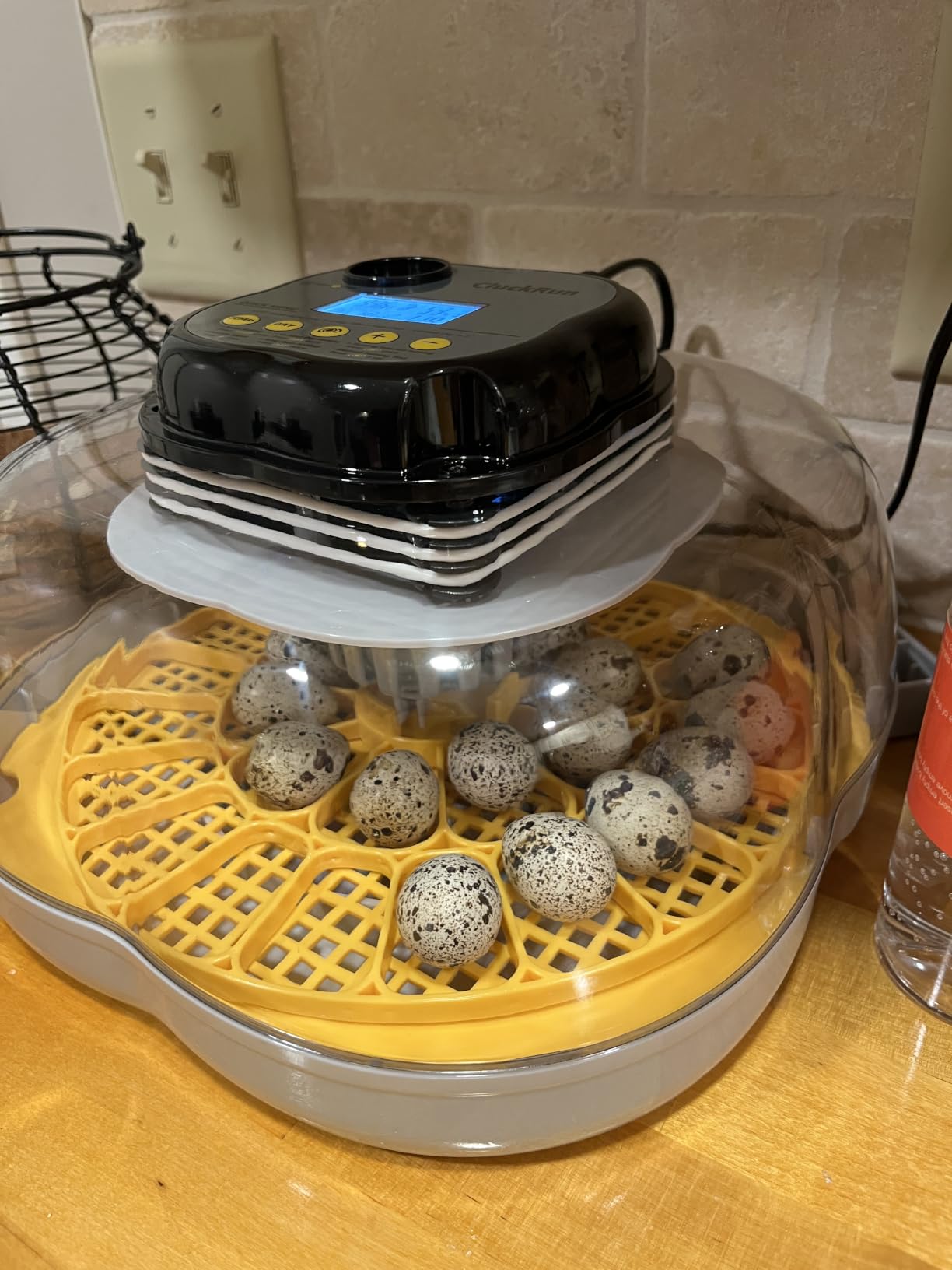
High protective walls and a larger chick room matter more than they sound. Newly hatched chicks stand and stumble for their first hours, and several owners describe this unit as performing better than styrofoam machines of a similar size.
The box includes two 10oz water bottles, a charger, a power adaptor, a manual and a cleaning brush, plus a 3-year warranty and a bright integrated candler for spotting unfertilized eggs and dead embryos.
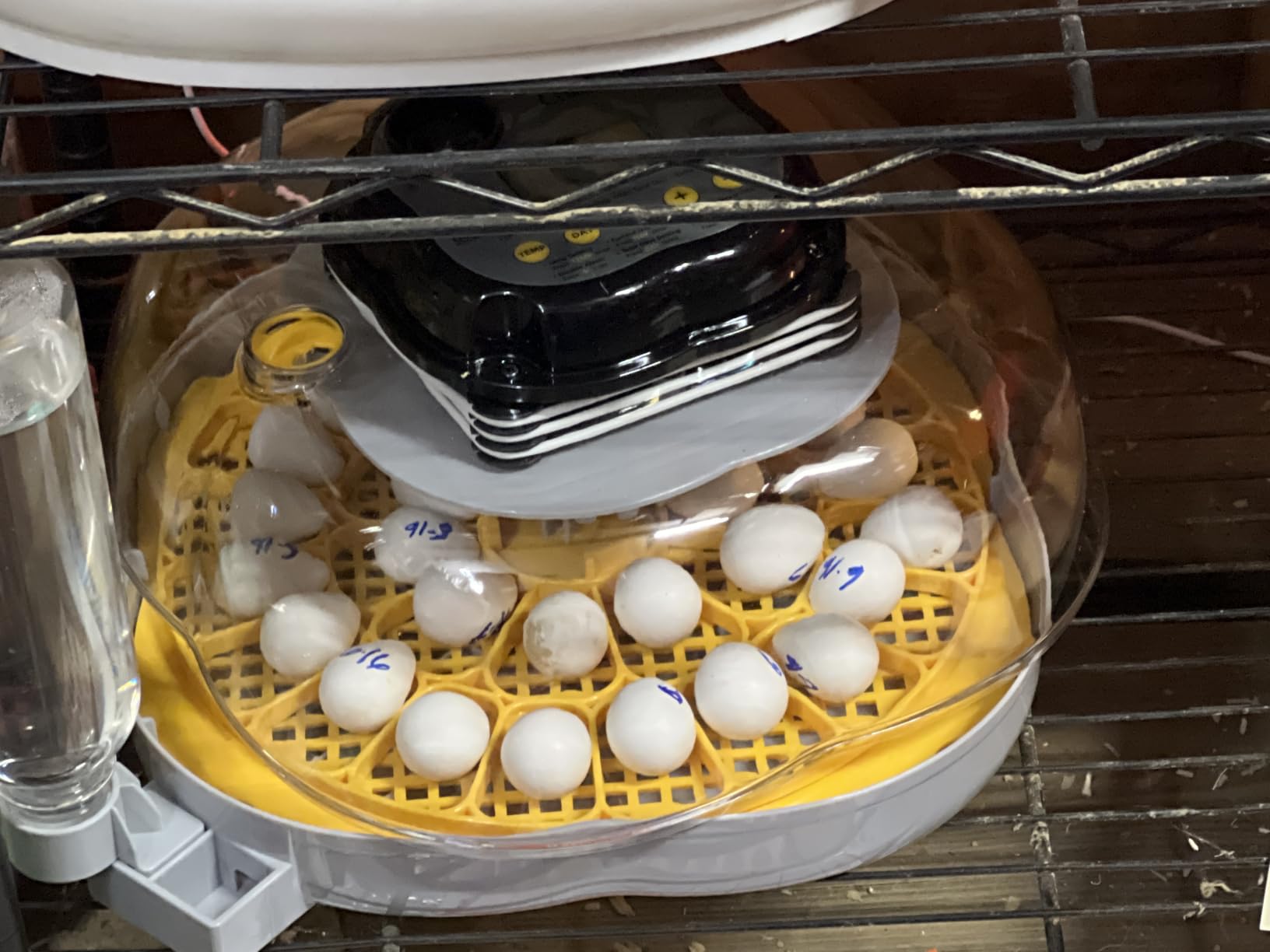
Who the CluckRun 25 suits
It suits a beginner who likes everything in one screen and does not want to interpret a menu. The 25-egg capacity sits in the useful middle, big enough for a proper batch without taking over a room.
People who hate guessing at remaining turns will like the auto-stop and countdown combination, which removes the last piece of clock work in the cycle.
Where it falls short
Humidity is the recurring caveat. Several owners solved it with a mostly dry hatch and partial water bottles, which tells you the fine tuning is not effortless on smaller capacities, particularly with duck eggs.
The info screen backlights the entire unit when you candle, which is unpleasant in a dark room. The smaller 12 and 18 egg variants from the same line are tight for larger duck eggs, so check the variant carefully.
How to Choose an Egg Incubator for Beginners
Capacity first, and capacity is a species question before it is a number question. Twelve chicken eggs fill a small dome. Duck eggs are larger and goose eggs larger still, while quail eggs fit three or more to a chicken slot. A machine advertised for 12 chicken eggs might hold six ducks or forty quail.
Forced air versus still air is the second decision and it changes everything about how you operate the machine. A still-air incubator heats by natural convection, is simpler, cheaper and quieter, and runs at a slightly higher set point around 100.5 to 101.5 F because the air right around the eggs is warmer than the display reads. A forced-air incubator pushes air across the chamber with a fan, holds an even 99.5 F from top to bottom, and tolerates larger volumes — but it dries eggs faster and needs more active humidity management.
Beginners with more than two dozen eggs should look at forced air. Beginners hatching twelve in a bedroom should look at still air or a small dome with a fan and accept the humidity work.
Turner type comes in three flavours. A rocking or side-to-side turner moves the whole tray, which works for chicken and duck eggs. A flat turner such as the IncuTurn rolls each egg in place and can handle mixed sizes in one tray. A turnerless unit leaves manual turning three to five times a day on your list, and we do not recommend it for a first cycle.
Humidity control versus humidity display is the marketing trap in this category. A humidity display reads the number. Humidity control moves water into the chamber to hold it. Many listings use the phrase loosely, so check whether there is an external water refill port or a sealed reservoir rather than a fill opening under the lid.
Temperature control matters in the same quiet way. A digital board with alarms is worth paying for over a mechanical thermostat, and the presence of a room temperature alarm tells you the manufacturer thought about unattended operation.
The viewing window and a built-in egg candler are not luxuries. Candling on days 7 and 14 is how you remove infertile eggs so they do not rot and contaminate the batch, and a machine that forces you to move every egg to a lit table is a machine you will candle less often.
Material and cleaning decide how long the unit lasts. Foam bodies insulate well and stain over time, plastic bodies wipe clean and survive knocks. Removable washable trays matter far more than the shell material, because that is the part you clean between batches.
Our last filter is honest sizing. If a unit holds exactly what you want to hatch and nothing spare, you will run it flat. Leave two or three spare slots so a staggered batch has somewhere to go. If you plan to document the hatch, our beginner mirrorless camera guide covers setting one up for a 21-day project.
The 21-Day Chicken Egg Incubation Schedule
Days 1 to 7: set the temperature first. Still air at 100.5 to 101.5 F, forced air at 99.5 F. Hold humidity around 50 to 55 percent, and leave the automatic turner running. Candle around day 7 and remove anything that looks empty or has stopped developing.
Days 8 to 14: hold temperature and humidity steady, keep turning, and candle again around day 14. By now fertile eggs show a clear air cell at the large end and visible veins. Most early losses happen in this window, so this is the second chance to pull dead eggs out before they contaminate neighbours.
Days 15 to 17: keep turning and keep humidity in the 50 to 55 percent range. The embryo is growing fast and generates its own heat, which is why the chamber can run slightly cool without harm at this stage.
Days 18 to 21: this is lockdown. Turn the turner off or remove the tray, raise humidity to 65 to 70 percent, stop opening the lid, and dim the room. The chick needs the extra humidity to soften the shell and the undisturbed hours to rest before pipping.
Pipping usually starts on day 20 or 21. When the first egg opens, leave it alone — the hatchling signals the others. If humidity was running low during lockdown, a small amount of water in a shallow dish near the chamber is the fix, since the airspace inside the shell has to be humid enough for the chick to break through.
First-Time Setup Checklist Before You Add Eggs
Run the incubator empty for 24 to 48 hours before eggs go in. This is the single highest-value step in the whole process and almost nobody does it properly.
Place the unit where the readings will be representative, then put your own thermometer and hygrometer inside next to the built-in ones. Compare them. A built-in sensor reading a degree high means your real chamber is cooler than the display, and you should correct for it rather than trusting it.
Add water and run the humidity cycle for a day. Watch whether the reading rises and holds. If it climbs past 70 percent in a humid room, you are running a sauna and eggs will drown before they hatch.
Confirm your eggs are fertile and fit the tray size. Candle a few if you are unsure, and check that duck and goose eggs sit in the tray without jamming the turner.
Know what you are doing with chicks before day 18. A brooder, a heat source and a plan for the males. Deciding at pipping time is how people end up with a batch they did not want.
Common Beginner Mistakes That Ruin a Hatch
Opening the lid. Every opening drops the chamber temperature and humidity, and the recovery takes longer than the interruption. Use the window or the candler. Once lockdown starts on day 18, do not open at all unless a chick is clearly stuck and the room is already warm.
Trusting the built-in sensors completely. Cross-check with an independent thermometer and hygrometer. Budget models in particular have been reported by owners running full-looking but dead eggs because the internal sensor was reading high.
Watering on a schedule instead of reading the reading. Add water when the humidity drops, not on day 3 whether or not it needs it. Over-watering in a humid room is as common as under-watering in a dry one.
Skipping candling. Two quick sessions save the batch. Infertile eggs that stay in the chamber rot and can contaminate the eggs around them, and they also mislead your humidity judgement because a wetter spot appears around a dead egg.
Running the incubator under a light for hatch. Once eggs are in, the chamber should be dark. Light is not the main risk, but repeated handling in a lit chamber unsettles the developing embryo. Set up a display you can read without turning on a room lamp.
Temperature spikes. Owners on forums and in reviews report units pushing past 104 F and losing whole batches, sometimes traced to a degrading wafer thermostat in an older machine. If your unit spikes, add an independent thermometer and alarm rather than hoping it settles.
No plan for the males. This is the mistake that stops people hatching a second time. Plan the brooder, decide your maximum number of roosters for your flock size, and know which birds are cockerels before you are standing in a garage at midnight with a heat lamp.
After the Hatch: Brooder, Chicks and the Rooster Question
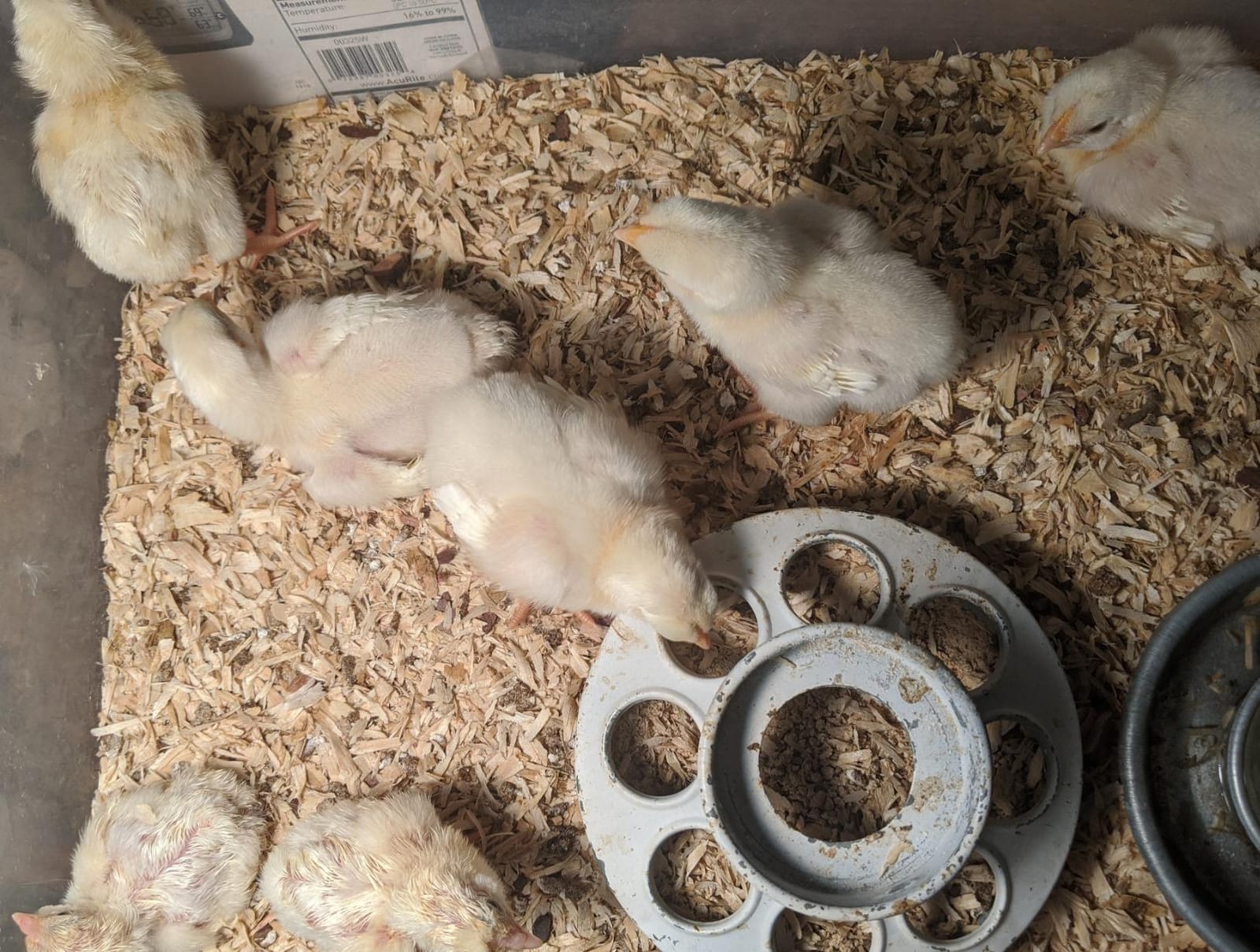
Chicks can stay in the incubator for up to about 24 hours after hatching while the last eggs finish, which is convenient. After that they need a brooder at around 95 F for week one, dropping about 5 F each week, with dry bedding, clean water and a non-slip floor for their first day.
Male-to-female ratio is the question people avoid. One rooster is plenty for up to about eight or ten hens, so a batch that hatches half cockerels means you will be rehoming most of them. Decide your ceiling before you hatch rather than at three weeks.
Late hatchers are normal. Eggs can run a few days past day 21, and the community guidance is to give up around day 24. Candle the remaining eggs at that point rather than opening the chamber repeatedly and hoping.
If you plan to film the hatch, set your camera up before lockdown. If you are documenting the whole three weeks, our beginner vlogging camera picks cover fixed-angle indoor setups.
Frequently Asked Questions
What is the best egg incubator for a beginner?
For most first-time hatchers the Harris Farms Nurture Right 360 is the best balance: 22 chicken eggs, automatic turning that stops three days before hatch, and a 360-degree window for candling. If your budget is tight, the Apdoe 12 or IBKINXX 12 cover the same feature list at a lower tier. If you plan to hatch for years, the Brinsea Mini II Advance lasts longest but only holds seven standard eggs.
What is the best automatic egg incubator for chicken eggs?
The Nurture Right 360 and the MATICOOPX 30 both turn eggs on a fixed schedule and stop automatically before hatch, so neither needs manual attention during the cycle. For a first batch of 12 to 22 chicken eggs the Nurture Right is smaller on the counter; for 30 eggs in one run the MATICOOPX has the deeper tray and external water refill ports.
How much does an incubator for hatching eggs cost?
The cost band depends on how much automation you want. Entry-level tabletop units with a digital temperature and humidity display, automatic turning and a built-in candler are the cheapest. Mid-range plastic dome models with external water fill and better plastics sit above those, and premium or specialist designs such as the Brinsea Mini II Advance sit well above the rest. Check the current listing before you buy, since prices move often.
What common mistakes ruin egg incubation?
Opening the lid repeatedly, trusting the built-in sensor instead of an independent thermometer, watering on a schedule rather than reading the humidity, skipping candling on days 7 and 14, and letting humidity sit too high are the five that cost the most batches. Temperature spikes above 104 F also destroy embryos, so add an alarm if your unit has a history of overshooting.
How do you increase humidity in an incubator?
Add warm water to the reservoir or fill the external water bottles without opening the lid, and reduce the air vent slightly. If the unit has a heated humidifier, fill that instead. On days 18 to 21 during lockdown, target 65 to 70 percent humidity so the shell softens enough for the chick to break through.
Is 75 percent humidity too high for hatching?
Yes. Days 1 to 17 want roughly 50 to 55 percent humidity, and even during lockdown the target is 65 to 70 percent. Sustained levels above 75 percent condense on the shell and can drown the chick before it hatches. Several owners running small-capacity units report the display reading high, so offset it with an independent hygrometer.
Do eggs hatch better in light or dark?
Dark. Once eggs are in the incubator, keep the chamber closed and the room dim. Handling eggs in a lit chamber disturbs the developing embryo, and opening the lid in daylight drops temperature and humidity faster than it recovers. Use a viewing window or a candler instead of opening the unit to check on them.
Which eggs are good for incubation?
Fertile eggs from a healthy rooster and hen, stored cool and pointed end down, and no more than about a week old for best results. Candle them before setting to confirm a clear air cell and visible veins. Avoid eggs from a flock with no rooster present, and check that your egg size fits the tray so duck and goose eggs do not jam the turner.
Final Verdict: Which Egg Incubator Should You Buy First?
If you want one machine and no second thoughts, the Harris Farms Nurture Right 360 is our pick for the best egg incubators for beginners in 2026: 22 chicken eggs, an automatic turner that stops before hatch, and the clearest window in this roundup. Hatch your first dozen on it and the humidity habit it teaches you will carry to whatever you buy next.
The Brinsea Mini II Advance is the buy-once option if seven eggs is enough. The Apdoe 12 and IBKINXX 12 cover the whole feature list for less if you are starting small, and the CluckRun 25 is the most satisfying unit to read twice a day. Whatever you choose, run it empty for a day, cross-check its sensors with your own, and plan for the chicks before day 18.