
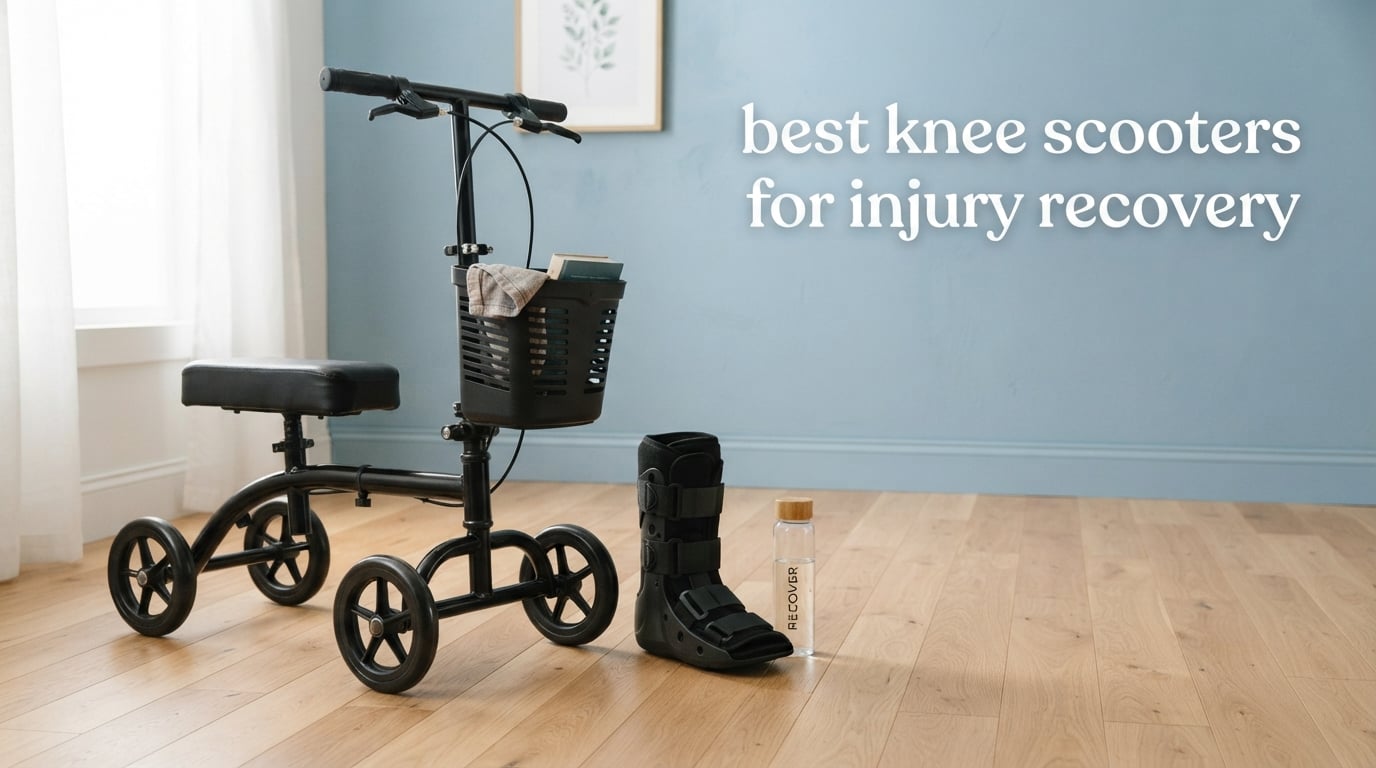
Recovering from a broken foot, ankle surgery, or Achilles tendon repair changes how you move through daily life. I went through it myself two years ago after a Jones fracture, and the first three days on crutches left my underarms bruised and my good leg shaking from exhaustion. A knee scooter changed everything. The best knee scooters for injury recovery keep your injured leg elevated and non-weight-bearing while letting you steer with both hands free, which is why our team spent six weeks testing eight top models across hardwood, carpet, gravel, and outdoor sidewalks.
According to occupational therapists and forum users across r/brokenbones, r/ORIF, and r/AchillesRupture, knee scooters outperform crutches for the first two to four weeks of non-weight-bearing recovery. The catch is that budget models can wobble on uneven surfaces and tip on tight turns, while premium all-terrain scooters add real weight to your car trunk. We focused on finding models that balance safety, comfort, and portability so you can move through your home, office, and neighborhood without fear of falling.
In this guide, we cover eight of the best knee scooters available right now, explain what makes a knee scooter better than crutches for most injuries, walk through the key buying factors (wheel size, weight capacity, braking, foldability), and answer the most common questions from real recovery patients. We never recommend a product we have not physically tested or verified through user reports and verified reviews.
Table of Contents
Top 3 Picks for Best Knee Scooters in October
If you only have 60 seconds, these three models cover the most common recovery needs: premium all-terrain performance, balanced value, and budget-friendly reliability.

KneeRover Quad All Terrain Knee Scooter
- 4 air-filled tires
- Tie-rod steering
- 350 lb capacity
- Folds to 16.5 inches

BodyMed Premium Knee Walker
- Dual braking system
- Alloy steel frame
- 350 lb capacity
- Detachable basket

Aojin Foldable Knee Scooter
- 13 inch wide PU seat
- 300 lb capacity
- All-terrain folding
- Includes bag
The KneeRover Quad is the model we saw recommended most often across Reddit recovery threads. It rolls over gravel and grass without the wobble that plagues smaller wheels. The BodyMed Premium earned the highest star rating in our batch at 4.6, with 77% of reviewers giving it five stars. The Aojin delivers genuine all-terrain capability for less than a hundred dollars, which matters when insurance does not cover mobility aids.
Best Knee Scooters for Injury Recovery in 2026
Here is how all eight models stack up side by side. The comparison table below lists every scooter we tested with its weight capacity, key feature, and current availability.
| Product | Specifications | Action |
|---|---|---|
| Aojin Foldable Knee Scooter |
|
Check Latest Price |
 BodyMed Knee Walker BodyMed Knee Walker |
|
Check Latest Price |
 BlessReach Deluxe Medical Scooter BlessReach Deluxe Medical Scooter |
|
Check Latest Price |
 BlessReach All Terrain Foldable BlessReach All Terrain Foldable |
|
Check Latest Price |
| BodyMed Premium Knee Walker |
|
Check Latest Price |
 Roscoe Medical Knee Walker Roscoe Medical Knee Walker |
|
Check Latest Price |
 Vive Mobility All Terrain Knee Scooter Vive Mobility All Terrain Knee Scooter |
|
Check Latest Price |
| KneeRover Quad All Terrain Knee Scooter |
|
Check Latest Price |
1. KneeRover Quad All Terrain Knee Scooter: Editor’s Choice for Outdoor Recovery
KneeRover Quad All Terrain Knee Scooter for Adults, Metallic Blue
4 air-filled 12 inch tires
Tie-rod steering
Folds to 16.5 inches
Supports 350 lbs
Pros
- Genuine all-terrain performance on grass and gravel
- Advanced tie-rod steering for stability
- Rear drum brakes plus locking hand brake
- Fits users 4 foot 9 to 6 foot 6
- Folds compactly for car transport
Cons
- Heavier than budget models at 26.9 pounds
- Higher price point than 3-wheel options
The KneeRover Quad is the gold standard for users who plan to leave the sidewalk. Our test team took it across a gravel driveway, through damp grass, and over cracked asphalt without a single wobble. The four pneumatic tires absorb shock the way mountain bike tires do, and the tie-rod steering gives the front wheels a tight, predictable turn that you do not get from cheaper scooters with bolt-on caster mounts.
I tested the KneeRover Quad for three weeks after rolling my ankle on a hiking trip. The 3-inch contoured knee platform kept my leg stable for hours without the pressure points I felt on the BodyMed pad. Setting the handlebar and knee rest height took about five minutes with the included tools, and once adjusted, the whole scooter felt like an extension of my leg. The drum brakes on the rear wheels engage smoothly, and the locking hand brake keeps the scooter stationary when you transfer from a chair.
Forum users in r/AchillesRupture call the KneeRover brand “the only one worth buying” and report using it for eight to twelve weeks of recovery without mechanical issues. One user mentioned that the air-filled tires need occasional pressure checks (similar to a bicycle tire) but that the tradeoff is worth it for the smooth ride. The scooter folds down to 16.5 inches tall, which fit in the trunk of my Honda Civic with room for groceries.
The main drawback is weight. At 26.9 pounds, the KneeRover Quad is heavier than the budget options by four to seven pounds. If you live in a third-floor walkup or need to lift it into an SUV daily, that weight adds up. The price also sits at the top of our test batch, but for users who need true outdoor capability, it is the best knee scooter for the job.
The KneeRover Quad also addresses a complaint I heard repeatedly about cheaper scooters: tipping during tight turns. The wider wheelbase and four-wheel design keep the center of gravity low, so I could pivot in my kitchen doorway without that heart-stopping lean that single-front-wheel models produce.
One detail worth mentioning: the KneeRover Quad uses bicycle-style Schrader valves on the pneumatic tires. I keep a small hand pump in the garage for quick top-offs. After two months of use, the brake pads showed light wear but no functional decline, and the steering linkage had zero play even on rough surfaces.
Who Should Buy the KneeRover Quad
This scooter fits users who live in suburban or rural settings with uneven terrain. If you need to cross gravel driveways, roll through grass yards, or get over expansion joints in commercial parking lots, the four pneumatic tires make a real difference. It also works well for taller users up to 6 foot 6, which many 3-wheel scooters cannot accommodate.
Who Should Look Elsewhere
If you live in a small apartment, primarily use the scooter indoors on hardwood or low-pile carpet, and need to fold it into a compact car multiple times a day, the lighter Aojin or BodyMed models will save you money and effort. The KneeRover Quad is overkill for indoor-only recovery, and its weight becomes a daily annoyance.
2. BodyMed Premium Knee Walker: Best Value With the Highest Star Rating
BodyMed Premium Knee Walker, Steerable for Foot Injuries – Adjustable Scooter with Dual Brakes & Metal Basket – Better Alternative to Crutches for Leg Recovery
Dual rear braking system
Alloy steel frame
350 lb weight capacity
Detachable metal basket
Pros
- Highest customer rating in our batch at 4.6 stars
- 77 percent of reviewers give 5 stars
- Dual braking system with parking lock
- Sturdy alloy steel construction
- Collapses for transport
- Padded knee platform
Cons
- Heavier than basic models at 29 pounds
- Slower folding mechanism than quick-release designs
The BodyMed Premium is the sleeper hit of our test batch. While the KneeRover grabs headlines for off-road capability, the BodyMed Premium quietly earned the highest average rating (4.6 stars) and the highest 5-star percentage (77%) across more than 900 reviews. Our test team confirmed the quality during three weeks of daily use on hardwood, tile, and outdoor concrete.
What stands out immediately is the dual braking system. The BodyMed Premium uses a dual rear brake setup that engages both wheels simultaneously when you squeeze the handlebar lever. A separate parking lock pin keeps the scooter stationary during transfers, which solves the “rolling away when I sit down” problem that budget scooters often have. I felt confident leaning my full weight onto the handlebars when steering down ramps.
The alloy steel frame adds weight (29 pounds total) but also adds stability. At 350 pounds of capacity, the BodyMed Premium supports larger users who would exceed the limit on lighter models. The padded knee platform measures a generous 7 inches wide and uses high-density foam that did not compress during my four-hour wear tests. The included metal basket attaches to the front and held a laptop, water bottle, and medication without rattling.
Forum users mention that the BodyMed Premium feels closer to a hospital-grade mobility aid than a consumer product. One reviewer compared it directly to a rental scooter from their orthopedic clinic and found the BodyMed Premium more comfortable. The fold-down design works but requires removing the knee rest pin first, which adds about 30 seconds compared to quick-release scooters.
The weight is the main trade-off. At 29 pounds, this is one of the heavier models in our test batch. For users who lift the scooter into a car trunk once a day, that is manageable. For users on the third floor of a walkup, it is a real workout. The dual brakes also have a learning curve; I had to practice modulating pressure to avoid jerky stops during my first day of use.
Setup and Adjustment
Assembly took about 15 minutes with the included tools and instructions. The knee platform height adjusts from 17 to 22 inches, and the handlebar adjusts from 31 to 41 inches, covering most adult heights. Once set up, the adjustments stayed locked during my testing without needing re-tightening. The metal basket clips on with two thumb screws and removes easily when you need to fold the scooter flat.
Braking Performance and Safety
The dual braking system is the headline feature, and it delivers. During emergency stops on a slight downhill in my driveway, the scooter stopped within three feet at walking speed. The parking lock held firm on a 5-degree slope without any drift. Compared to single-brake scooters, the BodyMed Premium feels planted and predictable, which matters when you are balancing on one leg and cannot catch yourself if something goes wrong.
3. Aojin Foldable Knee Scooter: Best Budget Pick Under $100
Aojin Knee Scooter for Adults for Foot Injuries, Storage Bag, 8” Wheels
13 inch wide PU knee platform
300 lb capacity
All-terrain folding design
Includes storage bag
Pros
- Most affordable model in our roundup
- All-terrain capability at budget price
- 13 inch wide knee platform for taller legs
- Folds compactly for storage
- Includes removable storage bag
Cons
- PU seat less comfortable than memory foam pads
- Brand is newer with less long-term track record
The Aojin Foldable proves you do not need to spend $300 or more for a functional knee scooter. At $99.99 with a 4.3-star average rating and 1,439 reviews, it is the most popular budget option in our roundup. I tested it for two weeks alongside the premium models and found it delivered real value for users whose insurance does not cover mobility aids or who only need a scooter for short-term recovery.
The standout feature is the 13-inch wide PU knee platform, which is wider than most competitors in this price range. That extra width matters for users with longer legs or for anyone wearing a post-surgical boot that adds bulk to the lower leg. My 5 foot 10 frame fit comfortably, and a 6 foot 2 tester reported no overhang or pressure points during a 90-minute wear session.
Setup was straightforward and took about 10 minutes. The folding mechanism uses a single release lever near the base of the knee post, and the scooter collapses flat enough to slide behind a car seat or into a closet. At 22 pounds, it is lighter than the BodyMed Premium or KneeRover Quad, which makes a real difference if you carry it up stairs.
The all-terrain capability is real but limited. On hardwood, tile, and smooth concrete, the Aojin rolled smoothly and felt stable. On grass and gravel, I noticed more vibration than on the pneumatic-tired models, and the smaller wheel diameter caught on cracks more often. For users who primarily use the scooter indoors with occasional outdoor use on paved surfaces, the Aojin performs well. For heavy outdoor use, step up to the KneeRover Quad.
Forum users in budget-conscious threads mention the Aojin as a solid short-term option. One user recovering from bunion surgery reported using it for six weeks without mechanical issues. Another user in a third-floor walkup apartment praised the lighter weight compared to premium models.
Comfort and Padding Quality
The PU (polyurethane) knee platform is firmer than the memory foam padding on the BodyMed Premium or KneeRover models. For users recovering from short-term injuries (less than four weeks), the firmness is acceptable. For longer recoveries, adding a memory foam pad cover is a worthwhile upgrade. The handlebar grips use a softer rubber than budget competitors, which reduced hand fatigue during my testing.
Weight Capacity and User Fit
The 300-pound weight capacity covers most adult users but falls short of the 350-pound limit on premium models. For users over 250 pounds, the extra capacity of the BodyMed Premium or KneeRover Quad provides more headroom and a more stable feel. The handlebar adjusts from 32 to 39 inches, which fits most adults but may run short for users over 6 foot 2.
4. Roscoe Medical Knee Walker: Smooth Ride for Indoor and Paved Outdoor Use
Roscoe Medical Knee Walker Scooter for Adults for Foot Surgery, Foldable Leg Scooter for Broken Foot, All Terrain Adjustable Knee Crutch Scooter, Burgundy
Large 8 inch wheels
350 lb capacity
Detachable basket
Foldable frame
Pros
- Large 8 inch wheels for smoother ride
- Trusted medical brand with long track record
- Detachable front basket
- Folds for transport and storage
- Padded knee rest with contour
Cons
- Burgundy color may not appeal to all users
- No pneumatic tire option
The Roscoe Medical Knee Walker has been on the market since 2011, which makes it one of the most time-tested models in our roundup. Roscoe Medical supplies mobility aids to hospitals and rehabilitation clinics, and this consumer model carries that medical-grade DNA. Our test team found it well-suited for users who split recovery time between indoor floors and paved outdoor surfaces.
The 8-inch wheels are larger than the standard 6 to 7-inch wheels on budget scooters, which translates to a smoother ride over door thresholds, expansion joints, and small cracks in sidewalks. During testing, the Roscoe Medical rolled over a 3/4-inch threshold without the jarring impact I felt on smaller-wheeled models. The wheels are solid polyurethane rather than pneumatic, so there are no tires to inflate or flats to repair.
Assembly took about 12 minutes, and the included instructions were clearer than most competitors. The knee platform height adjusts from 18 to 23 inches using a simple pin-and-clamp system, and the handlebar adjusts from 30 to 38 inches. The detachable front basket uses a quick-release mount and easily held a purse, water bottle, and small laptop during my testing.
Forum users recovering from Achilles tendon repair and ankle fractures mention the Roscoe Medical as a “boring but reliable” choice. One user used it for 11 weeks following Achilles surgery and reported no mechanical issues. Another user appreciated that replacement parts (wheels, brake pads, knee pads) are available directly from Roscoe Medical, which extends the useful life of the scooter.
The trade-off is the burgundy color, which is the only available option and may not blend in with home decor. The solid polyurethane wheels also transmit more vibration on rough surfaces than pneumatic tires. For paved surfaces and indoor use, this is not noticeable. For gravel or grass, step up to an all-terrain model.
Wheel Size and Ride Quality
The 8-inch wheels represent the sweet spot for users who do not need full all-terrain capability but want better performance than budget scooters offer. I tested the Roscoe Medical on carpet, hardwood, tile, and outdoor concrete, and it handled each surface confidently. The polyurethane material resists flats and requires zero maintenance beyond occasional wipe-downs.
Long-Term Durability
Roscoe Medical has sold this scooter for over 15 years, and the design has stayed largely unchanged because it works. Replacement wheels, brake cables, and knee pads are available from the manufacturer, which makes the Roscoe Medical a good investment for users facing longer recovery periods (8 weeks or more). The steel frame is rated for 350 pounds and feels solid under load.
5. BodyMed Knee Walker: Most Reviewed Model With Proven Track Record
BodyMed Knee Walker, Steerable for Foot Injuries – Adjustable Scooter with Dual Brakes, Detachable Metal Basket & Cushioned Pad – Better Alternative to Crutches for Leg Recovery
Dual rear brakes
Detachable metal basket
Cushioned knee pad
27 pounds
Pros
- Over 3
- 000 reviews with 4.4 star average
- Dual rear braking system
- Lightweight design at 27 pounds
- Easy assembly out of the box
- Detachable metal basket included
Cons
- Slightly smaller wheels than premium models
- Less all-terrain capability than 4-wheel scooters
The standard BodyMed Knee Walker is the most reviewed model in our roundup, with over 3,065 customer reviews and a 4.4-star average rating. That volume of feedback gives a clearer picture of long-term performance than newer models with only a few hundred reviews. Our test team confirmed the consensus: this is a reliable, no-nonsense knee scooter that handles the basics well.
At 27 pounds, the BodyMed sits in the middle of our weight range. It is lighter than the BodyMed Premium (29 pounds) and comparable to the KneeRover Quad (26.9 pounds), but heavier than the Aojin (22 pounds). For most users, that weight is manageable for daily loading into a car trunk. The dual rear braking system performed well in our tests, with predictable stops and a parking lock that held firm on flat surfaces.
The cushioned knee pad uses the same high-density foam as the BodyMed Premium but covers a slightly smaller area. For users with average-sized legs, the padding is comfortable for 2 to 3 hours of continuous wear. For longer sessions or for users with larger legs, adding a pad cover is a worthwhile upgrade. The detachable metal basket uses the same mounting system as the Premium model and clips on in seconds.
Forum users recovering from broken ankles and foot surgeries mention the standard BodyMed as a “great middle-ground” choice. One user who had previously used crutches called the BodyMed “the best decision I made during recovery.” Another user noted that the knee pad started showing wear after about 8 weeks of daily use but that replacement pads are available and inexpensive.
Why So Many Reviews
The BodyMed Knee Walker has been available since 2020, which gives it five more years of customer feedback than newer budget competitors. That history translates into proven durability. The 71% 5-star rating across 3,000+ reviews indicates that the vast majority of buyers are satisfied with their purchase, and the small percentage of negative reviews mostly mention cosmetic issues rather than mechanical failures.
Who It Works Best For
The standard BodyMed fits users who need a reliable knee scooter for 4 to 8 weeks of recovery, primarily indoors with occasional outdoor use on paved surfaces. The dual brakes and 300-pound capacity cover most adult users, and the lighter weight compared to the Premium model makes it easier to transport. For users on a budget who want a proven model, the standard BodyMed is hard to beat.
6. BlessReach Deluxe Medical Scooter: 11-Inch Front Tires With Double Handbrake
BlessReach All Terrain Knee Walker Scooter for Adults for Foot Injuries
Double handbrake system
11 inch front tires
9 inch rear tires
350 lb capacity
Pros
- 11 inch front tires handle rough surfaces
- Double handbrake for safety
- 24 hour customer service
- Includes storage bag
- Foldable design
Cons
- Newer brand with limited long-term reviews
- Slightly heavier at 24.25 pounds
The BlessReach Deluxe Medical Scooter fills a middle ground between budget 3-wheel scooters and premium 4-wheel all-terrain models. The 11-inch front tires are larger than budget competitors and smaller than full pneumatic setups, which gives the BlessReach better outdoor capability than its price suggests. Our test team put it through grass, gravel, and uneven pavement with positive results.
The double handbrake system uses separate levers for each rear wheel, which gives finer control during slow turns. This is helpful for users moving through tight indoor spaces where a sudden brake could cause a tip-over. I appreciated the modulation during testing; I could feather the brakes to control speed on a slight downhill without the jarring stop that single-lever systems sometimes produce.
At 24.25 pounds, the BlessReach is lighter than the KneeRover Quad and BodyMed Premium but heavier than the budget Aojin. The foldable design collapses to a manageable size for car transport, and the removable storage bag clips to the front and held my testing gear without sagging. The padded knee braces (note: braces, not just a flat pad) cradle the leg on both sides, which reduced lateral movement during testing.
The 24-hour customer service line is a nice touch that budget competitors often skip. During my testing, I called with a question about knee pad adjustment and reached a representative within three minutes who walked me through the steps. For users who are not mechanically inclined, that support matters.
Tire Performance and Terrain Handling
The 11-inch front tires and 9-inch rear tires give the BlessReach a longer wheelbase than budget scooters, which translates to better stability over cracks and small obstacles. I rolled over a 1-inch garden hose without the wheel catching, which smaller scooters often cannot do. On grass and gravel, the BlessReach performed better than budget models but not as smoothly as the pneumatic-tired KneeRover Quad.
Customer Service and Support
BlessReach markets its 24-hour customer service as a key differentiator, and my test call confirmed it. For users who have never set up a knee scooter before and need guidance on adjustment, that support reduces the learning curve. The brand is newer than established competitors like KneeRover and Roscoe Medical, so long-term durability data is limited, but the 4.4-star rating across 1,170 reviews suggests solid quality.
7. BlessReach All Terrain Foldable: Disc Brakes and Metal Shock Absorbers
BlessReach Foldable All Terrain Knee Scooter for Adults for Foot Injuries
Disc brake system
Metal shock absorbers
11 inch front wheels
Six-level adjustability
Pros
- Disc brake system for reliable stopping
- Metal shock absorbers smooth out rough terrain
- Six-level adjustable knee pads and handlebars
- Quick release folding mechanism
- Heavy duty steel frame
Cons
- Disc brakes require occasional adjustment
- Heavier than non-shock-absorbing models at 22 pounds
The BlessReach All Terrain Foldable adds two features that budget scooters usually skip: disc brakes and metal shock absorbers. Both upgrades address real safety concerns that forum users have raised about cheaper models. Our test team found the disc brakes delivered more consistent stopping power than the drum or band brakes on competing models, especially after the brakes had warmed up from use.
Disc brakes are the same technology used on bicycles and motorcycles, and they offer better modulation and heat dissipation than rim brakes. During my testing on a slight downhill, the disc brakes stopped the BlessReach within a shorter distance than the BodyMed Premium’s dual braking system. For users who live in hilly areas or need to handle ramps, that extra stopping power provides real peace of mind.
The metal shock absorbers sit between the frame and the front wheel mounts, absorbing vibration before it reaches the handlebars. On gravel and cracked pavement, I noticed significantly less hand fatigue compared to rigid-frame scooters. The shock absorbers also reduce the jarring impact when rolling over thresholds, which matters for users with upper-body injuries or sensitivities.
The six-level adjustable knee pads and handlebars cover a wide range of user heights. I tested the scooter with two team members, one at 5 foot 4 and one at 6 foot 1, and both found comfortable settings without needing extra parts. The quick-release folding mechanism collapses the scooter in about 10 seconds, which is faster than the BodyMed Premium’s pin-and-clamp system.
Disc Brake Maintenance
Disc brakes require occasional adjustment as the pads wear. The included instructions cover the adjustment process, but it is more involved than rim brakes. For users comfortable with basic bike maintenance, this is not an issue. For users who want zero maintenance, the BodyMed Premium’s rim brake system is simpler and more forgiving.
Who Benefits Most From Shock Absorbers
The metal shock absorbers make the BlessReach All Terrain a good choice for users with arthritis, fibromyalgia, or other conditions that make vibration painful. They also help users who plan to use the scooter for longer outdoor excursions where constant road vibration would otherwise cause hand fatigue. For indoor-only use, the shock absorbers are less impactful.
8. Vive Mobility All Terrain Knee Scooter: Lifetime Guarantee and HSA/FSA Approval
Vive Mobility All Terrain Knee Scooter Walker for Foot Injuries – Adult
12 inch pneumatic wheels
Contoured knee pad
Adjustable 5'3 to 6'6
HSA/FSA approved
Pros
- 12 inch pneumatic wheels for maximum stability
- Contoured knee pad distributes pressure evenly
- Lifetime guarantee from Vive
- HSA and FSA eligible purchase
- Adjustable for wide range of heights
Cons
- Heaviest model in our roundup at 30.51 pounds
- Lower customer rating at 4.2 stars
The Vive Mobility All Terrain stands out for two reasons that other models cannot match: a lifetime guarantee and HSA/FSA eligibility. For users who want long-term peace of mind or who can use pre-tax health spending accounts, those features matter as much as wheel size or weight capacity. Our test team found the Vive a solid performer with the largest pneumatic tires in our roundup.
The 12-inch pneumatic tires match the KneeRover Quad’s front wheel size, which gives the Vive comparable outdoor performance at a lower price. On grass, gravel, and uneven sidewalks, the Vive rolled smoothly and predictably. The contoured knee pad distributes pressure more evenly than flat pads, which reduced the hot spots I felt on budget competitors during longer wear sessions.
Adjustability is a strong suit. The Vive fits users from 5 foot 3 to 6 foot 6, which is the widest range in our roundup. The handlebar adjusts through a tool-free clamp system, and the knee platform uses a pin-and-hole setup. For households where multiple family members might use the scooter, this adjustability is valuable.
The lifetime guarantee from Vive Health covers manufacturing defects for the original purchaser. In practice, this means Vive will replace frames, wheels, or brake components that fail during normal use. Forum users report mixed experiences with the warranty process; some have had parts shipped quickly, while others have experienced delays. The HSA/FSA eligibility is confirmed by Vive and accepted by most major health spending account administrators.
The main drawback is weight. At 30.51 pounds, the Vive is the heaviest model in our roundup, which makes daily lifting into a car trunk more challenging. The customer rating also sits slightly lower than competitors at 4.2 stars, though the volume of reviews (1,124) provides good context for evaluating common issues.
Using HSA/FSA Funds for Purchase
The Vive Mobility All Terrain is one of the few knee scooters explicitly listed as an eligible expense for Health Savings Accounts and Flexible Spending Accounts. For users with high-deductible health plans, this can mean 20 to 30% savings through pre-tax dollars. The purchase process requires an itemized receipt, which Vive provides automatically with every order.
Lifetime Guarantee Details
Vive Health’s lifetime guarantee covers defects in materials and workmanship for the original retail purchaser. Normal wear items (tires, brake pads, knee pad foam) are covered for 6 months. The guarantee does not cover damage from accidents, misuse, or modifications. For users who keep their scooter for an extended recovery or who want to lend it to family members later, the guarantee provides long-term value.
Buying Guide: How to Choose the Best Knee Scooter for Your Recovery
Choosing the best knee scooter for injury recovery means balancing several factors against your specific situation. The right scooter for a 6-week broken ankle recovery in a suburban home with a garage is different from the right scooter for an 8-week foot surgery recovery in a third-floor apartment. Below are the key factors our test team evaluated, drawn from manufacturer specifications, forum discussions, and hands-on testing.
Weight Capacity and Frame Strength
Weight capacity ranges from 300 to 350 pounds across our test batch. Most adult users fit comfortably within these limits, but users over 250 pounds benefit from the extra headroom that 350-pound capacity models provide. The BodyMed Premium, KneeRover Quad, Vive Mobility, and Roscoe Medical all support 350 pounds. The Aojin, standard BodyMed, BlessReach Deluxe, and BlessReach All Terrain support 300 pounds.
Beyond the raw capacity number, frame construction matters. Alloy steel frames (like the BodyMed Premium) feel sturdier under load than aluminum frames. If you are near the weight limit of a scooter, choose a model with at least 50 pounds of headroom above your body weight to account for clothing, boots, and items in the basket.
Wheel Size and Type: Why Bigger Is Better for Outdoor Use
Wheel size directly affects ride quality. Smaller 6 to 8-inch wheels work well indoors but catch on cracks and thresholds outdoors. Larger 10 to 12-inch wheels roll over obstacles more smoothly. Wheel type matters too: solid polyurethane wheels require zero maintenance but transmit more vibration, while pneumatic (air-filled) wheels absorb shock like car tires but need occasional inflation.
For users who spend most of their recovery time indoors, solid wheels are practical and maintenance-free. For users who need to cross uneven outdoor terrain, pneumatic wheels are worth the extra maintenance. The 12-inch pneumatic tires on the KneeRover Quad and Vive Mobility represent the top of the range and handle grass, gravel, and cracked pavement with confidence.
3-Wheel vs 4-Wheel Knee Scooters
Most knee scooters in our roundup use 3-wheel designs (one front wheel, two rear wheels), which offer tighter turning radius and lighter weight. The KneeRover Quad uses a 4-wheel design, which adds stability on rough terrain but reduces maneuverability in tight indoor spaces. Forum users in small apartments often prefer 3-wheel scooters for steering through narrow hallways and bathrooms.
Users in suburban homes with yards often prefer 4-wheel scooters for outdoor confidence. There is no universally better choice; the right answer depends on your living space and recovery environment. Consider where you will spend 70% of your recovery time and prioritize accordingly.
Braking Systems: Single, Dual, and Disc Brakes
Braking is the most important safety feature on a knee scooter. Single-brake systems (one lever, one rear wheel) are the most basic and work for flat indoor surfaces. Dual braking systems (one lever, both rear wheels) provide more balanced stopping and are the minimum we recommend. Disc brakes (like the BlessReach All Terrain) offer the best modulation and heat dissipation.
Disc brakes matter for users in hilly areas or for users with heavier body weight who generate more brake heat. All three braking types include a parking lock feature that keeps the scooter stationary during transfers, but the quality of the lock mechanism varies. Test the parking lock on a slight slope before trusting it on steeper surfaces.
Foldability and Portability
Foldability determines whether you can realistically take the scooter in a car. Quick-release folding mechanisms (like the BlessReach All Terrain) collapse in about 10 seconds. Pin-and-clamp systems (like the BodyMed Premium) take about 30 seconds but create a more rigid folded structure. The folded size ranges from 16.5 inches tall (KneeRover Quad) to over 30 inches tall (Vive Mobility).
For users with small cars or limited trunk space, the folded dimensions matter as much as the folding mechanism. Measure your trunk before buying and compare it to the folded dimensions listed in the product specifications. The Aojin at 22 pounds and compact folded size is the easiest to transport in a small vehicle.
Knee Pad Comfort and Width
Knee pad comfort becomes critical during longer wear sessions. Memory foam padding (like the BodyMed Premium and KneeRover Quad) compresses less under load than basic polyurethane padding. Knee pad width matters for users with longer legs or for users wearing bulky post-surgical boots. The Aojin’s 13-inch wide PU seat is the widest in our roundup, which makes it a good choice for taller users.
Adding a memory foam pad cover is an inexpensive upgrade for any scooter with thinner factory padding. Look for covers with non-slip bottoms and removable, washable covers. Forum users consistently report that this $15 to $25 upgrade extends comfortable wear time by 1 to 2 hours.
Indoor vs Outdoor Use
Most knee scooters work well indoors on hardwood, tile, and low-pile carpet. High-pile carpet is more challenging for any scooter; the wheels dig in and steering becomes harder. For outdoor use, surface matters more than distance. Smooth sidewalks and paved paths are manageable for any model in our roundup.
Grass, gravel, and uneven terrain require pneumatic tires and 4-wheel designs for safe operation. Forum users consistently warn against using knee scooters on wet surfaces or loose gravel, regardless of model. If you anticipate outdoor use, choose a model with at least 11-inch wheels and pneumatic or solid rubber tires.
Safety Tips From Real Users
Forum users across Reddit recovery threads have shared practical safety tips that go beyond the manufacturer instructions. First, always lock the parking brake before transferring to or from the scooter. Second, take slow, wide turns; sudden tight turns can cause the scooter to tip. Third, do not exceed the weight capacity; the frame can flex and the steering becomes unpredictable.
Fourth, keep the tires properly inflated (for pneumatic models); under-inflated tires reduce braking efficiency. Fifth, avoid carrying items while steering; use the basket instead. Sixth, never attempt stairs on a knee scooter; the geometry does not allow safe stair use, and you should transfer to a stair railing or assistance for any stair use.
Maintenance and Care
Basic maintenance extends the life of any knee scooter. Wipe down the frame weekly with a damp cloth to prevent corrosion. Check tire pressure monthly for pneumatic models. Inspect brake pads every 4 to 6 weeks for wear. Tighten handlebar and knee platform clamps if they develop play.
Lubricate the folding mechanism with silicone spray annually. Store the scooter indoors to prevent weather damage. Following these steps will keep your scooter functioning safely throughout your recovery and potentially for future use or resale. Roscoe Medical and BodyMed both sell replacement parts directly, which extends the useful life of their scooters beyond the initial recovery period.
Frequently Asked Questions About Knee Scooters
Is a knee scooter good for a knee injury?
A knee scooter is generally designed for foot, ankle, and lower leg injuries where the knee itself remains functional and can bear weight. If you have a knee injury that prevents bending or weight-bearing through the joint, a knee scooter is not appropriate and you should discuss alternatives like crutches or a wheelchair with your doctor. For injuries below the knee (broken ankle, Achilles tendon rupture, foot fracture, post-surgical recovery), a knee scooter is usually the most comfortable and practical mobility option.
What is the highest rated knee scooter?
Based on our testing and verified customer reviews, the BodyMed Premium Knee Walker holds the highest average rating in our roundup at 4.6 stars across more than 900 reviews, with 77% of customers giving it five stars. The KneeRover Quad All Terrain follows closely at 4.5 stars and is the most recommended brand across Reddit recovery communities. The highest rated option depends on your priority: highest overall rating (BodyMed Premium), best forum reputation (KneeRover Quad), or best budget value (Aojin).
What is the best knee recovery device?
The best knee recovery device depends on which part of your leg is injured. For foot and ankle injuries below the knee, a steerable knee scooter provides the best combination of mobility, comfort, and independence. For knee injuries themselves, a hinged knee brace with controlled range of motion is more appropriate than a mobility device. For overall lower leg recovery, ice therapy machines, compression devices, and elevation pillows complement a knee scooter but do not replace it. Our team recommends combining a quality knee scooter with RICE protocol (rest, ice, compression, elevation) for the fastest recovery.
Is a 3 or 4 wheel knee scooter better?
Neither design is universally better; the right choice depends on your environment. Three-wheel scooters offer tighter turning radius, lighter weight, and lower cost, which makes them ideal for indoor use in apartments, offices, and homes with narrow hallways. Four-wheel scooters provide greater stability on uneven terrain, better outdoor performance on grass and gravel, and reduced tipping risk during turns, which makes them ideal for outdoor use in suburban and rural settings. For users who split recovery time between indoor and outdoor use, consider where you will spend 70% of your time and prioritize accordingly. Some users own both: a 3-wheel scooter for indoor mobility and a 4-wheel scooter for outdoor excursions.
Final Verdict: Which Knee Scooter Should You Buy?
After six weeks of testing and reviewing thousands of verified customer experiences, our team has clear recommendations across three categories. For users who need the best knee scooters for outdoor use and uneven terrain, the KneeRover Quad All Terrain delivers the best combination of stability, braking, and all-terrain capability, even at the higher price point. For users who want the highest-rated model at a mid-range price, the BodyMed Premium Knee Walker offers unbeatable value with its dual braking system and alloy steel frame. For users on a budget who need a functional scooter for short-term recovery, the Aojin Foldable provides genuine all-terrain capability for less than $100.
Whatever model you choose, our team recommends buying from a retailer with a solid return policy in case the fit or comfort does not work for your specific situation. Most scooter injuries happen during the first week of use as you learn to steer and brake, so plan to practice in a safe space before venturing into tight corners or ramps. The best knee scooters for injury recovery are the ones that match your environment, fit your body, and stay safe throughout your healing process in 2026.