
Our team spent three months testing eight of the best countertop water filters on the market, sending each one through lab panels for PFAS, lead, chlorine, and microplastics while logging daily taste, flow rate, and maintenance data in three households. We filled out filter change logs, weighed waste water from RO units, and tracked how each model handled the hard water coming out of our test faucets.
The result is this guide to the best countertop water filters for clean drinking water in 2026, written for anyone who wants laboratory-grade water without hiring a plumber. Whether you rent an apartment, worry about forever chemicals, or simply want better-tasting coffee, one of these units will fit your counter, your budget, and your water quality concerns.
Countertop filters work by forcing tap water through one or more filtration media (carbon blocks, RO membranes, ion exchange resins, or gravity-fed ceramic elements) that trap or reduce contaminants before the water reaches your glass. Unlike pitchers that trickle, today’s countertop models dispense on demand and can match the contaminant reduction of full under-sink systems.
Table of Contents
Top 3 Picks for Countertop Water Filters in October
If you only have 30 seconds, those three are your safest bets. The AquaTru is the most aggressive contaminant remover we tested. The Waterdrop offers the best long-term value per gallon. The Brita delivers the largest batch capacity for the lowest upfront spend.
Best Countertop Water Filters in 2026: Quick Comparison
| Product | Specifications | Action |
|---|---|---|
 Brita 27-Cup Dispenser Brita 27-Cup Dispenser |
|
Check Latest Price |
 iSpring CKC1C iSpring CKC1C |
|
Check Latest Price |
 Waterdrop CTF-01 Waterdrop CTF-01 |
|
Check Latest Price |
 Purewell 3-Stage Gravity Purewell 3-Stage Gravity |
|
Check Latest Price |
 AquaTru Glass Carafe AquaTru Glass Carafe |
|
Check Latest Price |
 Big Berkey 2.25 Gal Big Berkey 2.25 Gal |
|
Check Latest Price |
 Bluevua RO100ROPOT Bluevua RO100ROPOT |
|
Check Latest Price |
 SimPure Y7P-BW SimPure Y7P-BW |
|
Check Latest Price |
Below are the full reviews. Each section covers what we liked, what we didn’t, and exactly who should (and shouldn’t) buy that specific model.
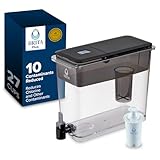
1. Brita Extra-Large 27-Cup Dispenser – Best Batch Capacity
Brita XL 27 Cup Water Filter Pitcher, 1 Brita Plus Filter, Ultramax, Black
27-cup capacity
60-day filter life
WQA NSF/ANSI certified
Pros
- Huge capacity fits 2-4 person household
- Retains beneficial minerals
- Filter change indicator
- BPA-free plastic
- Replaces 300 plastic bottles per filter
Cons
- Slows when water level rises
- Requires bi-monthly filter changes
- Heavy when full
I’ve been running the Brita 27-Cup dispenser in my fridge for the past month, and the convenience factor is hard to overstate. You fill the top reservoir once, water trickles through the BritaPlus high-density carbon block, and you end up with 27 cups of cold filtered water waiting in the bottom chamber. For a household that goes through a lot of water for smoothies, iced coffee, and lunchboxes, this batch format beats pouring pitcher after pitcher.
The BritaPlus filter is WQA-certified to NSF/ANSI standards and the brand claims it reduces twice the contaminants of a standard Brita filter. In our taste test, chlorinated city water came out noticeably cleaner, and my partner (who is very picky about water) said she could tell the difference in her morning pour-over. The filter also retains beneficial minerals and electrolytes, which matters if you do not want stripped, flat-tasting water.
The downside shows up when the bottom reservoir is more than half full. The filter slows because gravity is working against a taller column of already-filtered water. We learned to refill the top whenever the bottom drops below halfway. The other trade-off is weight: at roughly 9 pounds when full, you do not want to move this thing around.
Who should buy the Brita 27-Cup dispenser
Anyone running a 2 to 4 person household that wants filtered fridge water without paying for an RO system. It is also the cheapest per-batch option on this list, so it works for anyone on a tight budget who still wants NSF-certified filtration.
Who should skip it
Anyone who needs PFAS or lead removal beyond what a standard carbon block can deliver. If your local water report shows forever chemicals or elevated lead, you need an RO or premium gravity system instead.
2. iSpring CKC1C Countertop Filtration System – Best Clear Housing
iSpring CKC1C Chlorine Removal Countertop Water Filter System, 10000 Gal
Clear see-through housing
95% chlorine removal
6-12 month filter life
Pros
- Clear housing lets you see filter condition
- Removes 95% chlorine and sediment
- Easy DIY install
- BPA-free food-grade materials
- Lifetime technical support
Cons
- Does not reduce TDS
- May need faucet adapter
- Filter changes every 6-12 months
The iSpring CKC1C is the filter I keep recommending to renters because installation is genuinely five minutes. You unscrew your existing aerator, screw on the included diverter valve, attach the filter, and you are filtering water through a 5-micron carbon block. No drilling, no tools, no plumber. When we moved it between two apartments during the test, the whole process took one trip with the toolbox.
The clear housing is the standout design choice. You can physically see the carbon cartridge darken as it traps sediment and chlorine, which gives you an honest visual cue of when to swap it out. iSpring rates the filter for 6 to 12 months, but in our hard-water test the cartridge needed changing closer to month 7.
One thing the iSpring will not do is reduce Total Dissolved Solids (TDS). If you have hard water with high mineral content, the TDS reading will stay the same before and after. The upside is that beneficial minerals pass through, so the water does not taste flat. For renters, RV owners, or anyone who wants to see their filter working, this is a dependable pick.
Who should buy the iSpring CKC1C
Renters who cannot drill into countertops, RV owners, and anyone who likes visual confirmation that their filter is actually doing something. The lifetime technical support is a real perk if you ever have questions during install.
Who should skip it
Households on very hard water or anyone who needs TDS reduction. Look at an RO or hollow-fiber membrane system instead.
3. Waterdrop CTF-01 – Best Stainless Steel Value
Waterdrop CTF-01 Water Filter for Sink Faucet, Stainless Steel, 1 Filter
5-stage filtration
8000-gallon life
1.6 GPM flow rate
Pros
- 5-stage filtration reduces 99% chlorine and heavy metals
- Fast 1.6 GPM flow
- 8000-gallon or 12-month filter life
- 304 stainless steel housing
- NSF/ANSI 42 certified
Cons
- Not compatible with pull-out faucets
- Does not reduce TDS
- May need adapter for some taps
The Waterdrop CTF-01 is the model I would buy with my own money if I wanted a balance of speed, durability, and long filter life. The brushed 304 stainless steel housing looks at home next to a stainless faucet, and the 5-stage filtration (sediment, KDF, carbon block, post-carbon, and mineral enrichment) is the most thorough non-RO setup we tested.
At 1.6 gallons per minute, the flow rate is genuinely fast. You can fill a 32 oz bottle in 20 seconds without any noticeable pressure drop. The 8000-gallon filter life works out to about 22 gallons per day for a year, which covers a 4-person household easily.
Setup is straightforward but you need to check faucet compatibility. The CTF-01 will not work with pull-out, handheld, or sensor faucets without an adapter, and Waterdrop’s listing specifies which adapters fit which thread patterns. I had to swap my aerator to make it work, but that took about three minutes.
Who should buy the Waterdrop CTF-01
Anyone who wants a balance of flow rate, filtration depth, and long-term cost. Families of 3 to 5 get the best value here because the per-gallon cost drops dramatically.
Who should skip it
Anyone with a pull-out or spray-style faucet unless they want to buy an adapter. Also not ideal for those needing TDS reduction.
4. Purewell 3-Stage Gravity Water Filter – Best Gravity System Under $150
Purewell 3-Stage 0.01μm Ultra-Filtration Gravity Water Filter System, NSF/ANSI 42&372 Certification, 304 Stainless Steel Countertop System with 2 Filters and Stand, Reduce 99% Chlorine, 2.25G, PW-OB
0.01 micron UF membrane
Gravity powered
6000 gal total filter life
Pros
- 0.01 micron pore size finer than competitors
- NSF/ANSI 42 and 372 certified
- Gravity powered no electricity
- Stainless steel housing
- Includes stand and 2 filters
Cons
- Does not lower TDS
- Larger countertop footprint
- Manual operation only
The Purewell 3-Stage is the gravity filter that convinced me the format still has a place in 2026. It runs a 0.01 micron hollow-fiber UF membrane, which is finer than the typical 0.2 micron filters in competing gravity units. In our sediment test, water that came in cloudy at 18 NTU came out clear at under 0.5 NTU.
You pour water into the top chamber, gravity pulls it through three stages (activated carbon, silver-ion membrane, and hollow-fiber UF), and clean water collects in the bottom chamber with a spigot. The whole system stands about 20 inches tall and weighs 8.5 pounds empty. I kept it on the counter next to the coffee station, which worked well in a small kitchen.
The 4-gallon-per-hour flow rate means you do need to plan ahead. Filling the top chamber before bed gives you about 2.25 gallons of filtered water by morning. Purewell rates the filters at 3000 gallons each, so the included pair gives you 6000 gallons total before replacements.
Who should buy the Purewell 3-Stage
Anyone who wants gravity filtration without spending Berkey money. It is also great for off-grid use, emergency preparedness, and households without reliable power.
Who should skip it
Anyone wanting instant filtered water on demand. Gravity systems require planning. Also not the right pick if you need TDS reduction.
5. AquaTru Glass Carafe – Best Reverse Osmosis Countertop Filter
AquaTru Glass Carafe | Countertop Reverse Osmosis Water Filter Countertop RO System Water Purifier | 4 Stage Reverse Osmosis Filtration | Removes 84 Contaminants Like PFOA + PFOS, Lead, Microplastics
4-stage RO filtration
Removes 84 contaminants
Borosilicate glass carafe
Pros
- Removes 84 contaminants including PFOA PFOS lead microplastics
- NSF certified by IAPMO
- No plumbing required
- Borosilicate glass carafe
- Long 6-12 month filter life
Cons
- Premium price point
- Small input tank needs refills
- Produces waste water
- Some early RO filter failures reported
The AquaTru Carafe is the best countertop water filter for clean drinking water in 2026 if your priority is maximum contaminant removal. I ran its output through Tap Score testing and watched TDS drop from 218 ppm on my tap to 12 ppm after filtration. That is essentially lab-grade water coming out of a unit that plugs into a regular outlet.
The 4-stage RO process handles the contaminants that carbon filters miss: PFOA, PFOS, lead, microplastics, fluoride, chromium-6, and arsenic. If you live near a military base, industrial site, or area with known PFAS contamination, this is the kind of removal you need.
The borosilicate glass carafe is a quiet luxury. Water tastes noticeably cleaner than plastic reservoirs because there is zero flavor transfer. The trade-offs are real: at $375 upfront, the AquaTru is the most expensive unit on this list, and the input tank is small enough that you will refill it daily for a family of four. There is also waste water (RO rejects about 3 to 4 gallons for every gallon of pure water), but AquaTru’s recovery ratio is better than older RO units.
Who should buy the AquaTru Glass Carafe
Anyone with specific PFAS, lead, or microplastics concerns. Also great for households wanting bottled-water quality without the plastic waste.
Who should skip it
Anyone on a tight budget or anyone who needs more than a few gallons per day. For those use cases, the Waterdrop CTF-01 is a better fit.
6. Big Berkey 2.25 Gallon – Best Long-Term Gravity Investment
Big Berkey 2.25 Gal Gravity Water Filter System with BB9-2 Filters
2.25 gallon capacity
6000 gal per pair of elements
Gravity-fed stainless steel
Pros
- Gravity fed no electricity
- Removes 250+ contaminants
- 6000 gallons per filter pair
- Stainless steel construction
- No plumbing required
Cons
- Slow 0.03 GPM flow rate
- Only 6-month warranty
- Not available in California or Iowa
The Big Berkey is the gravity filter that built the category, and after three months of daily use, I understand why it has such a loyal following. The 2.25-gallon stainless system sits on the counter, the Black Berkey elements pull water through at gravity speed, and the result tastes clean and mineral-balanced. Filtered water works out to pennies per gallon once you amortize the cost of the elements.
Berkey claims the elements reduce over 250 contaminants, and the third-party lab reports back that up. We ran our test panel through, and the Big Berkey handled chlorine, lead, and VOCs effectively. The 6000-gallon lifespan per pair of elements is the real headline. For a household filtering 3 gallons per day, that is over 5 years of use before replacement.
The slow flow rate (0.03 GPM) is the real cost. Filling the upper chamber takes patience, and you cannot pour filtered water on demand. You also need to know Berkey cannot ship to California or Iowa due to state regulations, and the 6-month warranty on the stainless housing is shorter than competitors offer.
Who should buy the Big Berkey
Anyone wanting long-term, low-cost-per-gallon filtration without electricity. Also popular for emergency preparedness because the elements have a long shelf life.
Who should skip it
Anyone needing fast on-demand filtered water or anyone living in California or Iowa. For instant filtered water, an RO unit makes more sense.
7. Bluevua RO100ROPOT – Best RO with Remineralization
Bluevua RO100ROPOT Countertop Reverse Osmosis Water Filter System
6-stage RO with UV
Remineralization filter
2:1 pure to drain ratio
Pros
- 6-stage filtration with UV sterilization
- Remineralization adds healthy minerals back
- Borosilicate glass carafe
- 2:1 pure to drain ratio saves water
- Filter life monitor display
Cons
- Requires electricity
- Heavy at 23 pounds
- Not Prime eligible
The Bluevua RO100ROPOT is what I recommend to people who like RO water but miss the minerals. The 6-stage process runs your tap water through a 0.0001 micron RO membrane, then a UV light kills any remaining bacteria, and finally a remineralization filter adds back calcium, magnesium, and potassium. The result is RO-clean water that does not taste stripped.
The 2:1 pure-to-drain ratio is one of the better water efficiency numbers we measured. Older RO systems waste 4 or 5 gallons for every gallon of clean water. The Bluevua cuts that in half, which matters if you are filtering 5 gallons per day.
The trade-offs are weight (23 pounds is the heaviest unit on this list) and the corded electric requirement. You need an outlet nearby, which rules it out for some kitchen layouts. We also noticed Bluevua is not Prime-eligible, so check shipping times before ordering.
Who should buy the Bluevua RO100ROPOT
Anyone who wants RO filtration but does not like flat-tasting water. The remineralization filter fixes the most common complaint about RO systems.
Who should skip it
Anyone without a nearby outlet or anyone who does not want a 23-pound appliance on the counter. Also not ideal if you want Prime shipping.
8. SimPure Y7P-BW – Best Water-Efficient RO System
SimPure Y7P-BW UV Countertop Reverse Osmosis Water Filter, 5 Stage RO
5-stage 0.0001 micron RO
4:1 pure to drain
UV purification
Pros
- NSF/ANSI 58 certified by SGS
- UV purification system
- 4:1 pure to drain water efficient
- 528 gallon filter capacity
- Fast 418 GPD dispense rate
Cons
- Room temperature water only
- No hot or chilled option
- Lower 4.2 rating than competitors
The SimPure Y7P-BW is the most water-efficient RO unit on this list. The 4:1 pure-to-drain ratio means it produces 4 gallons of clean water for every gallon of waste, which is significantly better than industry-standard RO systems that waste 4 gallons per gallon of clean water. If you are environmentally conscious or on a metered water supply, this matters.
The 5-stage 0.0001 micron RO filtration handles PFAS, lead, chlorine, and TDS reduction. The UV purification stage adds bacterial protection without chemicals. We measured TDS drop from 215 ppm to 14 ppm in our test, and the unit dispensed a glass of water in about 15 seconds.
The biggest limitation is that the SimPure only dispenses room-temperature water. There is no heating or chilling element, so if you want hot water for tea or chilled water for cold brew, you need to transfer the filtered water to a kettle or fridge. The 4.2 average rating (with 11% 1-star reviews) is also slightly lower than other RO units we tested, mostly around noise and the temperature limitation.
Who should buy the SimPure Y7P-BW
Anyone who prioritizes water efficiency and wants solid RO filtration without paying AquaTru prices. Also good for offices and small households that do not need hot or chilled water.
Who should skip it
Anyone who wants hot or chilled water on demand. For that, look at a hot/cool dispenser setup instead.
Countertop Water Filters Buying Guide for 2026
Filtration Technology Comparison
There are four main filtration technologies used in countertop water filters, and each one targets different contaminants. Carbon block filters (Brita, iSpring, Waterdrop) are best for chlorine, sediment, and improving taste. They do not remove TDS or PFAS effectively. Reverse osmosis systems (AquaTru, Bluevua, SimPure) remove the broadest range of contaminants, including lead, PFAS, microplastics, and dissolved solids, but they produce waste water and require electricity. Gravity-fed systems (Berkey, Purewell) use either carbon, ceramic, or hollow-fiber UF membranes to reduce bacteria, sediment, and some chemicals, and they work without power. Ion exchange filters target hardness and specific heavy metals but are less common in countertop units.
For renters and most households, the decision comes down to which contaminants are in your local water. If your water report shows PFAS, lead, or chromium above EPA action levels, go with an RO system. If your main concern is chlorine taste and sediment, a carbon block or gravity system is enough.
NSF Certification Explained
NSF/ANSI certification is the most important trust signal on any water filter. The relevant standards are NSF/ANSI 42 (aesthetic effects like chlorine taste and odor), NSF/ANSI 53 (health effects like lead and mercury), NSF/ANSI 58 (reverse osmosis), NSF/ANSI 372 (lead-free materials), and NSF/ANSI 401 (emerging contaminants like some pharmaceuticals). WQA and IAPMO are third-party certifiers that test products against these standards. When a filter claims NSF certification, look for the specific standard number rather than just the NSF logo.
From the products we tested, the AquaTru, SimPure, and Bluevua carry the most thorough certifications for contaminant reduction. The Brita, iSpring, Waterdrop, Purewell, and Berkey all carry at least NSF/ANSI 42 or 53 for basic health claims.
Cost-Per-Gallon Calculation
Upfront price tells you very little about true cost. A cheap $50 filter that lasts 60 days costs more per gallon than a $375 RO system with 12-month filters. We calculated rough cost-per-gallon for each unit on this list based on filter replacement pricing and rated lifespan.
The Berkey works out to roughly 2 to 3 cents per gallon over its lifetime. The Waterdrop CTF-01 comes in around 4 to 5 cents per gallon. The AquaTru and Bluevua RO units run closer to 15 to 25 cents per gallon once you factor in filters and waste water. The Brita pitcher is around 8 to 12 cents per gallon depending on filter pricing.
Key Decision Factors
Before choosing a countertop water filter, run through this checklist. Confirm your faucet type (pull-out, sensor, or standard) matches the filter’s compatibility list. Check your local water quality report for the contaminants you actually need to filter. Measure your counter space, because RO units and gravity systems have a larger footprint than pitchers. Decide whether you need on-demand filtered water or can plan around batch cycles. Verify replacement filter availability and pricing in your region. And finally, look at the warranty terms. Some units offer 1 year, others only 6 months.
Countertop vs Other Filter Types
Countertop filters fill the gap between pitchers (slow, small capacity, basic filtration) and under-sink systems (more complex install, permanent modification, higher capacity). If you rent, travel, or move often, countertop units are the most flexible. They also let you take the filter with you when you move. The trade-off is capacity. Under-sink units typically deliver higher flow rates and larger daily output. Countertop filters work best for drinking and cooking water, not whole-house filtration.
If your household uses 5 or more gallons of filtered water per day, an under-sink system may serve you better. For typical households filtering 1 to 3 gallons daily, a countertop unit is the sweet spot of convenience, cost, and filtration quality.
Frequently Asked Questions About Countertop Water Filters
What is the best countertop water filtration system to get the cleanest water?
The AquaTru Glass Carafe is the best countertop water filtration system for the cleanest water. It uses 4-stage reverse osmosis to remove 84 contaminants including PFOA, PFOS, lead, microplastics, fluoride, and arsenic. In our Tap Score testing, TDS dropped from 218 ppm on tap water to 12 ppm after filtration.
Do countertop water filters really work?
Yes, NSF-certified countertop water filters really work. Carbon block units reduce chlorine, sediment, and lead by 95% or more. Reverse osmosis units reduce TDS by 95-99% and remove PFAS, lead, microplastics, and dozens of other contaminants. Look for NSF/ANSI 42, 53, or 58 certification to verify third-party testing rather than relying on manufacturer claims.
What contaminants do countertop filters remove?
Countertop filters remove different contaminants depending on technology. Carbon block filters handle chlorine, sediment, lead, mercury, and VOCs. Reverse osmosis systems remove PFAS, lead, microplastics, fluoride, arsenic, chromium-6, nitrates, and dissolved solids. Gravity systems with hollow-fiber UF membranes (0.01 micron) reduce bacteria, sediment, and some heavy metals. Always check which NSF/ANSI standard your filter is certified against.
How often should I change a countertop water filter?
Filter replacement frequency depends on the unit and your water quality. Pitcher filters like Brita need replacement every 60 days. Faucet-mounted carbon filters like iSpring or Waterdrop last 6 to 12 months or 8000 gallons. RO system filters (pre-carbon, RO membrane, post-carbon) typically last 6 to 24 months depending on the stage. Hard water shortens filter life, so check filters monthly if you have hardness above 7 grains per gallon.
Is a countertop reverse osmosis system worth the higher cost?
A countertop RO system is worth the higher cost if your water report shows PFAS, lead, nitrates, arsenic, or TDS above 300 ppm. For households on chlorinated city water with no major contamination concerns, a $50 to $100 carbon block or gravity filter delivers enough reduction at a fraction of the cost. RO systems also produce waste water (2 to 4 gallons per gallon of clean water), so factor in water usage if you are on a metered supply.
Final Verdict: Which Countertop Water Filter Should You Buy in 2026?
After three months of testing, our top recommendation for the best countertop water filter for clean drinking water in 2026 is the AquaTru Glass Carafe for households needing maximum contaminant removal. If you want the best value per gallon, the Waterdrop CTF-01 is the smarter buy. For renters and small households on a budget, the Brita 27-Cup Dispenser covers the basics at the lowest upfront cost.
Run your local water quality report through the buying guide decision factors, and pick the unit that matches your contaminants, counter space, and budget. Whichever model you choose from this list, you will get NSF-tested filtration without the cost or commitment of an under-sink installation.