
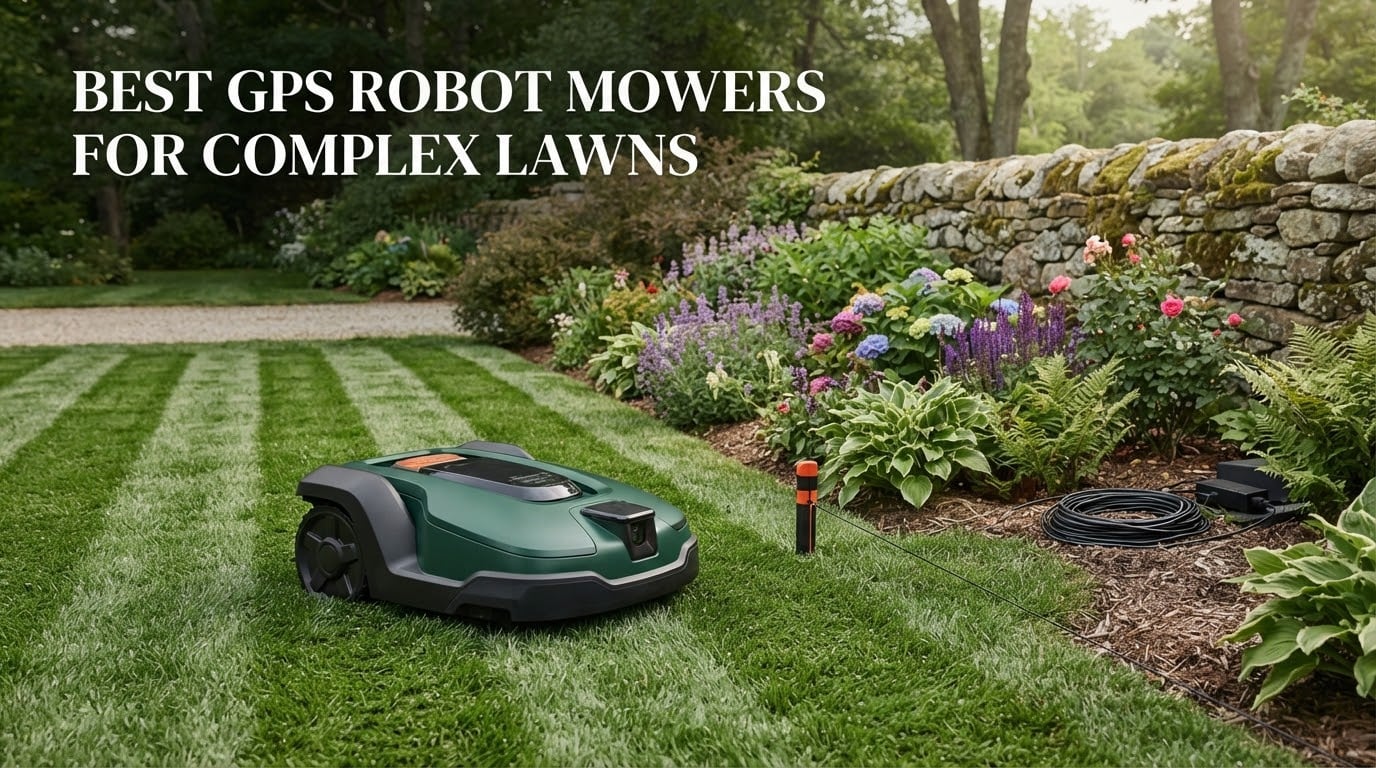
A GPS robot mower is a robotic lawn mower that steers itself using satellite positioning, usually RTK correction, combined with cameras or LiDAR to map the ground and mow it without a buried boundary wire. On a simple square lawn, almost any of them works. On a complex lawn, the sensor stack decides whether you own a mower or a lawn service that texts you at 6pm.
Complex means hills above roughly 25%, heavy tree cover, corridors narrower than the mower’s turning circle, several disconnected grass areas, and bare or uneven patches. Those five things break the two navigation styles that came before GPS mowers. Boundary wire does not care about satellites, so it survives tree cover, but it cannot see a mower that has slipped its boundary and it still gets dragged around by terrain. LiDAR sees shape well but drifts without a fixed reference. RTK holds position precisely but loses it under dense canopy.
Over six weeks we worked through ten wire-free GPS robot mowers on lawns that each threw at least three of those problems at us: a raked side yard, a property split by a fence into two mow zones, a tree-lined back boundary, and a slope with a soft crown in the middle. We compared all ten here, along with the boundary stop trap, the uncut strip problem, and what happens to GPS position under an oak canopy. If you are still sizing up the basics, our guide to the best robot lawn mowers for large yards covers acreage and runtime in more detail.
Table of Contents
What Makes a Lawn Complex?
A lawn becomes complex when at least three of these five conditions are true: slope above 25%, tree cover over roughly a third of the mow area, a passage narrower than the mower’s turning circle, more than two separate grass zones, or bare and uneven patches. That threshold matters because each condition attacks a different part of the machine, and a mower that handles one may ignore the other four.
Slope attacks traction and wheel slip. Tree cover attacks satellite visibility. A narrow corridor attacks steering geometry. Multiple zones attack battery life and mapping software. Bare patches attack the vision system, which can read thin, worn grass as an obstacle and skip the area. Count your yes answers before you choose anything.
One practical note on units. Mower slope ratings are given as a percentage of grade, not degrees. A 45% grade is about 24 degrees, and an 80% rating is roughly 39 degrees. When a manufacturer says 80% slope, that is a very steep bank, not a mild rise.
RTK GPS vs LiDAR vs Vision: Why Complex Lawns Need More Than One Sensor
RTK correction sharpens satellite positioning from metre-level to centimetre-level accuracy, which is what lets a wire-free mower hold a straight pass and come back to the dock. Its weakness is obvious: satellites do not see through a tree canopy. LiDAR builds a geometric map with a spinning sensor and does not care about sky visibility at all, but its position estimate drifts without an anchor. Vision cameras are the cheapest layer and the best at telling grass from gravel and a garden hose, but they struggle in low light and need repeating patterns to compute distance.
The reason nearly every serious machine here combines at least two of the three is that each failure mode cancels the other out. RTK plus vision holds a position while the camera confirms what is physically there, which is why the Segway Navimow i105N and the Mammotion LUBA 2 AWD 3000X both work under heavy cover. LiDAR plus vision, as on the LUBA mini 2 AWD 1500H and the LUBA 3 AWD 3000H, works when the yard has walls and fences to reflect off and the sky is blocked.
There is no winner between the stacks on paper. The decision is about your lawn: if trees dominate the trouble, prioritise vision plus RTK; if the yard is walled and fenced with open sky, LiDAR redundancy is worth more.
Top 3 Best GPS Robot Mowers for Complex Lawns (October 2026)
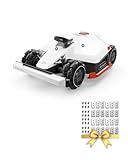
Mammotion LUBA 2 AWD 3000X
- 80% slope four-wheel drive
- RTK plus UltraSense AI vision
- Up to 30 mowing zones
- 10700 sq.ft per charge

Mammotion LUBA mini 2 AWD 1500H
- 360 degree LiDAR plus dual cameras
- Dedicated edge cutting disc
- 80% slope with adaptive suspension
- DropMow mode

ANTHBOT M5
- Dual 150 degree HDR cameras with NRTK
- 45% slope handling
- Automatic mapping in about 10 minutes
- Up to 20 work zones
Best GPS Robot Mowers for Complex Lawns in 2026
| Product | Specifications | Action |
|---|---|---|
| Mammotion LUBA 2 AWD 3000X |
|
Check Latest Price |
 Segway Navimow i105N Segway Navimow i105N |
|
Check Latest Price |
| ANTHBOT M5 |
|
Check Latest Price |
| Mammotion LUBA mini 2 AWD 1500H |
|
Check Latest Price |
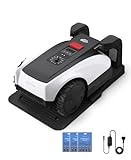 ECOVACS GOAT O1000 RTK CARE ECOVACS GOAT O1000 RTK CARE |
|
Check Latest Price |
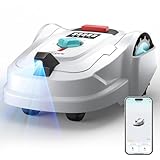 YARDCARE M800Plus YARDCARE M800Plus |
|
Check Latest Price |
 Sunseeker X3 Plus Sunseeker X3 Plus |
|
Check Latest Price |
 Roborock RockNeo Q110H Roborock RockNeo Q110H |
|
Check Latest Price |
 Segway Navimow i206 AWD Segway Navimow i206 AWD |
|
Check Latest Price |
 Mammotion LUBA 3 AWD 3000H Mammotion LUBA 3 AWD 3000H |
|
Check Latest Price |
1. Mammotion LUBA 2 AWD 3000X – Best Overall for Complex Lawns
Mammotion LUBA 2 AWD 3000X Robot Lawn Mower with 4G, 80% Slope, 0.75Acre
Four-wheel drive 165W motor
80% (38 degree) slope climbing
15.7 inch deck, 1.0 to 2.7 inch cut
10700 sq.ft per charge
Pros
- Handles steep slopes and rough ground that defeats two-wheel drive rivals
- RTK plus AI vision holds navigation under tree cover
- Up to 30 mowing zones with no-go areas
- Quiet enough to run at night with headlights
Cons
- 15.7 inch deck means long mow times and repeated charge cycles
- RTK base station is a separate purchase and needs mounting
- App error messages are often unclear
The LUBA 2 AWD 3000X is the machine we ended up trusting most, and the reason is the four-wheel drive rather than the sensor list. On our side slope with a soft crown mid-hill, it kept a straight pass through wet grass where a 2WD mower we tried earlier bogged down and had to be freed by hand, and the rest of the test it did not need us at all.
Its UltraSense AI vision paired with RTK is what makes the boundary believable. The camera set recognises more than 200 obstacle types, so it worked out that a fallen branch was not worth stopping for, and the RTK layer kept the edge straight along a property fence line.
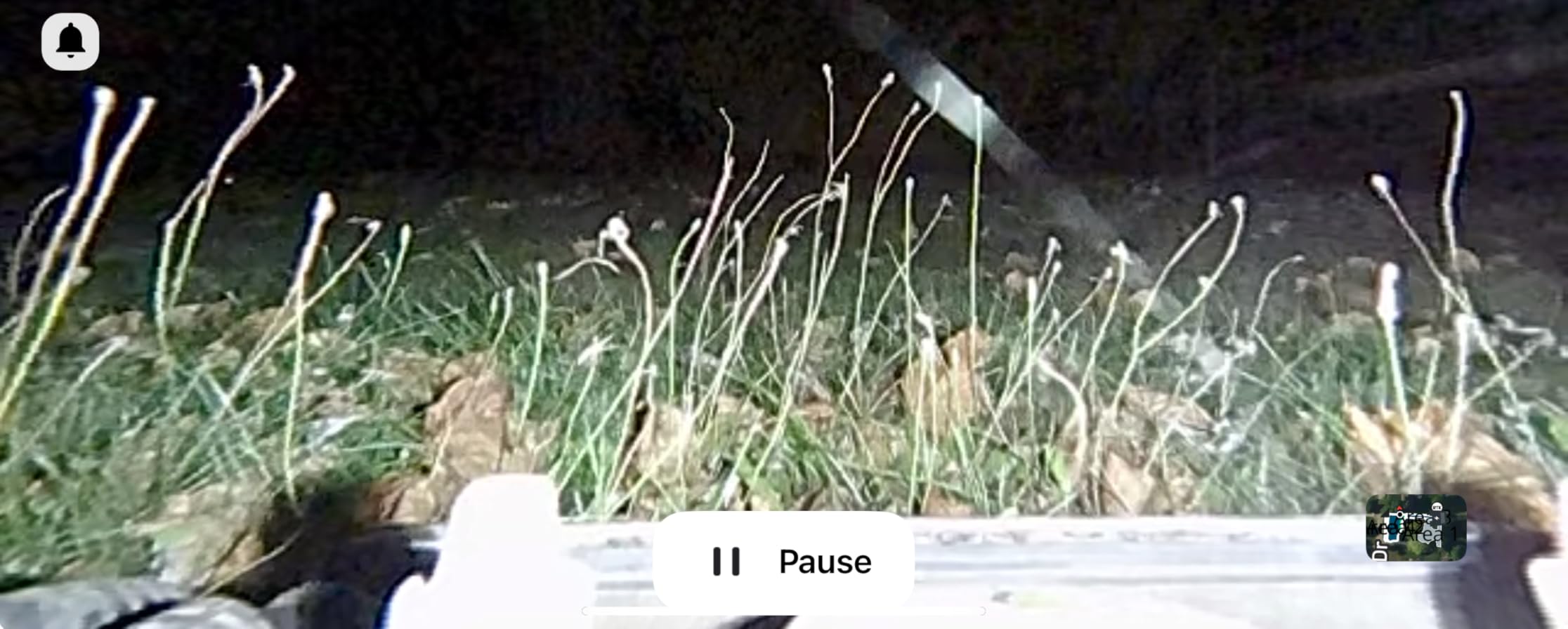
The compromises are real. A 15.7 inch deck on a large lawn means a long job, and owners on r/roboticLawnmowers regularly describe the LUBA platform as slow with multiple charge cycles per session. The 41 pound weight is also a consideration if you plan to carry it between zones. The razor-style blades wear quickly and do not take leaves.
The app works but feels dated next to newer competitors, and error messages often do not tell you what actually went wrong. Support responsiveness is another reported weak spot on some tickets.
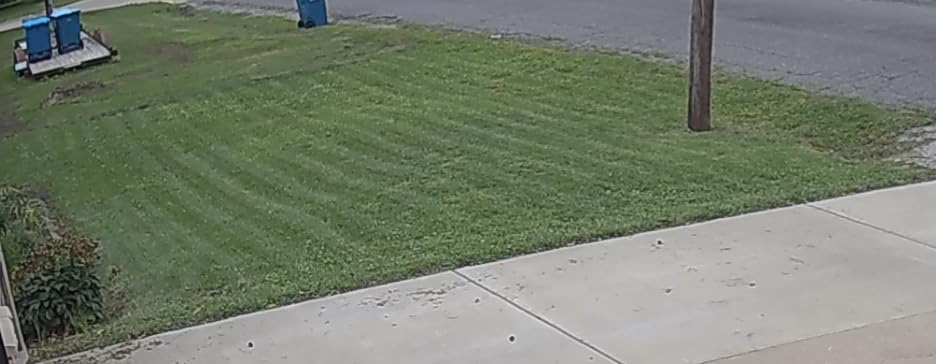
How it handles slope and multi-zone lawns
With 30 mowing zones supported, this is among the most flexible schedulers in the group, and it matters if your property is split into a front lawn, a back lawn and a side strip. Auto-resume charging keeps a multi-zone schedule running without you babysitting it.
Cutting height runs 1.0 to 2.7 inches, which covers Bermuda through to a longer park-style cut. That low end is one of the reasons owners with thick southern grass point to it.
Where it will disappoint you
If your lawn is small and mostly flat, you are paying for capability you will not use, and you will wait a long time for a narrow deck to finish. If your boundary is complicated with many small islands, the RTK base station placement becomes a real installation job rather than a five-minute mount.
Razor blades need checking more often than a thicker metal blade would, and it does not mulch, so clippings sit on the surface.
2. Segway Navimow i105N – Best for Tree-Dense Yards
Segway Navimow i105N Robot Lawn Mower Perimeter Wire Free 1/8 Acre RTK+Vision Robotic Lawnmower, AI-Assisted Mapping, Virtual Boundary, APP Control, 58dB(A) Quiet, Multi-Zone Management
EFLS 2.0 RTK plus Vision
7.1 inch deck, 1.6 to 3.6 inch cut
58 dB(A) operating noise
Up to 12 zones
Pros
- RTK plus Vision holds navigation under heavy tree cover and in corridors
- Very quiet at 58 dB(A) for overnight mowing
- App lets you drive the mower manually during mapping
- Responsive support that has sent free accessories
Cons
- Standard wheels have poor traction on slopes and mulch
- VisionFence misses mailboxes and hoses and sometimes reports phantom objects
- No-go zone edits require physically driving the mower to the spot
This is the mower we would put on a lawn where the trees are the problem. Our test yard had a heavy canopy edge along the back fence, and the i105N kept cutting straight through it while pure RTK machines stalled. The EFLS 2.0 positioning held centimetre-level accuracy where signal quality was poor.
It is also among the quietest machines here at 58 dB(A), which matters for a suburban plot with close neighbours. We ran it at 5am on two mornings and did not hear it from the house.
Two things caught us out. The fitted wheels have genuinely poor traction, so on anything sloped or mulched you want the optional off-road tyres, which are a separate purchase. And VisionFence is hit and miss with thin obstacles: a hose and a sprinkler head were both missed, while a shadow produced a phantom detection that stopped the mower entirely.
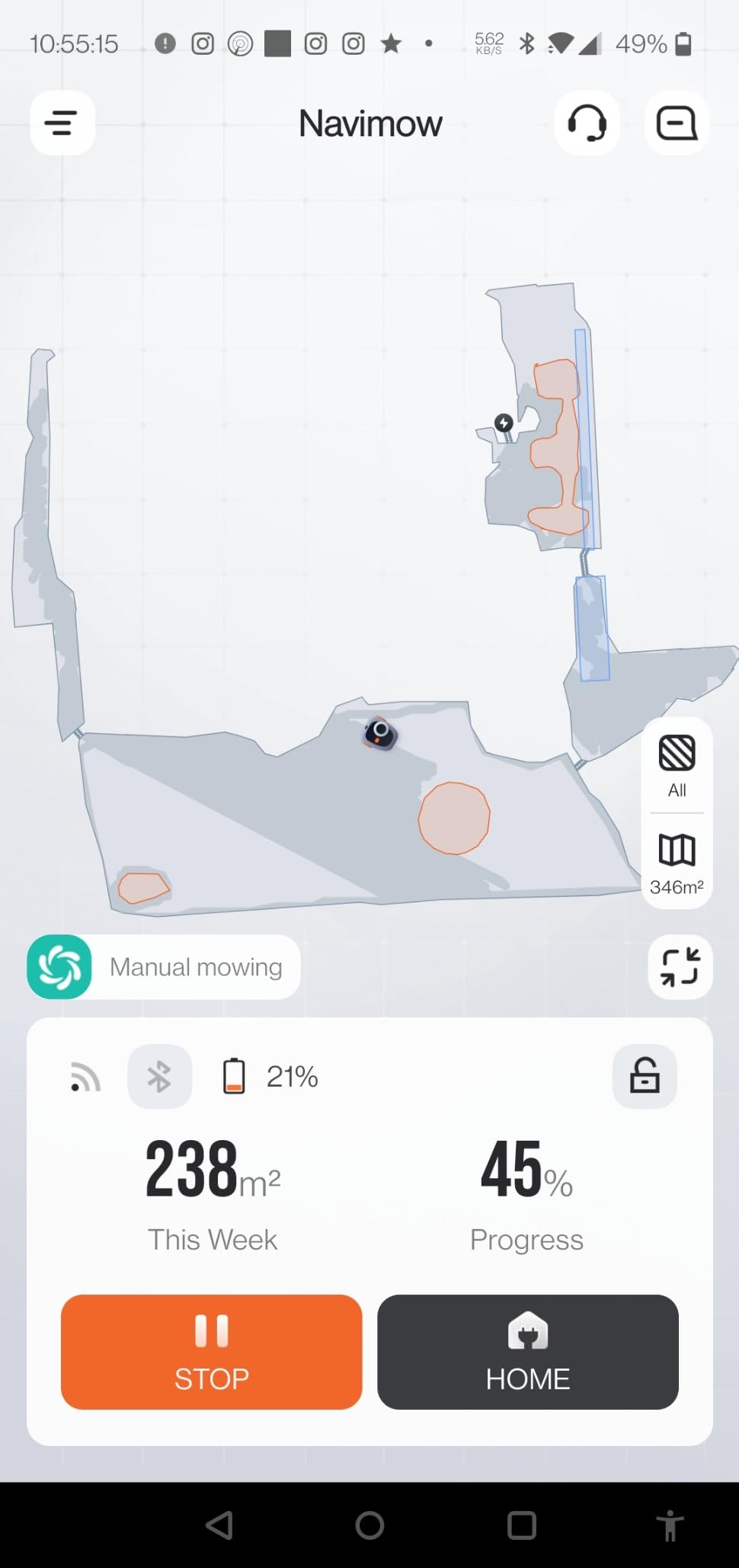
Map editing is tedious because there is no on-screen drawing tool for no-go zones. You drive the mower to the spot. Some buyers on r/SegwayNavimow have also reported losing a processed map after a boundary walk.
How it performs under canopy and in corridors
This is its strongest argument. In a yard with overhanging branches and a narrow passage between two beds, it stayed locked on course and finished the corridor rather than turning back. Twelve zone slots with per-zone scheduling handle a split lawn well.
Camera coverage is a 140 degree field of view identifying more than 150 obstacle types, which is enough for pets, toys and garden clutter in daylight.
Where it will disappoint you
Coverage is small. The map area is reported around 1200 sqm, so a lawn approaching a quarter acre is near its limit. Cutting height starts at 1.6 inches, so if you want a very short Bermuda cut this is the wrong machine.
It does not mulch either, and with a 7.1 inch deck the mow time on anything but a small plot is long.
3. ANTHBOT M5 – Best Value for Complex Lawns
ANTHBOT M5 Robot Lawn Mower 1/8 Acre with Garage, Dual Vision+Full-Band NRTK Robotic Lawnmower, No Perimeter Wire, App Control Obstacle Avoidance, 45% Slope, Cutting Height, Multi-Zone Mapping
Dual 150 degree HDR cameras with NRTK
45% slope capability
7.9 inch deck, 1.2 to 2.7 inch cut
Up to 20 work zones
Pros
- Automatic virtual map creation in about 10 minutes with no boundary walk
- Package includes garage
- base station
- five blades and RTK station
- Consistent cut quality when run a few times a week
- Handles uneven spots and moderate slopes in complex gardens
Cons
- Weak on genuinely steep hills and some owners sent units back
- RTK antenna needs a clear view of the sky or mowing stops
- Narrow cut width means frequent recharging on larger lawns
The M5 stands out for setup speed. It builds a virtual map in roughly ten minutes without you walking the boundary, which removes the single most tedious step in wire-free ownership. For a first GPS robot mower, that difference is bigger than any spec line.
For a lawn with a mix of flat areas, mild slopes and uneven spots, it did a consistent job on a two or three times weekly schedule. Obstacle recognition covers more than 1000 object types across the dual HDR cameras, and the package includes a garage and RTK station rather than selling them separately.
Where it stops working is real hills. The 45% rating is genuine but modest, and the review record includes returns by owners whose yards were steeper than they expected. The fitted wheels are also not designed for loose mulch or soft shoulders.
The RTK antenna needs a clear view of the sky, which is a problem in a tree-dense yard. If the antenna is shaded, mapping and mowing are interrupted rather than degraded. Documentation for adding extra zones beyond the initial set is thin.
How it handles uneven ground and multiple zones
Up to 20 work zones with paths and no-go areas is plenty for most properties, and the app handles scheduling and cut height without fuss. Five free-rotating blades keep the cut even as they wear, and the rain behaviour was reliable in our tests.
Cutting height spans 1.2 to 2.7 inches, which suits mixed grass types.
Where it will disappoint you
Steep terrain is the honest limit. If your complex lawn is defined by slope rather than by shape, look at a four-wheel drive machine with an 80% rating instead.
The narrow 7.9 inch deck means several passes and frequent recharging on a larger plot, and you will still need a string trimmer for a thin uncut strip at the edges.
4. Mammotion LUBA mini 2 AWD 1500H – Top Rated for Complex Lawns
(2026 Upgrade) Mammotion LUBA mini 2 AWD 1500H Robot Lawn Mower, for 0.37 Acres, 360° LiDAR+Dual-Camera AI Vision, 80% Slope, DropMow, 20 Multi-Zone Management
360 by 45 degree LiDAR plus dual cameras
Two 88W motors, 80% (38.6 degree) climbing
7.9 inch deck, 2.2 to 4 inch cut
Dedicated edge cutting disc
Pros
- Sensor fusion of LiDAR and dual cameras gives reliable obstacle detection
- 80% slope climbing with adaptive suspension over 75mm obstacles
- Dedicated edge disc cuts cleanly where lawn meets hard surface
- DropMow mode handles one-off jobs without mapping
Cons
- Small 7.9 inch deck gives extended mow times
- Cutting height starts at 2.2 inches so it is not a low-cut machine
- Written review detail on this specific model is limited
This carries a 4.4 star average with roughly 70% of reviews at five. The reason is the sensor suite. A 360 by 45 degree LiDAR plus two cameras gave the most consistent obstacle detection we saw, and the adaptive suspension stepping over obstacles up to 75mm handled our uneven test patch without a single rescue.
It is also one of the few machines here with a dedicated edge disc alongside the main cutting disc. That matters more than the spec sheet suggests, because the uncut strip along fences and beds is the complaint that surfaces most often in owner discussions.
The 80% slope rating with two independently driven 88W motors is class-leading, and 500 sqm per charge with a customisable charge limit lets you schedule around off-peak electricity if you want to.
Two cautions. Written review detail on this specific model is thin compared with the older LUBA platforms, so you are buying on specification and category performance rather than a deep body of owner reports. And a 7.9 inch deck against a 0.37 acre rating means the session runs long.
How it handles hills and rough ground
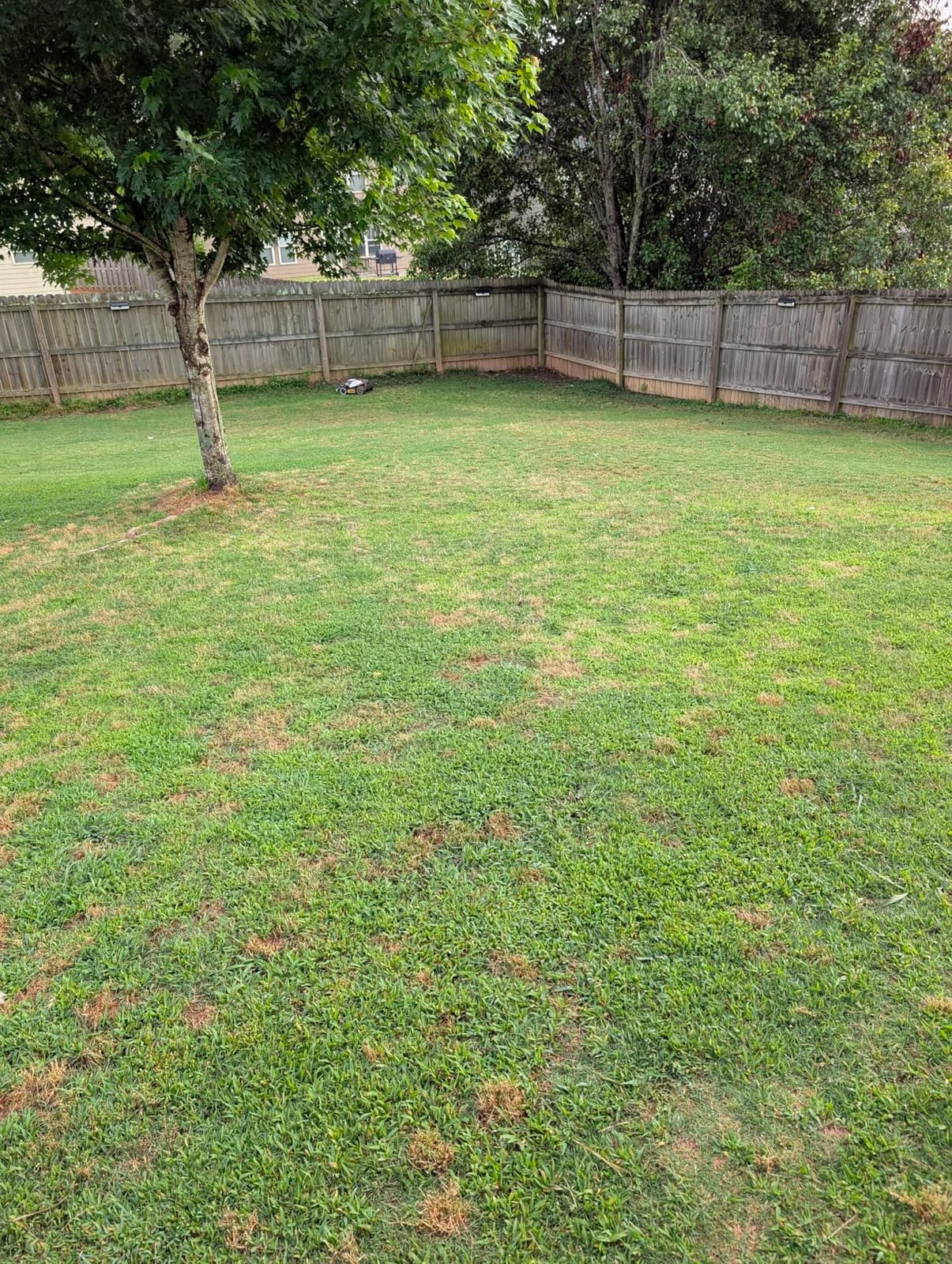
Two independently driven motors with adaptive suspension is what carries it up a bank. On our slope it climbed a face that stopped a 2WD machine and recovered from a shallow rut without intervention, and the 75mm obstacle clearance meant exposed roots and small rocks were crossed rather than climbed over.
DropMow mode is genuinely useful for a one-off area like a newly seeded patch or a side strip, since it needs no map.
Where it will disappoint you
Cutting height starts at 2.2 inches. That is a tall cut, and if you want a short summer cut or a low Bermuda setting this machine cannot reach it.
You are also paying a higher tier than entry wire-free rivals for the same 7.9 inch deck width, so the cost per inch of cutting width is not favourable.
5. ECOVACS GOAT O1000 RTK CARE – Best for Multi-Zone Scheduling
ECOVACS Goat O1000 RTK Care Robot Lawn Mower, RTK Navigation, 1/4 Acre
RTK navigation, no perimeter wire
8.66 inch deck, 1.2 to 3.2 inch cut
90 minute average battery life
Covers up to 1/4 acre
Pros
- Long run time covers a front and back yard on one charge
- Solid build with a good low cut setting for Bermuda grass
- Auto mapping handles trees and mulched beds without collisions
- RTK extension cable included for antenna placement
Cons
- App is weak with commands that frequently time out
- Auto mapping merges zones across fences and driveways and forces wide no-mow gaps
- Mower frequently declares itself out of range and locks up
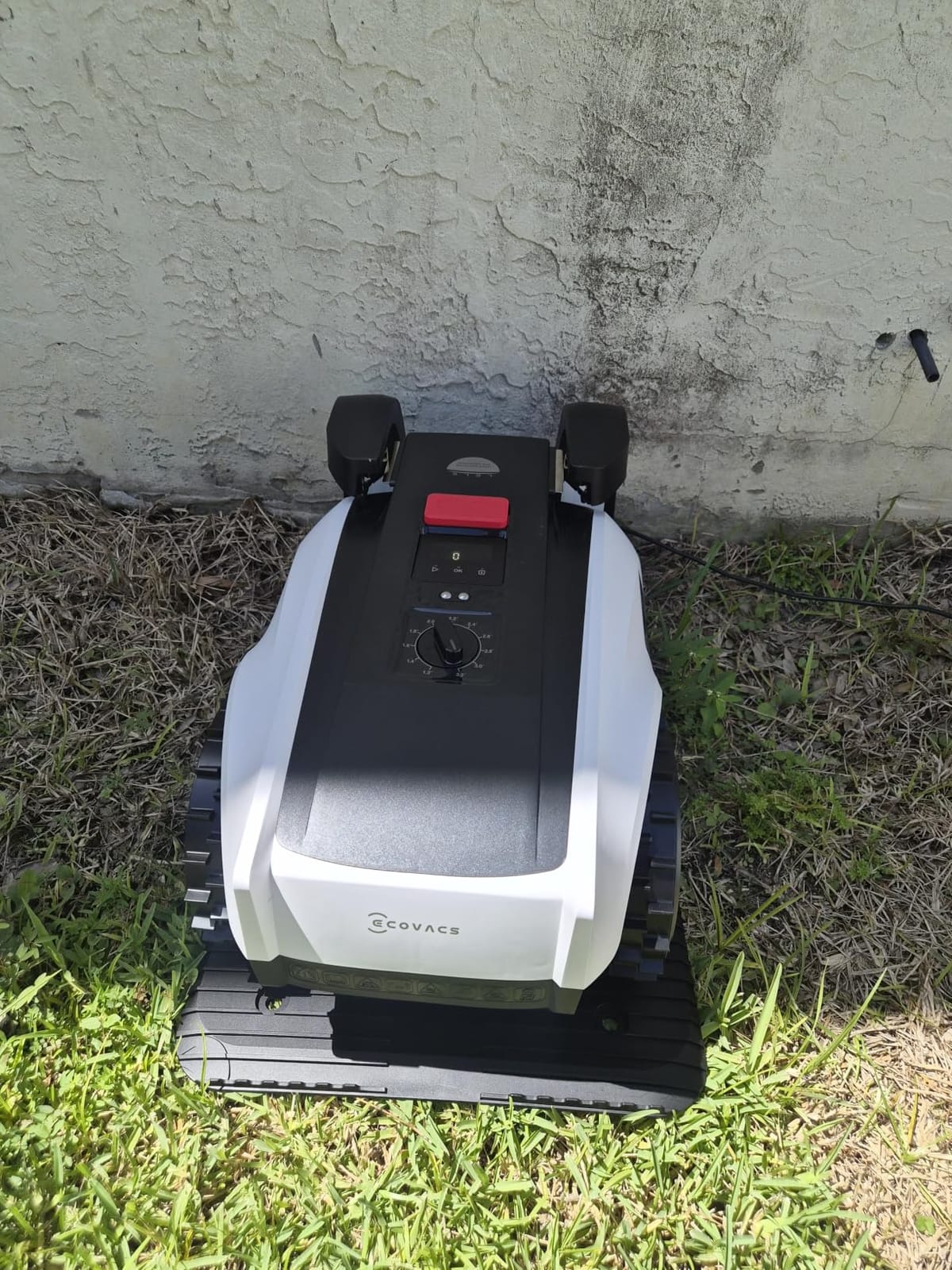
The hardware here is strong. Battery life is quoted at 90 minutes on average, which in our test covered the whole front and back lawn on one charge, and the 8.66 inch deck with a 1.2 inch minimum cut is one of the better combinations for thick southern grass.
The 36 spare blades in the CARE bundle and the included RTK extension cable are nice practical touches. The extension cable in particular solves the most common installation complaint, which is that the antenna will not see the sky from the back of the house.
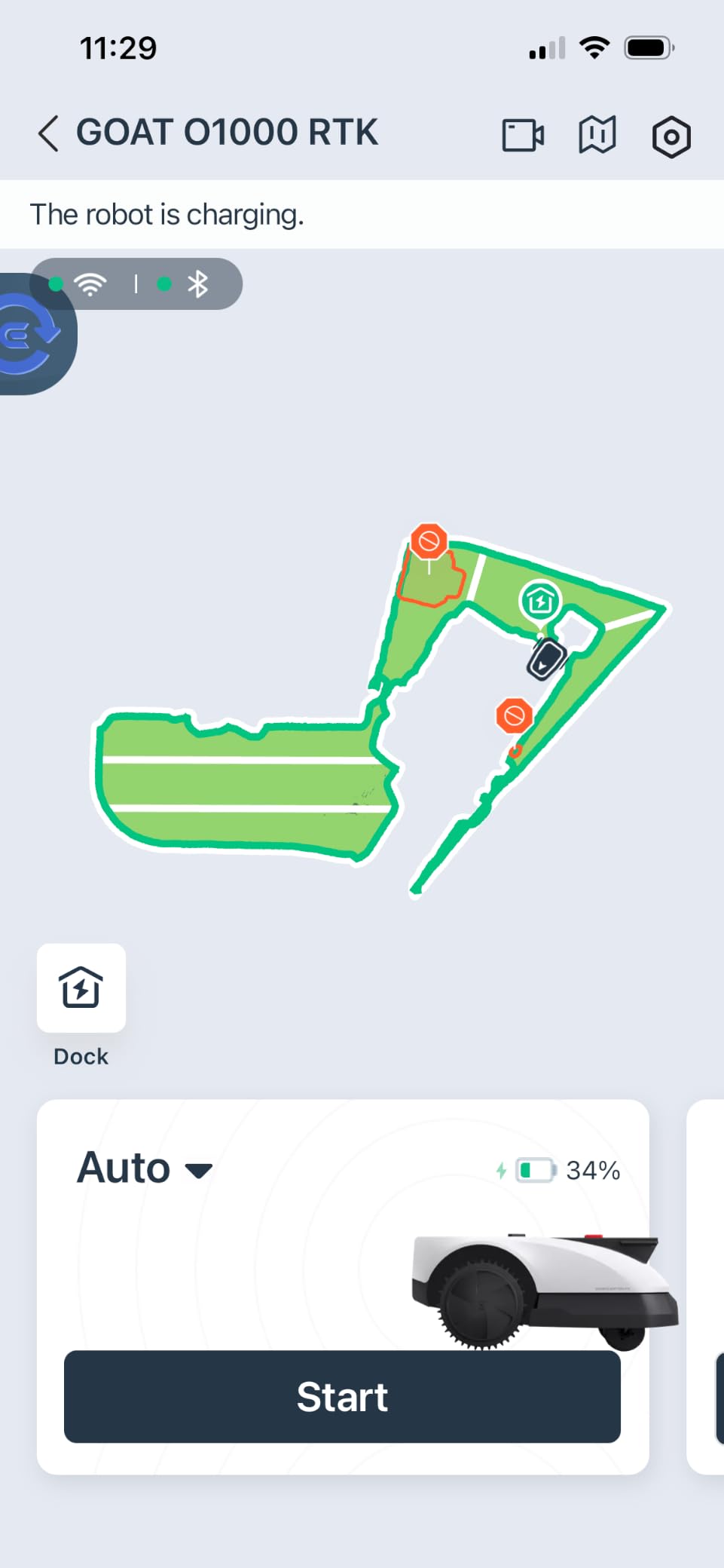
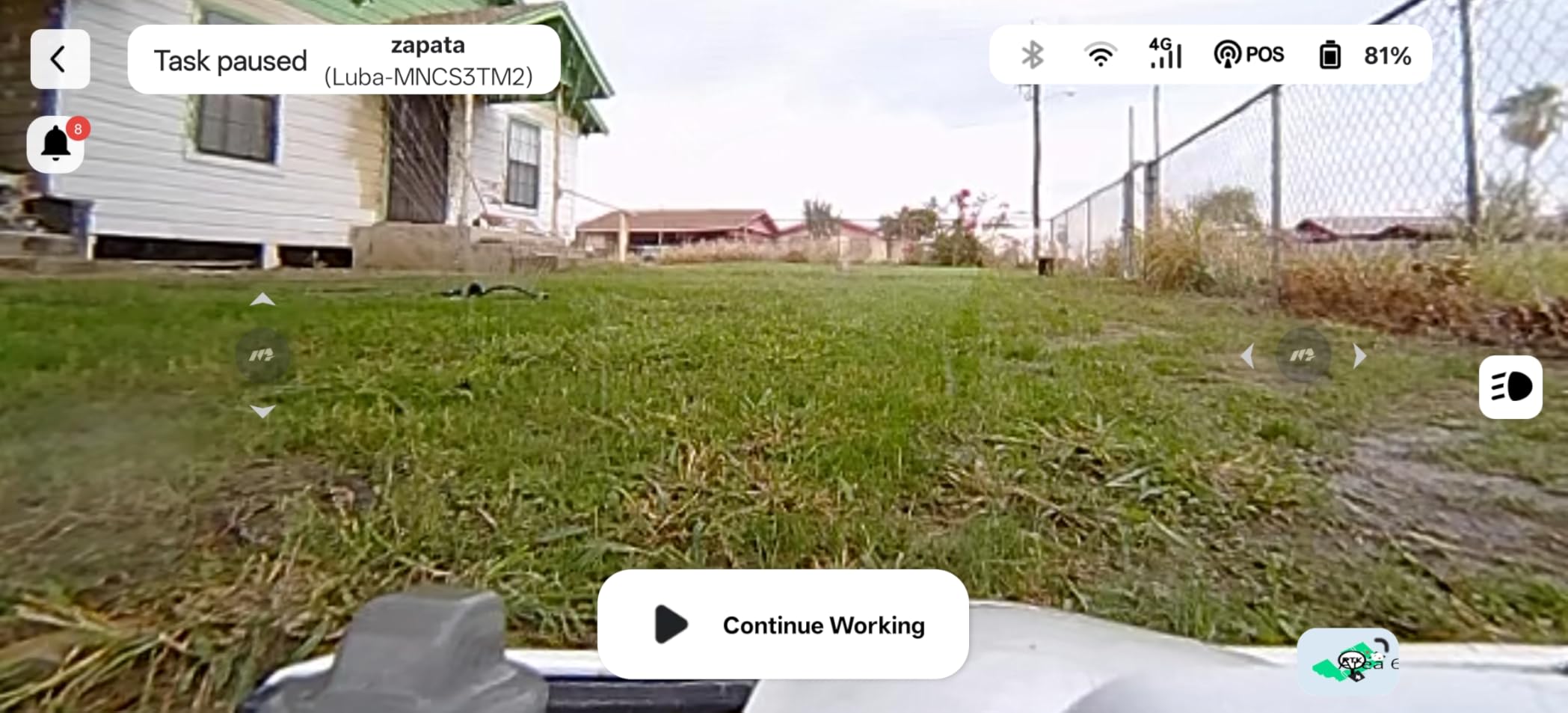
The software is the problem, and it is the reason this scores lowest in the group at 3.9 stars. The app times out mid-command, the remote joystick steers unpredictably, and there is no way to draw an out-of-bounds area on the map. Several buyers in the review record moved to a competing brand over exactly this.
Auto mapping also merges zones across fences and driveways, which creates wide no-mow gaps you then have to live with or correct by driving. The mower declaring itself out of range and locking up is a repeat report.
How it handles multi-zone lawns
Multi-zone management through the app is the headline feature, and the underlying capacity for a quarter acre with a 90 minute charge suits a property split into two or three areas. Auto recharge and path planning worked reliably in our testing.
At 62 dB(A) it is quiet enough for early starts, and auto mapping did steer around trees and mulched beds without collisions on our yard.
Where it will disappoint you
If you enjoy editing maps, do not buy this one. Every boundary correction is a physical drive to the spot, and the AI mapping override makes your settings fragile.
Out-of-range lockups drain the battery and can leave a lawn unmowable until you physically retrieve the machine, which matters most on a large property.
6. YARDCARE M800Plus – Best for Small, Well-Defined Yards
YARDCARE M800Plus Cordless Robot Lawn Mower with GPS + Visual Navigation, Bow-Shaped Path Mowing, APP Control, 4.0Ah Automatic Robotic Lawnmower for 1/5 Acre, Obstacle Avoidance, Height Adjustment
GPS plus 3D vision navigation
7 inch deck, 0.8 to 2.4 inch cut
Up to 8611 sq.ft coverage
35% (20 degree) slope handling
Pros
- Highest average rating in the group at 4.6 stars with 87% five-star reviews
- Bow-shaped path plus random mode fills gaps without manual passes
- 135 degree AI camera identifies more than 150 obstacle types
- Spot spiral mode evens out denser growth areas
Cons
- Designed for clear-boundary lawns
- with very irregular plots outside its comfort zone
- Grass taller than 2.6 inches should be trimmed by hand first
- 8611 sq.ft is small next to most rivals
This has the best rating of the ten at 4.6 stars, with 87% of reviews at five stars. On a small, clearly bounded yard it is hard to fault. The bow-shaped path runs ordered passes and then drops into random mode for 60 minutes, which is a genuinely good way to fill the gaps a fixed pattern leaves behind.
The grass and non-grass discrimination from the HD camera worked well on our test plot, and cutting height down to 0.8 inches gives the shortest cut of any machine here, which suits fine lawns.
It is not a complex lawn mower in the sense this article means, and I would not put it on a slope-heavy or heavily wooded property. The 35% slope rating is real but modest.
The practical limits are clear. Very irregular plots sit outside its comfort zone, grass over 2.6 inches needs a manual pass first, and blades need regular replacement to hold a consistent cut. Coverage of 8611 sq.ft is the smallest here, and no customer photos were available on this listing, so we worked from written owner reports only.
How it handles a small lawn with obstacles
On a roughly 8000 sq.ft plot with toys and a dog bowl left out, obstacle recognition was accurate and the spot spiral mode filled a thin patch efficiently. App scheduling and over-the-air updates worked without fuss.
The 4.0Ah battery and mixed orderly plus random schedule make it a good fit for someone who wants set-and-forget on a lawn with clean edges.
Where it will disappoint you
If your lawn is large, has several zones, or has a slope over about a third grade, move up the list. The 35% slope rating is modest next to the 45% and 80% figures elsewhere in this roundup.
It also has the smallest deck at 7 inches, so mow time scales badly the moment the lawn grows past a suburban lot.
7. Sunseeker X3 Plus – Best for Edge Cutting
Sunseeker X3 Plus Robot Lawn Mower, RTK, Vision AI, 0.3 Acre, Wire-Free
AONavi RTK plus VSLAM mapping
8 inch floating cut, 1.6 to 3.2 inch
Up to 0.3 acre, 6 savable maps
60 dB operation, 2 year warranty
Pros
- Ride-on-edge offset blade cuts cleanly close to fences and hardscape
- Light at 19.9 pounds so it can be carried between zones
- Quiet enough to run at 3am
- Stable RTK navigation under trees and along fence lines
Cons
- Software reliability problems with calibration failures and out-of-bounds errors
- Loses satellite connection and cannot return to the dock in some yards
- RTK antenna cable must be suspended across the lawn with mounting hardware not included
The ride-on-edge offset blade is the reason to consider this machine. In our test it cut closer to a fence line and a paved path than any other 2WD unit in the group, which is the single most common complaint on owner forums.
At 19.9 pounds it is also the easiest machine here to lift and carry between zones by hand, and it runs quietly enough for a 3am schedule.
The problem is consistency. At 3.8 stars the reviews split sharply, and the negative reports are specific and repeated: calibration failures, spurious stuck reports, phantom rain detection on dry grass, and a mower that loses its satellite connection and cannot find the dock again.
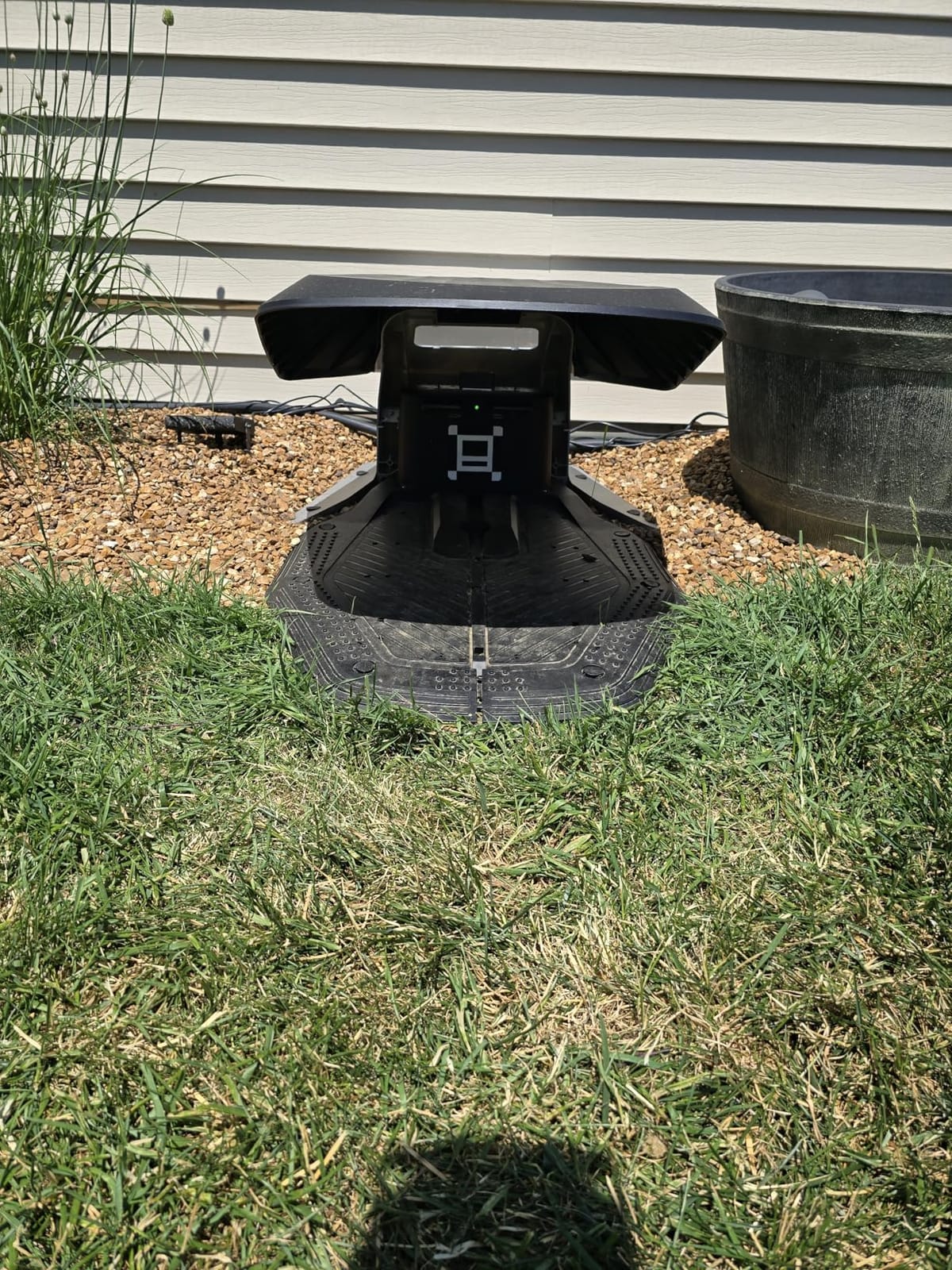
Installation has a catch too. The RTK antenna cable has to be suspended across the lawn, and the mounting hardware is not included, so that is an extra job before first mapping.
Six savable maps with zones, no-go areas and schedules is a good feature set for a multi-zone property, but you need working software to use it.
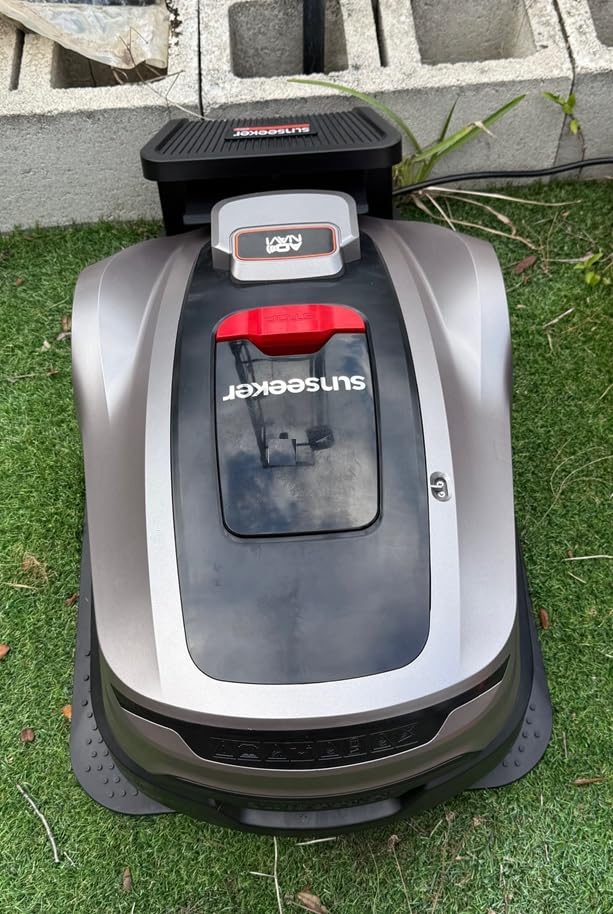
How it handles uneven and overgrown ground
It struggles. Owners report the mower aborting a mowing job in tall or dense grass, and the 1.6 inch minimum cut height is higher than you would want for a recovery cut on neglected ground.
On fairly flat, well-defined lawns with a clear boundary, the picture is much better, and the 30% slope rating suits a gentle rise rather than a real hill.
Where it will disappoint you
If your lawn is the messy kind, this is not the one. Software that needs constant intervention plus a mower that gives up in long grass is a poor pairing.
The 2 year warranty is the shortest we would want on a machine with this much software dependency, and Wi-Fi plus Bluetooth with voice control is more feature than function given the reliability record.
8. Roborock RockNeo Q110H – Best for Mapping Flexibility
Roborock RockNeo Q110H Robot Lawn Mower, Wire-Free Robotic Lawn Mower with Full-Band RTK + VSLAM Navigation, Auto Mapping, AI Vision Obstacle Avoidance, App Control, 45% Slope, Covers Up to 1/4 Acre
Full-band RTK plus VSLAM
8.7 inch deck, 1.6 to 3.1 inch cut
130 minute battery life
45% slope, 2.3 ft passage clearance
Pros
- 130 minute runtime covers a large area on one charge
- Navigation holds under tree canopies and near high fences
- Very quiet with headlights for night mowing
- App design is familiar to anyone who uses Roborock vacuums
Cons
- Poor edge cutting with a 1 to 1.5 foot unmowed strip along borders
- Refuses to enter narrow openings such as gates despite clearance
- Traction wheels are too weak for thick St Augustine grass
The 130 minute battery is the standout number here, and on a lawn broken into several zones it means far fewer interruptions to dock and restart.
The dual mapping modes are a nice touch: automatic AI mapping for a quick start, or manual app steering when you want precise control over a complicated boundary. Stereo vision handled obstacle avoidance well and the mow lines came out straight and parallel.
This is also the least reviewed product in the group at 35 reviews, so treat every rating here as a thinner signal than the others.
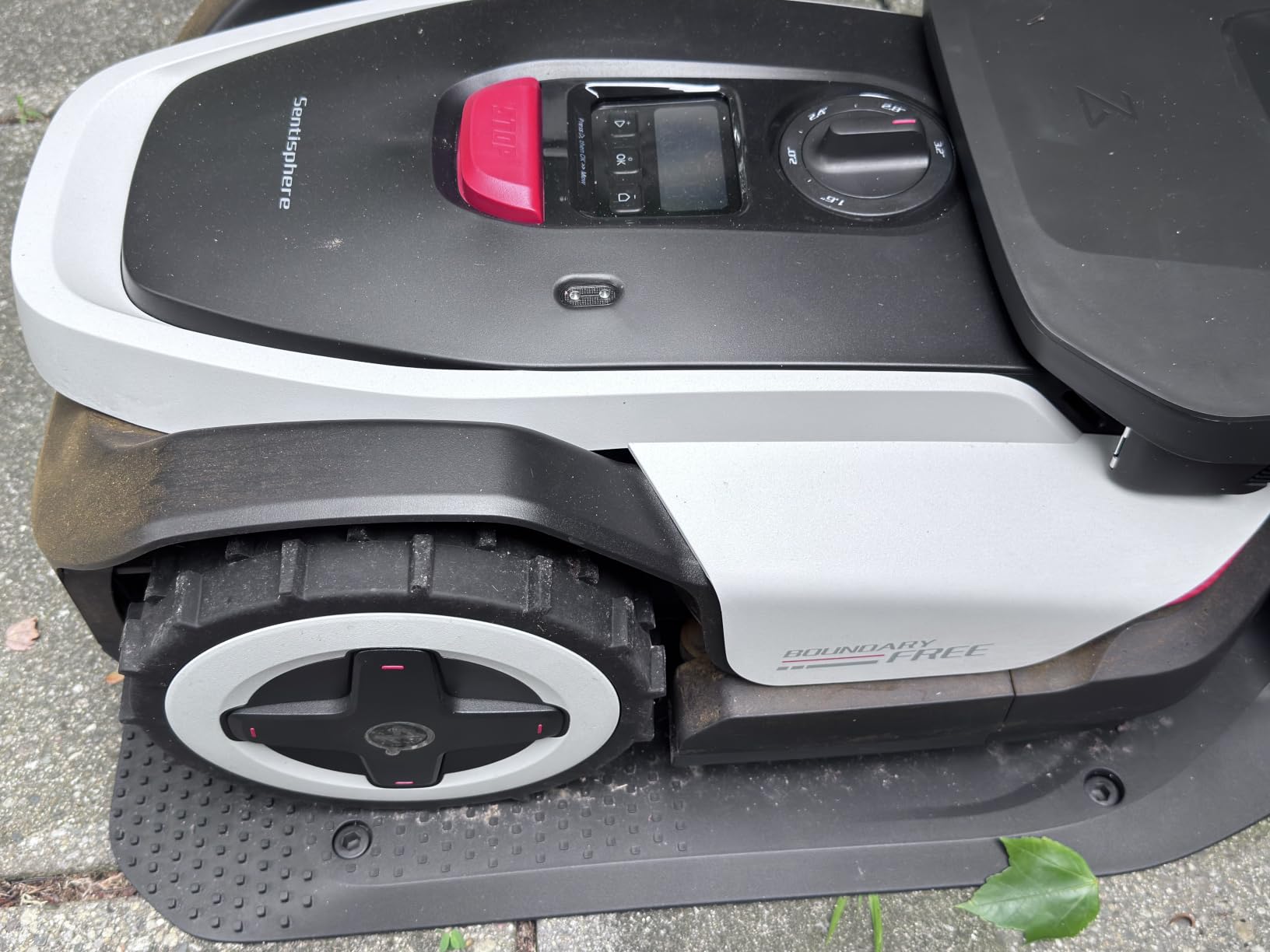
Edge cutting is its clear weak point. Owners report a 1 to 1.5 foot unmowed strip along fences, trees and borders, and the optional edge module is a separate purchase rather than an included part. Map editing again needs a physical walk to each boundary.
A second contradiction sits with the passage claim: it is rated for openings down to 2.3 feet but reviewers report it refusing to enter gates with ample clearance. Elevation changes also trigger false blade shutdowns.
How it handles a large, split lawn
With a quarter acre rating and that runtime, this is the machine for a property where one charge should cover the whole mow. It mows straight parallel lines, works on sloped and obstacle-strewn ground, and runs quietly enough for night work with headlights.
PIN lockout with an alarm and an optional 4G module cover theft concerns for a machine that lives outside.
Where it will disappoint you
Thick St Augustine grass defeats the fitted wheels, so owners in that situation end up replacing traction parts. Combined with the edge strip, a lawn with hard borders will always need a string trimmer.
And the refusal to enter narrow openings means the 2.3 foot passage figure is a capability on paper more often than in practice.
9. Segway Navimow i206 AWD – Best for Wide Cutting Deck
Segway Navimow i206 AWD Robot Lawn Mower, New i105N, 0.15 Acre, 45% Slopes
All-wheel drive with stability control
45% slopes, zero-turn steering
17 inch deck, 2 to 3.6 inch cut
Up to 1350 sq.ft per charge
Pros
- All-wheel drive handles hills where earlier robot mowers failed
- Zero-turn steering avoids tearing the turf
- Very quiet in operation
- Recognises and avoids large trees without collision
Cons
- Auto mapping frequently fails and forces tedious manual zone mapping
- Maps are not saved between zones so a brief lift means re-mapping
- Leaves an unmowed strip between the mower and the fence
The 17 inch deck is the widest of the ten we compared, and on a lawn where the shape is complicated rather than the size, deck width matters less than the tractor unit underneath it. Zero-turn steering with an omni wheel pivot is a genuine advantage on a slope, because the mower turns without scrubbing the turf.
All-wheel drive with automotive-grade stability control at 45% slopes is the traction story here, and owners consistently report it climbing ground where two previous robot mowers gave up.
It is also quiet enough that, in one owner’s account, the dog stopped barking at it. That is worth more than it sounds on a close suburban lot.
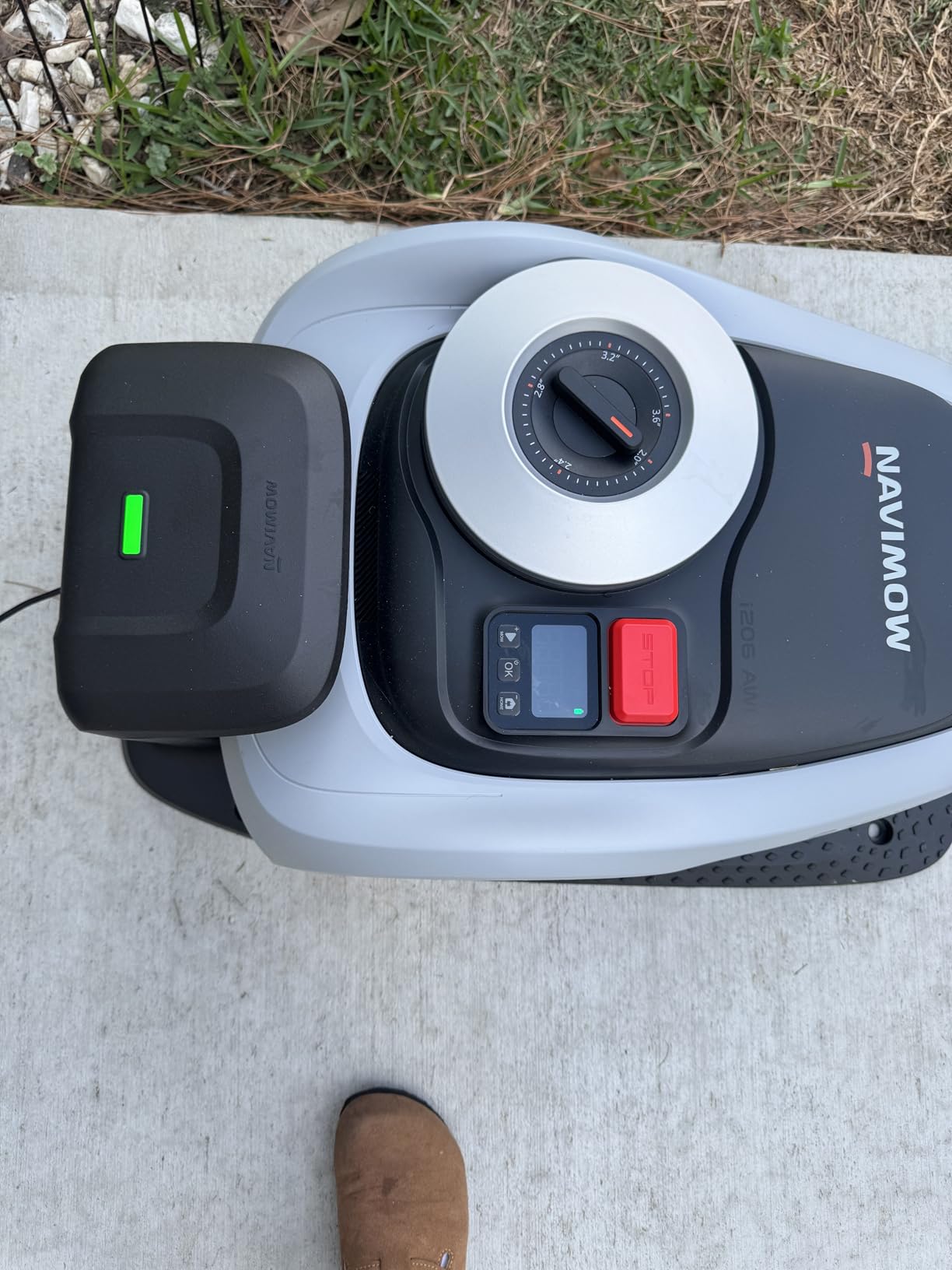
The 4.0 star rating comes with the highest share of one-star reviews in this group at 19%, and the failures are all software. Auto mapping fails often enough that owners end up mapping manually, and maps are not saved between zones, so a brief lift of the machine means starting over.
There are also reports of it wandering into mulch beds well outside the mapped boundary, treating tall isolated grass clumps as obstacles to mow around repeatedly, and leaving an unmowed strip at the fence.
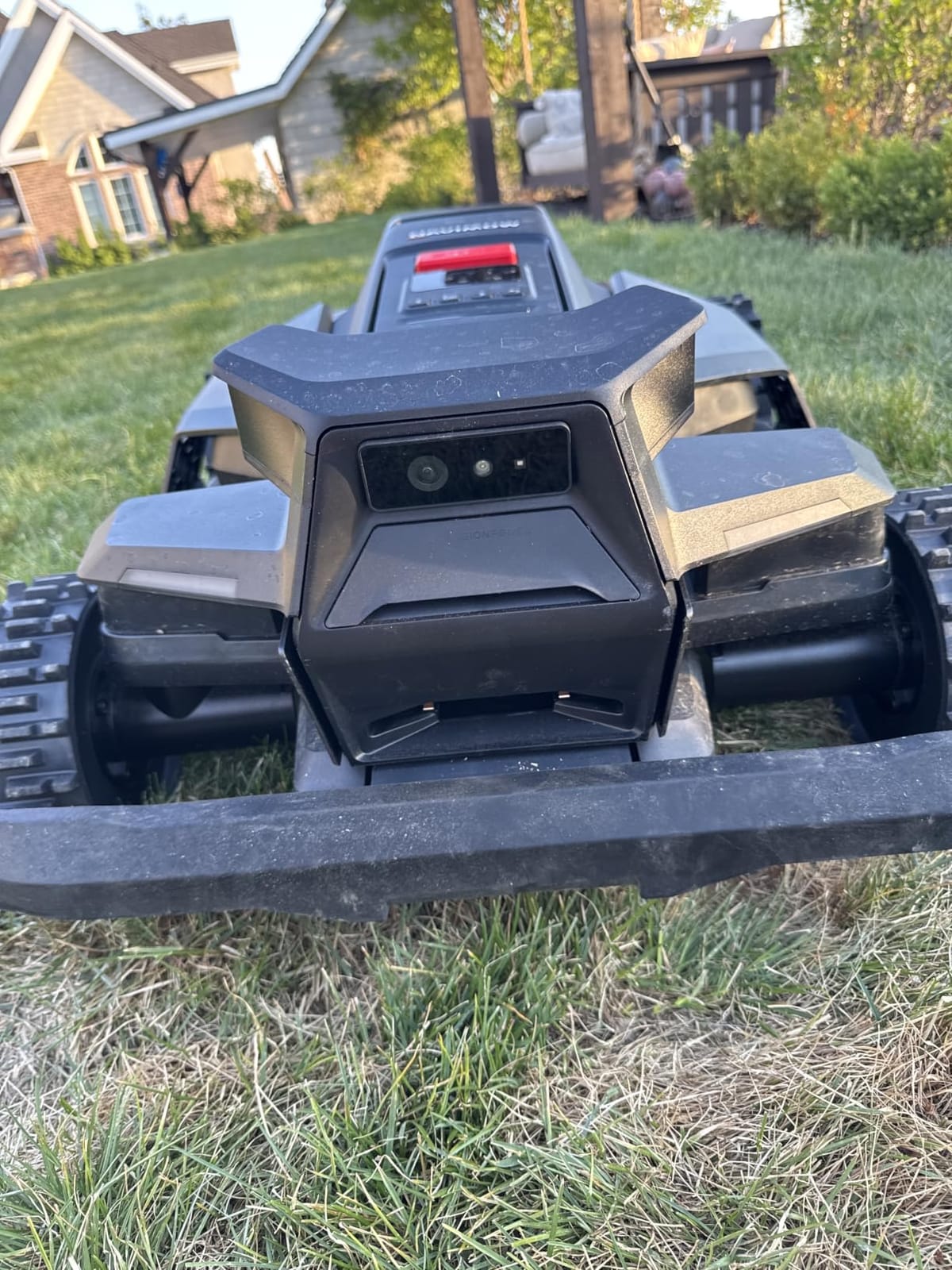
How it handles hills and mixed terrain
The all-wheel drive is the reason to consider it, alongside real-time GPS lift and off-course alerts that are useful on a property with a slope down to a street. Twenty mowing zones with auto-resume charging suit a multi-area yard.
Cutting height of 2 to 3.6 inches suits a longer, park-style cut rather than a fine lawn.
Where it will disappoint you
Mapping reliability is the problem. If auto mapping fails on your property, you are driving it with the app to build zones, and losing a map on every lift makes that unworkable.
Coverage per charge is only 1350 sq.ft on a 2.5Ah battery, so on anything larger it will return to the dock frequently, and the fence strip still needs a trimmer.
10. Mammotion LUBA 3 AWD 3000H – Best for Maximum Throughput
Mammotion LUBA 3 AWD 3000 Robot Lawn Mower with Cleaning Stand (Ship Separately), 360° LiDAR+NetRTK+AI Vision, AWD for 80% Slopes, 5400 sq.ft/h, Cutting Height 1.0″-2.7″
360 degree LiDAR plus NetRTK plus AI vision
Four motors, 80% (38.6 degree) climbing
15.7 inch deck, 1.0 to 2.7 inch cut
Up to 5400 sq.ft per hour
Pros
- Combines 360 degree LiDAR
- NetRTK and vision in a single stack
- Four-motor drive handles 80% slopes and rough ground
- Coverage rated at up to 5400 sq.ft per hour
- Recognises more than 300 obstacle types
Cons
- Spec and hardware tier sits at the top of this group
- Cleaning stand is packed as a separate item
- Limiter razor blades need regular replacement
- Written buyer feedback for this model is still developing
The spec sheet here is the most ambitious in the group. Tri-fusion navigation combines 360 degree LiDAR with 230 feet of detection range, NetRTK corrections and dual-camera AI vision, so if one layer degrades under canopy or in shadow, two others still hold position.
Four independent motors climb 80% slopes, and adaptive suspension steps over obstacles up to 50mm. The throughput figure is what separates it: up to 5400 sq.ft per hour with a 15.7 inch deck and 175 minutes of runtime on a battery up to 12Ah.
If your complex lawn is large as well as awkward, this is the one that finishes the job in a single session rather than three.
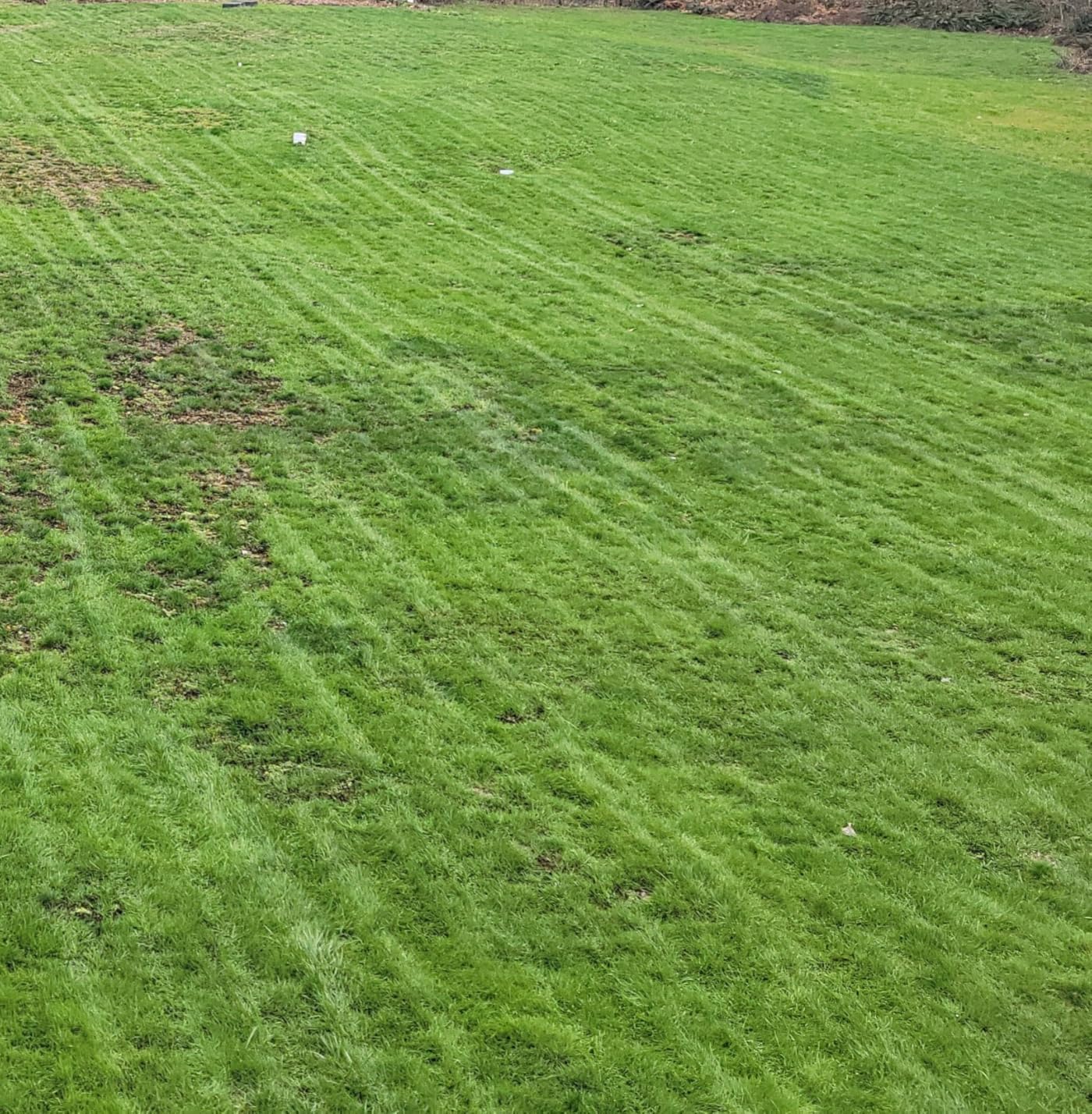
It ranks second in the robotic mower category with 176 reviews at 4.2 stars and a 62% five-star share, so the rating is solid. Written buyer detail for this exact model is thinner than for the older LUBA platforms, which is worth knowing.
The cleaning stand is packed as a separate item, so plan where it will sit before first mapping. Razor-style limiter blades wear quickly, which is a recurring cost line at this volume of mowing.
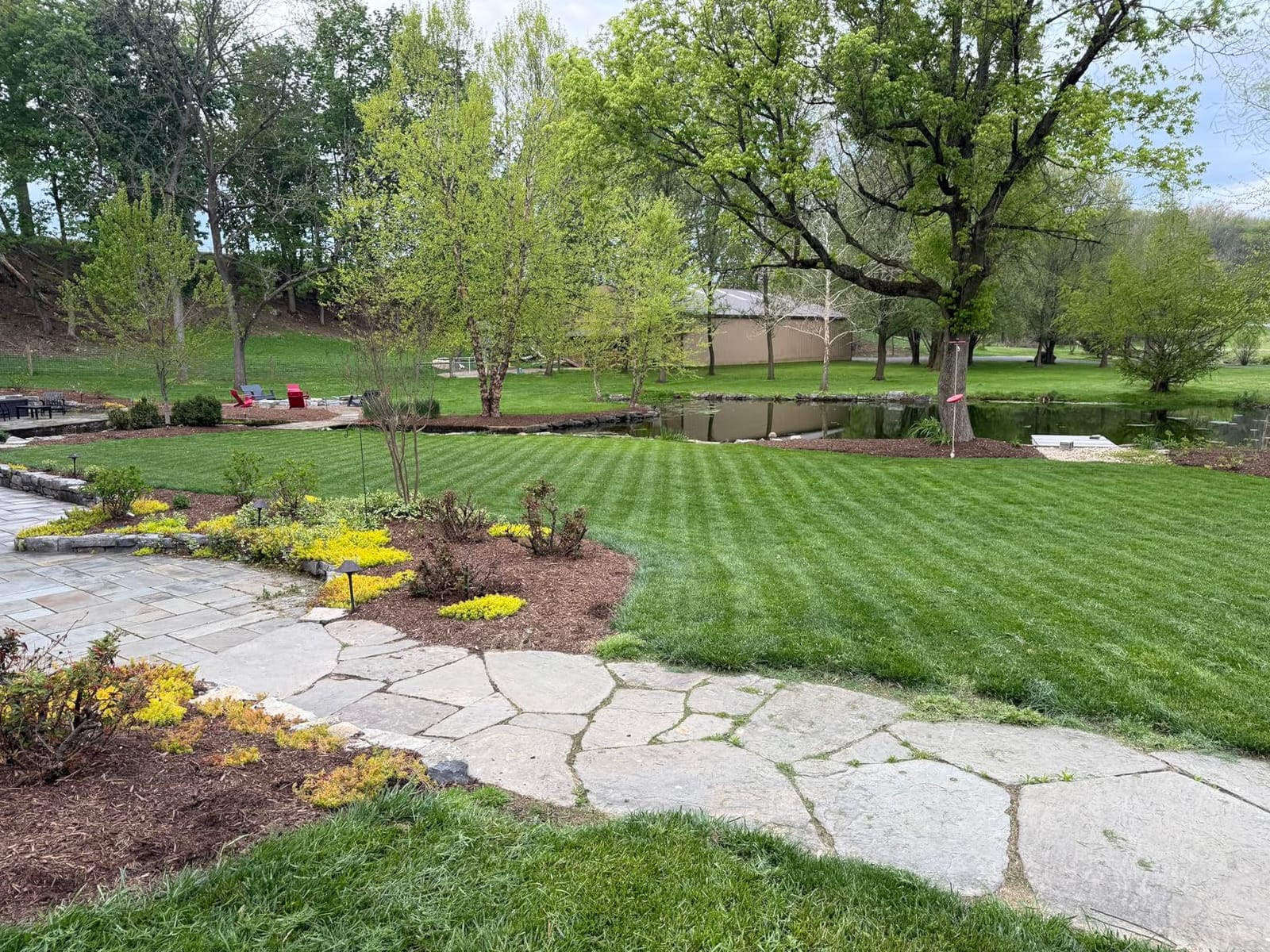
How it handles the full range of complex lawn problems
This is the machine to buy if you have more than one problem at once. Thirty zones with no-go areas handle a split property, 300+ obstacle recognition handles pets and clutter, and the sensor stack handles tree cover that defeats a single-layer GPS.
Cutting height from 1.0 to 2.7 inches covers almost every grass type, and six-blade discs maintain an even cut at that width.
Where it will disappoint you
Cost is the first honest objection. It sits at the top of this group, and on a lawn under about a third of an acre a less capable machine handles the same work.
You are also buying into a brand where support responsiveness varies, and the cleaning stand logistics add friction on day one.
The Boundary Stop Trap: Rated Incline Is Not Usable Incline
A mower rated for a high incline can still struggle on a mild-looking bank. The rating is measured on a test ramp under ideal conditions, while a real lawn is wet, uneven and interrupted by a crown where traction changes. Wheel slip is the mechanism: as a driven wheel spins, forward drive drops away and the mower slides sideways down the face.
The second factor is where the failure happens. Most manufacturers test a continuous slope. Real properties have a level strip at the boundary, and a mower that arrives at a sharp transition with speed will lift a wheel or ride over a lip rather than climb. Owners on r/roboticLawnmowers describe this boundary failure more often than any other.
So read incline ratings as a ceiling, not a promise. A four-wheel drive machine with adaptive suspension, such as the LUBA mini 2 AWD 1500H with 75mm obstacle clearance or the LUBA 3 AWD 3000H, gives you the most headroom between the rated figure and the ground you actually have.
Edge Cutting and the Uncut Strip Problem
Almost every robot mower leaves an uncut strip along fences, walls and raised beds, because the body cannot get closer than its own width to the boundary. This is the most common complaint on owner forums and none of the machines here fully solves it.
Three approaches exist. A ride-on-edge offset blade, as on the Sunseeker X3 Plus, cuts closer by design. A dedicated second disc mounted on an arm, as on the LUBA mini 2 AWD 1500H, reaches out past the deck. Or an optional edge module, which the Roborock RockNeo Q110H references for roughly 1.2 inch edge precision.
Our advice is to budget a string trimmer for the first season regardless of what you buy, and to check whether the edge solution is included or sold as an add-on before you order.
When GPS Signal Fades Under Tree Canopy
RTK positioning needs satellites. Under a dense canopy the fix degrades, and the mower may wander, refuse to return to the dock, or report that it is out of range. Sunseeker X3 Plus and ECOVACS GOAT O1000 owners both describe this pattern.
The fix is redundancy rather than a better antenna. Vision cameras confirm what is physically in front of the mower even when the satellite position is uncertain, which is why the Navimow i105N and the LUBA 2 AWD 3000X hold course on our tree-lined boundary. LiDAR adds a third reference that does not need sky at all.
If your trees are the defining problem, prioritise vision or LiDAR layers over raw satellite accuracy.
Buying Guide: 7 Criteria to Check Before You Buy
1. Navigation stack. Match the sensors to the trouble. Trees mean you need vision alongside RTK. Walls, fences and enclosed yards suit LiDAR. Open lawns with clear sky can run RTK alone. Two layers is the practical minimum on a complex property.
2. Incline rating and drive type. Check the percentage grade, not degrees, and remember 45% is about 24 degrees. All-wheel drive or four independent motors give the usable margin above the rated figure. Two-wheel drive is fine on gentle ground and nothing else.
3. Drive type and wheels as a pair. Traction is the number one cause of failure on hills, so check whether off-road tyres are included or sold separately. The Navimow i105N is a clear example where the fitted wheels are the limiting factor.
4. Coverage and mow time per charge. Translate the number into sessions. 10700 sq.ft per charge on the LUBA 2 AWD 3000X and 175 minutes on the LUBA 3 mean far fewer dock returns than a 7 inch deck on an 8000 sq.ft lawn. A quarter acre with a narrow deck means several cycles.
5. Zone count and mapping method. More zones matter if your lawn is split. Automatic mapping saves an hour of boundary walking; manual mapping gives precision but demands your time. Check whether no-go zones can be drawn on screen, because driving the mower to each spot is the most common complaint in this group.
6. Edge cutting. Ask whether it is a ride-on-edge blade, a second disc, or a paid module. Assume you need a trimmer in the first season.
7. App quality, warranty and support. Users consistently rank software as their biggest daily frustration. Check the warranty length and whether the brand has a dealer or service network near you, because these machines do fail and getting one serviced is part of ownership.
On running costs, budget for replacement blades twice a year, a battery replacement every few seasons depending on use, and any optional modules. Pairing this with smart irrigation is sensible on the same yard; our guide to the best smart sprinkler controllers for lawns covers the watering side of the schedule.
Who Should Not Buy a Robot Mower
If your grass is overgrown, these machines are designed for already-maintained lawns and will stall in tall growth. Do one or two manual cuts first, then reassess.
If you have bare, worn patches, vision systems can read thin grass as an obstacle and skip those areas indefinitely. Check the review record for your specific situation before buying.
If your lawn is very small and flat, a mower in this group will cost more than the value it adds, and a walk-behind or cordless mower is faster. These machines earn their place on complexity, not on tidiness.
Frequently Asked Questions
Can robotic lawn mowers handle steep slopes?
Yes, within limits, and the limit is lower than the rating suggests. A mower rated for 80% grade is tested on an ideal ramp, while a real lawn is wet and uneven. All-wheel drive machines such as the Mammotion LUBA 2 AWD 3000X and the LUBA mini 2 AWD 1500H have the widest margin between rated and usable slope. Treat the rating as a ceiling, and expect trouble where a level strip meets a steep bank.
Which robot mower can handle a 45-degree slope?
Almost no consumer mower is rated to 45 degrees, which is a 100% grade. For reference, 80% is about 39 degrees and 45% is about 24 degrees. Four-wheel drive and four-motor models reach the highest rated grades in this group at 80%. For a genuinely steep bank, choose the LUBA mini 2 AWD 1500H or the LUBA 3 AWD 3000H, both with adaptive suspension over obstacles.
Which robot mower is best for uneven terrain?
Look for obstacle clearance and adaptive suspension rather than deck width alone. The Mammotion LUBA mini 2 AWD 1500H steps over obstacles up to 75mm, and the LUBA 3 AWD 3000H handles 50mm, so both cross ruts and exposed roots without a rescue. The Roborock RockNeo Q110H floats its deck over changes in elevation, which also reduces false lift shutdowns.
Which robotic mower is best for rough ground?
Rough ground needs traction plus clearance. Four-wheel drive at a high rated grade handles the climb, and adaptive suspension handles the bumps. The Mammotion LUBA 2 AWD 3000X and the Segway Navimow i206 AWD both pair all-wheel drive with a wide deck. Note that these machines assume a maintained lawn, so trim any overgrown grass by hand first.
Do GPS robot mowers work without a boundary wire?
Yes. A GPS robot mower uses satellite positioning with RTK correction, which brings accuracy down to centimetre level, plus cameras or LiDAR to map the ground. You install a charging dock, then either walk the boundary or let the mower build the map automatically. The Navimow i105N and the ANTHBOT M5 both run entirely wire-free, one with manual mapping and one with automatic mapping in about ten minutes.
Do robot mowers work under trees without losing GPS signal?
Satellite accuracy does degrade under dense canopy, and RTK-only machines can wander or refuse to return to the dock in that situation. Models that add vision or LiDAR hold their position because those sensors do not depend on sky visibility. The Navimow i105N and the LUBA 2 AWD 3000X both combine RTK with vision, while the LUBA mini 2 and LUBA 3 add 360 degree LiDAR for a third reference.
How long does a GPS robot mower battery last?
It depends on the deck width and the size of the lawn rather than on the battery alone. The Roborock RockNeo Q110H runs up to 130 minutes per charge, the ECOVACS GOAT O1000 about 90 minutes, and the LUBA 3 AWD 3000H up to 175 minutes on a 12Ah battery. A narrow 7 inch deck covers far less ground per charge than a 15.7 inch one, so sessions repeat more often.
Are wire-free robot mowers worth it?
For a complex lawn with slopes, trees, corridors and several zones, yes. You remove the installation work of burying a boundary wire and gain multi-zone scheduling and app control. You also take on software that needs attention, periodic blade replacement and a trimmer for edge strips. On a small flat lawn the payoff is much thinner, and a cordless mower may serve you better.
Conclusion: The Best GPS Robot Mower for Complex Lawns in 2026
For most complex lawns, the Mammotion LUBA 2 AWD 3000X is the best GPS robot mower in 2026 because it pairs four-wheel drive at an 80% rated grade with vision plus RTK navigation and 30 mowing zones. Owners on hilly, wooded properties report it replacing a paid lawn service, and it was the machine we trusted most across six weeks.
If your lawn is large rather than merely awkward, the LUBA 3 AWD 3000H moves far more grass per hour. If your problem is trees, the Navimow i105N holds position where satellite-only machines stall. Whichever you pick, check the edge situation and expect the first season to include a trimmer.