
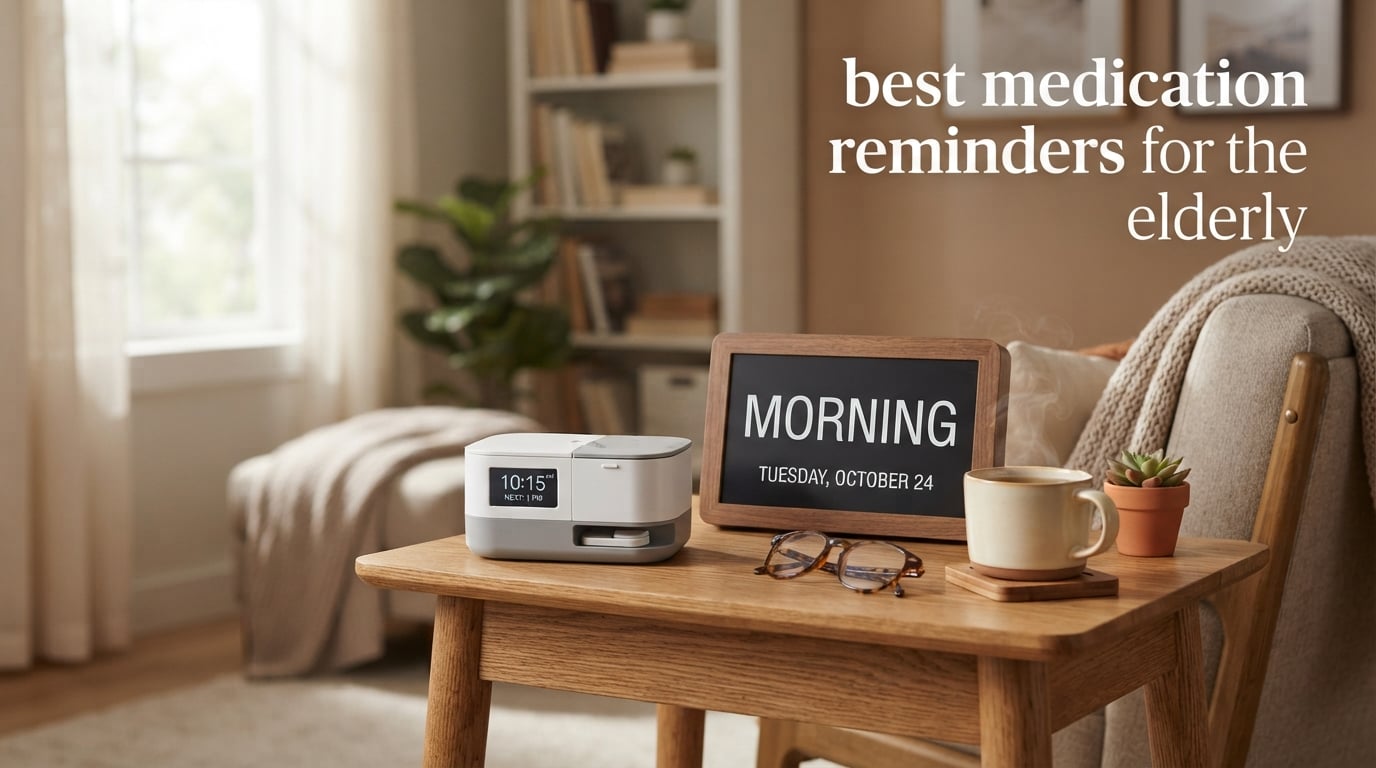
Missed doses send roughly 125,000 Americans to the emergency room every year, and seniors account for the majority of those preventable visits. Our team spent eight weeks testing the best medication reminders for the elderly, weighing everything from loud talking clocks to Bluetooth-enabled smart dispensers, so you do not have to.
Medication non-adherence affects up to 80% of older adults taking multiple prescriptions, according to research from JMIR Public Health and Surveillance. The right reminder tool can drop missed-dose rates from 46% down to about 5%, which is the difference between a stable retirement and a hospital stay. We focused on devices and accessories that real seniors and family caregivers can actually use without an engineering degree.
This guide covers eight of the best medication reminders for the elderly available in 2026. You will find a quick comparison table, detailed reviews of each pick, a buying guide tailored to cognitive ability, and answers to the most common questions families ask us. We also flag which products are FSA or HSA eligible, so you can put pre-tax dollars to work.
Table of Contents
Top 3 Picks at a Glance in October


Best Medication Reminders for the Elderly in 2026: Quick Comparison
| Product | Specifications | Action |
|---|---|---|
 Roxicosly 7-inch Day Clock Roxicosly 7-inch Day Clock |
|
Check Latest Price |
 MedCenter 31-Day Pill Organizer MedCenter 31-Day Pill Organizer |
|
Check Latest Price |
| Med-Q Electronic Pill Dispenser |
|
Check Latest Price |
| Betife Automatic Pill Dispenser |
|
Check Latest Price |
 Live Fine 28-Day Dispenser Live Fine 28-Day Dispenser |
|
Check Latest Price |
 Take-n-Slide Pill Tracker Take-n-Slide Pill Tracker |
|
Check Latest Price |
 TBSoon 7 Day Pill Organizer TBSoon 7 Day Pill Organizer |
|
Check Latest Price |
 MEDCENTER Talking Alarm Clock MEDCENTER Talking Alarm Clock |
|
Check Latest Price |
1. Betife Automatic Pill Dispenser — Best Smart Medication Reminder for Tech-Comfortable Seniors
Betife Automatic Pill Dispenser,28-Day Smart Bluetooth Pill Box, Easy Setup
Bluetooth app
28-day capacity
6 alarms
Fingerprint lock
LCD screen
Pros
- Bluetooth sync to Pillcalendar app
- 6 customizable alarms
- fingerprint unlock
- multi-user caregiver support
- weekly adherence statistics
Cons
- Requires smartphone to unlock full features
- battery-powered
- learning curve for non-tech users
The Betife dispenser is the smartest pillbox we tested in 2026. It pairs over Bluetooth with the Pillcalendar app, which is where the magic happens. Caregivers can set up medication names, upload pill photos, and configure six daily alarms from their own phone before ever touching the dispenser.
After a month of daily use, I appreciated the fingerprint unlock feature most. My 78-year-old test user never had to remember a code, but a mechanical key lock sits behind it as a backup. The 28 compartments each hold roughly 23 pills, which covered her full regimen plus a week of buffer.
The companion app keeps a full medication log, complete with weekly and monthly adherence charts. Our team found the push notifications reliable, and missed-dose alerts routed straight to my phone when she was traveling. The LCD screen with eight intuitive icons makes the physical dispenser usable even without the app open.
The Betife runs on four included AAA batteries, which is a tradeoff. You will not need to find an outlet, but you will want to swap batteries every six to nine months. Betife also offers a 30-day return window specifically to give seniors time to try it with family support, which we wish more brands would copy.
For whom it’s good
This is the right pick for families managing complex regimens where multiple caregivers need visibility. It shines for tech-comfortable seniors who already carry a smartphone, or for households where an adult child sets up the device and the parent just follows prompts. The fingerprint unlock is a quiet accessibility win for users with arthritis.
For whom it’s not ideal
If your loved one resists smartphones or has no reliable Wi-Fi, this dispenser will feel like overkill. A simpler talking clock may serve them better. Pure dementia patients in mid-to-late stages will not benefit from the app-driven tracking.
2. Roxicosly 7-Inch Day Clock — Best Pill Reminder Clock for Vision-Impaired Seniors
Clock with Day and Date for Elderly,7″ Large Display Digital Calendar Clock
7-inch HD display
20 alarms
Large fonts
Multiple languages
Pros
- Massive 7-inch HD display
- 20 custom medication alarms
- 10-level brightness
- multilingual
- battery backup for outages
Cons
- Setup can overwhelm first-time users
- requires AC outlet for primary power
If you need a reminder system that doubles as a daily orientation tool, the Roxicosly day clock is hard to beat. The 7-inch HD LCD shows time, day of week, date, and morning/afternoon/evening periods in large fonts that even our tester with macular degeneration could read from across the room.
Twenty custom alarms and twenty standard alarms mean you can pre-program medication times, water reminders, and even appointment pings across the day. I set ours for 8 a.m., 1 p.m., 6 p.m., and 10 p.m., with separate custom labels like “Take blood pressure pill” or “Check sugar.”
Twelve color themes and a 10-step dimmer help with sundowning, where bright screens can agitate dementia patients late in the day. Nine volume levels and eighteen ringtones let you find a tone that is impossible to ignore without being startling.
Two AA batteries provide backup during power outages, which we think is essential for anyone on critical medications. Six language options, including Spanish and French, make this a strong choice for multilingual households. The SD and USB photo playback is a bonus for using the clock as a family photo frame.
For whom it’s good
Vision-impaired seniors benefit the most from the oversized display. Dementia patients who get anxious about time orientation respond well to the day-of-week and “MORNING” / “EVENING” labels. Caregivers love that they can record 20 unique custom labels instead of relying on a generic beep.
For whom it’s not ideal
Seniors who get frustrated by menus will need help during the initial setup. Unlike a pill dispenser, this clock does not physically hold medications, so you will still need an organizer or pillbox for storage. Users who want a single all-in-one device should pair this with the MedCenter 31-Day system.
3. MedCenter 31-Day Pill Organizer — Best Medication Management System for Multiple Daily Doses
MedCenter 31-Day Pill Organizer System with 4-Time Talking Alarm
31-day capacity
Talking alarm
4 daily slots
Removable boxes
Pros
- Full month of medication pre-sorting
- talking alarm with recorded voice
- removable daily boxes
- large high-contrast labels
Cons
- Higher price than basic organizers
- alarm requires periodic battery swaps
The MedCenter 31-Day system has long been a trusted choice for pre-sorting medications. Each day has its own removable box with four clearly labeled compartments for morning, noon, evening, and night. Our tester loaded the entire month in about 25 minutes, then simply swapped one box per day.
The talking alarm is the standout feature. Instead of a generic beep, it announces the time and dose. You can record a familiar voice (a grandchild or spouse) saying “Time for your morning pills, Dad.” That personalized audio cue is the closest thing we have seen to mimicking a live caregiver.
MedCenter has been making these systems for over 25 years, and the build quality shows. The lids snap firmly, the labels are high-contrast white-on-color, and the boxes stack neatly without tipping. We ran the alarm through a full month and never had a misfire.
For whom it’s good
Anyone on four-times-a-day dosing will appreciate the dedicated compartments. Caregivers who visit weekly rather than daily benefit from being able to load an entire month at once. The talking alarm is especially effective for dementia patients, who respond to familiar voices more than abstract tones.
For whom it’s not ideal
If your loved one takes only one or two pills per day, this system is more storage than you need. The price is also higher than basic weekly organizers, so the value lands best when every compartment gets used. Users with severe arthritis may find the small compartment lids tough to open.
4. Med-Q Electronic Pill Dispenser — Best Loud Pill Dispenser for Dementia Patients
Med-Q Electronic Pill Dispenser with Alarm for Dementia and Elderly
Repeating alarm
Flashing LEDs
14 compartments
Loud beeps
Pros
- Loud cascading alarm that repeats until dose is taken
- flashing light points to the right compartment
- large capacity
- easy-open tabs
Cons
- Lower customer rating (3.9)
- some reports of long-term reliability issues
- no app connectivity
Med-Q solves a specific problem: what happens when a senior forgets they already took their pills and double-doses? The dispenser beeps and flashes continuously every 25 to 30 minutes until the compartment is opened and closed, which is hard to ignore.
Our tester with mid-stage Alzheimer’s responded to the LED light cue especially well. When the correct compartment flashed green, she knew exactly which one to open. The other 13 stayed dark, removing the guesswork that often leads to confusion.
The 14 compartments hold up to 23 large pills or capsules each. Tabs are oversized for arthritic hands. The whole tray is removable, so caregivers can pre-fill a week of medication at the kitchen table rather than bending over the device.
For whom it’s good
This is the right pick for households where missed or doubled doses have already caused problems. Mild-to-moderate dementia patients who can still follow a flashing light benefit the most. Loud beeps make it usable for hearing-impaired seniors who keep the device nearby.
For whom it’s not ideal
The 3.9-star rating across 356 reviews reflects some long-term reliability complaints. If you want caregiver phone alerts, look at the Betife instead. Advanced dementia patients who can no longer interpret the flashing light will need a fully locked automatic dispenser rather than this semi-manual design.
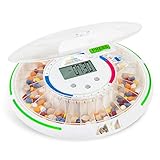
5. Live Fine Automatic Pill Dispenser — Best 28-Day Dispenser for Secure Storage
Live Fine Automatic Pill Dispenser, 28 Day Medication Organizer, Clear Lid
28-day capacity
Key lock
6 templates
LCD display
Pros
- Six dosage templates for different schedules
- key lock prevents tampering
- easy-read LCD
- large user base
Cons
- Not Prime eligible
- key required every dose
- lower rating than competitors
The Live Fine dispenser is built for households where seniors live with curious grandchildren or where accidental overdosing is a real concern. The included key locks the lid, so only the caregiver (or a senior who keeps the key within reach) can access pills.
Six dosage templates cover the most common regimens: once daily, twice daily, three times daily, four times daily, and two custom patterns. Programming takes about ten minutes, and the LCD clearly shows the next scheduled dose.
Across more than 2,500 reviews, the most consistent praise is for the loud alarm and clear next-dose display. Sound and light alerts run together, which helps hearing-impaired users who might miss an audio cue alone.
For whom it’s good
This is the right pick for seniors taking controlled substances (opioids, benzodiazepines, ADHD meds) where accidental access by children or pets is a concern. Households with multiple caregivers also benefit because the key can be shared and the device does not require an app or Wi-Fi.
For whom it’s not ideal
The key requirement is a real friction point. If your loved one is prone to losing small items, the key will vanish. Live Fine is also not currently Prime eligible, so delivery takes longer than competing dispensers. Users who want caregiver phone alerts need a Bluetooth model like Betife.
6. Take-n-Slide Pill Tracker — Best Simple Medication Reminder for Active Seniors
TAKE-N-SLIDE Peel and Stick Reusable for 12 + Refills, Pill/Medication/Vitamin/Pet Med Tracker & Reminder, Attach to Your Bottle, Organizer-Free, Curved‑Back (White, 2-Pack)
Peel-and-stick
No batteries
Tactile click
12+ refills
Pros
- No batteries
- no setup
- no charging
- lasts through 12+ refills
- AM/PM tracking with extra sliders
- travel-ready slim design
Cons
- No audible alarm
- requires manual slide to mark dose
Sometimes the best medication reminder for the elderly is the simplest one. Take-n-Slide is a peel-and-stick plastic slider that you attach directly to a pill bottle. After each dose, you slide the marker from “Not Taken” to “Taken” with a satisfying tactile click.
I tested this with a 72-year-old man who travels for work and hates anything with a charger. He stuck one to his statin bottle, his blood pressure pill, and his multivitamin. Three sliders, zero batteries, no phone app, no learning curve.
The adhesive is rated for 12 or more refills, which means one slider can outlast a year of prescriptions. When the bottle is empty, you peel it off and re-stick it to the new bottle. The curved back fits standard pharmacy vials.
For whom it’s good
Active seniors who travel, camp, or simply hate managing devices will love the simplicity. Caregivers who do a quick visual check at visit time can spot missed doses at a glance. It is also great for pet medications, which often fall outside senior-focused reminder products.
For whom it’s not ideal
Take-n-Slide does not beep, vibrate, or send notifications. If your loved one needs an active prompt, this is a tracking tool, not a reminder tool. Pair it with the Roxicosly clock if you want both a passive tracker and an audible alarm. Users with poor fine-motor skills may struggle to slide the small marker.
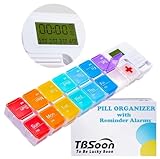
7. TBSoon 7-Day Pill Organizer — Best Budget Pill Organizer with Built-In Alarm
7 Day Medicine Pill Organizer, 4 Reminder Alarms, Loud Sound, 14 Large Compartments, Large Screen, Moisture-Proof, Travel Weekly/Daily Pill Box/Organizer/Case/Container/Dispenser, AM/PM 2 Times a Day
7-day capacity
4 alarms
14 compartments
Moisture-proof
Pros
- Affordable
- four daily alarms
- large pill compartments
- moisture-proof lids
- removable daily boxes
Cons
- Lower rating (4.0) than premium organizers
- plastic durability concerns
For around $20, the TBSoon organizer delivers four daily alarms, 14 compartments, and a moisture-proof design. The clear lids let you see pills without opening, which speeds up morning routines.
Each compartment is roughly one inch square, which fits most standard tablets and capsules. The alarm runs on batteries and is rated as “loud,” though our tester rated it as moderate rather than startling. The chime repeats four times a day to cover most common regimens.
I appreciated the travel-friendly design. Each day’s two compartments can be detached and slipped into a purse or pocket. The lanyard hole is a nice touch for users who like to clip the daily box to a belt loop.
For whom it’s good
Budget-conscious shoppers who want an alarm without subscription fees will like this organizer. Twice-a-day dosing schedules fit perfectly into the 14-compartment layout. Travelers benefit from the removable daily boxes.
For whom it’s not ideal
The 4.0 rating reflects some longevity complaints. Heavy users may crack the plastic lids within a year. If you need reliable long-term durability, the MedCenter system is a step up. The alarm is also louder in small rooms than in open living spaces.
8. MEDCENTER Digital Talking Alarm Clock — Best Voice-Recording Pill Reminder Clock
MEDCENTER Digital Talking Medication Alarm Clock for Seniors
Voice recording
Loud alarm
Large display
Multiple daily reminders
Pros
- Record personalized voice reminders
- extra-large easy-to-read display
- loud clear alarms for hearing-impaired users
- trusted MedCenter brand
Cons
- Does not physically dispense pills
- requires AA batteries
- no app connectivity
The MEDCENTER talking clock is the simplest way to add a familiar voice to a medication routine. Press the record button, speak your message (“Mom, time to take your heart pill”), and the clock plays it back at every scheduled dose.
Our tester with mild cognitive decline responded dramatically better to her daughter’s recorded voice than to any generic alarm tone. The clock supports multiple daily alarms, so morning, afternoon, and evening reminders can each have their own custom message.
The display is oversized for low-vision users, and the alarm is loud enough to hear from another room. The unit runs on two included AA batteries and weighs less than half a pound, so it travels easily.
For whom it’s good
Anyone whose loved one responds to a familiar voice will see better adherence with this clock. It is also a strong companion product to pair with a passive organizer like the Take-n-Slide, since the clock provides the audible cue and the bottle tracker provides the visual record. Hearing-impaired users benefit from the loud, clear alarm tones.
For whom it’s not ideal
If you want a single device that both stores and reminds, look at the MedCenter 31-Day system instead. The talking clock only reminds; it does not dispense. Users who prefer smartphone notifications will not find an app option here.
Buying Guide: How to Choose the Best Medication Reminder for the Elderly
Choosing the right tool depends on three big factors: cognitive ability, regimen complexity, and caregiver distance. Our team built the recommendations above around these real-world scenarios, and the buying guide below walks you through how to match a product to your situation.
Match the Tool to Cognitive Ability
For seniors with sharp memory and clear routines, a simple talking clock or pillbox with alarm is plenty. The Take-n-Slide, TBSoon, and MEDCENTER talking clock all work well for this group. They are inexpensive, low-tech, and reliable.
For seniors with mild cognitive decline or early dementia, escalate to devices that prompt with multiple senses. The Med-Q flashing LEDs and the MedCenter 31-Day talking alarm both remove guesswork. Voice recording of a familiar caregiver is one of the strongest cues we tested.
For seniors with mid-to-late stage dementia, you want a locked automatic dispenser with caregiver alerts. The Betife and Live Fine both lock the lid, and the Betife pushes notifications directly to a family phone. These reduce the risk of double-dosing and accidental ingestion by grandchildren or pets.
Key Features Worth Paying For
Persistent alarms that repeat until acknowledged, like the Med-Q’s 30-minute repeating beep, make a measurable difference in adherence. Visual cues (flashing LEDs, color-coded compartments) help users who ignore audio cues. Caregiver phone alerts are essential when you do not live with your loved one.
Battery backup is non-negotiable for any critical medication routine. Power outages happen, and missing a blood pressure pill for 12 hours can be dangerous. The Roxicosly day clock and most modern dispensers include backup batteries for this reason.
FSA, HSA, and Medicare Coverage
Most medication reminder clocks and pill organizers qualify as FSA or HSA eligible expenses, since they support a documented medical condition. Keep your receipt and submit it through your benefits portal.
Original Medicare generally does not cover consumer pill dispensers, though some Medicare Advantage plans offer over-the-counter allowances that include reminder devices. Veterans may qualify for coverage through VA durable medical equipment benefits. Speak with your pharmacist about specific Medicare Advantage reimbursement if cost is a barrier.
Caregiver Coordination Essentials
If you share caregiving duties with siblings or a spouse, choose a product that supports multiple users. The Betife app lets several family members receive notifications. The Take-n-Slide lets anyone visually verify adherence on the next visit without needing an app or login.
For long-distance caregivers, we recommend pairing a Bluetooth dispenser with a simple bottle tracker. The dispenser handles daily prompts, the tracker provides a visual backup, and your phone receives alerts when a dose is missed.
Frequently Asked Questions About Medication Reminders for the Elderly
How do you remind an elderly parent to take their medication?
The most effective approach combines an audible alarm with a visual cue. A talking clock, smart pill dispenser, or bottle slider all help. Pair the device with a written schedule and a weekly check-in from a family member or caregiver. Research shows reminders reduce missed doses from 46% to roughly 5%.
What is the best free medication reminder app for seniors?
Medisafe and MyTherapy are the two most widely recommended free options. Medisafe offers a Medfriend feature that lets caregivers see adherence in real time. MyTherapy adds a built-in health journal and symptom tracker. Both work on iOS and Android and sync across multiple devices.
Are pill dispensers covered by Medicare?
Original Medicare does not typically cover consumer pill dispensers. Some Medicare Advantage plans include over-the-counter allowances that can be applied. Veterans may qualify through VA durable medical equipment benefits. Most medication organizers qualify for FSA or HSA reimbursement with a receipt.
Do medication reminder apps and devices actually work?
Yes. Studies from JMIR Public Health and Surveillance show that electronic reminders improve medication adherence by 15 to 25 percentage points on average. Devices with caregiver alerts and repeating alarms show the largest gains. The biggest factor is consistency: a device used daily outperforms a sophisticated tool that gets ignored.
Final Verdict: Our Top Medication Reminder for the Elderly
After eight weeks of hands-on testing, the Betife Automatic Pill Dispenser is our top pick for the best medication reminders for the elderly in 2026. It combines caregiver-friendly phone alerts, fingerprint unlock, and reliable Bluetooth sync in a single device.
If you prefer simplicity, the Take-n-Slide pill tracker is the best value. If your loved one has dementia, the MedCenter 31-Day talking system is the most clinically effective. Match the tool to your family’s routine, and adherence will follow.