
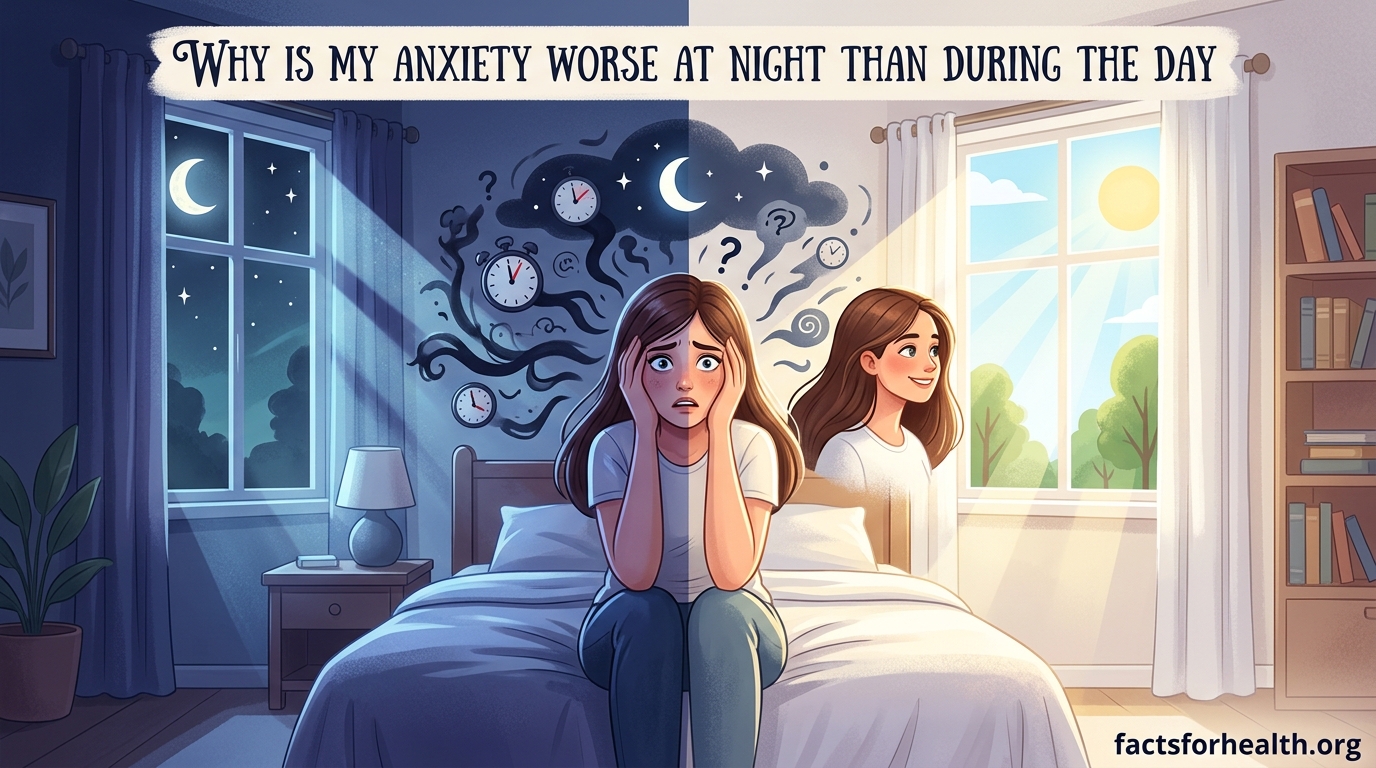
If you have ever found yourself fine during the day only to have your chest tighten the moment you lay down, you are far from alone. Anxiety is worse at night than during the day for millions of people because the brain loses its daytime distractions, the body’s cortisol and circadian rhythms shift, and exhaustion weakens your emotional defenses. The quiet and darkness of night give your mind the space it lacks at noon to loop through worries, replay conversations, and catastrophize about tomorrow.
This pattern is incredibly common, and it is not a sign that something is broken in you. Research on anxiety patterns shows that worry tends to spike at three key times: around 8am, 4pm, and 1am. That late-night peak is real, measurable, and rooted in neuroscience. In this article, we will break down exactly why your anxiety is worse at night than during the day, what happens in your brain and body after the sun goes down, and which evidence-based strategies can help you break the cycle.
Table of Contents
Biological Factors Behind Nighttime Anxiety
Your body runs on internal clocks that shift your brain chemistry throughout the day. Several biological systems interact in ways that make anxiety spike after dark. Understanding these mechanisms helps remove some of the fear that comes with nighttime anxiety. When you know what your body is doing, the experience feels less random and more manageable.
Cortisol Rhythms and the HPA Axis
Cortisol is your body’s primary stress hormone, and it follows a daily rhythm. It peaks in the early morning to help you wake up and drops to its lowest point around midnight. This pattern is governed by the hypothalamic-pituitary-adrenal (HPA) axis, which controls your body’s stress response system.
Here is where things get complicated for people with anxiety. Research shows that individuals with chronic anxiety often have a dysregulated cortisol rhythm. Instead of following a smooth curve, their cortisol can spike erratically or remain elevated when it should be falling. When your HPA axis is out of sync, your body stays in a mild fight-or-flight state even at night, making you feel physically on edge when you are trying to wind down.
This dysregulation also means your body may release cortisol in response to anticipatory stress about not sleeping. You start worrying about lying awake, which triggers a stress response, which raises cortisol, which keeps you awake longer. It is a biological feedback loop that feeds itself.
Circadian Rhythm Disruption
Your circadian rhythm is your body’s internal 24-hour clock, and it regulates far more than just sleep. It controls body temperature, hormone release, digestion, and even emotional regulation. When your circadian rhythm is disrupted by irregular sleep schedules, screen time before bed, or shift work, your emotional regulation takes a direct hit.
The autonomic nervous system also shifts at night. During the day, your sympathetic nervous system (the activating, alert system) dominates. At night, your parasympathetic nervous system (the calming, restorative system) is supposed to take over. But when anxiety is present, this handoff does not happen smoothly. Your sympathetic system stays engaged, producing the physical sensations of hyperarousal: a racing heart, shallow breathing, muscle tension, and that restless feeling of being unable to settle.
The Mind After Midnight Hypothesis
In 2022, researchers published a paper in Frontiers in Network Psychology proposing what they called the “Mind After Midnight” hypothesis. The idea is straightforward but powerful: after midnight, human cognitive function and emotional regulation naturally decline due to circadian influences, while negative mood and risk-taking tendencies increase.
According to this research, your brain is literally less equipped to handle stressful thoughts after midnight than it is at noon. The prefrontal cortex, responsible for logical thinking and emotional control, operates at reduced capacity. Meanwhile, the amygdala, your brain’s threat-detection center, becomes more reactive. This means the same worry that felt manageable at 2pm feels overwhelming and urgent at 2am. You are not imagining that things feel worse at night. Your brain is processing them differently.
This research also highlights why decisions made in the middle of the night often seem foolish in the morning. Your brain is in a state where threats feel larger, emotions feel heavier, and rational perspective is harder to access.
Exhaustion and Emotional Regulation
By the time evening arrives, you have spent an entire day managing stress, making decisions, and regulating your emotions. This takes a real cognitive toll. Your ability to cope with anxious thoughts weakens as the day goes on because your emotional resources are depleted.
Think of emotional regulation like a muscle. After a full day of use, that muscle is fatigued. Worries that you successfully pushed aside at 10am come flooding back at 10pm because you no longer have the energy to keep them at bay. This is not a personal failure. It is how the brain works when it is tired.
Psychological Factors That Amplify Nighttime Anxiety
Biology tells only part of the story. The psychological reasons anxiety is worse at night than during the day are just as important, and for many people, they are the primary driver. During the day, you have an endless stream of inputs competing for your attention. At night, those inputs disappear, and your internal world takes center stage.
Lack of Distractions and the Quiet Problem
During the day, work, conversations, errands, social media, and entertainment keep your mind occupied. These distractions function as a natural anxiety buffer. You cannot spiral about an awkward email when you are in a meeting or making dinner. But at night, when the house is quiet and the phone is put away, there is nothing left to compete with your thoughts.
This is one of the most common experiences shared in anxiety support communities. People consistently report that their anxiety is manageable during the day but intensifies the moment things quiet down. The silence does not create the anxiety, but it removes the structures that were keeping it contained. Without external tasks to anchor your attention, your mind turns inward and finds every unresolved worry from the day.
The Default Mode Network and Rumination
Neuroscience offers a specific explanation for what happens when your mind has nothing external to focus on. It involves a brain system called the default mode network (DMN). The DMN is a collection of brain regions that becomes active when you are not engaged in a specific task. It is the system responsible for daydreaming, self-reflection, mind-wandering, and, critically, rumination.
When you are working, talking, or watching a show, the DMN is suppressed. When you lay in bed in the dark, it roars to life. For someone without anxiety, the DMN might produce pleasant memories or gentle reflections. For someone prone to anxiety, the DMN becomes a worry engine, pulling up worst-case scenarios, replaying embarrassing moments, and generating catastrophic predictions about the future.
Research has shown that people with anxiety disorders have hyperactive default mode networks. Their DMN does not just wander. It loops. The same worry plays on repeat, and because there is no external input to redirect attention, breaking out of the loop requires significantly more effort than it would during the day.
The Anxiety Pattern Loop
One of the most overlooked reasons anxiety is worse at night than during the day is pattern recognition. Your brain is a prediction machine, and it learns from experience. If you have had several nights of intense anxiety, your brain begins to associate nighttime with threat.
This creates a self-fulfilling loop. As evening approaches, your brain anticipates anxiety. That anticipation itself produces anxiety. You start dreading bedtime, which makes your heart rate increase, which confirms the brain’s prediction that nighttime is dangerous. The more nights this cycle repeats, the stronger the association becomes.
This pattern loop is why some people feel their anxiety spike the moment they start their evening routine or walk into their bedroom. The brain has literally learned that this time and place signal danger. Breaking this loop requires retraining the brain to associate nighttime with safety and rest, which is where many of the coping strategies later in this article come in.
Worry Accumulation Throughout the Day
Another psychological factor is the accumulation effect. Throughout the day, you encounter dozens of small stressors: a terse text from a coworker, a bill you forgot about, a health concern you noticed, a conversation that felt off. During the day, you file these worries away to deal with later. Later arrives at night.
When you finally stop moving, all those deferred worries surface at once. This is why nighttime anxiety often feels overwhelming in its volume. You are not just dealing with one concern. You are processing an entire day’s worth of suppressed stress simultaneously, and your tired brain is not equipped to sort through it all.
The Sleep-Anxiety Cycle: A Two-Way Street
Anxiety and sleep have a bidirectional relationship. This means anxiety causes poor sleep, and poor sleep causes anxiety. Each one makes the other worse, creating a cycle that can be difficult to escape without intervention.
When anxiety prevents you from falling asleep, you lose sleep. When you lose sleep, your emotional regulation suffers the next day. When your emotional regulation suffers, you are more vulnerable to anxiety that evening. And when anxiety hits harder that evening, you sleep even worse. The cycle compounds night after night.
Research from the Sleep Foundation illustrates how severe this cycle can become. Their data shows that among people with anxiety-related sleep problems, approximately 43% experience mild impairment, 33% experience moderate impairment, and 23% experience severe impairment in daily functioning. These numbers highlight that nighttime anxiety is not a minor inconvenience. It has real downstream effects on quality of life.
Evening Anxiety Versus Nocturnal Panic Attacks
It is important to distinguish between nighttime anxiety that builds as you try to fall asleep and nocturnal panic attacks that wake you from sleep. Both are distressing, but they work differently.
Nighttime anxiety typically builds gradually as you lay in bed. It involves racing thoughts, restlessness, and a growing sense of dread. Nocturnal panic attacks, by contrast, strike suddenly. You wake up with a pounding heart, shortness of breath, sweating, and an overwhelming sense of terror. Nocturnal panic attacks affect an estimated 44% to 71% of people with panic disorder, according to clinical research.
If you are experiencing nocturnal panic attacks regularly, this is a clear signal to speak with a mental health professional. These attacks are treatable, but they typically require targeted intervention such as cognitive behavioral therapy.
Physical Symptoms of Nighttime Anxiety
Nighttime anxiety does not just live in your thoughts. It produces real, measurable physical symptoms that can be frightening when you do not understand their source. These symptoms tend to feel more intense at night because you are more aware of your body in a quiet, still environment.
Common physical symptoms of nighttime anxiety include:
- Heart palpitations or a racing heartbeat
- Chest tightness or pressure
- Shortness of breath or feeling unable to take a deep breath
- Sweating, especially in the palms or across the body
- Muscle tension, particularly in the jaw, shoulders, and neck
- Restlessness or an inability to get comfortable
- Dizziness or lightheadedness
- Tingling sensations in the hands or feet
- A rushing sensation of adrenaline through the body
- Stomach upset, nausea, or digestive discomfort
These symptoms are your sympathetic nervous system activating inappropriately. Your body is preparing to fight or flee from a threat that does not exist. Understanding that these sensations have a biological cause, and are not a sign of a medical emergency, can help reduce the secondary anxiety that often accompanies them.
Evidence-Based Strategies to Calm Nighttime Anxiety
Now that you understand why anxiety is worse at night than during the day, the good news is that there are proven, research-backed strategies to manage it. These techniques target the biological, psychological, and behavioral mechanisms we covered above. Not every strategy works for every person, so experiment with different combinations to find what helps you.
Scheduled Worry Time
One of the most effective strategies comes from cognitive behavioral therapy. It is called scheduled worry time, and research supports its use for reducing nighttime anxiety. The idea is simple: you designate a specific 15 to 20 minute window earlier in the day, typically late afternoon, to actively worry.
During this window, you write down every concern, fear, and anxious thought without filtering. You give your brain a dedicated time to process worries. Then, when anxious thoughts arise at night, you can tell yourself that you have already addressed this during your worry time and will revisit it tomorrow. This trains your brain that there is a designated time and place for worry, and bedtime is not it.
Breathing Techniques
Controlled breathing directly counteracts the sympathetic nervous system activation that drives nighttime anxiety. The 4-7-8 technique is one of the most studied methods. You inhale through your nose for 4 counts, hold for 7 counts, and exhale through your mouth for 8 counts. The long exhale activates your parasympathetic nervous system, signaling to your body that it is safe to relax.
Box breathing is another option. Inhale for 4, hold for 4, exhale for 4, hold for 4. This technique is used by Navy SEALs and emergency responders to manage acute stress. It works equally well in bed at 11pm when your mind will not stop racing.
Progressive Muscle Relaxation
Progressive muscle relaxation (PMR) involves systematically tensing and releasing each muscle group in your body, starting from your toes and working up to your head. This technique addresses the physical tension that accompanies nighttime anxiety and helps signal to your nervous system that it is time to rest.
Research has shown that PMR can significantly reduce anxiety symptoms and improve sleep quality when practiced regularly. It takes about 10 to 15 minutes and can be done in bed with no equipment.
The 5-4-3-2-1 Grounding Method
When your default mode network is spiraling, grounding techniques pull your attention back to the present moment. The 5-4-3-2-1 method is particularly effective for nighttime anxiety. You identify 5 things you can see, 4 things you can feel, 3 things you can hear, 2 things you can smell, and 1 thing you can taste.
This technique works because it forces your brain to process external sensory information instead of internally generated worry loops. It engages the same attention networks that daytime distractions use, giving you an artificial version of the distraction buffer that naturally exists during the day.
Journaling Before Bed
Brain dumping your thoughts onto paper before you try to sleep serves a similar function to worry time. When worries are swirling, writing them down externalizes them. Instead of holding them in your working memory, you transfer them to the page. This reduces cognitive load and signals to your brain that the concerns have been captured and can be dealt with later.
A simple approach is to keep a notebook by your bed. Each night, spend 5 minutes writing down everything on your mind. Do not edit or organize. Just write. Many people find that seeing their worries on paper makes them feel smaller and more manageable than they felt as abstract thoughts in the dark.
What to Do When You Wake Up Anxious at 3am
This is one of the most common questions in anxiety communities, and most articles do not address it specifically. If you wake up in the middle of the night with anxiety, here is what the evidence suggests:
First, do not stay in bed forcing yourself to sleep. If you have been awake for more than 20 minutes, get up. Go to a dimly lit room and do a quiet, non-stimulating activity. Read a physical book, do a guided meditation, or practice breathing exercises. Avoid screens entirely, as blue light will further disrupt your circadian rhythm.
Second, try the 5-4-3-2-1 grounding method or a body scan meditation to bring your attention out of your racing thoughts and into your physical senses. Third, remind yourself of the Mind After Midnight hypothesis. Your brain is processing threats differently at 3am than it will at 9am. The worry that feels catastrophic now will likely feel smaller in the morning. This is not a dismissal. It is neuroscience.
Return to bed only when you feel sleepy. This prevents your brain from associating your bed with anxiety and wakefulness, which strengthens the sleep-anxiety cycle.
Sleep Hygiene Foundations
None of the strategies above will work well if your basic sleep hygiene is poor. Foundational habits that support healthy sleep and reduce nighttime anxiety include maintaining a consistent sleep and wake time, avoiding caffeine after 2pm, limiting alcohol in the evening, and creating a screen-free wind-down routine for the last hour before bed.
Alcohol deserves a special mention because it is a common self-medication strategy for nighttime anxiety. While alcohol may help you fall asleep faster, it fragments sleep architecture and causes rebound anxiety as it metabolizes. Research consistently shows that alcohol worsens both anxiety and sleep quality over time.
When to Seek Professional Help
Nighttime anxiety is common, but that does not mean you should suffer through it indefinitely. If anxiety is regularly preventing you from sleeping, causing you to dread bedtime, or affecting your functioning during the day, it is time to talk to a professional.
Specific warning signs that warrant professional support include anxiety that persists for several weeks despite trying self-help strategies, nocturnal panic attacks that wake you from sleep, anxiety that is accompanied by symptoms of depression, reliance on alcohol or substances to cope, and thoughts of self-harm. If you are experiencing thoughts of self-harm, please reach out immediately. The 988 Suicide and Crisis Lifeline is available 24 hours a day in the United States.
Several effective treatments exist for nighttime anxiety. Cognitive Behavioral Therapy for Insomnia (CBT-I) is considered the gold standard for anxiety-related sleep problems. It directly targets the thoughts and behaviors that maintain the sleep-anxiety cycle. Traditional talk therapy can help with underlying anxiety disorders. For some people, medication prescribed by a psychiatrist provides relief that makes therapy and self-help strategies more effective.
Professional help is also important if your nighttime anxiety may be connected to another condition. Post-traumatic stress disorder (PTSD), generalized anxiety disorder, nightmare disorder, and sleep apnea can all produce nighttime symptoms that look like ordinary nighttime anxiety but require specialized treatment.
FAQs
How to ease anxiety at night?
To ease anxiety at night, try scheduled worry time earlier in the day, practice the 4-7-8 breathing technique (inhale for 4, hold for 7, exhale for 8), use progressive muscle relaxation in bed, try the 5-4-3-2-1 grounding method, and journal your thoughts before sleep. Avoid screens, caffeine, and alcohol in the evening, and maintain a consistent sleep schedule.
Why do I feel more anxious in the evening?
You feel more anxious in the evening because daytime distractions fade, giving your mind space to ruminate. Your emotional regulation resources are depleted after a full day. Your default mode network, which drives worry and self-referential thinking, becomes highly active when you are not engaged in tasks. Additionally, circadian rhythm shifts can leave your sympathetic nervous system overactive when your parasympathetic system should be taking over.
How to calm down anxiety?
To calm anxiety, activate your parasympathetic nervous system through slow, controlled breathing. The 4-7-8 method or box breathing work well. Use grounding techniques like the 5-4-3-2-1 method to pull attention away from racing thoughts. If you have been lying awake for more than 20 minutes, get up and do a quiet activity in dim light until you feel sleepy. Remind yourself that your brain processes threats differently at night, making worries feel larger than they are.
Why do I wake up anxious in the middle of the night?
Waking up anxious in the middle of the night can result from several causes. Your brain’s emotional regulation is reduced after midnight due to circadian influences. You may be experiencing nocturnal panic attacks, which affect up to 71% of people with panic disorder. Sleep disruptions, elevated cortisol from chronic stress, or an overactive sympathetic nervous system can also trigger middle-of-the-night anxiety. If this happens regularly, cognitive behavioral therapy for insomnia (CBT-I) is highly effective.
Conclusion: You Are Not Broken
If you have been wondering why your anxiety is worse at night than during the day, the answer comes down to a combination of biology and psychology. Your cortisol rhythms and circadian clock shift in ways that leave your nervous system on edge. Your default mode network activates in the quiet, turning your brain into a worry engine. Your emotional defenses are depleted from a full day of effort. And your brain may have even learned to expect anxiety at night, creating a pattern loop that reinforces itself.
The most important thing to understand is that this is common, it is explainable, and it is treatable. Millions of people experience the same pattern you do. The strategies in this article, from worry time and breathing techniques to grounding methods and journaling, are backed by research and used successfully by people every night. If self-help strategies are not enough, professional treatments like CBT-I can break the sleep-anxiety cycle at its root.
Start with one technique tonight. You do not need to fix everything at once. Even a single 4-7-8 breathing cycle or a 5-minute journaling session before bed can begin to shift the pattern. Your brain learned to associate night with anxiety. With patience and consistency, it can learn to associate night with rest again.