
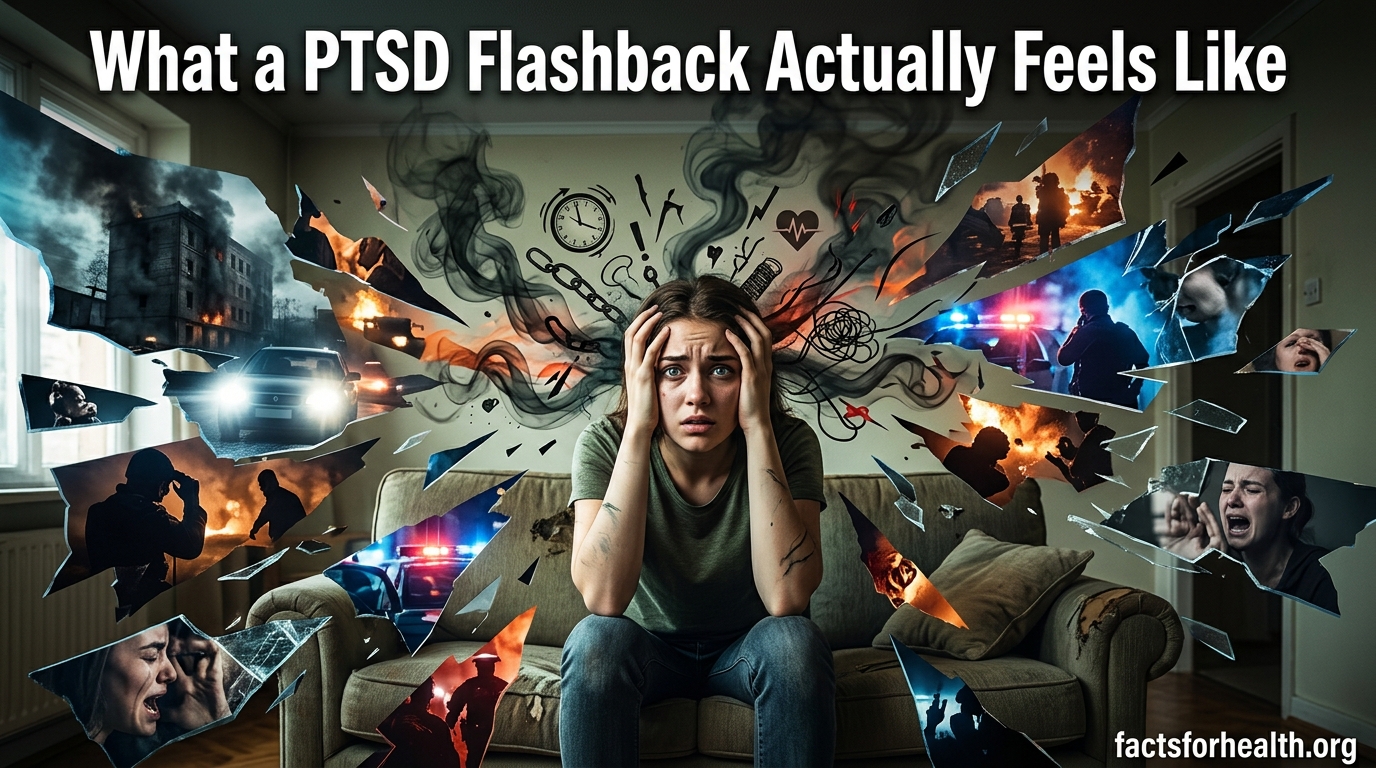
If you have ever wondered what a PTSD flashback actually feels like, the most honest answer is this: it feels like the past collapsing into the present. Not as a memory you watch from a safe distance, but as something your body believes is happening right now, in this room, at this moment.
People who experience post-traumatic stress disorder flashbacks often describe them as involuntary, overwhelming re-experiencing of a traumatic event. The nervous system reacts as though the original threat has returned. The brain’s alarm system fires at full volume, and the body responds accordingly with racing heart, shallow breathing, muscle tension, and a flood of stress hormones.
Understanding what PTSD flashbacks feel like matters for several reasons. It helps people who live with trauma recognize their own experiences and stops them from thinking they are “going crazy.” It gives loved ones the knowledge to respond with patience instead of confusion. And it connects people to the right treatment options, from trauma-focused therapy to somatic approaches that address how the body holds trauma.
Our team spent weeks reviewing clinical research, mental health forums, and first-person accounts from trauma survivors to build this guide. We drew from communities like r/ptsd, r/CPTSD, and lived-experience narratives to describe the subjective experience of flashbacks in a way clinical resources often miss.
Table of Contents
Quick Answer: What a PTSD Flashback Actually Feels Like
A PTSD flashback is an involuntary re-experiencing of a traumatic event in which the brain and body respond as though the trauma is happening in the present moment. The amygdala, the brain’s threat detection system, fires as though you are in active danger, while the prefrontal cortex, the part responsible for knowing where and when you are, partially goes offline.
This is why flashbacks feel so overwhelmingly real. Your body produces the same physical sensations, emotions, and sensory input it did during the original trauma. A person having a flashback may experience racing heart, sweating, trembling, chest tightness, dissociation, intense fear, shame, or rage. Some people see vivid images. Others feel only emotions or body sensations with no visual component at all.
Flashbacks are not regular memories. They are the nervous system dysregulation that occurs when trauma memories, stored without proper contextual processing, resurface in response to a trigger. They are a documented neurological response to trauma, not a sign of weakness.
What a PTSD Flashback Actually Feels Like: The Subjective Experience
Understanding what a PTSD flashback actually feels like requires going beyond clinical definitions. The experience is embodied, sensory, and deeply disorienting. Survivors consistently describe a loss of the boundary between past and present.
One person on a PTSD support forum described it this way: “My hands, feet and face go numb. My chest tightens and I feel like I can’t breathe. I go instant panic mode because of the lack of oxygen.” Another shared: “Within seconds, I feel nauseous, I lose track of my surroundings, I lose hold on my emotions and thoughts. My mind is flooded with shame, guilt, and worthlessness.”
These descriptions are not exaggerations. During a flashback, the fight-or-flight response activates at full intensity. The nervous system mobilizes the body for survival, releasing adrenaline and cortisol. Heart rate spikes. Breathing becomes rapid and shallow. Muscles tense as though preparing to fight or flee.
Time distortion is one of the most disorienting aspects. People frequently lose track of where they are, what time it is, and sometimes even who they are with. The prefrontal cortex, which normally keeps us oriented to the present, goes partially offline. This is not a choice or a failure of willpower. It is how the trauma-affected brain processes threat.
Many survivors describe the sensory flooding that accompanies a flashback. Sounds may become overwhelmingly loud. Lights can feel blinding. Specific smells, textures, or tastes connected to the original trauma may surface with startling intensity. One forum member noted that their flashbacks are primarily auditory and tactile, triggered by seeing people who resemble their abuser or smelling chlorine.
The emotional experience is equally intense. Fear is the most common emotion, but shame, guilt, rage, helplessness, and worthlessness also surface frequently. One person wrote: “I had uncontrollable rage at everyone and everything, then I started crying. It’s embarrassing to admit but that’s what happens.”
Dissociation often accompanies flashbacks. People describe feeling disconnected from their bodies, watching themselves from outside, or feeling like the world around them is not real. Some people freeze entirely, unable to move or speak. As one survivor put it: “Pain. Absolute fear. I freeze, stop breathing. I become dizzy, nauseous. I’ve fainted, I’ve thrown up.”
What makes this experience especially difficult is that it happens without warning and without the person’s consent. The brain cannot simply distinguish between “then” and “now” when a trauma memory is triggered. The body responds first, faster than conscious thought, and the person is pulled into the experience before they can stop it.
Types of PTSD Flashbacks
Not all flashbacks look the same. In fact, many people who experience flashbacks do not realize that is what they are having because their experience does not match the dramatic, cinematic depictions seen in movies and television. Understanding the different types of PTSD flashbacks helps people identify what is happening to them and seek appropriate support.
Visual Flashbacks
Visual flashbacks are what most people picture when they think of a PTSD flashback. The person sees full or partial images of the traumatic event, either superimposed on their current visual field or playing like a film behind their eyes. These can range from brief flashes of an image to prolonged, detailed visual replays. Visual flashbacks are often the most recognizable type, but they are not the most common form.
Auditory Flashbacks
Auditory flashbacks involve hearing sounds connected to the trauma. This can include voices, specific phrases, music, ambient noises, or sounds of impact. A person might hear a tone of voice, a specific word, or a sound like a door slamming and feel as though they are hearing it from the original traumatic moment. These can be especially disorienting because the person may not immediately connect the sound to a flashback.
Emotional Flashbacks
Emotional flashbacks are sudden, overwhelming emotional states that occur without accompanying visual images or clear memories. Coined by trauma therapist Pete Walker, this concept is particularly important for understanding complex PTSD (C-PTSD). During an emotional flashback, a person may suddenly feel intense fear, shame, helplessness, despair, or rage that seems disproportionate to their current situation.
One forum member described it this way: “It’s more like an emotional flashback where suddenly I begin to believe my current experience is unsafe or unstable. It’s really strange because there’s no obvious trigger.” Emotional flashbacks often go unrecognized for years because there is no visual scene being replayed. Many people mistake them for personality flaws, mood swings, or anxiety.
Somatic and Tactile Flashbacks
Somatic flashbacks involve physical body sensations connected to the trauma. The person may feel pain, pressure, temperature changes, or tactile sensations associated with the original event without any visual or auditory component. These are sometimes called body memories. A person might feel hands on their body, a specific type of pain, or physical sensations that match the trauma even though nothing is currently touching them.
Olfactory Flashbacks
Olfactory flashbacks involve smells connected to the trauma. Scent is processed in a part of the brain closely linked to memory and emotion, which makes smell-based flashbacks particularly vivid and sudden. A specific perfume, cleaning chemical, food, or environmental smell can instantly transport the nervous system back to the traumatic event.
The following comparison summarizes the key differences between flashback types:
- Visual: Seeing images of the trauma. Often the most recognizable type. Triggered by sights resembling the event.
- Auditory: Hearing sounds, voices, or phrases from the trauma. Can be mistaken for real sounds in the environment.
- Emotional: Sudden floods of fear, shame, rage, or helplessness with no visual component. Common in C-PTSD. Often unrecognized.
- Somatic: Physical body sensations, pain, or tactile feelings connected to the trauma. Sometimes called body memories.
- Olfactory: Smelling scents associated with the trauma. Highly triggering due to the brain’s scent-memory connection.
Many people experience combinations of these types. Someone might have a visual flashback accompanied by auditory and somatic elements, or an emotional flashback that includes physical sensations. The experience is unique to each person and each trauma.
Physical Symptoms of PTSD Flashbacks
The physical symptoms of PTSD flashbacks are real, measurable, and intense. They occur because the body’s fight-or-flight system activates as though the original threat is present right now. The nervous system does not distinguish between a memory of danger and actual danger.
Common physical symptoms include:
- Racing or pounding heart as adrenaline surges through the body
- Rapid, shallow breathing or feeling unable to catch a breath
- Chest tightness or pressure that can mimic a heart attack
- Sweating, sometimes profuse, even in cool environments
- Trembling or shaking in the hands, legs, or throughout the body
- Dizziness or lightheadedness from rapid breathing and blood pressure changes
- Nausea or sudden gastrointestinal distress
- Muscle tension, particularly in the jaw, shoulders, and neck
- Numbness or tingling in the hands, feet, or face
- Changes in body temperature, including hot flashes or sudden coldness
- Dissociation, including feeling disconnected from the body or surroundings
- Fainting or near-fainting in severe cases
These symptoms happen because the amygdala, the brain’s threat detection center, sends emergency signals to the hypothalamus. This triggers the release of adrenaline and cortisol. Heart rate and blood pressure spike. Breathing accelerates. Blood flows away from the digestive system and toward the muscles.
What makes these physical symptoms so distressing is that they feed the flashback cycle. A pounding heart and shortness of breath reinforce the brain’s belief that danger is present. This intensifies the flashback, which produces more physical symptoms. Breaking this cycle is a core focus of grounding techniques and trauma therapy.
It is also important to note that these symptoms can be exhausting. After a flashback passes, the body has been through the equivalent of a high-intensity stress response. Many people describe feeling completely drained, hollow, or fatigued for hours afterward. This is a normal physiological response to adrenaline depletion.
What Triggers PTSD Flashbacks
PTSD flashback triggers are highly individual. What triggers one person may not trigger another, even if they experienced similar traumas. Triggers work by activating sensory or emotional pathways connected to the original trauma memory, causing the nervous system to respond as though the threat has returned.
External triggers include sensory cues in the environment:
- Sounds: A specific tone of voice, a door slamming, sirens, fireworks, a song
- Sights: Someone who resembles the abuser, a specific location, certain lighting
- Smells: Perfume, alcohol, cleaning products, smoke, a specific food
- Touch: Unexpected physical contact, a specific texture, temperature changes
- Situations: Being in crowds, medical appointments, driving, being confined
- Dates: Anniversaries of the trauma, holidays, specific seasons
Internal triggers come from within the body and mind:
- Emotions: Feeling trapped, helpless, rejected, or out of control
- Physical sensations: Elevated heart rate from exercise, fatigue, illness
- Thoughts: Intrusive memories, rumination, or certain thought patterns
- Body states: Hunger, exhaustion, pain, or hormonal changes
Warning signs that a flashback may be coming include sudden changes in breathing, feeling disconnected from surroundings, a sense of impending doom, sudden irritability or anxiety, and heightened startle responses. Learning to recognize these early warning signs is a skill developed in trauma therapy.
Triggers can also change over time. Something that was not triggering for months may suddenly become triggering, or a trigger may lose its power as healing progresses. This unpredictability is one of the most frustrating aspects of living with PTSD.
How Long Do PTSD Flashbacks Last
The duration of a PTSD flashback varies widely from person to person and from episode to episode. Some flashbacks last only a few seconds or minutes. Others can stretch on for hours. The intensity and duration depend on factors including the severity of the trauma, the strength of the trigger, the person’s current stress levels, and whether they have grounding skills to use.
The flashback itself, meaning the acute phase where the person is most fully re-experiencing the trauma, typically lasts anywhere from a few seconds to 30 minutes. However, the nervous system arousal that accompanies a flashback can persist much longer. Elevated heart rate, hypervigilance, and anxiety may continue for hours.
The aftermath of a flashback is an aspect of the experience that very few resources discuss. One survivor described it plainly: “The worst part is the aftermath. Hours of feeling hollow and exhausted, like my brain ran a marathon.” This post-flashback period can include deep fatigue, emotional numbness, shame, difficulty concentrating, headache, muscle soreness, and a lingering sense of unsafety.
Recovery time varies. Some people feel back to baseline within an hour. Others need a full day or more to recover their equilibrium. The intensity of the flashback, the person’s overall stress load, and whether they have support all influence recovery time.
With effective trauma treatment, the frequency, intensity, and duration of flashbacks typically decrease over time. Some people achieve complete remission of flashbacks through therapies like EMDR, Cognitive Processing Therapy, or somatic experiencing. Others learn to manage flashbacks so effectively that they become brief and manageable rather than overwhelming.
How to Get Through a PTSD Flashback
Getting through a PTSD flashback requires bringing the nervous system back to the present moment. The goal is not to stop the flashback through force of will, which is impossible, but to help the brain recognize that the trauma is not happening now. Grounding techniques are the most effective tools for this.
Here is a step-by-step approach to getting through a flashback:
Step 1: Recognize what is happening. Name it silently or out loud: “I am having a flashback. This is a memory, not something happening now.” Even this simple recognition can begin to re-engage the prefrontal cortex.
Step 2: Use the 5-4-3-2-1 grounding method. Name five things you can see, four things you can physically feel, three things you can hear, two things you can smell, and one thing you can taste. This forces the brain to process current sensory input, which competes with the trauma sensory input.
Step 3: Focus on your breathing. Slow your breath deliberately. Breathe in for four counts, hold for four, exhale for four. This signals to the nervous system that you are not in immediate danger, since rapid breathing is part of the fight-or-flight response.
Step 4: Engage your body in the present. Press your feet firmly into the floor. Hold something cold like ice or a frozen object. Splash cold water on your face, which activates the mammalian dive reflex and can rapidly calm the nervous system. Grip the arms of a chair and feel the solid surface.
Step 5: Orient yourself. Look around the room and name objects out loud. Say the current date, your location, and your age. Remind yourself: “I am safe. I am in [location]. It is [year]. The trauma is in the past.”
Step 6: Do not try to push the flashback away. Fighting it can intensify the experience. Instead, acknowledge it, use grounding techniques, and let it pass. Remind yourself that it will end.
Step 7: Practice self-compassion afterward. Flashbacks are exhausting. Rest, drink water, and allow yourself time to recover. Do not judge yourself for having a flashback or for how long it takes to feel normal again.
These techniques take practice. Working with a trauma therapist can help you develop a personalized grounding toolkit. Over time, many people find that flashbacks become shorter and less intense as their nervous system learns new responses.
How to Help Someone Having a PTSD Flashback
Knowing how to help someone having a PTSD flashback is one of the most valuable skills a loved one can develop. Your calm, grounded presence can help bring the person back to the present more quickly. But knowing what not to do is just as important.
Here are the steps for helping someone through a flashback:
1. Stay calm. Your regulated nervous system can help co-regulate theirs. If you panic, it reinforces the sense of danger. Speak in a steady, low voice.
2. Do not touch them without asking. Physical contact during a flashback can be deeply triggering, especially if the trauma involved physical violation. Ask first: “Is it okay if I touch your hand?” If they say no or do not respond, respect that.
3. Gently orient them to the present. Say their name. Tell them where they are. Remind them of the current year. Say: “You are safe. You are in [location]. It is [year]. The danger is not here.”
4. Guide them through grounding. Suggest they look around the room and name objects. Offer them cold water to drink or hold. Encourage slow breathing by breathing visibly alongside them.
5. Do not argue with their experience. During a flashback, the person’s brain believes the trauma is happening. Saying “that is not real” or “you are fine” does not help and can feel dismissive. Instead, acknowledge their experience while gently reminding them of the present.
6. Do not try to make them talk about the trauma. Debriefing during or immediately after a flashback is not helpful. Let the flashback pass before having any conversation about what happened.
7. Follow their lead afterward. Some people want to be held. Some want to be alone. Some want to talk about something completely unrelated. Ask what they need and respect their answer.
To an outsider, a person having a flashback may appear suddenly distant, confused, panicked, or frozen. They may seem to zone out, become unresponsive, or react intensely to something that seems minor. They might suddenly leave a room, become agitated, or startle easily. Understanding these outward signs helps loved ones respond with patience rather than confusion or frustration.
The Shame and Self-Blame After Flashbacks
One of the most under-discussed aspects of PTSD flashbacks is the shame and self-blame that often follows. Forum communities consistently highlight this pain point. People feel embarrassed about losing control. They judge themselves for not being able to “just get over it.” They worry they are burdening their loved ones.
This shame is itself a symptom of trauma, not a character flaw. Trauma reshapes how the brain processes self-worth and safety. The harsh inner critic that activates after a flashback is often part of the trauma response itself.
One forum member shared a perspective that resonated deeply: “I didn’t realize I was having emotional flashbacks for years. I just thought I was a depressed, angry person. Learning they were flashbacks changed everything.” Recognizing flashbacks for what they are, neurological events rather than personal failures, is a critical step toward healing.
If you experience flashbacks, you are not broken. You are not overreacting. Your nervous system adapted to survive something overwhelming, and it is doing what trauma-trained nervous systems do. With proper treatment, this can change.
When to Seek Professional Help
If flashbacks are interfering with your daily life, relationships, work, or sense of safety, professional help can make a significant difference. Trauma-focused therapies have strong evidence for reducing flashback frequency and intensity.
Effective treatment options include:
- EMDR (Eye Movement Desensitization and Reprocessing): Uses bilateral stimulation to help the brain reprocess trauma memories so they no longer trigger intense emotional and physical responses.
- Cognitive Processing Therapy (CPT): A structured therapy that helps people examine and modify unhelpful beliefs that developed after trauma.
- Somatic Experiencing: Focuses on how the body holds trauma and helps release stored survival energy through body awareness.
- Internal Family Systems (IFS): Explores the different “parts” of the psyche that carry trauma, shame, and protective responses.
- Prolonged Exposure Therapy: Gradually helps people approach trauma-related memories and triggers in a safe, controlled way.
- Medication: SSRIs and other medications can reduce overall PTSD symptom intensity and may be recommended alongside therapy.
If you are in crisis or need immediate support, these resources are available 24/7:
- 988 Suicide and Crisis Lifeline: Call or text 988 from any phone in the United States.
- SAMHSA National Helpline: Call 1-800-662-4357 for free, confidential treatment referral and information.
- Veterans Crisis Line: Call 988 and press 1, or text 838255.
- Crisis Text Line: Text HOME to 741741 from anywhere in the US.
You do not have to be suicidal to call a crisis line. These resources are available to anyone who needs support during a mental health crisis, including severe flashbacks.
FAQs
What are the physical symptoms of PTSD flashbacks?
Physical symptoms of PTSD flashbacks include racing heart, rapid shallow breathing, chest tightness, sweating, trembling, dizziness, nausea, muscle tension, numbness or tingling in the extremities, changes in body temperature, and dissociation. These symptoms occur because the body’s fight-or-flight system activates as though the original threat is present, releasing adrenaline and cortisol.
Do PTSD flashbacks feel real?
Yes, PTSD flashbacks feel extremely real. During a flashback, the brain’s threat detection system fires as though the original traumatic event is happening right now. The prefrontal cortex, responsible for knowing where and when you are, partially goes offline. The body experiences the same physical sensations, emotions, and sensory input as during the original trauma.
How do you get someone out of a PTSD flashback?
To help someone out of a PTSD flashback: stay calm and present, gently orient them to the present by naming their location and the current time, ask before touching them, guide them through grounding using the five senses, avoid arguing with their experience or trying to logic them out of it, and follow their lead on what they need after they return to the present.
What are emotional flashbacks in PTSD?
Emotional flashbacks are sudden, overwhelming emotional states such as fear, shame, helplessness, or rage that occur without accompanying visual images or clear memories. Coined by trauma therapist Pete Walker, emotional flashbacks are common in complex PTSD (C-PTSD) and often go unrecognized because there is no visual scene being replayed. The person simply finds themselves in an intense emotional state that feels disconnected from current reality.
Understanding What a PTSD Flashback Actually Feels Like Matters
Understanding what a PTSD flashback actually feels like helps reduce the stigma that surrounds trauma. Flashbacks are not dramatic movie scenes. They are real, embodied neurological events that happen when the nervous system responds to stored trauma memories as though the threat has returned.
If you experience flashbacks, your reactions make sense. Your body adapted to survive something overwhelming. What you are experiencing is a documented trauma response, not weakness or brokenness. With trauma-informed therapy, grounding skills, and support, flashbacks can become less frequent, less intense, and more manageable over time.
If you love someone with PTSD, your patience and willingness to learn make a difference. Simply being a calm, nonjudgmental presence during a flashback can help them return to the present more quickly.
You do not have to navigate this alone. Reach out to a trauma-informed therapist, call 988 if you are in crisis, or contact the SAMHSA helpline at 1-800-662-4357 for treatment referral and support. Healing from trauma is possible, and recovery from flashbacks is achievable with the right tools and support.